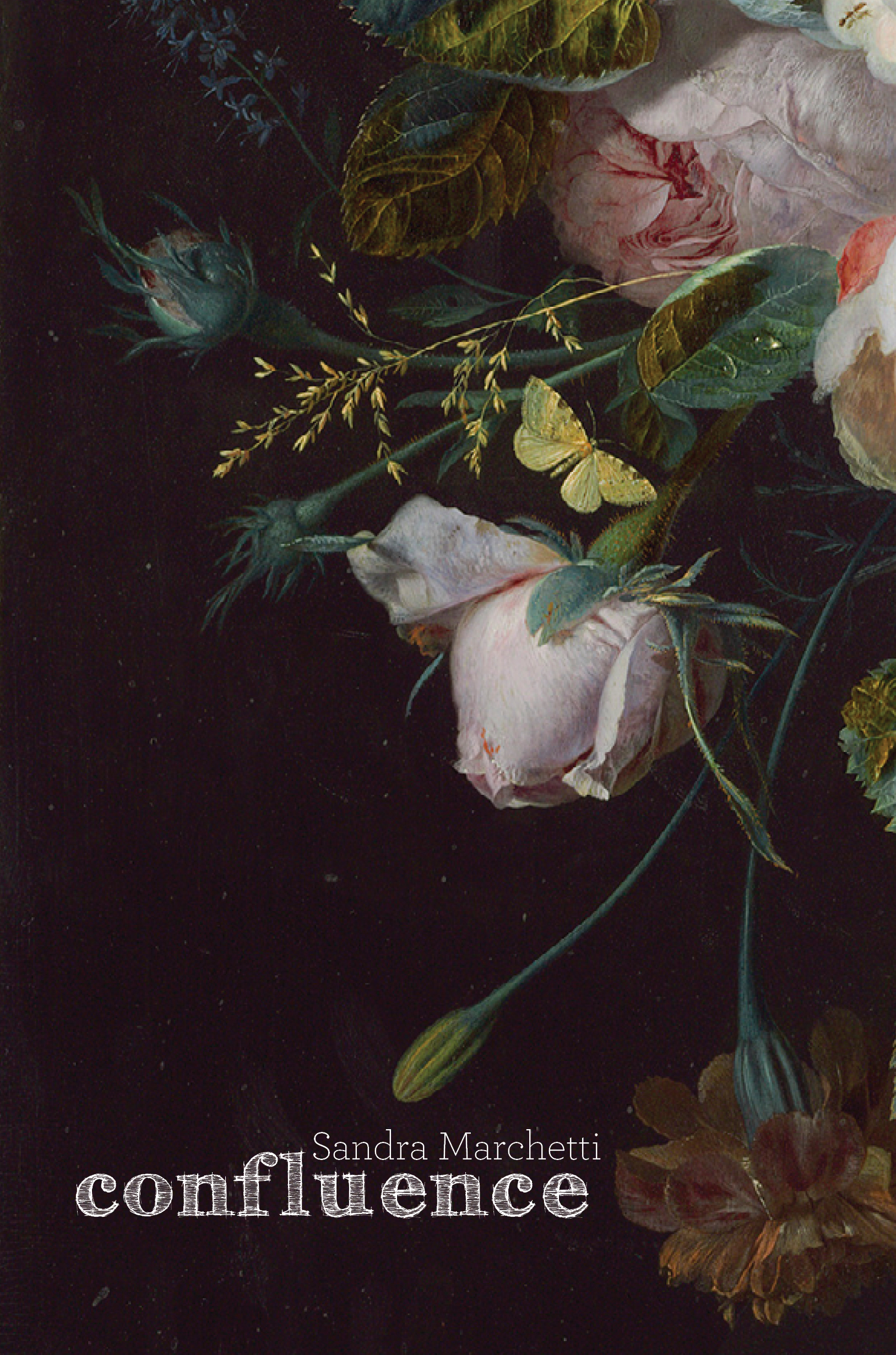
SATURDAY POETRY SERIES PRESENTS: CONFLUENCE

Confluence front


From CONFLUENCE
By Sandra Marchetti:


THE RETURN

               “figurations of mist
               at the turn of the corner,
               figurations of time
               at the bend in this pause,”
                              ~ Octavio Paz, trans. Eliot Weinberger

Beyond the body itself
is the thin blue line,
the sky folding back on its spine.

I saw today the paper gold mists,
the terrible last burnings off of morning;

I have an idea that you ate me then,
and slid belching through the fog—

you slicked my breast
on past your teeth and tasted
my unsalted skin.

I’m small; I know when I’ve been
swallowed whole, been rounded out
gold and beaming,

become a curve in your smile,
the element of light—broken on the tide—
the start of day.


FISSURES

By night
my body disconnects, falls,

lies on the bed in bones
and curls of hair.

There is nothing
to join it.

Skin flicks off
through shudders, and furls—

I lay and am unhitched,
unrolled.

I see what is done darkly,
between shadows and the neatest black.

The low lake below
lets go its nets,

from joints I wash toward confluence,
dissolved in a room of night.


MIGRATION THEORY

The womb a tent,
lit from within, flutters
golden on the wind.

I’m given to pregnancy
dreams again.

Sleeping, the world becomes round once more—
sleeping atop my midriff. Sleeping in
silence and veins and skin—a globe, a missive.

I’m told the child
is ghost; instead

the sleep is lifted into,
alight with curiosities
curling out from the hand.

Sleep. The light sheet ruffles within.
White moths in flight
lift from the body—the skin.


Today’s poems are from Confluence, published by Sundress Publications, copyright © 2015 by Sandra Marchetti, and appear here today with permission from the poet.


Confluence: “’Roam the ground where you are’ writes Sandy Marchetti in Confluence, her impressive debut. Mediating the world in between—lover and beloved, day and night, lost and found, now and then—this lyric poetry celebrates the intimate as ebullient, charged. The lyrics, read through imagery and felt through sound, ‘riff in bits and licks.’ Sandy Marchetti has convincingly made us a world.” —Sally Keith, author of The Fact of the Matter and Dwelling Song


Sandra Marchetti is the author of Confluence, a debut full-length collection of poetry from Sundress Publications, and a co-author of Heart Radicals, a collaborative chapbook of love poems. Eating Dog Press published an illustrated letterpress edition of her essays and poetry, A Detail in the Landscape, and her first volume, The Canopy, won Midwest Writing Center’s Mississippi Valley Chapbook Contest. Sandy’s work appears in Subtropics, Sugar House Review, Ecotone, Green Mountains Review, Blackbird, Southwest Review, and elsewhere. She is a Lecturer in Interdisciplinary Studies at Aurora University outside of her hometown of Chicago.


Editor’s Note: Sandra Marchetti’s Confluence is incredibly vivid, electric with unique imagery, and rife with moments of depth and contemplation that force the reader to slow down in wonder. “Beyond the body itself / is the thin blue line, / the sky folding back on its spine;” “I’m small; I know when I’ve been / swallowed whole.” The body is at times singular, existing in pieces, dissolved: “By night / my body disconnects, falls, // lies on the bed in bones / and curls of hair.” The I is the ever-observer, seeing the world as one only can from the lone darkness: “I see what is done darkly, / between shadows and the neatest black.” The lines are blurred between life’s joys and devastations: “I’m given to pregnancy / dreams again;” “I’m told the child / is ghost.” No matter the consideration or the angle of the reflection and the poet’s gaze, forever driving these poems is a rampant lyricism, steady and rhythmic as a heartbeat, fervently alive.


Want to see more from Sandra Marchetti?
Pre-order Confluence from Sundress Publications
Appalachian Heritage
Thrush Poetry Journal
The Rumpus
Words Without Borders

SATURDAY POETRY SERIES PRESENTS: MY FRIEND KEN HARVEY

khcover

From MY FRIEND KEN HARVEY
By Barrett Warner:


MY FRIEND DAVID BOMBA

Screen Shot 2015-08-21 at 11.44.40 PM


MY FRIEND KEITH MARTIN

My friend Keith Martin is dead. He died in early April.
It’s kind of a busy month to die. The ground is softening—
rows raked and sown—jealous hues emerging like rye.

It’s weird that he died the same month I was born.
Now the ghost would be forever Aries, the passionate one,
the one who gets things almost right, who gets in his own way.

A friend is a brick against the sweet hereafter. Lose a friend
and you lose a brick. Lose Keith and you lose a wall.
It’s just a matter of time until the roof falls down.

Marsha his wife sat cold on offers coming quickly on his land.
I don’t blame her holding out for more, but suffered lifetimes
are always cheap. I gave away anything I ever tried to sell.

No one ever wants to buy what you don’t love.

Their house is a quarter mile away, through dense spite trees
planted by our neighbor so he wouldn’t have to look at Keith getting out of his car.

I can’t imagine hating someone so much I’d plant trees.

One dog’s not enough, and two dogs are too many.
That’s how Keith would talk, like Ben Franklin.

He wanted me to feel better, but I never did.


MY FRIEND LARRY MCKEE

My friend Larry McKee notices each leaf in an oak forest.
I see firewood, fence boards, squirrels, squirrel stew.

I hustle through life’s minor beauty to make myself sweat,
wearing work on my face like khol.

I am trying to say I don’t belong here, don’t deserve
this world. I need to earn every second of it.

If I stop sweating I’ll stop earning.
It’s why I’ll always have a job, and Larry, a passion.

Someone ate this, he says.
He holds a 175-year-old raccoon femur.

Someone knelt here in 1841 and prayed for something.
Maybe, yes, there was singing. Listen! Sobs and singing.

I have been sweating all day and all night and all year.
It’s only a matter of time before I exile myself.

It would be nice if Larry could learn from me too
but I have nothing to teach, even about drinking.

Larry grows the mint, makes ice from spring water
collected in caves, smokes the bourbon over apple wood.

He has a special black basalt rock that fits his hand
to crush the beautiful ice into manageable debris.

He takes so long to make a two minute drink
that I’m drunk on beer and hung over before his first sip.

Still, it’s the best I ever tasted.
And of course, the next day, I steal the rock.

The things I’ve bashed. The cars. The lives. The dogs.
The sweat that flew off my brow. The wasted muscle.

One night I pound some lamb into burgers, smother it
with sheep cheese, and I think, Larry would have admired this.

I call him up to brag about the recipe. His wife Hannah
passes over the phone. Sounds delicious, he says.

We haven’t spoken in thirty years. Leftover enchiladas for us,
Always better the second night, filled with grilled chicken cut up

Small mixed with salsa and corn cut off the cob. On the patio,
Watching fireflies and hummingbirds until dark.

Couple extra chairs at the table if you’re ever in the neighborhood.
The things I learned from Larry. The things I never learned.


Today’s poems are from My Friend Ken Harvey, published by PubGen, copyright © 2014 by Barrett Warner, and appear here today with permission from the poet.


My Friend Ken Harvey: “Nostalgia and sentiment were dirty words in poetry until Barrett Warner’s My Friend Ken Harvey came on the scene. Here we have a chapbook that shows us the many forms of love, how relationships can be measured as ‘not enough war or too much war in someone’s life,’ and how the simplest moments can be transcendent, all while dipping in and out of the sepia tint of memory.” —Dakota Garilli, Book Review: MY FRIEND KEN HARVEY by Barrett Warner


Barrett Warner’s poems, stories, and essays have appeared in newsprint, paper and online since 1982, and most recently in Entropy, Revolution John, and Four Chambers. In 2014 he won the Salamander fiction prize and the Cloudbank poetry prize. He has a website where he blogs about bathing, medication, gardening, Proust, and Kalamazoo.


Editor’s Note: Struck by the unique nature of this collection, I asked the author if he would share a few words on his vision and process. “To me,” he replied, “the biographical poem is an ekphrastic poem, but instead of writing about a Hopper painting or a Grecian urn, I’m writing about everyday people with whom I’ve had some moment of fantastic empathy.” What is “fantastic empathy,” and how does it translate from lived experience to poem to reader, I wonder. I find my answer in my own experience in reading these poems. “I’ll have the starfish, Bomba says,” because “Everyone should be allowed to order what they want / even if it’s not on the menu.”

This collection is at times hilarious, at times touching, at times lyric, simple, and stunning. “A friend is a brick against the sweet hereafter. Lose a friend / and you lose a brick. Lose Keith and you lose a wall,” Warner writes of the death of his friend Keith Martin. “I am trying to say I don’t belong here, don’t deserve / this world. I need to earn every second of it,” he writes, from some honest place between existentialism and a search for meaning. In a way, these poems are–as the poet says–ekphrastic, biographical, minute in their reports of human interactions. Yet in another way they are meta, like staring up at the night sky and trying to truly grasp what you are seeing. From the minutiae to the horizon, I suggest reading and rereading these poems and seeing where the experience leads you.


Want to see more from Barrett Warner?
Entropy
Cultural Weekly
Lines + Stars
Quarter After Eight
drafthorse

SATURDAY POETRY SERIES PRESENTS: JAIMIE GUSMAN


Jaimie


By Jaimie Gusman:


BABY

The baby carriage on top of the roof is too much. The husband says to his wife, it has to end here. Years before they were in love, the kind of love that was quiet but infectious. The kind of love that made their friends feel all the complexities of love with great jealousy and excitement. Now, the baby carriage is on the roof again, even though he brought it back inside just yesterday, after 13 hours of work at the shed. He was driving home when he saw it – navy blue with periwinkle-ruffled trim.

She sewed that trim herself. He remembered her pregnancy, her sewing. She made sure the detail was just right for their little boy. Her friends all said ooh and ahh and complimented her dedication and creativity. He remembers being proud of his wife, how that pride filled him, heated him up and up where the atmosphere was tempered by a soft breeze.

When they lost the blue baby she held him close. She sang him the lullabies she practiced late at night when she couldn’t sleep. She put him in the carriage and showed him off to the other mothers in the ward. And after even that, she did not want to let her blue baby go. Friends and family were worried. She sang lullabies all the time.

One day, her husband came home to a dozen watermelons swaddled in a bright cerulean celestial covered fabric. Our blue baby is safest at night. His wife put her head against the cloth of one melon. She looked bright. Sweet boy, she sang, dissolving into the fabric. And he thought that was enough, this tone, this textile. That she could be happy with this.


BIRDSONG

I hold my wedding dress tight,
the bottom, like tissue paper
prepped for plastering to a mannequin.
All the other brides, too,
hold white birds
against their thighs.

When we get to the altar,
the men pour forth.
They step up, one by one,
and point to a dress. A dress!
The man then opens his mouth,
and a bride crawls right inside it.

None of the brides are terrified,
but I can’t help but be disturbed.
These are swallowed women,
women that cling to rhinestones,
while layers of organza and silks
sway with an effortlessness numb.

When a man chooses me
I blush, but try not to.
He grabs my hand, lifting me
to the altar. I know what’s next,
I know I must get in position
and drop the dress so the train
makes a trail of feathers. I do.

What happens inside the mouth?
Nothing! A dark wet corridor
leads to another dark wet corridor.
I find a cool bench and listen
to his echoing thoughts.
I love this man, I begin feeling
and then saying out loud.

Where are the others?
Where are the glistening waistlines
that so briskly walked down
aisles before me? History?
I search my own wet echoes.
Hello, is this thing on?


Today’s poems are from the chapbook Gertrude’s Attic (Vagabond Press, 2014, © Jaimie Gusman ), and appear here today with permission from the poet.


Jaimie Gusman’s work has appeared in The Feminist Wire, Moss Trill, Sonora Review, B O D Y, Trout, Mascara Review, Unshod Quills, LOCUSPOINT, Capitalism Nature Socialism, Hearing Voices, Hawaii Women’s Journal, Tinfish Press, Spork Press, Shampoo, Juked, Barnwood, DIAGRAM, and others. She is the 2015 Rita Dove Poetry Prize winner, and has three chapbooks: Gertrude’s Attic (Vagabond Press, 2014), The Anyjar (Highway 101 Press, 2011), and One Petal Row (Tinfish Press, 2011). She lives and works in Kaaawa, HI.

Editor’s Note: What I love about today’s poems is the stories they tell. The lives–both inner and outer–they reveal. Stories reminiscent of beloved favorites like “The Yellow Wallpaper,” “Hills Like White Elephants,” and “The Story of an Hour.” Brimming with social commentary and strong with the struggles we don’t always speak of, these are the stories that must be told. And how brave, moving, and enchanting they are when Jaimie Gusman tells them.

Want more from Jaimie Gusman?
Jaimie Gusman’s Official Blog
One Petal Row
Gertrude’s Attic
The Anyjar
Two Poems in The Feminist Wire

SATURDAY POETRY SERIES PRESENTS: PATRICK PHILLIPS

Photo by Marion Ettlinger


HEAVEN
By Patrick Phillips

It will be the past
and we’ll live there together.

Not as it was to live
but as it is remembered.

It will be the past.
We’ll all go back together.

Everyone we ever loved,
and lost, and must remember.

It will be the past.
And it will last forever.


Today’s poem is from the collection Boy (The University of Georgia Press, 2008, © Patrick Phillips), and appears here today with permission from the poet.


Patrick PhillipsElegy for a Broken Machine was published in 2015 by Alfred A. Knopf. A recent Guggenheim and National Endowment for the Arts fellow in poetry, he is the author of two earlier collections, Boy and Chattahoochee, and translator of When We Leave Each Other: Selected Poems of Henrik Nordbrandt. His work has appeared in many magazines, including Poetry, Ploughshares, and The Nation, and his honors include the Kate Tufts Discovery Award, a Pushcart Prize, and the Lyric Poetry Award from the Poetry Society of America. He lives in Brooklyn and teaches at Drew University.

Editor’s Note: I came across today’s poem on the New York subway as part of the MTA/Poetry Society of America collaboration, “Poetry in Motion.” Whenever I see a poem on the subway I read it. Of course I do. How often does one come across poetry in public spaces in America these days? But not since I came across Reznikoff’s “If There is a Scheme” on the PATH train has a poem in a public space so moved me.

What is so wonderful about today’s poem? Is it the way it plays with time, making the future of the past? “It will be the past / and we’ll live there together.” Is it the subtle way the poet uses rhyme and repetition, as if the poem were a lullaby — “together / remembered / together / remember / forever”? Or is it the promise of the poem? That within our future lies our past, that heaven is where we might relive our memories over and over, that we will be reunited there with everyone we ever loved, “And it will last forever.”

Want more from Patrick Phillips?
Buy Elegy for a Broken Machine from Amazon
Patrick Phillips’ Official Website

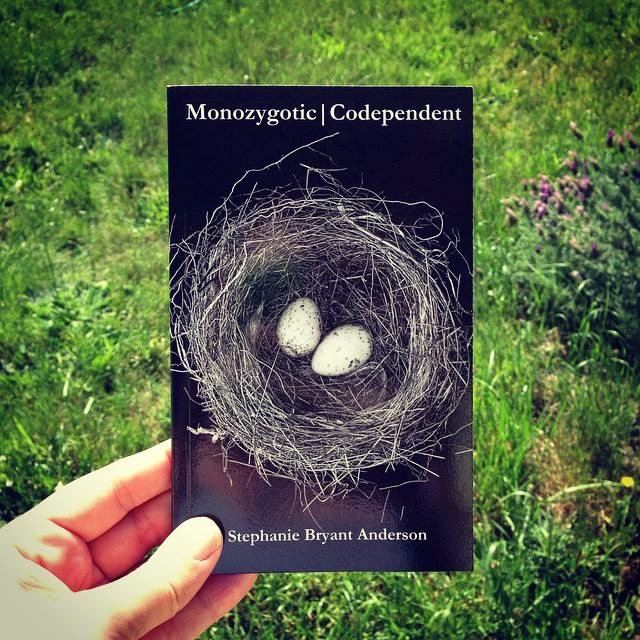
SATURDAY POETRY SERIES PRESENTS: MONOZYGOTIC | CODEPENDENT

monocofinal


From MONOZYGOTIC | CODEPENDENT
By Stephanie Bryant Anderson:


LONELINESS CAME INSIDE MY HOME, UNPACKED ITS
THINGS

I sat on the floor
in a blue room choking

on emotions, confessing
sadness to the cake falling

down my throat, wondering
how I have come to hate winter

when it snows
such beautiful white flowers.

But—

it’s the way I’ve neatly folded the laundry
over and over.

It’s the way fear visits me twice,
and courage once.

It’s the way I move alone at night
from the couch to the door

to the curtains,
back to the couch.

It’s how you catch me dreaming
and step over my body.


LIKE THE BLACK HOLE CARTOGRAPHER WHO WENT
HUNTING FOR WALNUTS

When the door closed this time, she knew it
       would be different. She saw his eyes—
emotionless ticks that had grown into the plural

patterns of empty walnut shells. Someone once
       star-mapped Aries the Ram, and generously
gave him horns. I am strong as an Ox

he reminded her as she stood to leave. Reminded
       her that she was the Year of the Rabbit with closed
curtains.

Safety over risk, she recalled looking at the door,
       but her body lied, it could not carry her there.
You cry too easily— he said, after the first hit

into her eye-bone crunched, sounding the way
       the nutcracker sounded when breaking open
walnuts. He stood over her

using the same angle God used to look down from.
       But, here, for her,
there was no longer a down—


ANXIETY WHILE CROSSING THE TENNESSEE-ARKANSAS
BRIDGE

Last November my sister got married.
My heart cropped, carried

for months in my handkerchief. At night
it would cry out from extinction.

This amputation being no small ache, I left
Tennessee, my heartbeat slow.

Memphis with her strange spell
filled my piano-ribs

with a slow blues loaded
with heavy bees and suicide ghosts.

The road tasted like salt. I drove until
I couldn’t see the shape of us,

until my heart could again beat
on its own.


Today’s poems are from Monozygotic | Codependent, published by The Blue Hour Press, copyright © 2015 by Stephanie Bryant Anderson, and appear here today with permission from the poet.


In Monozygotic | Codependent, Stephanie Bryant Anderson’s poems are concerned with splitting the self and uncovering the woman beneath the familial myths. Yet the essential paradox for Bryant Anderson: when the self has a twin—a ‘shadow,’ a ‘dark-haired mirror girl’—what then of the split? These poems ache; in the style of Southern gothic, these poems are ‘filled [with] piano ribs, a slow blues loaded with heavy bees and suicide ghosts.’ Bryant Anderson’s are poems of survival, built in fragile and beautiful shell casings, stanzas deceptively elegant and delicate, for what pinions each graceful couplet is a fierceness of spirit, a deep-seated desire for life, always life, even in the midst of pain and memory, ‘shaped as an open field plagued by black irises.’ I am broken and remade by these poems. —Jennifer Givhan, 2015 Winner National Endowment for the Arts fellowship


Stephanie Bryant Anderson is author of Monozygotic | Codependent (The Blue Hour Press 2015). Recent or forthcoming publications include Vinyl, burntdistrict, Rogue Agent and The Blueshift Journal. Besides poetry she enjoys kickboxing and math. Stephanie is founder of Red Paint Hill Publishing.


Editor’s Note: Monozygotic | Codependent opens with a quote from Sylvia Plath: “I do not know who I am, where I am going – and I am the one who has to decide the answers to these hideous questions.” And so Stephanie Bryant Anderson sets the stage for this brave, vulnerable collection. The journey the poet takes us on is deeply confessional, beginning in loneliness and ending in leaving, with panic, regret, abuse, anxiety, divorce, codependence, death, and God doggedly pursuing the I in-between. This is not the story of a light at the end of the tunnel; it is a story of survival. But there is so much beauty in the words, in their brutal honesty, in the intimacy of what is revealed, in the shared experience that arises when one speaks up about that which is too-seldom talked about. In this way, this book is Plathian, reflecting the intersection between lived suffering and staggering art.

Following the Plath quote, Monozygotic | Codependent welcomes us into its world with “Loneliness Came Inside My Home, Unpacked Its Things.” Here we sit on the floor. Here we are choking. Here we are eating our feelings. Here we are “wondering / how I have come to hate winter // when it snows / such beautiful white flowers.” A line so beautiful, it hurts to confront it. Like the idea of stepping over a woman dreaming.

From stepped over to stepped on, “Like the Black Hole Cartographer Who Went Hunting for Walnuts” takes us deep into the reality of a woman abused. She is not safe. She cannot leave. She is looked down on by man and God alike, only “here, for her, / there [is] no longer a down.”

In “Anxiety While Crossing the Tennessee-Arkansas Bridge” we encounter one of the major themes of the book: twin-ness. What it means to be a twin, to have been born into that level of codependence and to have to survive that conjunction into the individuality of adulthood. The result is a heart that must be “cropped, carried,” that has to learn to beat again on its own.


Want to see more from Stephanie Bryant Anderson?
Stephanie Bryant Anderson’s Website
Buy Monozygotic | Codependent from The Blue Hill Press
Follow Stephanie Bryant Anderson on Twitter

SATURDAY POETRY SERIES PRESENTS: SARA JUNE WOODS

FullSizeRender (1)
& SOMEWHERE THE SUN
By Sara June Woods

Somewhere there is a clearing
in a forest where the world is
not a lonely place.

Somewhere there is a mountain
I have written on in forest fires
that says I am sorry I am not

the one you were looking for.
I wanted to be so badly.
But I am just this one person.

& it says all this
spiraling across
below the tree line.

& somewhere the sun
looks the same coming up
as it does going down.


Today’s poem was previously published in jellyfish magazine and appears here today with permission from the poet.


Sara June Woods is author of three books, Sara or the Existence of Fire (Horse Less Press, 2014), Wolf Doctors (Artifice Books, 2014) and the forthcoming Careful Mountain (Civil Coping Mechanisms, 2016). Her poetry is published widely in journals such as Guernica, Columbia Poetry Review, Diagram, Gulf Coast, Denver Quarterly and Salt Hill. She is a trans woman and a Scorpio and she lives in Portland, OR with her girlfriend she is married to.

Editor’s Note: What do you do when a poem is heartbreaking? When its simple, honest revelations break your heart? When its line breaks break you? What do you do with a poem that devastates you with its simple, brutal truth? With a poem that’s so good, it hurts to read it? Why, you share it, of course. Here, you say to the world. You’re welcome.

Want more from Sara June Woods?
Healthy Dog Poem – Writing by Sara June Woods
P(r)o(bl)em – saramountain tumblr

SATURDAY POETRY SERIES PRESENTS: PATTY PAINE

10259779_10152027363561933_7567284404520260511_n copy

ANTIPHONY
By Patty Paine

Go back to that stream, touch
your lips to the cold, clear quivering,
draw into yourself a time when it was simple
as this to be quenched, to draw in what was
needed. Walk back over the dewed grass
of your past, past the water tower you filled
with dark imaginings, feel
the air crisp & clean on your skin, call
this hope, and carry it
to these moments when a photograph
can send you spiraling, your husband
now six months gone, waiting at the bottom
of an escalator in some airport
or another, everyone hurrying to be somewhere
else, except for this one man, waiting
for you to descend. How a face can be
indelible, yet fade so quickly, is an alchemy
best left unknowable. Hold that sting
of hope, and call out
the name of one who ministered
to you, over & over, until from the dark
you hear your own name return
to you, wild, and rising and clear.


Today’s poem originally appeared in Thrush and appears here today with permission from the poet.


Patty Paine is the author of Grief & Other Animals (Accents Publishing), The Sounding Machine (Accents Publishing), Feral (Imaginary Friend Press), Elegy & Collapse (Finishing Line Press), and co-editor of Gathering the Tide: An Anthology of Contemporary Arabian Gulf Poetry (Garnet Publishing & Ithaca Press) and The Donkey Lady and Other Tales from the Gulf (Berkshire Academic Press). Her poems, reviews, and interviews have appeared in Blackbird, Verse Daily, The Atlanta Review, Gulf Stream, The Journal and many other publications. She is the founding editor of diode poetry journal and Diode Editions. She is an Assistant Professor of English at Virginia Commonwealth University in Qatar where she teaches writing and literature, and is Interim Director of Liberal Arts & Sciences.

Editor’s Note: Today’s poem is one I encourage you to read over and over. For each reading is like opening the next layer of a Russian doll, and there is always more waiting to be discovered within. While one reading simply does not do the poem justice, you honor yourself, dear reader, each time you slip deeper into these words.

Start in media res. Start in motion. Begin not at the beginning, but by turning back. The world of the poem is visceral. Go on, touch the stream, feel the “cold, clear quivering.” Go deeper now. “[D]raw into yourself a time when it was simple / as this to be quenched, to draw in what was / needed.” Move backwards; a poem—a life—in rewind. Let the story unfold in this way—cinematic, emotive, devastating. Let the reverse motion be what propels you forward. You are Lot’s Wife. You are Orpheus. There is only looking back, but looking back leaves you alone in the dark, “hear[ing] your own name return / to you, wild, and rising and clear.”

What a fraught landscape, yes, but what a gift to have been taken on such a journey by such a guide.

Want more from Patty Paine?
Buy The Sounding Machine from Amazon
Buy Feral from Imaginary Friend Press
diode poetry journal
Diode Editions
Interview on The Best American Poetry blog

SATURDAY POETRY SERIES PRESENTS: AMORAK HUEY

IMG_3503

By Amorak Huey:


THE POND IN THE CORNER OF THE YARD

It seems so important that I get this right—

memory choked with algae,
memory dried to nothing in the summer,

memory’s post-dawn sky already fevered with desire,
memory’s grass grabbing wet at my hungry ankles.

I remain the same lonely child I was,

never having learned the rules of prayer. Instead I offer
this uncurling body, this frog-song,
tornado-spike, voice-from-the-trees:

the word green
the word green
the word green
.


THE CORN IN THE VALLEY

A sea of silk, a sky of stalk, a sun of ear and song.

There is a season for planting,
a season for harvest,

a moon-color for the storms between.

The lightning has something to do with nourishment,
something to do with need.


THE DOGWOOD AT THE CORNER OF THE PORCH

By our presence we alter the shape of the tree,

crook its looping limbs to suit our prayers,
our psalms and songs,
our cautionary tales.

It’s not the tree asking forgiveness
for its part in our most thoughtless acts—

our blossom-burst and leaf-turn,
our self-inflicted separations.


“The Pond in the Corner of the Yard” originally appeared in Thrush. Today’s poems appear here today with permission from the poet.


Amorak Huey is author of the chapbook The Insomniac Circus (Hyacinth Girl Press, 2014) and the forthcoming poetry collection Ha Ha Ha Thump (Sundress Publications, 2015). A former newspaper editor and reporter, he teaches writing at Grand Valley State University in Michigan. His poems appear in The Best American Poetry 2012, The Cincinnati Review, The Southern Review, The Collagist, Menacing Hedge, and many other print and online journals. Follow him on Twitter: @amorak.

Editor’s Note: I have had the pleasure of featuring Amorak Huey here on the Saturday Poetry Series before, and I am as struck by his poetry today as I was when I encountered it all those years ago. Is it the way he infuses the everyday with a touch of magic? Is it the fine line he conjures between nature and spirit and prayer? Perhaps it is the world he harvests, words sprouting from the earth as if from seeds, the quiet calm of the farm balanced by the weight of repetition, alliteration, form. It is as if you could part the corn stalks and encounter the poem. As if the poem could be turned over like earth, fertile ground for all the words that have yet to be planted.

Want more from Amorak Huey?
“Self-Portrait Following a Trail of Reese’s Pieces” in Radar
“When They Serialize My Life They’re Going to Have a Problem with 1993” in disquieting muses quarterly
“The Fathers at the Little League Field” in Hobart
“Melon Heads” in Stirring from Sundress Publications

SATURDAY POETRY SERIES PRESENTS: HEMISPHERE

hemisphere


From HEMISPHERE
By Ellen Hagan:


RIVER. WOMAN.

I.
Downriver is always long
& always flailing, finding

where our lives begin,
intersect?  You, your bones

the humped slope of nose
browned skin of home.

You, sand. You, ocean.
You, bending & me.

How many nights we sleep
alone, our bodies rising—

what it means to miss you.
What it means to expand.
What it means to be birthed.
What it means to be sacred.
What it means to go home.

Place of birth, birthing
ground. Ground that is sacred.
You that is sacred.

Bones that hold together.  Bind.
Bound to you.  My mother.

II.
Me
I am bound to you.  My mother.
You stitch me from inside.  Hollowed.
your split sheath of self, your letters
the slow cursive of your language,
can’t I hear your voice, always?

Her
Lock the doors.  Latch the locks.
Shut the windows.  Close the blinds.
Cover up.  Clean your room.  Do
the dishes.  Wash the clothes.  Behind
your ears, yourself.  Clean the floor.  
Scrub.  Mop the remains every day
is one that you can use to erase all
the mistakes.  Blemish free.
Shine the doorknobs, pine, every
crease of space.  Cabinets.  Don’t leave
food out.  Food brings mice.  Mice
bring disease.  You will die.  You could 
die.  Don’t die.  Don’t ever die.  You 
stitch me from inside.  I am bound
to you.  Can’t you always hear
my voice?


LESSONS ON SPELLING

Bring the snakes in their skins, sly
& surrender. Simple bodies of grass
& clover, their slithering and sleuth-ness.
& the earth & the dusty fisherman
in from their boats, bobbing. Bring
piano, bring pain. That yellow skirt
pocked w/ fuchsia & the halter
of your mother’s pixie 60’s ways.
Let out the hems from your dresses,
the vertebrae in your back, body
forget skeleton—be loose, let it be dirty.
Get there. Call the black cat promenade,
lazy through the streets. Let your hair
down. Let it crawl, crowd the length
of your back. Bring soca & fiddle,
that record player your father bought
your mother in 1974. Bring all the days
from 1974 & on because time is a revolver.
A bag of limes on your back porch
squeezed & bitter & neon & orbiting
over you. Is your neighbor calling.
Is satsumas bursting on your tongue.
Bring your shiny shoes & arched soles
for the flapping pageant of second line
parade, the 100 parades from now until.
Autumnal. Hymns. Prayers.
Ways to say yes. Bring with you
your rope of hide, your many rings
of muscle & the washcloth
for your stomach, your feet
for the laying nape of your neck.
Bring danger & ways to hold your lips,
your lips, bring them too.
Spanning the whole of you.
You become.


WATER SIGN

Already a lullaby inside.
Your palms to belly, breath
on hip.  You are changing,
beginning. Too.  And you,
baby girl, or boy. Or two.
Are just gills. Still. Heart in
mouth. Red burst of newness.
Fins.  Fish or fowl. Shrimp
are larger than you.

Still, you are breaking me
apart. Him too. Our hearts
and lungs, and gills. Bursting 
You are stretching all,
all of us. Open.


Today’s poems are from Hemisphere, published by TriQuarterly Press/Northwestern University Press, copyright © 2015 by Ellen Hagan, and appear here today with permission from the poet.


Hemisphere: The poems in Hemisphere explore what it means to be a daughter and what it means to bear new life. Ellen Hagan investigates the world historical hemispheres of a family legacy from around the globe and moves down to the most intimate hemisphere of impending motherhood. Her poems reclaim the female body from the violence, both literal and literary, done to it over the years. Hagan acknowledges the changing body of a mother from the strains of birth from the growing body of a child, to the scars left most visibly by a C-section €”as well as the changes wrought by age and, too often, abuse. The existence of a hemisphere implies a part seeking a whole, and as a collection, Hemisphere is a coherent and cogent journey toward reclamation and wholeness. —TriQuarterly Press/Northwestern University Press


Ellen Hagan is a writer, performer, and educator. Her latest collection of poetry, Hemisphere, was released by Northwestern University Press in Spring 2015. Ellen’s poems and essays can be found in the pages of Creative Nonfiction, Underwired Magazine, She Walks in Beauty (edited by Caroline Kennedy), Huizache, Small Batch, and Southern Sin. Her first collection of poetry, Crowned, was published by Sawyer House Press in 2010. Ellen’s performance work has been showcased at The New York International Fringe and Los Angeles Women’s Theater Festival. She is the recipient of the 2013 NoMAA Creative Arts Grant and received grants from the Kentucky Foundation for Women and the Kentucky Governor’s School for the Arts. National arts residencies include The Hopscotch House and Louisiana Arts Works. Ellen recently joined the po­etry faculty at West Virginia Wesleyan in their low-residency MFA program. She teaches Memoir, Poetry & Nature, and co-leads the Alice Hoffman Young Writer’s Retreat at Adelphi University. She is Poetry Chair of the DreamYard Project and a regular guest artist at the Kentucky Governor’s School for the Arts.


Editor’s Note: I fell in love with the poems in Ellen Hagan’s Hemisphere for their language: earthy, sensual, gritty. Unafraid of blood and birth, of mud and heat, of nature, of relationship, of what is real and lush and vivid, of what is primal and complex. I am reminded of the swamp, of the first creatures that dragged themselves forth from the murky depths, crawling forward, always, evolving for the sake of life. I am reminded, also, of witchcraft, of alchemy, of drawing down the moon. Of things my mother taught me, of that which has been handed down from woman to woman through the ages.

Today’s poems were meant to be, here, today. Because they are about the twin experience of birth—both as child and mother. Because much of this book is about the relationship between mother and daughter, the circle of life as only mother and daughter experience it: “where our lives begin, / intersect;” “what it means to miss you. / What it means to expand. / What it means to be birthed. / What it means to be sacred. / What it means to go home.”

In honor of Mother’s Day, and of the magic that grows from the rich soil of today’s poems, today’s feature is dedicated to my mother, the water sign, from your daughter, the water sign. “You that is sacred… I am bound to you. My mother.”


Want to see more from Ellen Hagan?
Ellen Hagan’s Official Website
Ellen Hagan’s Blog
Duende
Drunken Boat
Buy Hemisphere from Indie Bound

SATURDAY POETRY SERIES PRESENTS: NORMA LILIANA VALDEZ

NLValdez head shot


By Norma Liliana Valdez:


UNACCOMPANIED

Everything is happening now. Everything is present tense. The horses. The running.

The losing. This operation is a well-oiled machine. All is slow motion until dusk. After

dusk come the icy furrows. Overnight temperatures the kind of cold that enters marrow.

There is so much winter in the eyes. From here the only lights: the moon and Chula

Vista. After the ice, the running. Ravine. Huizache. Thorns. The hiding. A Cadillac.

There is a gun in the glove compartment. There are two boys in the trunk. Two other

boys contort their bodies on the back seat floor, legs entwined. Face down. Face down.

He is the one balled on the front passenger floor because he is the smallest. He is bones

and destiny.


HUMMINGBIRD

every breath you exhaled

a blanket of hosannas

each hand like prayer, like

unfettered music

you were night, naked

shoulders in moonlight

I lost my breath

beneath your gravity

your touch slid along the arc

of every whisper

I inhaled greedily

filled every room

filled every empty space

inside of me

you must have known my anthem

when you left

urgent as an animal


“Unaccompanied” was the poetry winner of the 2015 San Miguel Writers’ Conference Writing Contest, and “Hummingbird” is an original feature on the Saturday Poetry Series on As It Ought To Be. Both poems appear here today with permission from the poet.


Norma Liliana Valdez is an alumna of the VONA/Voices Writing Workshop, the Writing Program at UC Berkeley Extension, and a 2014 Hedgebrook writer-in-residence. Her poems have appeared in Calyx Journal, The Acentos Review, As It Ought To Be, La Bloga, and Dismantle: An Anthology of Writing from the VONA/Voices Writing Workshop. She is the poetry winner of the 2015 San Miguel Writers’ Conference Writing Contest. Additional work is forthcoming in Poetry of Resistance: A Multicultural Anthology by University of Arizona Press. She lives and works in the San Francisco Bay Area.

Editor’s Note: Over the years Norma Liliana Valdez’s writing has grown much in the way bougainvillea grows. Along earth-toned buildings in warm places. A steady, fertile spread erupting in vibrant blossoms. Like the sight of bright and blooming bougainvillea, today’s poems take my breath away.

“Unaccompanied,” winner of the 2015 San Miguel Writers’ Conference Writing Contest in poetry, is a work of art. The title is evocative, deftly making its mark. The narrative envelopes us in a gripping and heart-wrenching tale that speaks as much to the experience of the few as to the dreams and suffering of the masses. This work is vocal, political, and brave. Brimming with stunning lyric, we feel “the kind of cold that enters marrow,” see how “there is so much winter in the eyes,” and are left with what reads like a told fortune: “He is bones / and destiny.”

While “Unaccompanied” is yin-like—covert and treacherous—”Hummingbird” is like the yang—in relief, open, belonging to this world. The energy is sensual and intense, with “each hand like prayer.” And while both poems end spectacularly, “Hummingbird” is volta-like in its finale, confessing that “you must have known my anthem / when you left / urgent as an animal.”

This is the poet’s third Saturday Poetry Series feature. Three is a sacred number. The Holy Trinity. Maiden, Mother, Crone. The Triple Bodhi. The Trimurti. Which is fitting, as the poet divines poems that are alchemical. Spiritual. Faithfully wrought and nearly religious in their lyricism. Evocative of a humanity made palpable through poetry.

Want to read more by Norma Liliana Valdez?
Saturday Poetry Series feature, As It Ought To Be, 2011
Saturday Poetry Series feature, As It Ought To Be, 2010
Winners of the 2015 San Miguel Writers’ Conference Writing Contest
Spiral Orb
The Acentos Review