SATURDAY POETRY SERIES PRESENTS: D.H. LAWRENCE ON SPRING

DH_Lawrence_1906
THE ENKINDLED SPRING
By D.H. Lawrence

This spring as it comes bursts up in bonfires green,
Wild puffing of emerald trees, and flame-filled bushes,
Thorn-blossom lifting in wreaths of smoke between
Where the wood fumes up and the watery, flickering rushes.

I am amazed at this spring, this conflagration
Of green fires lit on the soil of the earth, this blaze
Of growing, and sparks that puff in wild gyration,
Faces of people streaming across my gaze.

And I, what fountain of fire am I among
This leaping combustion of spring? My spirit is tossed
About like a shadow buffeted in the throng
Of flames, a shadow that’s gone astray, and is lost.


(Today’s poem is in the public domain, belongs to the masses, and appears here today accordingly.)


David Herbert Richards Lawrence (1885 – 1930) was an English novelist, poet, playwright, essayist, literary critic and painter who published as D. H. Lawrence. His collected works, among other things, represent an extended reflection upon the dehumanising effects of modernity and industrialisation. Although best known for his novels, Lawrence wrote almost 800 poems, most of them relatively short. His first poems were written in 1904 and two of his poems, “Dreams Old” and “Dreams Nascent,” were among his earliest published works in The English Review. His early works clearly place him in the school of Georgian poets, a group not only named after the reigning monarch but also to the romantic poets of the previous Georgian period whose work they were trying to emulate. (Annotated biography of Yehuda Amichai courtesy of Wikipedia, with edits.)

Editor’s Note: Lyric gyrations, thick alliteration, words and images like blossoms and wildfire. D.H. Lawrence helps us welcome spring while questioning the I amidst such a season.

Want to read more by and about D.H. Lawrence?
The world of DH Lawrence
Biography.com
Academy of American Poets

SATURDAY POETRY SERIES PRESENTS: DIODE

Screen Shot 2016-04-02 at 11.12.42 AM
Editor’s Note: It has been my honor and privilege to write another omnibus review for Diode Poetry Journal, this time a review of four full-length poetry collections. Each of the poets that are the subject of this review have been featured here on the Saturday Poetry Series, and diode gave me the opportunity to expand my inquiries into these collections and to help share the gift of poetry with the world. Read selections from the review below, then hop on over to diode and read the full review and the incredible issue.


from SMALL PRESS FULL LENGTH COLLECTIONS OMNIBUS REVIEW
diode 9.1, by Sivan Butler-Rotholz

New from [Red Hen Press, Texas Tech University Press, Black Lawrence Press, and The (Great) Indian Poetry Collective] are four full-length poetry collections from four visionary writers. Whether crafted by award-winning artists or carefully curated, whether hand-selected or born of generous mentorship, these thoughtful and painstaking works gift the reader an exquisite unrest. Vivid, lyric, and evocative, the words and ideas proffered within these books enable the reader not only to question, but to reconsider, not only to reflect, but to be transformed.

Seemingly disparate, these collections grow from the fertile soil of common ground. Each one stems from the rich roots of questioning, and among their boughs are inquiries into science and religion, genesis, generations, and death, the infinite and the inevitable, history, humanity, and crossing over.

from Review | Histories of the Future Perfect, by Ellen Kombiyil
The (Great) Indian Poetry Collective, 2015

Imagine a world freed by the boundless realms of a child’s imagination. A child, that is, with a PhD and the resources of NASA at its fingertips. And a heart that has lived more than one lifetime. “Of the heart,” Kombiyil observes, “one might say that it slows,” and “love is / lava spilling out & cooling into rock.” From earth, she imagines the stars, and from space, she longs for earth. In “While Sipping Lemon Tea on Saturn’s Ice-Cloud Deck,” the poet experiences “Dizzy days and sleepless nights—elongated years,” wistful when admitting that “I’ve forgotten the outline of my body against you.”

from Review | The Glad Hand of God Points Backwards, by Rachel Mennies
Texas Tech University Press, 2014

The Glad Hand of God Points Backwards “cradle[s] a weight unasked of it.” This ambitious collection is laden with questions of religion and God, of Judaism as a uniquely weighted experience, of the tension between a lost matriarchy and a present patriarchy—“prayers as old as a thousand matriarchs;” “Sarah had Rebekah had Leah and Rachel had… no use for sarcasm but lived thick within God’s ironies…” Woven between the fibers of these themes are the intrinsic considerations of—and reflections upon—history and those relationships that are the genesis, generation, and continuation of life.

from Review | Decency, by Marcela Sulak
Black Lawrence Press, 2015

When the book considers history, that consideration is varied enough to encompass Cortés, the Holocaust, and the southern backyard of the poet’s own childhood. Sulak writes of La Malinche, a Nahau (Aztec) woman who was born noble, sold into slavery, and came into the possession of Cortés:

              They call me La Malinche,
              because I betrayed. Cortés called me
              Doña Marina. Our friends
              called us by the same name.
              You can call me mother,
              of course. But what I like most,
              is the unanswered calling in the sun
              and the corn and the coins, those luminous
              voices eternally seeking their gods

And of the poet’s own history:

              At the end of our marriage, I remember
              the raccoons of my childhood . . .
              how my brother set the spring-triggered steel jaw trap for the coons
              in the dim light of the barn floor; my cat stepped into it and caught her paw,
              and how she howled, her desperate twist, and when I bent to release her
              she bit my finger and it swelled ten times its normal size, how that’s what
                     happens,
              my father said, when you touch an animal in pain.

from Review | River Electric With Light, by Sarah Wetzel
Red Hen Press, 2015

The driving force and metaphor running through this work is water. Rivers carry words, ideas, people. “If I must choose a word for you, / let it be river,” the book opens, and in this way the poet conjures up a world in which water and the you of the collection become one. She then echoes these words with a shift that sets the stage for the ways in which water—and the you—shifts throughout the book, throughout life, and throughout both personal history and the history of the world: “If I must choose a word for you, / let it be the word / for what flows.”


Today’s selections are from diode 9.1. Read the full omnibus review here. Read the full issue here.


Diode: Diode publishes electropositive poetry. Poetry that excites and energizes. Poetry that uses language that crackles and sparks. The journal features poetry from all points on the arc, from formal to experimental.

Want to read more at the intersection of yours truly and diode?
Diode 9.1 – Small Press Full Length Collections Omnibus Review
Diode 8.3 – Accents Publishing Chapbook Omnibus Review

SATURDAY POETRY SERIES PRESENTS: THE BOOK OF ESTHER BY STACEY ZISOOK ROBINSON

me

By popular demand, in celebration of Purim we are re-featuring this stellar poem by Stacey Zisook Robinson, in conversation with your faithful editor at the crossroads of feminism and midrash.

By Stacey Zisook Robinson:


THE BOOK OF ESTHER

That blush on my cheek?
It’s paint,
And I have glittered my eyes
And robed myself in the finery
of silk and gossamer,
lapis and gold–
And whored myself for your salvation.

You asked for no thoughts.
You merely offered my body
to the king–
My life forfeit
If my beauty failed.

You asked for no ideas
And I gave you none,
Though I had a thousand,
And ten thousand more.

Diplomacy was played on the field of my body,
The battle won in the curve of my hip
And the satin of my skin,
Fevered dreams of lust
And redemption.

That blush on my cheeks?
It is the stain of victory
And of my shame.


Today’s poem was originally published on Stumbling Towards Meaning and appears here today with permission from the poet.


Stacey Zisook Robinson is a single mom. She sings whenever she can. She writes, even when she can’t. She worked in Corporate America for a long time. Now she works at her writing and looks for God and grace, meaning, connection, and a perfect cup of coffee, not necessarily in that order. Stacey has been published in the Summer 2013 issue of Lilith Magazine and in several anthologies including The Hope (Menachem Creditor, ed) and In Transit (BorderTown Press, Daniel MacFadyen, ed). Watch for her book, Dancing in the Palm of God’s Hand, forthcoming from Hadasah Word Press. Stacey has recently launched a Poet in Residence program designed to work with both adults and kids in a Jewish setting to explore the connection between poetry and prayer as a way to build a bridge to a deepened Jewish identity and faith.

Editor’s Note: This week we celebrated Purim, a Jewish holiday that commemorates Queen Esther (5th c. B.C.E.) saving Persian Jews from genocide. Esther’s rise to power, however, was problematic. Her predecessor, Queen Vashti, was summoned to appear in her crown, ordered to display her beauty before the king and his nobles. The implication, according to many scholars, is that Queen Vashti was ordered to appear wearing only her crown. She refused, and it was suggested that she should be de-throned and replaced by a “worthier woman” so that “all wives [would] henceforth bow to the authority of their husbands, high and low alike” (Esther 1:19-20).

And there’s your daily dose of female oppression, Bible style.

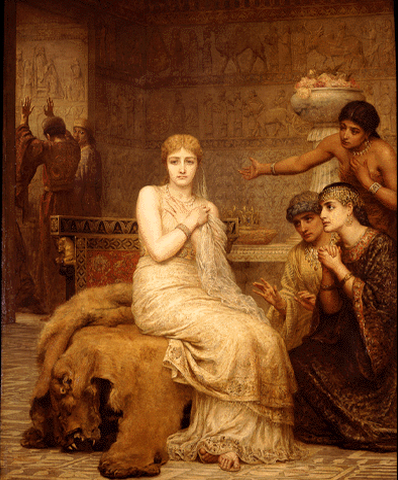
"Vashti Refuses the King's Summons" by Edwin Long (1879). Public Domain image.
“Vashti Refuses the King’s Summons” by Edwin Long (1879). Public Domain image.


A search began for beautiful young virgins. Those who made the cut were subjected to twelve months of beauty treatments before the king would even deign to lay eyes on them. The hopefuls then appeared before the king, who did not see any of them ever again “unless he was particularly pleased by her” (Esther 2:12-14). King Xerxes liked Esther best of all the young virgins displayed before him, and crowned her queen in Vashti’s stead. Plot twist: the king did not know that Esther was Jewish, for she had deliberately kept that fact from him. In the end Esther was able to use her beauty to bend the king to her will, and when one of his henchmen sought to have all the Jews in the kingdom annihilated, Esther stood up for her people and they were spared.

While it is this end-result that is remembered and celebrated each year at Purim, it is Esther’s degrading rise to the throne—and what it cost her to to save her people—that is the subject of today’s poem.

To come to power, Esther had to take the rightful queen’s place and become the poster child for the idea that “all wives [should] bow to the authority of their husbands.” To catch the king’s eye she had to strip away her personhood until nothing was left but her physical beauty. “That blush on my cheek? / It’s paint, / And I have glittered my eyes / And robed myself in the finery / of silk and gossamer, / lapis and gold.” It was not her devotion to her people that allowed her to save them, but that she “whored [her]self for [their] salvation.” Nor did her people care who she was beneath her beauty, or whether she survived her attempt to save them: “You asked for no thoughts. / You merely offered my body / to the king– / My life forfeit / If my beauty failed.”

"Queen Esther" by Edwin Long (1878). Public Domain image.
“Queen Esther” by Edwin Long (1878). Public Domain image.


Queen Esther was a pawn in men’s games, as women of history have too often been. “Diplomacy was played on the field of my body, / The battle won in the curve of my hip.” She used her beauty and her sexual allure because, as a woman of her time and place, they were the only instruments of power available to her. But if she were given a voice, she might speak of inner conflict. She might tell us what it feels like to lack the ability to either refuse or consent. Queen Esther was a hero, but what did it cost her to package and sell herself in the name of the greater good? “That blush on my cheeks? / It is the stain of victory / And of my shame.”

Today’s poem does what all great feminist biblical interpretation and midrashot do: it examines, deconstructs, and reconstructs androcentric assumptions, biases, and perspectives in biblical literature, placing women, gender, and sexuality at the center of reinterpretation.

In a time when the Bible is still being used to justify the oppression of women, we need much more of the important work Stacey Zisook Robinson is doing with “The Book of Esther.”

Want more from Stacey Zisook Robinson?
Stacey Zisook Robinson’s Blog
Stacey Zisook Robinson’s Official Website
Personal Essays and Opinion Pieces on iPinion
ReformJudaism.org

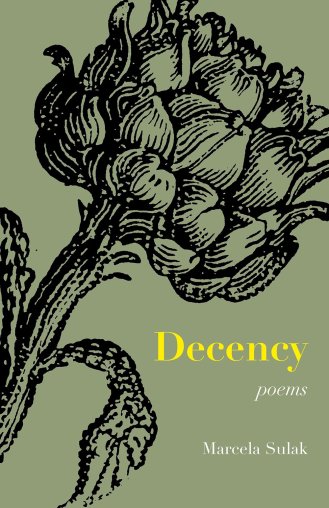
SATURDAY POETRY SERIES PRESENTS: DECENCY


Decency


From DECENCY
By Marcela Sulak:


selections from SOLIDARITY

vi. Virginity

It’s not that you get tired, it’s that it starts to be the only thing,
starts to disappear you.

Your parents phone you at college to ask: how is your virginity
doing? Did your virginity have a good day?

What does it want to be when it grows up? Your virginity sounds
a little sad this morning. What kind of cake does your virginity want

for its birthday? your girlfriends saw the most amazing shoes
that your virginity would look terrific in!

Want to go shopping? your boyfriends—would your virginity like to see
a movie? What about dinner?


ix. witches

My daughter is named for my grandmother, a midwife
who attended the births of 90 babies in rural Texas

before they had cars and after they finished having witches
but before there were doctors. Now you may understand

what I mean when I say another woman
gave my daughter a book called “The witches and the rabbi”

for her birthday. Here is the plot: a village is terrorized by a plague
of witches who fly from their cave when the moon is full,

on brooms through the sky except when it’s raining. I’m not sure
what the witches actually do to the village, since no one

actually goes outside on those nights. Gary, Indiana, could use
an infestation of witches—no stabbings

or gunshot wounds on evenings of full moons.
But one full moon when it is raining the rabbi shows up

with twenty townsmen. The witches
are so delighted they make them a feast of all the good things

they have. The rabbi tricks them into dancing with him and
the vigilante men, out into the rain,

which kills them. I knew her father’s mother was secretly
glad when I started to hemorrhage. She didn’t want me

to have a homebirth with a midwife.
“What kind of rabbis are these?”

Says my rabbi, stopped by for a quick hello. My daughter
wanted to show him that we had a book about rabbis. “They’re

engaging the poor witches
in mixed dancing and leading them astray,” he says.

This is the broom which sweeps the sky of the stars you have
to be too drunk to write about, as Daisy put it.

This is the housework the princesses do disguised
as village maidens. These are the constellations that form

in the shadow of the stars.
Silent are the women in the village

who took their cloth packets of herbs and were silent
when their husbands rushed off to kill the witches in that story.


CHOCOLATE

The day I won the custody case my lawyer gave me a bitter chocolate
in black and silver paper. Once I saw cacao pods
drying in a Venezuelan village square

during Easter week; through the open church doors, peeling saints sniffed
        and were carried
like colicky children through night streets. The local hot chocolate
was thickened with cornmeal and canella bark

somebody tore from the trees. To reach that village we found a fisherman,
        plowed
through rows of porpoises, then hiked five kilometers
inland through banana and cocoa trees,

which like shade. Once only men could drink
chocolate. Women were permitted cacao beans as currency,
to buy meat or slaves or pay tribute. It feels good to imagine a single seed,

hidden in the forbidden mouth, the tongue
curled, gathering the strength to push. The Aztec king discarded
each gold-hammered cup after its initial use; his chocolate was red as fresh
        blood.

He was a god to them. It was frothy,
poured from great heights. When we bathed in the village river, girls
gathered around me, whispering, why is your skin so pale? Why is your
        hair so straight?

Can we braid it? Dime, eres blanca?
The judge, our lawyers, her father, and I decided the fate
of my child. The dark liquid we poured was ink, initialing our little
        negotiations.

Who can know the heart of another, the blood
spiced with memory, poured from one generation to the next
over great distances? The Mayan word for chocolate means bitter. The
        village

used to be a plantation; now it is a co-operative, owned by descendants
of the former slaves. At Easter Vigil the women lined up
behind the most beautiful, in a long sky

-blue dress adorned with gold stars. Between the decades of the rosary she
        called out,
while we shuffled our feet in merengue beat, bearing the saints
through the streets, someone shot off a Roman

candle. The men’s procession paused for rum. I know I’ll be paying for it
        the rest
of my life. The Mayan word means bitter water. The cacao
tree was uprooted from paradise.


HOW TO USE A NAPKIN

Understand the napkin
has been unnecessary
for most of human history.

Understand the world is filled with people
eager to bend
things to their will.
We shall practice on the napkin.
When you have finished eating
place your napkin loosely
next to your plate
.

It should not be crumpled or twisted,
which would reveal untidiness or nervousness;
nor should it be folded,

which might be seen as an implication
that you think your hosts
might reuse it without washing
.
.
It is a delicate affair.
Don’t argue with me
said my husband

who had called for my advice
about the apartment he was renting
when he didn’t want to live with me.

It is largely
symbolic today
except for barbecues.
Lightly dab the lips.

I suspect the word
argue is the space
in the mouth for things
to come apart in.

The napkin must not be left
on the chair, it might seem
as if you have an inappropriately

dirty napkin to hide
or even that you are trying
to run off with the table linens.

It takes great trust
to use a napkin.
It takes an act
of faith to leave
the table.


Today’s poems are from Decency (Black Lawrence Press, 2015), copyright © 2015 by Marcela Sulak, and appear here today with permission from the poet.


Decency: Poetry. Jewish Studies. Women’s Studies. Decency celebrates the spunky wenches, the unfortunate queens, the complicated translators, the wistful wives who have been hustled off the spotlit stages of history. Through the lens of Victorian manuals of etiquette, through the unfolding of religion from the Middle East to the American Southwest, Decency thinks through the brutal things we do to one another, recording the ways the individual operates in relation to society’s mores and harms. From the Sumerian queen Puabi to contemporary female recruits to the Israeli intelligence’s “Honeytrap” operation, Decency is a mix of the documentary and the lyrical, the wrathful and the joyful.


Marcela Sulak‘s poetry collections include Decency (2015) and Immigrant (2010), both with Black Lawrence Press. She’s translated four collections of poetry from the Czech and French, and, most recently, the Hebrew: Orit Gidali’s Selected Poems: Twenty Girls to Envy Me (University of Texas Press, July 2016). She’s co-edited the 2015 Rose Metal Press title Family Resemblance: An Anthology and Exploration of 8 Hybrid Literary Genres. Sulak directs the Shaindy Rudoff Graduate Program in Creative Writing at Bar-Ilan University. ​​


Editor’s Note: If there is a question driving the poems in Marcela Sulak’s sophomore collection, it is a question of the ways in which we are and are not decent to one another. As individuals and as countries. As intimates and strangers. Both within and across the (real or artificial) divides of race, creed, culture, and nationality. Sulak pursues the answers to this question with the keen eye of an academic and a researcher, then relays her observations and discoveries with the skilled and deliberate abandon of an artist. These questions of decency are considered and depicted through the lenses of history, relationship, and etiquette. The result is a brave yet dainty collection. A powerful yet vulnerable collage. A work that charms the reader with its quaintness so that its harsh truths and difficult revelations go down like chocolate–bitter yet sweet, delicate yet bold.

Among the many long poems in this collection is one that stopped me in my tracks when I heard the poet read it aloud at the book’s New York launch last year. “Solidarity” is a stunning inquiry into rape–its ramifications and its afterlife and the endless experiences that collide with sexual violence in concentric circles. Today, for example, are Sulak’s reflections on misogyny and witch hunts, virginity and agency. Of virginity she writes, “It’s not that you get tired, it’s that it starts to be the only thing, / starts to disappear you.” Determined that her daughter know the truth about the history of hysteria, misogyny, and women healers, she considers witches through the skewed twin lenses of history and scaremongering: “Silent are the women in the village // who took their cloth packets of herbs and were silent / when their husbands rushed off to kill the witches in that story.” If I could have, I would have reprinted this long poem in its entirety. But then, you really ought to buy the book so that you can read this breathtaking work for yourself.

Throughout this masterful collection the poet’s own experiences are coupled with the larger lenses of the book–history and etiquette, for example–so that what is gleaned by the reader is at once deeply personal and delightfully educational. “The day I won the custody case my lawyer gave me a bitter chocolate,” Sulak writes of her unique experience, then later, in the same poem, writes of the history of chocolate: “Once only men could drink / chocolate. Women were permitted cacao beans as currency, / to buy meat or slaves or pay tribute.” Yet these ideas are not disparate; they are finely woven together by the poet’s skilled hand. The genius of this interrelation is beautifully evidenced by moments like this, in a poem that appears to be about the history of the napkin, but is equally about the poet’s leaving her husband: “It takes great trust / to use a napkin. / It takes an act / of faith to leave / the table.” The art of the poem–like the collection that houses it–is enriched beyond experience and information by a powerful lyric: “It feels good to imagine a single seed, // hidden in the forbidden mouth, the tongue / curled, gathering the strength to push.”


Want to see more from Marcela Sulak?
Marcela Sulak Official Website
“Jerusalem” in the Cortland Review
Decency” and “Raspberry” in Haaretz
Buy Decency from Black Lawrence Press, Book Depository, or Amazon

SATURDAY POETRY SERIES PRESENTS: RIVER ELECTRIC WITH LIGHT

river-electric-with-light


From RIVER ELECTRIC WITH LIGHT
By Sarah Wetzel:


A WORSHIP OF RIVERS

If I must choose a word for you,
let it be river. Not the river’s smoothed banks
that, like skin, give form
to breath and blood, the throb
of twenty trillion red cells wildly
ferrying their burdens.
If I must choose a word for you,
let it be the word
for what flows. Down one river,
a ruined house, down another,
eight empty boats bobbing. Inside a ninth,
there is a girl on her knees, knife
in hand. A kind of river
is running through her.
Because the worship of rivers
is also the worship of a chimney
for smoke, the needle its thread
as it closes the wound, of the wire
for its extra electron.
Because all three are worships
of motion, which is why
I race after rainclouds and trains, the postman
and bicycle messengers. Why I think
wind speaks to me. You,
you don’t speak. Yet you take
whatever I throw in. Which is why
I will always live close to water
but never again by the sea
from which everything eventually
finds its way shore again—
arthritic driftwood, the bones
of dogfish and dogs, and Mr. Levi,
the wristwatch still on his wrist. Which is why
I believe the girl puts down the knife
and she rises, the river
                                          electric with light.


THIRD VERSION

The rain leaves fingerprints
in last summer’s
window dust,

while just off shore, anchored
and waiting,
the barge that will ferry the lucky.

In one version of my story,
I sell my hair
and the good skin of my stomach.

In one version, I carry you
from the burning car
and this time you don’t die.

The sea with the rubber hose of a river
down its throat
is swallowing as fast as it can.

If you watch long enough, you’ll see that rain
shapes a path in the pane
for what falls behind it—

yet if you put a hand
to the glass,
the water will fall toward you.

Our lives are always half over.
There’s still time.


SAYING JERUSALEM

It’s become tricky to talk about Jerusalem
these days. Tricky, that is, without saying
cinnamon trees and narrow alleys, overfed
sparrows
, or Hasidic boys in metal spectacles.

I’ve nothing to say about trees or sparrows
or quaint Jerusalem characters, mustached men
selling talismans. Why don’t you like Arabs,
one asked, when I tried to bargain. Some Israelis joke

all we really need is Tel Aviv and the freeway
to Ben Gurion airport. Let the Arabs and fanatics
fight over everything else. From the roof
of my Tel Aviv house, I can sometimes glimpse

Jerusalem, the gleaming tip of al-Haram ash-Sharif.
Let them have everything else. Everything.


Today’s poems are from River Electric With Light (Red Hen Press, 2015), copyright © 2015 by Sarah Wetzel, and appear here today with permission from the poet.


River Electric With Light: Sarah Wetzel’s stunning second collection of poems, River Electric with Light, is a work of pilgrimage, a work in search of the sacred and the spiritually significant. Touching down in Tel Aviv and Jerusalem, Kabul, New York, and Rome, Wetzel’s poems, ranging from lyric meditations to discursive drama, weave themselves from her life as wife, lover, stepmother, and traveler. She names the force propelling her River—“If I must choose a word for you, / let it be the word / for what flows,” she writes. At times joyful, at times grief-ridden, Wetzel’s poems accumulate associatively pulling slivers of secular solace from a world where violence infuses the body, the landscape, and even dreams, recognizing that while: “Our lives are always half over. / There’s still time.” – See more at Red Hen Press


Sarah Wetzel is the author of River Electric with Light, which won the AROHO Poetry Publication Prize and was published by Red Hen Press in 2015, and Bathsheba Transatlantic, which won the Philip Levine Prize for Poetry and was published in 2010. Sarah currently teaches creative writing at The American University of Rome, Italy. She still spends a lot of time on planes, however, dividing time between Manhattan, Rome, and Tel Aviv, Israel. Sarah holds an engineering degree from Georgia Institute of Technology and a MBA from the University of California, Berkeley. More importantly for her poetry, Sarah completed a MFA in Creative Writing at Bennington College in January 2009. You can read samples of her work at www.sarahwetzel.com. ​​


Editor’s Note: Sarah Wetzel’s River Electric With Light is enigmatic, transversive, transformative. There is a motion within its pages–between sections and poems, between concepts and experiences–that is reminiscent of the Italian notion of attraversiamo; crossing over, moving on, getting to another place. Be it that of the smallest rain drop or the greatest ocean, be it that of trains, planes, or automobiles, this collection is electric with movement, even in its deepest and most sacred moments of quiet contemplation.

There is water–and the life water ensures–running through this book. Rivers that carry words, ideas, people. “If I must choose a word for you, / let it be the word / for what flows.” And along with this motion comes an unsettled feeling underlying the life of these poems: “Which is why / I will always live close to water / but never again by the sea.”

This collection hums with a delicate, thoughtful lyricism that lulls the reader so that we float along easily–though shifting locales, through political commentary, through mindful meditations on religion, relationship, life and death. Never set or singular–because life is never as black and white as one experience or perspective–we are reminded that “Our lives are always half over,” but, in the same breath, “There’s still time.”


Want to see more from Sarah Wetzel?
Superstition Review
Poetrynet.org
Ilanot Review
Recours au Poeme

SATURDAY POETRY SERIES PRESENTS: JEN LAMBERT


JenLambert


DINNER FOR THE DYING
By Jen Lambert


When the boy comes inside
with blood on his ripe hands
and a quiver of pointed explanations
on his back, I’m chopping yellow onions.

When he says it’s a doe, that she lies
on the edge of the wood, and that he knows
she was pregnant, my skin tightens.
The scar on my belly, that battered, barbwire grin
that opened like a window for him, twitches
for the dying mother and the calf like a love note in her womb.

When he hangs his knife on his belt
and heads toward the wood, I boil water, crush garlic.
I remember when the doctor pulled him, screaming,
from my belly. I remember the howl in my womb
as he sewed me shut. I remember my first meal
as a mother. Nothing could satisfy.
I salt the vegetables. Crush the mint.


Today’s poem was originally published in Boxcar and appears here today with permission from the poet.


Jen Lambert is a founding editor of Spark Wheel Press and burntdistrict magazine. She received an MFA from the University of Nebraska, and her work has appeared in journals such as Pank, The Los Angeles Review, Sugar House Review, and Redactions, among others.

Editor’s Note: As a new mother, I recently began a search for today’s best poems about motherhood. Jen Lambert’s “Dinner for the Dying” came highly recommended and does not disappoint. And so today we kick off a series of poems within this Saturday Poetry Series that will consider motherhood and hopefully leave their mark upon the reader as today’s poem has left its mark upon me.

There is something of Naomi Shihab Nye in this work. In the salted vegetables and crushed mint. In the intersection of the natural, the familial, and the body. This is a poem of quiet power, wherein tragedy is gently stitched to memory, where life and loss are depicted as two sides of the same coin. Moments of radiant lyric emerge from the subtlety and strength of today’s poem: “a quiver of pointed explanations,” “that battered, barbwire grin / that opened like a window for him, twitches / for the dying mother and the calf like love note in her womb.”

Want more from Jen Lambert?
Official Website
Heart Journal
Tahoma Literary Review

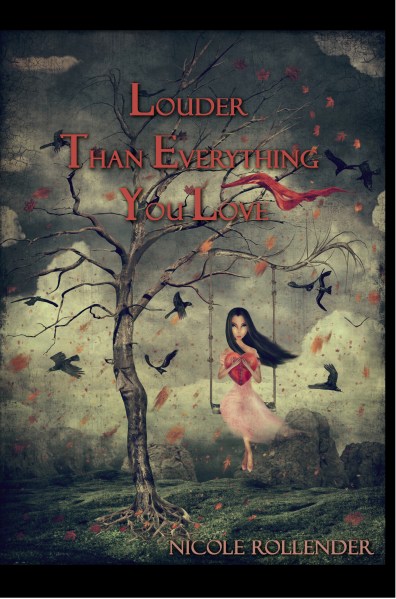
SATURDAY POETRY SERIES PRESENTS: LOUDER THAN EVERYTHING YOU LOVE


Louder_Cover


From LOUDER THAN EVERYTHING YOU LOVE
By Nicole Rollender:


SCATTERING

I remember your clavicle pressed like a blade
under your skin, the moon

pooling in your cheeks’ hollows. You wanted
to be buried in the green dress

you always wore with pearls. We’d sit outside your back
door, watching bats swing over the lake.

Once you were like a weather vane twisting
at the edge of a field as you watched tornados spin

toward your house, your mother asleep on the couch.
I suppose you couldn’t tell me you wanted

her dead. But now you’re gone like she is.
I listen for your voice in the church

inside me, where a priest’s hands outline the shape
of a death. Yes, he believes vertebrae have ghosts.

This luminous pew, where a bird can earn a spot
in paradise—but I’m told the earth

can’t perform the miracle of giving you back.
I know the music your bone shards

make in the urn. You could be an old woman
shaking fish skeletons to conjure the dead.

You could be this fish skeleton.
I should know when a body need not be resurrected—

when the ways we said our names between us,
quietly near the azaleas, trying not to startle

robins (now, now they’re singing on your spine),
stop being music I can hear in my mind,

but become something other: how I scatter
the notes, adagio, pianissimo, and what answers

as the wind scatters white feathers into the lake.


PSALM TO BE READ WHILE MY DAUGHTER CONSIDERS MARY

A swaddling, a manger: but what happened before all this, my
daughter says: when Mary was a girl: I said yes: did she feel an
undersea tug on her spirit: did she think she might be able to move
jugs of water with her mind: I said yes: to birth a man who would
walk on water: a man who would tattoo his image in blood and sweat
on a shroud: did she, in the night fields, look for a star that would
lead seven shadows as colors into her life: what is wine: what are
these fishes, these loaves: for, he entered and exited her as light: her
waters stayed intact: yet, she swaddled a baby who would nurse, laid
him in prickly hay next to goats’ stiff fur: I said yes: listen to this: your
great-grandmother saw Mary appear next to my mother’s crib: my
mother caught measles as a baby: your great-grandmother was a seer:
she walked with Mary back to the stable: comets circling as angels in
a flock overhead: Joseph, wondering: I said yes: Mary, whose baby
pierced through her as light: holding a boy who’d be lanced with a
sword: who would bleed, pee, sweat and groan: who contained God:
who contained her blood: who contained everything in the world:
yet, held out his hand and cried for her milk.


THE LIGHT MAKES MY GRANDMOTHER CRY

Her stories still smoke up the kitchen, a dead woman
cooking peasant soup. Pigeons, lightning boiling

for the living. What kind of truth-telling do we expect
to fall off bird bones? Her death was supposed to be

a leaving, except it wasn’t. Her mutterings clack on
the backs of my teeth. She’s learning what dead women

do: swim the blood of their daughters, spread themselves
on ceilings like giant moths radiating light. The solstice

lights the halo-less among us. Her gap-teeth swallow ashes
in the urn. The coffee grounds won’t settle. She pushes

her hands up into mine, slides her ghost bones under
my skin, and watches my fingers dance the shadow-

-woman-waltz-grasping-at-spoons. She remembers
the day Pinky the poodle was nabbed from her front

yard, pretends to pet his wooled head. That’s why you
need fences to keep the dark ones out
. She uses her skull

as a pot, hissing up, Give back the life I gave you. The sink
runs red angry water. She tiptoes up my spine in her

old slippers, knocking on every vertebra she sees.
It’s true that the dead get younger. Some nights she’s

a skinny girl waking from a bad dream, calling for
a winged mother, the saint of lost dogs, to come down

from a parapet. It’s this girl I let stay, because she also
cries at the stars, whose light goes right through her,

for the dead woman she will grow up to be. That new
blaze, coming from as far away as blue stars going nova,

the lesson in the death-light: The dead learn
to smell what’s sweetest among all the rotting.


Today’s poems are from Louder Than Everything You Love (ELJ Publications, 2015), copyright © 2015 by Nicole Rollender, and appear here today with permission from the poet.


Louder Than Everything You Love: Nicole Rollender’s poems balance on the uneasy boundary between third eye and communion wafer. Beside an “old woman shaking fish skeletons to conjure the dead,” the poet as body becomes a conduit for the generations in both directions, such that her “body is full of holes the dead / look in and out,” while of her daughter she says, “my ribs / were her scaffolding.” Rollender alternately glories and suffocates in her holy entanglement with her lineage, with her God. And when she comes up for air, she ululates a hauntingly familiar song. —Jessica Goodfellow, author of Mendeleev’s Mandala


Nicole Rollender’s work has appeared or is forthcoming in The Adroit Journal, Alaska Quarterly Review, Best New Poets, The Journal, Memorious, THRUSH Poetry Journal, West Branch, Word Riot and others. Her first full-length collection, Louder Than Everything You Love, was published by ELJ Publications in 2015. She’s the author of the poetry chapbooks Arrangement of Desire (Pudding House Publications, 2007), Absence of Stars (dancing girl press & studio, 2015), Bone of My Bone, a winner in Blood Pudding Press’s 2015 Chapbook Contest, and Ghost Tongue (Porkbelly Press, 2016). She has received poetry prizes from CALYX Journal, Ruminate Magazine and Princemere Journal. ​​


Editor’s Note: Nicole Rollender’s first full-length collection is haunting and haunted, tender and tendrils, eye of newt and mother’s milk. The poems contemplate generations and generation. Death and little deaths. The ways we go on, the ways we are remembered. How birds alight on our remnants after we are gone. Its pages are rife with the inheritance of seers and magic, wisdom and sight. With what is passed down amongst women through the ages, from mother to daughter again and again and beyond.

The book’s moments of stunning lyric are interwoven with its major themes so that they become “the music… bone shards // make in the urn.” On the theme of death, the poet writes: “I listen for your voice in the church // inside me, where a priest’s hands outline the shape / of a death” and “I’m told the earth // can’t perform the miracle of giving you back.” When contemplating Mary as mother, she notes the real miracle, that Mary birthed a god “who contained her blood: who contained everything in the world: / yet, held out his hand and cried for her milk.”


Want to see more from Nicole Rollender?
Author Website
Author Blog
Order a signed copy of Louder Than Everything You Love and get a bonus broadside
“How to Stop Drowning” in Muzzle Magazine
“Aperture” in A-Minor Magazine

SATURDAY POETRY SERIES PRESENTS: OLAM, SHANA, NEFESH

Etching on chapbook cover by Andi Arnovitz

From OLAM SHANA NEFESH
By Jane Medved:


SIRENS

They think it is the young girls singing
you see, we pull them to us as smoothly

as oiled rope uncurls into golden braids.
It only takes a few minutes before everything

they see is woman. The pale skin of the sails
spreading like thighs, the thick knots

that tie the anchor turning to strands
of dampened hair held by a lover

before she shakes it free. The salt tastes
as sweet as sweat and soon the ship’s thrust

into the sea becomes unbearable.
This would be enough for galley slaves,

soldiers who tattoo fortunes on their scars,
the simple, parched sailors. But they are not

the ones we want. When we see the heroes
whose fierce deeds fall like hammers, we lay

aside our nocturne of desire. We sing instead
as a mother holds a dying child until

the horizon is the circle of our arms, the wind
a cloth wrapping them in its whisper, the waves

a gentle hush upon each creaking of the deck.
“Do not be afraid. You will be remembered and reborn.”


WHITE FIRE

There is a cable and it reaches
from the side of loving kindness

to the cold window across the room
taking over the function of your heart

which is tired of trying to make blood
out of air. Some days it’s just too hard

to keep on lifting, to appear in a robe
which keeps on falling, exposing

all sorts of intimate matters and the
little whispers beneath. Do not worry.

You are the hand, the page, the white fire
and you cannot be erased. The black letters

will burn and sing and declare themselves
but they are nothing without your silence;

which is not the absence of words, empty
as the howl of a bowl, but the promise made

between all words before they are spoken,
that they will reach across the black lines

and know each other again, even
if they no longer recognize themselves.


LEAVING A NOTE AT THE WESTERN WALL

There is a splintered door leading
nowhere and a lot of women crying
today I can’t even get near the wall.
Luckily I have my own tricks.
I place my arm over a young girl’s shoulder,
sigh sympathetically as she bends
her head in prayer, then edge myself
into her space. Everyone wants to touch
God’s face, to press their forehead
against his slippery cheek and brush
the pitted marks beneath, thank you
for my eyes, my legs, my arms, my breath
.
Herod did a good job, the ancient stones
hold solid. They outweigh the base
of the great pyramids and nothing moves
them, perhaps they are even held up
by pleading, since every crack is filled
with scraps of blue-lined paper, torn
index cards, a piece of yellow legal pad,
a folded napkin, sealed envelopes, airmail,
express, please, listen, thank you for my eyes,
my legs, my arms, my breath, excuse me
,
a woman pushes past me, excuse me please,
when she reaches for the wall a handful
of notes loosen and fall at our feet.
The chair behind me is piled with prayers
as morning, evening and darkness
make their requests, songs from the sons
of Korach even though their father moans
in the earth thank you for my arms,
my legs, my eyes, my breath
, women beg
the matriarchs and children press letters
into fists of stone while God sends back his answers
– No and no and no.


Today’s poems are from Olam, Shana, Nefesh (Finishing Line Press, 2014), copyright © 2014 by Jane Medved, and appear here today with permission from the poet.


Olam, Shana, Nefesh: “‘Olam, Shana, Nefesh’ is a Kabbalistic phrase used to describe the three dimensions of Place, Time and Person. Olam is most commonly translated as ‘world.’ But in Hebrew olam comes from the root of the word ‘hidden.’ This implies that place always has an unrevealed element to it; that we are surrounded by a reality beyond what is immediately visible. Shana literally means ‘year.’ It invokes an image of repetition, re-visiting, return, a never -ending cycle of months. In the Jewish calendar time is not a passive backdrop to human endeavor, but an active force whose windows of opportunity open and close, blossom and die just like the seasons. Nefesh can be translated as ‘person’ but it refers to the spirit as well as the body; the infusion of the divine into the physical. This is an inherently volatile combination, since a human being always contains a push and pull between the material and the spiritual, the body with its appetites and fears and the spirit. This is ‘person’ as the container of the animal and the divine.” – From Olam, Shana, Nefesh (Finishing Line Press, 2014)


Jane Medved is the poetry editor of the Ilanot Review, the on-line literary magazine of Bar Ilan University, Tel Aviv. Her chapbook, Olam, Shana, Nefesh, was released by Finishing Line Press in 2014. Her recent essays and poems have appeared or are forthcoming in Lilith Magazine, Mudlark, Tinderbox Poetry Journal, Cimarron Review, Spoon River Poetry Review, Tupelo Quarterly and New American Writing. A native of Chicago, Illinois, she has lived for the last 25 years in Jerusalem, Israel.


Editor’s Note: Olam, Shana, Nefesh is an absolutely stunning collection. A rare assortment of meditations on myth and history, religion, spirituality, sensuality, gender and place. The questions posed are epic, the answers as small and as critical as breath. The poems themselves are absolutely gorgeous in their own right; lyric delights that any reader would feel indulgent slipping into, with moments like “The salt tastes / as sweet as sweat and soon the ship’s thrust // into the sea becomes unbearable,” “The black letters // will burn and sing and declare themselves / but they are nothing without your silence,” and “Everyone wants to touch / God’s face.” But this book is even more rewarding for those readers familiar with the rich landscapes the poems call and respond to. How rewarding is “Sirens” for those well-versed in Greek mythology, how brilliant “White Fire” for those who know and love midrash, and how masterful “Leaving a Note at the Western Wall” for students of religion and history, for Jewish women, for those who have been to Jerusalem’s Wailing Wall, who have “press[ed] their forehead[s]/ against [God’s] slippery cheek and brush[ed] / the pitted marks beneath, [saying] thank you / for my eyes, my legs, my arms, my breath.”


Want to see more from Jane Medved?
Tinderbox Poetry Journal
Lilith Magazine
Buy Olam, Shana, Nefesh from Amazon

SATURDAY POETRY SERIES PRESENTS: KEETJE KUIPERS

30_DSC5432

GETTING THE BABY TO SLEEP
By Keetje Kuipers


Sometimes the baby can’t reconcile
the self with the self: too hungry
to eat, too tired to sleep. I know

the feeling. O, America, on those nights
when you are too beautiful for me
to continue to forgive you any longer—

for allowing us to kill each other
with your graceless bullets, or exile
our neighbors across your fictitious

border, or argue over the ownership
of each young girl’s body as if its freedom
is a lie she must stop telling herself—

I go out into your radiant embrace.
The baby and I drive through your streets,
over the bridge and its light-chipped

waters, under a moon so big, so full
of itself that though I know it belongs
to the world, it can’t be anything but

American. I hang my arm out the window
and skim the air like touching skin.
I breathe you in, and the baby sleeps.


Today’s poem was originally published in Blackbird and appears here today with permission from the poet.


Keetje Kuipers has been the Margery Davis Boyden Wilderness Writing Resident, a Stegner Fellow at Stanford, and the Emerging Writer Lecturer at Gettysburg College. A recipient of the Pushcart Prize, her poems, essays, and fiction have appeared in numerous magazines and anthologies, including Best American Poetry. Her first book of poetry, Beautiful in the Mouth, won the 2009 A. Poulin, Jr. Poetry Prize and was published by BOA Editions. Her second collection, The Keys to the Jail, was published by BOA in 2014. Keetje is an Assistant Professor at Auburn University where she is Editor of Southern Humanities Review.

Editor’s Note: Today’s poem absolutely blows me away. It is too powerful to contain, and yet it is perfectly wrought as if chiseled from marble. It is metaphor and life, politic and country, as near as a closely-held infant and as far as the moon. It is the American affliction: needless gun violence, our backs turned and hearts hardened against immigrants and refugees, our deep seated fear of women’s sexuality, freedom, independence. “O, America, on those nights… you are too beautiful for me / to continue to forgive you any longer.” Absolutely stunning. Heartbreaking. An outcry in the form of a quiet, contemplative drive, cruising America in an attempt to get the baby to sleep.

Want more from Keetje Kuipers?
www.keetjekuipers.com

SATURDAY POETRY SERIES PRESENTS: STATE OF GRACE: THE JOSHUA ELEGIES

41oGCGJb2kL._SX331_BO1,204,203,200_


From STATE OF GRACE: THE JOSHUA ELEGIES
By Alexis Rhone Fancher:


DYING YOUNG

Midnight, and again I’m chasing
sleep: its fresh-linen smell and
deep sinking, but when I close my eyes I see
my son, closing his eyes. I’m afraid of that dream,
the tape-looped demise as cancer claims him.

My artist friend cancels her L.A. trip. Unplugs the
internet. Reverts to source. If cancer
will not let go its grip, then she will
return its embrace. Squeeze the life out of
her life. Ride it for all it’s worth.

By the time his friends arrive at the cabin
my son is exhausted, stays behind while
the others set out on a hike. He picks up the phone.
“Mom, it’s so quiet here. The air has never
been breathed before. It’s snowing.”

I put on Mozart. A warm robe. Make a pot
of camomile tea. The view from my 8th floor
window, spectacular, the sliver moon, the stark,
neon-smeared buildings, their windows dark.
Sometimes I think I am the only one not sleeping.

My artist friend wants to draw the rain. She
wants to paint her memories, wrap the canvas
around her like a burial shroud.

Tonight, a girl in a yellow dress stands below
my window, top lit by a street lamp, her long shadow
spilling into the street. She’s waiting for someone.

I want to tell my friend I’ll miss her.
I want to tell my son I understand.
I want to tell the girl he won’t be coming.
That it’s nothing personal. He died young.


SNOW GLOBE

Despair arrived, disguised as
nine pounds of ashes in a
velvet bag, worried so
often between my fingers
that wear-marks now stain
the fabric.

Is it wrong to sift
the remains of my dead son,
bring my ashen finger to my
forehead, make the mark of
the penitent above my eyes?

His eyes, the brown of mine,
the smooth of his skin, like mine.
Unless I look in the mirror
I can’t see him.

Better he’d arrived
as a snow globe, a small figure,
standing alone at the bottom of his
cut-short beauty.

Give him a shake, and watch
his life float by.


OVER IT

Now the splinter-sized dagger that jabs at my heart has
lodged itself in my aorta, I can’t worry it
anymore. I liked the pain, the
dig of remembering, the way, if I
moved the dagger just so, I could
see his face, jiggle the hilt and hear his voice
clearly, a kind of music played on my bones
and memory, complete with the hip-hop beat
of his defunct heart. Now what am I
supposed to do? I am dis-
inclined toward rehab. Prefer the steady
jab jab jab that reminds me I’m still
living. Two weeks after he died,
a friend asked if I was “over it.”
As if my son’s death was something to get
through, like the flu. Now it’s past
the five-year slot. Maybe I’m okay that he isn’t anymore,
maybe not. These days,
I am an open wound. Cry easily.
Need an arm to lean on. You know what I want?
I want to ask my friend how her only daughter
is doing. And for one moment, I want her to tell me she’s
dead so I can ask my friend if she’s over it yet.
I really want to know.


Today’s poems are from State of Grace: The Joshua Elegies (KYSO Flash, 2015), copyright © 2015 by Alexis Rhone Fancher, and appear here today with permission from the poet.


State of Grace: The Joshua Elegies: “Alexis Rhone Fancher’s book, State of Grace: The Joshua Elegies, maps in searing detail a landscape no parent ever wants to visit—a mother’s world after it’s flattened by her child’s death. Though her son’s early passing was ‘nothing personal,’ her poems howl with personal devastation. They insist that the reader take the seat next to hers in grief’s sitting room and ‘imagine him in his wooden forever.’ Fancher grapples with how to reconcile oneself to the slow loss of memory’s fade-out, and with how to go on living without betraying the dead, how to ‘[s]queeze the life out of / her life.’ You’ll need tissues when you read this book, but it’s well worth rubbing your heart raw against the beauty of these poems and their brave, fierce honesty.” — Francesca Bell, eight-time nominee for the Pushcart Prize in poetry, and winner of the 2014 Neil Postman Award for Metaphor from Rattle


Alexis Rhone Fancher is the author of How I Lost My Virginity To Michael Cohen and Other Heart Stab Poems, (Sybaritic Press, 2014). Find her work in Rattle, Menacing Hedge, Slipstream, Fjords Review, H_NGM_N, great weather for media, River Styx,The Chiron Review, and elsewhere. Her poems have been published in over twenty American and international anthologies. Her photos have been published worldwide. Since 2013 Alexis has been nominated for three Pushcart Prizes and two Best of The Net awards. She is photography editor of Fine Linen, and poetry editor of Cultural Weekly, where she also publishes The Poet’s Eye, a monthly photo essay about her ongoing love affair with Los Angeles. www.alexisrhonefancher.com


Editor’s Note: The poems in today’s collection slew me. Long after I finished reading them, they stayed with me, a specter. As I nursed my young son, worried over his maladies, rejoiced in his small accomplishments, there in the shadows was the poetry of Alexis Rhone Fancher reminding me that life is precious, fleeting, that nothing should be taken for granted, that anything–no matter how dear–can be taken away.

It is impossible not to be moved by these poems. By “a girl in a yellow dress [who] stands below / my window, top lit by a street lamp, her long shadow / spilling into the street… waiting for someone.” By the poet, the mother, who wants “to tell the girl he won’t be coming. / That it’s nothing personal. He died young.” By the admission, “Unless I look in the mirror / I can’t see him.” By the callousness of a friend who would ask if a mother is “over” her son’s death. By a mother’s very human reaction to such a question: “I want to ask my friend how her only daughter / is doing. And for one moment, I want her to tell me she’s / dead so I can ask my friend if she’s over it yet. / I really want to know.”

State of Grace: The Joshua Elegies is raw, brave, honest. It rips you apart as you read it–and leaves you grieving long after–because of the very vulnerable and wounded place from whence the poems arose. This is an incredibly compelling collection that does what lyric, confessional, narrative poetry does best: invites the reader into a human experience that is at once personal and shared, pairing vivid imagery and beautiful language with a story so moving that the reader is forever changed by the very act of having read it.


Want to see more from Alexis Rhone Fancher?
Buy State of Grace: The Joshua Elegies from Amazon
Four poems in Ragazine, including “When I turned fourteen, my mother’s sister took me to lunch and said:,” chosen by Edward Hirsch for inclusion in The Best American Poetry, 2016
Broad (“Dying Young” was first published in Broad)
Alexis Rhone Fancher’s Official Website / link to published works