SATURDAY POETRY SERIES PRESENTS: PAPER COTTON LEATHER

Paper_Cotton_Leather_cover


From PAPER COTTON LEATHER
By Jenny Sadre-Orafai:


RETRACT OR RECANT

This accordion love expands or exhales,
retracts or recants. It is only as much
as we allow. It squeezes out warnings
of cardboard walls closing in.

Its wheezing fills a willful tide
with dread. I turn to this gone
love. I was taught curve into the slide
when spinning on frozen road.


CUTTING YOUR HAIR

When I was done, a ring of hair
or a halo curved your hunched
shoulders. Your broad back didn’t
flinch when the scissors’ legs twitched,
when I wanted to cut more than you mimed.


PREMATURE OBITUARY

I pretend you’re dead.
I don’t let them say your name.
I was taught it’s impolite
to talk behind a dead man’s back.

I wear black four months and ten days.

I smell your clothes before
hand washing, bagging,
and then giving them away.
I don’t give your mother a thing.

I pray for what’s left of you.

I stack the wedding ring, all the rings
you gave me on my right hand,
my proclamation that you are no longer
with us or like us, the living, listening.

I tell myself what I tell myself
to keep from going back.


Today’s poems are from Paper, Cotton, Leather, published by Press 53, copyright © 2014 by Jenny Sadre-Orafai, and appear here today with permission from the poet.


PAPER COTTON LEATHER: “The specter of divorce haunts Sadre-Orafai’s debut, although Paper, Cotton, Leather is much more than a lyrical response to loss. Paper, Cotton, Leather is an instruction manual for the amateur anthropologist, the domestic ghost-hunter, and the doomsday prepper. In ‘Retract or Recant,’ Sadre-Orafai writes: ‘I was taught curve into the slide/when spinning on frozen road.’ This is exactly what Paper, Cotton, Leather can teach us: how to navigate the heart’s switchbacks, how to survive a spin-out on its loneliest back roads.” —Shelley Puhak, author of Guinevere in Baltimore (From the Press 53 website.)


Jenny Sadre-Orafai is the author of four poetry chapbooks—Weed Over Flower (Finishing Line Press), What Her Hair Says About Her (H_NGM_N Books), Dressing the Throat Plate (Finishing Line Press), and Avoid Disaster (Dancing Girl Press). Her poetry has appeared in H_NGM_N, Gargoyle, Rhino, Redivider, PANK, Mount Hope, Sixth Finch, iO: A Journal of New American Poetry, and other journals. Her creative nonfiction has been published in The Los Angeles Review, South Loop Review, and The Rumpus. She co-founded and co-edits the literary journal Josephine Quarterly. She lives in Atlanta and is an Associate Professor of English at Kennesaw State University.


Editor’s Note: Reading Paper, Cotton, Leather is like reading a diary written in achingly executed lyric. The compact, controlled poems function almost ironically; tiny scaffolding straining beneath the pressure of massive weight and breadth. The poems are honest. Fiercely, unapologetically honest. Surely it took no small amount of courage for the poet to sift through the wreckage of her failed marriage and catalogue its failures for us in verse.

In the poem “Fortune,” Sadre-Orafai writes, “Our pictures live in a box marked / THE PAST in my parents’ garage.” Each poem reads like its own discreet picture from that box. Vignettes of trying, failing, moving on, and learning to let go. Together those pictures—these poems—tell a story. This book is carefully held by a narrative arc that gives the illusion that we might piece together the end of this marriage like a puzzle. And yet, You know nothing, Jon Snow. This is an expertly crafted book of poems, not a memoir. We are left only with what the poet chooses to reveal. With what poetry is perhaps best at conveying. A selection of life’s moments as if through lens and shutter. Emotion. Regret and loss and heartache. Experience that finds a kindred spirit in the reader. This is a book that one reads to remember that life’s trials are universal, that we are not alone.

We are not alone. So many of us know, or have known, love like an accordion, squeezing out warnings, wheezing and transforming into gone love. “Cutting Your Hair” recalls Delilah, in all her power, destroying her lover. So, too, does that recollection call forth Regina Spektor (who is quoted in one of the book’s epigrams) in her song “Sampson”: “I cut his hair myself one night, a pair of dull scissors in the yellow light.” In this manner one can read Paper, Cotton, Leather like an archaeologist, dusting away layers to discern history, or, as Shelley Puhak suggests, like an anthropologist, observing humanity, past and present. So how does the poet pick herself up, dust herself off, and move into the future? In the most human way imaginable: striving and imperfect. “I pretend you’re dead. / I don’t let them say your name.” “I smell your clothes before / hand washing, bagging, / and then giving them away.” “I tell myself what I tell myself / to keep from going back.”


Want to see more from Jenny Sadre-Orafai?
Buy Paper, Cotton, Leather from Press 53
Jenny Sadre-Orafai’s Official Website
Jenny Sadre-Orafai on As It Ought To Be

SATURDAY POETRY SERIES PRESENTS: GLOSSOLALIA

GLOSSOLALIACOVER


from GLOSSOLALIA
By Marita Dachsel:


PATTY BARTLETT SESSIONS

I

I was 17, newly married
when I first put a woman to bed,
her new babe in arms.

Awaiting death, I’ve tallied,
attended 3977 births. Midwife,
my eminent title.

Pride is a sin,
but I think I will be forgiven
for the surge I feel
when I consider my record.


II

47 did not feel old,
but looked ancient to him.
A month after my daughter,
me. Sexless, righteous.
Virtuous. Finished.


III

I became a Mother in Israel,
coaxing young women
into the new covenant.

We were Sarah & Hagar. Rachel & Leah.

But I was wrong about polygamy.

Lust, envy & wrath are sins,
& I know I will never be forgiven
for being the zealous handmaiden
to this difficult life.


IV

I have lost four children. Heartache
is my chronic companion,
chafing the every day.

But my dear husband David
took a second wife
& I will tell you
what the others won’t admit:

There is no other earthly pain,
constant, raw & rending,
like sharing your man
with a younger wife.


V

I am a practical woman:
I can heal with herbs & my hands,
I brew my own beer, sew, knit,
& speak in tongues.

After birth, I would show
the mother the slick placenta,
raised up, a stretched orb.
An offering.

It carries the tree of life.
Rough, ropey. Red,
the colour of strawberry jam
boiling low on the stove.


VI

Being the first hand
to touch a life
is a powerful thing.

I have wondered
what imprint
I have left

& what has been
left on me.


AFTER THE MARTYRDOM

The men, they surged
from their homes,
from their women,
a confluence
in search of
their Galilee.

They shuffled, they scuffed
dirt across the land,
a hand of a crone.

The men, they fished.
Eyes skimmed the shore
for a stranger they would know.
Hope bobbed in their throats.
Loss, a lure, caught
shredding what they once knew true.

The women, they were left
with the children,
the dead.
The scriptures gave no guide
for wives at a time like this.


Today’s poems are from Glossolalia, published by Anvil Press, copyright © 2013 by Marita Dachsel, and appear here today with permission from the poet.


GLOSSOLALIA is an unflinching exploration of sisterhood, motherhood, and sexuality as told in a series of poetic monologues spoken by the thirty-four polygamous wives of Joseph Smith, founder of The Church of Jesus Christ of Latter-day Saints. In Marita Dachsel’s second full-length collection, the self-avowed agnostic feminist uses mid-nineteenth century Mormon America as a microcosm for the universal emotions of love, jealousy, loneliness, pride, despair, and passion. Glossolalia is an extraordinary, often funny, and deeply human examination of what it means to be a wife and a woman through the lens of religion and history. (From the Anvil Press website.)


Marita Dachsel is the author of Glossolalia, Eliza Roxcy Snow, and All Things Said & Done. Her poetry has been shortlisted for the Robert Kroetsch Award for Innovative Poetry and the ReLit Prize and has appeared in many literary journals and anthologies. Her play Initiation Trilogy was produced by Electric Company Theatre, was featured at the 2012 Vancouver International Writers Fest, and was nominated for the Jessie Richardson Award for Outstanding New Script. She is the 2013/2014 Artist in Residence at UVic’s Centre for Studies in Religion and Society.


Editor’s Note: In this collection Marita Dachsel has taken on no small task. By seeking to reclaim women’s stories from the polygamous world of Joseph Smith, the poet gives voice to the voiceless, the unknown, the lost and forgotten. Their stories come to life, their lives become known history. In “Patty Bartlett Sessions,” polygamous wife Patty Bartlett converts other women to the Mormon faith, “coaxing young women / into the new covenant.” But when she realizes the insurmountable trials of polygamy, she knows she “will never be forgiven / for being the zealous handmaiden / to this difficult life.” Instead she finds inspiration and fulfillment in her work as a midwife, for “Being the first hand / to touch a life / is a powerful thing.” In “After the Marytrdom” Dachsel speaks for a chorus of wives left by husbands seeking a divine experience, noting ruefully that “The scriptures gave no guide / for wives at a time like this.”


Want to see more from Marita Dachsel?
All Things Said & Done – Marita Dachsel’s Official Blog
Canadian Poetries
The Rusty Toque
The Barnstormer
Youtube: Too True: The poetry of four acclaimed BC poets

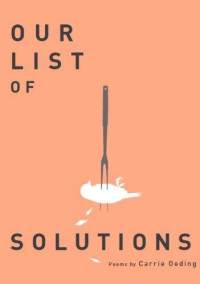
A Review of Carrie Oeding’s Our List of Solutions

Carrie Oeding Our List of SolutionsA Review of Carrie Oeding’s Our List of Solutions

by Angie Mazakis

In a January 2010 blog post at HTMLGIANT, Elisa Gabbert, with the help of Mike Young*, cataloged popular “moves” in contemporary poetry, and the list, which is singular and far-reaching, is veracious in its deconstruction of the recent (and nearly-recent) ways in which poets’ work has attempted a unique voice. The list was undoubtedly welcomed by poetry’s readers and writers, corroborating our suspicions that certain repeated current devices may have become gimmick, especially if they are vulnerable to a collection of several examples and labeled as “moves.” At the same time, the list is somewhat dispiriting―all our word tricks exposed in one bill of misfare. (See #34 on Gabbert’s list: “Clipping or altering a cliché.”)

Carrie Oeding’s poems in Our List of Solutions, winner of the inaugural 42 Miles Press Poetry Award, transcend reliance on any of the devices delineated in Gabbert’s list, which, even to a minor extent, can be found in most current poetry. Oeding has achieved an exceptionally distinct voice that stands out among the assemblage of blossoming contemporary camps and persuasions by creating personae in her poems that illuminate the incidental, that offer hyper-awareness through witty, appealingly and truly unique voices. Oeding’s poems are a refreshing shift from imposture or imitation.

Though readers may find the speakers in Our List of Solutions alone on a dance floor or navigating a barbeque in a way that is more meditative and remote than social, they aren’t easily categorized as the standard introvert and socially isolated ingenues they may seem to represent at first glance; they belong to a social category of cool outside observers that has transcended the vagrant cynic; they’ve replaced aloofness with sensitive observation, have deflected incuriosity with perspicacity. They’re appealing because readers will want to participate in their unique perceptions, in the exclusivity of their rare appreciations (their own nice ears, for example). We feel their anxiety and envy it for its accuracy.

Their intimations of detachment often seem either accepted or self-invoked–they know too much about social normalcy (“Don’t wait for me to point out how people work”; “They all do what they’re only made to”). They are furtive and unbending at once, deliberate introverts who make directive statements while retaining their vulnerability. They are the solitary who do not want/need to be found (“Someone find someone who wants to find anyone/ and tell them no one wants to be found”). They are speakers who’ve resolutely jilted the stars (“Sandy Says No More! To Just About Everything”). They seem less anxious about their aloneness than they do about their advertent observations of the world and the people living in it. In “Sandy’s Beauty,” the speaker’s exposure of the social obligation of flattery creates a response that is both hilarious and touching at once:

One of my neighbors said, You’re beautiful!
As if she discovered Beautiful for me…

Hello Beautiful.
What do you like? It’s almost winter.

Frankly Beautiful,
I have always had a feeling about myself.

Sandy personifies the superfluous “beauty,” sits it down and deconstructs and talks to it, having been given something she already had.

Despite the shy authority of these voices, the solitary inwardness of many of the speakers does not lose its moving, heartbreaking quality:

and I’ll make my own table too.
Better, without chairs.

—from “Amy Wears Blue Shirts Every Day, Too”

The voice of “we” weaves in and out of the book, dispensing instruction or exerting a warning (“We all know what happened to Dean”) or acting as a collective speaker of the poem (“Do you whisper, I can do this better,/ Susanna? Funny how we knew that. / We’ve already done better.”) Though it seems that the voice of “we” in Oeding’s poems is caricatured, the collective voice has desires or tastes that act so singularly readers will feel as though the we’s assertion is something they should have already felt or considered along with them. The voice is so convincing that we’re left wishing we were part of the group. It is also another avenue through which humor is used in the collection. (“We’re going to stop. We have a date. You understand.”)

When we think Oeding’s speakers are going to indulge in “description by negation,” (number 36 in Gabbert’s list of “moves”), even then they surprise by turning the negation further, so that there is still something unexpected around a corner we hadn’t anticipated.

After six whiskeys he can’t tell which neighbor can see through him.
Without seven he can’t tell the night what he doesn’t see.

—from “His List of Solutions”

Oeding does this another time as a kind of hyperbolic way of criticizing a prescriptive approach to finding love:

Don’t just like the lack of choice
in who you could really love, like all the choices
you could make to avoid love in hopes of finding love.

—from “We Like Steve and Louise’s Love”

The line break after “choices” creates an unexpected turn in the directive as well as in the negative indicators don’t, lack, and avoid, which oppose the positive could, could, and in hopes. This works to create surprise and subversion while deconstructing the meaning of the word “choice” and considering the various possibilities of choices.

Another way that Oeding impresses through the unexpected is by asking an ordinary question and then asking the relevant question readers likely wouldn’t think to ask—one that, in the following lines, makes up an inquiry concerning fundamental desire that beautifully, achingly resonates:

I wish it wasn’t dancing that gave me joy—

Can’t there be something besides dancing?
or maybe can’t there be something besides joy?
Oh, can’t there be something besides joy?

—from “Joy”

Another technical way Oeding uses language inventively is when she returns to a minor word, phrase, or idea soon after it has escaped the reader’s attention in a pleasing and unexpected reintroduction. This is done in a way that makes the reader surprised at the technique and surprised that he or she didn’t expect it. In “Storm’s A’Comin’,” we’re told there’s “a story about Dean and one about a funny hat, a favorite hat flying off in the wind.” Two lines later, when the wind seems to have ordinarily passed, “Someone’s mom has gout or goat―it’s hard to hear above the wind.” The phrase “asking for trouble” comes up again, wearing a new layer of meaning, as well as “pineapple”―just when we thought the case on the pineapple was closed.

One of the delights of Our List of Solutions is in the way that Oeding illuminates the minutiae. In “Lullaby for a Barrette,” the single act of pulling back hair is illuminated and examined, as is the act of sending a package in “Packages Under Our Control,” but illumination of the seemingly negligible and forgotten is a quiet strength throughout each of the poems, whether for its own sake or to create the rare, exquisite impressions that singularize unforgettable speakers. Carrie Oeding exposes the hidden sides―the felt but unexpressed, the loudly perceived but unsaid, and in the act of saying illuminates them, “each sequin getting its moment to be seen.”

Carrie Oeding, Our List of Solutions. 42 Mile Press, 2012: $14.25

*Correction: This review originally misattributed Elisa Gabbert’s article as being primarily written by Mike Young.

***

Angie Mazakis’s poems have appeared in The New Republic, Boston Review, Narrative Magazine, Best New Poets 2008, Drunken BoatNew Ohio Review, Everyday Genius, and other journals. She has received a Dorothy Sargent Rosenberg Prize and prizes from New Letters, New Ohio Review, and Smartish Pace.


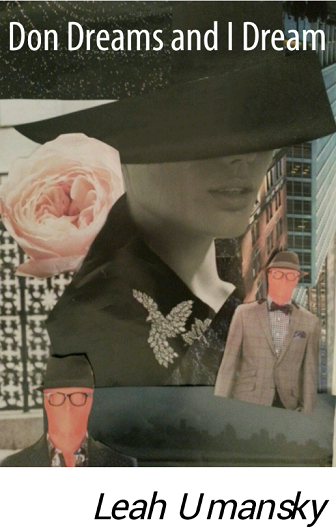
A Review of Leah Umansky’s Don Dreams and I Dream

Don Dreams and I Dream

A Review of Leah Umansky’s Don Dreams and I Dream 

by Sarah Marcus

As a binge watcher of the television show Mad Men and as a feminist reading through a feminist lens, I was interested to discover the manner in which Leah Umansky would address the main character of this AMC drama, Don Draper, a mysterious and not so mysterious cheating-hero. Umansky accomplishes the difficult task of both honoring this fictional man and exposing his distorted idealism and chauvinism in her compelling work, Don Dreams and I Dream. To begin with the end, in her final poem, “The Times,” Umansky admits, “I thought I’d hate Don, like everyone else, but I don’t. I long/ for him the way kids long for the turning of the Ice Cream Man.” Umansky’s pining for Don is matched by her insight and mastery of language as she navigates the boundaries between a public and private sense of past and present and of intimacy and distance.

While these poems absolutely can and do stand alone without knowledge of the show, the experience of this chapbook of 15 poems is much enhanced by understanding the intricacies of each character and relationship. As I entered the world of poet-advertising, I was most struck by how, at first glance, these poems seem to be concerned with the past but are in fact very much about the future. These poems not only look forward, they often exist in a landscape of fearing things to come. In the TV show and in our current lives, there is an ever-present anxiety that what we do will eventually be considered irrelevant, and that we are, perhaps, living too much in this moment. Much of this work touches the very core of our search for worldly permanence.

Love, although not necessarily romantic, is a strong narrative thread tying together each poem in this collection. In these pages, the reader finds love of work, love of self, love as “an advertisement,” and love as “sold and bought.” While considering the many ways in which love is made visible or tangible, Umansky makes sure to remind the reader that they are not in charge here. For example, in the very first poem, “Simple Enough For a Woman,” as if the title was not enough of an affront, the reader is uncomfortably directed to “be happy.” Here, we are also enabled to consider the notion of value. These poems give life to the decision of who and what is valuable and asks us to determine how value is measured. The model of worth and of knowing what we are worth, and to whom, is the cornerstone, the key, to entering this world of consumerism.

To be your “own engineer” is the goal, and to be able to accomplish this, as seen in the poem, “Days of Sterling/ Days of Yore,” one must “[live] the dream” like Don. In the poem, “In My Next Life, I Want to Be an Ad Man,” we receive another bold direction: “Make me look good; the world is dangerous.” Appearances are of the highest import and looking good is always preferable to safety.

The world is dangerous, but these poems inhabit a world of what feels like distant danger, as if there is an awareness of impending doom, but there is inherent fun to be had within this instability. The dangers include not only the extravagant lifestyles (of women, booze, and parties), but also the rise of physical and emotional manufacturing: the steel machinery and the coolness of selling an idea. Near the end of this manuscript, there is even a poem titled, “Beauty is in the Machinery,” where Umansky writes, “It is easy to get turned or turned on,” as if chaos is necessary to vulnerability and the threat of losing yourself is not only worth the risk but is sexy and desired, even mandatory.

Generous wordplay and insistent internal rhyme contribute to a feeling that these poems are flirtatious and lighthearted despite their focus on identity and personal significance. The reader is reminded in poems like “It’s the Selling,” that “[we] want to be told” what to think, what to do, and how to feel. We are essentially being asked to buy these poems and these ideas.  And again, in the poem “How Advertising Works,” we are told to be bold and confident (forceful, even), to “be a stallion.” One cannot walk away from this chapbook without considering what they are selling and what they are being sold.

These poems reveal a meticulous planning and careful stepping, where everything feels on purpose and orchestrated. Perfectly arranged in the poem, “Creation without Design,” Umansky writes, “I want the color/ to repeat itself/ down your neck;/ So you remember/ that lipstick/ wasn’t made for you,/ but for me;/ So that I can remember/ what a man does/ to his woman.” A stunning image, but moreover a statement that a system is already set-up and composed. Something already existed and was done for you and in spite of you.

The manuscript’s final line, “It’s a man’s world, but not for all of us,” references the act of a young woman, one of Don’s protégées, rising in the advertising ranks and accepting a job with a competitor company. She is leaving the nest, so to speak. For her, and for a moment in our solidarity with her (we can taste the us), the world feels wide open and possible—but, it is a man’s world, and Don Draper is the man, and Umansky, like the show’s writers, never lets us forget that we are very much at his patriarchal mercy. This last line of Don Dreams and I Dream reasserts ownership of our delusion in thinking that things could, in fact, ever be different from how they have been. We are dared to want this, but as Leah Umansky cautions us in “Don Discovered America,” “wanting and having/ are two different things.”

Leah Umansky, Don Dreams and I Dream. Kattywompus Press, 2014: $12

 ***

Sarah Marcus is the author of BACKCOUNTRY (2013, Finishing Line Press) and Every Bird, To You (2013, Crisis Chronicles Press). She is also a Count Coordinator for VIDA: Women in Literary Arts and an editor of Gazing Grain Press. Read more at sarahannmarcus.com.