SATURDAY POETRY SERIES PRESENTS: HISTORIES OF THE FUTURE PERFECT


HOTFP-cover-front-only


From HISTORIES OF THE FUTURE PERFECT
By Ellen Kombiyil:


CERBERUS AND PERSEPHONE

It’s audible to the three-headed dog:
her fear a high-pitched shriek

held in her throat. Pre-unleashed. The thought
of the shriek and not the shriek itself.

It’s freaking her out, this mind-reader dog,
how he tracks muscle-twitch, her intent to act,

pre-synapsed. He demands to know the before,
before the before: she was plucking flowers,

yes, when the ground opened its mouth,
but how she arrived at this exact spot,

how slowly she chewed and what she ate
for breakfast, how she slipped, stepping

onto the bathmat, her precise existence
at this particular moment—the two-, no

three-second pause at the four-way stop.
Indelible decisions. The luck

of the draw. The dog deciphers
eye-flicker, delves past thought in search of

the anatomy of thought, which moves
like starlight, born but the reaching delayed,

which moves like the gorgeous dark.
He’s doing it again, she thinks,

and he reads that, too. In his pupil-black,
black surrounded by gold flecks, she sees

the pre-patterned repetition
of next and next and next: her mouth, stained red;

she will not be leaving this place, not yet.
This future splits away like a cannon-

boom of sound. Calla lilies, held fast,
she lets drop. The great winding of a clock.


WHILE SIPPING LEMON TEA ON SATURN’S ICE-CLOUD DECK

The distant sun rises, the size of a dime.
Red light looks warm but is cold, the opposite of what I know.

What can’t be unknown: encrypted DNA, curling inside me.
What I google: Orbit: 29 years, 167 days. Rotation: 10.233 hours.

Dizzy days and sleepless nights—elongated years.
I’ve forgotten the outline of my body against you

how I’d reach across your warmth to the nightstand for water.
I am an untethered moon, unloosed from the sun.

Now is no time to panic: remember Sherlock Holmes.
He discards the superfluous, keeps room for important truths.

Human contact is what I’m lacking, so far from home.
Can you see me on the cloud deck, waving my arms?

I’m calling out for connection, any Watson will do:
It’s elementary, my dear; come here. I need you.


JULIET DREAMS OF THE CRYPT

Is it joy, waking to tall ceilings
painted white, inlaid with the smell

of almonds? The blind see colors,
cool heft of objects hand-held.

They do not see what is tarnished.
I’d be lying if I said I knew how

to get to the other side of my heart.
I rehearsed my speech as a child—Love

is a heavy wheelbarrow crushed with
hibiscus
—before pretending to plunge

the knife into my chest. My mouth
at the moment of loss unbinds a thousand

mouths all making the same sound. I practiced
for the day I am blind, when

I will trade myself for one
dram of bottled summer, a lawn

that tickles my neck when I lie down
next to you without expectation.


Today’s poems are from Histories of the Future Perfect, published by The (Great) Indian Poetry Collective, copyright © 2015 by Ellen Kombiyil, and appear here today with permission from the poet.


Histories of the Future Perfect by Ellen Kombiyil is a book of poetry inspired by concepts in astrophysics. Canvassing across time and space to provide a luminescence unafraid of the big ideas, the book itself has what Kombiyil calls a quantum structure. Here we find Galileo’s thumbprint, Kurt Cobain Las Vegas, and Mary Lincoln communing with the dead. The poems themselves are never narrowly historical but rather cosmic in their inflections, taking on subatomic particles, DNA, and black holes, not simply as scientific props but as the very impetus for lyric motion.


Ellen Kombiyil is the author of Histories of the Future Perfect (2015). She is a recent transplant from Bangalore, India, where she lived for nearly eleven years, teaching creative writing and yoga. A fellow at the University of Iowa’s International Writing Program in 2013, Kombiyil’s poetry and fiction have appeared in many journals, including BOOTH, Spillway, Cordite, and Poemeleon. She is a four-time Pushcart Prize nominee and has read, performed or taught workshops at the annual Prakriti Poetry festival in Chennai, the Raedleaf Poetry Awards in Hyderabad, and Lekhana in Bangalore. She is the co-Founder of The (Great) Indian Poetry Collective, a mentorship-model poetry press, publishing innovated voices from India/Indian diaspora. Originally from Syracuse, New York, and a graduate of the University of Chicago, she now lives in New York City with her husband and two children.


Editor’s Note: Ellen Kombiyil’s Histories of the Future Perfect is an absolutely stunning collection, from its opening image to its closing word, soaring and shining with every star and feather in-between. In truth, I am like “the tarot-reading parrot” in the gorgeous cover image by Kalyani Ganapathy, selecting today’s poems by divination rather than choice, because there is far, far too much that is worthy of sharing in this book.

Enter a world where nothing is off limits for exploration: history, mythology, love. Dive to the deepest depths of the ocean and travel as far as the imagined reaches of outer space. Slip into the skin of the philosopher, historian, astronaut, necromancer, classicist, adventurer–all as imagined by the contemplative mind and lyric lilt of the poet. Give yourself over to moments as beautiful as they are thought-provoking–“My mouth / at the moment of loss unbinds a thousand // mouths all making the same sound”–and know that these are the ripples circling out across the waters of this one-of-a-kind collection.

Buy this book. Revel in its beauty. Let your mind drift, weightless. Be carried away.


Want to see more from Ellen Kombiyil?
The (Great) Indian Poetry Collective
Buy Histories of the Future Perfect on Amazon
POEMELEON
Booth
SATURDAY POETRY SERIES PRESENTS: KAREN PAUL HOLMES

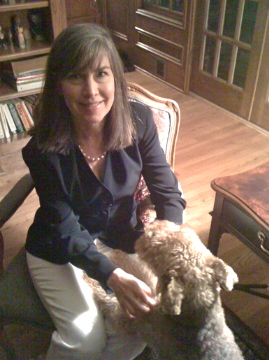
Karen Paul Holmes with dog

By Karen Paul Holmes:


VISITOR

A bare branch lounges
in my Adirondack chair
under the Japanese maple–
gray, elegant:
Comforting to me,
now without a husband,
a good omen
in my walled garden
cocooned by snow.


LIFE, ACT 3

Time knows its lines
has spoken them
across our foreheads.
In this stage of living
we censor the critic,
applaud the comedy,
watch the script unfold.
Gravity plays upon
these bodies, while
souls move inward,
heavenward.
The star in me
celebrates the star in you.


“Visitor” first appeared in Town Creek Poetry. Today’s poems are from the collection Untying the Knot (Aldrich Press 2014) and appear here today with permission from the poet.


Karen Paul Holmes is the author of the poetry collection, Untying the Knot (Aldrich Press, 2014), which tells a story of loss and healing with a voice that “pushes readers forward into the unknown with confidence, precision, and empathy,” according to Poet Dorianne Laux. Karen received an Elizabeth George Foundation emerging writer grant in 2012 and was nominated for Best New Poets 2014. Publishing credits include Poetry East, Atlanta Review, Caesura, The Sow’s Ear Poetry Review, Every Day Poems, The Southern Poetry Anthology Vol 5: Georgia, and Stone, River, Sky: An Anthology of Georgia Poems.

Editor’s Note: Today’s poems are full of dichotomies: simple and complex, small and epic. They contain all at once the quiet contemplation of nature, of meditation, of breath, yet their gentile reflectiveness is balanced precisely by the weight of a life lived. This is a life–and a poetry–as simple as a bare branch under a Japanese maple, yet as complex as the comfort of being “now without a husband,” and that being “a good omen.” This is a human experience as small as the lines time “has spoken… across our foreheads,” and as epic as the idea that “The star in me / celebrates the star in you.”

Want more from Karen Paul Holmes?
Blue Fifth Review
Verse-Virtual
Extract(s)
Amarillo Bay
See inside Untying the Knot

SATURDAY POETRY SERIES PRESENTS: ALL DAY, TALKING

allday_1024x1024


From ALL DAY, TALKING
By Sarah A. Chavez:


DEAR CAROLE, I FINALLY DID IT

I cut it all off into a trendy bob
that fades up the back. You told me
not to, said you loved my hair long.
Well, you’re not here anymore.


DEAR CAROLE, TODAY I’M WEARING THAT RING

you stole for me at the art fair
on the green at Fresno State.
God, was I such a baby!
Poor me, I don’t have any money
to buy things.
I kept whining.
I never get to have anything nice.
And most of what we’d seen
iron sculptures, clay dishes fired
for ornament, I was only just
discovering, but still, I thought
I deserved them.
That’s another thing age teaches you –
you ain’t owed shit. There is nothing
on this flying water rock that anyone deserves.
You should’ve smacked me, echoed
my father and told me to suck it up.
But you didn’t.

It was the third time we’d circled
back to that booth. Everything
about it was pretty: the rainbow
canopy, the sunlight glinting off
the semi-precious gems and hued
glass, the hot hippie without a bra
telling every passer-by about Gaia.
I fingered a large red and black
swirled ring, slipped it over
the callouses on my middle finger,
and spread my hand flat to admire it,
its heft impressive for something so lovely.
The hippie told me, the ring
wants to be a ring. I never take
from the Earth without her permission.
I spoke to the stone, told her what
she’d be
and she gave me her blessing.

The hippie looked so sincere
when she spoke, looked into my eyes
with her large cobalt irises, the pupil a pinprick
in the blue with the sun glaring
behind me. I’m sure I said something
stupid. I always get so nervous
around people like that, who walk
through life like an open wound, their blood
and tissue exposed to the elements,
their insides shining on the outside.

I probably said, Cool and behind me,
you probably rolled your eyes.
I put the ring back on the organic
hemp cushion with the other
metamorphisized rocks, then spun
the color-tinted glass of the wind chimes
hanging from the canopy’s aluminum
frame to hear their tingle-tangle
and submerged my hand into the basket
of oddly-shaped beads, feeling what I
imagined the quiet core within a fossilized
stone felt like. As we walked away,
you said Thanks, which was weird, but
I thought maybe it got to you too –
so much unattainable beauty,
the reminder of all the things
we didn’t have and all the things
we couldn’t yet know we wanted.

Walking to 711 for cigarettes,
we stopped at the crosswalk light.
You took my hand and pressed
the weight of the ring into my palm.
I looked up at you, squinting in surprise,
but you just shrugged, said The stone told me
to take it. It said it wanted you to wear it.


DEAR CAROLE, FOR HOURS, IT’S BEEN BURNING

a hole in my gut, the shame
of never saying thank you
twelve years ago for that fucking pizza
you bought with SSI back pay.
It tasted so good: the grease,
the sweet of the tomato sauce,
the salt from the olives prickling
my tongue – I could actually taste it.
They don’t say on those Cymbalta commercials
depression takes away taste.
Sleep, yeah, sex drive, focus, but not taste.
I never told you
how for those months, alone
in my one-bedroom apartment I tried
to eat just about anything,
but it was all so thick and waxen . . .
one night, ravenous and wretched
I tried to eat an entire loaf of bread.
Cross-legged on the kitchen floor
the light from the street lamp cast ghastly
shadows against the apartment blinds
while I took slice after slice
of Wonder Bread from the Hostess overstock
warehouse on Weldon Street and bit
into each one wanting desperately
for the next to taste
like summer,
like 1998,
like the smell of patchouli
in your room, like rain water,
like mud-stained carpet, like midnights
on the front porch,
like lying to our mothers and never getting caught.
Slice after slice – mutilated, the impression
of my teeth embossed on each one’s cottony
flesh – lay scattered
on the linoleum. I couldn’t bring myself
to swallow even the smallest
bite. Just kept spitting
slobbery hunks onto my naked lap,
into my tangled hair, until
I laid down, the floor clammy and smooth
like the palms of your hands.


Today’s poems are from All Day, Talking, published by Dancing Girl Press, copyright © 2014 by Sarah A. Chavez, and appear here today with permission from the poet.


All Day, Talking: “A stunning, gritty, and beautifully irreverent collection of poems, All Day, Talking repeatedly and necessarily corrupts the conventional elegy. Chavez mourns Carole, yes, but she also mourns herself—and all of us, the tragedy of how we see (or don’t see) one another in our contradictory identities and bodies. If you want to know the honest truth about what it means to grieve and to survive, keep these poems close and listen to this ‘all day, talking,’ which is both deeply personal and profoundly political.” — Stacey Waite, author of Butch Geography


Sarah A. Chavez, a mestiza born and raised in the California Central Valley, is the author of the chapbook, All Day, Talking (Dancing Girl Press, 2014), which was featured on Sundress Publications’ book spotlight, The Wardrobe’s Best Dressed. She holds a PhD in English with a focus in poetry and Ethnic Studies from the University of Nebraska – Lincoln. Her work can be found or is forthcoming in North Dakota Quarterly, Stirring: A Literary Collective, Spoon River Poetry Review, Luna Luna Magazine, among others. Her manuscript, This, Like So Much, was an Honorable Mention for the 2013 Quercus Review Press Poetry Book Contest. A selection from her chapbook manuscript All Day, Talking won the Susan Atefat Peckham Fellowship in 2013. She is a proud member of the Macondo Writers Workshop.


Editor’s Note: There is a refreshing honesty to the poems in All Day, Talking that is, in equal measures, surprising, laugh-out-loud funny, and deeply touching. In this collection grief is portrayed–and love remembered–through a lens of realism that mirrors the very real and very unstable experience of loss. Memory is the vehicle through which a life lost is a life recalled, and the speaker addresses the absence with a candor and wit that seems to honor the relationship that gave rise to it when Carole was still living. Amidst a text thick with engaging and humorous stories, within the world of deeply confessional admissions and recollections, there exists the heartbeat of the lyric, “the reminder of all the things / we didn’t have and all the things / we couldn’t yet know we wanted.”


Want to see more from Sarah A. Chavez?
Sarah A. Chavez’s Official blog/website
Buy All Day, Talking directly from the poet
Buy All Day, Talking from the publisher
Rogue Agent
Broadside of “The Day the Alligators Feasted on Time” from Stirring: A Literary Collection
The Poetry Foundation: Irene Lara Silva in conversation with Sarah A. Chavez

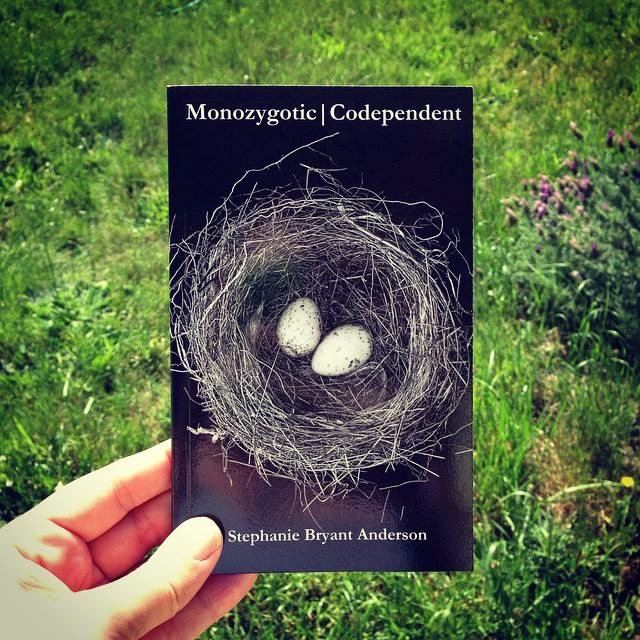
SATURDAY POETRY SERIES PRESENTS: MONOZYGOTIC | CODEPENDENT

monocofinal


From MONOZYGOTIC | CODEPENDENT
By Stephanie Bryant Anderson:


LONELINESS CAME INSIDE MY HOME, UNPACKED ITS
THINGS

I sat on the floor
in a blue room choking

on emotions, confessing
sadness to the cake falling

down my throat, wondering
how I have come to hate winter

when it snows
such beautiful white flowers.

But—

it’s the way I’ve neatly folded the laundry
over and over.

It’s the way fear visits me twice,
and courage once.

It’s the way I move alone at night
from the couch to the door

to the curtains,
back to the couch.

It’s how you catch me dreaming
and step over my body.


LIKE THE BLACK HOLE CARTOGRAPHER WHO WENT
HUNTING FOR WALNUTS

When the door closed this time, she knew it
       would be different. She saw his eyes—
emotionless ticks that had grown into the plural

patterns of empty walnut shells. Someone once
       star-mapped Aries the Ram, and generously
gave him horns. I am strong as an Ox

he reminded her as she stood to leave. Reminded
       her that she was the Year of the Rabbit with closed
curtains.

Safety over risk, she recalled looking at the door,
       but her body lied, it could not carry her there.
You cry too easily— he said, after the first hit

into her eye-bone crunched, sounding the way
       the nutcracker sounded when breaking open
walnuts. He stood over her

using the same angle God used to look down from.
       But, here, for her,
there was no longer a down—


ANXIETY WHILE CROSSING THE TENNESSEE-ARKANSAS
BRIDGE

Last November my sister got married.
My heart cropped, carried

for months in my handkerchief. At night
it would cry out from extinction.

This amputation being no small ache, I left
Tennessee, my heartbeat slow.

Memphis with her strange spell
filled my piano-ribs

with a slow blues loaded
with heavy bees and suicide ghosts.

The road tasted like salt. I drove until
I couldn’t see the shape of us,

until my heart could again beat
on its own.


Today’s poems are from Monozygotic | Codependent, published by The Blue Hour Press, copyright © 2015 by Stephanie Bryant Anderson, and appear here today with permission from the poet.


In Monozygotic | Codependent, Stephanie Bryant Anderson’s poems are concerned with splitting the self and uncovering the woman beneath the familial myths. Yet the essential paradox for Bryant Anderson: when the self has a twin—a ‘shadow,’ a ‘dark-haired mirror girl’—what then of the split? These poems ache; in the style of Southern gothic, these poems are ‘filled [with] piano ribs, a slow blues loaded with heavy bees and suicide ghosts.’ Bryant Anderson’s are poems of survival, built in fragile and beautiful shell casings, stanzas deceptively elegant and delicate, for what pinions each graceful couplet is a fierceness of spirit, a deep-seated desire for life, always life, even in the midst of pain and memory, ‘shaped as an open field plagued by black irises.’ I am broken and remade by these poems. —Jennifer Givhan, 2015 Winner National Endowment for the Arts fellowship


Stephanie Bryant Anderson is author of Monozygotic | Codependent (The Blue Hour Press 2015). Recent or forthcoming publications include Vinyl, burntdistrict, Rogue Agent and The Blueshift Journal. Besides poetry she enjoys kickboxing and math. Stephanie is founder of Red Paint Hill Publishing.


Editor’s Note: Monozygotic | Codependent opens with a quote from Sylvia Plath: “I do not know who I am, where I am going – and I am the one who has to decide the answers to these hideous questions.” And so Stephanie Bryant Anderson sets the stage for this brave, vulnerable collection. The journey the poet takes us on is deeply confessional, beginning in loneliness and ending in leaving, with panic, regret, abuse, anxiety, divorce, codependence, death, and God doggedly pursuing the I in-between. This is not the story of a light at the end of the tunnel; it is a story of survival. But there is so much beauty in the words, in their brutal honesty, in the intimacy of what is revealed, in the shared experience that arises when one speaks up about that which is too-seldom talked about. In this way, this book is Plathian, reflecting the intersection between lived suffering and staggering art.

Following the Plath quote, Monozygotic | Codependent welcomes us into its world with “Loneliness Came Inside My Home, Unpacked Its Things.” Here we sit on the floor. Here we are choking. Here we are eating our feelings. Here we are “wondering / how I have come to hate winter // when it snows / such beautiful white flowers.” A line so beautiful, it hurts to confront it. Like the idea of stepping over a woman dreaming.

From stepped over to stepped on, “Like the Black Hole Cartographer Who Went Hunting for Walnuts” takes us deep into the reality of a woman abused. She is not safe. She cannot leave. She is looked down on by man and God alike, only “here, for her, / there [is] no longer a down.”

In “Anxiety While Crossing the Tennessee-Arkansas Bridge” we encounter one of the major themes of the book: twin-ness. What it means to be a twin, to have been born into that level of codependence and to have to survive that conjunction into the individuality of adulthood. The result is a heart that must be “cropped, carried,” that has to learn to beat again on its own.


Want to see more from Stephanie Bryant Anderson?
Stephanie Bryant Anderson’s Website
Buy Monozygotic | Codependent from The Blue Hill Press
Follow Stephanie Bryant Anderson on Twitter

SATURDAY POETRY SERIES PRESENTS: SARA JUNE WOODS

FullSizeRender (1)
& SOMEWHERE THE SUN
By Sara June Woods

Somewhere there is a clearing
in a forest where the world is
not a lonely place.

Somewhere there is a mountain
I have written on in forest fires
that says I am sorry I am not

the one you were looking for.
I wanted to be so badly.
But I am just this one person.

& it says all this
spiraling across
below the tree line.

& somewhere the sun
looks the same coming up
as it does going down.


Today’s poem was previously published in jellyfish magazine and appears here today with permission from the poet.


Sara June Woods is author of three books, Sara or the Existence of Fire (Horse Less Press, 2014), Wolf Doctors (Artifice Books, 2014) and the forthcoming Careful Mountain (Civil Coping Mechanisms, 2016). Her poetry is published widely in journals such as Guernica, Columbia Poetry Review, Diagram, Gulf Coast, Denver Quarterly and Salt Hill. She is a trans woman and a Scorpio and she lives in Portland, OR with her girlfriend she is married to.

Editor’s Note: What do you do when a poem is heartbreaking? When its simple, honest revelations break your heart? When its line breaks break you? What do you do with a poem that devastates you with its simple, brutal truth? With a poem that’s so good, it hurts to read it? Why, you share it, of course. Here, you say to the world. You’re welcome.

Want more from Sara June Woods?
Healthy Dog Poem – Writing by Sara June Woods
P(r)o(bl)em – saramountain tumblr

SATURDAY POETRY SERIES PRESENTS: PATTY PAINE

10259779_10152027363561933_7567284404520260511_n copy

ANTIPHONY
By Patty Paine

Go back to that stream, touch
your lips to the cold, clear quivering,
draw into yourself a time when it was simple
as this to be quenched, to draw in what was
needed. Walk back over the dewed grass
of your past, past the water tower you filled
with dark imaginings, feel
the air crisp & clean on your skin, call
this hope, and carry it
to these moments when a photograph
can send you spiraling, your husband
now six months gone, waiting at the bottom
of an escalator in some airport
or another, everyone hurrying to be somewhere
else, except for this one man, waiting
for you to descend. How a face can be
indelible, yet fade so quickly, is an alchemy
best left unknowable. Hold that sting
of hope, and call out
the name of one who ministered
to you, over & over, until from the dark
you hear your own name return
to you, wild, and rising and clear.


Today’s poem originally appeared in Thrush and appears here today with permission from the poet.


Patty Paine is the author of Grief & Other Animals (Accents Publishing), The Sounding Machine (Accents Publishing), Feral (Imaginary Friend Press), Elegy & Collapse (Finishing Line Press), and co-editor of Gathering the Tide: An Anthology of Contemporary Arabian Gulf Poetry (Garnet Publishing & Ithaca Press) and The Donkey Lady and Other Tales from the Gulf (Berkshire Academic Press). Her poems, reviews, and interviews have appeared in Blackbird, Verse Daily, The Atlanta Review, Gulf Stream, The Journal and many other publications. She is the founding editor of diode poetry journal and Diode Editions. She is an Assistant Professor of English at Virginia Commonwealth University in Qatar where she teaches writing and literature, and is Interim Director of Liberal Arts & Sciences.

Editor’s Note: Today’s poem is one I encourage you to read over and over. For each reading is like opening the next layer of a Russian doll, and there is always more waiting to be discovered within. While one reading simply does not do the poem justice, you honor yourself, dear reader, each time you slip deeper into these words.

Start in media res. Start in motion. Begin not at the beginning, but by turning back. The world of the poem is visceral. Go on, touch the stream, feel the “cold, clear quivering.” Go deeper now. “[D]raw into yourself a time when it was simple / as this to be quenched, to draw in what was / needed.” Move backwards; a poem—a life—in rewind. Let the story unfold in this way—cinematic, emotive, devastating. Let the reverse motion be what propels you forward. You are Lot’s Wife. You are Orpheus. There is only looking back, but looking back leaves you alone in the dark, “hear[ing] your own name return / to you, wild, and rising and clear.”

What a fraught landscape, yes, but what a gift to have been taken on such a journey by such a guide.

Want more from Patty Paine?
Buy The Sounding Machine from Amazon
Buy Feral from Imaginary Friend Press
diode poetry journal
Diode Editions
Interview on The Best American Poetry blog

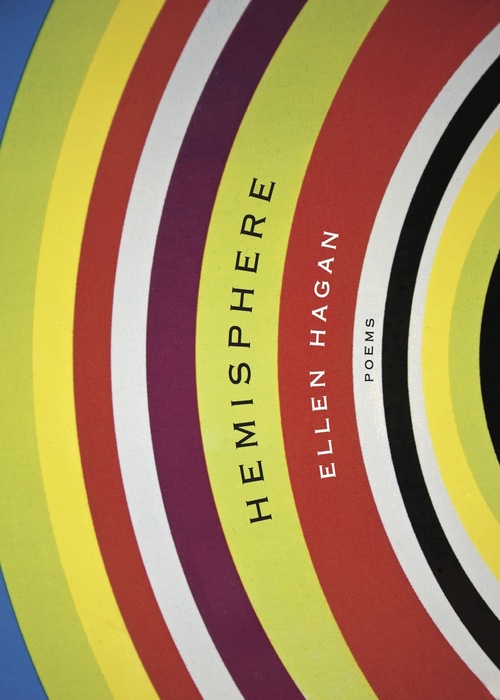
SATURDAY POETRY SERIES PRESENTS: HEMISPHERE

hemisphere


From HEMISPHERE
By Ellen Hagan:


RIVER. WOMAN.

I.
Downriver is always long
& always flailing, finding

where our lives begin,
intersect?  You, your bones

the humped slope of nose
browned skin of home.

You, sand. You, ocean.
You, bending & me.

How many nights we sleep
alone, our bodies rising—

what it means to miss you.
What it means to expand.
What it means to be birthed.
What it means to be sacred.
What it means to go home.

Place of birth, birthing
ground. Ground that is sacred.
You that is sacred.

Bones that hold together.  Bind.
Bound to you.  My mother.

II.
Me
I am bound to you.  My mother.
You stitch me from inside.  Hollowed.
your split sheath of self, your letters
the slow cursive of your language,
can’t I hear your voice, always?

Her
Lock the doors.  Latch the locks.
Shut the windows.  Close the blinds.
Cover up.  Clean your room.  Do
the dishes.  Wash the clothes.  Behind
your ears, yourself.  Clean the floor.  
Scrub.  Mop the remains every day
is one that you can use to erase all
the mistakes.  Blemish free.
Shine the doorknobs, pine, every
crease of space.  Cabinets.  Don’t leave
food out.  Food brings mice.  Mice
bring disease.  You will die.  You could 
die.  Don’t die.  Don’t ever die.  You 
stitch me from inside.  I am bound
to you.  Can’t you always hear
my voice?


LESSONS ON SPELLING

Bring the snakes in their skins, sly
& surrender. Simple bodies of grass
& clover, their slithering and sleuth-ness.
& the earth & the dusty fisherman
in from their boats, bobbing. Bring
piano, bring pain. That yellow skirt
pocked w/ fuchsia & the halter
of your mother’s pixie 60’s ways.
Let out the hems from your dresses,
the vertebrae in your back, body
forget skeleton—be loose, let it be dirty.
Get there. Call the black cat promenade,
lazy through the streets. Let your hair
down. Let it crawl, crowd the length
of your back. Bring soca & fiddle,
that record player your father bought
your mother in 1974. Bring all the days
from 1974 & on because time is a revolver.
A bag of limes on your back porch
squeezed & bitter & neon & orbiting
over you. Is your neighbor calling.
Is satsumas bursting on your tongue.
Bring your shiny shoes & arched soles
for the flapping pageant of second line
parade, the 100 parades from now until.
Autumnal. Hymns. Prayers.
Ways to say yes. Bring with you
your rope of hide, your many rings
of muscle & the washcloth
for your stomach, your feet
for the laying nape of your neck.
Bring danger & ways to hold your lips,
your lips, bring them too.
Spanning the whole of you.
You become.


WATER SIGN

Already a lullaby inside.
Your palms to belly, breath
on hip.  You are changing,
beginning. Too.  And you,
baby girl, or boy. Or two.
Are just gills. Still. Heart in
mouth. Red burst of newness.
Fins.  Fish or fowl. Shrimp
are larger than you.

Still, you are breaking me
apart. Him too. Our hearts
and lungs, and gills. Bursting 
You are stretching all,
all of us. Open.


Today’s poems are from Hemisphere, published by TriQuarterly Press/Northwestern University Press, copyright © 2015 by Ellen Hagan, and appear here today with permission from the poet.


Hemisphere: The poems in Hemisphere explore what it means to be a daughter and what it means to bear new life. Ellen Hagan investigates the world historical hemispheres of a family legacy from around the globe and moves down to the most intimate hemisphere of impending motherhood. Her poems reclaim the female body from the violence, both literal and literary, done to it over the years. Hagan acknowledges the changing body of a mother from the strains of birth from the growing body of a child, to the scars left most visibly by a C-section €”as well as the changes wrought by age and, too often, abuse. The existence of a hemisphere implies a part seeking a whole, and as a collection, Hemisphere is a coherent and cogent journey toward reclamation and wholeness. —TriQuarterly Press/Northwestern University Press


Ellen Hagan is a writer, performer, and educator. Her latest collection of poetry, Hemisphere, was released by Northwestern University Press in Spring 2015. Ellen’s poems and essays can be found in the pages of Creative Nonfiction, Underwired Magazine, She Walks in Beauty (edited by Caroline Kennedy), Huizache, Small Batch, and Southern Sin. Her first collection of poetry, Crowned, was published by Sawyer House Press in 2010. Ellen’s performance work has been showcased at The New York International Fringe and Los Angeles Women’s Theater Festival. She is the recipient of the 2013 NoMAA Creative Arts Grant and received grants from the Kentucky Foundation for Women and the Kentucky Governor’s School for the Arts. National arts residencies include The Hopscotch House and Louisiana Arts Works. Ellen recently joined the po­etry faculty at West Virginia Wesleyan in their low-residency MFA program. She teaches Memoir, Poetry & Nature, and co-leads the Alice Hoffman Young Writer’s Retreat at Adelphi University. She is Poetry Chair of the DreamYard Project and a regular guest artist at the Kentucky Governor’s School for the Arts.


Editor’s Note: I fell in love with the poems in Ellen Hagan’s Hemisphere for their language: earthy, sensual, gritty. Unafraid of blood and birth, of mud and heat, of nature, of relationship, of what is real and lush and vivid, of what is primal and complex. I am reminded of the swamp, of the first creatures that dragged themselves forth from the murky depths, crawling forward, always, evolving for the sake of life. I am reminded, also, of witchcraft, of alchemy, of drawing down the moon. Of things my mother taught me, of that which has been handed down from woman to woman through the ages.

Today’s poems were meant to be, here, today. Because they are about the twin experience of birth—both as child and mother. Because much of this book is about the relationship between mother and daughter, the circle of life as only mother and daughter experience it: “where our lives begin, / intersect;” “what it means to miss you. / What it means to expand. / What it means to be birthed. / What it means to be sacred. / What it means to go home.”

In honor of Mother’s Day, and of the magic that grows from the rich soil of today’s poems, today’s feature is dedicated to my mother, the water sign, from your daughter, the water sign. “You that is sacred… I am bound to you. My mother.”


Want to see more from Ellen Hagan?
Ellen Hagan’s Official Website
Ellen Hagan’s Blog
Duende
Drunken Boat
Buy Hemisphere from Indie Bound

SATURDAY POETRY SERIES PRESENTS: ELIZABETH LANGEMAK

LangemakPhoto

By Elizabeth Langemak:

A PHOTOGRAPH OF HER SHOWERING

                                          As passionless, burned-out, dusty shells, we dislike love poems . . . As [one of our editors] says, why not “text me a photograph of her showering”?

I am enclosing, as text, the photo
you ask for. Though my husband

refuses, I make this in secret
and print it black over white. Though

the angles and lighting are tough
to nail down, and the process

makes my whole body a long face
for tears as the spray breaks over

my scalp and rolls down.
Though my right hand withers,

as I rake damp hair into rows.
Though the cheap curtain cleaves

to my thigh, I peel it off like a rind
teased from its fruit in one strip.

You thought I was dusty, a shell.
You said I was burned out,

but now my skin is slapping and slick,
the camera demanding more arch

and frontal. When I read your note
I was spitting with anger. I could

not get your eyes off my nipples,
my breasts, but now I make you

this square handful of edges,
a black-and-white chip where my ass

hangs over tan lines like a sun
without set, where stretch marks

like fault lines ride over each thigh
and a pocked scar stabs into my shoulder.

Once I knew men like you and tried
to be sexy but in the shower

I only got soaked. On the bed
where I practiced I only looked

posed. In cabins on nights with your jars
full of scotch I hoped you might

see past what you saw and fuck me,
but now it seems we have both changed

our minds. Here I am. In a poem,
just breath-long, I am perfect.

I send you this picture because
a photo of showering is just wet

and sex, but the poem lays down
its camera and hands me a towel,

knows the route I send it
over my calves, over my nape

and around. How many
flashes and clicks turn a love poem

around into only a woman to
fuck you? Fuck you.

Today’s poem was originally published in AGNI and appears here today with permission from the poet.

Elizabeth Langemak lives in Philadelphia, Pennsylvania.

Editor’s Note: Today’s poem is one of resistance. In response to the editors who called love poems “burned-out, dusty shells” and said, why not “text me a photograph of her showering,” Elizabeth Langemak speaks out against the objectification of women’s bodies and the misogyny rearing its ugly head in a still-patriarchal society. Frankly feminist, exquisitely lyric, and commendably unabashed, today’s poet answers the question “Why not text me a photograph of her showering?” with the only response needed: “Fuck you.”

Want more from Elizabeth Langemak?
Elizabeth Langemak’s Official Website

SATURDAY POETRY SERIES PRESENTS: RICHARD D’ABATE

photo (5)

By Richard D’Abate:


THE SADNESS OF YOUNG MOTHERS

Because we’re at the beach today our sadness
knows itself,

Between the sinking sand and slowly measured
falling waves.

Not long ago time was arrow-tipped and
ravenous.

It found its mark before the god of love had
even stirred.

It filled our bones to bursting, era of the second
self begun.

Now every gesture mirrors gestures of a
smaller one.

They raise their arms, we raise our arms, they wobble
toward the sea

Like turtle hatchlings, thoughtless prey, and
so do we.

We match the steps of half-formed beings—
tender, new—

Ourselves, our future selves, alive but always
cut in two.

We are afraid. The burning sun devours
little bones.

Their little mouths will gulp the tangled weed, the
sliding foam.

We run, we start to run, but time has a thickness
all its own,

And half of half of half is motion’s rule or
none at all,

As when the cresting tops of glittering breakers
do not fall,

Or when in dreams we hear, but do not hear, our
children call.


Today’s poem was originally published by AGNI and appears here today with permission from the poet.


Richard D’Abate is the author of a poetry collection, To Keep the House From Falling In (Ithaca House Press), as well as stories and poems in Epoch, Apple and other magazines. His most recent work appears in Agni Online. A native of New York City, his professional life has been focused in Maine: as a professor of English literature, an advocate for the public humanities, and director of the Maine Historical Society, a statewide cultural agency and research center. His scholarly essays have appeared in various publications, including American Beginnings (University of Nebraska Press), on New World exploration, encounter, and cartography. He now lives and writes in Wells, Maine.

Editor’s Note: As a reader and a card-carrying feminist, I was as taken aback by today’s poem for its stunning lyric as I was by the (male) poet’s ability to capture the way mothers worry for their children. (Fathers do as well, of course, but today’s poem is about the experience of young mothers, specifically.) How audacious to take on this persona! And how effortlessly and accurately the poet has captured this unique viewpoint that is not his own. Haters gonna hate, and there are those who feel that a male writing from a female perspective is a patriarchal act of establishing dominion over a realm that is not theirs to control. But the other half of that debate is that of being empathetic, of trying to understand the other from within the other’s shoes, of being sensitive to those from outside our own gender, and Richard D’Abate has done this with today’s honest and heartbreaking work.

The poet has given breathtaking form to the parental experience, naming it the “era of the second self,” calling children “our future selves,” who, through a mother’s eyes, are “alive but always / cut in two.” Even more palpable is the mother’s fear for her children: “they wobble / toward the sea // Like turtle hatchlings, thoughtless prey, and / so do we,” “We are afraid. The burning sun devours / little bones. // Their little mouths will gulp the tangled weed, the / sliding foam. // We run, we start to run, but time has a thickness / all its own … [as] when in dreams we hear, but do not hear, our / children call.” By the skilled hand of the poet the fear and helplessness mothers feel for their children is brought to life through a vivid imagery and lyric beauty so chilling we feel it as if it were our own.

Want more from Richard D’Abate?
Buy To Keep the House from Falling In on Amazon
The Richard D’Abate Lectures: Conversations About History, Art, and Literature
Maine Historical Society: Richard D’Abate Endowment Fund for Scholarship & Special Programs

SATURDAY POETRY SERIES PRESENTS: ELANA BELL

authorphoto.2

By Elana Bell:


ELEGY FOR A MOTHER, STILL LIVING

         The Lord gives everything and charges by taking it back. —Jack Gilbert

I was formed inside the body
of a woman who wanted me
as she wanted her own life,
allowed to drink the milk
made only for me.
I was given mother-love,
its bounty and its cocoon
of those first years without language.
It is right to mourn the rocky hills
of Crete where we walked, my small
hand in hers for hours. The hidden
beach where we swam naked
then baked on the fine sand. Lazy
afternoons in her lap, thick
hand stroking my curls.
Her fingers have stiffened.
In her eyes, the eyes of an animal in pain.
I hold the memory of my mother
against the woman she is.


Today’s poem was originally published by AGNI and appears here today with permission from the poet.


Elana Bell’s first collection of poetry, Eyes, Stones (LSU Press 2012) was selected by Fanny Howe as the winner of the Walt Whitman Award from the Academy of American Poets. She is the recipient of grants and fellowships from the Jerome Foundation, the Edward Albee Foundation, and the Brooklyn Arts Council. Her work has recently appeared in AGNI, Harvard Review, and the Massachusetts Review. Elana leads creative writing workshops for women in prison, for educators, for high school students in Israel-Palestine and throughout the five boroughs of New York City, as well as for the pioneering peace building and leadership organization, Seeds of Peace. She was a recent finalist for Split This Rock’s inaugural Freedom Plow Award for Poetry & Activism, an award which recognizes and honors a poet who is doing innovative and transformative work at the intersection of poetry and social change. Elana also teaches literature and creative writing at CUNY College of Staten Island and curates public art installations with Poets in Unexpected Places.

Editor’s Note: If I have learned anything from reading Li-Young Lee and Ocean Vuong, it is that great poetry changes the reader. Whenever I read Elana Bell, I am deeply moved in the moment. Many poems do this, and many make it into the pages of this series. But today’s poet has always moved me far beyond the moment of reading. Her words stay with me. Weeks, months, years later, her poems are still a part of me, as if they are my own memories. Once I have read an Elana Bell poem, I have been forever changed.

I first heard the poet read “Elegy for a Mother, Still Living” at NYC’s Bluestockings nearly four years ago, and the poem has never left me. A year later, I wrote “Elegy for the Still Living: Father Cannot Stand Still”, a mourning poem for my father’s illness, named in homage to today’s poem. Years have passed. My father has passed. No elegy I write for him will ever again be “for the still living.” But “Elegy for a Mother, Still Living” remains with me, a memory of a different time, a different kind of mourning.

When I came across today’s poem in AGNI, it was like coming across an old photograph. A commemoration of my own past. A memory like an artifact, layer upon layer of personal significance buried between the lines of someone else’s words, someone else’s experience, someone else’s life. And yet, by the gifted hand of the poet, someone else’s experience has become my own. I am reminded of a line from the musical Wicked: “Who can say if I’ve been changed for the better? (I do believe I have been changed for the better.) But, because I knew you, I have been changed for good.”

Want more from Elana Bell?
Elana Bells’ Official Website
Academy of American Poets
P.O.P. (Poets on Poetry) Shot and edited by poet and photographer Rachel Eliza Griffiths, P.O.P is a video series featuring contemporary American poets who read both an original poem and a poem by another poet, after which they reflect on their choice.
Poets in Unexpected Places
Buy Eyes, Stones
Reading on PBS