SATURDAY POETRY SERIES PRESENTS: ABRIANA JETTÉ


abeheadshotphtocredchrisjette


LIES OUR MOTHER TOLD US
By Abriana Jetté


I do not believe in the story of the virgin
but in the value of the human: the body —

because no matter what you were told
that soul is not yours. But the body,

the body is yours. The slight round
of the breast like the sun or the depth of your

toes to your crown: these are the ways
we measure ourselves. I do not want to

believe she was a vehicle. Tell me
there was pleasure; there were moans.

Tell me when she was fully grown
she remembered a wave a release an ecstasy

that entered her, that she could feel it in her
teeth. Motherhood means you are no longer

maiden but Queen. Tell me the story of the one
who smiled at the rustling of her sheets.


Today’s poem was published in the The Journal for Compressed Creative Arts, Spring 2015, and appears here today with permission from the poet.


Abriana Jetté: Born and raised in Brooklyn, New York Abriana Jetté is an internationally published poet and essayist and educator. Her anthology 50 Whispers: Poems by Extraordinary Women debuted as a #1 best seller on Amazon, and her work has appeared or is forthcoming in The Seneca Review, River Teeth, Barrelhouse, The Moth, and many other places. She teaches for St. John’s University, for the College of Staten Island, and for the nonprofit organization Sponsors for Educational Opportunity.

Editor’s Note: And then there was the poet who reimagined the Virgin Mary. Not as virgin, but as human, as woman, capable of “a wave a release an ecstasy // that entered her, that she could feel it in her / teeth.” Advocating for agency, the poet insisted, “I do not want to // believe she was a vehicle.” Reverent of the woman’s transformation, she taught us that “Motherhood means you are no longer // maiden but Queen.” And we saw her as the poet saw her. And it was good.

Want to see more from Abriana Jetté?
Hermeneutic Chaos Journal
Truthdig
Abriana Jetté’s Official Website
Stay Thirsty Publishing
Barrelhouse Mag

SATURDAY POETRY SERIES PRESENTS: THE BOOK OF ESTHER BY STACEY ZISOOK ROBINSON

me

By popular demand, in celebration of Purim we are re-featuring this stellar poem by Stacey Zisook Robinson, in conversation with your faithful editor at the crossroads of feminism and midrash.

By Stacey Zisook Robinson:


THE BOOK OF ESTHER

That blush on my cheek?
It’s paint,
And I have glittered my eyes
And robed myself in the finery
of silk and gossamer,
lapis and gold–
And whored myself for your salvation.

You asked for no thoughts.
You merely offered my body
to the king–
My life forfeit
If my beauty failed.

You asked for no ideas
And I gave you none,
Though I had a thousand,
And ten thousand more.

Diplomacy was played on the field of my body,
The battle won in the curve of my hip
And the satin of my skin,
Fevered dreams of lust
And redemption.

That blush on my cheeks?
It is the stain of victory
And of my shame.


Today’s poem was originally published on Stumbling Towards Meaning and appears here today with permission from the poet.


Stacey Zisook Robinson is a single mom. She sings whenever she can. She writes, even when she can’t. She worked in Corporate America for a long time. Now she works at her writing and looks for God and grace, meaning, connection, and a perfect cup of coffee, not necessarily in that order. Stacey has been published in the Summer 2013 issue of Lilith Magazine and in several anthologies including The Hope (Menachem Creditor, ed) and In Transit (BorderTown Press, Daniel MacFadyen, ed). Watch for her book, Dancing in the Palm of God’s Hand, forthcoming from Hadasah Word Press. Stacey has recently launched a Poet in Residence program designed to work with both adults and kids in a Jewish setting to explore the connection between poetry and prayer as a way to build a bridge to a deepened Jewish identity and faith.

Editor’s Note: This week we celebrated Purim, a Jewish holiday that commemorates Queen Esther (5th c. B.C.E.) saving Persian Jews from genocide. Esther’s rise to power, however, was problematic. Her predecessor, Queen Vashti, was summoned to appear in her crown, ordered to display her beauty before the king and his nobles. The implication, according to many scholars, is that Queen Vashti was ordered to appear wearing only her crown. She refused, and it was suggested that she should be de-throned and replaced by a “worthier woman” so that “all wives [would] henceforth bow to the authority of their husbands, high and low alike” (Esther 1:19-20).

And there’s your daily dose of female oppression, Bible style.

"Vashti Refuses the King's Summons" by Edwin Long (1879). Public Domain image.
“Vashti Refuses the King’s Summons” by Edwin Long (1879). Public Domain image.


A search began for beautiful young virgins. Those who made the cut were subjected to twelve months of beauty treatments before the king would even deign to lay eyes on them. The hopefuls then appeared before the king, who did not see any of them ever again “unless he was particularly pleased by her” (Esther 2:12-14). King Xerxes liked Esther best of all the young virgins displayed before him, and crowned her queen in Vashti’s stead. Plot twist: the king did not know that Esther was Jewish, for she had deliberately kept that fact from him. In the end Esther was able to use her beauty to bend the king to her will, and when one of his henchmen sought to have all the Jews in the kingdom annihilated, Esther stood up for her people and they were spared.

While it is this end-result that is remembered and celebrated each year at Purim, it is Esther’s degrading rise to the throne—and what it cost her to to save her people—that is the subject of today’s poem.

To come to power, Esther had to take the rightful queen’s place and become the poster child for the idea that “all wives [should] bow to the authority of their husbands.” To catch the king’s eye she had to strip away her personhood until nothing was left but her physical beauty. “That blush on my cheek? / It’s paint, / And I have glittered my eyes / And robed myself in the finery / of silk and gossamer, / lapis and gold.” It was not her devotion to her people that allowed her to save them, but that she “whored [her]self for [their] salvation.” Nor did her people care who she was beneath her beauty, or whether she survived her attempt to save them: “You asked for no thoughts. / You merely offered my body / to the king– / My life forfeit / If my beauty failed.”

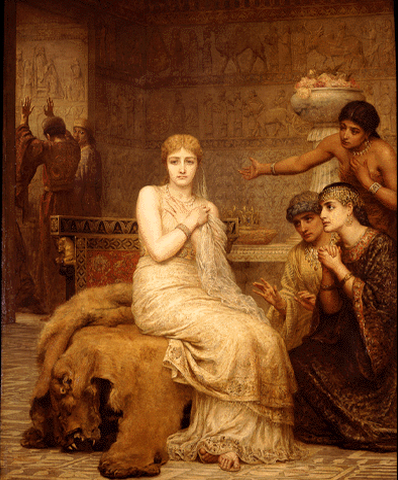
"Queen Esther" by Edwin Long (1878). Public Domain image.
“Queen Esther” by Edwin Long (1878). Public Domain image.


Queen Esther was a pawn in men’s games, as women of history have too often been. “Diplomacy was played on the field of my body, / The battle won in the curve of my hip.” She used her beauty and her sexual allure because, as a woman of her time and place, they were the only instruments of power available to her. But if she were given a voice, she might speak of inner conflict. She might tell us what it feels like to lack the ability to either refuse or consent. Queen Esther was a hero, but what did it cost her to package and sell herself in the name of the greater good? “That blush on my cheeks? / It is the stain of victory / And of my shame.”

Today’s poem does what all great feminist biblical interpretation and midrashot do: it examines, deconstructs, and reconstructs androcentric assumptions, biases, and perspectives in biblical literature, placing women, gender, and sexuality at the center of reinterpretation.

In a time when the Bible is still being used to justify the oppression of women, we need much more of the important work Stacey Zisook Robinson is doing with “The Book of Esther.”

Want more from Stacey Zisook Robinson?
Stacey Zisook Robinson’s Blog
Stacey Zisook Robinson’s Official Website
Personal Essays and Opinion Pieces on iPinion
ReformJudaism.org

SATURDAY POETRY SERIES PRESENTS: DECENCY


Decency


From DECENCY
By Marcela Sulak:


selections from SOLIDARITY

vi. Virginity

It’s not that you get tired, it’s that it starts to be the only thing,
starts to disappear you.

Your parents phone you at college to ask: how is your virginity
doing? Did your virginity have a good day?

What does it want to be when it grows up? Your virginity sounds
a little sad this morning. What kind of cake does your virginity want

for its birthday? your girlfriends saw the most amazing shoes
that your virginity would look terrific in!

Want to go shopping? your boyfriends—would your virginity like to see
a movie? What about dinner?


ix. witches

My daughter is named for my grandmother, a midwife
who attended the births of 90 babies in rural Texas

before they had cars and after they finished having witches
but before there were doctors. Now you may understand

what I mean when I say another woman
gave my daughter a book called “The witches and the rabbi”

for her birthday. Here is the plot: a village is terrorized by a plague
of witches who fly from their cave when the moon is full,

on brooms through the sky except when it’s raining. I’m not sure
what the witches actually do to the village, since no one

actually goes outside on those nights. Gary, Indiana, could use
an infestation of witches—no stabbings

or gunshot wounds on evenings of full moons.
But one full moon when it is raining the rabbi shows up

with twenty townsmen. The witches
are so delighted they make them a feast of all the good things

they have. The rabbi tricks them into dancing with him and
the vigilante men, out into the rain,

which kills them. I knew her father’s mother was secretly
glad when I started to hemorrhage. She didn’t want me

to have a homebirth with a midwife.
“What kind of rabbis are these?”

Says my rabbi, stopped by for a quick hello. My daughter
wanted to show him that we had a book about rabbis. “They’re

engaging the poor witches
in mixed dancing and leading them astray,” he says.

This is the broom which sweeps the sky of the stars you have
to be too drunk to write about, as Daisy put it.

This is the housework the princesses do disguised
as village maidens. These are the constellations that form

in the shadow of the stars.
Silent are the women in the village

who took their cloth packets of herbs and were silent
when their husbands rushed off to kill the witches in that story.


CHOCOLATE

The day I won the custody case my lawyer gave me a bitter chocolate
in black and silver paper. Once I saw cacao pods
drying in a Venezuelan village square

during Easter week; through the open church doors, peeling saints sniffed
        and were carried
like colicky children through night streets. The local hot chocolate
was thickened with cornmeal and canella bark

somebody tore from the trees. To reach that village we found a fisherman,
        plowed
through rows of porpoises, then hiked five kilometers
inland through banana and cocoa trees,

which like shade. Once only men could drink
chocolate. Women were permitted cacao beans as currency,
to buy meat or slaves or pay tribute. It feels good to imagine a single seed,

hidden in the forbidden mouth, the tongue
curled, gathering the strength to push. The Aztec king discarded
each gold-hammered cup after its initial use; his chocolate was red as fresh
        blood.

He was a god to them. It was frothy,
poured from great heights. When we bathed in the village river, girls
gathered around me, whispering, why is your skin so pale? Why is your
        hair so straight?

Can we braid it? Dime, eres blanca?
The judge, our lawyers, her father, and I decided the fate
of my child. The dark liquid we poured was ink, initialing our little
        negotiations.

Who can know the heart of another, the blood
spiced with memory, poured from one generation to the next
over great distances? The Mayan word for chocolate means bitter. The
        village

used to be a plantation; now it is a co-operative, owned by descendants
of the former slaves. At Easter Vigil the women lined up
behind the most beautiful, in a long sky

-blue dress adorned with gold stars. Between the decades of the rosary she
        called out,
while we shuffled our feet in merengue beat, bearing the saints
through the streets, someone shot off a Roman

candle. The men’s procession paused for rum. I know I’ll be paying for it
        the rest
of my life. The Mayan word means bitter water. The cacao
tree was uprooted from paradise.


HOW TO USE A NAPKIN

Understand the napkin
has been unnecessary
for most of human history.

Understand the world is filled with people
eager to bend
things to their will.
We shall practice on the napkin.
When you have finished eating
place your napkin loosely
next to your plate
.

It should not be crumpled or twisted,
which would reveal untidiness or nervousness;
nor should it be folded,

which might be seen as an implication
that you think your hosts
might reuse it without washing
.
.
It is a delicate affair.
Don’t argue with me
said my husband

who had called for my advice
about the apartment he was renting
when he didn’t want to live with me.

It is largely
symbolic today
except for barbecues.
Lightly dab the lips.

I suspect the word
argue is the space
in the mouth for things
to come apart in.

The napkin must not be left
on the chair, it might seem
as if you have an inappropriately

dirty napkin to hide
or even that you are trying
to run off with the table linens.

It takes great trust
to use a napkin.
It takes an act
of faith to leave
the table.


Today’s poems are from Decency (Black Lawrence Press, 2015), copyright © 2015 by Marcela Sulak, and appear here today with permission from the poet.


Decency: Poetry. Jewish Studies. Women’s Studies. Decency celebrates the spunky wenches, the unfortunate queens, the complicated translators, the wistful wives who have been hustled off the spotlit stages of history. Through the lens of Victorian manuals of etiquette, through the unfolding of religion from the Middle East to the American Southwest, Decency thinks through the brutal things we do to one another, recording the ways the individual operates in relation to society’s mores and harms. From the Sumerian queen Puabi to contemporary female recruits to the Israeli intelligence’s “Honeytrap” operation, Decency is a mix of the documentary and the lyrical, the wrathful and the joyful.


Marcela Sulak‘s poetry collections include Decency (2015) and Immigrant (2010), both with Black Lawrence Press. She’s translated four collections of poetry from the Czech and French, and, most recently, the Hebrew: Orit Gidali’s Selected Poems: Twenty Girls to Envy Me (University of Texas Press, July 2016). She’s co-edited the 2015 Rose Metal Press title Family Resemblance: An Anthology and Exploration of 8 Hybrid Literary Genres. Sulak directs the Shaindy Rudoff Graduate Program in Creative Writing at Bar-Ilan University. ​​


Editor’s Note: If there is a question driving the poems in Marcela Sulak’s sophomore collection, it is a question of the ways in which we are and are not decent to one another. As individuals and as countries. As intimates and strangers. Both within and across the (real or artificial) divides of race, creed, culture, and nationality. Sulak pursues the answers to this question with the keen eye of an academic and a researcher, then relays her observations and discoveries with the skilled and deliberate abandon of an artist. These questions of decency are considered and depicted through the lenses of history, relationship, and etiquette. The result is a brave yet dainty collection. A powerful yet vulnerable collage. A work that charms the reader with its quaintness so that its harsh truths and difficult revelations go down like chocolate–bitter yet sweet, delicate yet bold.

Among the many long poems in this collection is one that stopped me in my tracks when I heard the poet read it aloud at the book’s New York launch last year. “Solidarity” is a stunning inquiry into rape–its ramifications and its afterlife and the endless experiences that collide with sexual violence in concentric circles. Today, for example, are Sulak’s reflections on misogyny and witch hunts, virginity and agency. Of virginity she writes, “It’s not that you get tired, it’s that it starts to be the only thing, / starts to disappear you.” Determined that her daughter know the truth about the history of hysteria, misogyny, and women healers, she considers witches through the skewed twin lenses of history and scaremongering: “Silent are the women in the village // who took their cloth packets of herbs and were silent / when their husbands rushed off to kill the witches in that story.” If I could have, I would have reprinted this long poem in its entirety. But then, you really ought to buy the book so that you can read this breathtaking work for yourself.

Throughout this masterful collection the poet’s own experiences are coupled with the larger lenses of the book–history and etiquette, for example–so that what is gleaned by the reader is at once deeply personal and delightfully educational. “The day I won the custody case my lawyer gave me a bitter chocolate,” Sulak writes of her unique experience, then later, in the same poem, writes of the history of chocolate: “Once only men could drink / chocolate. Women were permitted cacao beans as currency, / to buy meat or slaves or pay tribute.” Yet these ideas are not disparate; they are finely woven together by the poet’s skilled hand. The genius of this interrelation is beautifully evidenced by moments like this, in a poem that appears to be about the history of the napkin, but is equally about the poet’s leaving her husband: “It takes great trust / to use a napkin. / It takes an act / of faith to leave / the table.” The art of the poem–like the collection that houses it–is enriched beyond experience and information by a powerful lyric: “It feels good to imagine a single seed, // hidden in the forbidden mouth, the tongue / curled, gathering the strength to push.”


Want to see more from Marcela Sulak?
Marcela Sulak Official Website
“Jerusalem” in the Cortland Review
Decency” and “Raspberry” in Haaretz
Buy Decency from Black Lawrence Press, Book Depository, or Amazon

SATURDAY POETRY SERIES PRESENTS: KEETJE KUIPERS

30_DSC5432

GETTING THE BABY TO SLEEP
By Keetje Kuipers


Sometimes the baby can’t reconcile
the self with the self: too hungry
to eat, too tired to sleep. I know

the feeling. O, America, on those nights
when you are too beautiful for me
to continue to forgive you any longer—

for allowing us to kill each other
with your graceless bullets, or exile
our neighbors across your fictitious

border, or argue over the ownership
of each young girl’s body as if its freedom
is a lie she must stop telling herself—

I go out into your radiant embrace.
The baby and I drive through your streets,
over the bridge and its light-chipped

waters, under a moon so big, so full
of itself that though I know it belongs
to the world, it can’t be anything but

American. I hang my arm out the window
and skim the air like touching skin.
I breathe you in, and the baby sleeps.


Today’s poem was originally published in Blackbird and appears here today with permission from the poet.


Keetje Kuipers has been the Margery Davis Boyden Wilderness Writing Resident, a Stegner Fellow at Stanford, and the Emerging Writer Lecturer at Gettysburg College. A recipient of the Pushcart Prize, her poems, essays, and fiction have appeared in numerous magazines and anthologies, including Best American Poetry. Her first book of poetry, Beautiful in the Mouth, won the 2009 A. Poulin, Jr. Poetry Prize and was published by BOA Editions. Her second collection, The Keys to the Jail, was published by BOA in 2014. Keetje is an Assistant Professor at Auburn University where she is Editor of Southern Humanities Review.

Editor’s Note: Today’s poem absolutely blows me away. It is too powerful to contain, and yet it is perfectly wrought as if chiseled from marble. It is metaphor and life, politic and country, as near as a closely-held infant and as far as the moon. It is the American affliction: needless gun violence, our backs turned and hearts hardened against immigrants and refugees, our deep seated fear of women’s sexuality, freedom, independence. “O, America, on those nights… you are too beautiful for me / to continue to forgive you any longer.” Absolutely stunning. Heartbreaking. An outcry in the form of a quiet, contemplative drive, cruising America in an attempt to get the baby to sleep.

Want more from Keetje Kuipers?
www.keetjekuipers.com

SATURDAY POETRY SERIES PRESENTS: JAIMIE GUSMAN


Jaimie


By Jaimie Gusman:


BABY

The baby carriage on top of the roof is too much. The husband says to his wife, it has to end here. Years before they were in love, the kind of love that was quiet but infectious. The kind of love that made their friends feel all the complexities of love with great jealousy and excitement. Now, the baby carriage is on the roof again, even though he brought it back inside just yesterday, after 13 hours of work at the shed. He was driving home when he saw it – navy blue with periwinkle-ruffled trim.

She sewed that trim herself. He remembered her pregnancy, her sewing. She made sure the detail was just right for their little boy. Her friends all said ooh and ahh and complimented her dedication and creativity. He remembers being proud of his wife, how that pride filled him, heated him up and up where the atmosphere was tempered by a soft breeze.

When they lost the blue baby she held him close. She sang him the lullabies she practiced late at night when she couldn’t sleep. She put him in the carriage and showed him off to the other mothers in the ward. And after even that, she did not want to let her blue baby go. Friends and family were worried. She sang lullabies all the time.

One day, her husband came home to a dozen watermelons swaddled in a bright cerulean celestial covered fabric. Our blue baby is safest at night. His wife put her head against the cloth of one melon. She looked bright. Sweet boy, she sang, dissolving into the fabric. And he thought that was enough, this tone, this textile. That she could be happy with this.


BIRDSONG

I hold my wedding dress tight,
the bottom, like tissue paper
prepped for plastering to a mannequin.
All the other brides, too,
hold white birds
against their thighs.

When we get to the altar,
the men pour forth.
They step up, one by one,
and point to a dress. A dress!
The man then opens his mouth,
and a bride crawls right inside it.

None of the brides are terrified,
but I can’t help but be disturbed.
These are swallowed women,
women that cling to rhinestones,
while layers of organza and silks
sway with an effortlessness numb.

When a man chooses me
I blush, but try not to.
He grabs my hand, lifting me
to the altar. I know what’s next,
I know I must get in position
and drop the dress so the train
makes a trail of feathers. I do.

What happens inside the mouth?
Nothing! A dark wet corridor
leads to another dark wet corridor.
I find a cool bench and listen
to his echoing thoughts.
I love this man, I begin feeling
and then saying out loud.

Where are the others?
Where are the glistening waistlines
that so briskly walked down
aisles before me? History?
I search my own wet echoes.
Hello, is this thing on?


Today’s poems are from the chapbook Gertrude’s Attic (Vagabond Press, 2014, © Jaimie Gusman ), and appear here today with permission from the poet.


Jaimie Gusman’s work has appeared in The Feminist Wire, Moss Trill, Sonora Review, B O D Y, Trout, Mascara Review, Unshod Quills, LOCUSPOINT, Capitalism Nature Socialism, Hearing Voices, Hawaii Women’s Journal, Tinfish Press, Spork Press, Shampoo, Juked, Barnwood, DIAGRAM, and others. She is the 2015 Rita Dove Poetry Prize winner, and has three chapbooks: Gertrude’s Attic (Vagabond Press, 2014), The Anyjar (Highway 101 Press, 2011), and One Petal Row (Tinfish Press, 2011). She lives and works in Kaaawa, HI.

Editor’s Note: What I love about today’s poems is the stories they tell. The lives–both inner and outer–they reveal. Stories reminiscent of beloved favorites like “The Yellow Wallpaper,” “Hills Like White Elephants,” and “The Story of an Hour.” Brimming with social commentary and strong with the struggles we don’t always speak of, these are the stories that must be told. And how brave, moving, and enchanting they are when Jaimie Gusman tells them.

Want more from Jaimie Gusman?
Jaimie Gusman’s Official Blog
One Petal Row
Gertrude’s Attic
The Anyjar
Two Poems in The Feminist Wire

SATURDAY POETRY SERIES PRESENTS: MIRIAM’S SONG

Feuerbach_Mirjam_2

“Miriam the prophetess” by Anselm Feuerbach. Public Domain image.


“Miriam the prophetess… took the tambourine in her hand; and all the women followed her with tambourines and dances. And Miriam called to them: Sing…” (Exodus 15:20-21)


Editor’s Note: The most important thing that has happened to Passover this year is the Notorious RBG’s decree that when we remember the Exodus, we need to remember the women. First and foremost among them, for me, is Miriam. The unsung hero of what is usually thought of as “Moses’ story,” Miriam is responsible for everything from Moses’ birth to his survival to providing water for the Israelites throughout their forty-year-sovereign in the desert. The first person in the Bible to be called a prophet, Miriam was beloved by her people but less-loved by her creator, who struck her down with leprosy to teach her the consequences of a woman voicing her opinion.

Song is one of the oldest forms of poetry, and the poetry of the Bible is one of the oldest written records of poetry we have. Sadly, all that remains of Miriam’s song in the Bible is a call to action: “And Miriam called to them: Sing…”

We are lucky, therefore, that Debbie Friedman (1951-2011) picked up this mantle. In “Miriam’s Song” she joins her voice with a new generation of women to remember and celebrate the heroine of the Passover story, responding to the prophetess’ call to action: “Sing.” Beloved by women and men alike all the world over, Debbie Friedman and “Miriam’s Song” are the kinds of modern Passover traditions we need. Inclusive and powerful, shedding new light on ancient traditions. For, as Debbie Friedman reminds us, “The more our voices are heard in song, the more we become our lyrics, our prayers, and our convictions.”

Want more Miriam, Debbie Friedman, and Feminist Passover?
Read the lyrics to “Miriam’s Song” by Debbie Friedman on Ritualwell
Debbie Friedman via the Jewish Women’s Archive
Miriam via the Jewish Women’s Archive
Buy The Journey Continues: The Ma’yan Passover Haggadah on Amazon

SATURDAY POETRY SERIES PRESENTS: ELIZABETH LANGEMAK

LangemakPhoto

By Elizabeth Langemak:

A PHOTOGRAPH OF HER SHOWERING

                                          As passionless, burned-out, dusty shells, we dislike love poems . . . As [one of our editors] says, why not “text me a photograph of her showering”?

I am enclosing, as text, the photo
you ask for. Though my husband

refuses, I make this in secret
and print it black over white. Though

the angles and lighting are tough
to nail down, and the process

makes my whole body a long face
for tears as the spray breaks over

my scalp and rolls down.
Though my right hand withers,

as I rake damp hair into rows.
Though the cheap curtain cleaves

to my thigh, I peel it off like a rind
teased from its fruit in one strip.

You thought I was dusty, a shell.
You said I was burned out,

but now my skin is slapping and slick,
the camera demanding more arch

and frontal. When I read your note
I was spitting with anger. I could

not get your eyes off my nipples,
my breasts, but now I make you

this square handful of edges,
a black-and-white chip where my ass

hangs over tan lines like a sun
without set, where stretch marks

like fault lines ride over each thigh
and a pocked scar stabs into my shoulder.

Once I knew men like you and tried
to be sexy but in the shower

I only got soaked. On the bed
where I practiced I only looked

posed. In cabins on nights with your jars
full of scotch I hoped you might

see past what you saw and fuck me,
but now it seems we have both changed

our minds. Here I am. In a poem,
just breath-long, I am perfect.

I send you this picture because
a photo of showering is just wet

and sex, but the poem lays down
its camera and hands me a towel,

knows the route I send it
over my calves, over my nape

and around. How many
flashes and clicks turn a love poem

around into only a woman to
fuck you? Fuck you.

Today’s poem was originally published in AGNI and appears here today with permission from the poet.

Elizabeth Langemak lives in Philadelphia, Pennsylvania.

Editor’s Note: Today’s poem is one of resistance. In response to the editors who called love poems “burned-out, dusty shells” and said, why not “text me a photograph of her showering,” Elizabeth Langemak speaks out against the objectification of women’s bodies and the misogyny rearing its ugly head in a still-patriarchal society. Frankly feminist, exquisitely lyric, and commendably unabashed, today’s poet answers the question “Why not text me a photograph of her showering?” with the only response needed: “Fuck you.”

Want more from Elizabeth Langemak?
Elizabeth Langemak’s Official Website

SATURDAY POETRY SERIES PRESENTS: STACEY ZISOOK ROBINSON

me

By Stacey Zisook Robinson:


THE BOOK OF ESTHER

That blush on my cheek?
It’s paint,
And I have glittered my eyes
And robed myself in the finery
of silk and gossamer,
lapis and gold–
And whored myself for your salvation.

You asked for no thoughts.
You merely offered my body
to the king–
My life forfeit
If my beauty failed.

You asked for no ideas
And I gave you none,
Though I had a thousand,
And ten thousand more.

Diplomacy was played on the field of my body,
The battle won in the curve of my hip
And the satin of my skin,
Fevered dreams of lust
And redemption.

That blush on my cheeks?
It is the stain of victory
And of my shame.


Today’s poem was originally published on Stumbling Towards Meaning and appears here today with permission from the poet.


Stacey Zisook Robinson is a single mom. She sings whenever she can. She writes, even when she can’t. She worked in Corporate America for a long time. Now she works at her writing and looks for God and grace, meaning, connection, and a perfect cup of coffee, not necessarily in that order. Stacey has been published in the Summer 2013 issue of Lilith Magazine and in several anthologies including The Hope (Menachem Creditor, ed) and In Transit (BorderTown Press, Daniel MacFadyen, ed). Watch for her book, Dancing in the Palm of God’s Hand, forthcoming from Hadasah Word Press. Stacey has recently launched a Poet in Residence program designed to work with both adults and kids in a Jewish setting to explore the connection between poetry and prayer as a way to build a bridge to a deepened Jewish identity and faith.

Editor’s Note: This week we celebrated Purim, a Jewish holiday that commemorates Queen Esther (5th c. B.C.E.) saving Persian Jews from genocide. Esther’s rise to power, however, was problematic. Her predecessor, Queen Vashti, was summoned to appear in her crown, ordered to display her beauty before the king and his nobles. The implication, according to many scholars, is that Queen Vashti was ordered to appear wearing only her crown. She refused, and it was suggested that she should be de-throned and replaced by a “worthier woman” so that “all wives [would] henceforth bow to the authority of their husbands, high and low alike” (Esther 1:19-20).

And there’s your daily dose of female oppression, Bible style.

"Vashti Refuses the King's Summons" by Edwin Long (1879). Public Domain image.
“Vashti Refuses the King’s Summons” by Edwin Long (1879). Public Domain image.


A search began for beautiful young virgins. Those who made the cut were subjected to twelve months of beauty treatments before the king would even deign to lay eyes on them. The hopefuls then appeared before the king, who did not see any of them ever again “unless he was particularly pleased by her” (Esther 2:12-14). King Xerxes liked Esther best of all the young virgins displayed before him, and crowned her queen in Vashti’s stead. Plot twist: the king did not know that Esther was Jewish, for she had deliberately kept that fact from him. In the end Esther was able to use her beauty to bend the king to her will, and when one of his henchmen sought to have all the Jews in the kingdom annihilated, Esther stood up for her people and they were spared.

While it is this end-result that is remembered and celebrated each year at Purim, it is Esther’s degrading rise to the throne—and what it cost her to to save her people—that is the subject of today’s poem.

To come to power, Esther had to take the rightful queen’s place and become the poster child for the idea that “all wives [should] bow to the authority of their husbands.” To catch the king’s eye she had to strip away her personhood until nothing was left but her physical beauty. “That blush on my cheek? / It’s paint, / And I have glittered my eyes / And robed myself in the finery / of silk and gossamer, / lapis and gold.” It was not her devotion to her people that allowed her to save them, but that she “whored [her]self for [their] salvation.” Nor did her people care who she was beneath her beauty, or whether she survived her attempt to save them: “You asked for no thoughts. / You merely offered my body / to the king– / My life forfeit / If my beauty failed.”

"Queen Esther" by Edwin Long (1878). Public Domain image.
“Queen Esther” by Edwin Long (1878). Public Domain image.


Queen Esther was a pawn in men’s games, as women of history have too often been. “Diplomacy was played on the field of my body, / The battle won in the curve of my hip.” She used her beauty and her sexual allure because, as a woman of her time and place, they were the only instruments of power available to her. But if she were given a voice, she might speak of inner conflict. She might tell us what it feels like to lack the ability to either refuse or consent. Queen Esther was a hero, but what did it cost her to package and sell herself in the name of the greater good? “That blush on my cheeks? / It is the stain of victory / And of my shame.”

Today’s poem does what all great feminist biblical interpretation and midrashot do: it examines, deconstructs, and reconstructs androcentric assumptions, biases, and perspectives in biblical literature, placing women, gender, and sexuality at the center of reinterpretation.

In a time when the Bible is still being used to justify the oppression of women, we need much more of the important work Stacey Zisook Robinson is doing with “The Book of Esther.”

Want more from Stacey Zisook Robinson?
Stacey Zisook Robinson’s Blog
Stacey Zisook Robinson’s Official Website
Personal Essays and Opinion Pieces on iPinion
ReformJudaism.org

SATURDAY POETRY SERIES PRESENTS: THE GLAD HAND OF GOD POINTS BACKWARDS

9780896728547


From THE GLAD HAND OF GOD POINTS BACKWARDS
By Rachel Mennies:


HOW GRANDMOTHER PAID HER PASSAGE TO NEW YORK

One by one her mother sold her silver spoons
and heirloom bracelets; goodbye, porcelain bear,
silk blouses, patent-leather Mary Janes, the scarves
and stud earrings for newly pierced ears, the red wool coat
spotted walking on another tiny body’s shoulders
down Wittenbergplatz. Goodbye, books bound
in leather, bone china, even the hangers, the goblets
and cabinets; goodbye to the Torah buried in the backyard,

the neighbors, the schoolmates, the mothers dressed so well
at services, the men with businesses who stayed behind
one week, two weeks more. What stylish
objects they became: the coins from fillings
and wedding rings, the soap, the wigs, lamp
after lamp to light a thousand decorated homes.


PHILADELPHIA WOMAN

The old sisters spoke with the wild gestures of trapped birds, snared or
cooped, their wings working toward an impossible escape. They stood
on street corners in Germantown and gesticulated the full span of their
arms. They argued over coffee, over books, over the dinner table, food
chilled to the temperature of the air. They hewed their beliefs for the
sake of debate. Soft-handed and pale-skinned, they lived mostly inside.

They took the trolley to Center City when they were in their twenties,
living in Logan with the rest of the refugee Jews. They told wild stories
of their childhoods, never explored or questioned. They worked as
bookkeepers, secretaries. They went to Girls’ High School, classrooms
filled with young women speaking foreign tongues, caught and released,
caught and released each day, back when men and women were kept
separately until marriage, fine china and daily dishware.

The oldest of the three married a soldier (never explored) who loved her
dearly (never questioned). When he died his mouth made words that
opened her chest like shrapnel. Tell them whatever you want, he said,
but I need you to know. I need you to know. Her hands stayed slack at her
side. Her name was. It was. She left his bedside and paced a block of Old
York Road, north and south, east and west, as if a cage around her kept
her close.


YAHRZEIT

Here the eye of God opens, unblinking,
at the throats of our grandmothers. The small pale
candle flickers on the windowsill, making
constellations of all our deaths.

How long a wick, how short a year. And here,
the family site, the only real estate
that’s mine—how clever, the way earth
makes us into mud—how heavy

the feet of our commemorators, how white
the knuckles that clasp their books of prayer.


Today’s poems are from The Glad Hand of God Points Backwards, published by Texas Tech University Press, copyright © 2014 by Rachel Mennies, and appear here today with permission from the poet.


The Glad Hand of God Points Backwards: In her first poetry collection, Rachel Mennies chronicles a young woman’s relationship with a complicated God, crafting a nuanced world that reckons with its past as much as it yearns for a new and different future. These poems celebrate ritual, love, and female sexuality; they bear witness to a dark history, and introduce us to “our God, the / collector of stories / and bodies,” a force somehow responsible for both death and liberation. Here, Mennies examines survival, assimilation, and intermarriage, subjects bound together by complex, if sometimes compromised, ties to the speaker’s Judaism. Through wit and careful prosody, The Glad Hand of God Points Backwards lays bare the struggles and triumphs experienced through a teenage girl’s coming of age, showing the reader what it means to become—and remain—a Jewish woman in America. —TTUP


Rachel Mennies is the author of The Glad Hand of God Points Backwards, winner of the Walt McDonald First-Book Prize in Poetry (Texas Tech University Press, 2014), and the chapbook No Silence in the Fields (Blue Hour Press, 2012). Her poems have appeared in Hayden’s Ferry Review, Poet Lore, The Journal, and elsewhere, and have been reprinted at Poetry Daily. She teaches in the First-Year Writing Program at Carnegie Mellon University.


Editor’s Note: The Glad Hand of God Points Backwards is an absolutely stunning collection. It is that rare breed of poetry book that you cannot help but read cover to cover, knowing all the while that you will return to it again and again. There is magic in this work. Ritual. Tradition. Its stories rise from the page in painstaking detail—vivid, emotive, and all too real. History is both honored and excavated; bones and memories are buried in the backyard. Time is not linear, but fifth dimensional; the past, present, and future unfold more like a snowflake than a line. The soundscape is rich and evocative, the themes resonant and deeply lyric, the entirety layered and striking.

And then there are these moments. These perfect, brilliant, heartbreaking moments. Reveals like the volta in “How Grandmother Paid Her Passage to New York,” when we discover what became of “the men with businesses who stayed behind / one week, two weeks more.” Lines like “When he died his mouth made words that / opened her chest like shrapnel.” Like every freakin’ moment of “Yahrzeit.”

Easy to invest in, the rewards of The Glad Hand of God Points Backwards are “as numerous as the stars in the sky and the sand on the seashore.”


Want to see more from Rachel Mennies?
Rachel Mennies – Official Website
Buy The Glad Hand of God Points Backwards from Texas Tech University Press
Buy The Glad Hand of God Points Backwards from Amazon
Linebreak
Thrush Poetry Journal

SATURDAY POETRY SERIES PRESENTS: HILA RATZABI


By Hila Ratzabi:


"Sedna the Arctic Sea Goddess" broadside, designed by poet and visual artist MaryAnn Miller
“Sedna the Arctic Sea Goddess” broadside, designed by poet and visual artist MaryAnn Miller.


SEDNA IN SPACE

             “Our newly discovered object is the coldest most distant place known in the solar
             system, so we feel it is appropriate to name it in honor of Sedna, the Inuit goddess of
             the sea, who is thought to live at the bottom of the frigid arctic ocean.”
                                                                                                                     ––Mike Brown, astronomer

Now you’re nothing
but a dwarf planet at the edge
of the asteroid formerly known as Pluto,

neighbor to demoted planet,
atmosphere-less,
stunted.

When the scientists ran out of Greek and Roman gods
they settled on you, “Big Bad Woman,”
as one tribe puts it.

You are made of water,
methane, nitrogen ice,
frozen all over.

It takes you
more than ten thousand years
to orbit the Sun.

I want to place a blanket
around your shivering surface,
tuck you in surrounded by stars.

Where I’m from, we’ve released
so much heat into the sky
it’s burning us back.

But I can’t turn up the heat
at your edge of the solar system,
can’t drag you any closer to the Sun.

From your corner the Sun
Is a wink of a star, so small
you could block it out

with the head of a pin.
Just look what a nothing it is
next to you, big girl.


“Sedna the Arctic Sea Goddess” was previously published in Alaska Quarterly Review and “Sedna in Space” was previously published in Narrative. These poems appear here today with permission from the poet.


Hila Ratzabi was selected by Adrienne Rich as a recipient of a National Writers Union Poetry Prize and has been nominated for a Pushcart Prize. She is the author of the chapbook The Apparatus of Visible Things (Finishing Line Press). Her poetry is published or forthcoming in The Bloomsbury Anthology of Contemporary Jewish American Poetry, Narrative, Alaska Quarterly Review, Drunken Boat, About Place, The Normal School, H_NGM_N, Cortland Review, and others. She holds an MFA from Sarah Lawrence College, and lives in Philadelphia where she founded the Red Sofa Salon & Poetry Workshop.


Editor’s Note: In Hila Ratzabi’s Sedna poems the Inuit goddess becomes a symbol of the trauma of climate crisis as explored through the lens of feminist response.

In “Sedna the Arctic Sea Goddess” we are introduced to Sedna’s creation myth. So, too, are we introduced to the misogyny and violence inherent in her tale. She is a “bitch goddess” whose father throws her to the sea and then cuts of her fingers when she tries to save herself.

In “Sedna in Space” we see Sedna rise again when a dwarf planet is discovered and named for her, but still she is “nothing / but a dwarf planet at the edge / of the asteroid formerly known as Pluto, // neighbor to demoted planet, / atmosphere-less, / stunted.” Through poetry, Ratzabi seeks to reclaim Sedna, to save her from the grips of oppression: “I want to place a blanket / around your shivering surface, / tuck you in surrounded by stars.” By shifting perspective, the poet empowers Sedna, making her grander than the sun: “From your corner the Sun / Is a wink of a star, so small / you could block it out // with the head of a pin. / Just look what a nothing it is / next to you, big girl.”


Want to read more by Hila Ratzabi?
Read recently published poems on climate change by Hila Ratzabi in About Place and Drunken Boat.
Learn about Hila’s poetry workshops in Philadelphia at The Red Sofa Salon & Poetry Workshop.
Purchase “Sedna the Arctic Sea Goddess” broadside (pictured above).
Purchase “Sedna in Space” broadside (poem above).
Purchase The Apparatus of Visible Things chapbook.