SATURDAY POETRY SERIES PRESENTS: JENNY SADRE-ORAFAI

Sadre-Orafai

KARAJ
By Jenny Sadre-Orafai

When I miss her, I open my popout map.
I spill my face into the streets of Tehran.
I hide in Laleh Park. I read street names
aloud, like I’m reporting to someone.
I pretend I see things no one else can─
who took the Peacock Throne, how the burnt
city fell. I say Karaj like I’m telling you your future.


Today’s poem was originally published in Thrush Poetry Journal and appears here today with permission from the poet.


Jenny Sadre-Orafai is the author of four chapbooks. Her first collection Paper, Cotton, Leather will be published this fall by Press 53. Recent poetry has appeared in Redivider, Thrush Poetry Journal, PANK, Rhino, Sixth Finch, ILK, iO: A Journal of New American Poetry, and Poemeleon. Recent prose has appeared in The Rumpus, The Toast, and Delirious Hem. She is co-founding editor of Josephine Quarterly and an Associate Professor of English at Kennesaw State University.

Editor’s Note: I fell in love with today’s poem because it so intimately and distinctly tells the poet’s story, and yet, this is not her story. I have my own Karaj, and anyone who has ever loved a city that lies on the other side of the world—anyone who has ever loved a city by way of memory and longing—speaks the language of this poem. I am reminded, too, of Danusha Laméris’ beautiful poem, “Arabic,” of the ways in which love—of a language, of a people, of a place—remain with us across the span of distance and time. When Jenny Sadre-Orafai leaves us with her (killer!) end-line, I know what my future holds. I know what city waits for me on distant shores.

Want to read more by Jenny Sadre-Orafai?
Official Website
Two poems with audio in PANK
Creative nonfiction essay with audio in The Rumpus

SATURDAY POETRY SERIES PRESENTS: LOUISE MATHIAS

Louise Desert headshot

THE PROBLEM OF HANDS
By Louise Mathias

And how to fill them
is the problem of cigarettes and paint.

First time I felt my undoing
was in front of

a painting—Sam Francis, I believe.

Oh, his bloomed out, Xanax-ed California.

I liked the word guard, but you know

we made each other
nervous, standing too close

for everyone concerned. All art being

a form of violence
as a peony
is violence.

Here you come

with your open hands.


Today’s poem previously appeared via the Academy of American Poets and appears here today with permission from the poet.


Louise Mathias grew up in England and Los Angeles. She is the author of two books of poems, Lark Apprentice, which won the New Issues Poetry Prize, and The Traps, released in 2013 from Four Way Books. She lives in Joshua Tree, a small town in California’s Mojave Desert.

Editor’s Note: As my faithful readers of this series know, I am a sucker for a poem with a killer ending. In today’s piece, it is the penultimate moment that takes my breath away: “All art being // a form of violence / as a peony / is violence.” What a stunning phrase. Followed by the gift of release, of promise: “Here you come // with your open hands.”

Once again I have Dr. Poet Jenny Stella to thank for bringing today’s poem to my attention. Viva la poesia!

Want to read more by Louise Mathias?
Verse Daily
The Traps from Four Way Books
The Rumpus
The Offending Adam
Everyday Genius

SATURDAY POETRY SERIES PRESENTS: ROSE NIELSEN

theresa1


WATER-WITCH
By Rose Nielsen

As April mist blew chill against the rocky beach,
the wishing pines, the trembling birch and cedars
leaned out as if to catch a glimpse of Mary Lake’s
ice petticoat swept to shore on last night’s tempest.

Divining rod in hand, stem pointing at the lake,
Y hugging at my hips, I felt no tug;
I thought the misty air, the soggy forest floor
must be too drenched to dowse a single source.

But when I looked again and saw the leaning birches
reach out their limbs, each one a pair of arms
held out to greet the lake, I turned the stem to point
toward me and felt the tug as it divined a hidden spring.


Today’s poem appears here today with permission from the poet.


Rose Nielsen is a writer, poet, musician, and a physical therapist in a small mountain town in British Columbia, Canada. She also teaches biology and English at the local community college. She recently received her MFA in Creative Writing from the University of British Columbia. Her work has appeared or will be appearing in RiverLit and CV2; and she is working on a novel and on a collection of poems about water and the bonds humans hold with it.

Editor’s Note: Rose Nielsen’s poetry reminds me of Alaska’s Poet Laureate, Peggy Shumaker, a favorite here on this series. These poets share a love of the interconnectivity of nature and the written word. Simple, yet rich, and working on the micro level, with sounds lulling and inspiring us, with images clear as if painted by brushstroke.

As tomorrow is Mother’s Day, I dedicate today’s selection to my Mama. The woman who taught me the wonders of water, witchcraft, nature, and poetry alike. For my mother, and for Mother Earth, the Great Mother of us all.

Want to read more by Rose Nielsen?
River Lit

SATURDAY POETRY SERIES PRESENTS: SPRING!

photo 3Spring’s first flowers spotted this week in New York’s Jefferson Market Garden.


WITH A BUNCH OF SPRING FLOWERS
By Kate Seymour Maclean

In the spring-time, out of the dew,
      From my garden, sweet friend, I gather,
      A garland of verses, or rather
A poem of blossoms for you.

There are pansies, purple and white,
      That hold in their velvet splendour,
      Sweet thoughts as fragrant and tender,
And rarer than poets can write.

The Iris her pennon unfurls,
      My unspoken message to carry,
      A flower-poem writ by a fairy,
And Buttercups rounder than pearls.

And Snowdrops starry and sweet,
      Turn toward thee their pale pure faces
      And Crocus, and Cowslips, and Daisies
The song of the spring-time repeat.

So merry and full of cheer,
      With the warble of birds overflowing,
      The wind through the fresh grass blowing
And the blackbirds whistle so dear.

These songs without words are true,
      All sung in the April weather–
      Music and blossoms together–
I gather and weave them for you.


(Today’s poem is in the public domain, belongs to the masses, and appears here today accordingly.)


Kate Seymour Maclean (1829-1916): Born in Fulton, New York, seemingly as “Chloe Ann Seymour” and educated at the Falley Seminary, Kate Seymour moved to Canada a few years after her 1857 marriage to Allan MacLean of Ingersoll, Ontario. She was well known as a poet in her day, producing three volumes of verse and publishing frequently in Canadian and American magazines. Her first book, The Coming of the Princess, And Other Poems (1881), is prefaced by Graeme Mercer Adam, then editor of the Canadian Monthly. Loyal to her adopted country, MacLean became a strong advocate of the “Canada First” movement. She died in Toronto at the age of 86. (Biography courtesy of The Simon Fraser University Library.)

Editor’s Note: If you are an avid reader of this series, you have faithfully read along as I lamented this year’s winter and dared Mother Nature to bring on the spring. This week, spring has finally arrived. The cherry blossoms are bursting in all their glory in Washington D.C., and here in New York City there is warm weather and sunshine, the first cherry blossoms have been spotted on the trees, and spring flowers can finally be seen lining the streets and blooming in the parks.

If you read this series, you know how we on the East Coast have suffered this long winter, and you know how anxiously your faithful Editor has awaited spring. Today I am happy to report that SPRING IS HERE, and in its honor I offer you “A flower-poem writ by a fairy,” “sung in the April weather,” “Music and blossoms together.” To celebrate spring’s arrival, here is a poem in the form of a bouquet, “gather[ed] and weave[d] … for you.”

Want to see more by Kate Seymour Maclean?
All Poetry
Public Domain Poetry

SATURDAY POETRY SERIES PRESENTS: ONLY RIDE

OnlyRide-Front

from ONLY RIDE
By Megan Volpert:


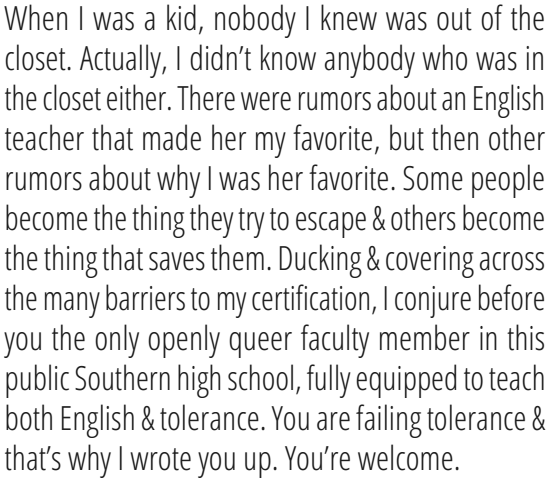
Screen Shot 2014-04-04 at 3.16.20 PM

Screen Shot 2014-04-04 at 3.18.58 PM


Screen Shot 2014-04-04 at 3.20.28 PM

Screen Shot 2014-04-04 at 3.29.11 PM


Picture 1

Picture 3


Today’s poems are from Only Ride, published by Sibling Rivalry Press, copyright © 2014 by Megan Volpert. “You are suspended” was first published in This assignment is so gay, edited by Megan Volpert and published by Sibling Rivalry Press. These poems appear here today with permission from the poet.


Only Ride: If Denis Johnson had written Tuesdays with Morrie, it’d feel like Megan Volpert’s book of prose poems. Clawing its way out through this minimalist checklist of suburban malaise is an emphatically optimistic approach to growing up. These tiny essays carefully detail how to avoid becoming one’s parents, how to manage a body addled by disease, and how to keep having the best possible time in life. After all: this is the only ride there is, and we can only ride it. Volpert’s is a story of Springsteenian proportions, a gentleman’s guide to rebellion complete with iron horses and the church of rock & roll.

Megan Volpert is the author of five books on communication and popular culture, most notably about Andy Warhol. She has been teaching high school English in Atlanta for the better part of a decade, and is currently serving as her school’s Teacher of the Year. She edited the American Library Association-honored anthology This assignment is so gay: LGBTIQ Poets on the Art of Teaching, which is currently a Lambda Literary Award finalist. Predictably, www.meganvolpert.com is her website.

Editor’s Note: Megan Volpert’s Only Ride is a no-holds-barred journey through personal history, with sage wisdom bursting from its rough-and-tumble seams. The book is less Zen and the Art of Motorcycle Maintenance and more Get a Grip and Ride Like it’s Your Only Ride. This is a book about how to live life. Suck it up and move past the childhood issues that scarred you. Don’t just cope with illness, thrive in the face of it. Live life full throttle no matter what it throws at you, because life is short and living demands fierce courage.

Throughout her journey Volpert takes personal and political stands, inspiring her readers to do the same. Sometimes you’ve just gotta smash things, because “a deep frustration that hurls pottery against the concrete floor… is not the thing to bottle up in shame.” Sometimes a teacher has a responsibility to teach more than just standard curriculum. As “the only openly queer faculty member in [a] public Southern high school,” Volpert is “fully equipped to teach both English & tolerance,” and she’ll write a student up for failing the latter.

Brimming with humor and hubris and wicked wit, the greatest gift of this book is the life lessons it relays. Stand up for what you believe in. Move past life’s bullshit and face adversity with a battle cry. Let go of the small stuff. “Many things annoy me,” Volpert confides, “but I seldom get really angry because now I just feel so lucky to be alive.” And we all should, the implication echoes. In a world where “[d]eath knocks twice: once for introductions & once to take you away,” why waste your precious life letting things get your goat? Having faced death, the poet gave her goat away; she has no goat to give. And we would all be well served to follow her example. “After all: this is the only ride there is, and we can only ride it.”

Want to see more from Megan Volpert?
Official Website
This assignment is so gay
Sibling Rivalry Press
FRONTIER PSYCHIATRIST

SATURDAY POETRY SERIES PRESENTS: LAURA YES YES

1970703_10152671596109251_151820833_n
By Laura Yes Yes:

SALEM 1994
(With touring partner Kim Johnson)

Courtesy of Jason Flynn’s youtube channel.


COLLEGE TRANSCRIPT

Courtesy of West Side School for the Desperate’s youtube channel.


Laura Swearingen-Steadwell (AKA Laura Yes Yes) has competed in slams nationwide, notably as a finalist in 2010’s Women of the World Poetry Slam. She tours and leads workshops as part of the queer female duo Shadowboxers Anonymous. Laura’s first book, How to Seduce a White Boy in Ten Easy Steps, was nominated for a National Book Award. She is currently an MFA candidate at Warren Wilson College.

Editor’s Note: I had the pleasure of seeing Laura Swearingen-Steadwell perform at louderARTS this week. louderARTS is home to a longstanding open mic, reading series, slam forum, and workshop series. Monday nights in Manhattan’s Bar 13 have been turning out the likes of Roger Bonair-Agard, Ocean Vuong, Elana Bell, Sabrina Hayeem-Ladani, John Paul Davis, Regie Cabico, and countless other rising stars and champions of the written and spoken word for years. The tradition continues every week. Show up at 6:00, like I did, and be treated to a FREE writing workshop with louderARTS members and visiting workshop leaders. I was lucky enough to kick off my evening with a workshop lead by today’s featured poet.

When Laura Swearingen-Steadwell opened up “Salem 1994” by inviting us all to join in a Kumbaya-esque rendition of Alanis Morissette’s “You Oughta Know,” I was all in. When the performance morphed into a feminist celebration of the songstresses who have been writing and performing the soundtrack of my life since I was fourteen years old, the poet officially had a new fan. When she performed “College Transcript” we were all invited to call out “brain,” “cunt,” “liver,” “fist” to accompany each of the poet’s hand gestures. It was fun. It was interactive. It was engaging. And it was truth, spoken from the poet’s own honest experience to resonate with our own. This is a poet who speaks her mind, who speaks her heart, who tells it like it is, unafraid, claiming the world for herself and for us all.

Want to see more by Laura Yes Yes?
“Habitat”
“Octopussy: The Playboy Interview”

SATURDAY POETRY SERIES PRESENTS: LIZZIE LAWSON ON SPRING

1185601_827625185839_902627425_nPhoto by Lydia Polimeni.


SPRING
By Lizzie Lawson

The tiny crocus is so bold
           It peeps its head above the mould,
           Before the flowers awaken,
To say that spring is coming, dear,
With sunshine and that winter drear
           Will soon be overtaken.


(Today’s poem is in the public domain, belongs to the masses, and appears here today accordingly.)


Lizzie Lawson (circa 1867–1902 OR 1858-1905) appears to have been a poet and children’s visual artist. This is a rare instance in which I was able to find many poems by the poet, but almost no biographical information whatsoever. The woman appears to have been lost to us, while her artistic creations remain. If anyone knows about the biography of this enigmatic artist, please share with us in the comments below!

Editor’s Note: Crocuses have been spotted on the east coast, “To say that spring is coming.” (See photographic evidence from photographer Lydia Polimeni above.) In fact, the first day of spring has come and gone. But… we here in the northeast expect snow next week, and are facing record lows for the beginning of spring. So, today’s entry is a kind of a rain dance, or, rather, a spring dance. A call to the powers that be: Bring on the spring! Bring on the sunshine! Bring on the—dare I say it?—warmth!!! Let the crocuses be the sign “that winter drear / Will soon be overtaken.” For we have had our fill of winter drear, thank you very much.

Want to see more by Lizzie Lawson?
Public Domain Poetry
Visual Art

SATURDAY POETRY SERIES PRESENTS: THE SONG OF SONGS

739px-Song_of_solomonDepiction of Solomon and Pharaoh’s daughter reciting the Song of Solomon.
This image is in the public domain.


From THE SONG OF SONGS
From the Hebrew Bible

I am a rose of Sharon,
a lily of the valleys.

As a lily among brambles,
so is my love among maidens.

As an apple tree among the trees of the wood,
so is my beloved among young men.
With great delight I sat in his shadow,
and his fruit was sweet to my taste.
He brought me to the banqueting house,
and his banner over me was love.
Sustain me with raisins,
refresh me with apples;
for I am sick with love.
O that his left hand were under my head,
and that his right hand embraced me!
I adjure you, O daughters of Jerusalem,
by the gazelles or the hinds of the field,
that you stir not up nor awaken love until it please.

The voice of my beloved!
Behold, he comes,
leaping upon the mountains,
bounding over the hills.
My beloved is like a gazelle,
or a young stag.
Behold, there he stands
behind our wall,
gazing in at the windows,
looking through the lattice.

My beloved speaks and says to me:
“Arise, my love, my fair one,
and come away;
for lo, the winter is past,
the rain is over and gone.
The flowers appear on the earth,
the time of singing has come,
and the voice of the turtledove
is heard in our land.
The fig tree puts forth its figs,
and the vines are in blossom;
they give forth fragrance.
Arise, my love, my fair one,
and come away.
O my dove, in the clefts of the rock,
in the covert of the cliff,
let me see your face,
let me hear your voice,
for your voice is sweet,
and your face is comely.
Catch us the foxes,
the little foxes,
that spoil the vineyards,
for our vineyards are in blossom.”

My beloved is mine and I am his,
he pastures his flock among the lilies.
Until the day breathes
and the shadows flee,
turn, my beloved, be like a gazelle,
or a young stag upon rugged mountains.


(Today’s poem is in the public domain, belongs to the masses, and appears here today accordingly.)


The Song of Songs, also known as the “Song of Solomon” or “Canticles,” is one of the megillot (scrolls) found in the last section of the Tanakh, known as the Ketuvim (or “Writings”), a book of the Old Testament/Hebrew Bible. The Song of Songs is unique within the Hebrew Bible: it shows no interest in Law or Covenant or the God of Israel; instead, it seems to celebrate sexual love. It gives “the voices of two lovers, praising each other, yearning for each other, proffering invitations to enjoy.” The two are in harmony, each desiring the other and rejoicing in sexual intimacy. (Annotated biography of King Solomon courtesy of Wikipedia.org, with edits.)

Editor’s Note: In honor of Valentine’s Day, the Saturday Poetry Series offers you a good old fashioned love poem, emphasis on the old. An anomaly among the fire and brimstone, monotheistic propaganda, and general prescription of the Bible, the illicit sexual nature and unbridled romance of The Song of Songs has baffled scholars for centuries. Believed to have been written some time between the tenth and second centuries BCE, there is no authoritative agreement regarding the poem’s authorship, inception, or setting. The subject matter of the poem itself has long been heatedly debated, with some scholars embracing the titillating nature of this epic poem, while others insist it is a metaphor for man’s love of God. While its milder language is often quoted in the context of weddings, showcasing a true love with ancient roots, when one sits down and reads this masterpiece from beginning to end—with eyes wide open—they encounter a hot and steamy poem that gives Fifty Shades of Grey a real run for its money.

Want to read more about Biblical poetry?
Wikipedia

SATURDAY POETRY SERIES PRESENTS: MARK NEPO

mark nepo

BREAKING SURFACE
By Mark Nepo

Let no one keep you from your journey,
no rabbi or priest, no mother
who wants you to dig for treasures
she misplaced, no father
who won’t let one life be enough,
no lover who measures their worth
by what you might give up,
no voice that tells you in the night
it can’t be done.

Let nothing dissuade you
from seeing what you see
or feeling the winds that make you
want to dance alone
or go where no one
has yet to go.

You are the only explorer.
Your heart, the unreadable compass.
Your soul, the shore of a promise
too great to be ignored.


(Today’s poem originally appeared via Mark Nepo’s Official Website and appears here today with permission from the poet.)

Mark Nepo is a poet and philosopher who has taught in the fields of poetry and spirituality for forty years. A New York Times #1 bestselling author, he has published fourteen books and recorded eight audio projects. Recent work includes: Reduced to Joy (2013), Seven Thousand Ways to Listen which won the 2012 Books for a Better Life Award, Staying Awake (2012), Holding Nothing Back (2012), As Far As the Heart Can See (2011), Finding Inner Courage (2011), and Surviving Has Made Me Crazy (2007), as well as audio books of The Book of Awakening, Finding Inner Courage, and As Far As the Heart Can See (2011). As a cancer survivor, Mark devotes his writing and teaching to the journey of inner transformation and the life of relationship.

Editor’s Note: Today Mark Nepo blesses us with a poem that celebrates all that each of us are capable of achieving. Poetry has historically been a source of inspiration, and “Breaking Surface” takes part in this age-old tradition, speaking straight to the heart, and imploring us to “Let nothing dissuade you from … [going] where no one has yet to go.”

Today’s piece is dedicated to Virginia Wilcox, herself a constant source of inspiration and a reminder of all that we are capable of when equipped with the right outlook and a willingness to seek out inspiration in the world.

Want to read more by and about Mark Nepo?
Mark Nepo’s Official Website

SATURDAY POETRY SERIES PRESENTS: PAUL NEMSER

4.28.13
MEETING YOU AFTER CHERNOBYL
By Paul Nemser


The last frozen day had come and gone, and we were
sleeping in the elbows of trees in the elbow of a town,
our sutures all sunken together as if we shared one wound,
as if we had climbed from a single pit

like a race of dinosaurs grown from a fused lump of eggs
that had slept in valley ice for three shifts of the North Star,
as the leaves undecorated the last few branches
which were skinny as bat bones or the bones of a squirrel.

There were cattle blotched with waning alphabets.
And there were eyes that had seen too many lights,
so we didn’t recognize the wells
we had drunk from all our lives, nor

the creek that flowed with clothes and flesh,
nor the seeds brought from all over the countryside,
from knived sacks in waterlogged barns, from pods
trembling on grotesque grasses.

We talked to each other until we could not talk.
It was gobbledygook, was joy, nothing to remember:
We would not be overrun like ants by a larger horde of ants.
The darkness would not come closer.

A dog would lift its howl to where the wind left
the tablecloths—crumpled, clawed up, drying in the sun.
A phalanx of trucks that had jostled our vertebrae
would sound like bubbles in a bottle.

I never missed you so much as waking from that sleep.
And I dream of you now lingering barely below ground,
all your twenty fingers warbling together as on flutes.
My pores open to you as to rain.

Years give way to lakes of white dust, to unyielding dirt-land.
The snouts of oxen stain pale as marble
when the beasts haul blades through the hardness that remains
of what decades ago had been garden.


(Today’s poem originally appeared in AGNI, and appears here today with permission from the poet.)

Paul Nemser’s book, Taurus, chosen by Andrew Hudgins as winner of the 2011 New American Poetry Prize, will be published by New American Press in November, 2013. His chapbook, Tales of the Tetragrammaton, will be published by Mayapple Press in summer, 2014. Nemser’s poems have recently appeared or are forthcoming in AGNI, Blackbird, Fulcrum, Per Contra, Raritan, Third Coast, and elsewhere. He lives in Cambridge, Massachusetts, with his wife Rebecca and practices law in Boston. Some of his family came from Chernobyl.

Editor’s Note: Today’s poem is one of those thoughtful, emotive, beautiful lyric poems that better expresses itself than I ever could. Some days the poems just speak for themselves. Are you listening?

Want to read more by and about Paul Nemser?
Read poems from the forthcoming Taurus on Blackbird
Two poems in White Whale Review
Poem in Unsplendid
After publication in November, 2013, check out Taurus on Google Books