Jennifer Schomburg Kanke Reviews Alone in the Burning by Wendy McVicker
Wendy McVicker’s work is often known for its meticulous attention to the miraculous details of everyday life. We see this aspect of her work in earlier poems such as “Into the Dark,” which appeared in The Journal of Mythic Arts in 2008 and thrills us with lines such as “Summer evenings on the terrace / as the risen dark / flowed in, phosphorescence / of fireflies, and heat / lightning startling / the horizon” and “the tall shapes / of the thunder gods /tramping through the dark.” But there was always something lurking there in her work, something not quite said. McVicker’s latest collection, the chapbook Alone in the Burning from Sheila-Na-Gig Editions, gives readers a glimpse into those quiet secrets that have been beneath all of her previous work.
Still firmly rooted in the domestic, McVicker utilizes a haunting tone as she allows her poems to imitate the slippery and hazy nature of traumatic memories while sharing childhood stories of family dysfunction. Even the titles of the poems reinforce this, as many of them are titled “When I was alone.” Because of this echoing, the reader is caught up in the way traumatic memories repeat themselves and begin to blur into one another. Lines from the poem on page 27, such as “I felt that forked fire// all the way/ through my body” and those from the one on page 10, such as “leaves in the trees/ breathed/ through my dreams” could be from the same poem, so cohesive and unified is this collection.
My favorite poem in Alone in the Burning is the “When I was alone” from page 13 which beautifully renders primal instincts. Lines such as “I knew how to wait: / one way to be safe // Running is another: / not my way” and “In the story the doe / broke and ran / across the clearing // That’s when the gun / found her // That’s how I learned to be still” remind the reader that there is more than just the fight or flight response to danger, there is also freeze.
But the collection also offers an answer to how we break that freeze, how we find ourselves again: language and imagination. In the first piece in the book, the modified haibun “Lost,” McVicker establishes the important (and sometimes dangerous and elusive) role language will play in the work:
                     The alphabet a rope
                                    slipping through my hands
                                                 each word a knot, burning
The penultimate piece in the book is also a modified haibun and counters the earlier “Lost” with “Found.” “This is a story about a girl who learned to live in books,” it begins. Its ending brings us into that life in books:
                       Language held the key
                                    Long strings of letters flying
                                                 off the page took her with them
We are never alone, the collection seems to say, so long as we have books, so long as we have writing. In this way, Alone in the Burning begins to serve as an ars poetica of sorts. It presents tight and clever turns of phrase reminiscent of Diane di Prima while wrapping them in a meditative confrontation of the domestic similar to the later work of Sharon Olds. I have long been a fan of McVicker’s work and this slim volume makes me excited to see where else her poems will go. As she says in the final “When I was alone,” “This has been / a long journey” and I, for one, am grateful she has brought the reader along on it with her.
Alone in the Burning by Wendy McVicker Sheila-Na-Gig Editions, 2024 ISBN: 9781962405072 $14.00
About the Author: Jennifer Schomburg Kanke’s work has appeared in New Ohio Review, Massachusetts Review, Shenandoah and Salamander. She is a winner of a Sheila-Na-Gig Fiction Award and her poetry collection, The Swellest Wife Anyone Ever Had, is now available from Kelsay Book. Her poetry collection centered on her experiences with ovarian cancer, Little Stone, Little Stone, is forthcoming in 2026 from Sheila-Na-Gig Editions. She can be found on YouTube as Meter&Mayhem.
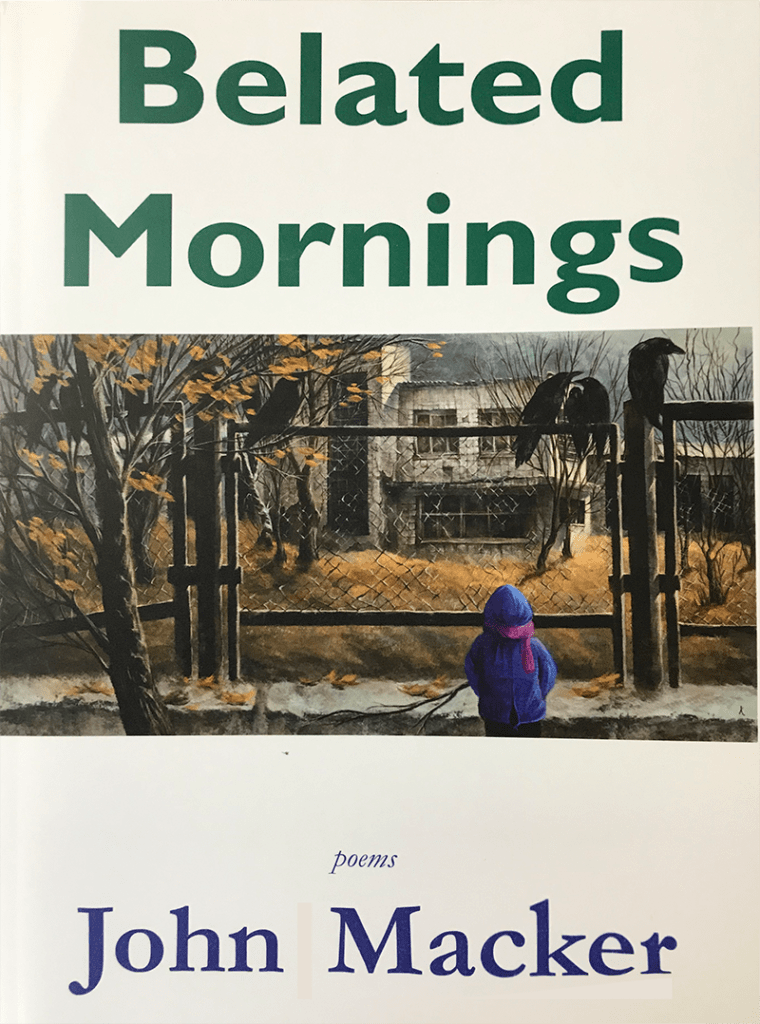
A small book, filled with large poems. I don’t mean the poems take up physical space, they take up brain space. Each one needs to be read, cogitated, chewed, swallowed, and digested, starting from the books’ epigraph, “That is my profession. / I am an archaeologist of morning.” —Charles Olson.
Our odyssey begins with Indian Summer, “Autumn as much a notion as it is / warm day, wind-drawn red crayon / moon above the canyon in slow motion, / a crisp yellow leaf afloat in its singularity / flows down a shadowed stream / into the Roaring Fork, is peace”
Macker takes us through mornings as night becoming light and mornings of memory. We are brought into the confessional in places, as he tells us about his first confession in the poem, St. Louis Blues.
Every poem is a picture, every poem has language and lines that resonate, biophilia ends with, “or hosanna Greta Thunberg’s name / in the church of feral light” and solstice ends with “I fear the longest night of the year / will last until spring” Oh, how many times have I thought that, only without such simple beauty!
The title poem, Belated Morning is a showstopper. “Last night starry-eyed blue whales / swimming over a yellowed desert appeared” and later, “…if you / don’t shine your morning light on the world / you aren’t listening, you aren’t breathing /”
These poems are musical, and accessible to anyone who wants a good story. One does not have to dig deep into hidden meaning and metaphor, one can simply read, and the best way to read any poem is to read it out loud! These poems stopped me several times, just for the sheer beauty of the words and the image they convey.
Stars Born Reaching begins “A rare hard rain at night on a flat / roof sounds like a jazz drummer’s / wet dream or palpitating steps late for / a flight…” I had to stop and remember all the times when it would rain and my grandfather and I would grab a book and go out to the travel trailer, stretch out and read until we went to sleep. And how many times I had to run to catch a connecting flight at the other end of the airport!
The book ends with the gentle hours. A gentle poem in Macker’s kitchen as he’s up and “shedding the shortened sleep” The last words, the words he leaves us with are words we can all hear in our minds, lean back in the chair with a cuppa, and cogitate, no matter our age. “…At my age I / become something I’m not all over again / and it fits me like a glove. Fate is a direction / that won’t let me lose my way.”
I recommend this book to any lover of poetry, as well as those who aren’t quite sure about poetry. Buy this book, it will be a treasure to read and a beacon on your bookshelf reminding you to live—and enjoy your mornings, no matter how you find them.
To purchase this book, please contact the author, John Macker at mackerjohn@yahoo.com. The cost is $10.00 plus s/h of $3.50.
About the Author: Lenora Rain-Lee Good, a Vietnam-era veteran of the WAC was born & raised in Portland OR and now lives in Kennewick, WA. Lenora is the author of three and a third published books of poetry—Blood on the Ground (Redbat Books, 2016), Marking the Hours (Cyberwit.net 2020), and The Bride’s Gate and Other Assorted Writings (Cyberwit.net, 2021). She co-authored Reflections: Life, the River, and Beyond(KDP 2020),with Jim Bumgarner and Jim Thielman, hence “the third.” She may be reached through her website https://coffeebreakescapes.com
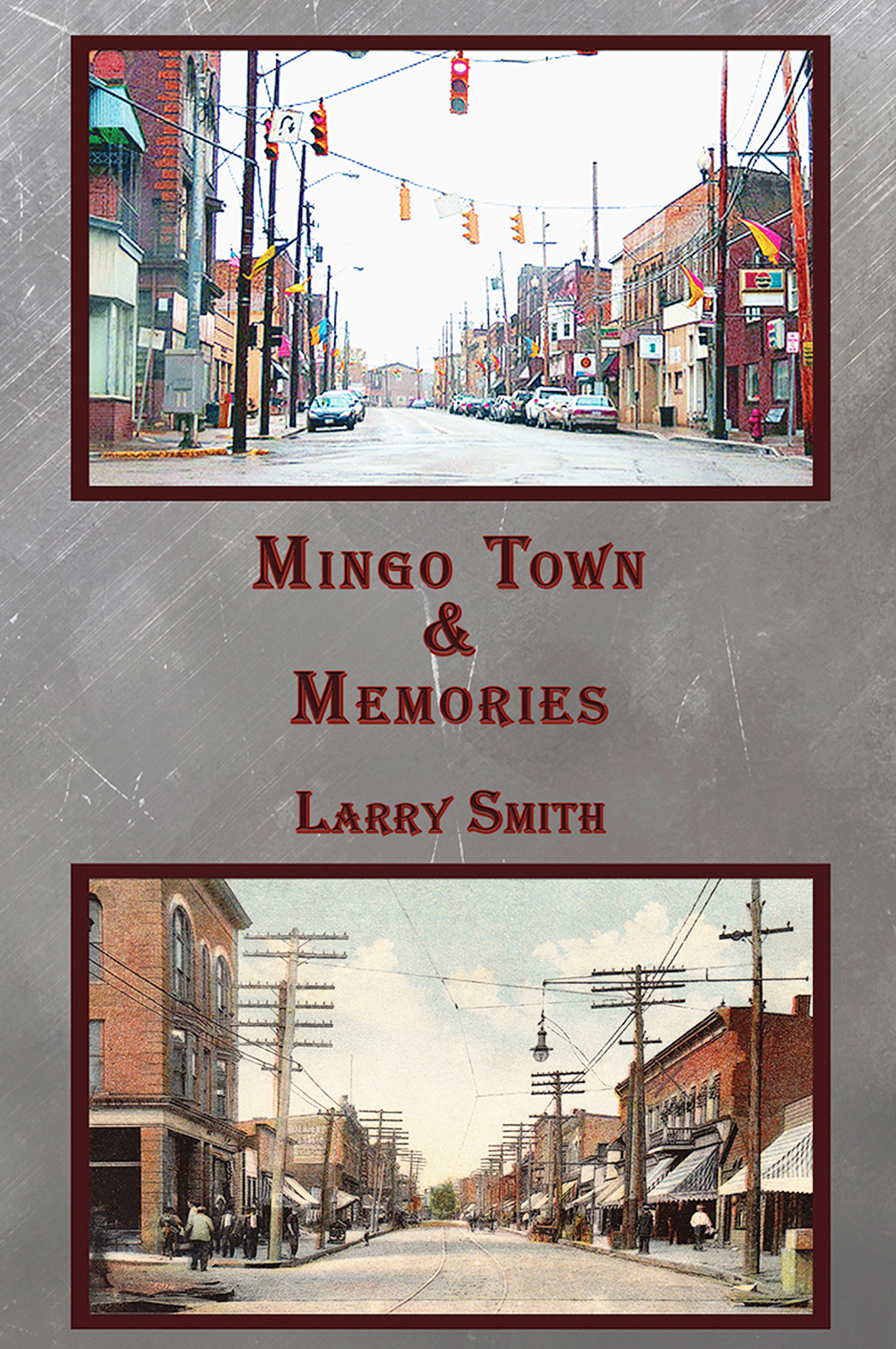
Larry Smith knows what a penny tastes like. I kept thinking that while reading his fine new collection of poems, not because he says that but because his poems are so concerned with the absence of money.
Neither Eugene Debs nor Sherwood Anderson are mentioned in any poem, but any reader might notice them at the book’s periphery. Like Debs, Smith is concerned with the underclass and with how class can go a long way towards shaping destiny. And, like Debs, he has an almost mystical faith in the goodness of collective humanity. Like Anderson, Smith is focused on day-to-day, small town, Ohio life. Also, just like Anderson, Smith is concerned with language spoken in diners and factories. There’s nothing ornamental in these poems. They are as sturdy and as practical as Amish furniture. His characters don’t always do right, but they seem to always recognize when they’ve done wrong.
Smith is an Ohio writer who has been publishing widely since the 1970’s. His books include poetry, novels, translations, biography, and non-fiction. For his many readers, this new collection will arrive like an old friend. The things he’s always done well he continues to shine with.
Here’s a sample to illustrate what Smith is really good at, from his poem, “Wages.”
When I break a plate, Mom cries, “Oh shit. Look what you’ve done.” You can hear the sound of wind. Then Mom hands Dad a fist full of bills, and we kids go off to our rooms. Tomorrow will mean our old clothes again and the counting of our coins.
Now poetry is about structuring language as much as it is about anything. Look at what Smith does with the endings of those lines. Only one word (again) is more than one syllable. Smith not only sticks to the vernacular here, but he also uses monosyllables to emphasize harshness and what it’s like to just get by. At the same time he allows the lines to play upon one another with off rhymes of wind/again and rooms/coins. This is an artful way to not draw attention away from the scene. Smith does a fine job of saying just enough in his poems.
These poems are often about the moments of just enough. Smith’s characters do a lot of waiting. Factory workers wait around to see if they will stay employed. Boys wait along the river. Old couples wait to talk. They are ordinary people killing time. Now and then a couple of his characters get together and are like, “two boats mooring along the shore.”
Mingo Town & Memories by Larry Smith
Bird Dog Publishing, 2020
Poetry, $15
About the Authors:
Mike James makes his home outside Nashville, Tennessee. He has published in numerous magazines throughout the country in such places as Plainsongs, Gargoyle, Birmingham Poetry Review, and Chiron Review. His fifteen poetry collections include: Journeyman’s Suitcase (Luchador), Parades (Alien Buddha), Jumping Drawbridges in Technicolor (Blue Horse), First-Hand Accounts from Made-Up Places (Stubborn Mule), Crows in the Jukebox (Bottom Dog), My Favorite Houseguest (FutureCycle), and Peddler’s Blues (Main Street Rag.) He served as an associate editor of The Kentucky Review and currently serves as an associate editor of Unbroken.
Larry Smith is the editor-publisher of Bottom Dog Press in Ohio, also the author of 6 books of fiction and 8 books of poems, most recently The Pears: Poems. A retired professor of humanities, he lives and works along the shores of Lake Erie in Huron, Ohio.
More Reviews by Mike James:
Mike James reviews “Dead Letter Office: Selected Poems” By Marko Pogacar
Mike James reviewsBeautiful Aliens: A Steve Abbott Reader and Have You Seen This Man? The Castro Poems of Karl Tierney
Many times, I have sat next to a random, drunk stranger at a bar, and he used the chance meeting to stammer and slur his words through his life’s story, the dizzying heights and crushing defeats. He has used my expressionless face as a sounding board for his ill-defined philosophies, raging impotently at foes he never really explained, pining for lost joys whose sweetness I couldn’t smell over his beer breath. He has seen a reflection of a younger self in my eyes, and tried to warn himself about the agonies of the future in which he lives.
Many times, that random drunk stranger at the bar was me.
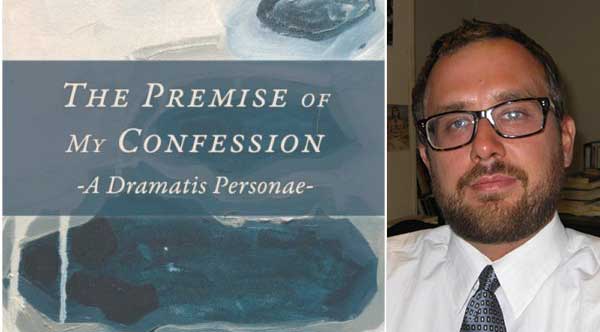
Maybe it’s because the bourbon has washed away all the specific contents of these tavern confessions, but I don’t remember any of them coming close to the philosophical depth and poetic craft of Sean Karns’ new book, The Premise of My Confession: A Dramatis Personae.
The premise of this chapbook is simple. A retired magician meets an nameless stand-in for the reader at a bar and in 25 pages, we hear the rise and fall of a magician addicted to and debilitated by his craft and the audience’s adoration of his spectacle. The longform poem is set up like a dramatic play, though the only other character who speaks and breaks up the magician’s monologue is a nameless narrator who addresses you, the reader, to provide exposition. Yet, the narrator does not just describe the scene and plot; he also tells you how you feel and react while listening to the magician:
You impatiently shift in your barstool And stare at your hands and pick at your nails. You have no clear exit strategy
Perhaps I am in the minority here, but this voice of a narrator explaining my own actions to myself replicates my experience of drinking and remaining silent as others prattle on.
Karns’ chapbook follows a tradition of random encounters with monologuing, philosophical drunks in literature. As I read the magician’s story, I thought about Crime and Punishment and The Fall. Raskolnikov listens to the drunken laments of barflies who squandered their family’s savings and reputation as Dostoevsky explores what he called “the present question of drunkeness.” In The Fall Camus places the reader in an Amsterdam bar. You are the unlikely recipient of the confession of a once prominent and respected defense attorney whose fall from grace came from the paralyzing realization he did not authentically believe in the values he championed in court.
Karns’ Magician is somewhere between the drunken oblivion of Mameladov and the weary introspection of Clemence. Like both Dostoevsky and Camus, Karns’ perspective is existential. All the world’s a stage, and that is where the crisis of authenticity opens the void, or as the Magician explains, a wound:
When you’re a spectacle, you can’t be something else. There are consequences for acknowledging
There is an absence. I didn’t want to be A lonely spectacle…how’re we spectacles,
You ask? Why so dismissive? The Wound will Let you know what you are or aren’t.
We’re formed by a collection of the Wound’s Memories, and through these memories,
We become a spectacle, a viewing pleasure For others, especially for the Wound.
Here, I feel as though I am under the gaze of Jean-Paul Sartre, thinking of how we internalize the gaze of others and become not a being in of itself, but a being for others. When how we perform for others pleases the other, we internalize that role and mistake it for an authentic self. As the magician puts it “While performing a pointless trick/ Perhaps our real selves are locked in trunks.”
As a young queer scholar, a short passage from Sartre’s Being and Nothingness redefined my understanding of my own identity. To illustrate the problems with authenticity, Sartre presents a scenario in which a homosexual man refuses to come out to another person who believes he has the right to urge him out of the closet. The homosexual man is in a bind here. If he were to lie about homosexual desires, he would be inauthentic with his true desires. But, if he were to confess, he would would be accepting the definition and expectations of sexuality that the other man holds, which the homosexual man does not agree with. He can’t deny himself, but he also can’t validate the flawed thinking of others that would place a label and category on him that doesn’t come from himself.
Karns’ Magician presents a similar problem with authenticity and being turned into a being for others:
As a spectacle, for it was all I knew, and I knew I’d regret it.
Hypnotize, I’d regret it. Don’t, I’d regret it. Disappear and relocate
An audience member, I’d regret it. Don’t I’d regret it. Unknowingly
The audience follows the spectacle Into ocean bound trunks.
Like Sartre’s example of the closeted homosexual, you regret staying in the trunk and hiding, but you also regret pantomiming the expectations of the crowd on stage. Even celebrated figures like famous magicians become bound by the persona needed to achieve applause. I wonder if those 80s and 90s bands, well past their glory years, that you see playing county fairs every summer ever feel this way. Could you find the guy from Smash Mouth sitting next to you at the funnel cake stand, confessing that he’d rather lock himself in the mic trunk than sing “All Star” one more time?
But here’s the inherent problem with confessions that the Magician, the homosexual man in Sartre’s story, and maybe even the Smash Mouth guy knows: they are always given to someone who does not possess the power to forgive them. As the Magician says:
And I longed for forgiveness for years Of deception, but the Wound ignores confessions
And redemptions–the Wound requires you To absolve your guilt, alone.
Since in this poem, the person receiving this statement is “you,” I wonder if this means that the magician knows this barroom confession is invalid since he is not alone and “you” cannot absolve his guilt, like some people assume priests can. Maybe this confession is as much a performance for an audience as any of his magic tricks.
Or, maybe this is why “you” do not speak in this poem, and why he speaks to a random stranger. Even though you’re there to hear him, he’s still alone in the bar.
The Premise of My Confession: A Dramatis Personae is available via Finishing Line Press
About the Author: Chase Dimock is the Managing Editor of As It Ought To Be Magazine. He holds a PhD in Comparative Literature from the University of Illinois and his scholarship has appeared in College Literature, Western American Literature, and numerous edited anthologies. His works of literary criticism have appeared in Mayday Magazine, The Lambda Literary Review, Modern American Poetry, and Dissertation Reviews. His poetry has appeared in Waccamaw, New Mexico Review, Faultline, Hot Metal Bridge, Saw Palm, Flyway, and San Pedro River Review among others. For more of his work, check out ChaseDimock.com.
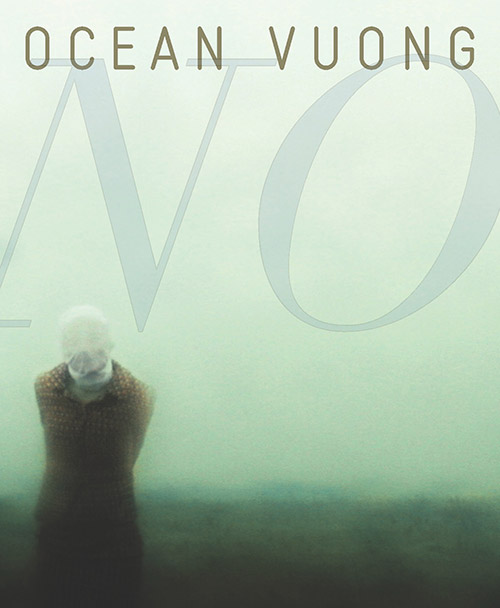
NO: Anyone who has already sensed that “hope is a feathered thing that dies in the Lord’s mouth,” should get their hands on NO. Honest, intimate, and brimming with lyric intensity, these stunning poems come of age with a fifth of vodka and an afternoon in an attic, with a record stuck on please, with starlight on a falling bomb. Even as Vuong leads you through every pleasure a body deserves and all the ensuing grief, these poems restore you with hope, that godforsaken thing—alive, singing along to the radio, suddenly sufficient. —Traci Brimhall, Our Lady of the Ruins
Ocean Vuong is a recipient of a 2013 Pushcart Prize as well as fellowships from Kundiman, Poets House, and The Saltonstall Foundation for the Arts. Poems appear in Poetry, The Nation, Beloit Poetry Journal, Passages North, Quarterly West, Denver Quarterly, and American Poetry Review, which awarded him the 2012 Stanley Kunitz Prize for Younger Poets. He lives in Queens, NY.
Editor’s Note: I’m just going to come right out and say this: Ocean Vuong is one of the best and most important poets writing in America today. I have not been so moved as I am by Vuong’s words since I first read Li-Young Lee. This poet has changed my life. He has renewed my belief in American poetry. That it can be emotional and heartbreaking. That is can be beautiful and full of hope. That modern American poetry can—and does—matter. In my humble opinion your poetry collection is simply not complete unless it houses both Vuong’s groundbreaking chapbook, Burnings, and his newest release from Yes Yes Books, NO.
NO is a surprisingly experimental collection, yet Vuong remains dedicated to the lyric and the narrative, guiding us through its formal twists and turns through emotive language and evocative imagery. Throughout its pages the poet intimately explores themes of love, sexuality, and belonging against a backdrop of devastating loss. It is a brilliant and beautiful collection, a true heartbreaking work of staggering genius. As the book’s publisher did when reading through the manuscript for the first time, when Ocean Vuong says NO to you, be prepared to say “Yes Yes!”
Only Ride: If Denis Johnson had written Tuesdays with Morrie, it’d feel like Megan Volpert’s book of prose poems. Clawing its way out through this minimalist checklist of suburban malaise is an emphatically optimistic approach to growing up. These tiny essays carefully detail how to avoid becoming one’s parents, how to manage a body addled by disease, and how to keep having the best possible time in life. After all: this is the only ride there is, and we can only ride it. Volpert’s is a story of Springsteenian proportions, a gentleman’s guide to rebellion complete with iron horses and the church of rock & roll.
Megan Volpert is the author of five books on communication and popular culture, most notably about Andy Warhol. She has been teaching high school English in Atlanta for the better part of a decade, and is currently serving as her school’s Teacher of the Year. She edited the American Library Association-honored anthology This assignment is so gay: LGBTIQ Poets on the Art of Teaching, which is currently a Lambda Literary Award finalist. Predictably, www.meganvolpert.com is her website.
Editor’s Note: Megan Volpert’s Only Ride is a no-holds-barred journey through personal history, with sage wisdom bursting from its rough-and-tumble seams. The book is less Zen and the Art of Motorcycle Maintenance and more Get a Grip and Ride Like it’s Your Only Ride. This is a book about how to live life. Suck it up and move past the childhood issues that scarred you. Don’t just cope with illness, thrive in the face of it. Live life full throttle no matter what it throws at you, because life is short and living demands fierce courage.
Throughout her journey Volpert takes personal and political stands, inspiring her readers to do the same. Sometimes you’ve just gotta smash things, because “a deep frustration that hurls pottery against the concrete floor… is not the thing to bottle up in shame.” Sometimes a teacher has a responsibility to teach more than just standard curriculum. As “the only openly queer faculty member in [a] public Southern high school,” Volpert is “fully equipped to teach both English & tolerance,” and she’ll write a student up for failing the latter.
Brimming with humor and hubris and wicked wit, the greatest gift of this book is the life lessons it relays. Stand up for what you believe in. Move past life’s bullshit and face adversity with a battle cry. Let go of the small stuff. “Many things annoy me,” Volpert confides, “but I seldom get really angry because now I just feel so lucky to be alive.” And we all should, the implication echoes. In a world where “[d]eath knocks twice: once for introductions & once to take you away,” why waste your precious life letting things get your goat? Having faced death, the poet gave her goat away; she has no goat to give. And we would all be well served to follow her example. “After all: this is the only ride there is, and we can only ride it.”
The Arrow: “It took almost a lifetime’s worth of emotions to read Lauren Ireland’s THE ARROW. She says Time eats at the edges of things so we hear her say other things, too, I am hating you from very far away and I am a grownup/flying right into the mouth of fear. This book is fraught with emotional emergencies, sometimes reckless, almost a little demented as one has to be when one faces who and what and where and how we are. Lucky for Ireland there are friends to whom many of these poems are dedicated who accompany her as she’s permanently lost in this very very mysterious flight we all share.” —Dara Wier
Lauren Ireland grew up in southern Maryland and coastal Virginia. She is a graduate of the MFA program for Poets and Writers at the University of Massachusetts-Amherst and an editor at Lungfull! Magazine. Lauren is the author of Dear Lil Wayne (Magic Helicopter Press, 2014) and two chapbooks, Sorry It’s So Small (Factory Hollow Press, 2011) and Olga & Fritz (Mondo Bummer Press, 2011). She co-curated The Reading at Chrystie Street in New York. Currently, she lives in Seattle with her husband and her husband’s cat.
Editor’s Note: As I read Lauren Ireland’s The Arrow I pushed against the book’s air of flippancy, its self-preservation in the guise of farce and self-deprecation, its false oaths of apathy. These are, as Naomi Shihab Nye would say, “the armor [the book] put[s] on to pretend [it has] a purpose in the world.” But this book does not need to pretend. It wears its armor as a tricked out husk around its fervent vulnerability. The poems within its pages are the bloodlettings of a twisted, tortured, and exceedingly human mind.
The Arrow is full of moments of lyric beauty and stunning, brutal clarity interwoven with equal portions of heaviness and frivolity that make for quite the witches’ brew. There is something unsettling about this book. Something that does not sit well. A wound or scab that begs to be healed yet must be picked at. I was often uncomfortable reading it, yet I could not put it down. I was drawn to the beauty and put off by the grotesque, and I believe this was meant to be the author’s poetic commentary on life. Life—like this book—is full of debauchery and death, fear and imagination, the mundane and the absurd. Love is inextricably linked with hate. There is a thin line between reality, waking dreams, and nightmares. This book is labyrinthine, in both the literal sense and the David Bowie sense of the word.
While it is easier to take some poems in the book more seriously than others, this, too, is an artistic reflection of the human life. As a work of art, however, I felt myself anchored throughout my journey by very deliberate artistic choices. Wickedly smart and poignant titles. Moments of lyric clarity that took my breath away. And a healthy dose of killer end-lines, which I am always a sucker for. “Now I am a grownup flying right into the mouth of fear,” “Now… I am running / from the nighttime wolves / in the forest that never was,” and that crushing Orphic echo, “Oh / I am exiled / my friend / this once / don’t turn.”
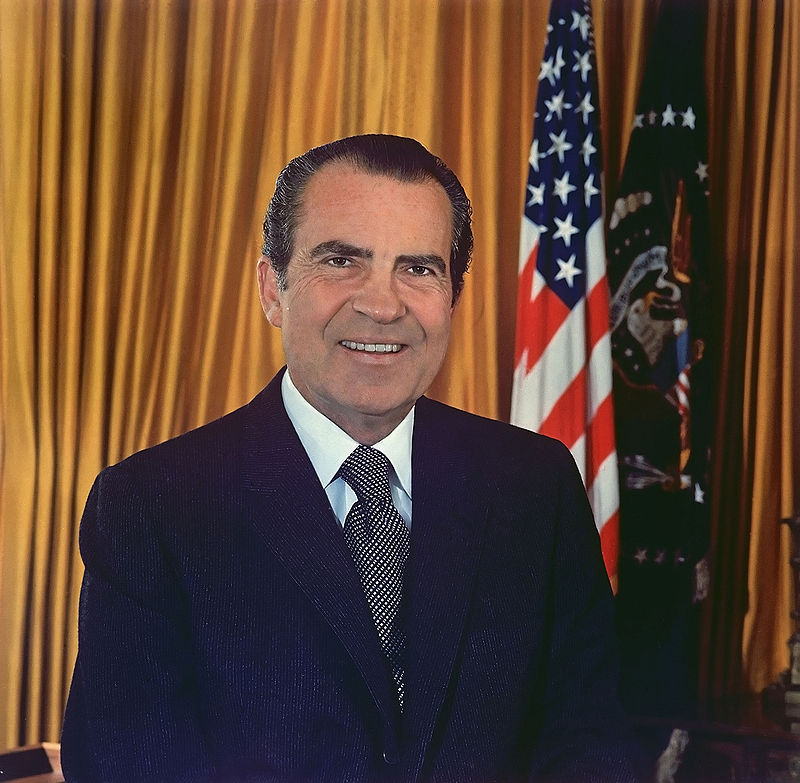
Official White House photo of President Richard Nixon NARA National Archives and Records Administration (public domain)
The most remarkable thing about Rick Perlstein’s Nixonland is that it was published four and a half years ago, before Barack Obama was elected president, before the Tea Party, before Occupy. Otherwise you might be forgiven for thinking that Perlstein was drawing meaningful parallels between our era and the 1960s and early 1970s of Richard Nixon’s heyday. There’s no way he could have been, of course. But it sure feels that way.
It is easy to forget that our current toxic “red state/blue state” opposition is nothing especially new, even if it has taken on a novel geographical aspect—a “big sort,” as Bill Bishop has it. We neglect to trace our current divide back through the Reagan era, through the Nixon era, to 1965, which is Perlstein’s starting point. The United States has been two oppositional yet intermingled nations for nearly fifty years, and Perlstein sets out to find out where it started and who stood to profit from exploiting that tension.
Nixonland is about Kulturkampf, American-style, and about Richard Nixon’s manipulation of it for political gain. Perlstein’s thesis is that the future president’s worldview was formed at Whittier College, where young Nixon was shut out of the world of the Establishment swells, known there as “Franklins”; Nixon formed his own social club for the lower-class strivers, which he called the Orthogonians. For the rest of his life, Perlstein claims, Nixon saw the world as divided between the Franklins and the Orthogonians. (This is an interesting tack for Perlstein to take, given that he prefaces every psychological insight he borrows from other sources—that is, virtually all of them—with “The psychobiographers might say that…” or something similar; more on that below.) What’s more, he had a gift for sniffing out these socioeconomic oppositions and using them to further his political career. Paradoxically, Nixon positioned himself as the champion of the traditional values of the working class in spite of his membership in the party of business and wealth, and he was the first to bring many blue-collar voters into that party, which so disdained their economic interests. Before there was What’s the Matter with Kansas? there were the Reagan Democrats, and before the Reagan Democrats, there was Nixon’s “Silent Majority.”
How did he do it? The answer is obvious to us, because it’s the political air we now breathe: cultural wedge issues. It wasn’t so obvious at the time. Nixon pioneered the alchemical transmutation of fear of change and class resentment (where class is a cultural category, rather than strictly an economic one) into virtues, a subtle manipulation that Perlstein calls “political jujitsu.” How dare those artists and movie stars, those pinko professors and Establishment liberals, that liberal-biased media sympathize with the Communists we’re fighting in Korea and Cuba and Vietnam, the druggie degenerates who are tearing apart the moral fabric of our great nation and perverting our children, the civil rights activists and Yippie political agitators who want to change our venerable Constitution and overthrow our government? How dare they throw their “tolerance” and “experimentation” in our faces? We just want economic stability and peace and quiet in the streets and the kind of life our parents had, only more prosperous.
And so, after a quick summary of Nixon’s boyhood, education, and early political career—including the all-important “Checkers” broadcast, in which Nixon gave an early virtuoso performance of his uniquely passive-aggressive brand of moral suasion—Perlstein throws us into the Watts riots of 1965, where the era of Great Society peace and prosperity promised by Lyndon Johnson’s 1964 landslide victory (the 1960s equivalent of Francis Fukuyama’s 1992 premature prediction of the “End of History”) immolated itself before a shocked television audience. Nixon took in the violent cultural fault lines created by desegregation and protest against an already unpopular war. He understood that once equal rights became a statutory reality, oppressed blacks would not tolerate anything but the full and immediate fulfillment of that legal promise, which most whites, especially Southern and working-class whites, would not abide. He saw that the traditionally Democratic South was appalled by LBJ’s liberal turn on civil rights and desegregation, and that in the North, traditional Democratic stalwarts such as labor unions and big-city machines felt as though their interests were being ignored in favor of rights and privileges for blacks and the non-working poor. And in all this he saw opportunity—opportunity for a traditional-values based Republican party, led by Richard M. Nixon, to make inroads into perennial Democratic strongholds. Nixon was always a hard worker, and he put all his energy, stamina, cunning, and political influence to work.
Perlstein goes into great detail as he traces the disintegration of the Democratic party—first at the notorious 1968 nominating convention in Chicago and then at the less-infamous, but perhaps even more damaging, 1972 convention in Miami Beach—and the implosion of George McGovern’s presidential run. Perlstein rightly sees McGovern’s campaign as doomed from the start: though his ill-advised choice of Thomas Eagleton as his running mate was the coup de grace, it was the Committee to Re-Elect the President’s sabotage, the internecine skirmishes and philosophical contradictions between rival candidates and factions, and the neutering of the once-powerful bosses, capped off by a three-ring circus of a convention that showcased the party’s divisions and apparent frivolities, that preordained the Democrats’ failure. Simultaneously, he follows the rise, and the beginning of the political demise, of Richard M. Nixon.
Perlstein’s talent (at least here) is not with original research (Nixonland contains little, if any), but with sifting through secondary sources and collocating and analyzing his finds. He arranges his facts to speak for themselves, and his style of analysis is subtle and unobtrusive, interwoven into the narrative so well that the reader sometimes fails to notice that the story has taken a didactic turn. He is also an astute student of politics and a political realist, with a deep respect for the compromise, the coalition, the power play, and even machine politics to a degree (for an excellent short-form example of Perlstein at work, see this recent piece on Barack Obama’s roots in Chicago machine politics). It is here that the lessons he takes from the history of Nixon’s era differ from the usual partisan fare—even when he’s using source material written by partisan observers—and where his analysis of the politics of that time provides unsettling insights into our current situation. He stresses how radicals’ chronic aversion to compromise and coalition-building, and their incorrigible overestimation of the majority’s tolerance for rapid change and novelty, nearly always dooms their efforts to effect reform, and how the top-down reforms they are able to institute so often meet with resistance from the rank-and-file. The radicals’ fetish for open discussion and equal and democratic representation in all decisions, especially in combination with the aversion to compromise and coalition, creates deadlock and endless delay and forecloses any possibility of quick executive decision-making and nimble response—a lesson that the Occupy movement has yet to take to heart. And all too often, there is a Richard Nixon figure, an adept of Realpolitik, to capitalize on the chaos that ensues.
And about Realpolitik: an argument that Perlstein seems implicitly to make is that Nixon’s downfall was at least partly a function of his transformation from a sort of Manichaean figure, the scourge of State Department crypto-Communists and hippies and champion of the “Silent Majority,” to a disciple of Henry Kissinger’s amoral power-worship. His manipulations vis-à-vis the Vietnam war—of facts, of the lives of POWs—and his brute, naked lust to gain a second term as president, his increasing paranoia, his stonewalling of the press, his abandonment of principle in the economic realm as stagflation and competition from Japan and the Common Market created trade imbalances and degraded the value of the dollar, his need to surround himself with venal yes-men who would do literally anything to get a leg up on the president’s “enemies”: these were distortions and exaggerations of Nixon’s character flaws that only grew the more power he amassed. It is an interesting theory, if it can even be called a full-fledged theory, but it smacks of the kind of armchair psychoanalysis that Perlstein claims to disdain.
Nixonland is a big book, a sprawling history, given its seemingly narrow focus of a seven-year period, and its epic scope and accumulative nature have the virtue of presenting the reader with a wealth of trivial information and glimpses—foreshadowings—of things and people that will become important only later. We meet a young Karl Rove, a campus Young Republican who ingratiated himself into the Committee to Re-Elect the President by bringing to the ’72 campaign a bag of political tricks garnered in college elections. We meet a newly-divorced Senator Bob Dole on the prowl, sporting bell-bottoms and a fake tan. We see early abuses of the Political Action Committee in John Connally’s Democrats for Nixon, which produced one of those tasty if vapid statistical coincidences that really make reading history fun: the specious claim, in a TV ad, that George McGovern would make 47% of the population eligible for welfare. But the agglomerative method also has its drawbacks: one finds repetitions of unfortunate words and phrases—near-comical overuses of the phrases “slow, soiling humiliations” and “man bites dog,” and of the words “solons” for legislators and “exuberants” for conservative die-hards come immediately to mind—as well as the sort of minor factual errors that have the effect of calling into question the veracity of more important claims: the film Straw Dogs is not a western; Richard Nixon’s father was born in Ohio, not Indiana; and the chief official of a Nazi political district was a Gauleiter, a German word, not gauletier, a real-sounding but imaginary French one.
On a more macro level, while one shudders at the possibility of seeing scores more instances of “slow, soiling humiliations,” it might have been interesting had Perlstein lent his skills to taking the book all the way through Watergate to Nixon’s actual resignation, rather than leaving off shortly after the 1972 election. But that could well be an entire 900-page book in itself, and Perlstein succeeds admirably in proving his point in the period he allotted himself. What remains to be seen is whether American politics continue to exhibit—as in Nixon, in his pupil Ronald Reagan, and in Reagan’s student George W. Bush—the pattern of ruthless power-seeking by the Right, and rudderless floundering and fissile factionalism within the Left. The human cost of such recurrent dysfunction is higher than ever.
Sloth by Mark Goldblatt (Greenpoint Press, 2010) reviewed by Duff Brenna
Air the color of khaki, soot on windows prismed with sunlight, neon-skewed dust, the smell of engine fluid and pralines, steam rising from the hood of a truck, a cluster of taxis. Throw into this assortment of images an unnamed narrator trying to prove he isn’t crazy: “Despite appearances, sir, I am not out of my mind. Quite the reverse, it is sanity itself which moves me to this exercise. Sanity itself which moves me to accost you … “
Dostoevsky permeates Goldblatt’s Sloth, especially Notes from Underground with its duality and layers of unreliable realities. Add a large lump of adoration for a TV aerobics instructor named Holly Servant worshipped and wooed from afar by the love-struck diarist of this story and you have what amounts to a word-rich ride, rollickingly inventive.
Will Holly ever respond to the letters of the man who gives himself the pseudonym Mark Goldblatt, whose Medieval beliefs rely, in part, on the notion that beauty of flesh testifies to higher virtues of the soul, the inside reflecting the outside? Truth is beauty, beauty is truth, that’s all ye know on earth and all ye need to know. The nameless narrator a.k.a. Mark Goldblatt builds his dizzying “metronomic dance” around Keats’ famous insight into what makes males tick, especially horny young males transfixed by “areolae shining like tulips through her leotard … pixied blond hair clinging to her moist back and shoulders.” Goldblatt, the real one, the author self-reflexively observing the fictional one, could easily (if he wanted to) write literary pornography that would rival (possibly surpass) anything Robert Cleland wrote when he was obsessed with Fanny’s fanny. But though Sloth doesn’t shy away from things sexual, titillating sex is not its primary purpose, which is rather a somewhat philosophical search for identity.
Who is a.k.a. Goldblatt? And who is Zezel (also known as Mark Goldblatt) who dips in and out of the narrative, playing the role of “best friend” and perhaps in the past a.k.a.’s lover, a great perhaps that a.k.a. denies. No: “He is my dearest friend, yes, but an odd case.”
Who is Mrs. Zezel? Mrs. Zezel is “a Vassar girl … summa cum sassy.
She is, in sum, the very locus of reason, a geometric proof of the soul …” And also trickster devil-may-care “cross between Lauren Bacall and Leo Gorcey.” Mrs. Zezel gets a.k.a. a date with Allison Molho, but he stands her up, an insult for which Mrs. Zezel will never forgive him, even after she finds out her husband Zezel has taken a.k.a.’s place and is in full-blown adultery mode. Mrs. Zezel’s revenge falls on a.k.a. This comes later in the book and is aided by a kitchen counter. Let your imagination loose, Goldblatt certainly does.
Into the author’s cheerful tongue-in-cheek muddle concerning the vicissitudes of love comes a.k.a.’s desperate need to make enough money to buy a VCR, so that he can rent Holly Servant’s Sunrise cassettes and watch her aerobic gyrations, until he is sweat-soaked and satisfied—at least for a few moments.
His main source of income comes from being a waiter. Not a waiter who waits on tables, but a waiter who waits in line, standing in for those who don’t want to show up too early and wait for doors to open for shows and/or events to begin. But the meager income a.k.a. earns from waiting is not enough to afford the coveted VCR. He reads an advertisement asking for volunteers for a scientific experiment. He signs up and is given some green pills, which might or might not contain a new psychotropic drug. His instructions are to take the pills and record his moods or behavior and return to the office every two weeks to have his finger pricked. Each time he is pricked he also receives one hundred dollars. What a deal! He’ll have that VCR in no time and will be able to spend his days and nights wallowing in Holly’s mesmerizing pulchritude.
The plot thickens when a young gay man is murdered and a.k.a. becomes a person of interest. At this point Zezel has already fallen for Allison Molho. The woman who pricks a.k.a.’s finger has also fallen for Allison Molho. Then Mrs. Zezel has that encounter with a.k.a. on the kitchen counter. But even before such a frightening event, Holly starts answering a.k.a.’s letters at last. Their correspondence moves them ever so slowly closer. Maybe he’s her soul-mate. He tells her he is a writer and sends her some of his stories. Problem is: Zezel wrote the stories. Zezel wrote them under the pseudonym Mark Goldblatt. So right away a.k.a. is misrepresenting himself. He’s already lying to the woman he loves more than anyone else in the world.
And then they talk about meeting.
And the detectives keep questioning him.
And a menacing-looking man is spying on a.k.a.
When Zezel breaks into the apartment and reads a.k.a.’s journal, what he finds there makes him want revenge for the kitchen counter incident with Mrs. Zezel.
Will he do something desperate? Will he hurt a.k.a.? Will the spy kidnap him? Will Holly really show up for the rendezvous? Will the detectives try to pin the murder of the gay man on a.k.a.?
Well, it just gets curiouser and curiouser.
Sloth is a work full of artistic flavor and Rabelaisian slumming. It is funny, serious, insightful and as unique in style and substance as any seriocomic novel I’ve read since Steven Gillis penned The Consequence of Skating or Junot Diaz wrote The Brief Wondrous Life of Oscar Wao. Some novels leave you with a smile. Some leave you thoroughly satisfied. Sloth does both.
***
DUFF BRENNA is the author of six novels. He is the recipient of an AWP Award for Best Novel, a National Endowment for the Arts Award, a South Florida Sun-Sentinel Award for Favorite Book of the year, a Milwaukee Magazine Best Short Story of the Year Award, and a Pushcart Honorable Mention. His work has been translated into six languages.
One Last Good Time
Michael Kardos
Press 53 (2010), 185 pages, $14.95
The trouble with interconnected story collections is that they are interconnected.
I know, I know: the first rule of tautology club is the first rule of tautology club. But in this case, it’s not an argumentative fallacy to say that the qualities that make interconnected story collections theoretically interesting can make them disappointing in practice. It has to do with reader response: we come to a short story for a discrete experience – a world we enter and leave in the same sitting. If we recognize a character, a setting, or a matrix of events from a previous story the sense of separateness is lost. And at the same time, we don’t get the total immersion of a novel. READ MORE








 As It Ought To Be