SATURDAY POETRY SERIES PRESENTS: OLAM, SHANA, NEFESH

Etching on chapbook cover by Andi Arnovitz

From OLAM SHANA NEFESH
By Jane Medved:


SIRENS

They think it is the young girls singing
you see, we pull them to us as smoothly

as oiled rope uncurls into golden braids.
It only takes a few minutes before everything

they see is woman. The pale skin of the sails
spreading like thighs, the thick knots

that tie the anchor turning to strands
of dampened hair held by a lover

before she shakes it free. The salt tastes
as sweet as sweat and soon the ship’s thrust

into the sea becomes unbearable.
This would be enough for galley slaves,

soldiers who tattoo fortunes on their scars,
the simple, parched sailors. But they are not

the ones we want. When we see the heroes
whose fierce deeds fall like hammers, we lay

aside our nocturne of desire. We sing instead
as a mother holds a dying child until

the horizon is the circle of our arms, the wind
a cloth wrapping them in its whisper, the waves

a gentle hush upon each creaking of the deck.
“Do not be afraid. You will be remembered and reborn.”


WHITE FIRE

There is a cable and it reaches
from the side of loving kindness

to the cold window across the room
taking over the function of your heart

which is tired of trying to make blood
out of air. Some days it’s just too hard

to keep on lifting, to appear in a robe
which keeps on falling, exposing

all sorts of intimate matters and the
little whispers beneath. Do not worry.

You are the hand, the page, the white fire
and you cannot be erased. The black letters

will burn and sing and declare themselves
but they are nothing without your silence;

which is not the absence of words, empty
as the howl of a bowl, but the promise made

between all words before they are spoken,
that they will reach across the black lines

and know each other again, even
if they no longer recognize themselves.


LEAVING A NOTE AT THE WESTERN WALL

There is a splintered door leading
nowhere and a lot of women crying
today I can’t even get near the wall.
Luckily I have my own tricks.
I place my arm over a young girl’s shoulder,
sigh sympathetically as she bends
her head in prayer, then edge myself
into her space. Everyone wants to touch
God’s face, to press their forehead
against his slippery cheek and brush
the pitted marks beneath, thank you
for my eyes, my legs, my arms, my breath
.
Herod did a good job, the ancient stones
hold solid. They outweigh the base
of the great pyramids and nothing moves
them, perhaps they are even held up
by pleading, since every crack is filled
with scraps of blue-lined paper, torn
index cards, a piece of yellow legal pad,
a folded napkin, sealed envelopes, airmail,
express, please, listen, thank you for my eyes,
my legs, my arms, my breath, excuse me
,
a woman pushes past me, excuse me please,
when she reaches for the wall a handful
of notes loosen and fall at our feet.
The chair behind me is piled with prayers
as morning, evening and darkness
make their requests, songs from the sons
of Korach even though their father moans
in the earth thank you for my arms,
my legs, my eyes, my breath
, women beg
the matriarchs and children press letters
into fists of stone while God sends back his answers
– No and no and no.


Today’s poems are from Olam, Shana, Nefesh (Finishing Line Press, 2014), copyright © 2014 by Jane Medved, and appear here today with permission from the poet.


Olam, Shana, Nefesh: “‘Olam, Shana, Nefesh’ is a Kabbalistic phrase used to describe the three dimensions of Place, Time and Person. Olam is most commonly translated as ‘world.’ But in Hebrew olam comes from the root of the word ‘hidden.’ This implies that place always has an unrevealed element to it; that we are surrounded by a reality beyond what is immediately visible. Shana literally means ‘year.’ It invokes an image of repetition, re-visiting, return, a never -ending cycle of months. In the Jewish calendar time is not a passive backdrop to human endeavor, but an active force whose windows of opportunity open and close, blossom and die just like the seasons. Nefesh can be translated as ‘person’ but it refers to the spirit as well as the body; the infusion of the divine into the physical. This is an inherently volatile combination, since a human being always contains a push and pull between the material and the spiritual, the body with its appetites and fears and the spirit. This is ‘person’ as the container of the animal and the divine.” – From Olam, Shana, Nefesh (Finishing Line Press, 2014)


Jane Medved is the poetry editor of the Ilanot Review, the on-line literary magazine of Bar Ilan University, Tel Aviv. Her chapbook, Olam, Shana, Nefesh, was released by Finishing Line Press in 2014. Her recent essays and poems have appeared or are forthcoming in Lilith Magazine, Mudlark, Tinderbox Poetry Journal, Cimarron Review, Spoon River Poetry Review, Tupelo Quarterly and New American Writing. A native of Chicago, Illinois, she has lived for the last 25 years in Jerusalem, Israel.


Editor’s Note: Olam, Shana, Nefesh is an absolutely stunning collection. A rare assortment of meditations on myth and history, religion, spirituality, sensuality, gender and place. The questions posed are epic, the answers as small and as critical as breath. The poems themselves are absolutely gorgeous in their own right; lyric delights that any reader would feel indulgent slipping into, with moments like “The salt tastes / as sweet as sweat and soon the ship’s thrust // into the sea becomes unbearable,” “The black letters // will burn and sing and declare themselves / but they are nothing without your silence,” and “Everyone wants to touch / God’s face.” But this book is even more rewarding for those readers familiar with the rich landscapes the poems call and respond to. How rewarding is “Sirens” for those well-versed in Greek mythology, how brilliant “White Fire” for those who know and love midrash, and how masterful “Leaving a Note at the Western Wall” for students of religion and history, for Jewish women, for those who have been to Jerusalem’s Wailing Wall, who have “press[ed] their forehead[s]/ against [God’s] slippery cheek and brush[ed] / the pitted marks beneath, [saying] thank you / for my eyes, my legs, my arms, my breath.”


Want to see more from Jane Medved?
Tinderbox Poetry Journal
Lilith Magazine
Buy Olam, Shana, Nefesh from Amazon

SATURDAY POETRY SERIES PRESENTS: STATE OF GRACE: THE JOSHUA ELEGIES

41oGCGJb2kL._SX331_BO1,204,203,200_


From STATE OF GRACE: THE JOSHUA ELEGIES
By Alexis Rhone Fancher:


DYING YOUNG

Midnight, and again I’m chasing
sleep: its fresh-linen smell and
deep sinking, but when I close my eyes I see
my son, closing his eyes. I’m afraid of that dream,
the tape-looped demise as cancer claims him.

My artist friend cancels her L.A. trip. Unplugs the
internet. Reverts to source. If cancer
will not let go its grip, then she will
return its embrace. Squeeze the life out of
her life. Ride it for all it’s worth.

By the time his friends arrive at the cabin
my son is exhausted, stays behind while
the others set out on a hike. He picks up the phone.
“Mom, it’s so quiet here. The air has never
been breathed before. It’s snowing.”

I put on Mozart. A warm robe. Make a pot
of camomile tea. The view from my 8th floor
window, spectacular, the sliver moon, the stark,
neon-smeared buildings, their windows dark.
Sometimes I think I am the only one not sleeping.

My artist friend wants to draw the rain. She
wants to paint her memories, wrap the canvas
around her like a burial shroud.

Tonight, a girl in a yellow dress stands below
my window, top lit by a street lamp, her long shadow
spilling into the street. She’s waiting for someone.

I want to tell my friend I’ll miss her.
I want to tell my son I understand.
I want to tell the girl he won’t be coming.
That it’s nothing personal. He died young.


SNOW GLOBE

Despair arrived, disguised as
nine pounds of ashes in a
velvet bag, worried so
often between my fingers
that wear-marks now stain
the fabric.

Is it wrong to sift
the remains of my dead son,
bring my ashen finger to my
forehead, make the mark of
the penitent above my eyes?

His eyes, the brown of mine,
the smooth of his skin, like mine.
Unless I look in the mirror
I can’t see him.

Better he’d arrived
as a snow globe, a small figure,
standing alone at the bottom of his
cut-short beauty.

Give him a shake, and watch
his life float by.


OVER IT

Now the splinter-sized dagger that jabs at my heart has
lodged itself in my aorta, I can’t worry it
anymore. I liked the pain, the
dig of remembering, the way, if I
moved the dagger just so, I could
see his face, jiggle the hilt and hear his voice
clearly, a kind of music played on my bones
and memory, complete with the hip-hop beat
of his defunct heart. Now what am I
supposed to do? I am dis-
inclined toward rehab. Prefer the steady
jab jab jab that reminds me I’m still
living. Two weeks after he died,
a friend asked if I was “over it.”
As if my son’s death was something to get
through, like the flu. Now it’s past
the five-year slot. Maybe I’m okay that he isn’t anymore,
maybe not. These days,
I am an open wound. Cry easily.
Need an arm to lean on. You know what I want?
I want to ask my friend how her only daughter
is doing. And for one moment, I want her to tell me she’s
dead so I can ask my friend if she’s over it yet.
I really want to know.


Today’s poems are from State of Grace: The Joshua Elegies (KYSO Flash, 2015), copyright © 2015 by Alexis Rhone Fancher, and appear here today with permission from the poet.


State of Grace: The Joshua Elegies: “Alexis Rhone Fancher’s book, State of Grace: The Joshua Elegies, maps in searing detail a landscape no parent ever wants to visit—a mother’s world after it’s flattened by her child’s death. Though her son’s early passing was ‘nothing personal,’ her poems howl with personal devastation. They insist that the reader take the seat next to hers in grief’s sitting room and ‘imagine him in his wooden forever.’ Fancher grapples with how to reconcile oneself to the slow loss of memory’s fade-out, and with how to go on living without betraying the dead, how to ‘[s]queeze the life out of / her life.’ You’ll need tissues when you read this book, but it’s well worth rubbing your heart raw against the beauty of these poems and their brave, fierce honesty.” — Francesca Bell, eight-time nominee for the Pushcart Prize in poetry, and winner of the 2014 Neil Postman Award for Metaphor from Rattle


Alexis Rhone Fancher is the author of How I Lost My Virginity To Michael Cohen and Other Heart Stab Poems, (Sybaritic Press, 2014). Find her work in Rattle, Menacing Hedge, Slipstream, Fjords Review, H_NGM_N, great weather for media, River Styx,The Chiron Review, and elsewhere. Her poems have been published in over twenty American and international anthologies. Her photos have been published worldwide. Since 2013 Alexis has been nominated for three Pushcart Prizes and two Best of The Net awards. She is photography editor of Fine Linen, and poetry editor of Cultural Weekly, where she also publishes The Poet’s Eye, a monthly photo essay about her ongoing love affair with Los Angeles. www.alexisrhonefancher.com


Editor’s Note: The poems in today’s collection slew me. Long after I finished reading them, they stayed with me, a specter. As I nursed my young son, worried over his maladies, rejoiced in his small accomplishments, there in the shadows was the poetry of Alexis Rhone Fancher reminding me that life is precious, fleeting, that nothing should be taken for granted, that anything–no matter how dear–can be taken away.

It is impossible not to be moved by these poems. By “a girl in a yellow dress [who] stands below / my window, top lit by a street lamp, her long shadow / spilling into the street… waiting for someone.” By the poet, the mother, who wants “to tell the girl he won’t be coming. / That it’s nothing personal. He died young.” By the admission, “Unless I look in the mirror / I can’t see him.” By the callousness of a friend who would ask if a mother is “over” her son’s death. By a mother’s very human reaction to such a question: “I want to ask my friend how her only daughter / is doing. And for one moment, I want her to tell me she’s / dead so I can ask my friend if she’s over it yet. / I really want to know.”

State of Grace: The Joshua Elegies is raw, brave, honest. It rips you apart as you read it–and leaves you grieving long after–because of the very vulnerable and wounded place from whence the poems arose. This is an incredibly compelling collection that does what lyric, confessional, narrative poetry does best: invites the reader into a human experience that is at once personal and shared, pairing vivid imagery and beautiful language with a story so moving that the reader is forever changed by the very act of having read it.


Want to see more from Alexis Rhone Fancher?
Buy State of Grace: The Joshua Elegies from Amazon
Four poems in Ragazine, including “When I turned fourteen, my mother’s sister took me to lunch and said:,” chosen by Edward Hirsch for inclusion in The Best American Poetry, 2016
Broad (“Dying Young” was first published in Broad)
Alexis Rhone Fancher’s Official Website / link to published works

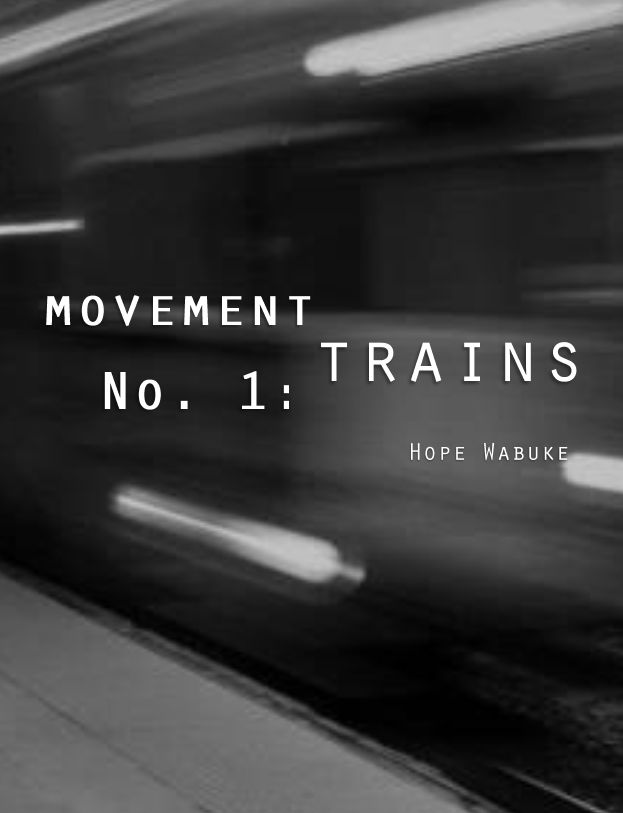
SATURDAY POETRY SERIES PRESENTS: MOVEMENT NO. 1: TRAINS


movement_1024x1024


From MOVEMENT NO. 1: TRAINS
By Hope Wabuke:


and when she waits, knowing its coming by the movement of light
across rusted metal, the dirty white tiles of tunnel wall almost
beautiful in the light sliding closer through darkness, approaching
rumble and tearing, metal wheel against track, gears shifting; halt.

in the loud echo still, vibrations pulsing—the only thing. she
imagines the sound she hears is breathing.


it is only when she thinks of him that her body becomes soft; she is
so conscious, then, of the movement of his body pressed against
hers’. so now she slides slightly, left, right, with the swaying motions
of the car. the train is stopped on the bridge, a windy day. the
intercom voice presses through static and she lifts arms above head,
stretches out her body to touch fingertips light to metal pole in
aisle’s center. the violence of the train’s starting and picking up, of
speed. in the meeting of the many tiny bones in her wrist against the
cold hardness, in the press of fingers soft against metal pole. she is
understanding pain in increments of waves, the pulsing slow
softening in rhythm with the traincar, rocking—her body, pushed
backwards, against scratched plexiglass window.

and in the moment of the train’s descent underground, her last view
a mirrored body, lines like chain links against grey sky, grey water.
the shape of their structures, repeating, suspended: a half-circle, a
half-closed eye .


and on the day after his leaving. she notices his absence in the
awkward stillness of her legs, the way her arms hang stiffly at her
sides. this is when she will remember how, as he would touch
drumsticks to upside-down white buckets to make beats, she would
see sound touch tile in tunnel walls and touch heels to ground.
rocking upward in tiny motions, she would lift hands lightly; she
would move her body in tiny circles of his rhythm.


Today’s poems are from Movement No. 1: Trains, published by dancing girl press, copyright © 2015 by Hope Wabuke, and appear here today with permission from the poet.


Movement No. 1: Trains is a city symphony of New York, where the author lived for many years–the daily rhythm of riding the subway and dancing between people walking the streets. Blurring the lines between past and the present, these prose poems explore the movement between love, loss and longing in a young woman’s memory.


Hope Wabuke: Born in exile to Ugandan refugees, Hope Wabuke is a writer, essayist and poet based in California. Hope is a contributing editor for The Root and a contributing writer for the Kirkus Reviews. Her poetry has also appeared in Lit Hub, The North American Review, Potluck Magazine, Ruminate Magazine, Fjords Literary Journal, Salamander Literary Journal, NonBinary Review, JoINT Literary Journal, Weave Magazine, Cease Cows, Kalyani Magazine, Split this Rock and Literary Mama. Her essays and criticism have appeared in Newsweek’s The Daily Beast, Salon, Gawker, Guernica, Dame, The Root, Ozy, The Hairpin, Ms. Magazine online, The Rumpus, Los Angeles Magazine and The Feminist Wire. Her fiction has been featured in the anthology All About Skin. Her chapbook Movement No. 1: Trains was published in June 2015 by dancing girl press. Her second chapbook, The Leaving, will be published in 2016 by Akashic Press as part of Kwame Dawes and Chris Abani’s New Generation African Poets series.


Editor’s Note: Part train ride, part memory, Movement No. 1: Trains takes the reader on a journey through which narrative blends with past, history is distorted by the present, and the tracks of the mind become one with the train lines of the New York subway system. Disjointed in a halting motion that mirrors the jerky movements of an underground train, the sway and lurch of this collection is tempered by moments of clarity and thoughtful reflection: “she / imagines the sound she hears is breathing;” “it is only when she thinks of him that her body becomes soft;” “she / would move her body in tiny circles of his rhythm.”


Want to see more from Hope Wabuke?
Hope Wabuke’s Official Website
Hope Wabuke’s Twitter
Buy Movement No. 1: Trains from dancing girl press
Literary Hub
The Hairpin

SATURDAY POETRY SERIES PRESENTS: HISTORIES OF THE FUTURE PERFECT


HOTFP-cover-front-only


From HISTORIES OF THE FUTURE PERFECT
By Ellen Kombiyil:


CERBERUS AND PERSEPHONE

It’s audible to the three-headed dog:
her fear a high-pitched shriek

held in her throat. Pre-unleashed. The thought
of the shriek and not the shriek itself.

It’s freaking her out, this mind-reader dog,
how he tracks muscle-twitch, her intent to act,

pre-synapsed. He demands to know the before,
before the before: she was plucking flowers,

yes, when the ground opened its mouth,
but how she arrived at this exact spot,

how slowly she chewed and what she ate
for breakfast, how she slipped, stepping

onto the bathmat, her precise existence
at this particular moment—the two-, no

three-second pause at the four-way stop.
Indelible decisions. The luck

of the draw. The dog deciphers
eye-flicker, delves past thought in search of

the anatomy of thought, which moves
like starlight, born but the reaching delayed,

which moves like the gorgeous dark.
He’s doing it again, she thinks,

and he reads that, too. In his pupil-black,
black surrounded by gold flecks, she sees

the pre-patterned repetition
of next and next and next: her mouth, stained red;

she will not be leaving this place, not yet.
This future splits away like a cannon-

boom of sound. Calla lilies, held fast,
she lets drop. The great winding of a clock.


WHILE SIPPING LEMON TEA ON SATURN’S ICE-CLOUD DECK

The distant sun rises, the size of a dime.
Red light looks warm but is cold, the opposite of what I know.

What can’t be unknown: encrypted DNA, curling inside me.
What I google: Orbit: 29 years, 167 days. Rotation: 10.233 hours.

Dizzy days and sleepless nights—elongated years.
I’ve forgotten the outline of my body against you

how I’d reach across your warmth to the nightstand for water.
I am an untethered moon, unloosed from the sun.

Now is no time to panic: remember Sherlock Holmes.
He discards the superfluous, keeps room for important truths.

Human contact is what I’m lacking, so far from home.
Can you see me on the cloud deck, waving my arms?

I’m calling out for connection, any Watson will do:
It’s elementary, my dear; come here. I need you.


JULIET DREAMS OF THE CRYPT

Is it joy, waking to tall ceilings
painted white, inlaid with the smell

of almonds? The blind see colors,
cool heft of objects hand-held.

They do not see what is tarnished.
I’d be lying if I said I knew how

to get to the other side of my heart.
I rehearsed my speech as a child—Love

is a heavy wheelbarrow crushed with
hibiscus
—before pretending to plunge

the knife into my chest. My mouth
at the moment of loss unbinds a thousand

mouths all making the same sound. I practiced
for the day I am blind, when

I will trade myself for one
dram of bottled summer, a lawn

that tickles my neck when I lie down
next to you without expectation.


Today’s poems are from Histories of the Future Perfect, published by The (Great) Indian Poetry Collective, copyright © 2015 by Ellen Kombiyil, and appear here today with permission from the poet.


Histories of the Future Perfect by Ellen Kombiyil is a book of poetry inspired by concepts in astrophysics. Canvassing across time and space to provide a luminescence unafraid of the big ideas, the book itself has what Kombiyil calls a quantum structure. Here we find Galileo’s thumbprint, Kurt Cobain Las Vegas, and Mary Lincoln communing with the dead. The poems themselves are never narrowly historical but rather cosmic in their inflections, taking on subatomic particles, DNA, and black holes, not simply as scientific props but as the very impetus for lyric motion.


Ellen Kombiyil is the author of Histories of the Future Perfect (2015). She is a recent transplant from Bangalore, India, where she lived for nearly eleven years, teaching creative writing and yoga. A fellow at the University of Iowa’s International Writing Program in 2013, Kombiyil’s poetry and fiction have appeared in many journals, including BOOTH, Spillway, Cordite, and Poemeleon. She is a four-time Pushcart Prize nominee and has read, performed or taught workshops at the annual Prakriti Poetry festival in Chennai, the Raedleaf Poetry Awards in Hyderabad, and Lekhana in Bangalore. She is the co-Founder of The (Great) Indian Poetry Collective, a mentorship-model poetry press, publishing innovated voices from India/Indian diaspora. Originally from Syracuse, New York, and a graduate of the University of Chicago, she now lives in New York City with her husband and two children.


Editor’s Note: Ellen Kombiyil’s Histories of the Future Perfect is an absolutely stunning collection, from its opening image to its closing word, soaring and shining with every star and feather in-between. In truth, I am like “the tarot-reading parrot” in the gorgeous cover image by Kalyani Ganapathy, selecting today’s poems by divination rather than choice, because there is far, far too much that is worthy of sharing in this book.

Enter a world where nothing is off limits for exploration: history, mythology, love. Dive to the deepest depths of the ocean and travel as far as the imagined reaches of outer space. Slip into the skin of the philosopher, historian, astronaut, necromancer, classicist, adventurer–all as imagined by the contemplative mind and lyric lilt of the poet. Give yourself over to moments as beautiful as they are thought-provoking–“My mouth / at the moment of loss unbinds a thousand // mouths all making the same sound”–and know that these are the ripples circling out across the waters of this one-of-a-kind collection.

Buy this book. Revel in its beauty. Let your mind drift, weightless. Be carried away.


Want to see more from Ellen Kombiyil?
The (Great) Indian Poetry Collective
Buy Histories of the Future Perfect on Amazon
POEMELEON
Booth

SATURDAY POETRY SERIES PRESENTS: ALL DAY, TALKING

allday_1024x1024


From ALL DAY, TALKING
By Sarah A. Chavez:


DEAR CAROLE, I FINALLY DID IT

I cut it all off into a trendy bob
that fades up the back. You told me
not to, said you loved my hair long.
Well, you’re not here anymore.


DEAR CAROLE, TODAY I’M WEARING THAT RING

you stole for me at the art fair
on the green at Fresno State.
God, was I such a baby!
Poor me, I don’t have any money
to buy things.
I kept whining.
I never get to have anything nice.
And most of what we’d seen
iron sculptures, clay dishes fired
for ornament, I was only just
discovering, but still, I thought
I deserved them.
That’s another thing age teaches you –
you ain’t owed shit. There is nothing
on this flying water rock that anyone deserves.
You should’ve smacked me, echoed
my father and told me to suck it up.
But you didn’t.

It was the third time we’d circled
back to that booth. Everything
about it was pretty: the rainbow
canopy, the sunlight glinting off
the semi-precious gems and hued
glass, the hot hippie without a bra
telling every passer-by about Gaia.
I fingered a large red and black
swirled ring, slipped it over
the callouses on my middle finger,
and spread my hand flat to admire it,
its heft impressive for something so lovely.
The hippie told me, the ring
wants to be a ring. I never take
from the Earth without her permission.
I spoke to the stone, told her what
she’d be
and she gave me her blessing.

The hippie looked so sincere
when she spoke, looked into my eyes
with her large cobalt irises, the pupil a pinprick
in the blue with the sun glaring
behind me. I’m sure I said something
stupid. I always get so nervous
around people like that, who walk
through life like an open wound, their blood
and tissue exposed to the elements,
their insides shining on the outside.

I probably said, Cool and behind me,
you probably rolled your eyes.
I put the ring back on the organic
hemp cushion with the other
metamorphisized rocks, then spun
the color-tinted glass of the wind chimes
hanging from the canopy’s aluminum
frame to hear their tingle-tangle
and submerged my hand into the basket
of oddly-shaped beads, feeling what I
imagined the quiet core within a fossilized
stone felt like. As we walked away,
you said Thanks, which was weird, but
I thought maybe it got to you too –
so much unattainable beauty,
the reminder of all the things
we didn’t have and all the things
we couldn’t yet know we wanted.

Walking to 711 for cigarettes,
we stopped at the crosswalk light.
You took my hand and pressed
the weight of the ring into my palm.
I looked up at you, squinting in surprise,
but you just shrugged, said The stone told me
to take it. It said it wanted you to wear it.


DEAR CAROLE, FOR HOURS, IT’S BEEN BURNING

a hole in my gut, the shame
of never saying thank you
twelve years ago for that fucking pizza
you bought with SSI back pay.
It tasted so good: the grease,
the sweet of the tomato sauce,
the salt from the olives prickling
my tongue – I could actually taste it.
They don’t say on those Cymbalta commercials
depression takes away taste.
Sleep, yeah, sex drive, focus, but not taste.
I never told you
how for those months, alone
in my one-bedroom apartment I tried
to eat just about anything,
but it was all so thick and waxen . . .
one night, ravenous and wretched
I tried to eat an entire loaf of bread.
Cross-legged on the kitchen floor
the light from the street lamp cast ghastly
shadows against the apartment blinds
while I took slice after slice
of Wonder Bread from the Hostess overstock
warehouse on Weldon Street and bit
into each one wanting desperately
for the next to taste
like summer,
like 1998,
like the smell of patchouli
in your room, like rain water,
like mud-stained carpet, like midnights
on the front porch,
like lying to our mothers and never getting caught.
Slice after slice – mutilated, the impression
of my teeth embossed on each one’s cottony
flesh – lay scattered
on the linoleum. I couldn’t bring myself
to swallow even the smallest
bite. Just kept spitting
slobbery hunks onto my naked lap,
into my tangled hair, until
I laid down, the floor clammy and smooth
like the palms of your hands.


Today’s poems are from All Day, Talking, published by Dancing Girl Press, copyright © 2014 by Sarah A. Chavez, and appear here today with permission from the poet.


All Day, Talking: “A stunning, gritty, and beautifully irreverent collection of poems, All Day, Talking repeatedly and necessarily corrupts the conventional elegy. Chavez mourns Carole, yes, but she also mourns herself—and all of us, the tragedy of how we see (or don’t see) one another in our contradictory identities and bodies. If you want to know the honest truth about what it means to grieve and to survive, keep these poems close and listen to this ‘all day, talking,’ which is both deeply personal and profoundly political.” — Stacey Waite, author of Butch Geography


Sarah A. Chavez, a mestiza born and raised in the California Central Valley, is the author of the chapbook, All Day, Talking (Dancing Girl Press, 2014), which was featured on Sundress Publications’ book spotlight, The Wardrobe’s Best Dressed. She holds a PhD in English with a focus in poetry and Ethnic Studies from the University of Nebraska – Lincoln. Her work can be found or is forthcoming in North Dakota Quarterly, Stirring: A Literary Collective, Spoon River Poetry Review, Luna Luna Magazine, among others. Her manuscript, This, Like So Much, was an Honorable Mention for the 2013 Quercus Review Press Poetry Book Contest. A selection from her chapbook manuscript All Day, Talking won the Susan Atefat Peckham Fellowship in 2013. She is a proud member of the Macondo Writers Workshop.


Editor’s Note: There is a refreshing honesty to the poems in All Day, Talking that is, in equal measures, surprising, laugh-out-loud funny, and deeply touching. In this collection grief is portrayed–and love remembered–through a lens of realism that mirrors the very real and very unstable experience of loss. Memory is the vehicle through which a life lost is a life recalled, and the speaker addresses the absence with a candor and wit that seems to honor the relationship that gave rise to it when Carole was still living. Amidst a text thick with engaging and humorous stories, within the world of deeply confessional admissions and recollections, there exists the heartbeat of the lyric, “the reminder of all the things / we didn’t have and all the things / we couldn’t yet know we wanted.”


Want to see more from Sarah A. Chavez?
Sarah A. Chavez’s Official blog/website
Buy All Day, Talking directly from the poet
Buy All Day, Talking from the publisher
Rogue Agent
Broadside of “The Day the Alligators Feasted on Time” from Stirring: A Literary Collection
The Poetry Foundation: Irene Lara Silva in conversation with Sarah A. Chavez

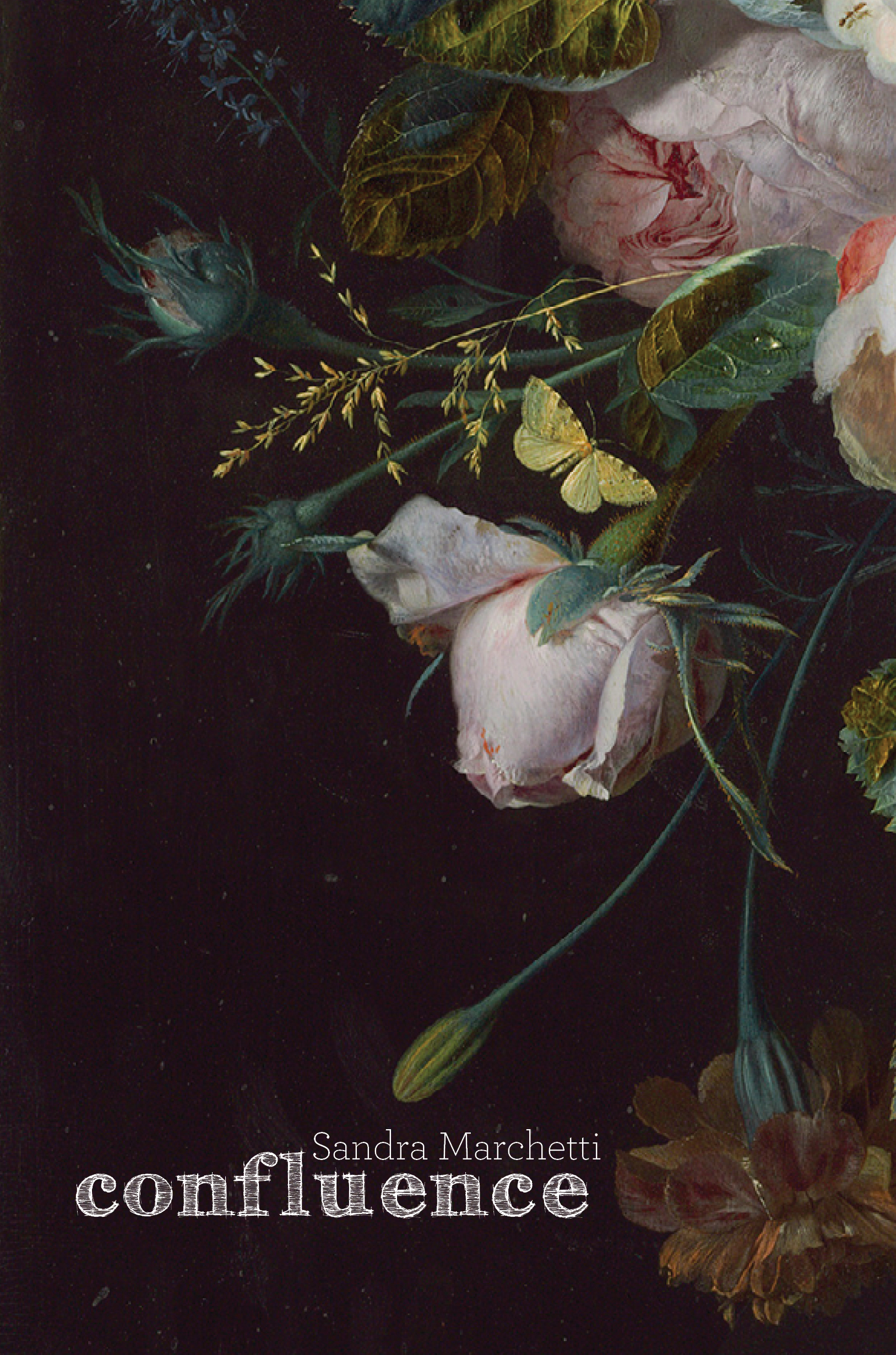
SATURDAY POETRY SERIES PRESENTS: CONFLUENCE

Confluence front


From CONFLUENCE
By Sandra Marchetti:


THE RETURN

               “figurations of mist
               at the turn of the corner,
               figurations of time
               at the bend in this pause,”
                              ~ Octavio Paz, trans. Eliot Weinberger

Beyond the body itself
is the thin blue line,
the sky folding back on its spine.

I saw today the paper gold mists,
the terrible last burnings off of morning;

I have an idea that you ate me then,
and slid belching through the fog—

you slicked my breast
on past your teeth and tasted
my unsalted skin.

I’m small; I know when I’ve been
swallowed whole, been rounded out
gold and beaming,

become a curve in your smile,
the element of light—broken on the tide—
the start of day.


FISSURES

By night
my body disconnects, falls,

lies on the bed in bones
and curls of hair.

There is nothing
to join it.

Skin flicks off
through shudders, and furls—

I lay and am unhitched,
unrolled.

I see what is done darkly,
between shadows and the neatest black.

The low lake below
lets go its nets,

from joints I wash toward confluence,
dissolved in a room of night.


MIGRATION THEORY

The womb a tent,
lit from within, flutters
golden on the wind.

I’m given to pregnancy
dreams again.

Sleeping, the world becomes round once more—
sleeping atop my midriff. Sleeping in
silence and veins and skin—a globe, a missive.

I’m told the child
is ghost; instead

the sleep is lifted into,
alight with curiosities
curling out from the hand.

Sleep. The light sheet ruffles within.
White moths in flight
lift from the body—the skin.


Today’s poems are from Confluence, published by Sundress Publications, copyright © 2015 by Sandra Marchetti, and appear here today with permission from the poet.


Confluence: “’Roam the ground where you are’ writes Sandy Marchetti in Confluence, her impressive debut. Mediating the world in between—lover and beloved, day and night, lost and found, now and then—this lyric poetry celebrates the intimate as ebullient, charged. The lyrics, read through imagery and felt through sound, ‘riff in bits and licks.’ Sandy Marchetti has convincingly made us a world.” —Sally Keith, author of The Fact of the Matter and Dwelling Song


Sandra Marchetti is the author of Confluence, a debut full-length collection of poetry from Sundress Publications, and a co-author of Heart Radicals, a collaborative chapbook of love poems. Eating Dog Press published an illustrated letterpress edition of her essays and poetry, A Detail in the Landscape, and her first volume, The Canopy, won Midwest Writing Center’s Mississippi Valley Chapbook Contest. Sandy’s work appears in Subtropics, Sugar House Review, Ecotone, Green Mountains Review, Blackbird, Southwest Review, and elsewhere. She is a Lecturer in Interdisciplinary Studies at Aurora University outside of her hometown of Chicago.


Editor’s Note: Sandra Marchetti’s Confluence is incredibly vivid, electric with unique imagery, and rife with moments of depth and contemplation that force the reader to slow down in wonder. “Beyond the body itself / is the thin blue line, / the sky folding back on its spine;” “I’m small; I know when I’ve been / swallowed whole.” The body is at times singular, existing in pieces, dissolved: “By night / my body disconnects, falls, // lies on the bed in bones / and curls of hair.” The I is the ever-observer, seeing the world as one only can from the lone darkness: “I see what is done darkly, / between shadows and the neatest black.” The lines are blurred between life’s joys and devastations: “I’m given to pregnancy / dreams again;” “I’m told the child / is ghost.” No matter the consideration or the angle of the reflection and the poet’s gaze, forever driving these poems is a rampant lyricism, steady and rhythmic as a heartbeat, fervently alive.


Want to see more from Sandra Marchetti?
Pre-order Confluence from Sundress Publications
Appalachian Heritage
Thrush Poetry Journal
The Rumpus
Words Without Borders

SATURDAY POETRY SERIES PRESENTS: MY FRIEND KEN HARVEY

khcover

From MY FRIEND KEN HARVEY
By Barrett Warner:


MY FRIEND DAVID BOMBA

Screen Shot 2015-08-21 at 11.44.40 PM


MY FRIEND KEITH MARTIN

My friend Keith Martin is dead. He died in early April.
It’s kind of a busy month to die. The ground is softening—
rows raked and sown—jealous hues emerging like rye.

It’s weird that he died the same month I was born.
Now the ghost would be forever Aries, the passionate one,
the one who gets things almost right, who gets in his own way.

A friend is a brick against the sweet hereafter. Lose a friend
and you lose a brick. Lose Keith and you lose a wall.
It’s just a matter of time until the roof falls down.

Marsha his wife sat cold on offers coming quickly on his land.
I don’t blame her holding out for more, but suffered lifetimes
are always cheap. I gave away anything I ever tried to sell.

No one ever wants to buy what you don’t love.

Their house is a quarter mile away, through dense spite trees
planted by our neighbor so he wouldn’t have to look at Keith getting out of his car.

I can’t imagine hating someone so much I’d plant trees.

One dog’s not enough, and two dogs are too many.
That’s how Keith would talk, like Ben Franklin.

He wanted me to feel better, but I never did.


MY FRIEND LARRY MCKEE

My friend Larry McKee notices each leaf in an oak forest.
I see firewood, fence boards, squirrels, squirrel stew.

I hustle through life’s minor beauty to make myself sweat,
wearing work on my face like khol.

I am trying to say I don’t belong here, don’t deserve
this world. I need to earn every second of it.

If I stop sweating I’ll stop earning.
It’s why I’ll always have a job, and Larry, a passion.

Someone ate this, he says.
He holds a 175-year-old raccoon femur.

Someone knelt here in 1841 and prayed for something.
Maybe, yes, there was singing. Listen! Sobs and singing.

I have been sweating all day and all night and all year.
It’s only a matter of time before I exile myself.

It would be nice if Larry could learn from me too
but I have nothing to teach, even about drinking.

Larry grows the mint, makes ice from spring water
collected in caves, smokes the bourbon over apple wood.

He has a special black basalt rock that fits his hand
to crush the beautiful ice into manageable debris.

He takes so long to make a two minute drink
that I’m drunk on beer and hung over before his first sip.

Still, it’s the best I ever tasted.
And of course, the next day, I steal the rock.

The things I’ve bashed. The cars. The lives. The dogs.
The sweat that flew off my brow. The wasted muscle.

One night I pound some lamb into burgers, smother it
with sheep cheese, and I think, Larry would have admired this.

I call him up to brag about the recipe. His wife Hannah
passes over the phone. Sounds delicious, he says.

We haven’t spoken in thirty years. Leftover enchiladas for us,
Always better the second night, filled with grilled chicken cut up

Small mixed with salsa and corn cut off the cob. On the patio,
Watching fireflies and hummingbirds until dark.

Couple extra chairs at the table if you’re ever in the neighborhood.
The things I learned from Larry. The things I never learned.


Today’s poems are from My Friend Ken Harvey, published by PubGen, copyright © 2014 by Barrett Warner, and appear here today with permission from the poet.


My Friend Ken Harvey: “Nostalgia and sentiment were dirty words in poetry until Barrett Warner’s My Friend Ken Harvey came on the scene. Here we have a chapbook that shows us the many forms of love, how relationships can be measured as ‘not enough war or too much war in someone’s life,’ and how the simplest moments can be transcendent, all while dipping in and out of the sepia tint of memory.” —Dakota Garilli, Book Review: MY FRIEND KEN HARVEY by Barrett Warner


Barrett Warner’s poems, stories, and essays have appeared in newsprint, paper and online since 1982, and most recently in Entropy, Revolution John, and Four Chambers. In 2014 he won the Salamander fiction prize and the Cloudbank poetry prize. He has a website where he blogs about bathing, medication, gardening, Proust, and Kalamazoo.


Editor’s Note: Struck by the unique nature of this collection, I asked the author if he would share a few words on his vision and process. “To me,” he replied, “the biographical poem is an ekphrastic poem, but instead of writing about a Hopper painting or a Grecian urn, I’m writing about everyday people with whom I’ve had some moment of fantastic empathy.” What is “fantastic empathy,” and how does it translate from lived experience to poem to reader, I wonder. I find my answer in my own experience in reading these poems. “I’ll have the starfish, Bomba says,” because “Everyone should be allowed to order what they want / even if it’s not on the menu.”

This collection is at times hilarious, at times touching, at times lyric, simple, and stunning. “A friend is a brick against the sweet hereafter. Lose a friend / and you lose a brick. Lose Keith and you lose a wall,” Warner writes of the death of his friend Keith Martin. “I am trying to say I don’t belong here, don’t deserve / this world. I need to earn every second of it,” he writes, from some honest place between existentialism and a search for meaning. In a way, these poems are–as the poet says–ekphrastic, biographical, minute in their reports of human interactions. Yet in another way they are meta, like staring up at the night sky and trying to truly grasp what you are seeing. From the minutiae to the horizon, I suggest reading and rereading these poems and seeing where the experience leads you.


Want to see more from Barrett Warner?
Entropy
Cultural Weekly
Lines + Stars
Quarter After Eight
drafthorse

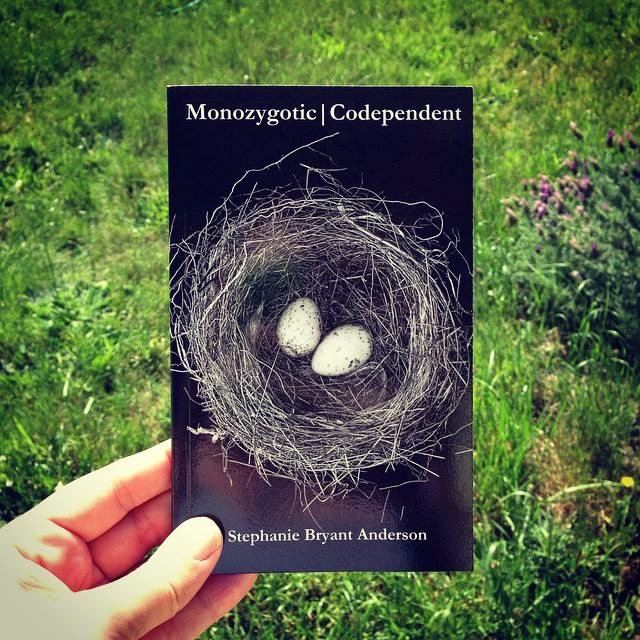
SATURDAY POETRY SERIES PRESENTS: MONOZYGOTIC | CODEPENDENT

monocofinal


From MONOZYGOTIC | CODEPENDENT
By Stephanie Bryant Anderson:


LONELINESS CAME INSIDE MY HOME, UNPACKED ITS
THINGS

I sat on the floor
in a blue room choking

on emotions, confessing
sadness to the cake falling

down my throat, wondering
how I have come to hate winter

when it snows
such beautiful white flowers.

But—

it’s the way I’ve neatly folded the laundry
over and over.

It’s the way fear visits me twice,
and courage once.

It’s the way I move alone at night
from the couch to the door

to the curtains,
back to the couch.

It’s how you catch me dreaming
and step over my body.


LIKE THE BLACK HOLE CARTOGRAPHER WHO WENT
HUNTING FOR WALNUTS

When the door closed this time, she knew it
       would be different. She saw his eyes—
emotionless ticks that had grown into the plural

patterns of empty walnut shells. Someone once
       star-mapped Aries the Ram, and generously
gave him horns. I am strong as an Ox

he reminded her as she stood to leave. Reminded
       her that she was the Year of the Rabbit with closed
curtains.

Safety over risk, she recalled looking at the door,
       but her body lied, it could not carry her there.
You cry too easily— he said, after the first hit

into her eye-bone crunched, sounding the way
       the nutcracker sounded when breaking open
walnuts. He stood over her

using the same angle God used to look down from.
       But, here, for her,
there was no longer a down—


ANXIETY WHILE CROSSING THE TENNESSEE-ARKANSAS
BRIDGE

Last November my sister got married.
My heart cropped, carried

for months in my handkerchief. At night
it would cry out from extinction.

This amputation being no small ache, I left
Tennessee, my heartbeat slow.

Memphis with her strange spell
filled my piano-ribs

with a slow blues loaded
with heavy bees and suicide ghosts.

The road tasted like salt. I drove until
I couldn’t see the shape of us,

until my heart could again beat
on its own.


Today’s poems are from Monozygotic | Codependent, published by The Blue Hour Press, copyright © 2015 by Stephanie Bryant Anderson, and appear here today with permission from the poet.


In Monozygotic | Codependent, Stephanie Bryant Anderson’s poems are concerned with splitting the self and uncovering the woman beneath the familial myths. Yet the essential paradox for Bryant Anderson: when the self has a twin—a ‘shadow,’ a ‘dark-haired mirror girl’—what then of the split? These poems ache; in the style of Southern gothic, these poems are ‘filled [with] piano ribs, a slow blues loaded with heavy bees and suicide ghosts.’ Bryant Anderson’s are poems of survival, built in fragile and beautiful shell casings, stanzas deceptively elegant and delicate, for what pinions each graceful couplet is a fierceness of spirit, a deep-seated desire for life, always life, even in the midst of pain and memory, ‘shaped as an open field plagued by black irises.’ I am broken and remade by these poems. —Jennifer Givhan, 2015 Winner National Endowment for the Arts fellowship


Stephanie Bryant Anderson is author of Monozygotic | Codependent (The Blue Hour Press 2015). Recent or forthcoming publications include Vinyl, burntdistrict, Rogue Agent and The Blueshift Journal. Besides poetry she enjoys kickboxing and math. Stephanie is founder of Red Paint Hill Publishing.


Editor’s Note: Monozygotic | Codependent opens with a quote from Sylvia Plath: “I do not know who I am, where I am going – and I am the one who has to decide the answers to these hideous questions.” And so Stephanie Bryant Anderson sets the stage for this brave, vulnerable collection. The journey the poet takes us on is deeply confessional, beginning in loneliness and ending in leaving, with panic, regret, abuse, anxiety, divorce, codependence, death, and God doggedly pursuing the I in-between. This is not the story of a light at the end of the tunnel; it is a story of survival. But there is so much beauty in the words, in their brutal honesty, in the intimacy of what is revealed, in the shared experience that arises when one speaks up about that which is too-seldom talked about. In this way, this book is Plathian, reflecting the intersection between lived suffering and staggering art.

Following the Plath quote, Monozygotic | Codependent welcomes us into its world with “Loneliness Came Inside My Home, Unpacked Its Things.” Here we sit on the floor. Here we are choking. Here we are eating our feelings. Here we are “wondering / how I have come to hate winter // when it snows / such beautiful white flowers.” A line so beautiful, it hurts to confront it. Like the idea of stepping over a woman dreaming.

From stepped over to stepped on, “Like the Black Hole Cartographer Who Went Hunting for Walnuts” takes us deep into the reality of a woman abused. She is not safe. She cannot leave. She is looked down on by man and God alike, only “here, for her, / there [is] no longer a down.”

In “Anxiety While Crossing the Tennessee-Arkansas Bridge” we encounter one of the major themes of the book: twin-ness. What it means to be a twin, to have been born into that level of codependence and to have to survive that conjunction into the individuality of adulthood. The result is a heart that must be “cropped, carried,” that has to learn to beat again on its own.


Want to see more from Stephanie Bryant Anderson?
Stephanie Bryant Anderson’s Website
Buy Monozygotic | Codependent from The Blue Hill Press
Follow Stephanie Bryant Anderson on Twitter

SATURDAY POETRY SERIES PRESENTS: HEMISPHERE

hemisphere


From HEMISPHERE
By Ellen Hagan:


RIVER. WOMAN.

I.
Downriver is always long
& always flailing, finding

where our lives begin,
intersect?  You, your bones

the humped slope of nose
browned skin of home.

You, sand. You, ocean.
You, bending & me.

How many nights we sleep
alone, our bodies rising—

what it means to miss you.
What it means to expand.
What it means to be birthed.
What it means to be sacred.
What it means to go home.

Place of birth, birthing
ground. Ground that is sacred.
You that is sacred.

Bones that hold together.  Bind.
Bound to you.  My mother.

II.
Me
I am bound to you.  My mother.
You stitch me from inside.  Hollowed.
your split sheath of self, your letters
the slow cursive of your language,
can’t I hear your voice, always?

Her
Lock the doors.  Latch the locks.
Shut the windows.  Close the blinds.
Cover up.  Clean your room.  Do
the dishes.  Wash the clothes.  Behind
your ears, yourself.  Clean the floor.  
Scrub.  Mop the remains every day
is one that you can use to erase all
the mistakes.  Blemish free.
Shine the doorknobs, pine, every
crease of space.  Cabinets.  Don’t leave
food out.  Food brings mice.  Mice
bring disease.  You will die.  You could 
die.  Don’t die.  Don’t ever die.  You 
stitch me from inside.  I am bound
to you.  Can’t you always hear
my voice?


LESSONS ON SPELLING

Bring the snakes in their skins, sly
& surrender. Simple bodies of grass
& clover, their slithering and sleuth-ness.
& the earth & the dusty fisherman
in from their boats, bobbing. Bring
piano, bring pain. That yellow skirt
pocked w/ fuchsia & the halter
of your mother’s pixie 60’s ways.
Let out the hems from your dresses,
the vertebrae in your back, body
forget skeleton—be loose, let it be dirty.
Get there. Call the black cat promenade,
lazy through the streets. Let your hair
down. Let it crawl, crowd the length
of your back. Bring soca & fiddle,
that record player your father bought
your mother in 1974. Bring all the days
from 1974 & on because time is a revolver.
A bag of limes on your back porch
squeezed & bitter & neon & orbiting
over you. Is your neighbor calling.
Is satsumas bursting on your tongue.
Bring your shiny shoes & arched soles
for the flapping pageant of second line
parade, the 100 parades from now until.
Autumnal. Hymns. Prayers.
Ways to say yes. Bring with you
your rope of hide, your many rings
of muscle & the washcloth
for your stomach, your feet
for the laying nape of your neck.
Bring danger & ways to hold your lips,
your lips, bring them too.
Spanning the whole of you.
You become.


WATER SIGN

Already a lullaby inside.
Your palms to belly, breath
on hip.  You are changing,
beginning. Too.  And you,
baby girl, or boy. Or two.
Are just gills. Still. Heart in
mouth. Red burst of newness.
Fins.  Fish or fowl. Shrimp
are larger than you.

Still, you are breaking me
apart. Him too. Our hearts
and lungs, and gills. Bursting 
You are stretching all,
all of us. Open.


Today’s poems are from Hemisphere, published by TriQuarterly Press/Northwestern University Press, copyright © 2015 by Ellen Hagan, and appear here today with permission from the poet.


Hemisphere: The poems in Hemisphere explore what it means to be a daughter and what it means to bear new life. Ellen Hagan investigates the world historical hemispheres of a family legacy from around the globe and moves down to the most intimate hemisphere of impending motherhood. Her poems reclaim the female body from the violence, both literal and literary, done to it over the years. Hagan acknowledges the changing body of a mother from the strains of birth from the growing body of a child, to the scars left most visibly by a C-section €”as well as the changes wrought by age and, too often, abuse. The existence of a hemisphere implies a part seeking a whole, and as a collection, Hemisphere is a coherent and cogent journey toward reclamation and wholeness. —TriQuarterly Press/Northwestern University Press


Ellen Hagan is a writer, performer, and educator. Her latest collection of poetry, Hemisphere, was released by Northwestern University Press in Spring 2015. Ellen’s poems and essays can be found in the pages of Creative Nonfiction, Underwired Magazine, She Walks in Beauty (edited by Caroline Kennedy), Huizache, Small Batch, and Southern Sin. Her first collection of poetry, Crowned, was published by Sawyer House Press in 2010. Ellen’s performance work has been showcased at The New York International Fringe and Los Angeles Women’s Theater Festival. She is the recipient of the 2013 NoMAA Creative Arts Grant and received grants from the Kentucky Foundation for Women and the Kentucky Governor’s School for the Arts. National arts residencies include The Hopscotch House and Louisiana Arts Works. Ellen recently joined the po­etry faculty at West Virginia Wesleyan in their low-residency MFA program. She teaches Memoir, Poetry & Nature, and co-leads the Alice Hoffman Young Writer’s Retreat at Adelphi University. She is Poetry Chair of the DreamYard Project and a regular guest artist at the Kentucky Governor’s School for the Arts.


Editor’s Note: I fell in love with the poems in Ellen Hagan’s Hemisphere for their language: earthy, sensual, gritty. Unafraid of blood and birth, of mud and heat, of nature, of relationship, of what is real and lush and vivid, of what is primal and complex. I am reminded of the swamp, of the first creatures that dragged themselves forth from the murky depths, crawling forward, always, evolving for the sake of life. I am reminded, also, of witchcraft, of alchemy, of drawing down the moon. Of things my mother taught me, of that which has been handed down from woman to woman through the ages.

Today’s poems were meant to be, here, today. Because they are about the twin experience of birth—both as child and mother. Because much of this book is about the relationship between mother and daughter, the circle of life as only mother and daughter experience it: “where our lives begin, / intersect;” “what it means to miss you. / What it means to expand. / What it means to be birthed. / What it means to be sacred. / What it means to go home.”

In honor of Mother’s Day, and of the magic that grows from the rich soil of today’s poems, today’s feature is dedicated to my mother, the water sign, from your daughter, the water sign. “You that is sacred… I am bound to you. My mother.”


Want to see more from Ellen Hagan?
Ellen Hagan’s Official Website
Ellen Hagan’s Blog
Duende
Drunken Boat
Buy Hemisphere from Indie Bound

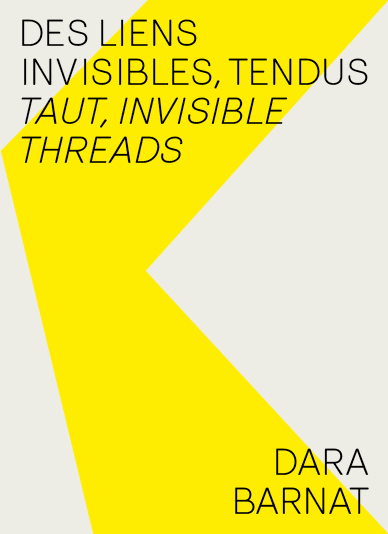
SATURDAY POETRY SERIES PRESENTS: DES LIENS INVISIBLES, TENDUS / TAUT, INVISIBLE THREADS


Liens


From DES LIENS INVISIBLES, TENDUS / TAUT, INVISIBLE THREADS
Poems by Dara Barnat; Translations by Sabine Huynh:


A BRILLIANT FISH

We must choose each other
again and again.

The feeling is a brilliant fish
you catch a thousand times.

We must carry each other
like smooth stones
in the palms of our hands –

a familiar feel,
a roundness.


UN POISSON MOIRÉ

Un poisson moiré
Se choisir l’un l’autre, s’y reprendre
à plusieurs fois.

Cet émoi ressenti face à un poisson moiré
qu’on pourrait attraper des milliers de fois.

Transportons-nous
tels des galets lisses
dans le creux de la paume –

toucher familier,
rondeur.


GROWING VEGETABLES

Her wide hips remind me
that I was born,
because in photos at twenty
they are still narrow
and slim.

Bending over
and planting roses
she gathers immense joy
from the dirty pebbles
and the new petals.

I hold her basket
like a daughter should
and almost pretend
to smile and be grateful
for the fresh, ripened tomatoes.

Is it with age
that happiness can be found
in growing mint
and drinking ice water
that has collected tiny bugs?

My mother shares soap
with a man who is not my father
but a good man,
waiting inside
to make our sauce.

The basket is now full
and since her joy
takes up the whole garden
there is no room
for my joy.

But she says daughter,
you will have your own life,
and your own garden,
just pray for rain,
and grow your vegetables.


CULTIVER SON POTAGER

Ses hanches généreuses
me rappellent ma naissance
– dans des photos d’elle à vingt ans
elles sont encore étroites
elle est encore mince.

Penchée
sur les roses mises en terre
elle recueille une joie immense
des cailloux sales
et des jeunes pétales.

Je lui tiens son panier
telle une fille dévouée
et réussis presque
à sourire de gratitude
pour ces tomates mûres.

Est-ce avec l’âge
que l’on trouve du bonheur
à faire pousser de la menthe
à boire de l’eau glacée
où surnagent des petites bêtes?

Ma mère partage son savon
avec un homme qui n’est pas
mon père, un homme bon,
il attend à l’intérieur
de préparer notre sauce.

Le panier est plein
la joie de ma mère
remplit le jardin
plus de place
pour la mienne.

Alors elle me dit : tu sais ma fille,
tu auras ta propre vie
et ton propre jardin,
prie pour qu’il pleuve
et cultive ton potager.


PRAYER I DO NOT KNOW

No one is here, just me,
alone. I close

my eyes and try
to remember your face,

its light, your
fingers, their light

touch, your laugh,
the lightness. I recite a prayer

that is my own:
May we live

a thousand years together
in another life.


PRIÈRE OBSCURE

Comment prier
pour toi ? Personne

ici, moi
seule. Je ferme

les yeux, tente de voir
ton visage,

sa lumière, tes doigts,
l’affleurement,

ton rire,
la légèreté. Je récite une prière

qui est mienne:
Puissions-nous vivre

mille ans ensemble
dans une autre vie.


Today’s poems are from Des liens invisibles, tendus / Taut, Invisible Threads, published by Recours au poème éditeurs (2014), and appear here today with permission from the poet.


Des liens invisibles, tendus / Taut, Invisible Threads is a bilingual collection of poems by the American poet Dara Barnat, translated to French by Sabine Huynh. Dara Barnat explores migration (between New York, where she was raised, and Tel Aviv, her adopted city), the experience of being an English-language poet in Tel Aviv, intimate familial relationships, her father’s long illness and passing, as well as secrets, history, and memory. Loss is certainly at the core of the poems; although she succeeds in guiding her readers to comfort, even joy, with wisdom she has learned from enduring grief. In the last poem of the book, the speaker addresses her father in the afterlife, and they are both happy to be “alive.” This exhilarating vision demonstrates how Walt Whitman informs the poet’s elegies. She imagines herself walking down the street with Whitman. It is also not surprising to encounter Emily Dickinson or Robert Frost, since the power of Dara Barnat’s poetry resides in its capacity to observe our solitude with grace and honesty.


Dara Barnat was born in 1979. Her poetry appears widely in journals in the United States and Israel. She is the author of the chapbook Headwind Migration (2009), as well as poetry translations and scholarly essays. Dara holds a Ph.D. from the School of Cultural Studies at Tel Aviv University. Her dissertation explored Walt Whitman’s influence on Jewish American poetics. She teaches poetry and creative writing.


Sabine Huynh was born in 1972. She holds a Ph.D. in Linguistics (Hebrew University of Jerusalem), has authored poetry and prose books (novel, short stories, academic book, literary essay, diary), and has edited an anthology of modern French poetry, which were published by Galaade Editions, Voix d’encre, La Porte, éditions publie.net, Recours au poème éditeurs, E-Fractions Editions, among other French publishers. She writes in English and French, translates daily, occasionally teaches creative writing classes, and regularly contributes to the French literary journals Terre à ciel, Terres de femmes, and Recours au poème. Her website: http://www.sabinehuynh.com


Editor’s Note: The opening poem in Dara Barnat’s debut collection begins, “Please know that taut, / invisible threads / tethered us / to those years.” Threads that bind the speaker to mother and home, to father and illness, to time, to what comes into being and what inevitably slips away. And so Des liens invisibles, tendus / Taut, Invisible Threads invites us into a deeply personal yet resonant world of life and death, love and loss, relationship and the human experience.

Nestled within the honest, reflective, beautiful lyric of these poems are the moments poetry was made for: “maybe / we should part now, because oceans / dry up in time, / even the whitest bones / turn to ash.” Equally powerful are so many of the poems’ closing stanzas and end-lines: “daughter, / you will have your own life, / and your own garden, / just pray for rain, and grow your vegetables;” “May we live // a thousand years together / in another life.”

Throughout the book we are welcomed into a private, sacred space. Into kitchens and gardens, hospitals and homelands. We are invited to bake bread and receive intimate moments like sacrament. Crossing the wide span between memory and horizon, Taut, Invisible Threads is like a migrating bird that “fights the seasons, / and lands wherever / there are seeds, / water, and soft earth, // until it arrives.”

I wish that I were well-versed in French and thereby able to comment on the translations by Sabine Huynh housed within this moving bilingual collection. Falling far short of that wish, I can only say that I have had the pleasure of hearing the translator read some of her poetry translations aloud in French, and it was a transformative experience. Her voice is emboldened by its quiet humility, and the passion she has for translation is well-known amongst the numerous writers who seek to have their work translated by this gifted writer and translator.

I have had the pleasure of featuring both Dara Barnat and Sabine Huynh on this series, and am thrilled to see these two incredibly talented writers and translators brought together in one stunning collection. This book—and this collaboration—is a gift to the poetry world that should be read, shared, and celebrated.


Want to see more by Dara Barnat?
Buy Des liens invisibles, tendus / Taut, Invisible Threads from Recours au poème éditeurs
Dara Barnat’s Official Website
Dara Barnat’s Official Blog
“At Least Forward Now” in Haaretz