The Very Southern Pronunciation Still Rings In My Ears: A Conversation With Poet Mike James

.

The Very Southern Pronunciation Still Rings In My Ears:

A Conversation With Poet Mike James

By Chase Dimock

.

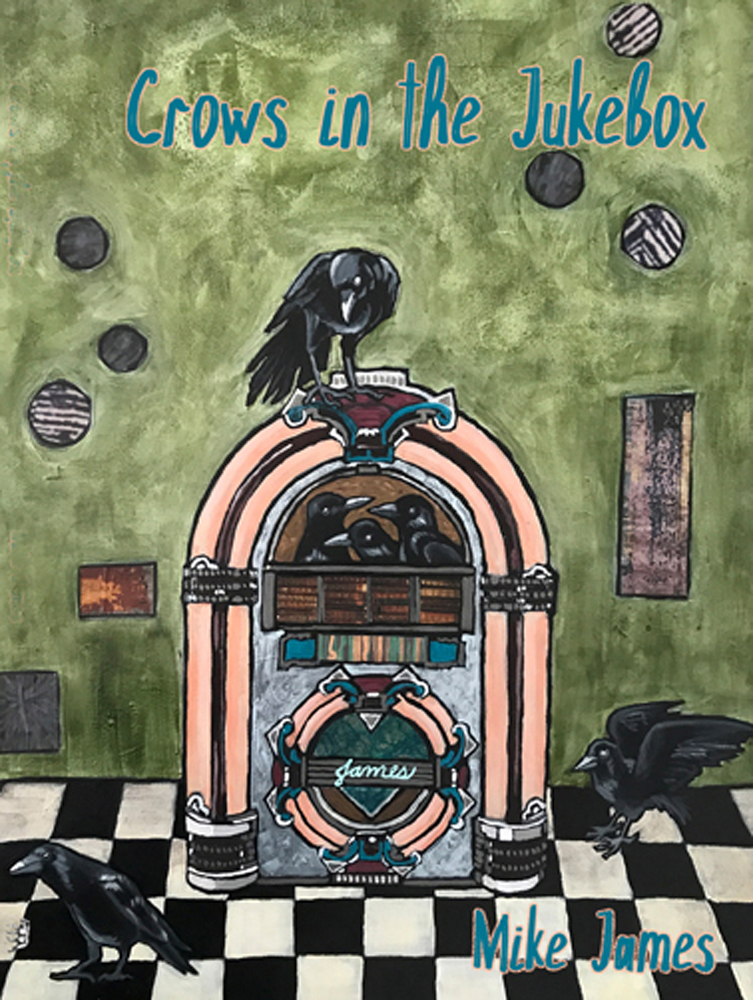
Keats had his nightingale, Shelley had his skylark, Poe had his raven, Stevens had 13 ways of looking at a blackbird, and Mike James has a jukebox full of crows. While fans of poems about birds will not be disappointed, Crows in the Jukebox is just as much about the jukebox as it is about the crows. James’s book reads like the playlist of an old jukebox in a roadside, greasy spoon diner. There are folk songs that retell old family lore, slow ballads that honestly and sweetly pay tribute to his love, and melancholic memories of a self-destructive father on par with any country tune sung by Loretta Lynn or Tammy Wynette. You can hear the drawl in his words, but James is not constrained by the clichés or expectations of his background in the Carolinas. His poetry is, as the crow flies, direct in its route and positioned with a vision that can muse on the specific while connecting it to a wider, areal view.

.

Chase Dimock: Crows pop up as the subject of several poems in your book, Crows in the Jukebox. In “The Crows,” you write that you “love those damned birds for what they aren’t” and in “Poem” you declare that “crows are good at waiting, much better than we are with our alphabet of needs.” What is it about crows that makes them such a fertile subject for poems? How does your interest in crows connect with some of the other ideas and themes in your work?


Mike James:  I’ve always loved crows. They are, with pigeons, my favorite birds.  Part of what I like about them is their intelligence, but I also love the fact that they exist at the margins. No one goes to the zoo to see crows. They are always around, watching and plotting survival. Many people have a real aversion to them. That marginality probably interests me as much as anything since I think the best writing comes from working against dominant culture, of getting by at the margins. So many of “the great dead” I admire worked actively outside of the mainstream.  (I’m thinking of poets like Stephen Jonas, Bill Knott, Jack Spicer, Lorine Niedecker, and Mbembe Milton Smith.) I don’t make a conscious decision to work around any specific themes; however, I have a real love for the decayed, the failing, and the decrepit. In so many ways I am in love with ruination. Give me the choice between walking through a mansion and walking through a closed factory and I will choose the factory on every occasion.


Chase Dimock: Let’s talk more about your interest in marginality and resisting the dominant culture. I feel that one way writers cultivate a unique voice and resist the dominant culture in their work is through identifying with the unique region and culture in which they live and write. Steinbeck had Monterrey Bay and Faulkner had rural Mississippi. You were born in the Carolinas, and you currently live in Chapel Hill. A number of your poems make references to places in the South, including a town in the poem “Off Interstate 95” where “people hope for jury duty ’cause it’s a job.” How does living in this region inform your poetry and influence your feeling of marginality?


Mike James: It’s easy for a southerner to relate to marginalized cultures because the south has always been either looked down upon or romanticized in an unhealthy and non-useful way.  Coming from a blue collar background, as I do, presents two choices:  Either accept the dominant culture imposed by wealth and commercialism and forget your origins or stand slightly outside the mainstream and question basic assumptions. Good writing, for me, is all about questioning assumptions.

I’ve been very determined to never lose my, fairly thick, southern accent.  My voice identifies my birth region.  So many people have negative views of southerners.  Once, at a training seminar for my job, the instructor, who I had not spoken with, mentioned her hatred for southern accents because, she said, southerners do not sound educated.  When I questioned her, she asked, “Honestly, don’t you ever think you sound like a hillbilly?” I replied, “No.  I think I sound like William Faulkner and Reynolds Price and Tennessee Williams.”

One way the south definitely influenced me was through the orality of the culture I grew up in.  During my childhood, my relatives gathered on an almost nightly basis and told stories. Even though I’m not a narrative poet, that spoken tradition still informs my work. And the very southern pronunciation still rings in my ears. It’s only in the south that tired and hard can come off like off-rhymes. (You can hear that rhyme in Loretta Lynn’s “Coal Miner’s Daughter.”)

All that being said, I really don’t consider myself a southern writer. James Dickey and Everette Maddox are, probably, the only two southern poets I can definitely say have influenced me and those are two wildly disparate voices.  Most of the poets I read and relate to are from places outside of the south.
Continue reading “The Very Southern Pronunciation Still Rings In My Ears: A Conversation With Poet Mike James”

SATURDAY POETRY SERIES PRESENTS: LITTLE CLIMATES


From Little Climates
By L. A. Johnson:


EPISTEMOLOGY

I never had quiet times in the kitchen
making an icebox cake.
I never inspected the back of the box,
folded wafers up with cream.

In the morning, you fix whatever
needs fixing. You make eggs
with toast. And in the afternoon, I walk
out far past the end of the acre.

Only then do the strays come
to the porch, looking for a dish of milk,
a can of fish left open. No arguing
or crying can be heard nearby.

In the evening, the walls confine
the regular angers. We listen
to the kettle sing on the stove
that nobody bothers to stop.

In the freezer, always, only the notion
of an icebox cake—its layers
softening to be like the real thing.
The icing, milk and smooth.

Stranger, if only things had been
a little different, I could be
old-fashioned in my happiness,
blushing and easy to love.


SPLIT-LEVEL

Today the six of us perform a funeral for a home—
we wreathe the doorway with lilies, carry
our possessions above our heads like caskets.

We scatter the enviable parts of our lives
across the lawn: a radio, ceramic bowls, a sweater

that never fit. Strangers stop by to look
at all our things, each one dressed in black.

Then with hammers, we begin the destruction.
Afternoon sun exposes the fine particles
of wool and fiberglass that kept us warm.

Behind the medicine cabinet, we find razor blades
rusted in a wall-hollow. In the vacant lot next door,

a ravine appears that no stray dog will cross.
We know in some towns, this demolition is modest

or even ordinary. A bulldozer loiters elsewhere.
In a future, this house will become honeycomb
and bees will make clear honey out of all our mistakes.


“Epistemology” previously appeared in the Antioch Review and “Split-Level” previously appeared in the Indiana Review. Both peoms are from the collection Little Climates (Bull City Press, 2017; copyright L. A. Johnson) and appear here today with permission from the poet.


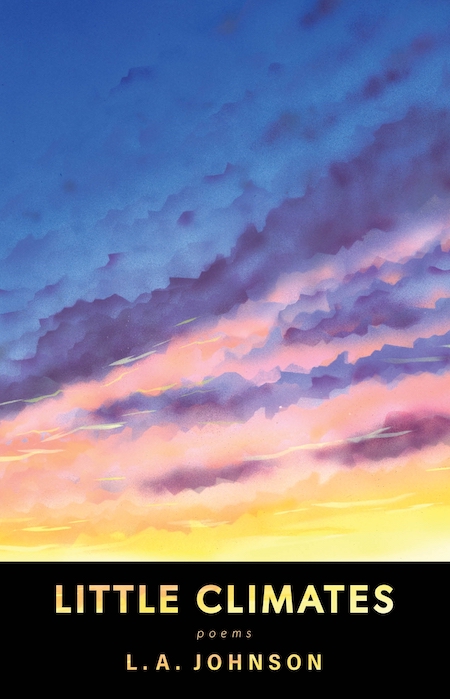
Little Climates: The lyric poems of Little Climates address the divisions between the self and the world, the self and the lover, and self with the self. In her debut collection, L. A. Johnson examines of the disparate spaces humans occupy in relationships: together and separately, alone and as unit. Each partner’s past, how they’ve changed, how they dream of the present—these are the little climates.


L. A. Johnson is the author of the chapbook Little Climates (Bull City Press). She received her MFA from Columbia University and is currently pursuing her PhD in literature and creative writing from the University of Southern California, where she is a Provost’s Fellow. She’s received scholarships and fellowships from Vermont Studio Center and Sewanee Writers’ Conference. Her poems have recently appeared or are forthcoming in The American Poetry Review, Antioch Review, The Iowa Review, Narrative Magazine, The Southern Review, and elsewhere.


Guest Editor’s Note: I first heard L. A. Johnson’s poems at a reading the poet gave in Los Angeles. When I read Little Climates a few weeks later, I realized that her imagery is so acute and vivid that it had stayed with me. Johnson is an expert at creating poignant landscapes and visceral environments. At times, they are intensely familiar: “the notion/of an icebox cake—it’s layers/softening to be like the real thing,” but the poet also deftly moves in directions the reader might never have imagined; “In the evening, / the walls confine the regular angers.” The detailed, sensory world the poet creates builds into unforgettable landscapes that stay with the reader long after the pages of Little Climates have been closed.


Want to read more by and about L. A. Johnson?
L. A. Johnson’s Official Website
Buy Little Climates from Bull City Press
Buy Little Climates from Amazon
Read more poems via At Length
Read more poems via The Account


Guest Editor Alan Toltzis is the author of The Last Commandment. Recent work has appeared in print and online publications including Hummingbird, Right Hand Pointing, IthacaLit, r.k.v.r.y. Quarterly, and Cold Noon. Find him online at alantoltzis.com.


A NOTE FROM THE MANAGING EDITOR:

After nearly ten years as Contributing Editor of this series, the time has come for change. I am thrilled to expand my role to Managing Editor and provide the opportunity for fresh voices to contribute to this ongoing dialogue. Today and in the coming weeks, please help me welcome a series of guest editors to the newest incarnation of the Saturday Poetry Series.

Viva la poesia!
Sivan, Managing Editor
Saturday Poetry Series, AIOTB


SATURDAY POETRY SERIES PRESENTS: PATRICE BOYER CLAEYS

By Patrice Boyer Claeys:

Favorite Color
after Ruth Stone’s “White on White”

A yellow flag iris,
a lick of flame,
glass of Sauternes.

Blinking lights at intersections,
the bills of mallards, old knotty pine
paneling, sticky to the touch.

Lemon meringue pie,
spent elm leaves, the fish brought home
from the fair in its water-filled bag.

Caution tape to mark the murder scene,
the road to Oz,
a wobbling flan, chicken fat.

The burning hydrogen of Arcturus,
broken brooms,
xenophobic dread.

A cheesy joke, wheezy phlegm,
the running rheumy eyes and shaded
teeth of jaundiced men.

Mustard, pus and broken yolks.
The nicotine-stained fingers
of Johnny Cash and Vonnegut.

Slimy bile, old bruises, the pulsing
membrane on the poisonous gland.
The dusty, bitter sex of crocus throat.


Today’s poem first appeared in Volume 5, Issue 1 of Bird’s Thumb and appears here today with permission from the poet.


Patrice Boyer Claeys enjoys the freedom of the empty nest. She thanks her writing group, Plumb Line Poets, for keeping her chiseling away. Her work has appeared in Mom Egg Review, Found Poetry Review, Blue Heron, Avocet, ARDOR, the Aurorean, Beech Street Review and Bird’s Thumb, and is forthcoming in Nassau Review. She was featured in Light, a Journal of Photography and Poetry. She was nominated for Best of the Net.

Guest Editor’s Note: On the surface, the literal and the metaphorical are given equal weight in this poem by Patrice Boyer Claeys. Each item anticipates the next, and the effect is a list of things that are yellow that might or might not be favorable in spite of the title “Favorite Color.” The poet references Ruth Stone’s “White on White” to give some direction for reading, which feels like an excavation, a mining for truth in the scrutiny of the color, its denotation and connotations.

Each line of the poem seems innocuous until the fifth stanza which ends with “xenophobic dread.” This metaphor stops the speaker’s examination of the more benign imagery that includes mallard bills, knotty pine, and “Lemon meringue pie,” and illuminates the “blinking lights of intersections” that has become a portent of imminent threats.

The final three stanzas do not disappoint in providing perilous symbols of imminent dangers, both familiar and unfamiliar. The depictions of disease—the “wheezy phlegm,” the “rheumy eyes,” the “old bruises”—succeed in changing the tone and in producing a mood of ominous expectation. The speaker observes instances of yellow and presents those that are the most necessary to the theme which seems to be a warning and a lesson in keen observation and meaning in context.

Want to read more by and about Patrice Boyer Claeys?
RHINO Poetry
Blue Heron Review
Beech Street Review


Anne Graue

Guest Editor Anne Graue is the author of Fig Tree in Winter (Dancing Girl Press, 2017), and has published poems in literary journals and anthologies, including The Book of Donuts (Terrapin Books), the Plath Poetry Project, One Sentence Poems, and Rivet Journal.


A NOTE FROM THE MANAGING EDITOR:

After nearly ten years as Contributing Editor of this series, the time has come for change. I am thrilled to expand my role to Managing Editor and provide the opportunity for fresh voices to contribute to this ongoing dialogue. Today and in the coming weeks, please help me welcome a series of guest editors to the newest incarnation of the Saturday Poetry Series.

Viva la poesia!
Sivan, Managing Editor
Saturday Poetry Series, AIOTB


Letting the Meat Rest: A Conversation With Poet John Dorsey

Letting the Meat Rest:

A Conversation With Poet John Dorsey

By Chase Dimock

.

If you pick up a copy of Letting the Meat Rest, hoping to find tips for juicy pork chops, luckily, John Dorsey’s got you covered:

a pork chop sizzles in a pan
for six minutes tops
any longer & you’ll let the imagination
bleed out all over your plate
& escape into the woods
like magic.

Yet, Dorsey’s subject matter extends beyond pork products. Reading Letting the Meat Rest is like rummaging through a friend’s box of old Polaroids. You want to learn more about these people and moments captured in time. Some snapshots are brief, impressionistic prints of a person frozen in a sliver of life, while others have their detailed history scrawled on the back. These vignettes present us with visions of addiction, poverty, and trauma, but also optimistic moments of youthful ambition, rebellion, and intimate friendship. No matter what Dorsey depicts, whether it’s a full portrait or a quick sketch, it’s always crafted with deep humanity

.

Chase Dimock: I first became acquainted with your work when a mutual friend of ours told me he was driving up to Central Missouri to pick up the Poet Laureate of Belle, MO. At that moment I learned a few things: 1. That a town named Belle, MO exists 2. That a town of less than 2,000 people in rural Missouri has a Poet Laureate, and 3. That the Poet Laureate of Belle, MO is John Dorsey. Having lived for a few years in Cape Girardeau myself, I know there are quite a few cultural gems to be found in rural Missouri. How did you become the Poet Laureate of Belle, MO and what has that experience been like? I saw one poem in Letting the Meat Rest depicting the appropriately named Dinner Belle restaurant in town, so I am curious to know how this experience in Belle has impacted your writing.

John Dorsey: Well, to make a short story long, Chase,  I ended up in Belle at the end of 2015, from Wisconsin, after being awarded a residency at the Osage Arts Community and through that connection, in particular with the Executive Director Mark McClane, I started to meet more people in town,  including Mayor Steve Vogt, who seeing all of the work I had done and was continuing to do, offered me the appointment as Poet Laureate, I’m actually the first Poet Laureate the town of Belle has ever had. Since my appointment we’ve opened a Non-Profit used bookstore, Barb’s Books, and I founded, and Co-Edit, with Jason Ryberg, a literary journal, the Gasconade Review, which received grant funding through the Friends of the Belle Library, from Kingsford/Clorox. As far as the impact on my work, the first full book I finished here was Being the Fire, which was 80 new poems, written in my first two months here, and published by Tangerine Press in London in Fall of 2016. Since I’ve been here I’d say I’ve written between 300-400 poems, which have gone into 6 or 7 different books or chapbooks and have written a full length feature film, Missouri Loves Company, which was produced by Paladin Knight Pictures out of New Jersey, on a budget of around $60,000, which was shot on the East Coast and here in town, and is currently being edited. In terms of my poetry, I’d say that at least half of everything since I’ve been here has to do with Belle itself, so the impact has been significant. Continue reading “Letting the Meat Rest: A Conversation With Poet John Dorsey”

SATURDAY POETRY SERIES PRESENTS: MAX RITVO

Portrait of poet Max Ritvo. Photo Credit: Ashley Woo, Ari Ritvo

By Max Ritvo:


Holding a Freshwater Fish in a Pail Above the Sea

He strips health out
of the water,
reminding me
of my mother.

I walk in sea
and hold my sweet
fish above me,
no small feat

given the rice-
hard salt scraping
my eyeballs twice
each blink of lid.

I put the pail
in the ocean
and then unveil
the decorous

frail white-eyed koi.
But the salt, I
think, will destroy
his rocking breath.

Where he wants space
he will get salt.
Where key traces
of the silence

should hang inside
his cathedral
of musical
blood—

Instead, delicious
crystal drills
will crack it all
open; the church,

its ebbs and flows.
I scoop the fish
up by its nose,
a forked affair.

I show you him.
Looks fine to me
you say (Ha!), dim
and lovely you.

This happens more
times, stopping and
starting, me showing
you my full hand,

my fish. Where have
you gone? I was
hoping to wake
from this dream

with you drawing
the curtains, a gold
glow on the sheet
wrapping me up.

You aren’t here
but I’m aware
that somewhere
you have moved.


Today’s poem is from Four Reincarnations (Milkweed Editions, 2016), copyright © 2016 by Max Ritvo, and appears here today with permission from Milkweed Editions.

Max Ritvo (1990 – 2016) was an American poet. Milkweed Editions posthumously published a full-length collection of his poems, Four Reincarnations, to positive critical reviews. Milkweed has announced two more books, Letters from Max (co-written with Sarah Ruhl); and a second collection of Ritvo’s poems, The Final Voicemails, forthcoming in 2018. Ritvo earned his BA in English from Yale University, where he studied with the poet Louise Glück, and his MFA in Poetry from Columbia University. In 2014, he was awarded a Poetry Society of America Chapbook Fellowship for his chapbook AEONS. He edited poetry at Parnassus: Poetry in Review and was a teaching fellow at Columbia. Ritvo died from Ewing’s sarcoma on August 23, 2016, and is survived by his wife Victoria; his father Edward Ritvo, his mother Riva Ariella Ritvo-Slifka, and his three siblings, Victoria Black, Skye Oryx, and David Slifka. Ritvo’s work has appeared in Poetry, The New Yorker, Boston Review, and as a Poem-a-day on Poets.org. (Annotated bio courtesy of Wikipedia, with edits.)

Guest Editor’s Note: Knowing about the life and death of the poet can provide a lens through which to read each poem in Max Ritvo’s Four Reincarnations. This poem from the collection, “Holding a Freshwater Fish in a Pail Above the Sea,” offers a number of thematic opportunities, but is most powerful through the biographical filter. The poet controls the language—each word, line, and stanza confounds expectations and inspires repeated visits to the poem and its evocative images.

At the outset, there is fear and love for the fish bound in memory and fear. The gentle rhyming quatrains are almost imperceptible behind the fierceness of feeling, but they provide the rhythm and sway of the water controlling the speaker’s emotions even in a dream state. Shifting awareness supplies a type of psychoanalytic wish fulfillment accompanied by an acceptance of the inevitable.

Each turn in the poem feels natural and effortless within a controlled formal structure, and this makes the emotional charge more concentrated and pungent. The lines “Where he wants space/ he will get salt” are especially potent and seem to anchor the speaker in reality revealed by the metaphors and symbols that emerge from the subconscious. Ritvo’s poem exposes the terror in living a life that ends in death and does so in language that is accessible and miraculous.

Want to read more by and about Max Ritvo?
The Poetry Foundation


Guest Editor Anne Graue is the author of Fig Tree in Winter (Dancing Girl Press, 2017), and has published poems in literary journals and anthologies, including The Book of Donuts (Terrapin Books), the Plath Poetry Project, One Sentence Poems, and Rivet Journal.

A NOTE FROM THE MANAGING EDITOR:

After nearly ten years as Contributing Editor of this series, the time has come for change. I am thrilled to expand my role to Managing Editor and provide the opportunity for fresh voices to contribute to this ongoing dialogue. Today and in the coming weeks, please help me welcome a series of guest editors to the newest incarnation of the Saturday Poetry Series.

Viva la poesia!
Sivan, Managing Editor
Saturday Poetry Series, AIOTB


SATURDAY POETRY SERIES PRESENTS: MARISA CRAWFORD


By Marisa Crawford:


I’m too sensitive for this world / this Foot Locker

Oh right, the bomb
Sorry so boring
300-year-old wiener dog
China teacups rimmed in gold
Oh right, underwater
Backwards somersault, no
Outside w/ the flowers
Uhhhhhhhhhhhhhh like it matters
9th grade Metallica disaster
Cutest hottest-pink dress ever
Janie / not Janie / not over
Summer that bled into forever
See that backslash that’s the gash in my left arm
See that scar that’ll always be there
Janie’d be like, so show me so stop doing it
So eat something, J
So coconut cake bonne bell
You shoved it in my face / posted on my wall
Smell it, smells like a memory
Smells like a fake cake
This metal gate has been a gift to me
That metal guy at the party with the long hair and the gift for
Piercing the beer can / swallowing it all in one gulp
Was that the first time
He like, put his arms around me from behind
Somehow I willed it to happen w/ my mind
& then there was / a porch swing
Macbeth, my whole life, my death, everything


Poem

I like being a lil bit mean to Stephen
Wearing things that look architecture-y
Eating apple pie with my ice cream
I guess I couldn’t help it
I imagined my wedding brunch
on the tabletop catalog spread
called “A Perfect Match”
Girls at work who talk on the phone
in another language, girls who don’t
She asks me where I live in New York City
I don’t live there, I don’t live anywhere
Clip art of a nine-year-old
girl climbing a tree
leaning on her elbow
skinning her knee
VP of Creative sending an email
with the subject line “The Future”
You calling my tampon a “little mouse”
as you pulled it out


Today’s poems appear here today with permission from the poet.

Marisa Crawford is a New York-based writer, poet, and editor. She is the author of the poetry collections Reversible (2017) and The Haunted House (2010) from Switchback Books, and the chapbooks Big Brown Bag (Gazing Grain) and 8th Grade Hippie Chic (Immaculate Disciples). Her poetry has appeared in publications including Prelude, Bone Bouquet, Glittermob, and No, Dear, and she’s written about feminism, art, and pop culture for Hyperallergic, BUST, Bitch, Broadly, The Hairpin, and elsewhere. Marisa is the founder and editor-in-chief of Weird Sister, a website and organization that explores the intersections of feminism, literature, and pop culture.

Guest Editor’s Note: Reading Marisa Crawford’s poems reminds one of the feeling you get while looking through a Viewmaster. The reader experiences a gut punch of image and sensory recognition as Crawford takes the reader to the a New York City street, to a party, to a phone screen, face-to-face with a tampon. She plays on our olfactory senses. Macbeth shows up and makes us briefly feel those feelings of doom and futility in the face of human fallacies, blood trails and all. In “Poem” we confront the absurdity and futility of office life. Crawford writes, “VP of Creative sending an email / with the subject line ‘The Future,’” and with that the future unfolds. What will it taste like? What will it remind us of? She is a master of non-sentimental nostalgia. There’s a lightness of being to reading these poems, but the poems themselves are not light. They speak of the feminist and the feminine, the collective experience of being alive in these weird times.

Want to read more by and about Marisa Crawford?
Marisa Crawford’s Official Website
Buy Reversible from Swtichback Books
Weird Sister


Guest Editor Natalie Lyalin is the author of two books of poetry, Blood Makes Me Faint, But I Go For It (Ugly Duckling Presse 2014), and Pink & Hot Pink Habitat (Coconut Books 2009), as well as a chapbook, Try A Little Time Travel (Ugly Duckling Presse 2010). She is the co-editor of Natural History Press. She lives in Philadelphia and is working to befriend a flock of crows.

A NOTE FROM THE MANAGING EDITOR:

After nearly ten years as Contributing Editor of this series, the time has come for change. I am thrilled to expand my role to Managing Editor and provide the opportunity for fresh voices to contribute to this ongoing dialogue. Today and in the coming weeks, please help me welcome a series of guest editors to the newest incarnation of the Saturday Poetry Series.

Viva la poesia!
Sivan, Managing Editor
Saturday Poetry Series, AIOTB


SATURDAY POETRY SERIES PRESENTS: MEGAN WILDHOOD

After nearly ten years as Contributing Editor of this series, the time has come for change. I am thrilled to expand my role to Managing Editor and provide the opportunity for fresh voices to contribute to this ongoing dialogue. Today and in the coming weeks, please help me welcome a series of guest editors to the newest incarnation of the Saturday Poetry Series.

Viva la poesia!
Sivan, Managing Editor
Saturday Poetry Series, AIOTB


How to Use Water as Fuel
By Megan Wildhood

Dad says I should have been born a fish,
what with the eerily natural way I moved through water.

He and I got our scuba diving certificates
together when I was 12 – I didn’t notice

the Caribbean makes your hair sticky as it’s drying
under a sun I didn’t care would rudely

find every last fleck of flesh exposed.
My sister rejected diving, getting in the water

at all, because of what the wild does
to your hair and skin.

We glossed arguments in the family,
like makeup on my sister’s face. I had to be

persuaded to start wearing the stuff because it seemed
like both Mom and sister needed a cleanup crew

every night just for their faces. They used water
to wash; I used it to fly.


Today’s poem is from Long Division (Finishing Line Press, 2017), copyright © 2017 by Megan Wildhood, and appears here today with permission from the poet.

Megan Wildhood: Do you feel isolated, uncertain about where in the world your story might be welcome? Megan Wildhood, a Seattle-based writer and poet, can deeply relate – she feels like an outsider most places she goes. She’s written about the various ways she’s felt like a misfit in The Atlantic, Contrary Magazine, America Magazine and in her chapbook Long Division, released September 2017 from Finishing Line Press, among other publications. She’s working on a novel and more poetry projects; head on over to meganwildhood.com to learn more.

Guest Editor’s Note: Family dynamics are notoriously complicated, and Megan Wildhood tackles them with unflinching honesty in “How to Use Water as Fuel” from her chapbook, Long Division. In this poem, we’re immersed in water, exploring a closeness to certain family members and a distance from others. The speaker feels connected to her father — “Dad says I should have been born a fish, / what with the eerily natural way I moved through water” — but disconnected from her mother and sister. The final lines of the poem highlight this aching contrast: “They used water / to wash; I used it to fly.” Finding commonalities and bridging the gaps between us is critical. “How to Use Water as Fuel” ultimately explores the longing for connection, even when our differences get in the way.

Want to read more by and about Megan Wildhood?
Megan Wildwood’s Official Website
Buy Long Division from Finishing Line Press
“Not Jumping” in America Magazine

Guest Editor Alana Saltz is a poet, writer, and freelance editor living in Tacoma, Washington. She received her MFA in Writing from Antioch University and her work has been published in The Washington Post, The LA Times, The Huffington Post, Angels Flight, voxpoetica, and The East Jasmine Review. You can find out more about her at alanasaltz.com or @alanasaltz on Instagram and Twitter.

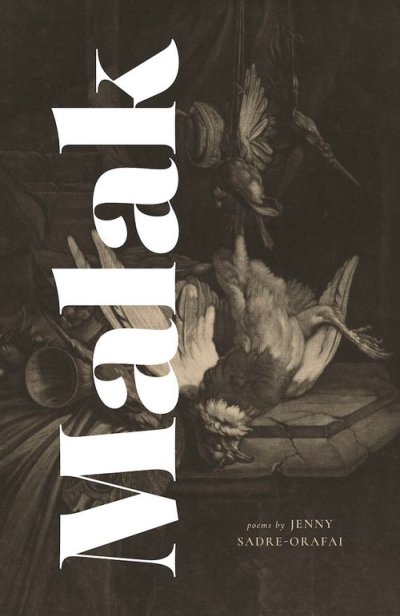
SATURDAY POETRY SERIES PRESENTS: MALAK


From MALAK
By Jenny Sadre-Orafai:


LAST READING

There is a pregnant bird in the cup.
Malak looks at me like she has never looked

at that in a cup before. My father looks at me
like there are things I’m not telling him.

She crochets baby caps, square blankets,
booties in Neapolitan ice cream colors.

If I ever have these babies, if I’m the bird
in the cup, I’ll want to devour them.

After the last reading she leaves the cup turned up,
daring the bird to forget I was pregnant.


MOTHER SPELL

I felt for mountain
and ocean, my first globe.

Mouth or beak. Arm or wing.
Skin or feather. Feet or feet.

Who brought these to me
to dress in booties and caps.

I didn’t ask to know a belly
so tight.

I didn’t ask if it was girl
or boy or bird.


LANGUAGE OF SIGNS

I slept the whole day
without remembering, Malak.

I dreamt I had a son
growing so fast,

a tomato plant sprawled
everywhere, unstoppable.

I held him at my hipline.
And I fed his hunger.

Now he’s a pitcher
of water.


Today’s poems are from Malak (Playtpus Press, 2017), copyright © 2017 by Jenny Sadre-Orafai, and appear here today with permission from the poet.


Malak is an invocation of past and future. With familial lament and childish wonder, the words lay tribute to the infinite—to the beauty in descent and the heartache that binds us to place. To our smallness in death and the importance of conjuring anew.

Jenny Sadre-Orafai is the author of Paper, Cotton, Leather and five chapbooks. Her poetry has appeared in Cream City Review, Ninth Letter, The Cortland Review, Hotel Amerika, The Pinch, and other journals. Her prose has appeared in Los Angeles Review, The Rumpus, South Loop Review, Fourteen Hills, The Collagist, and other journals. She is co-founding editor of Josephine Quarterly and an Associate Professor of English at Kennesaw State University.

Editor’s Note: Birds, tea leaves, foxes. If there are talismans that illuminate the path Jenny Sadre-Orafai’s Malak lays out for the reader, these may be those divining objects. There is magic within these pages — the kind that is conjured up in Gypsy tents and over old world kitchen tables, magic from a time and place when women were believed. But the future is always uncertain, and the tales that unfurl within Malak‘s pages curve and splinter like the lines on a palm.

What is inheritance, this collection asks. What is lived? What is lost? Do we inherit even that which cannot be passed down? Are predictions only as good as their fruition?

Malak is a book that pairs loss with beauty, future with past, the certainty of fate with the unknown and the unknowable. Throughout its pages, a sense of familiarity is established that both grounds and destabilizes. Its stories are told in the dark of night, but under the light of a full and generous moon. When Malak‘s truths reveal themselves, you bask in their luminosity and marvel at the careful magic of their making. You do not ask if they are boy or girl or bird.

Want more from Jenny Sadre-Orafai?
Buy Malak in paperback from Platypus Press
Buy Malak on Kindle from Amazon
Jenny Sadre-Orafai’s Official Website

High School Poetry Series: Gender, Identity, & Race — Robert Garrett

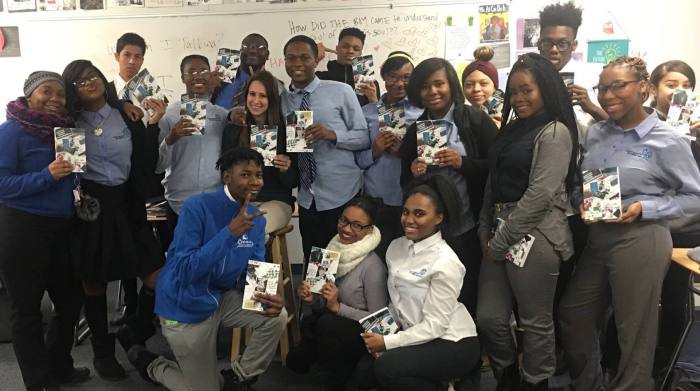
16403407_10103555321683718_111071533205757261_oA note from Series Editor Sarah Marcus-Donnelly: Born from a powerful in-class discussion that we had about gender, race, and the role of masculinity in rape culture, many of these poems are an analysis of gendered, racial personal experience and a study of our intersectionality. This poetry series was inspired by a HuffPost essay I wrote called, “Why I Teach Feminism at an Urban High School.” The poets featured here are all current students whose work I found to be brave and progressive. Please help me support their crucial and influential voices.

I chose this poem for its insistent rhyme that is both grounding and unsettling. The devastation is palpable, and the vision of a violence-free future is essential.


Shell

Life is an empty shell
because of a shell.
I wonder if you fly in the sky
or cry in hell?

I hope your killer rot in jail
in an uncomfortable cell.
As I sit back and reminisce
the memories bliss–

I remember the near miss that almost kissed
My skull instead
it leaked your lung
then the blood
ran down as your eyes hung.
Still, in that moment, it never seemed real.

Till I heard the sirens squill.
I still remember the feel I caught
the chills but didn’t cry, and I can’t
remember why, but I had this feeling
that day I should’ve died.

Time moved fast; it was your funeral now.
Tears dropped, hearts stopped
The room froze,
you could hear a penny drop
The preacher walked
to the stage, cleared his throat
and flipped the page.

Said a prayer to start
then read off your obituary–
your age,
the whole crowd sighed in dismay.

They said, “He was a good kid,”
“He had bright future,”
But all I thought about was the weapon
that took your life was a Ruger.

And as I sat I had a dream
like Martin Luther King Jr.
of a world filled with peace.
Man it was nice, you could walk down street
without looking twice.
You could walk at night
when the lights wasn’t bright
without hearing gunshots left and right.

Then reality set in, and I was back
in the war zone
where guns are easy to get in.
And at least once a day
somebody becomes “a dead man”.

A place where hope is destroyed
and the whole country wants to fit in.
With the depiction of weapons
that Hollywood is setting.

But they’re not showing the truth,
because the truth don’t sell.
We watch as it fails the youth
and floods the cells.

It’s time to break through the shell
of ignorance.
You can no longer
claim your innocence.

You just need to open your eyes;
they say it’s a beautiful world, but it’s a disguise.
Cause every other day, a child’s mother cries,
as their precious one floats to the sky.

At the hands of the “necessary evil,” the picture deceitful,
because if they get one, you get one, we all get one.

We need to change the soil
that is growing the seeds doing the bad deeds.
Like cutting the dead roots from sick trees.
Cause now we just watching the leaves
turn brown as the sun goes down
nobody looks around to notice that world
is a continuous run from danger.

The feeling when a stranger can rearrange
your life, wonder where we made a left
cause this world ain’t right.

IMG_1068

Robert Garrett is a high school senior who enjoys reading, social activism, and volunteering. He loves playing baseball and is a 4-year starting centerfielder. He is currently very busy applying to colleges.


SATURDAY POETRY SERIES PRESENTS: #METOO POETRY


Editor’s Note: As the #metoo movement that originated ten years ago with Tarana Burke reached a critical mass this week, together we bore witness to innumerable traumas. Perhaps, like me, you felt far more than you were able to articulate. In times like these I turn to poetry to find the words there are no words for. To that end, today I turn to poetry of witness and testimony. To poems that are unafraid to call out sexual assault and its aftereffects. To poetry that says: me, too.


“Seized” by Rachel Heimowitz

“I Should Quit Teaching” by Lois Roma-Deeley

Rupi Kaur’s #metoo poem

“bone” by Yrsa Daley-Ward

Nayyirah Waheed