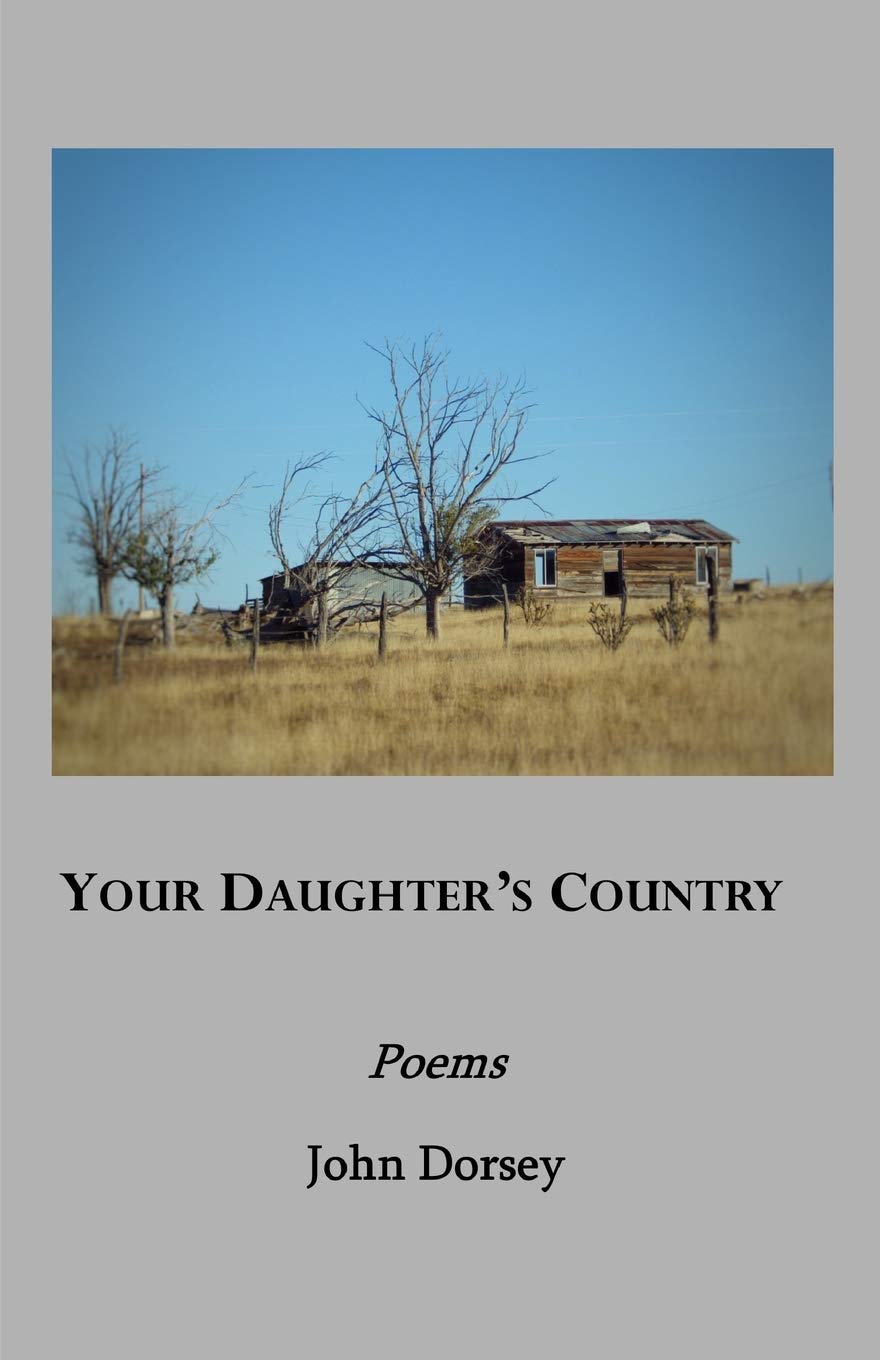
“A Review of John Dorsey’s Your Daughter’s Country” By Chase Dimock


Your Daughter’s Country by John Dorsey

Reviewed by Chase Dimock


Reading Your Daughter’s Country (Blue Horse Press) is like leafing through an old family photo album. But, instead of your good-natured grandma narrating while tactfully dancing around family secrets and perfuming the pictures of cousins nobody talks about anymore with a folksy “it takes all kinds,” your guide is Uncle John, who tells you everything. Schlitz in hand, he tells you of aunts with “cracked skin” who could “eat $20 worth of burger king”, abusive great-grandfathers, uncles who never left their “mother’s side,” and cousins bathing in a steel drum.

You wonder if it’s appropriate to hear all this, but you can see the fondness, empathy, and pain in Uncle John’s eyes, and you realize this isn’t gossip or the settling of old scores. It’s love for the wear and tear we see in people content with their scars or nursing their bruises, and an almost ethical duty to present people as they are: neither sensationalized nor sanitized.

Dorsey’s first two poems “Poem for Olin Marshall” and “A History of Bite Marks” might best express this style of empathy through truth.

all my grandmother’s cousin ever wanted
was his own pizza & a used lawn tractor
the son of sharecroppers & war heroes
he drove a school bus & raised wild dogs
that bit the hand that fed them

We see Olin’s life as a series of loss: he talks of his dead sister “as if she were a saint,” his wife who passed the same year (“he had never seen a ghost quite as lovely”) and the death of his brother, whose estate he inherited, but simply let sit in a bank, resigned to “gathering his history up like dead leaves.” It’s this understanding of Olin’s melancholia that perhaps explains why in “A History of Bite Marks,” Dorsey does not complain too loudly about washing Olin’s dog Bruno as “he tried to take chunks out of our ankles.” Loving others means being bitten, and finding meaning in the language of bite marks.

When applied to his family, Dorsey’s trademark empathy for the underappreciated tells us more about his own identity. In “Tommy” he remembers a great uncle born with cerebral palsy like himself:

one of the sweetest men
i’ve ever known
he was a large baby
big enough to swallow
whole japanese tourists
in some infant godzilla scenario

Several poems remember his grandfather, who bears the decline of the Rustbelt on his shoulders. In “His Summer Place” he laments his grandfather losing an inherited family property after the failure of his painting business. “We Were Still Brave Then” depicts Dorsey as a child and his naive but charitable reaction to his Grandfather’s unemployment, gifting eight dollars to help the family. In a way, we’re reading the John Dorsey origin story, a look into how he inherited and developed his human insight and empathy as a poet.


The collection’s eponymous poem “Your Daughter’s Country” is Dorsey at his most revealing and unsettling, tracing the lineage of generational trauma. It begins with a fairly standard description of his great-grandfather’s depression era farm life, but then suddenly he exposes what the family long repressed:

the family history gets a little fuzzy

it wasn’t until i was in my 20’s
that i found out he had also been
an alcoholic
a railroad man
& a rapist

something my own father never knew

The rest of the poem delves into the tragic, abused life of his grandmother, for whom “there was never anywhere for her to go that was far enough away from where she’d been.” This is Dorsey’s greatest twist. He populates the book with several endearing, or at least sympathetic portraits of family, until you come to the poem that bears the book’s name, and he rips apart our expectations, like the way his great-grandfather’s abuse likely tore through generations of family.

While the poems about his literal family stand out, for John Dorsey, the familial extends beyond blood kin. Throughout his career, Dorsey’s work has been known for his portraits of people often overlooked or misunderstood. Whether it’s an old friend or a weathered stranger’s face at a rural Missouri diner, he has the ability to pull something from deep inside a person that feels as if it came from the memories of a cousin you spent all your summers swimming with.

In “Poem for Mary Anthony” Dorsey portrays a trucker who knows “you won’t find god in the stacks of books we have piled high in the bookstore in town.” In another poem, he mentions a friend’s brief recollection of a man who placed second in an episode of Star Search, but

just like in life
nobody ever remembers
the runner up.

instead they ask you
for your last cigarette

I’d argue that Dorsey’s poetry is all about remembering the runner up, as well as the last place finishers, those who didn’t get an audition, and all those who never got to dream of an opportunity.


Your Daughter’s Country is available from Blue Horse Press.


About the Author: Chase Dimock is the Managing Editor of As It Ought To Be Magazine. He holds a PhD in Comparative Literature from the University of Illinois and his scholarship has appeared in College LiteratureWestern American Literature, and numerous edited anthologies. His works of literary criticism have appeared in Mayday MagazineThe Lambda Literary ReviewModern American Poetry, and Dissertation Reviews. His poetry has appeared in Waccamaw, Hot Metal Bridge, Saw Palm, San Pedro River Review, and Trailer Park Quarterly. For more of his work, check out ChaseDimock.com.


More by Chase Dimock: 

Letting the Meat Rest: A Conversation With Poet John Dorsey 

Leadwood: A Conversation With Poet Daniel Crocker

First-Hand Accounts From Made-Up Places: An Interview With Poet Mike James
“The Word with the Schwa that’s Really a Short U” By Ronnie Sirmans


THE WORD WITH THE SCHWA THAT’S REALLY A SHORT U

My new friend’s from Boise,
and I remember: as a boy
reading the word and mis-
pronouncing it as “Boys.”  
Some words seem to say
themselves to us. Like love.  
Has anyone moved lips
and tongue with a long o
to whisper to their true “loave”?  
Instincts may shape the syllable,
from inaudible caul, borne by
fluid breath like spoken words.
The pronunciation, its middle is u,
but not mouthed as “you,” but rather
the sound of our uncertainty, “uh”
— announcing our confusion over
how to grasp the word’s meanings,
a rainbowed fish still in the currents,
that we can’t catch with our bare hands
but need strong jaws like the bear
or a hook that snags the mouth
and lips, causing a bloody wound.


About the Author: Ronnie Sirmans is a digital editor for a print newspaper in Atlanta, and his poems have appeared in Gargoyle, The South Carolina Review, Tar River Poetry, BlazeVOX, The American Journal of Poetry, Deep South Magazine, and elsewhere.


More By Ronnie Sirmans:

“Remembering the Great Flood in the Frozen Food Aisle”


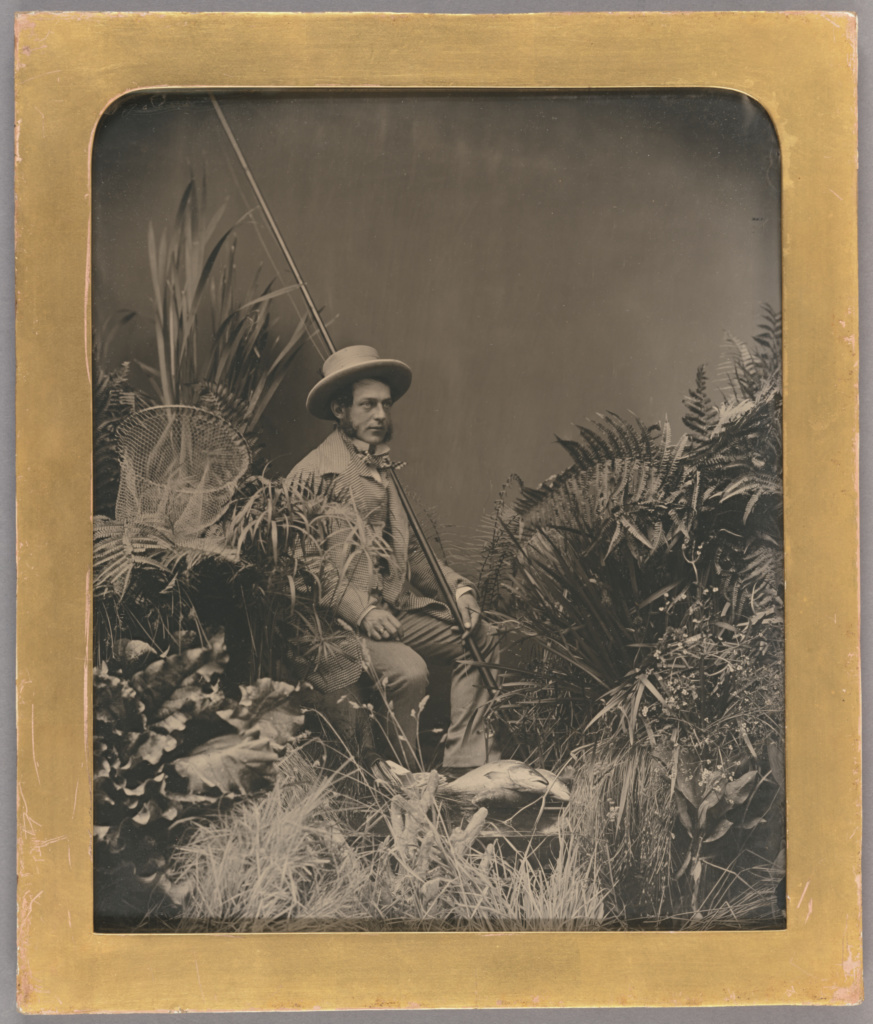
Image Credit: “Studio Portrait of a Man Posed with Fishing Gear / The Fisherman” Artist Unknown.  Digital image courtesy of the Getty’s Open Content Program

Bunkong Tuon: “Gender Danger”


This is the second in a series of poems from a forthcoming poetry collection about raising a biracial daughter in Contemporary America, during this polarizing time of political and cultural upheavals where sexual harassment allegations abound, where a wall, literal and figurative, threatens to keep out immigrants like the narrator, a former refugee and child survivor of the Cambodian Genocide. You can find the full series of poems below.


Gender Danger

Chanda goes down
the slide, then climbs
back on it, and laughs
when I shake my head,
“No, not that way.”
She flies on the zip-line,
yells, “Look at me, Daddy.”
Inside a giant plastic globe
she screeches as I spin
her world. Then she says,
“Potty, Daddy, Potty.”
We cross the lawn,
go through a corridor,
and find ourselves in
front of the bathroom.
I move us towards
the men’s room
but Chanda yanks me
to the women’s room.
She is aware of gender
but is not ready to use
the restroom on her own.
“Daddy can’t go in there,”
I explain. She cries, “No
boysroom. No boys!”
A woman walks by.
I want to ask for help
but reason prevails.
So I pull Chanda
into the men’s room.
She’s on the toilet,
tears streaming
down her face.
Someone comes in
right after us, whistling.
Chanda looks at me,
eyes squinting, screeches.
I hold one of her hands,
pat her shuddering
shoulders, and repeat,
“It’s okay, Honey.
Daddy’s right here.”


About the Author: Bunkong Tuon is the author of Gruel (2015) and And So I Was Blessed (2017), both poetry collections published by NYQ Books, and a regular contributor to Cultural Weekly  He is also an associate professor of English and Asian Studies at Union College, in Schenectady, NY.


Bunkong Tuon’s series of poems on raising a biracial daughter in contemporary America:

Ice Cream

Gender Danger

The Bite

Tightrope Dancer

Women’s March in Albany

My Mother on Her Deathbed


Image Credit: “Young girl taking a Kodak picture of her doll” (1917) Library of Congress

“Sent My Way” By Marc Frazier


Sent my Way

A white crow is at home in my front yard—
a symbol like everything is
I know when I see a cardinal’s red flit before me
It’s the spirit of my mother Agnes checking in
But I didn’t even know such an anomaly existed
I remember the white buffalo of Wisconsin
Many years back which drew crowds
But it died on everyone—a clear message I believe
Who likes crows to begin with
This one is loud like the rest and speaks to me
In its own inimitable bird language
A thing alone and so noticeable must be a treat
to predators—red in tooth and claw
though poets created a “murder” of crows
(scientists don’t use such a term)
some primal violence is associated with them
and I wonder how many baby robins
this glorious creature by my elm has devoured.
like me it must fit in with its peers where it can
It seems to feel safe and listened to with me near
When I hear a cardinal’s chirp I know God is real
When I hear this white crow, I wonder how we survive
When so much sets us apart from the flock
Our blessing, our curse


About the Author: Marc Frazier has widely published poetry in journals including The Spoon River Poetry Review, ACM, Good Men Project, f(r)iction, The Gay and Lesbian ReviewSlant, Permafrost, Plainsongs, and Poet Lore. Marc is the recipient of an Illinois Arts Council Award for poetry and has been nominated for a Pushcart Prize and a “best of the net.” His book The Way Here and his two chapbooks are available on Amazon as well as his second full-length collection Each Thing TouchesWillingly, his third poetry book, will be published by Adelaide Books New York in 2019. His website is http://www.marcfrazier.org.


Image Credit: Emmanuel Bastien, “Crows” Remixed by the AIOTB Magazine staff Creative Commons.

“Hit and Run” By Steve Cushman


Hit and Run

My father had left us two days earlier
and my mother was driving the rusting
Torino to my sister’s softball practice.
Kim was in the front, and I was in the back.
Mom stopped at a red light when a man 
read-ended us. Shit, Mom said, enough already,
but we weren’t yet done with heartbreak because
five minutes later the hit and run driver, a tall
skinny drunk guy seemed to realize what sort
of trouble he was in, so he took off.  When the
police officer arrived and walked over, my mother
punched his chest, and my sister shook her head,
said Men.  The cop opened his arms when he could
have closed them.  Then he did what I couldn’t do,
held my mother, told her it was going to be alright
whether he believed this or not I’ll never know.


About the Author: Steve Cushman has published three novels, including the 2004 Novello-Award Winning Portisville.  His first poetry collection, How Birds Fly, is the winner of the 2018 Lena Shull Book Award.


More by Steve Cushman:

“Small Gifts”


Image Credit: “Manayunk, Pennsylvania. Part of an automobile junk yard on Ridge Avenue” by Paul Vanderbilt (1938) from The Library of Congress

“Cards” by Jonathan K. Rice


Cards
           circa 1965

It’s time for the monthly bridge club
my parents host with couples
from other neighborhoods
and it’s our turn. My role is minimal.

I’m told to stay in my room,
but to first greet everyone and say goodnight,
just not be seen and not play my records.
Preferably not make any noise at all.

I decide to read The Island of Dr. Moreau
I bought at the school book fair that morning,
maybe play around with the crystal radio I built from a kit.

Before long I can hear people laughing,
ice clinking. I can smell the vermouth, gin,
the occasional cigarette.

I open the window, take off the screen
and climb out behind the tall hibiscus,
dodging palmetto bugs and lizards,

steal away into the night down the block
where older kids hang by the street light.
The newspaper boy has a zip gun he made
with some pipe from a nearby construction site.

He says it will shoot .22 bullets
and he has a pocketful. I can see the cars
in the driveway and along the street
in front of my house.

The kid shoots his zip gun. It sounds like a
firecracker, and we hear broken glass. He loads
it again. More fireworks. More broken glass.
And it’s all in front of my house.

We run in different directions.
I run toward a neighbor’s backyard
around to my window.

I hear the needle scratch vinyl, screeching
through my dad’s bossa nova record
while men cuss. This is not what Bridge
usually sounds like.

I hear poker chips being thrown and stacked,
the hardness of bottles and glasses on the table,
doors opening and closing, people coming and going.
footsteps down the hallway.

The screen and window back in place,
I pick up my book. Mom comes in,
finds me reading H.G.Wells.


About the Author: Jonathan K. Rice edited Iodine Poetry Journal for seventeen years. He is the author of two full-length poetry collections, Killing Time (2015), Ukulele and Other Poems (2006) and a chapbook, Shooting Pool with a Cellist (2003), all published by Main Street Rag Publishing. He is also a visual artist. His poetry and art have appeared in numerous publications, including Cold Mountain Review, Comstock Review, Diaphanous, Empty Mirror, Gargoyle, Inflectionist Review, Levure Litteraire, The Main Street Rag, Wild Goose Poetry Review and the anthologies, Hand in Hand: Poets Respond to Race and The Southern Poetry Anthology VII: North Carolina.


More by Jonathan K. Rice

“Springmaid Pier”


Image Credit: “Detroit, Michigan. Poker hand and hands of girl players” (1941) Arthur S. Siegel. from The Library of Congress

Bunkong Tuon: “Ice Cream”


This is the first in a series of poems from a forthcoming poetry collection about raising a biracial daughter in Contemporary America, during this polarizing time of political and cultural upheavals where sexual harassment allegations abound, where a wall, literal and figurative, threatens to keep out immigrants like the narrator, a former refugee and child survivor of the Cambodian Genocide. You can find links to the full series of poems below.


Ice Cream

I take Chanda
to the local mall,
where she flies
in the bounce house
with other kids,
screaming and laughing.
She climbs up
the slide and rolls
down the cushy steps.
She pirouettes
on the piano floor.
Then I take her
to the ice cream place
where we share
a cup of vanilla.
I watch her quietly
shove a spoonful
into her waiting mouth,
tasting the sweetness
on her pink tongue.
Memories of my father
flood, how he lost his wife.
When the Khmer Rouge regime
fell, Grandma was preparing to
take me with her to Thailand.
My father took me out
for ice cream one day.
He was telling me
something important.
That he would follow
Grandma and bring me home.
That he would wait
for me.
That he would always . . .
But I couldn’t hear a word
he said once the ice cream
flooded my tongue with
such sweetness.


About the Author: Bunkong Tuon is the author of Gruel (2015) and And So I Was Blessed (2017), both poetry collections published by NYQ Books, and a regular contributor to Cultural Weekly  He is also an associate professor of English and Asian Studies at Union College, in Schenectady, NY.


Bunkong Tuon’s series of poems on raising a biracial daughter in contemporary America:

Ice Cream

Gender Danger

The Bite

Tightrope Dancer

Women’s March in Albany

My Mother on Her Deathbed


Image Credit: “Miss Lisa’s ice cream sign, old Rt. 31, Perrysburg, Michigan” By John Margolies, The Library of Congress

“My Joints Hurt And Other Fascinating Topics Of Conversation” By Margaret Crocker


MY JOINTS HURT
AND OTHER FASCINATING TOPICS OF CONVERSATION

So.

This is what it’s come to.
You
and me,
green tea
and a free association of maladies.

You cannot know how sick I am,
the pain I feel,
the woes I have.

But, hey,
here’s a dirty joke to make it better.

All laugh.
I cough.
You sweat.
We both sigh,
and limp
ever closer
to the finish line.


About the Author: Margaret Crocker is an artist, writer, wife, mother, daughter, sister and thief. She collects stray animals and has this weird fantasy of being on The Great British Baking Show, despite the fact she uses a bread machine. She knows little but proclaims much. There is much we don’t know about her.


More By Margaret Crocker

“The Art of Acquiescence”

“Earth, Air, and Lynda Carter”

“Mental Health Portraits”


Image Credit: “Dance of Death: The Doctor” Hans Holbein (The Cleveland Museum of Art)


Two Prose Poems By Mike James


Moving Again

Not everything fits on the back of my motorcycle. For instance, neither my pet cactus nor my roommate cat travel well. Both claw me considerably in different ways. And my bike is not large. It’s the small engine type I never grew out of.

Thomas De Quincey knew it was time to move when no more books would fit on shelves and when bill collectors came more often than meals. I know it’s time when someone tells me. My jokes worn thinner than the cheapest tissue paper, which won’t absorb more than a shot glass of tears.


Gutter Angels

Identify not by wings, which mostly stay jacket-hidden, but by sadness which serves as eyeliner. Also, by any buffalo penny worn as a pendant. If wings are seen, feathers are frequently oily. Often a few lost on alley bets and during sidewalk waltzes. Be warned: when they crack their knuckles dreams escape. Mice can hear it. And dogs who so often come and happily lick their hands.


About the Author: Mike James is the author of eleven poetry collections. His most recent books include: First-Hand Accounts From Made-Up Places (Stubborn Mule Press) Crows in the Jukebox (Bottom Dog), My Favorite Houseguest (FutureCycle), and Peddler’s Blues (Main Street Rag.) He has previously served as associate editor for both The Kentucky Review and Autumn House Press. After years spent in South Carolina, Missouri, Pennsylvania, and Georgia, he now makes his home in Chapel Hill, North Carolina with his large family and a large assortment of cats.


More By Mike James

“Grace”

“Two Ghazals”

“Two Prose Poems”


Image Credit: “Barrel Cactus” C.R. Savage. (1870s) Digital Image Courtesy of the Getty Digital Collection

“Betty Doesn’t Know Who She Loves More” By Daniel Crocker


Betty Doesn’t Know Who She Loves More

Bruce is the sensitive type
a little nervous but
It’s nice when someone
really listens

Honestly, most of the time
she probably prefers him
Hulk tries, but his thoughts get
muddled. They go from rage
to depression and back again

But Bruce can be a little boring
at times with his talk of
quantum physics, cures and
medication

Hulk has something
and it’s not just the ripped
abs and cantaloupe biceps

Hulk once
knocked a man through
a wall for her

The man died

That says something, doesn’t it
That he would end everything
a man could possibly be so easily
wipe out a billion timelines

and maybe she just couldn’t
love one without the other

Both Bruce and Hulk
know their place
Neither are very happy with it
but it is what it is

and she knows something
they don’t. She knows they are in
love with each other. She couldn’t
force them to part. No, she’ll have both.
Thanks.

.

This poem appears in Daniel Crocker’s book Gamma Rays. For more information, check out this interview between our Managing Editor Chase Dimock and Daniel Crocker about his collection of Hulk inspired poetry.

.

About the Author: Daniel Crocker’s work has appeared in The Los Angeles Review, Hobart, Big Muddy, New World Writing, Stirring, Juked, The Chiron Review, The Mas Tequila Review and over 100 others. His books include Like a Fish (full length) and The One Where I Ruin Your Childhood (e-chap with thousands of downloads) both from Sundress Publications. Green Bean Press published several of his books in the ’90s and early 2000s. These include People Everyday and Other Poems, Long Live the 2 of Spadesthe novel The Cornstalk Man and the short story collection Do Not Look Directly Into Me. He has also published several chapbooks through various presses. His newest full length collection of poetry, Shit House Rat, was published by Spartan Press in September of 2017. Stubborn Mule Press published Leadwood: New and Selected Poems—1998-2018 in October 2018. He was the first winner of the Gerald Locklin Prize in poetry. He is the editor of The Cape Rock (Southeast Missouri State University) and the co-editor of Trailer Park Quarterly. He’s also the host of the podcast, Sanesplaining, about poetry, mental illness and nerd stuff.