Under the Tamarind Tree

Francisco Manuel Blanco: “Tamarindus Indica”
.

Under the Tamarind Tree

By Bunkong Tuon

.

Editor’s Note: This past week, the nation witnessed devastating images from detention centers and heard hateful rhetoric spewed about immigration. Now, more than ever, it is important to humanize immigration and emphasize empathy. It is in this spirit that we are proud to present the final post in a series of poems about the immigrant experience in America.

Our late Managing Editor, Okla Elliott, featured Bunkong Tuon’s work on As It Ought To Be back in January of 2017. Okla was particularly concerned about the anti-immigration rhetoric heating up in the country and he hoped to showcase the voices of immigrants on our site. In honor of Okla’s memory, Tuon has allowed us to feature more of his poetry about his experience as an immigrant from Cambodia in the United States. All of the poems from this series can be found linked at the end of this article.

.

Under the Tamarind Tree

The child sits on the lap
of his aunt, under the old tamarind tree
outside the family home.

The tree stands still, quiet,
indifferent. The house sways
on stilts.

Monks in saffron robes,
and nuns with shaved heads,
lips darkened with betel-nut stain,

sit chanting prayers
for the child’s mother.

Incense perfumes the hot dry air.

There emerges a strange familiar song
between the child and his aunt that day—
a distant one, melodic but harsh,
as if the strings are drawn too tight—

Each time the child hears prayers
coming from the house, he cries;
each time he cries, the aunt, a girl herself,
pinches the boy’s thigh.

.

Previous poems from Bunkong Tuon’s series on the immigrant experience in America:

Fragments

Our Neighborhood in Revere, MA

Snow Day

An Elegy for a Fellow Cambodian

Halloween, 1985

Dancing Fu Manchu Master

Fishing for Trey Platoo

Lies I Told About Father


.

About the Author: Bunkong Tuon is the author of Gruel (2015) and And So I Was Blessed (2017), both poetry collections published by NYQ Books, and a regular contributor to Cultural Weekly  He is also an associate professor of English and Asian Studies at Union College, in Schenectady, NY.

“It Ain’t No Lie, Baby” By Daniel Crocker

.

It Ain’t No Lie, Baby

By Daniel Crocker

.

My first boyfriend killed himself. We didn’t call ourselves boyfriends, but we went to the movies together, went to dinner together, and had a lot of sex. Part of the reason we didn’t call ourselves for what we really were is that it was the ’90s and things then weren’t what they are now. More than that I think, even though he was out of the closet, was my insistence that I wasn’t gay. And I wasn’t and am not. I was a bit of a coward, though.

I didn’t realize at the time that there was another option or, as it turns out, countless other options. And who knows, maybe I’m being presumptuous to think that he would have wanted to call me his boyfriend. He was beautiful and wild and unpredictable. He had a lot of suitors. Still, I do sometimes wonder if things would have been different if I, at that time, could have just went all in so to speak.

It wouldn’t be until several years later that I came out to my friends as a bisexual male—something seemingly as rare as a unicorn. That’s when things got weird. Some of my friends shrugged, and said, “So?” That was the best response possible, and I appreciate each and every one of them. Others weren’t sold on the idea. How is that possible, they wondered, you’re married to a woman.

The reaction from my gay friends could be even more baffling. I heard the old standby, “Bi now, gay later” plenty. That one didn’t bother me at first because so many gay men I knew at the time did go through a period where they told people they were bisexual. They were just testing the waters. But, five years later, it started to get a little old. When I agreed to sit on a panel hosted by the university I attended as the “representative bisexual” most of the questions I got were variations of, “What does your wife think about you cheating on her with men?” My relationship is monogamous I said . . . over and over and over.

My oldest friend, a guy I grew up with, went to church with, love like a brother, had one of the hardest times believing it. His dad was a preacher. Once, when we were young, we were having a conversation about homosexuality in my bedroom. He had not yet come out of the closet and wouldn’t until his early twenties, but it was something we’d talk about now and again. Maybe he was seeing how I would react, but I believe him when he says he just hadn’t been able to admit it to himself yet. We lived in a community that was violently homophobic.

“Look,” I said. “If I was gay I’d march up and down the street telling people. There’s nothing wrong with it.” I don’t know where I got this attitude. Not from my parents, any adult I knew, and certainly not from my hellfire and brimstone church. A church where, mind you, I made the mistake of wearing an earring. The preacher, looking right at me the entire time, went on a rant against homosexuality before saying, “When I was a kid, if a boy had an earring it meant one thing. It still means that today.” Amens all around.

I think what my friend meant when he told me I wasn’t bisexual was that he really expected, if I were, that I would be marching up and down the street telling people. I still love him. He’s incredibly accepting of who I am. We’ve been friends for thirty years. We Skype on Sundays to watch a classic episode of Doctor Who—a tradition started when we’d watch it Sunday nights on PBS. But, I digress. However, I wondered that if he, someone who knew some of the men I had slept with, didn’t buy it, why, I thought, would anyone else?

Continue reading ““It Ain’t No Lie, Baby” By Daniel Crocker”

What Would Jesus Say?

Pieter Brueghel the Younger “Christ and the Woman Taken in Adultery” (circa 1600s)

.

What Would Jesus Say?

By Robert Boucheron 

.

There is a gap of thirty years or more from the death of Jesus in about 30 A. D. to the writing of Mark, the earliest gospel, after 60 A. D. During this period of time, Jesus’s teaching—the parables, prayers, healings, and other words and deeds—was passed down by word of mouth, scholars believe. The Greek word for this oral material is logia, translated as “sayings.”

Evidence for an oral tradition comes from three passages. The best known is the beginning of the gospel of Luke. Luke 1:1-3 reads:

Since many have undertaken to set down an orderly account of the events that have been fulfilled among us, just as they were handed on to us by those who from the beginning were eyewitnesses and servants of the word, I too decided, after investigating everything carefully from the very first, to write an orderly account . . .

Two other passages are quotations in Eusebius from Exposition of the Sayings of the Lord, a lost book by bishop Papias of Hierapolis, who wrote about 100 A. D:

Mark in his capacity as Peter’s interpreter, wrote down accurately as many things as he recalled from memory, though not in an ordered form, of the things either said or done by the Lord. For he neither heard the Lord nor accompanied him, but later, as I said, Peter, who used to give his teachings in the form of anecdotes . . .

Matthew put the sayings in in an ordered arrangement in the Hebrew [Aramaic] language.

The name at the head of each gospel has kata, or “according to” in Greek, and by custom we refer to the names as their authors. In fact, we do not know how the gospels were composed, by whom, where, or for what audience. A standard view is that Matthew and Luke used Mark as a source, added material, and aimed for gentile readers. John wrote last, at the end of the century and independently, with another eyewitness source, “the disciple whom Jesus loved.”

Regarding the second passage from Papias, some scholars think that the gospel of Matthew was composed in Greek, based on its style, and not translated from a Semitic language. But Papias might still be correct, and what we have is a paraphrase or loose translation. Luke wrote better Greek than Mark or Matthew, and he altered the sayings. John reworked the sayings in the way that Plato used the words of Socrates to compose his dialogues, and John added his own theological ideas about Jesus. Some of the speeches in this gospel, then, are unlikely to be things that Jesus actually said.

As quoted, the words of Jesus have a literary quality. They are not spur-of-the moment improvisations or off-the-cuff remarks. After two thousand years and translation to English, they still sound fresh. In addition to the visionary “kingdom of God” and the ambiguous “son of man,” as well as many striking phrases, the sayings have rhetorical style, a gift for metaphor, and the story-telling appeal of the parables. They also sound consistent, the product of a single mind. Continue reading “What Would Jesus Say?”

SATURDAY POETRY SERIES PRESENTS: LAURA READ


RIP, LAURA’S VAGINA
By Laura Read


Your vagina is beginning to devitalize,
the doctor explained, when I asked him why
I had had so many urinary tract infections lately.
The first thing I thought was that I should say
No, your vagina is devitalizing, because I have
two teenage sons, and that is what passes for wit
in our house. But then I got lost in the fact
that he didn’t, in fact, have a vagina,
and I thought I should point that out instead
because in some circles—say, mine—
that would be an insult. Then, in the little
room inside my mind where Dorothy Parker
was holding court at the Algonquin,
I thought maybe devitalize is just a medical term,
give the guy a break. But I didn’t even know
this man. Couldn’t he just give me a prescription
and say something vague about aging?
What about euphemism? I guess devitalize
was one because he went on to more vividly
explain that my tissues were, frankly, deteriorating.
At that point, I was thinking But you haven’t even
seen the area in question
and How did you get
this far without knowing how to talk to women?

Devitalize reminds me of de-ice which is what
I was doing just before this tricky moment
at the Urgent Care. My son was late to Algebra
because it’s really cold and it took a while
to clean the car. And at 8:00 the door
where he usually goes in automatically closes,
so I had to take him around to the front,
and he dropped his phone in the snow
and it got run over, so now there’s a crack
in the screen. He wants me to replace it,
but I said, No, it still works.


Today’s poem previously appeared in the Beloit Poetry Journal, Volume 68, No. 1. Winter 2018, and appears here today with permission from the poet.

Laura Read’s first collection of poems, Instructions for My Mother’s Funeral, was published in 2012 by the University of Pittsburgh Press. Her second collection, Dresses from the Old Country, will be published by BOA in fall of 2018. She teaches English at Spokane Falls Community College.

Guest Editor’s Note: This poem moves through thought and returns to previous memory in a deceptively effortless progression, as if listening to someone recount an experience in conversation. The speaker fixates on a word that informs the tone of the experience and the poem: devitalize. This word takes her down a linguistic path that leads to another path and another, but, unlike Robert Frost, she returns to the fork in the road at the end of the poem with her response to her son that is meant for the insensitive doctor: “No, it still works.”

The allusive dark humor of Dorothy Parker is conjured as a familiar satirical connection and an anchor for association or a metaphorical leap. The “little room” inside the speaker’s mind is where pithy retorts are stored for occasions such as the encounter at the Urgent Care clinic, but she doesn’t respond in the way that she wants to, keeping her thoughts to herself, as many women do in these situations when they are being told that their bodies have failed them in some way by doctors who make assumptions without being completely sure.

The significant linguistic turn the speaker takes to a new word: “Devitalize reminds me of de-ice” leads her to recent memory, and the experience of taking her son to school that morning evokes mournful anger and defiance in the face of a doctor’s proclamation that a vital part of her female-ness is deteriorating. The details are important in her reliving the moments with her son as she is sitting in the clinic, and seemingly mundane facts become the thematic crux, informing the reader how life and language connect to produce intense emotion when we least expect it.

Want to read more by and about Laura Read?
Laura Read’s Official Website


Guest Editor Anne Graue is the author of Fig Tree in Winter (Dancing Girl Press, 2017), and has published poems in literary journals and anthologies, including The Book of Donuts (Terrapin Books), the Plath Poetry Project, One Sentence Poems, and Rivet Journal.

A NOTE FROM THE MANAGING EDITOR:

After nearly ten years as Contributing Editor of this series, it is an honor and a unique opportunity to share this space with a number of guest editors, including the editor featured here today. I am thrilled to usher in an era of new voices in poetry as the Managing Editor of this series.

Viva la poesia!
Sivan, Managing Editor
Saturday Poetry Series, AIOTB


Visit Our Updated Author Interviews Page

Vanessa Bell “Conversation at Asheham House” (1912)

Over the years, we have had the privilege to interview a range of poets, novelists, and multimedia artists. Check out our updated archive of interviews and discover some new, contemporary literary voices.

Bunkong Tuon: “Lies I Told about Father”

From a Russian Anti-Alcohol Poster

.

Editor’s Note: This is the fifth post in a series of poems about the immigrant experience in America. Our late Managing Editor, Okla Elliott, featured Bunkong Tuon’s work on As It Ought To Be back in January of 2017. Okla was particularly concerned about the anti-immigration rhetoric heating up in America and he hoped to showcase the voices of immigrants on our site. In honor of Okla’s memory, Tuon has allowed us to feature more of his poetry about his experience as an immigrant from Cambodia in the United States. You can find the full series of poems at the end of this page.

.


Lies I Told about Father

I believed I had the power to revive you,
to sit you up in the family’s pigsty,
drunk off your ass, smiling at nothingness,
the late morning light shining on your face.
With a son’s quiet adoration, I chiseled you:
a gangster from the East, a Khmer Krom
whose blood cried out Khmer characters (not Vietnamese),
who, guided by fate, found himself in the West
and married mother for her virtue and beauty.

In these poems you drink because, well, real men
drink, curse, and sleep around (the cursing
and sleeping around, you didn’t do, of course,
because of your love and respect for Mother).
I was an aspiring writer then,
renting a tiny studio on Ocean Boulevard
in Long Beach, following in the drunken
bouts of Charles Bukowski, buying cheap wine,
imitating free verse,
waking up to the stench of sour vomit.
Of course, this life did not last long.
I can’t hold liquor, let alone women.
I have always been a reader,
safe behind words, punctuation, and sentences,
between the pages, where I can conquer
an entire nation or seduce women with my long dash—.

Now, I am engaged to a kind, generous person.
Mother would approve of her.
I am returning to you once again,
not for approval, just to talk,
son to father, but it dawns on me:
I am without you.

.


About the Author: Bunkong Tuon is the author of Gruel (2015) and And So I Was Blessed (2017), both poetry collections published by NYQ Books, and a regular contributor to Cultural Weekly. He is also an associate professor of English and Asian Studies at Union College, in Schenectady, NY.


Previous poems from Bunkong Tuon’s series on the immigrant experience in America:

Our Neighborhood in Revere, MA

Snow Day

An Elegy for a Fellow Cambodian

Halloween, 1985

Dancing Fu Manchu Master

Fishing for Trey Platoo

Lies I Told About Father

Visit Our Updated Commentary Archives

“The Passion of Creation” By Leonid Pasternak

.

Since its inception, As It Ought To Be has published commentaries on a wide range of topics, including current events, politics, and cultural criticism. We’ve just finished archiving the past five years of articles. Check out our newly updated commentary page and relive the last five years of social and political changes through the eyes of our writers.

Bunkong Tuon: “Fishing for Trey Platoo”

Fishing for Trey Platoo

By Bunkong Tuon


Editor’s Note: This is the fourth post in a series of poems about the immigrant experience in America. Our late Managing Editor, Okla Elliott, featured Bunkong Tuon’s work on As It Ought To Be back in January of 2017. Okla was particularly concerned about the anti-immigration rhetoric heating up in America and he hoped to showcase the voices of immigrants on our site. In honor of Okla’s memory, Tuon has allowed us to feature more of his poetry about his experience as an immigrant from Cambodia in the United States. The full series of poems is available below.

.


Fishing for Trey Platoo 

You might have seen them 
fishing on the shores of the Cape Cod Canal: 

My uncle in his fisherman’s hat 
pulling in a one-foot scup, my aunt in her pajama-like 

pants walking backward up the bike path, 
snapping a line that’s got stuck between the rocks, 

my other aunt reeling in a sea bass 
her husband by her side directing. 

Bikers, joggers, teenagers and their dates, 
families with their children look curiously on. 

Or maybe you have seen them
lining up all three sides of a pier in Salem, 

their wrists jerking in a language 
that bewitches the squids below. 

They are not the only ones.
Other Cambodians and Vietnamese, once enemies, 

fish side by side on the same American pier. 
Other immigrants, Chinese, Spanish, Portuguese 

speaking languages that I can’t understand, come together 
on this spot: sacred rods in hands, beckoning the squid. 

Or maybe you have seen them
under a bridge fishing the Providence River, 

looking for trey platoo, a type of mackerel
like they used to eat in the refugee camps in Thailand. 

Sometimes, my aunts and uncles run into an old friend 
from those long ago days. They talk about the lack 

of food, of sneaking out at night to fish, and of running, 
always running, from the Thai police. 

They exchange phone numbers, share fishing secrets,
and set up a time and place where they’ll fish together again. 

When they get home, my aunts gut the fish,
clean them, fry them, and put them in boiling stew 

of galangal, lemongrass, and kaffir leaves.
My uncles and aunts sit in a circle on the floor, 

eat, and tell stories of how this fish got away
or how one of them got caught by the Thai police. 

No matter how hard they try, they can never understand 
why my cousin and I ever bother with fishing— 

Why we catch and release food, as if it’s some sport.

.


About the Author: Bunkong Tuon is the author of Gruel (2015) and And So I Was Blessed (2017), both poetry collections published by NYQ Books, and a regular contributor to Cultural Weekly  He is also an associate professor of English and Asian Studies at Union College, in Schenectady, NY.


Previous poems from Bunkong Tuon’s series on the immigrant experience in America:

Our Neighborhood in Revere, MA

Snow Day

An Elegy for a Fellow Cambodian

Halloween, 1985

Dancing Fu Manchu Master

Fishing for Trey Platoo

Lies I Told About Father


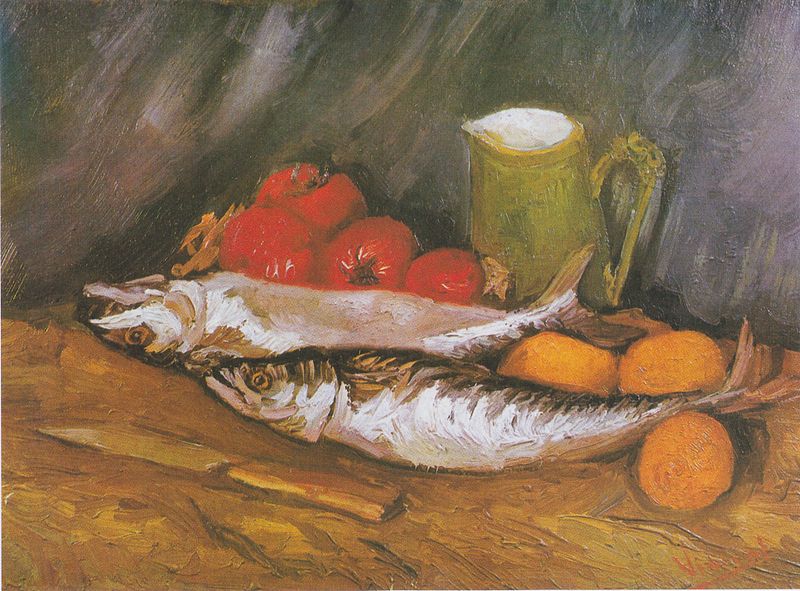
Image Credit: “Still Life with Mackerel, Lemon and Tomato” By Vincent Van Gogh (1886) Public Domain

“Ringo Starr Answers Questions on Larry King Live about the Death of George Harrison” By Roy Bentley

.

Ringo Starr Answers Questions on Larry King Live
about the Death of George Harrison

First, Larry King mistakenly calls Ringo
George then asks him whether his passing,
George’s, was expected. He answers that it was.
Says they knew he was sick. Had lung cancer.
I’m watching, though it’s none of my business
how grief-stricken Ringo Starr was and likely
still is or whether he was there, at the bedside,
at the moment George left his life for some other,
if you can believe what George believed, which
was that we keep coming back till we get it right.
And when Ringo is about to let down his guard
and be a bit more self-disclosing, even honest,
Larry interrupts, asking, Do you ever want to
pinch yourself? And Ringo Starr says, Sure.
In 1988, years before, in another interview,
with George, this years after Lennon’s death,
Ringo confessed that he was the poorest Beatle
then laughed and blew cigarette smoke upward.
Which must’ve seemed terribly funny to George,
an inside joke, because he said Hello, John to
the smoke like it was Lennon (by virtue of his
acknowledged wealth) or some spirit he used to
conquer worlds with. Ringo says he was shocked
upon hearing the news of the death of John Lennon,
but that George’s death was another thing entirely.
He doesn’t quote from the Bhagavad Gita, but it’s
as if he wants to say we continue on, are these spirits,
a sort of outrageous bliss even to think it, dumb luck
on the order of being hired as the Beatles’ drummer.
Maybe he would have said it, with respect to George
or ventured his own beliefs, if Larry hadn’t butted in
to ask him which of the Beatles was the best musician.
You mean, now? And I want to laugh now because
maybe Ringo’s imagining how hard it is to move
your hands after you’re dead, or to move at all,
and how impossible it must be to keep time
and tempo in all that anonymous blankness,
the dark become your most imploring fan.

.
This poem first appeared in Rattle

.

About the Author: Roy Bentley has published five books of poems, including Walking with Eve in the Loved City, which was selected as a finalist for the 2018 Miller Williams Poetry Prize and is available from the University of Arkansas Press or at Amazon. Bentley’s poems have appeared in Able Muse, Rattle, Blackbird, Shenandoah, Prairie Schooner, The Southern Review, and elsewhere. He is the recipient of a Creative Writing Fellowship in Poetry from the National Endowment for the Arts, as well as fellowships from the Florida Division of Cultural Affairs and the Ohio Arts Council.


More by Roy Bentley:

Nosferatu in Florida

Saturday Afternoon at The Midland Theatre in Newark, Ohio


Image Credit: photo collage of Ringo Starr on Larry King Live by Chase Dimock

SATURDAY POETRY SERIES PRESENTS: DEEP CALLS TO DEEP


From DEEP CALLS TO DEEP
By Jane Medved:


WINTER BURIAL

For the sky that reaches into its hushed pocket,
                                           for the bridle of winter waiting to be released.

For the ghost face which slips over everyone,
                                           for the tusk of the same white beginning.

For crystals that shape themselves while falling,
                                           for the storm’s icy laugh.

For the charred bars of the petting zoo,
                                           whose cages were made out of wood and went up fast.

For the twin goats trapped, for the small fire they turned their back on,
                                           the bread burning, the coffee.

For the one surviving goose housed in a Little Tikes kitchen,
                                           the black centers of his eyes and the string closing the door.

For the fenced-in storage area now zoned for a park,
                                           where there used to be patches of dried grass.

For the last time it snowed on the Jerusalem highway,
                                           and they wouldn’t let anyone in or out.

For the holiday makers who were stranded
                                           without fun.

For my niece’s baby who never woke up that day,
                                           she was an angel in her crib.

For they got her into the ground just before it froze,
                                           but no one knows where.

For the hidden ear of the tzaddik she is buried next to,
                                           for the cooing she drops into the ground where it melts.

For her small breaths, none of which are
                                           shaped the same.

For the soul, which cracks open the body,
                                           for the body, which is told what it must carry.

For when the ice let me back down the hill,
                                           I found my niece in her kitchen, forgiving everyone.


from THE LAST TIME I SAW HEROD

I. Women’s shelter, Miriam HaHashmonait St., Jerusalem

He was banging on the gate
even though there is no way
to know that we are in here.

He was looking for his wife,
aren’t they all, which is why
we make the children play

in the yard and of course
he knew her real name,
which makes me wonder

what’s the point of being
a princess if even that
can be taken away. I’m not

sorry he looked thin. I used
to feed my own husband
but I never watched him eat.

In my mind he was gulping
me down, tearing everything
apart so as not to miss a piece.


EVERYTHING WILL TELL ITS OWN STORY

sooner or later, coins, a copper lantern,
bits of colored glass, Napoleon’s diary
on loan from Harvard and the endless
lap of water at the world’s toothless edge.

These were found in the Phoenician port
where Napoleon threw his cannonballs
into the Mediterranean to lighten the load.
He wised up soon enough and tossed
his soldiers overboard instead.

The metal balls are shocked into rust
and stare like thick black eyeballs
from their shelf in the dusty museum.
History ignores the bodies though,
their bones turn to fine sand
that tricks the treasure hunters
with its unpredictable lapses. Never mind.

We are all one part ocean anyway,
which is why sex smells like fish, and waves
always come back to a dry river bed.

We are all one part earth, which is why
snow angels cannot fly but lose themselves
to the ground, only the children
leave a clue, a small piece of spine
that still remains even if they are forced into ashes.

We are all one part fire, angry
as a kidney stone, a fist, absolutely certain,
a blaze that hides for months in the smoking
roots of the rotem tree, waiting
to be lifted out, spoken into flame and taken.

We are all one part wind, did you notice
how birds spread out like notes
when they fly, faithful as radio beams
to their unseen connections.

I inhale the invisibility of it, using up
my appointed breaths, certain
that the air will always pass through me
cold and hot and justified.


WHICH IS TO SAY,

                               there is another way home.
                                                                                Just
yesterday, I saw the beating arc of starlings

who migrate to the Negev every year. It was late
and you have to take my word for this. They

became a single body that exhaled a melody
of startled scales made out of bones and feathers,

a flock of notes that scattered to swoop and play,
then reassemble in a different serenade, a fist of

sky squeezing its shape, or the curve of a swan’s
neck.
                   It was remarkable,
                                                      how soundless waves
could cart away the distance,
                                               and how I forgave,
in that moment, everyone.
                                                             Which is to say,

that the desert is a grave and lonely place,
where silence reappears as another kind of music.


Today’s poems are from Deep Calls to Deep (New Rivers Press, 2017), copyright © 2017 by Jane Medved, and appear here today with permission from the poet.


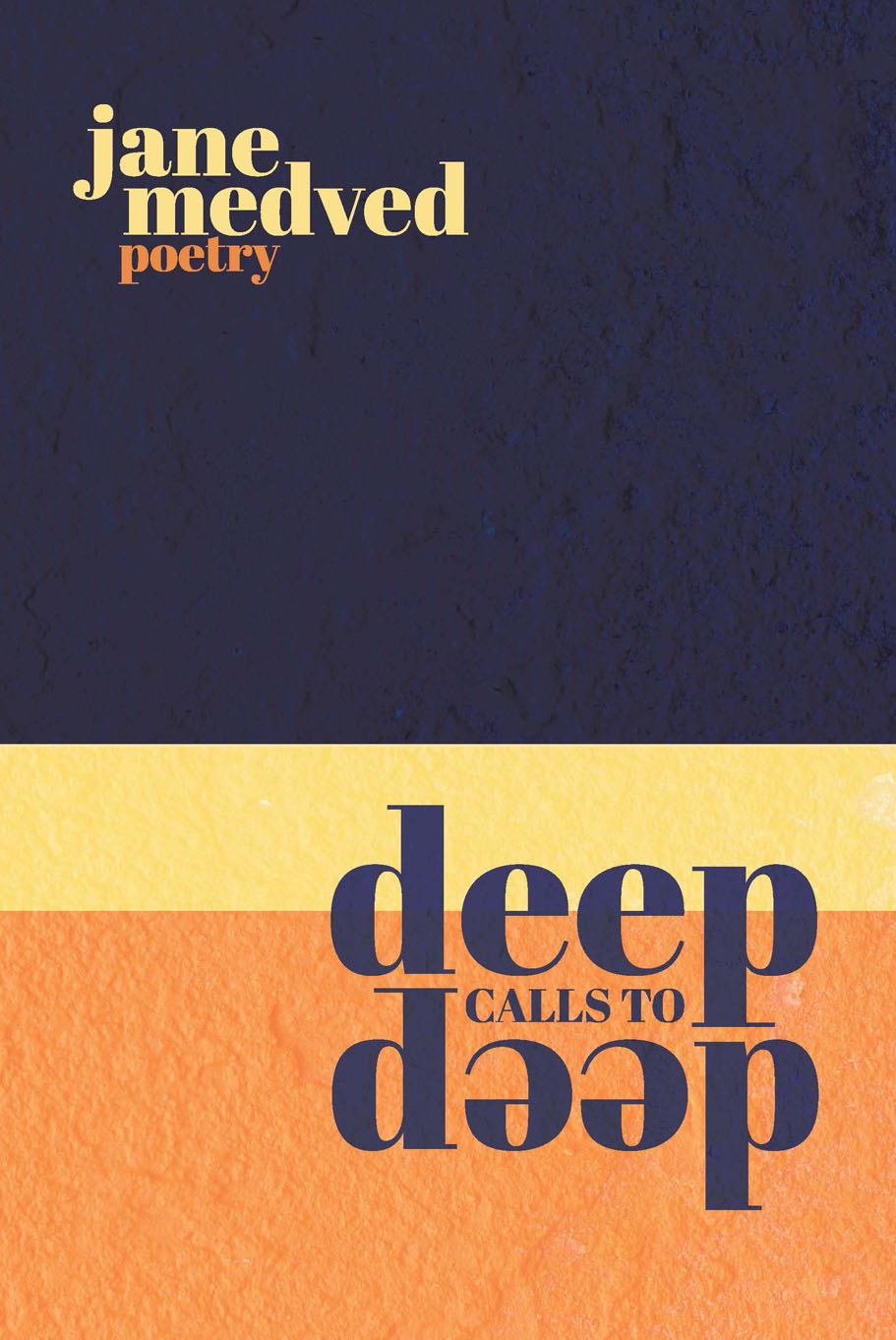
Deep Calls to Deep: “Taking its title from Psalm 42, Deep Calls to Deep explores the nexus between the depths of biblical history and the depths of the self, and the twin powers of faith and doubt that drive them both. Building from a masterful sequence exploring the legacies of Herod to a final richly lyrical sequence, Deep Calls to Deep becomes richer with multiple readings. With stunning formal variety and skill, it enacts not only the struggle to maintain faith, but to ground it equally in past and present, chaos and void, self and other.” — Leslie Adrienne Miller, author of Y and The Resurrection Trade

Jane Medved is the author of Deep Calls to Deep (winner of the Many Voices Project, New Rivers Press 2017) and the chapbook Olam, Shana, Nefesh (Finishing Line Press, 2014) Her recent essays and poems have appeared or are forthcoming in Queen Mob’s Teahouse, The Tampa Review, The Atticus Review, The Cortland Review, 2River View and Vinyl. She is the poetry editor of the Ilanot Review, the on-line literary magazine of Bar Ilan University, Tel Aviv. She lives and teaches creative writing in Jerusalem, Israel.

Editor’s Note: “History ignores the bodies,” but Jane Medved does not. It is through her own determined lens on history that the poet shapes this stunning new collection. The history she embraces is personal and familial, ancient and deeply entrenched, a history of people and place, of nature and land, of violence and loss. One might approach this work like an archaeologist, gentle and sifting, knowing that “coins, a copper lantern, bits of colored glass” are all precious, that every word and artifact you come across has a story to tell.

Deep Calls to Deep is ambitious, provocative, heart-wrenching and sacred. Within its pages the spiritual commingles with the archaeological, and words lay bare lost treasures like a desert wind revealing fact and fiction from beneath centuries of sand. The collection is divided into four sections, each so distinct and compelling that I could only begin to give you a taste of the whole by sharing a poem from each.

How visceral it is to read this collection. How engrossing. How evident on every page the capable hand of the poet who wrought the work, her knowledge and skill as writer and reader, how in tune she is with the human experience. Deep Calls to Deep is a masterpiece of the lyric, overflowing with stunning language and accessible imagery, at once startling in its beauty and reassuring in its familiarity. “Which is to say, // there is another way home… Which is to say, // that the desert is a grave and lonely place, / where silence reappears as another kind of music.”

Want more from Jane Medved?
Buy Deep Calls to Deep from Amazon
Queen Mob’s Teahouse
Cortland Review
2River View


A NOTE FROM THE MANAGING EDITOR:

After nearly ten years as Contributing Editor of this series, I am thrilled to expand my role to Managing Editor and provide the opportunity for fresh voices to contribute to this ongoing dialogue. It is an honor and a unique opportunity to now share this series with a number of guest editors, and we’ll be hearing more from them in the coming weeks. Today’s feature, however, is a labor of love from yours truly.

Viva la poesia!
Sivan, Managing Editor
Saturday Poetry Series, AIOTB