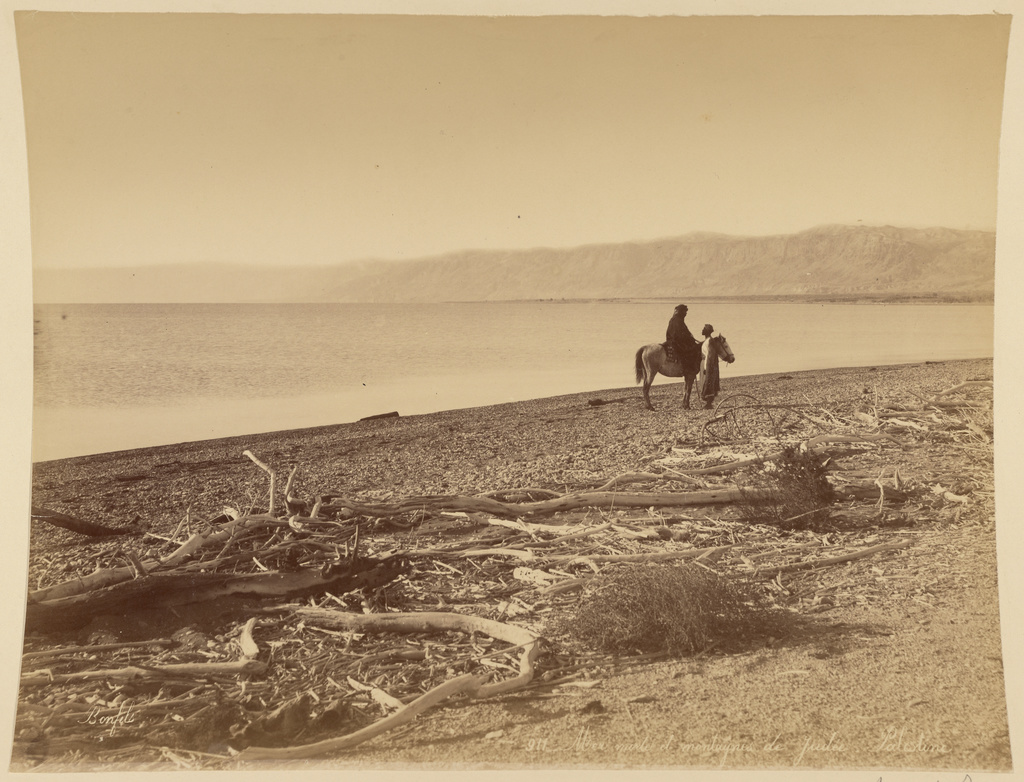
Félix Bonfils “Mer morte et montagnes de Judée” Digital image courtesy of the Getty’s Open Content Program
the bleeding horse at sea
By John Sweet
the bleeding horse at sea
and then it turned out that the trick was just to give in to depression, and of course i felt like a fool for not realizing this earlier
i sat there in an empty house listening to water run down the walls
sat there listening to the starlings in the attic
thought about my oldest boy
about all of the apologies i owed him
kept wishing i was asleep until my alarm clock woke me up the next morning
.
About the Author: john sweet, b 1968, still numbered among the living. A believer in writing as catharsis. Opposed to all organized religion and political parties. His latest collections include APPROXIMATE WILDERNESS (2016 Flutter Press), BASTARD FAITH (2017 Scars Publications) and the limited edition HEATHEN TONGUE (2018 Kendra Steiner Editions). All pertinent facts about his life are buried somewhere in his writing.
“The Bad Book” Unknown Artist, Digital image courtesy of the Getty’s Open Content Program
All of the Above
By Jason Ryberg
All of the Above
A book of poems is a family photo album for a spectacularly dysfunctional family,
a scrapbook of newspaper clippings, wedding announcements, obituaries and concert ticket stubs,
a file cabinet full of classified documents, elaborately detailed conspiracy theories and jealously guarded recipes.
A book of poems is a jelly jar full of fortune cookie fortunes,
an ancient tome of forbidden knowledge,
a grimoire of (otherwise) benign spells, hexes, hoodoos and charms.
A book of poems is (at least) equal parts scrapyard and curio shop, (bus station at 2am / country crossroads at midnight),
a shoebox full of old post cards and love letters,
a rolodex of dead or merely recommissioned phone numbers (I’m sorry, who were you looking for?)
A book of poems is an estate sale for a wealthy, eccentric hoarder who has been missing and presumed dead for nearly a decade.
an operator’s manual for a machine that hasn’t been invented yet,
a road atlas for a lost continent.
A book of poems is …
all of the above.
.
About the Author: Jason Ryberg is the author of twelve books of poetry, six screenplays, a few short stories, a box full of folders, notebooks and scraps of paper that could one day be (loosely) construed as a novel, and, a couple of angry letters to various magazine and newspaper editors. He is currently an artist-in-residence at bothThe Prospero Institute of Disquieted P/o/e/t/i/c/sand the Osage Arts Community, and is an editorand designer at Spartan Books. His latest collections of poemsare Zeus-X-Mechanica (Spartan Press, 2017)and A Secret Historyof the Nighttime World (39 West Press, 2017). He lives part-time in Kansas City with a rooster named Little Redand a billygoat named Giuseppe and part-time somewherein the Ozarks, near the Gasconade River, where there are alsomany strange and wonderful woodland critters.
In Leadwood, Daniel Crocker surveys twenty years of his work as a poet. Ranging from the metaphysical significance of the McRib to courageous deep dives into bipolar disorder, Crocker’s book is more than a collection of poems; it’s a chronicle of a poet’s maturation and a man’s coming to terms with his upbringing and identity.
Leadwood is the Daniel Crocker origin story. He was born among the long closed lead mines and chat dumps that littered his rural Missouri hometown. He confronts poverty, bigotry, and religious zealotry along with personal tragedies that shaped him as man and a writer. As a middle aged poet, Crocker depicts the lingering effects of Leadwood, balancing nostalgia and care for his home with trauma. In his newest poems, he gives us stirring insight into his relationship with bipolar disorder.
No matter his age, his work has always been confessional and brave. Crocker is a rural Anne Sexton, a Sylvia Plath raised on Sesame Street and WWE wrestling, a John Berryman in the Wal-Mart aisles, a Robert Lowell with a smirk and morbid punchlines.
Chase Dimock: Although this is a collection of your work from the past two decades, you decided to give the book a title: Leadwood. Once the reader hits the first poem “Where We Come From,” they will learn that Leadwood is the name of your small hometown. Why did you decide that this one word would be descriptive of two decades worth of your work? What does understanding Leadwood as a town achieve toward understanding Daniel Crocker as a poet?
Daniel Crocker: This kind of dates back to my very first full length book, People Everyday and Other Poems (Green Bean Press, 1998), which I dedicated to Leadwood. Later, me and my wife, Margaret, would do a chapbook together called “My Favorite Hell.” It was put out by Alpha Beat Press. We used the Leadwood population sign as our cover art. So, I guess Leadwood has had a hold on me from the beginning.
Like you said, it’s my hometown. I think most of us are shaped by where we grew up–for better or worse. Most of my formative experiences happened there, and I’ve written a lot about them. And, I certainly have love/hate relationship with Leadwood. I have many great childhood memories, but also worries about lead poisoning and the ecological disaster that my home town is. Mostly, however, I wanted to make sure that the voices of my small town, and by extension other small towns, aren’t lost. There are small towns all over the country that have been ravaged and left behind by corporations–whether it’s Leadwood, which was founded by a lead mining company who later up and left the town with huge piles of chat (lead and dust) that were as big as football stadiums. The cancer rate there is extremely high. The soil has been tested there was found to be 10,000 more times the lead in the soil that is considered safe. Continue reading “Leadwood: A Conversation with Poet Daniel Crocker”→
she’s from Yonkers has white skin white hair and a bright smile she used to do social work and her insight means she can finish our therapist’s sentences and initiates the growing process of others so much until she stops responding to her name and denies everything into the fog of disassociation and waking up lost, not knowing where and how she’s found herself again.
.
About the Author: Kevin Ridgeway is from Whittier, CA. He is the author of six chapbooks of poetry. His latest book is A Ludicrous Split (alongside poems by Gabriel Ricard, Alien Buddha Press). Recent work has appeared or is forthcoming in Slipstream, Chiron Review, Up the River, Nerve Cowboy, The American Journal of Poetry, Main Street Rag, Cultural Weekly, San Pedro River Review, Lummox, Misfit Magazine, The Cape Rock, Plainsongs and So it Goes: The Literary Journal of the Kurt Vonnegut Memorial Library. He lives and writes in Long Beach, CA.
Cape Split Cape Split is quite literally the “end of the world” Google quote
I
Pain is like the prenup you forgot to get, it takes all the sweetness, leaves you with the pawn tickets. You will never be able to buy back an unfurled forehead, true smile and the grace of comfort.
II
So you sit in the bar, listen to complaints of other people’s unwanted houseguests, drink just enough. One more winter outlives its welcome as you as you lick your cold lips, search for a warm face.
III
The weather is ice over shade, you need an elbow to pity you home. This is not the first time. The tide is out, you are restingon mud, you need a pilot, who knowsyour analogies are weak
and your pride is mighty. Like a ship a–sail with no engine, you pray for wind to lead you past the soft swell of young lovers to the breakwater of hearth, to tea and the quiet compass of a stranger’s voice bidding you safe travels, small hurts.
.
(This poem first appeared in Sterling Magazine)
.
About the Author: Tobi Alfier (Cogswell) is a multiple Pushcart nominee and multiple Best of the Net nominee. Her chapbook “Down Anstruther Way” (Scotland poems) was published by FutureCycle Press. Her full-length collection “Somewhere, Anywhere, Doesn’t Matter Where” was published by Aldrich Press. “Slices of Alice & Other Character Studies” was just published by Cholla Needles Press. She is co-editor of San Pedro River Review (www.bluehorsepress.com).
It is spring, and in a town that awaits the luster of fairgrounds to come alive,
the doors of taverns open early, like strangers with a promise. Flat-roofed houses yield
to groves of mesquite. Their limbs stretch streetlight halos into frail shadows veining asphalt
that webs the neighborhood. The trundling iron of the Union Pacific enters town at a late
hour. Its headlamp startles shacks to burnished yellow as it floods for mere seconds the frame
of a drunken soldier, home on leave from a long war. He shuffles through an unpaved alley
like an astronaut scuffing the dust of the moon. A final blast from the locomotive seems to hew
the world into the past tense. It surmounts cheers unreeling from a small crowd seated under
the ballfield lighting of a pickup game. A young hopeful sprints homeward, rounds third, already out.
This poem previous appeared inIdyll for a Vanishing River (Glass Lyre Press, 2013)
.
About the Author: Jeffrey Alfier is 2018 winner of the Angela Consolo Manckiewick Poetry Prize, from Lummox Press. In 2014 he won the Kithara Book Prize, judged by Dennis Maloney. Publication credits include Crab Orchard Review, Southern Poetry Review, Atlanta Review, Copper Nickel, Emerson Review, Iron Horse Literary Review, Kestrel, Hotel Amerika, Midwest Quarterly, Poetry Ireland Review and South Carolina Review. He is author of The Wolf Yearling, Idyll for a Vanishing River, Fugue for a Desert Mountain, Anthem for Pacific Avenue: California Poems, Southbound Express to Bayhead: New Jersey Poems, The Red Stag at Carrbridge: Scotland Poems, Bleak Music – a photo and poetry collaboration with poet Larry D. Thomas and The Storm Petrel: Poems of Ireland. He is founder and co-editor at Blue Horse Press and San Pedro River Review. An Air Force veteran, he is a member of Iraq and Afghanistan Veterans of America.
Image Credit: “Main Street, Benson, Arizona” By Jeffrey Alfier
like you could slip from light (or is it life) and no one tells you
no dark was too loud to keep itself shut
but light this big quiet light it could swallow us whole
it could be wiping its lips right now
Today’s poem was previously published in Issue 14 of Rivet: The Journal of Writing that Risks and is reprinted here today with permission from the poet.
Andrea Sherwood’s work is published or forthcoming in Pennsylvania’s Best Emerging Poets, Lavender Review, and Rivet. Currently, Andrea is pursuing an MFA at the School of the Art Institute of Chicago.
Guest Editor’s Note: Repetition is effective in conveying palpable fear and panic in Sherwood’s piece about loneliness and dread. The light and dark entities in this poem reach out like hands to the throat, alternately choking and releasing air and emotion. The airiness of the lines allows space for feeling and time to process, and line breaks leave breathless openings for more. Form operates successfully to produce an uncomfortable disposition and an opportunity for understanding of the speaker’s secret inner turmoil.
The metaphorical box feels real and turning light into a terrible monster is a remarkable turn at the end of the poem. The trepidation lingers long after the terror has been distilled in the image of “screaming three a.m.” which bends the poem into a new perspective and a dialogue with the dark. Light then becomes a colossal entity more unexpectedly frightening than living in the “thick dark” of a “black box / under a barbershop.” The final image of the light that “could be wiping its lips right now” is an alarm sounding somewhere, maybe even silently, that what is true in the dark is also true in the light and fear knows no difference.
Guest Editor Anne Graue is the author of Fig Tree in Winter (Dancing Girl Press), and has published poems in literary journals and anthologies, including The Book of Donuts (Terrapin Books), Blood and Roses: A Devotional for Aphrodite and Venus (Bibliotheca Alexandrina), Gluttony (Pure Slush Books), The Plath Poetry Project, One Sentence Poems, Random Sample Review, Into the Void Magazine, Allegro Poetry Magazine, and Rivet Journal.
A NOTE FROM THE MANAGING EDITOR:
After nearly ten years as Contributing Editor of this series, it is an honor and a unique opportunity to share this space with a number of guest editors, including the editor featured here today. I am thrilled to usher in an era of new voices in poetry as the Managing Editor of this series.
Viva la poesia!
Sivan, Managing Editor
Saturday Poetry Series, AIOTB
About the Author: A past winner of the Jim Harrison Award for contributions to baseball literature, Tim Peeler has also twice been a Casey Award Finalist (baseball book of the year) and a finalist for the SIBA Award. He lives with his wife, Penny in Hickory, North Carolina, where he directs the academic assistance programs at Catawba Valley Community College. He has published close to a thousand poems, stories, essays, and reviews in magazines, journals, and anthologies and has written sixteen books and three chapbooks. He has five books in the permanent collection at the Baseball Hall of Fame Library in Cooperstown, NY. His recent books include Rough Beast, an Appalachian verse novel about a southern gangster named Larry Ledbetter, Henry River: An American Ruin, poems about an abandoned mill town and film site for The Hunger Games, and Wild in the Strike Zone: Baseball Poems, his third volume of baseball-related poems.
The empty habit of a priest appears between Heaven and Earth with the cross on a string of beads still flowering on the breast.
His sandals, alight with needles, rest on the incline where he stepped out of his body, and red blossoms have grown at the nine tips of his whip that put down roots since last it stung his back.
The shadow of his horizontal arms is burned into the pale stones where he was nailed to the heat
and the bones he left behind withered into straws which were taken for a nest by the immortal Phainopepla.
.
About the Author: David Chorlton is a transplanted European, who has lived in Phoenix since 1978. His poems have appeared in many publications online and in print, and often reflect his affection for the natural world, as well as occasional bewilderment at aspects of human behavior. A recent collection of poems is Bird on a Wire from Presa Press, and The Bitter Oleander Press published Shatter the Bell in my Ear, his translations of poems by Austrian poet Christine Lavant. A new book, Reading T. S. Eliot to a Bird, is out from Hoot ‘n Waddle, based in Phoenix.
The desert ends in a pit of light, streets cacophonous in their escape from dark. They’ve pried the gas from its place in the Periodic Table, stroked electricity from the demon’s feet. A hemangioma of multicolored tubing, burns blisters in the sand.
.
Disobedience
I will wake the lilies under the window. I will bite deeply into the apple’s defenseless cheek. I will follow the seagulls over the waves as they etch the air with their wings. I will not be good. I will not be safe. I will ride the tide as it goes out. And when the man comes in the dark, I will show him the family silver’s shining secrets.
.
About the Author: Ruth Bavetta writes at a messy desk overlooking the Pacific Ocean. Her poems have appeared in Rattle, Nimrod, Tar River Review, North American Review and many other journals and anthologies. Her books are Fugitive Pigments (FutureCycle Press, 2013) Embers on the Stairs (Moontide Press, 2014,) Flour Water Salt (FutureCycle Press, 2016.) and No Longer at This Address (Aldritch Books 2017.) She likes the light on November afternoons, the music of Stravinsky, the smell of the ocean. She hates pretense, fundamentalism and sauerkraut.