“Early Exits: New Books from Two Poets Lost to AIDS” By Mike James


Early Exits: New Books from Two Poets Lost to AIDS

By Mike James


Beautiful Aliens: A Steve Abbott Reader
Edited by Jamie Townsend
Nightboat Books, 2019
$19.95

Have You Seen This Man? The Castro Poems of Karl Tierney
Edited by Jim Cory
Sibling Rivalry Press, 2019 
$18.00


One of the reasons Steve Abbott is so refreshing is because he takes his lusts the same way he might drink orange juice: straight up. There are poems and essays about queerness and AIDS (his ultimate killer), but also ones about transcendence, poverty, and fatherhood. This collection pulls together essays (including a stunning piece on Bob Kaufman), fiction, poetry, cartoons, letters, and memoirs across a wide range of styles. His work reads like a mind never at rest.  

Abbott was part of the generation of queer poets who came of age in the 1970’s. This generation, which included Tim Dlugos, Kevin Killian, Steve Carey, and Jim Brodey, did not hide their sexuality even if some did not make it the center of their work. (A freedom taken for granted by heterosexual poets.) Prior to the 1970’s, most queer poets who took sex as a subject were either outliers (Harold Norse and John Weiners) or artfully oblique (Hart Crane and W.H. Auden.) 

Abbott’s work has a freedom and casualness not found in many poets prior to his generation. He’s able to toss off lines like, “The sky is so full / you hear footsteps on the roof” or drop in a line like, “So far as I know / Chairman Mao never wore a dress.”  It’s his knack for not taking the world too seriously which makes Abbott such an endearing writer. His work is casual, but never sloppy. He’s always precise. Check out how he starts this poem. 

It’s A Strange Day Alysia Says, A Green

“It’s a strange day,” Alysia says, “a green
bug in my room & now this mushroom growing in the car.”

She’s right. Under damp newspapers & cigarette
butts, from the floor, protrudes a slimy brown thing. 

Maybe I should get a new car or at least
clean it up, fix the window like the kids say. 

But how can I do this & still talk to angels?

Poets get absorbed in strange quests,
question not the creative regimen of poverty. 

I wanted to meditate on this but before I could
a hitchhiker we pick up crushes…

The poem continues in side-chat fashion, but this gives an idea of his voice. Tucked between the cigarettes, the ampersands, and the hitchhiker, this poem belongs to the 1970’s as surely as shag carpet, disco balls, and Pontiac Firebirds. And just like those well-remembered items, it’s tactile and timeless. The poet records a conversation between his self and soul about parenting, poverty, and poetry and lets the reader eavesdrop along the way.  

Because of Alysia Abbott’s fine and tender memoir, Fairyland, Steve Abbott is better known as a subject than as a writer. Beautiful Aliens should start to correct that oversight. 

Despite some obvious similarities (queer and San Francisco based) Karl Tierney was a different sort of poet than Steve Abbott. The new collection, Have You Seen This Man? illustrates that point. 

First, it must be noted, this collection was a love labor from Jim Cory, Tierney’s friend and literary executor. Tierney committed suicide in 1995 after an AIDS diagnosis. Cory spent the next 20 plus years submitting Tierney’s poetry to magazines and trying to gain interest from publishers for a collection. Cory, a wonderful and heart wrenching poet in his own right, kept the focus on Tierney rather than himself. This collection is a testament to Tierney’s talent as a poet and to Cory’s skill as an editor. Cory’s insightful introduction is worth the price of the book. 

But poets have to be judged by the quality of their work, not by the sadness of their lives. So, what kind of poet was Tierney? In a word: lustful. As Cory correctly notes, Tierney seems to channel the Roman poet Catullus in both his direct, almost comedic, style as well as in his subject matter. Like Catullus, Tierney writes like a man on a mission. The mission is getting either a or b or both into bed and the best poems (there are numerous gems) concern fleshly wants or their aftermaths. 

Here’s are a few lines from a typical piece to shows what he does well. 

Part-Time Whores In Doorways

Some of them are handsome, 
even if two sheets to the wind 

shaking skin and bones. 
Little meat upon them 

except between the legs 
meticulously exposed when rising

towards tweaks, Johns, or numbers. 
There is no need for pity. 

They milk even the bosom of Mary 
and display…

The poems continues and catalogs Tierney’s world of wants, fulfilled and unfulfilled. His characters go to every party and hate to go home alone. Tierney’s characters, are like so many party hungry, lonely people. As a poet though, he is unique. His poems are postcards of fanciful directness, finally delivered after so many years.


About the Author: Mike James makes his home outside Nashville, Tennessee. He has been published in numerous magazines throughout the country in such places as Plainsongs, Laurel Poetry Review, Birmingham Poetry Review, and Tar River Poetry. His fourteen poetry collections include: Parades (Alien Buddha), Jumping Drawbridges in Technicolor (Blue Horse), First-Hand Accounts from Made-Up Places (Stubborn Mule), Crows in the Jukebox (Bottom Dog), My Favorite Houseguest (FutureCycle), and Peddler’s Blues (Main Street Rag.) He has served as an associate editor of The Kentucky Review and as publisher of the now defunct Yellow Pepper Press. More information about him can be found on his website, mikejamespoetry.com.


More By Mike James:

Grace

Paul Lynde

Two Prose Poems


Image Credit: World AIDS Day Ribbon. Public Domain
“Dear Allen Ginsberg” By Jeffrey Betcher


This is the first in a new series of posts remembering the work of poet and activist Jeffrey Betcher (1960-2017).


Preface: Left “believing in the pack mentality of strays,” the poetry of Jeffrey Betcher speaks from the entire collective of American queer stray culture, that very lost-and-found narrative of reinvention on the docks of survival. These docks, being the green-heeled sanctuary of San Francisco from 1986-2016, these docks gave birth to an examination and liberation of meaning, as wildly honest and true-to-mirror as every queer breath weʼve danced. From this collection of Jeffrey Betcherʼs poems, “The Fucking Seasons, Selected Poems 1986 to 2016,” we hear the journeys into witness, touch the lips of knowing “love has been here. Hungry footsteps, breath released, and touch can change the land forever.” A San Franciscan born of rural Ohio, Jeffrey Betcherʼs poetry informs the landscape of nature, saying simply, “Iʼm a witness. Love has been here.”

– Toussaint St. Negritude,
Poet, bass clarinetist, composer


Dear Allen Ginsberg

Dear Allen Ginsberg, you won’t remember me whose mother’s howl,
as she delivered me, evaporated off the hills of Ohio while you
became famous.
I should have written sooner, from the road between chance and a
San Francisco that was Beat if not terminal when I arrived.
But news of you suffered surgery at every Midwest border, and by
the time Doug Woodyard introduced us I probably thought you
would be made of marble.
That was at a queer writers’ conference long before any of us knew
that one day James Franco would lend you his voice and pretty
bones.
James Broughton held my hand and twinkled snow from withered
brow while Joel, his impossibly handsome lover, looked on amused.
We huddled in the lobby of the Cathedral Hotel as it crumbled into
the margin of San Francisco’s notorious beauty. (Doug is dead now,
by the way.
HIV of course. His glorious passing exasperated nurses at Davies on
Castro as he alternated between Sobranies and an oxygen mask.)
You didn’t even bother to flirt, in fact seemed wary as I stammered
at something I don’t recall, ready with a sexless reply before I
began.
Had I noted the address you gave in your keynote, you asked. Will
you write a protest letter? Don’t admire, you seemed to say. Act.
Then act. Then act again. Squinting through a face locked in
counter-clockwise swirl, you were serious as sin.
More steel than marble, you leaned into a lethal bluster from
Washington that shook the Cathedral, while I nodded and fell into
wide-eyed silence.
Despite homo-haters and wars set on automatic, no matter how
bare the ranks of sign-swapping protesters, your faith swelled fat as
a bloody lip.
In an unthinking world, you left me believing in the pack mentality
of strays, the meander of meaning and the promise in every tap on
a stuck compass.


(C) 2017 Jeffrey L. Betcher Living Trust


About the Author: Jeffrey Betcher donned many hats over more than 30 years in San Francisco, yet maintained an integrity of purpose. A writer, an educator, an advocate for the prevention of violence against women and children, and a grassroots community organizer, he gained national attention as a leader in the “guerrilla gardening” movement, helping transform his crime-ridden street in the Bayview neighborhood into an urban oasis. His intimate poetry was also cultivated over the decades, exploring survival and engagement, and the labyrinth of the heart. Though he dodged the HIV bullet in the plague-torn years, a terminal bout of cancer cut his life short in 2017. In addition to his chapbook of Selected Poems (1986-2016), he completed an epic sonnet, Whistling Through, an odyssey into the cancer machine and death itself


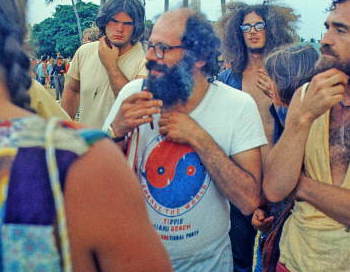
Image Credit: Tony Schweikle “Poet and activist Allen Ginsberg with the protestors – Miami Beach, Florida.” (1972) Public Domain

“The Whole Point of the Game” By Brian Rihlmann


.

THE WHOLE POINT OF THE GAME

the headline of the article
said something about
dodgeball being dehumanizing
he ridiculed it, of course
this “friend” of mine
said we’re turning
our kids into a bunch of pussies
blah, blah, blah
and though I didn’t read it
it brought back memories
of those rainy days
in Junior High
when I last played the game…

how some poor kid
smaller or weaker
or fatter or bookish
was always singled out
while we—
like little savages out of Golding—
all pegged him at once
usually aiming for the face
a bloody nose
or broken glasses
was glorious
and celebrated with
high fives and riotous laughter

I’m sure
for the rest of the day
those kids sat in class
with swollen, bee-stung faces
and pondered the sin
of being smaller
or weaker
or fatter
or bookish

and did this toughen them up
and help them become
happy and well adjusted adults?

I could ask
but it’s the damndest thing…
we haven’t kept in touch.

.
.
About the Author: Brian Rihlmann was born in NJ, and currently lives in Reno, NV. He writes mostly semi autobiographical, confessional free verse. Folk poetry…for folks. He has been published in Constellate Magazine, Poppy Road Review, The Rye Whiskey Review, Cajun Mutt Press and has an upcoming piece in The American Journal Of Poetry.
.
.
More By Brian Rihlmann:
.
.
Image Credit: Lewis W. Hine “The Dumps Turned Into A Children’s Play Ground.” (1909) Digital image courtesy of the Getty’s Open Content Program

“Blend” By Gwil James Thomas


Blend. 

I was the grey hair 
on the baby’s head, 
the ugly Casanova, 
the bug that traded 
his wings for feelings 
and wished he could 
trade them back, 
the herd’s first 
carnivorous cow, 
the vegan piranha,   
the one who got you 
back on your feet 
and then the one 
you left behind,
the sheep 
in wolf’s clothing, 
the ghost of all that 
was and ever will be – 
never blending into 
the crowd –
even when 
I tried.


About the Author: Gwil James Thomas is a novelist, poet and inept musician originally from Bristol, England. He is a Best of The Net nominee whose work has recently been featured in print in Low Light Magazine, 3 Poets Volume 1, Paper & Ink and online in Punk Lit Press, Cephalo Press, Expat Press and Under The Bleachers. He has two forthcoming poetry chapbooks  from Concrete Meat Press and Holy & Intoxicated Publications. He is currently laying low somewhere in Northern Spain.


Image Credit: “Unidentified man in costume with back to camera, going through side of a curtain” Digital image courtesy of the Getty’s Open Content Program.

“Epistemology of Touch” By Jai Hamid Bashir


EPISTEMOLOGY OF TOUCH

This life: a sleep
that only holds one dream. Our atoms 

someday dashed and divided into
bloom. Through this secret: death 

is lonely, so it is endless. Ask of me 
how you didn’t know how long 

I had been fasting. 
Could we ever resurface 

in an event horizon before 
oblivion?  Leafy light 

cradling the last birdcall.
Shifting night to morning to hold

your shoulders. Was there ever an Atlas
on the table where I put bills? Only birds

when we got to the mountaintop to receive
the message. Eventide pulled in all smoke 

from the city. In synapses of words themselves 
returning from a black hole, the latest dream. 

It was so cold we slept like The Lovers 
wrapped in a whiter shade of pale our faces 

barely touching. Remember 
tides do not rip at the seam. Turning 

on and on. To face the faces you have let 
down. So rolling stones join bluedark buzz of moss.


About the Author: Jai Hamid Bashir is a Pakistani-American and second-generation artist. She is an MFA candidate at Columbia University where she was awarded the Linda Corrente Poetry Fellowship. Her work has appeared in Palette Poetry, The Margins | Asian American Writer’s Workshop, Sierra Magazine, Poets.org, and others.


Image Credit: Joos Van Cleve detail from Portrait of Joris Jacobs Vezelaer (1518) Public Domain

Jonathan K. Rice: “Pillows on the Interstate”


Pillows on the Interstate

Blue pillow
rests in a rut 
of red clay 
beside 
a northbound
exit ramp.

Blew from 
the cargo bed
of a pickup    
with a love seat 
from somebody’s 
front porch.

Left behind 
by its matching 
sibling 
and cushion
on their way
to a new home. 

Further down
the highway 
memory foam
reacts to every tire, 
every tread,
returning to its
shape every time. 

Turquoise 
throw pillow
bounces
between lanes
through tailwinds
and exhaust. 

A feather 
pillow floats 
across an overpass 
following 
a convoy
of eighteen wheelers.

Miles of lost pillows 
like roadkill
disemboweled. 
Feathers, latex,
polyurethane

ripped 
and dragged
between 
mile markers,
ground 
into the tar
and asphalt.
left to decompose, 

to scatter in the wind.


About the Author: Jonathan K. Rice edited Iodine Poetry Journal for seventeen years. He is the author of two full-length poetry collections, Killing Time (2015), Ukulele and Other Poems (2006) and a chapbook, Shooting Pool with a Cellist (2003), all published by Main Street Rag Publishing. He is also a visual artist. His poetry and art have appeared in numerous publications, including Cold Mountain Review, Comstock Review, Diaphanous, Empty Mirror, Gargoyle, Inflectionist Review, Levure Litteraire, The Main Street Rag, Wild Goose Poetry Review and the anthologies, Hand in Hand: Poets Respond to Race and The Southern Poetry Anthology VII: North Carolina.


More by Jonathan K. Rice

“Springmaid Pier”

“Cards”

“Stravinsky in the Shower”


Image Credit: Ben Shahn “Roadside advertising along Route 40, central Ohio” (1938) The Library of Congress

“We Might Have Existed” By Brian Chander Wiora


We Might Have Existed

It’s the future, where America falls
into book after book, each page laced
with a blue truth, like bubbles in an aquarium. 
The seahorses galloping past their hooves. 

When the pilgrims arrived, some had been here
before. From this, a whole country can be discovered. 
You need the sun to have rivers of sunlight. 
You need a river to have Columbus.

In the summer when I turned seventy-five, 
I bought ten thousand shovels, combing ten thousand 
heads of hair, in the parlor with a line out the door. 
Let me say: it was not a museum but a room

with every outfit we wore in that American time. 
How the red dress fell all night. How often 
did I fly to California, just to watch the birds 
eating eggs off my plate, a strange reincarnation. 

Touring the earth’s edge, I notice a nickel 
rolling over the horizon, Jefferson’s face facing 
the mountains in the south. Geography: 
as in the place where toy fish flap plastic fins,

those feral machines. The Americans are watching 
television again. We watch because the television 
is yellow. We watch because we know no 
good songs. The music happens, but not enough

for the noise to become more than an echo, 
the way a shadow falls behind us and is soon forgotten
by everyone but the lightbulbs, just Tesla
between Edison and a fetish for light. 

What happens in the aftermath of roses, America?
You are infamous for your boredom now. Someone there 
is a father, if not fatherhood. Someone else is desperate. 
And I am like the world. I can close my eyes, and spin.


About the Author: Brian Chander Wiora teaches poetry at Columbia University, where he is an MFA candidate. His poems have appeared in RattleGulf Stream MagazineThe New Mexico ReviewAlexandria Quarterly and other places. Besides poetry, he enjoys listening to classic rock music and performing stand up comedy.


More by Brian Chander Wiora:

“The Oysters”


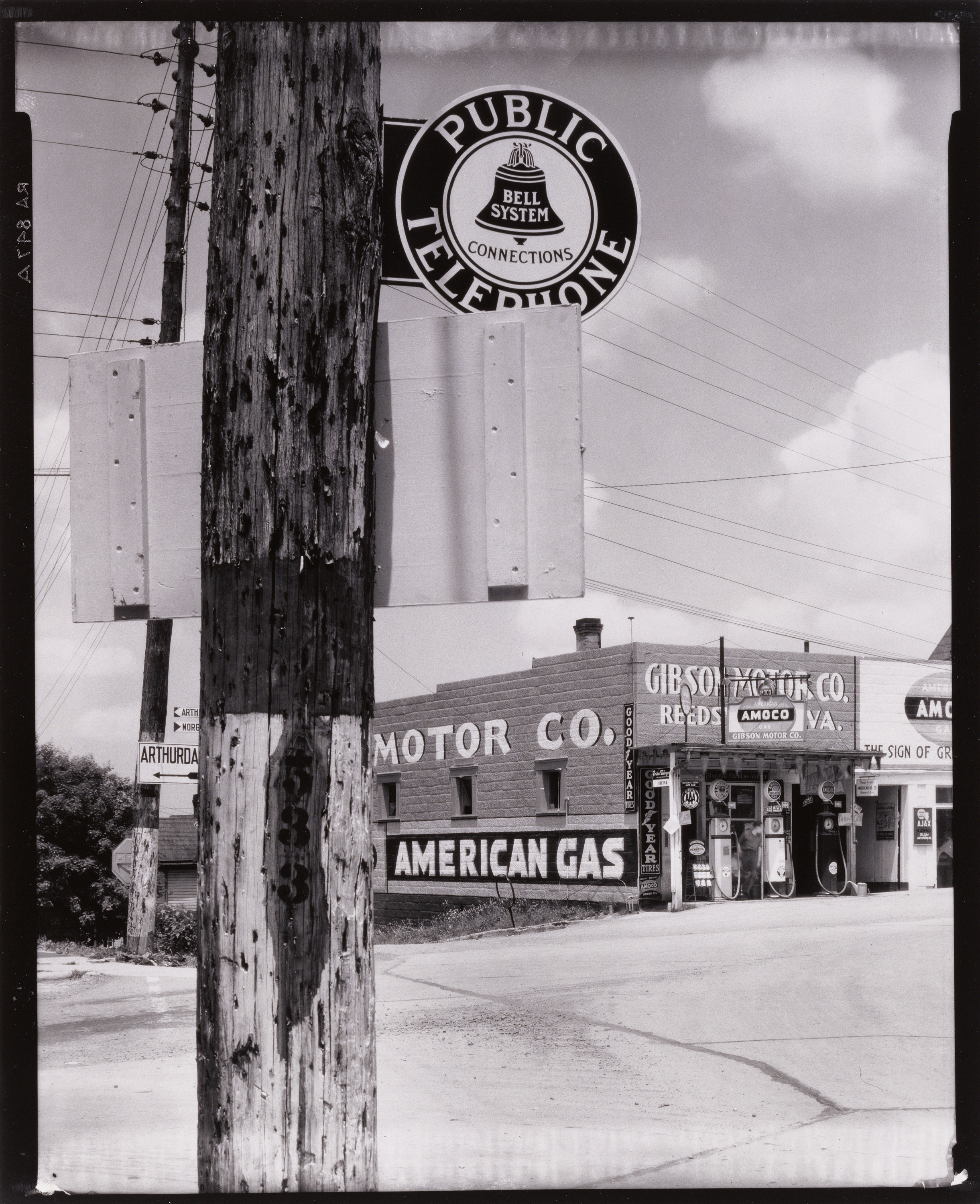
Image Credit: Walker Evans “Highway Corner, Reedsville, West Virginia” (1935) Digital image courtesy of the Getty’s Open Content Program.

“I forgot the earth and heaven” By Jason Baldinger


I forgot the earth and heaven

every morning this 
city introduces me 
to a new shade of gray

I’m wearing a t-shirt
of an old friends
long dead country band

the ocean’s a rocks glass
overfull with ice
a trick to sterilize the taste

I saw a crass sticker
on a kia soul
a voice in my head says maniacal laugh

there’s a pitcher of beer
waiting for me
I’m almost sure its a cry for help

she drops her head on my shoulder
irrigation systems, telegraph poles
I say, I love you, sorry yr suffering

it should be a regular greeting
in this cathedral
the noise is unbearable


About the Author: Jason Baldinger is a poet from Pittsburgh, Pennsylvania.  He was recently a Writer in Residence at Osage Arts Community, and is founder and co-director of The Bridge Series. He has multiple books available including the soon to be released The Better Angels of our Nature (Kung Fu Treachery) and the split books The Ugly Side of the Lake with John Dorsey (Night Ballet Press) as well as Little Fires Hiding with James Benger (Kung Fu Treachery Press). His work has been published widely in print journals and online. You can listen to him read his work on Bandcamp on lps by the bands Theremonster and The Gotobeds.


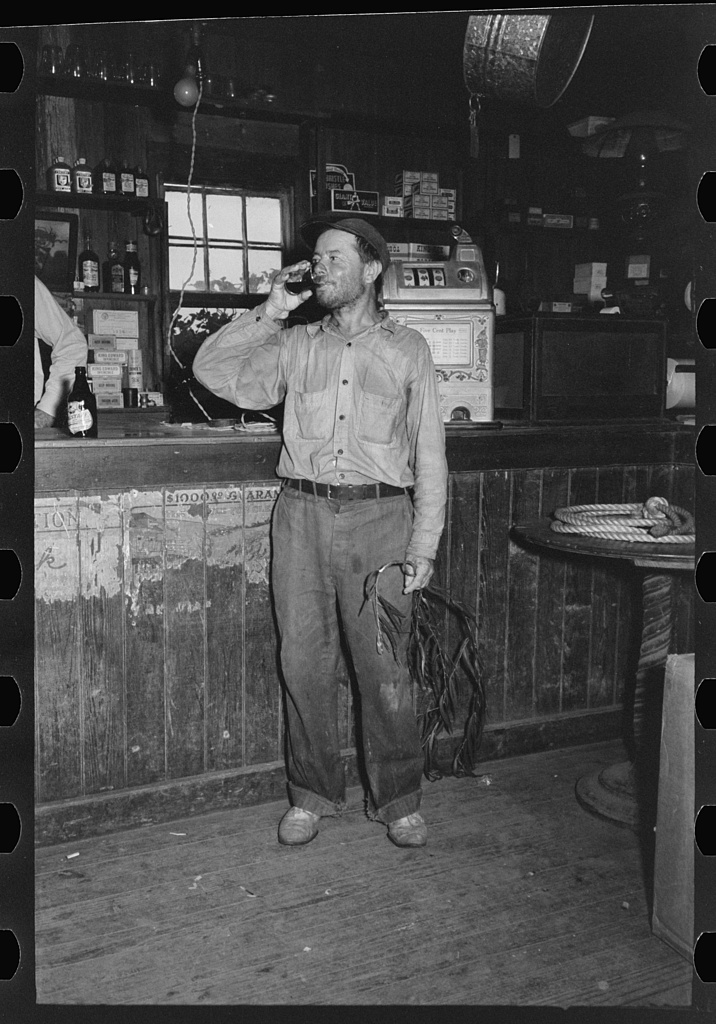
Photo Credit: Lee Russell “Native of Olga, Louisiana drinking at the bar. Note the branch of tree used as a mosquito switch” (1938) The Library of Congress

“Old Notebooks” By Hugh Blanton


Old Notebooks

Pulling those old notebooks out –
looking at the journal entries of 30 years ago.
Notebooks scribbled in during the worst times of my life.

There I was getting a job.
Less than a page later I was fired.
Not to worry – there at the bottom of that very same page 
I got another job. Two pages later – fired again.
Repeat for months and years on end –
peppered with assurances that I would do better –
that I knew exactly where I had gone wrong.

Tallying up all the credit card debt.
My debt was triple what I made in a year –
maybe not a lot by typical American standards –
but it killed me.

Those old notebooks were college ruled –
enabling me to get more bullshit onto the page.
Their spiral coils – now rusted –
barely allow the pages to be turned without being torn.

Why was I writing all of that down?
Sitting in that tiny filthy room –
writing down all my real failures
and fake promises.
Nothing ever got better.
Even when I found an employer
who didn’t fire me for years –
I remained broke and miserable.

Dragging out thirty-year-old notebooks
is an effortless way to let pessimism defeat me.


About the Author:  Hugh Blanton lives in San Diego, California and combs poems out of his hair in the moments he can steal away from his employer’s loading dock. He has appeared in Bottom Shelf Whiskey, Dope Fiend Daily, and Terror House Magazine.


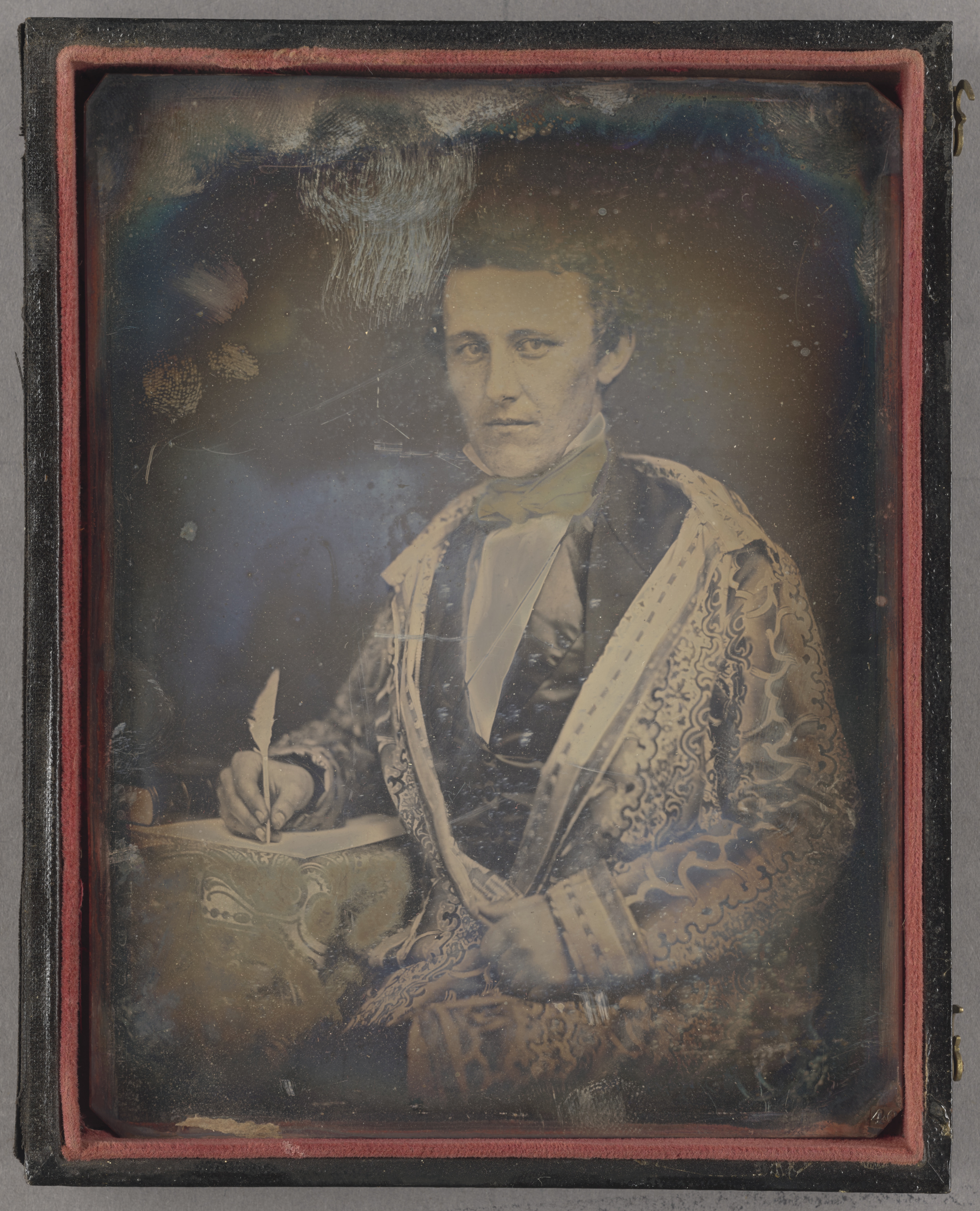
Image Credit: Portrait of an Unidentified man in smoking jacket seated holding a feather-quill pen. Digital image courtesy of the Getty’s Open Content Program.

“In the Drowned Woods” By Anna Saunders


In the Drowned Woods

It’s not as if we were together long I tell my heart,
but it isn’t listening. 

In the drowned woods long blades of garlic 
have been crushed by the storm
and wild white flowers float like tiny water lilies.  

A bough drips ivy and clings on to another tree trunk
like a drowning man grasping his rescuer’s arm. 

The pine tree is full of Goldfinches, their high pitched song 
sounds like squabbling. There is a dove, fluttering to a settle. 

A male bird flies down and lands on the back of the female.

There’s a fury of pearl and platinum, 
a flourish of wings like sheets flapping or skirts billowing up.

The coupling is brief, but beautiful,
and in the spring light, the birds resemble angels. 

I have all the symptoms of grief. 
But oh – the memory of two creatures colliding, 
that airborne heat, 
before both creatures flew off into separate skies.


About the Author: Anna Saunders is the author of Communion, (Wild Conversations Press), Struck, (Pindrop Press) Kissing the She Bear, (Wild Conversations Press), Burne Jones and the Fox (Indigo Dreams) and Ghosting for Beginners (Indigo Dreams, Spring 2018). Anna has had poems published in journals and anthologies, which include Ambit, The North, New Walk Magazine, Amaryllis, Iota, Caduceus, Envoi, The Wenlock Anthology, Eyeflash, and The Museum of Light. Anna is the CEO and founder of Cheltenham Poetry Festival. She has been described as ‘a poet who surely can do anything’ by The North and ‘a poet of quite remarkable gifts’ by Bernard O’Donoghue.


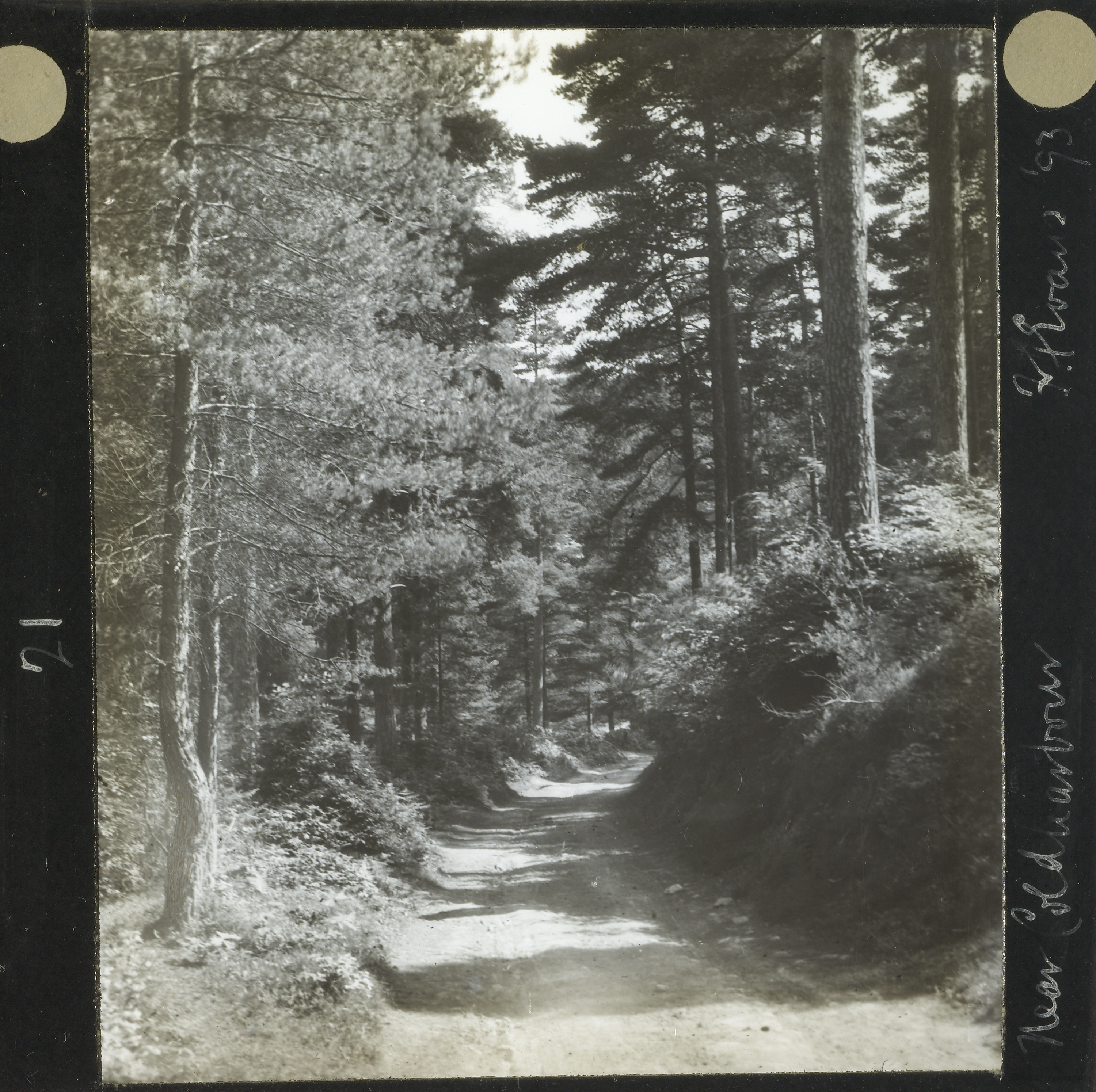
Image Credit: Frederick H. Evans “Near Coldharbour” (1893) Digital image courtesy of the Getty’s Open Content Program.