
The Surreal Sex of Beauty:
Jean Cocteau and Man Ray’s “Le Numéro Barbette”
By Chase Dimock
In 1923, the American acrobat Vander Clyde better known by his stage name “Barbette” made his theater debut in Paris at the famed Moulin Rouge and the Folies Bergère and captivated the French artistic community with his show. Yet, his success was not merely due to his death defying high wire or trapeze acts. What built his reputation and fame was his uncanny female impersonation as he performed his stunts. Most who saw Barbette for the first time were completely unaware of his true sex, but as Barbette’s renown grew in Paris, audiences poured in knowing they were witnessing the feminine graces of a man, yet they were captivated by how willingly they bought into the artful deception. During his days on the American Vaudeville circuit, Barbette’s revelation of his male gender at the end of his show may have shocked the audience, perhaps with laughter and the occasional moral offense, but in Paris, his act transcended the carnival aesthetic of oddities and shock value and was understood more as an art akin to ballet.
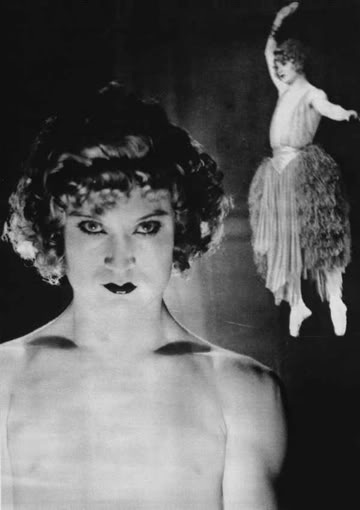
This appreciation for Barbette’s artistic sensibilities came as it was embraced by the Parisian avant-garde and explored in the works of two surrealist artists, the French writer Jean Cocteau and the American photographer Man Ray. In 1926, Cocteau commissioned Man Ray to take a set of photographs chronicling Vander Clyde’s physical transformation into Barbette before a performance. In these photos, Man Ray presents Barbette in a stage half-way between average man and the over the top show girl outfit that completed Barbette as a character. Barbette’s wig is on and his face is made up, but his chest is bare and unmistakably a man’s. For Jean Cocteau, this state in between genders, sexes, and identities constitutes the essence of Barbette as neither a man impersonating or transformed into a woman, but instead as a being that takes advantage of the fluidity of aesthetics and theatrics to render gender and sex amorphous, constantly in a state of movement. Through the pen of Cocteau and the lens of Ray, surrealism supplied a poetics of language and an aesthetics of vision for expressing Barbette’s play of gender and the repressed queer dimensions of the unconscious his act revealed.
Vander Clyde was born in 1904 in Texas where he first saw trapeze artists in the circus and as an adolescent began to recreate their acts on his mother’s clothesline. By his teenage years, he was already touring with the circus, most notably as a replacement for one of the “World Famous Arial Queens”, the Alfaretta Sisters after one of them had died. It was as a member of this act that Vander Clyde first performed dressed as a woman. Later, as Vander Clyde developed his solo act, he chose the name “Barbette” because it sounded exotic and could be a first or a last name and thus also could signify both genders. By the time Barbette had achieved international fame and had taken his act to Paris in the 1920s, his performance appeared generally as Frank Cullen describes it in his entry on Barbette in his encyclopedia of Vaudeville,
“In his glory days of the 1920s, he entered the vaudeville stage or circus ring like a Ziegfield showgirl, swathed in ostrich feathers, stunningly gowned, bejeweled and bewigged. He then removed his headdress, cape and gown, and garbed in as little as possible to suggest near nudity but not run afoul of the law, Barbette began the acrobatic part of his act. He walked a tight wire, slack wire, and performed on the rings and the trapeze. He was a master of the dramatic, seeming to fall only to catch himself by a last second hook of his foot. He kept his audience aghast and amazed until he left the stage. When he returned to acknowledge the sustained applause, he doffed his wig, revealing his bald head and reminding all that they had marveled at a man playing a woman.”
In an interview with Francis Steegmuller as an old man retired to his native Texas, Barbette explained the impetus for inventing the character, “I’d always read a lot of Shakespeare…and thinking that those marvelous heroines of his were played by men and boys made me feel that I could turn my specialty into something unique. I wanted an act that would be a thing of beauty—of course it would have to be a strange beauty”. This “strange beauty” Barbette speaks of might translate today as a desire to create a queer aesthetics on stage. Though we do not have any definitive proof of what he would consider his gender or sexual identity by today’s terms, Barbette did have homosexual relationships. He was kicked out of London’s Palladium after he was discovered in intimate embrace with another man, which caused him to never again be able to receive a work visa to perform in England, and Barbette even had a brief romance with Cocteau himself. Barbette was more than a character portrayed on a stage; she was a tactical use of the conventions of theater in which the audience implicitly embraces the breaking of conventions of gender. Like so many queer people of the era, it was beneath the limelight where he could realize and enact elements of his own identity prohibited to him off stage.
The Surnaturel Sex of Beauty
 Early in his famous 1926 essay Le Numéro Barbette published in the Nouvelle Revue Française, Cocteau likens the transformation into Barbette to both a Jekyll and Hyde construction and the metamorphoses of people into flora found in Greek and Roman literature. While some criticisms of Cocteau’s writing have seized upon these metaphors as evidence that he saw gender in terms of a binary, I read these more as acknowledgements of how we have as a western culture theorized the notion of a transition between states of being in order to prepare the reader for a more radical concept of gender. Cocteau understood that Barbette’s act was more than a mere circus act or cheap exploitation; it illuminated the possibilities of thinking gender, sex, and sexuality outside of conventional binaries through aesthetic and theatrical innovation. He argues that the reason for Barbette’s success is that “he pleases those who see in him woman and those who perceive in him man, yet to others, their souls are moved by the supernatural (surnaturel) sex of beauty.” Barbette satisfies the drive of the audience to gender and sex him both as male and female, and at the same time for others, Barbette reaches a higher sex “above or beyond nature” legible only through an aesthetic practice of beauty that comes alive through theatrics. Cocteau thus takes the “strange beauty” that Barbette appropriated and modernized from Shakespeare and places it within the modern scientific discourse of sexuality which in the 20s was dominated the model of the “invert” as the chief paradigm for understanding homosexuality. This idea of a separate sex also borrows from the concept of a “third sex”, which contemporaneous researchers in sexology used to categorize the invert as neither man nor woman, but a distinctly different sex. The “invert” model perceived the homosexual as simply being a woman trapped inside the body of a man. It would appear that Barbette fits this description perfectly, but the more we read into Barbette’s performance and Cocteau’s analysis, the more it becomes apparent that Barbette was neither a woman trapped in a man nor a man parodying a woman, but a figure of grace, agility, and beauty interested in challenging how we gender these concepts.
Cocteau’s invention of a third, surnaturel sex of beauty marries Immanuel Kant’s concept of the beautiful from Critique of Judgment with the aesthetic and philosophical practices of surrealism. Barbette as a character created by Vander Clyde meets Kant’s most important requirement for “the beautiful”—that the object pleases us because it is beautiful and not that we deem it beautiful simply because it pleases us. For Kant, the beautiful exists as pure form and design and retains its universal quality of beauty irrespective of subjective taste. While Barbette initially lures the desire of those drawn in by his pleasing make up and costuming, he is still able to retain the beauty of femininity after removing these items. Therefore, the attraction of Barbette is deeper than the pleasing veneer of femininity that he wears; it comes from an attraction to the pure form of beauty that he realizes through his acrobatic stunts and graceful movements. If Barbette could sustain his feminine form after all of the socially constructed signifiers of femininity had been stripped from his body, then it stands that Barbette had discovered some universally attractive structure of beauty that kindles desire irrespective of gender constructs.
 This is where the influence of surrealism on Cocteau’s work comes in to inform this surnaturel sex of beauty. Although Cocteau was not a member of the surrealist movement, he nonetheless frequently collaborated with surrealists such as Man Ray and was a “fellow traveler” of their philosophical and artistic endeavors. The surrealists who were at their peak of popularity and innovation at the same time as Cocteau wrote this essay, based their work on the exploration of the unconscious and worked through literature, art, and film to render it legible to the public. Just as Cocteau’s use of the term “sur-naturel” speaks to that which is above or beyond nature, the “sur-real” addresses that which is on, above, or beyond reality, namely, the effect of unconscious drives and associations that inform our knowledge of self and the world around us. In their mission to unlock the creative potential of the unfettered unconscious the surrealists paid close attention to the role of desire as Freud and the psychoanalysts stipulated that all human drives are invested in libidinal desires. Sexual drives work in and through our unconscious associations and suture together objects, images, emotions and imbue them with libidinal impulses. Barbette’s prediscursive beauty spawns from this unconscious nature of desire. The aesthetics of his beauty elicits a desire that becomes gendered and sexed once the viewer becomes conscious of that desire and tries to fix it on appropriate objects and repress it from inappropriate objects.
Yet, once it is revealed that Barbette is a man and not a woman, is this desire determined to be a fraud? to be mistaken? Freud’s disciple Jacques Lacan, who wrote his doctoral thesis while associating with and finding inspiration in the ideas of the surrealists, would respond that all forms of desire are in fact “genuine” in so far as all desire, once it becomes conscious, is manipulated around our imaginary relationship with the outside world. Lacan’s theory leads us to understand that desire in of itself is neither gendered nor compliant with a sexual orientation, it is a pure drive that becomes cathexed onto an object of desire upon which social constructions of heterosexual and homosexual have been affixed. To bring back Kant into the conversation, a key element of “the beautiful” as he defined it is that it would be universally recognized outside of subjective interest. To this question of the universal quality of “the beautiful”, I add the universality of desire as understood by Freud and Lacan. All individuals regardless of their identities or subjective tastes are universally driven by their capacity to desire. Thus, what Cocteau earlier identifies as Barbette’s success, his ability to seem masculine or feminine according to what the individual wishes to perceive, gives him a universality that becomes in of itself a distinct form of sex through beauty. Just as desire exists before it is fixed on a gendered object, Barbette’s supernatural sex of beauty exists before it can be gendered according to social construction.
Barbette Shocks the Masters of Shock
Despite surrealism’s stated goal to shock bourgeois society by representing the unrestrained unconscious in its most ruthless forms, the movement nonetheless reproduced some sexist and homophobic thinking. Some of the most iconic images of surrealism present the woman as an object on which the sexual desire of the male artist and spectator performs violence. Some examples include Dali and Bunuel’s slicing of a woman’s eyeball in Un Chien Andalou and surrealism’s founder André Breton’s novel Nadja in which he has an affair with a mentally disturbed prostitute for whom he pursues no psychiatric help, but instead praises as a “true surrealist”. Although one may argue that such disturbing images come as a result of the startling concoctions that the truly unfiltered unconscious may provide, the surrealist canon of art consists of few images that consider a male body and subject in these ways. The absence of such images indicates a certain reluctance or fear of the largely male and heterosexual movement to cede the mastery and privilege of the artist and become the object overtaken by their unconscious that surrealism was supposed to achieve.
Breton voiced specifically homophobic sentiments. In a series of transcribed discussions from 1928 among Breton and other surrealists on the subject of sex published in their journal La Revolution Surrealist, he accuses “homosexuals of confronting human tolerance with a mental and moral deficiency which tends to turn itself into a system and paralyze every enterprise I respect”. In the second session held four days later, Breton accused the new attendees of the “promotion of homosexuality” and threatened to disband the discussion altogether. Breton was particularly intolerant of Cocteau. Fellow gay surrealist poet Charles Henri Ford stated that Breton thought of Cocteau as a “sexual propagandist” and resented him for the mainstream popularity he achieved. Considering Breton tolerated both Ford and gay French novelist René Crevel in his movement, Breton’s homophobia could very well have been specifically targeted at Cocteau who not only employed the language and imagery of surrealism without allegiance to Breton’s philosophy, but also used it to openly theorize a queer eroticism through it.
 Despite some surrealists’ sexism and homophobia, Barbette was not the first drag figure to emerge from surrealist aesthetics and theory. The earlier Dadaist and later surrealist artist Marcel Duchamp (best known for exhibiting a urinal in an art gallery and calling it “the fountain”) created a female alter ego for himself called “Rrose Sélavy” that he used as a pseudonym for some of his works. The name Rrose Sélavy is intended to be a pun, sounding like “Eros” and “c’est la vie” (Love…that’s life!) or “arroser, c’est la vie”, the verb “arroser” referring to the notion of toasting something, thus a toast to life. In 1921, Duchamp posed for a series of photographs dressed as Rrose Sélavy taken by Man Ray. Duchamp used some of these photos in a series of readymades in which he pasted the photo over an existing bottle of perfume he renamed Belle Haleine, Eau de Voilette, which translates as “beautiful breath” and by replacing the t in “eau de toilette” toilet becomes “veil”.
Rrose Sélavy, like Barbette, plays with the notion of uncannily hiding one’s self beneath a “veil” of another gender. Yet, Duchamp’s character is meant to be transparent, shabbily female so that Duchamp is recognizable beneath it. Rrose Sélavy is parodic of gender; Barbette is transcendent. This is most apparent via the different methods Man Ray used to photograph Rrose Sélavy and Barbette. Although Rrose Sélavy is adorned completely in women’s clothing while Barbette betrays his womanly identity with a bare male chest, Barbette nonetheless appears more legibly female while Duchamp’s decidedly masculine features draw attention to the man situated awkwardly behind a sloping wig and haphazard makeup.
Contrasting with Duchamp’s fairly incompetent attempt at drag, Man Ray accentuates Barbette’s aptitude at applying make up and a wig, using a backlight to give Barbette the surreal appearance of being haloed and glowing–supernatural. The viewer is drawn to the immaculately feminine facial features, an angelic apparition so perfect that we accept it despite the equally luminous, pale white chest of a man upon which it sits. Bathed in luminescence, the flesh of the man’s chest becomes a canvas upon which the feminine radiance of the face is projected and the flat musculature becomes feminine too, yet not unmanly and not womanly as it lacks curves and retains the form of a man.
Through the aesthetics of surrealism, Man Ray achieves the vision of making the desire of the unconscious that knows nothing of the biological impossibilities or social prohibitions that would forbid this seamless fusion of the male and female. While Man Ray positions Rrose Sélavy a figure of camp aesthetics where we mock conventions by reading the obvious masculinity beneath the wig, Barbette’s photos defy the violence or subjugation of the female body common to surrealism and presents femininity’s agency over the sensibilities and desires of the viewer.
Barbette Shifting the Aesthetics of Modernity
 In his essay, Cocteau uses Barbette’s performance as a harbinger of change in the artistic world of modernism. Cocteau borrows surrealism’s analysis of dreamscapes for conceptualizing the space of Barbette’s stage, “Barbette moves in silence. Despite the orchestra that accompanies his saunter, his graces and perilous exercises, his number seems to be from far away, performed in the streets of a dream, in a place from where sounds cannot be heard, being carried there by a telescope or by a dream”. The space of the theater allows for the same suspension of reality and logic allowed in a dream where mutually exclusive constructs of distances, sounds, and shapes can coexist. “When Barbette enters, he throws dust in our eyes. He throws it with such violence so that he can concentrate solely on his acrobatic work. From then, his masculine gestures serve him instead of giving him away”. Barbette’s dust is whatever phenomenon in the theater that suspends reason and shifts out perception, allowing the viewer to seamlessly integrate what logic may deem disjunctive. Like in the dreams the surrealists represented in painting and writing that spoke to the inner workings of the unconscious, Barbette’s dust clouds objective viewership, allowing for the unconscious to take reign. Cocteau thus conceives of Barbette’s body like a piece of modernist art come to life:
“Cinema has dethroned realist sculpture. The personas of marble, their grand, pale heads their volumes of shadows, their superb illuminations, all this abstract humanity, this silent inhumanity replaces what the eye had demanded of statues. Barbette relieves these statues that move. Even when one is aware of him, he does not lose his mystery. He lives in a model of plaster, a wax model, a living bust that sings on a pedestal of velour.”
Barbette’s persona is a synthesis of the classical forms of sculpture that become animated and alive through modern innovation. A sculpture presents us not with real bodies, but the ideal form of real bodies. Barbette’s surnaturel sex of beauty animates this form. Cinematography presents us also not with real bodies but with the range of motions bodies can take as illuminated, projected shadows of film. Barbette is the opposite of film. Film captures reality and makes it a flat aesthetic. Barbette takes the conceptual forms of aesthetics and makes them come alive.
Commenting on the final leg of the performance in which Barbette reveals himself to be a man, Cocteau argues that Barbette “rebecomes a man”, stating roughly that he indicates the truth of his sex through the same acts through which she crafts the lie. Cocteau writes: “Barbette, immediately after removing his wig ‘interprets the role of a man, rolls his shoulders, spreads out his hands, and exaggerates the athletic motion of a golf player.” Barbette does not simply reveal his male identity and return to his true self, instead, he pantomimes and performs the masculinity supposedly revealed by removing his wig. His male sexed body and its expected postures and actions are revealed to be as much a product of artifice and performance as the female persona he adopts on stage. As the curtain closes, Cocteau adds that Barbette knowingly blinks, hops on one leg and does a childish, coquettish dance, taunting the audience with his ability to turn the persona on and off at will regardless of the way he is dressed. It is revealed at this final moment that the clothes, make up, and wig were all in of themselves a ruse, a decoy that lead the spectator to invest desire into the form and motion of Barbette’s body that cannot be divested once its powder puff camouflage is removed.
Although he spends the bulk of the essay zoomed in on Barbette’s body, the theater space, and theories of aesthetics Cocteau expands the enigma of Barbette to encompass questions of national identity and politics in his final paragraph:
“All the souls in distress, sick, desperate, worn out by the forces that plague us in and outside of death, find rest in the silhouette. After some years of Americanism, the wave where the Capital of the United States hypnotized us like a revolver, le numéro Barbette finally shows me the real New York with the ostrich plumes of its sea and its factories, its buildings in tulle, its precision, its siren’s voice, its finery, its electric aigrettes.”
By the term “Americanism”, Cocteau refers to the wave of American artists, performers, musicians, and athletes that came over to France in the post WWI years and whetted an appetite in the French public for American culture and products. The most famous of these American luminaries and perhaps the most influential on the public reception of Barbette was the African-American entertainer Josephine Baker, who performed erotically charged dances in the same French concert halls as Barbette just a few months prior to the publication of Cocteau’s essay.
I have chosen above an image of Baker in her infamous banana costume, which in a way manipulates images of male and female sexuality in the opposite fashion as Barbette. While Barbette commands the audience as man concealing his manhood, Baker appropriates manhood in the shape of the banana, suggesting that her magnetism as a performer commands and appropriates power over the viewer as she reveals (in a Lacanian way) that she as a woman possesses the phallus.
Yet, Cocteau’s quote seems to suggest that while Baker’s popularity came from France’s interest in primitivism, which was always already a colonial fantasy of exotic otherness, Barbette reveals the “true” America because his act is self consciously about the production of fantasy as the reality of human desire. Although Baker’s aesthetic is just as consciously constructed to perform a specific fantasy of feminine sexuality, those that ascribed to the primitivist movement (like Picasso who was influenced by African masks) did so under the illusion that the movement reacquainted them with the authentic “primitive” origin of human expression. Perhaps then, Barbette rang more true to Cocteau simply because his artifice was more apparent and not because either artist was more skilled at manipulating the semiotics of femininity. In this surreal synthesis of the delicately feminine and brutishly industrial imagery, Cocteau extends the scope of Barbette as a character to something uniquely a product of American culture and industry. His showgirl ostrich plumes and jewelry now adorn the factories and buildings that produce modern American industry. Just as the dazzling array of consumer products on the market disguise the means of their production, Barbette’s feminine finery conceals the production of her gender. However, revealing the real means of production does not make Barbette or any other commodity any less beguiling or desirable. Rather, as Cocteau has been arguing the whole time, artifice is the reality of beauty and far more compelling than the “natural” because the natural has always already been a human construct.



 As It Ought To Be

