SATURDAY POETRY SERIES PRESENTS: OCEAN VUONG

By Ocean Vuong:


TO LOVE WELL

is to place a hand
  on another’s chest and know
  that the heart only beats
  when locked in a cage
  of bone.


DEPARTURE

Dawn cracks: a lightning bolt
carving slowly through the clouds.

All night I listened to your breath.
Even tasted your lips
when the moon turned you pale
as a corpse.
I haven’t killed a thing

since the morning
we followed gunshots into a field
peppered with sparrows. Remember
how their necks twitched
beneath our thumbs? Before twisting,
I took some time to feel

the rage of wings against palm,
marveling at such fierce resistance
to mercy. Perhaps
it was selfish—I couldn’t bear
the sound of wings
flying nowhere.

Darling, forgive me. When you wake
and begin to flutter in the emptiness
still warm from my whispers,
I will be too far
from this field
to wrap my hands around
that little bird
                               in your chest.


(“To Love Well” and “Departure” were originally published in Diode. Both poems are reprinted here today with permission from the poet.)


Ocean Vuong: Born in Saigon, Vietnam, Ocean Vuong is the author of Burnings (Sibling Rivalry Press, 2010) and is currently an undergraduate at Brooklyn College, CUNY. His poems have received an Academy of American Poets Prize, the Beatrice Dubin Rose Award, the Connecticut Poetry Society’s Al Savard Award, as well as four Pushcart Prize nominations. Poems appear in Word Riot, Diode, Lantern Review, Softblow, and PANK, among others. Work has also been translated into Hindi, Korean, Vietnamese, and Russian. He lives in Brooklyn and is an avid supporter of animal rights and veganism.

Editor’s Note: I find Ocean Vuong at once inspiring and inhibiting. Like Rimbaud before him, I am in awe of Ocean’s extreme talent and numerous accomplishments at his age, and at the same time I am inhibited by feelings of inferiority when considering both his written word and his accolades. I’ll try to err on the side of inspiration and say that I am honored to be sharing a city, a school, and a genre with this exceptionally gifted poet. Ordinarily I would share with you some of my favorite moments from today’s poems, but I am honestly in awe of every word, every beat, every line. I urge you to read and re-read today’s poems; it is like breathing a new kind of air. I also urge you to consider buying Ocean’s first chapbook, Burnings, to support both this up-and-coming artist and Sibling Rivalry Press, an on-the-rise press you should be keeping an eye on.

Want to read more by and about Ocean Vuong?
Ocean Vuong’s Blog
Buy Ocean Vuong’s book, Burnings
An interview with PANK magazine

Rites of Passage

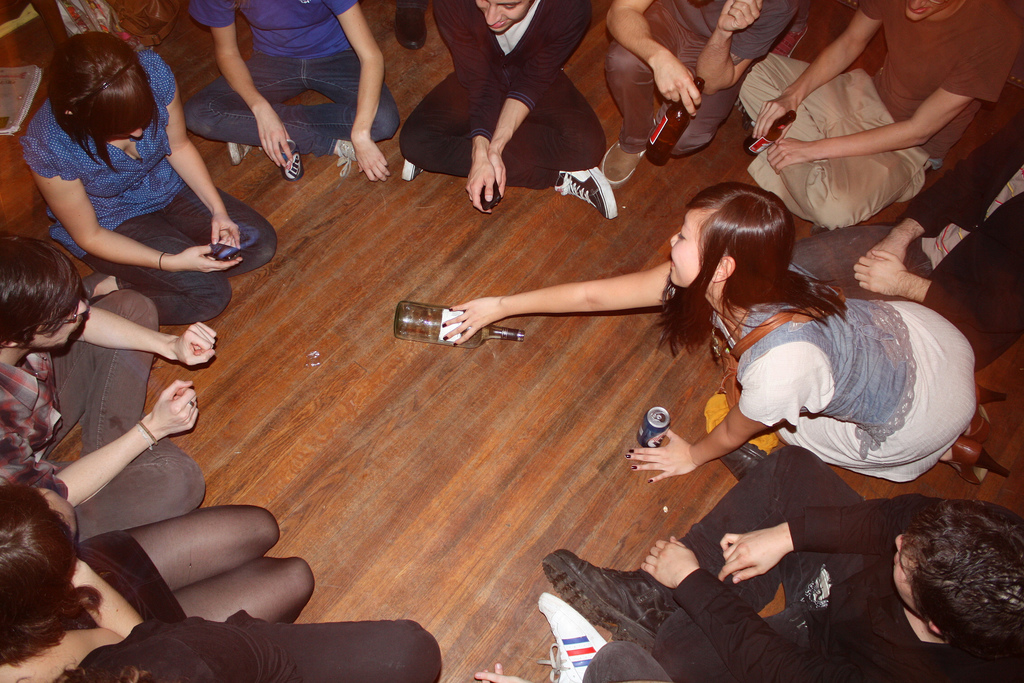
Spin the Bottle. Photo credit: Flickr user atsealevel.

I’ve been asked to explain a bit about the personal essays I often contribute to this blog. I wrote most of them for the popular “Readers Write” feature in my favorite literary magazine, The Sun. Each month they propose a topic like “Rites of Passage” and invite readers to contribute their own stories. Of the submissions they receive—sometimes as many as a thousand—they publish the most interesting. An abridged version of this essay appears in the current print edition of The Sun (June 2011).

Rites of Passage
By John Unger Zussman

In seventh grade, my peer group began to play kissing games at parties. Spin the Bottle, Seven Minutes in Heaven—tame stuff, in retrospect, but to me it seemed intimidating and immoral and I wanted no part of it. Entering adolescence shortly after my father died, I had no adult male hand to guide me. (I did have an older friend who breathlessly explained that babies resulted when the boy peed into a little hole in the girl. I knew that couldn’t be right.)

It’s not that I wasn’t interested in girls; I was desperately interested, and spent many nights agonizing over how to get them to like me. No, it was sex I wasn’t interested in, even when I got the story straight. I had absorbed a strict moral code from my mother and was convinced that sex before marriage was wrong. I was after girls’ admiration and love, and I believed I would win that by respecting them.

I didn’t leave the parties when the games began; I would simply not partake. For a while, my best friend felt the same way, and we would watch awkwardly from the edge of the circle. But soon, he succumbed too, and I was left to uphold my moral code alone.

(Years later, I asked my mother what she thought of the way I abstained from those games. “I thought you were dumb,” she told me bluntly. Thanks a lot, Mom. Now you tell me. All I needed was someone to explain that girls were sexual beings too, and that they were just as curious about exploring those feelings as I was, if not quite so driven or tormented.)

By the time I started dating in tenth grade, I had decided that kissing, at least, was permissible. My dates and I spent hours necking, in my car or in their living room, at summer camp or youth group retreats. One girl, bored with kissing, urged me to go further. Her previous boyfriend had a serious disease, she explained, that had pushed them into early intimacy. Despite her clear invitation, I was immobilized by impending guilt.

And so the task was left to Wendy, my girlfriend at the beginning of senior year. Exasperated after yet another marathon make-out session, she took my hand and placed it gently on her breast. That act of mercy opened the floodgates, and for that, Wendy, my wife and I are forever grateful.

Copyright © 2011, John Unger Zussman. All rights reserved.

SATURDAY POETRY SERIES PRESENTS: KEETJE KUIPERS, REVISITED

By Keetje Kuipers:

THE OPEN SPACES

She said it was a place that held nothing
but sadness for her. Still, I think I could
lie down in it forever, head resting
in the sagebrush flats. I told her I once had a man

who drove us past every chapel in Vegas
threatening to turn in. But I’m wedded
to the burlap hillsides and bearded drivers
of pickups, my dog’s face the shadow

in my rearview mirror. With all this light,
I don’t need water, don’t need the river’s
green lung. I can take up the sadnesses
that surround me, these small ones

of dust in the air, of weeds that climb
the ditches until yellow is the worst
color. Semis that make the dead
bird’s feathers fly again, the deer’s tail

leap from the gravel of the road. She
can go home to the farmer’s sunless chest
under his shirt. I’ll sleep beneath
mountains still choosing which name

they want to take. If I’ve learned anything
about myself, this is where I belong:
with the dead scattered where we hit them,
the engine ticking as it cools under my hand.


DOLORES PARK

In the flattening California dusk,
women gather under palms with their bags

of bottles and cans. The grass is feathered
with the trash of the day, paper napkins

blowing across the legs of those who still
drown on a patchwork of blankets. Shirtless

in the phosphorescent gloom of streetlamps,
they lie suspended. This is my one good

life—watching the exchange of embraces,
counting the faces assembled outside

the ice-cream shop, sweet tinge of urine by
the bridge above the tracks, broken bike lock

of the gay couple’s hands, desperate clapping
of dark pigeons—who will take it from me?


(“The Open Spaces” and “Dolores Park” were originally published in The Offending Adam. Both poems are reprinted here today with permission from the poet.)


Keetje Kuipers is a native of the Northwest. She earned her B.A. at Swarthmore College and her M.F.A. at the University of Oregon. She has been the recipient of fellowships from the Vermont Studio Center, Squaw Valley Community of Writers, Oregon Literary Arts, and Soapstone. In 2007 she completed her tenure as the Margery Davis Boyden Wilderness Writing Resident, which provided her with seven months of solitude in Oregon’s Rogue River Valley. She used her time there to complete work on her book, Beautiful in the Mouth, which was awarded the 2009 A. Poulin, Jr. Poetry Prize and was published in March 2010 by BOA Editions. It contains poems previously published in Prairie Schooner, West Branch, Willow Springs, and AGNI, among others. You can also listen to her read her work—which has been nominated five years in a row for the Pushcart Prize—at the online audio archive From the Fishouse. Keetje has taught writing at the University of Montana and is currently a Wallace Stegner Fellow at Stanford University. In the 2011-2012 academic year, Keetje will serve as the Emerging Writer Lecturer at Gettsyburg College. At the moment, she divides her time between San Francisco and Missoula, Montana, where she lives with her dog, Bishop, and does her best to catch a few fish.

Editor’s Note: Well, this is embarrassing, but I’m determined to make lemonade out of lemons and take this opportunity to open up our discussion about poetry from today’s little mishap. You see, when I went to prepare today’s post, featuring a poet I had secured reprint permission from a couple of weeks ago, I discovered that my co-editor, who edits the weekly Friday Poetry Series here on As It Ought To Be, had shared the work of Keetje Kuipers on her series yesterday. At the time I made the discovery it was too late to secure permission from another poet, and so here we are, looking at the work of Keetje Kuipers for a second day in a row. This little blunder, however, gives us a chance to think about what draws us to poetry.

While my co-editor and I both read The Offending Adam, from whence today’s poems came. But the poem my co-editor shared yesterday actually came from a different journal altogether. Somehow both of us found today’s poet in the poetry world at large and were both drawn enough to her skill with words that we each wanted to share her work with you.

Are these poems that everyone would like? Is there such a thing? What is it about today’s poet that we both found so captivating? My co-editor and I both like Walt Whitman and Federico Garcia Lorca. Is there such a thing as a poet who is so universal in their way with words that everyone who reads them is drawn to their work? Poetry, like any form of art, is subjective. And yet, there are some who are so adept that most people agree on an appreciation of their work. Keetje Kuipers, apparently, is among the next generation of such artists.

As for me and my co-editor, it is fitting that our friendship came about as a result of our involvement with this site, and that we became friends in San Francisco, the city that houses the Dolores Park written of above. We have both left San Francisco, and yet, when it comes to poetry, our hearts and minds clearly still reside in the same place. Much love, Lezlie. Great minds clearly think alike!

Want to read more by and about Keetje Kuipers?
Keetje Kuipers Official Website

Consider the Rant: A Book Review

Consider the Rant

by Okla Elliott

On Pain of Speech: Fantasies of the First Order and the Literary Rant
Dina Al-Kassim
University of California Press
ISBN 978-0-520-25925-6
$34.95 Paperback
$28.00 E-Book

In Dina Al-Kassim’s new book On Pain of Speech: Fantasies of the First Order and the Literary Rant, she takes up (among other things) Michel Foucault’s interest in the limit-experience of reading certain texts (particularly Georges Bataille) and turns it around by asking what it means to write such a text—that is, under what conditions, with what linguistic tools, and to what purposes such texts are written. Al-Kassim focuses mostly on Oscar Wilde, Jane Bowles, and Abdelwahab Meddeb—giving each of these authors an entire chapter—and makes regular use of Georges Bataille, Charles Baudelaire, and Aimé Césaire, thus making her project an utterly comparative one that insists on its portability across national and linguistic borders.

The basic argument of the book runs as follows: Speaking truth to power has been co-opted by institutions of power in many instances; these institutions, such as elite universities, exclude more people than they include, thus making them part of the Foucauldian schema of the microphysics of power in society (as he lays out in Society Must Be Defended and other works); therefore, the rant (whose tradition harkens back, Al-Kassim explains, to the “rakish libertinage” of the seventeenth century) is often the only form of discourse available to the dispossessed or the subaltern. She is clear, however, that the literary rant is not a genre. “Postscripts, letters, afterwords: marginal genres aat the edges of masterful texts are often the site of the rant’s emergence, but what I am calling the rant is not a genre in itself.” Al-Kassim engages yet further definition by privation, emphasizing that the literary rant is also not parrhesia (“fearless speech”). It is a speech act or series of speech acts that run counter to the powered entities of a society, but it is not necessarily confrontational (though it can be and often is). The essential aspect of the literary rant is that it is unintelligible speech that takes place when no speech is possible.

The theoretical DNA of On Pain of Speech can be easily determined by a quick look at its paratextual elements. The book opens with three epigraphs—one from the philosopher-pornographer Georges Bataille, one from Michel Foucault, and one from Judith Butler. By picking a single line from each of the epigraphs, we can get a reasonable picture of the project Al-Kassim has put before herself. From the Bataille epigraph: “Qu’on me fasse taire (si l’on ose)!”; from Foucault: “We are dealing . . . with a discourse that turns the traditional values of intelligibility upside down.”; and, finally, Butler: “This relation to the Other does not precisely ruin my story or reduce me to speechlessness, but it does, invariably, clutter my speech with signs of its undoing.” A look in the Index lets us see that there are fifty-one references to Freud and sixty-three to Lacan, six for Judith Butler, but only two for Jameson and two for Derrida. This is fitting since Al-Kassim uses many psychoanalytic terms and tries to rethink (rather successfully) Lacan’s theory of foreclosure, and she focuses considerably more on speech acts as they constitute the self than on speech acts qua speech acts. It is surprising, however, to see that Gayatri Spivak receives only one mention in the book, and that her widely influential essay “Can the Subaltern Speak?” is not the occasion of this single reference—surprising because Al-Kassim’s central effort could be seen as exploring how the subaltern attempts speech via the rant.

Here I feel compelled to point out that Al-Kassim chooses never to clearly define what a literary rant is. This is not to suggest that she does not give ample examples and even certain quasi-universal features to literary rants, but it would be anathema to the nature of a literary rant, as Al-Kassim conceives it, for it to have rigid genre specifications. Its purpose is precisely to explode genre specifications and expectations.

Al-Kassim’s analysis could profitably be applied to much modernist and avant-garde writing, ranging from the feminist-experimentalist Gertrude Stein to the Communist-Dadaist Tristan Tzara to many contemporary post-colonial avant-garde artists (such as the Raqs Collective in India). It can also, however, be applied to the fascist-Futurist Filippo Tomaso Marinetti and others of his ilk productively, though given the book’s focus on leftist and post-colonial resistance, it might come as a surprise to Al-Kassim to see her work thus employed. As she conceives her theoretical model, it is already remarkably portable across decades and nations and movements, but it has an even larger scope than the author herself seems to give it. So long as the writing in question “turns the traditional values of intelligibility upside down” and challenges the dominant paradigm of thought at a given time, it seems it could be profitably read through the lens of Al-Kassim’s book.

This wide portability and the refreshingly readable prose of the book make On Pain of Speech an ideal text for courses on post-colonialism, Modernism, and avant-garde literatures at the advanced undergraduate level and beyond.

[This piece was originally published in Inside Higher Education online.]

Art Review Series

The Disappearing Artist

by David Gibbs

Andrea Rosen Gallery’s Katy Moran exhibition attempts, conceptually, to eliminate Moran from the work. Society at large, terrain, and the objects that have filled the subject matter of still-life are some of the ways she forces the idea of the individual out from its own abstraction, despite the Abstract Expressionist’s influence. In a time when self-independence is of the highest priority, when the self dominates subject matter most, Moran attempts to break from this mass desire for individualism by striving to express a altered model of the self that is obscured, and therefore cutting free of this post-war trend.

No signatures, no paintings have a name, few canvases are finished only using paint. Mostly they are collages of materials undisguised, giving complexities to the non-self items (a tree, geometric forms) painted so loosely they almost, and at times do, loose that common quality that aides us in their identification. Overall, there is nothing vibrant about the colors, they are earth tones that when mixed by wide brushstrokes or in frenzied layers, only darken.

The self is absorbed into the work as an emigrant is absorbed into a city, which too is utilized. Torn and overlapping layers of collage resemble overused and decaying billboards. Gum-like substances bead near corners and edges on a few pieces, as if the public had participated in the project. This pseudo-invitation is one of the most interesting aspect of the exhibition, that is, the fake public dissolving the individual, or even traditional forms dissolving the individual to the history of art, the centuries old timeline that no one can survive.

Despite the landscape’s accessibility the natural imagery and city-scape-surfaces feel arbitrary, as if these monumental structures could never liberate a constant awareness of the self. The controlled quality of the nearly haphazard strokes suggest the haziness of thinking, of murky images forming from an aged memory, as if Moran were trying to channel a painting she had seen and mostly forgotten, and consequentially directing herself away from the self. The gallery’s statement characterizes her work as “allow[ing] for the slippage of theory in to the intensity, irrationality and violence of letting go,” despite the limitation set by aiming to let go, that is becoming better connected with the unconscious self. The desire to rebel is courageous of Moran, although it feels sometimes forced by this unending problem of ego.

Moreover, the sense of forthright communication obscures as the self and society awkwardly function together. Often divisions are thrust upon the viewer through torn and folded-out collage layers of magazine fragments. Strips of canvas interrupt the underlying paint and a fabric that looks like a dull brown and white static draws the attention away from the rest. The tension between the two seems manageable, and not overwhelming by the modestly sized frames, as if this issue was not as urgent as the brushstrokes imply.

However the understated size, Moran seems to want communication with a variety of people, from those accustomed to street images, to art scholars, and to those preferring the middle or upper class lifestyles, as hinted with the use of a newly varnished wood floor panel as a canvas, while expressing an unresolved imbalance with today’s trends.

This exhibition by Katy Moran can be seen at the Andrea Rosen Gallery, from May 5-June 11, 2011.

SATURDAY POETRY SERIES PRESENTS: JARED RANDALL

STATIONS OF THE CROSS (UNTRANSUBSTANTIATED)
by Jared Randall

I. Jesus is condemned to death

No one suspects our empty stomachs
when shaking hands
over polished oak pews, our smiles
averting dark stains
we hide in skin creases, the body ache
we carry across
our imagined spirits, our thirsty backs
and sealed lips.


II. Jesus carries his Cross

This sanctuary cross is always empty,
a memory without body,
without panting, thirst, hanging head,
blood and sweat. No fingers
stray—too needy a gesture—to touch
his nail-scarred hands.
No slivers sink deep into flesh, sharing
the rough-hewn death.
No wine to drink, nothing blood-thick,
but watered-down Welch’s
chase stale saltines, broken in pieces
to save money. Only
our symbols, our denied sustenance.


III. Jesus falls the first time

When poorly we remember, poorly we live:
our after-church feasts,
spirits still craving a crumb of bread
until by Monday
the symbols have faded, souls thirst
even vinegar,
next communion a month, two,
three months away.


IV. Jesus meets his afflicted mother

No one from church sees us, angry-palmed,
shouting children down;
passing the beggar who will only spend
on alcohol, we know
and tighten a fist; or hungry-eyed, slipping
into video stores,
past dark paneling and plate glass windows
to little rooms in back—
thrilled and dead and rising, peeking
for eternity.


V. Simon of Cyrene helps Jesus to carry his Cross

Our shaking hands pick forbidden fruit
from outstretched arms.
When she has gone, we wake at night
and hear a crying,
pluck thorns and slivers from flesh
we feel, each quiver.
We would nail our limbs to dogwood…
the hammer too heavy.


VI. Veronica wipes the face of Jesus

A cool hand on our brow traces
the shape of sin,
her hand soft over stretched limbs,
our tired eyes licking
her light, her curve, every touch.
Unheavenly angel,
never—almost—pull back,
my earth-angel.


VII. Jesus falls the second time

Eyes on our backs are not enough.
The shopping aisles white
and bleeding, we turn our faces
to stolen paperbacks
and bottles, red-letter editions
mouthed around glass
openings, fluorescent visions,
lusts we trade in, covers
we open, available confessions
we whisper.


VIII. Jesus meets the women of Jerusalem

All eyes confess the shape of hips,
of necklines worn low,
the inconcealable draw of veils, lace
uncovering skin
whenever electronic eyes meet.
We wonder why girls
lose their eyes—why stars pirouette—
and we wonder.


IX. Jesus falls a third time

Touching, she began to touch, we say—
not our blame here,
having forgotten how thirsty…
How thirsty men drink
from any stream, well, fountain.
The tin cup hanging
from a rusty nail, wooden post,
falls clattering
and if she picks it from the ground
eyes follow
                         legs inside.


X. Jesus is stripped of his clothes

We look away when wives cluster nearby—
no temptations here—
but with their laughter in the kitchen
our eyes unglue the screen,
her curves shaking pom-poms
on football Sunday,
a groove we all imagine swimming,
our voices fallen.


XI. Jesus is nailed to the Cross

Each pounding rhythmic wave takes us
over the crest.
Flesh: the sight, the touch, the hunger,
our angry words
at children asking why to our backs:
why this pounding,
these nails we should not have seen?

(Let the children come…)

What did he do, did we see, pretend—
what does wine mean,
this blood spouting from nails, over wood,
this bread?


XII. Jesus dies on the Cross

Can we turn from her, turn away,
release the fist,
climb a hill outside any known city
loose with gravel,
the pit where children ride their bikes
and teen lovers meet
on nights to empty their hunger,
the thirsty ground
where people dump old appliances.
Do we admit this?
Eli, Eli, lama sabachthani? Must we
pound this nail
and why? Must we kneel in this dust,
say, Yes…my hammer
…see my hammer, hear my rhythms,
Eli, Eli…


XIII. The body of Jesus is taken down from the Cross

When it is over, hunger admitted,
we want more
and to eat, bread and to drink, wine
and frequent sips.
This month. That week. Every Sunday,
Friday to remember
with a body on every cross. Every tomb
empty. Open palms.


XIV. Jesus is laid in the tomb

Still we tear them open, our gaping wounds
from plucked nails,
lower the rags, wrap in white, oil
embalmed limbs.
We chew our bread softer, a weight
on shoulders
we lay down (hungry tomb) and wipe
thinned blood around
the rim, drip to earth. We wait the month,
two months, another
passing. Wait the crackers and juice. Someday
we only hope to drink
the symbols we fear incarnate. We dare
her, body’s hunger.
We dare her
                           to substantiate


(“Stations of the Cross (Untransubstantiated)” was originally published in The Offending Adam, and is reprinted here today with permission from the poet.)


Jared Randall received his BA from Western Michigan University in 2006 and his MFA from the University of Notre Dame in 2009 after spending a decade working in warehouses. His first book of poetry, Apocryphal Road Code, saw print in 2010 from Salt Publishing. His work can be read in Controlled Burn, Crucible, and online at Danse Macabre, Subtle Tea, and The Offending Adam. He is also responsible for the occasional blog post at Montevidayo.com. Connect with him via Facebook or Twitter at his personal blog, Wandering Stiff.

Randall resides in Michigan where urban sprawl cramps old farmhouses. When not writing about tourist attractions, roadside diners, aging factories, the future, the past, and the folk who might frequent them, he makes his living as an adjunct instructor and freelancer. He hopes you’ll keep a wandering eye open for new roads and that you’ll always lend a ride and a hand to fellow travelers.

Editor’s Note: What is this poem about? Suffering? Longing? Sacrifice? All of the above? What at first glance appears to be a religious poem upon further reflection proves to be deeper, richer, layered with the exceedingly current themes of hunger, desire, poverty, desolation, sex, and sin. People–all over the world and in this poem–are starving. They are stealing to survive. They are giving in to temptation. They are human, with human needs, desires, and flaws. In today’s poem, Randall not only weaves for us a world that is thick with meaning, but does so with moments of finely-crafted language. Moments like “a memory without body,” “When poorly we remember, poorly we live,” and “All eyes confess the shape of hips, / of necklines worn low, / the inconcealable draw of veils, lace / uncovering skin.”

Want to read more by and about Jared Randall?
Wandering Stiff
Subtle Tea
The Offending Adam

“The Surreal Sex of Beauty: Jean Cocteau and Man Ray’s “Le Numéro Barbette” By Chase Dimock


The Surreal Sex of Beauty:

Jean Cocteau and Man Ray’s “Le Numéro Barbette”

By Chase Dimock


In 1923, the American acrobat Vander Clyde better known by his stage name “Barbette” made his theater debut in Paris at the famed Moulin Rouge and the Folies Bergère and captivated the French artistic community with his show. Yet, his success was not merely due to his death defying high wire or trapeze acts. What built his reputation and fame was his uncanny female impersonation as he performed his stunts. Most who saw Barbette for the first time were completely unaware of his true sex, but as Barbette’s renown grew in Paris, audiences poured in knowing they were witnessing the feminine graces of a man, yet they were captivated by how willingly they bought into the artful deception. During his days on the American Vaudeville circuit, Barbette’s revelation of his male gender at the end of his show may have shocked the audience, perhaps with laughter and the occasional moral offense, but in Paris, his act transcended the carnival aesthetic of oddities and shock value and was understood more as an art akin to ballet.

This appreciation for Barbette’s artistic sensibilities came as it was embraced by the Parisian avant-garde and explored in the works of two surrealist artists, the French writer Jean Cocteau and the American photographer Man Ray. In 1926, Cocteau commissioned Man Ray to take a set of photographs chronicling Vander Clyde’s physical transformation into Barbette before a performance. In these photos, Man Ray presents Barbette in a stage half-way between average man and the over the top show girl outfit that completed Barbette as a character. Barbette’s wig is on and his face is made up, but his chest is bare and unmistakably a man’s. For Jean Cocteau, this state in between genders, sexes, and identities constitutes the essence of Barbette as neither a man impersonating or transformed into a woman, but instead as a being that takes advantage of the fluidity of aesthetics and theatrics to render gender and sex amorphous, constantly in a state of movement. Through the pen of Cocteau and the lens of Ray, surrealism supplied a poetics of language and an aesthetics of vision for expressing Barbette’s play of gender and the repressed queer dimensions of the unconscious his act revealed.

Vander Clyde was born in 1904 in Texas where he first saw trapeze artists in the circus and as an adolescent began to recreate their acts on his mother’s clothesline. By his teenage years, he was already touring with the circus, most notably as a replacement for one of the “World Famous Arial Queens”, the Alfaretta Sisters after one of them had died. It was as a member of this act that Vander Clyde first performed dressed as a woman. Later, as Vander Clyde developed his solo act, he chose the name “Barbette” because it sounded exotic and could be a first or a last name and thus also could signify both genders. By the time Barbette had achieved international fame and had taken his act to Paris in the 1920s, his performance appeared generally as Frank Cullen describes it in his entry on Barbette in his encyclopedia of Vaudeville,

“In his glory days of the 1920s, he entered the vaudeville stage or circus ring like a Ziegfield showgirl, swathed in ostrich feathers, stunningly gowned, bejeweled and bewigged. He then removed his headdress, cape and gown, and garbed in as little as possible to suggest near nudity but not run afoul of the law, Barbette began the acrobatic part of his act. He walked a tight wire, slack wire, and performed on the rings and the trapeze. He was a master of the dramatic, seeming to fall only to catch himself by a last second hook of his foot. He kept his audience aghast and amazed until he left the stage. When he returned to acknowledge the sustained applause, he doffed his wig, revealing his bald head and reminding all that they had marveled at a man playing a woman.”

In an interview with Francis Steegmuller as an old man retired to his native Texas, Barbette explained the impetus for inventing the character, “I’d always read a lot of Shakespeare…and thinking that those marvelous heroines of his were played by men and boys made me feel that I could turn my specialty into something unique. I wanted an act that would be a thing of beauty—of course it would have to be a strange beauty”. This “strange beauty” Barbette speaks of might translate today as a desire to create a queer aesthetics on stage. Though we do not have any definitive proof of what he would consider his gender or sexual identity by today’s terms, Barbette did have homosexual relationships. He was kicked out of London’s Palladium after he was discovered in intimate embrace with another man, which caused him to never again be able to receive a work visa to perform in England, and Barbette even had a brief romance with Cocteau himself. Barbette was more than a character portrayed on a stage; she was a tactical use of the conventions of theater in which the audience implicitly embraces the breaking of conventions of gender. Like so many queer people of the era, it was beneath the limelight where he could realize and enact elements of his own identity prohibited to him off stage.


The Surnaturel Sex of Beauty


Early in his famous 1926 essay Le Numéro Barbette published in the Nouvelle Revue Française, Cocteau likens the transformation into Barbette to both a Jekyll and Hyde construction and the metamorphoses of people into flora found in Greek and Roman literature. While some criticisms of Cocteau’s writing have seized upon these metaphors as evidence that he saw gender in terms of a binary, I read these more as acknowledgements of how we have as a western culture theorized the notion of a transition between states of being in order to prepare the reader for a more radical concept of gender. Cocteau understood that Barbette’s act was more than a mere circus act or cheap exploitation; it illuminated the possibilities of thinking gender, sex, and sexuality outside of conventional binaries through aesthetic and theatrical innovation. He argues that the reason for Barbette’s success is that “he pleases those who see in him woman and those who perceive in him man, yet to others, their souls are moved by the supernatural (surnaturel) sex of beauty.” Barbette satisfies the drive of the audience to gender and sex him both as male and female, and at the same time for others, Barbette reaches a higher sex “above or beyond nature” legible only through an aesthetic practice of beauty that comes alive through theatrics. Cocteau thus takes the “strange beauty” that Barbette appropriated and modernized from Shakespeare and places it within the modern scientific discourse of sexuality which in the 20s was dominated the model of the “invert” as the chief paradigm for understanding homosexuality. This idea of a separate sex also borrows from the concept of a “third sex”, which contemporaneous researchers in sexology used to categorize the invert as neither man nor woman, but a distinctly different sex.  The “invert” model perceived the homosexual as simply being a woman trapped inside the body of a man. It would appear that Barbette fits this description perfectly, but the more we read into Barbette’s performance and Cocteau’s analysis, the more it becomes apparent that Barbette was neither a woman trapped in a man nor a man parodying a woman, but a figure of grace, agility, and beauty interested in challenging how we gender these concepts.


Cocteau’s invention of a third, surnaturel sex of beauty marries Immanuel Kant’s concept of the beautiful from Critique of Judgment with the aesthetic and philosophical practices of surrealism. Barbette as a character created by Vander Clyde meets Kant’s most important requirement for “the beautiful”—that the object pleases us because it is beautiful and not that we deem it beautiful simply because it pleases us. For Kant, the beautiful exists as pure form and design and retains its universal quality of beauty irrespective of subjective taste. While Barbette initially lures the desire of those drawn in by his pleasing make up and costuming, he is still able to retain the beauty of femininity after removing these items. Therefore, the attraction of Barbette is deeper than the pleasing veneer of femininity that he wears; it comes from an attraction to the pure form of beauty that he realizes through his acrobatic stunts and graceful movements. If Barbette could sustain his feminine form after all of the socially constructed signifiers of femininity had been stripped from his body, then it stands that Barbette had discovered some universally attractive structure of beauty that kindles desire irrespective of gender constructs.

This is where the influence of surrealism on Cocteau’s work comes in to inform this surnaturel sex of beauty. Although Cocteau was not a member of the surrealist movement, he nonetheless frequently collaborated with surrealists such as Man Ray and was a “fellow traveler” of their philosophical and artistic endeavors. The surrealists who were at their peak of popularity and innovation at the same time as Cocteau wrote this essay, based their work on the exploration of the unconscious and worked through literature, art, and film to render it legible to the public. Just as Cocteau’s use of the term “sur-naturel” speaks to that which is above or beyond nature, the “sur-real” addresses that which is on, above, or beyond reality, namely, the effect of unconscious drives and associations that inform our knowledge of self and the world around us. In their mission to unlock the creative potential of the unfettered unconscious the surrealists paid close attention to the role of desire as Freud and the psychoanalysts stipulated that all human drives are invested in libidinal desires. Sexual drives work in and through our unconscious associations and suture together objects, images, emotions and imbue them with libidinal impulses. Barbette’s prediscursive beauty spawns from this unconscious nature of desire. The aesthetics of his beauty elicits a desire that becomes gendered and sexed once the viewer becomes conscious of that desire and tries to fix it on appropriate objects and repress it from inappropriate objects.

Yet, once it is revealed that Barbette is a man and not a woman, is this desire determined to be a fraud? to be mistaken? Freud’s disciple Jacques Lacan, who wrote his doctoral thesis while associating with and finding inspiration in the ideas of the surrealists, would respond that all forms of desire are in fact “genuine” in so far as all desire, once it becomes conscious, is manipulated around our imaginary relationship with the outside world. Lacan’s theory leads us to understand that desire in of itself is neither gendered nor compliant with a sexual orientation, it is a pure drive that becomes cathexed onto an object of desire upon which social constructions of heterosexual and homosexual have been affixed. To bring back Kant into the conversation, a key element of “the beautiful” as he defined it is that it would be universally recognized outside of subjective interest. To this question of the universal quality of “the beautiful”, I add the universality of desire as understood by Freud and Lacan. All individuals regardless of their identities or subjective tastes are universally driven by their capacity to desire. Thus, what Cocteau earlier identifies as Barbette’s success, his ability to seem masculine or feminine according to what the individual wishes to perceive, gives him a universality that becomes in of itself a distinct form of sex through beauty. Just as desire exists before it is fixed on a gendered object, Barbette’s supernatural sex of beauty exists before it can be gendered according to social construction.


Barbette Shocks the Masters of Shock


Despite surrealism’s stated goal to shock bourgeois society by representing the unrestrained unconscious in its most ruthless forms, the movement nonetheless reproduced some sexist and homophobic thinking. Some of the most iconic images of surrealism present the woman as an object on which the sexual desire of the male artist and spectator performs violence. Some examples include Dali and Bunuel’s slicing of a woman’s eyeball in Un Chien Andalou  and surrealism’s founder André Breton’s novel Nadja in which he has an affair with a mentally disturbed prostitute for whom he pursues no psychiatric help, but instead praises as a “true surrealist”. Although one may argue that such disturbing images come as a result of the startling concoctions that the truly unfiltered unconscious may provide, the surrealist canon of art consists of few images that consider a male body and subject in these ways. The absence of such images indicates a certain reluctance or fear of the largely male and heterosexual movement to cede the mastery and privilege of the artist and become the object overtaken by their unconscious that surrealism was supposed to achieve.

Breton voiced specifically homophobic sentiments. In a series of transcribed discussions from 1928 among Breton and other surrealists on the subject of sex published in their journal La Revolution Surrealist, he accuses “homosexuals of confronting human tolerance with a mental and moral deficiency which tends to turn itself into a system and paralyze every enterprise I respect”. In the second session held four days later, Breton accused the new attendees of the “promotion of homosexuality” and threatened to disband the discussion altogether. Breton was particularly intolerant of Cocteau. Fellow gay surrealist poet Charles Henri Ford stated that Breton thought of Cocteau as a “sexual propagandist” and resented him for the mainstream popularity he achieved. Considering Breton tolerated both Ford and gay French novelist René Crevel in his movement, Breton’s homophobia could very well have been specifically targeted at Cocteau who not only employed the language and imagery of surrealism without allegiance to Breton’s philosophy, but also used it to openly theorize a queer eroticism through it.

Despite some surrealists’ sexism and homophobia, Barbette was not the first drag figure to emerge from surrealist aesthetics and theory. The earlier Dadaist and later surrealist artist Marcel Duchamp (best known for exhibiting a urinal in an art gallery and calling it “the fountain”) created a female alter ego for himself called “Rrose Sélavy” that he used as a pseudonym for some of his works. The name Rrose Sélavy is intended to be a pun, sounding like “Eros” and “c’est la vie” (Love…that’s life!) or “arroser, c’est la vie”, the verb “arroser” referring to the notion of toasting something, thus a toast to life. In 1921, Duchamp posed for a series of photographs dressed as Rrose Sélavy taken by Man Ray. Duchamp used some of these photos in a series of readymades in which he pasted the photo over an existing bottle of perfume he renamed Belle Haleine, Eau de Voilette, which translates as “beautiful breath” and by replacing the t in “eau de toilette” toilet becomes “veil”.

Rrose Sélavy, like Barbette, plays with the notion of uncannily hiding one’s self beneath a “veil” of another gender. Yet, Duchamp’s character is meant to be transparent, shabbily female so that Duchamp is recognizable beneath it. Rrose Sélavy is parodic of gender; Barbette is transcendent. This is most apparent via the different methods Man Ray used to photograph Rrose Sélavy and Barbette. Although Rrose Sélavy is adorned completely in women’s clothing while Barbette betrays his womanly identity with a bare male chest, Barbette nonetheless appears more legibly female while Duchamp’s decidedly masculine features draw attention to the man situated awkwardly behind a sloping wig and haphazard makeup.

Contrasting with Duchamp’s fairly incompetent attempt at drag, Man Ray accentuates Barbette’s aptitude at applying make up and a wig, using a backlight to give Barbette the surreal appearance of being haloed and glowing–supernatural. The viewer is drawn to the immaculately feminine facial features, an angelic apparition so perfect that we accept it despite the equally luminous, pale white chest of a man upon which it sits. Bathed in luminescence, the flesh of the man’s chest becomes a canvas upon which the feminine radiance of the face is projected and the flat musculature becomes feminine too, yet not unmanly and not womanly as it lacks curves and retains the form of a man.

Through the aesthetics of surrealism, Man Ray achieves the vision of making the desire of the unconscious that knows nothing of the biological impossibilities or social prohibitions that would forbid this seamless fusion of the male and female. While Man Ray positions Rrose Sélavy a figure of camp aesthetics where we mock conventions by reading the obvious masculinity beneath the wig, Barbette’s photos defy the violence or subjugation of the female body common to surrealism and presents femininity’s agency over the sensibilities and desires of the viewer.


Barbette Shifting the Aesthetics of Modernity


In his essay, Cocteau uses Barbette’s performance as a harbinger of change in the artistic world of modernism. Cocteau borrows surrealism’s analysis of dreamscapes for conceptualizing the space of Barbette’s stage, “Barbette moves in silence. Despite the orchestra that accompanies his saunter, his graces and perilous exercises, his number seems to be from far away, performed in the streets of a dream, in a place from where sounds cannot be heard, being carried there by a telescope or by a dream”. The space of the theater allows for the same suspension of reality and logic allowed in a dream where mutually exclusive constructs of distances, sounds, and shapes can coexist. “When Barbette enters, he throws dust in our eyes. He throws it with such violence so that he can concentrate solely on his acrobatic work. From then, his masculine gestures serve him instead of giving him away”. Barbette’s dust is whatever phenomenon in the theater that suspends reason and shifts out perception, allowing the viewer to seamlessly integrate what logic may deem disjunctive. Like in the dreams the surrealists represented in painting and writing that spoke to the inner workings of the unconscious, Barbette’s dust clouds objective viewership, allowing for the unconscious to take reign. Cocteau thus conceives of Barbette’s body like a piece of modernist art come to life:

“Cinema has dethroned realist sculpture. The personas of marble, their grand, pale heads their volumes of shadows, their superb illuminations, all this abstract humanity, this silent inhumanity replaces what the eye had demanded of statues. Barbette relieves these statues that move. Even when one is aware of him, he does not lose his mystery. He lives in a model of plaster, a wax model, a living bust that sings on a pedestal of velour.”

Barbette’s persona is a synthesis of the classical forms of sculpture that become animated and alive through modern innovation. A sculpture presents us not with real bodies, but the ideal form of real bodies. Barbette’s surnaturel sex of beauty animates this form. Cinematography presents us also not with real bodies but with the range of motions bodies can take as illuminated, projected shadows of film. Barbette is the opposite of film. Film captures reality and makes it a flat aesthetic. Barbette takes the conceptual forms of aesthetics and makes them come alive.

Commenting on the final leg of the performance in which Barbette reveals himself to be a man, Cocteau argues that Barbette “rebecomes a man”, stating roughly that he indicates the truth of his sex through the same acts through which she crafts the lie. Cocteau writes: “Barbette, immediately after removing his wig ‘interprets the role of a man, rolls his shoulders, spreads out his hands, and exaggerates the athletic motion of a golf player.” Barbette does not simply reveal his male identity and return to his true self, instead, he pantomimes and performs the masculinity supposedly revealed by removing his wig. His male sexed body and its expected postures and actions are revealed to be as much a product of artifice and performance as the female persona he adopts on stage. As the curtain closes, Cocteau adds that Barbette knowingly blinks, hops on one leg and does a childish, coquettish dance, taunting the audience with his ability to turn the persona on and off at will regardless of the way he is dressed. It is revealed at this final moment that the clothes, make up, and wig were all in of themselves a ruse, a decoy that lead the spectator to invest desire into the form and motion of Barbette’s body that cannot be divested once its powder puff camouflage is removed.

Although he spends the bulk of the essay zoomed in on Barbette’s body, the theater space, and theories of aesthetics Cocteau expands the enigma of Barbette to encompass questions of national identity and politics in his final paragraph:

“All the souls in distress, sick, desperate, worn out by the forces that plague us in and outside of death, find rest in the silhouette. After some years of Americanism, the wave where the Capital of the United States hypnotized us like a revolver, le numéro Barbette finally shows me the real New York with the ostrich plumes of its sea and its factories, its buildings in tulle, its precision, its siren’s voice, its finery, its electric aigrettes.”

By the term “Americanism”, Cocteau refers to the wave of American artists, performers, musicians, and athletes that came over to France in the post WWI years and whetted an appetite in the French public for American culture and products. The most famous of these American luminaries and perhaps the most influential on the public reception of Barbette was the African-American entertainer Josephine Baker, who performed erotically charged dances in the same French concert halls as Barbette just a few months prior to the publication of Cocteau’s essay.

I have chosen above an image of Baker in her infamous banana costume, which in a way manipulates images of male and female sexuality in the opposite fashion as Barbette. While Barbette commands the audience as man concealing his manhood, Baker appropriates manhood in the shape of the banana, suggesting that her magnetism as a performer commands and appropriates power over the viewer as she reveals (in a Lacanian way) that she as a woman possesses the phallus.

Yet, Cocteau’s quote seems to suggest that while Baker’s popularity came from France’s interest in primitivism, which was always already a colonial fantasy of exotic otherness, Barbette reveals the “true” America because his act is self consciously about the production of fantasy as the reality of human desire. Although Baker’s aesthetic is just as consciously constructed to perform a specific fantasy of feminine sexuality, those that ascribed to the primitivist movement (like Picasso who was influenced by African masks) did so under the illusion that the movement reacquainted them with the authentic “primitive” origin of human expression. Perhaps then, Barbette rang more true to Cocteau simply because his artifice was more apparent and not because either artist was more skilled at manipulating the semiotics of femininity. In this surreal synthesis of the delicately feminine and brutishly industrial imagery, Cocteau extends the scope of Barbette as a character to something uniquely a product of American culture and industry. His showgirl ostrich plumes and jewelry now adorn the factories and buildings that produce modern American industry. Just as the dazzling array of consumer products on the market disguise the means of their production, Barbette’s feminine finery conceals the production of her gender. However, revealing the real means of production does not make Barbette or any other commodity any less beguiling or desirable. Rather, as Cocteau has been arguing the whole time, artifice is the reality of beauty and far more compelling than the “natural” because the natural has always already been a human construct.


Andreas Economakis

Greek camel (photo by Andreas Economakis ©2011)

Camel Man and the Airline From Hell

by Andreas Economakis

Few things in life are worse than bad breath. Ever been trapped in a confined space with someone who has halitosis? I think jabbing a souvlaki stick under a fingernail is less painful. Ever stop going out with somebody or not ask someone out on a date because his or her breath could kill your cat? Do people with bad breath realize they have bad breath? I suppose they don’t, because if they did they would do something about it, kind of like fixing a flat tire for the first time ever while trying to learn how on TreadHunter.com or pulling out a cactus thorn from their big toe. One thing is for sure: it is virtually impossible to tell someone that they have bad breath. It’s akin to offending one’s newborn or insulting a dead granddad or telling someone that a booger is stuck to the tip of their nose. We all just gulp and breathe through our mouths, praying to God and the high seas and the yellow flowerpot to get us through the encounter without turning blue. My Uncle Ric once wrote a poem about this very issue; he mentions leaving pieces of Dentyne gum around his house every time his halitosis-afflicted friend dropped by for a visit. He said it was like dropping “Dentyne hints” and, frankly, it’s not such a bad idea. Unfortunately people with bad breath don’t generally chew gum or candy. If they did, well, there wouldn’t be a problem would there?

Like most people, I always try to put some distance between people with bad breath and myself. But sometimes there’s just no choice or way around it. And so it was that I found myself flying to Greece one day, on that savage Dutch airline whose fiscal belt-tightening has practically given all its passengers gangrene. They may have cheap tickets but they sure make you pay for it in other ways. They pack you in like death row sardnines and their 747’s seem to be the oldest in the world. I arrived at LAX early, hoping to get a choice seat, bulkhead window or aisle, a seat I could stretch out in for the 12 hour first leg of the trip to Amsterdam. No such luck. The lines were huge as per usual and the cops were jittery like angry navy seals. By the time I made it to the check-in counter all that were left were seats between other seats. Damn. Oh well, I decided to drown my sorrow with a ridiculously overpriced beer from the terminal. (Man, they really stick it to you in airports, don’t they? If I wasn’t so traumatized by all the security I would have snuck in a couple of tall boys and a brown paper bag before the flight, like the good old days before 911…).

When I finally arrived at my seat assignment, my heart sank. Seated by the window was perhaps the world’s fattest man. We’re talking Guinness Book of World Records big here. This mountain of a man was sweating buckets just from the exertion of breathing and he was spilling over into my entire seat. When he saw me looking at him like a deer in headlights he kind of sucked his gut in a bit, trying to reduce the hostile takeover. Now he only spilled over into 3/4 of my seat. I stood there, wondering what I should do, when the stewardess walked by and kindly asked me to take my seat. I squeezed into my seat and became instantly slap-glued to the fat man, who started sweating even more profusely, obviously ill at ease with my dilemma. The man’s unease didn’t last for long. Remarkably, he turned his head to the window and fell into a deep, wet sleep. Like a nervous oyster stuck to a huge rock, I looked over to the empty seat on my left and prayed and prayed that it would remain empty. I even prayed for calamity to fall on the occupant’s head – anything, so long as the seat remained empty. That’s bad, and so providence punished me with a cruel trick in the end. A very thin old man approached and indicated that he was the seat’s occupant. I became instantly enthused by the prospect that at least I could spill over into his seat to avoid the perspiring mountain to my right.

The thin old man slowly sat down, arranged his affairs and reclined in his seat. All was well. Or was it? First thing that hit my nostrils was that all too familiar smell of stale tobacco most smokers have lingering about them. I then noticed the soft pack of Camel Cigarettes in his shirt pocket, kind of like an exterior pacemaker in reverse. Who smokes Camels? The man was obviously terminal. Camel Man then turned his head toward me to say hello. That’s when it happened. First came the long nicotine yellow camel teeth, large like primitive fossils desperately clinging for dear life in deathly grey gums. Camel Man unleashed an unreal nuclear blast of bad breath my way. Halitosis central. My nose hairs shrieked, curled and then dropped dead out of my nose, dusting my shorts. I pressed myself into the wet fat man fearing for my life, like in those cartoons where Daffy Duck becomes paper thin against a wall to avoid a killer car that’s trying to run him over. I became one with wet man. My eyes were watering when I introduced myself to Camel Man, half-gagging. To my horror, he smiled and then fell instantly asleep, head tilted my way, mouth agape, deathly Camel fumes blowing my way like mustard gas. I must have passed out, because I don’t really remember the rest. When I finally got home the next day, my t-shirt was still wet with the fat man’s sweat, white fat-man salt crystals forming wave patterns up and down my shirt. I could still smell Camel breath in my brain. I was a war victim. Would I ever recover? I vowed to never ever take that Dutch airline again.

Two months later, there I was again, a passenger on the same dreaded airline (they sucker punch you in the wallet every time). I had to return quickly to LA for a job and Kyriakos, my travel agent, could only find me a cheap ticket on the cursed airline. I pleaded and pleaded for something else but it was high season and I was out of luck. I would once again have to endure that clog-wearing, holier than thou, why do they all speak fluent English (?), tulip gathering airline. I got to the airport early, fingers and toes crossed. Middle seat again! If there weren’t so many Greek cops with machine guns lounging about (these guys are arguably more relaxed than their American counterparts if all the coffees and cigarettes and jocularity is any indication), I would have leapt up on the ticket counter and done a self-immolating voodoo dance in front of the smiling blonde wooden clog-wearing stewardess. Defeated, I shuffled onto the plane and arrived at my seat assignment.

To my good fortune, the two people on either side of my seat were young, thin, and, I realized upon seating myself, freshly tooth-brushed! Hallelujah! Smiling like a jackass with a fresh bucket of hay, I laughed and settled in for the long ride. The plane took off and just when the “Fasten Seat Belts” sign went off, I tried to recline my seat. Nothing. I pressed the button harder and pushed backwards. Nothing. I jammed and jammed, pushed and pushed harder. Nothing. I looked around for a stewardess for help. By this point everyone in the entire airplane was fully reclined and some had even fallen into a comfortable sleep that would last 12 hours. Desperate, I finally flagged down a stewardess who, after trying what I had tried, apologized. I asked for another seat and she shrugged with a satanic smile. The plane was booked to capacity. “Holy shit,” I thought. She smiled and walked off, leaving me bolt upright, my face millimeters away from the oily bald spot of the man in front of me. Dude was fully reclined and already sawing wood. I could practically smell his dandruff. I swallowed hard. Maybe there is something worse than halitosis after all.

–Andreas Economakis

This piece is part of a collection of stories on blindness entitled: The Blindness of Life.

Copyright © 2011, Andreas Economakis. All rights reserved.

For more stories by Andreas Economakis click on the author’s name below.

War, Resistance, and the Birth of the Surveillance State

Reviewed:

To End All Wars: A Story of Loyalty and Rebellion 1914-1918. By Adam Hochschild (New York: Houghton Mifflin Harcourt, 2011).

*

“Neither race had won, nor could win, the War. The War had won, and would go on winning.”

—Edmund Charles Blunden, “The Somme Still Flows,” 1929

*

If the Korean War was America’s Forgotten War, and World War II its Good War, then World War I was its Relief-Pitcher War. Never an official member of the Allies, the United States didn’t even enter the War until April 1917, and its military didn’t participate fully until the War’s final six months, by which time the combatant nations had bled each other white and there was little left to do but deflect Germany’s last, desperate major offensive and hold the line until an armistice was declared between the opponents’ exhausted armies. Consequently, most historical surveys of the War in the West focus on Britain or France, the Allied powers that were in it from beginning to end.

Adam Hochschild’s To End All Wars is no different in this regard: though Hochschild is an American historian, his book concentrates mainly (though not exclusively) on wartime Great Britain. What is somewhat unusual about Hochschild’s book is its primary focus: not the conflict between nations, but rather the conflict within a nation, using Britain’s case as a synecdoche for the conflict between the majority, who were eager to enter the war; and the vocal but disorganized pacifist minority. Britain had probably the healthiest and most outspoken peace movement of any nation involved in the War: some 20,000 men refused military conscription as conscientious objectors (COs); 6,000 of these were imprisoned at some time during the War for their beliefs, an illustrious group that included no fewer than six future members of Parliament, a future cabinet minister, a well-known investigative journalist, a newspaper editor, and at least one member of the Peerage and future recipient of the Nobel Prize in Literature.

As in his earlier books, Hochschild’s greatest strength lies in his vivid and detailed characterization: in the book’s prologue, set in the years beginning with Queen Victoria’s 1897 Diamond Jubilee, continuing through the Second Boer War, and ending with the pre-War struggle for women’s suffrage, we are introduced to most of the dramatis personae; many of these were selected not just for their important historical roles, but also for their charged relationships with one another. We meet, for instance, Sir John French, who is to become the first Commander-in-Chief of the British Expeditionary Force (BEF) in war-torn France, and his sister, the renowned Socialist, suffragette, and peace activist Charlotte Despard. We meet the Pankhurst family: mother Emmeline and eldest daughter Christabel, who began as activists for women’s right to vote, then became ardent War boosters and campaigners; the younger sisters Adela, willingly exiled to Australia by Emmeline for failing to subordinate her pacifist views to her support of women’s rights; and Sylvia, who campaigned against the war in open defiance of her mother, and who became the mistress of Keir Hardie, the Independent Labour Party MP from Glasgow and ardent workers’ advocate and pacifist. We also meet Emily Hobhouse, one-time relief worker in the inhumane British concentration camps set up during the Boer War, who would go on to be the only Briton to travel to Germany during the World War to make peace overtures and negotiate prisoner exchanges; and Emily’s second cousin Stephen Hobhouse, a wealthy young man from a rich and influential family, who, instigated by Emily’s arguments and the writings of Tolstoy, renounced his inheritance and became a Quaker relief worker in London’s slums before being imprisoned as a CO during the War. Other central characters include the mathematician, philosopher, and pacifist Bertrand Russell; the world-famous writers and pro-war propagandists Rudyard Kipling and John Buchan; the former High Commissioner for Southern Africa and Governor of the Cape Colony, Alfred Milner, who would eventually become Secretary of State for War, second only to Prime Minister David Lloyd George himself; and a host of other luminaries and common people, both within Britain and without, who worked tirelessly but fruitlessly to end the War.

Britain was not especially eager to go to War in the five weeks in 1914 between the assassination of Archduke Ferdinand and the outbreak of actual hostilities; most saw it as just a minor Balkan incident, the result of Austria-Hungary’s poor management of its empire. Besides, Germany, whatever the state of its defensive alliances and its warlike intentions, was—as the upper class was well aware—Great Britain’s biggest trading partner, and the Kaiser was a blood relative of the King. And certainly, as Socialist leaders continually reminded the working class, they had no quarrel with their German fellow-workers: the leaders of both countries’ Socialist parties had just held an emergency meeting in Brussels days before the outbreak of war, during which there were many assurances that workers would not fight workers at the behest of their Capitalist overlords. However, when Germany violated  Belgium’s neutrality—indeed, pillaged the country—on the way to invading France, it forced Britain’s hand. Many Britons believed that it was essential to their nation’s honor to fulfill a treaty obligation and defend Belgium; others simply felt that Germany must be prevented from committing any further atrocities. In any case, the Left’s pacifist principles were largely forgotten. In France and Germany, too, few workers resisted the call-up; many were afraid that opposition to the War would result in government repression of Socialist unions and newspapers, and imprisonment of party leaders. Even the German Peace Society, nonsensically fearing a Russian invasion, endorsed the War. Hochschild quotes historian Barbara Tuchman: “The working class went to war willingly, even eagerly, like the middle class, like the upper class, like the species.”

Field Marshal Sir John French was put in charge of the 75,000-strong British Expeditionary Force, and almost immediately began to squander the public’s enthusiastic support of the War. Overconfident from his prior victories against under-armed and undisciplined Africans and Boer militiamen, ignorant of the French language, absurdly concerned with his troops’ appearance and polish, dedicated beyond reason to the precept that the cavalry charge was the sine qua non of all combat tactics, almost unbelievably inept (his own deputy chief of staff wrote that he had “absolutely no brains”)—the BEF’s commander was utterly unprepared for the hell of mechanized trench warfare, in which the enemy dug in and fought back with machine guns and howitzers, rather than spears and breech-loading muskets. Before he was finally relieved and replaced in December 1915 by General Sir Douglas Haig—a marginally less doltish tactician—he had wasted hundreds of thousands of young lives trying to achieve the elusive and now-obsolete offensive “breakthrough,” directing his troops in waves of frontal charges over the tops of their trenches and into No Man’s Land, where they were met with German barbed-wire and a withering hail of machine gun fire, where they died by the hundreds, the thousands—in vain, for no gain of territory. (It later came to light that in some cases, German soldiers took pity on retreating British troops and held fire, so horribly had they been mauled.) This was to become the leitmotif of the entirety of the War, in which a weekly death count of 5,000 troops—not including major battle casualties—was considered “normal wastage” and hardly remarked upon; in which special “battle police” were deployed behind the front lines during major offensives to prevent retreats, surrenders, and desertions; in which staff officers celebrated casualties among their own troops, reasoning that they were inflicting a like number of casualties on the enemy and thus attrition—the new measure of success, now that gaining territory was out of the question—was being achieved. By the War’s end, one million British servicemen were dead, including not only working-class men, but a disproportionate number of the upper classes, among them the sons of Prime Minister Herbert Asquith and Rudyard Kipling and the grandson of the Duke of Westminster.

This unprecedentedly bloody, futile stalemate led to widespread cynicism and bathypelagic morale, both among the troops and at home. The British government had two official responses to this: propaganda and police repression. The former worked somewhat better than the latter. In the first months of the war, a call went out to most of the country’s best-known writers, including Thomas Hardy, James Barrie, H.G. Wells, Arthur Conan Doyle, John Buchan, and Rudyard Kipling. They were induced to sign an open letter exhorting all English-speaking people to join the war effort (Bertrand Russell was one of the few not to sign; in return, he was dismissed from his position at Cambridge, banned from lecturing, forbidden to travel outside the country, put under surveillance, and eventually jailed). Their further mission: to produce pro-war propaganda, which they did, in spades. At the same time, censorship, both officially imposed and voluntary, became commonplace. The press regularly sugar-coated its war reports so as not to disturb the populace. War correspondents were “embedded” at the front, as commissioned officers; as long as they played by the rules, they lived comfortably in officers’ quarters. The troops, consequently, hated the reporters for writing sanitized pap for domestic consumption. Lord Northcliffe, the owner of The Times, was in General Haig’s pocket, and frequently visited the front as a VIP. Waldorf Astor, MP and owner of The Observer, was a close friend of Prime Minister David Lloyd George and, along with Alfred Milner, helped to secretly found and finance the British Workers’ League, a thuggish proto-Fascist association of trade unionists that combined ultra-nationalism with support for social welfare programs, meant to undermine support for and intimidate workers’ organizations and political parties that favored pacifism and internationalism, especially the Independent Labour Party.

As the rate of voluntary enlistment proved too meager to replenish the troops being butchered en masse across the Channel, conscription became the law of the land. The government shrewdly instituted a fairly broad and flexible draft exemption for COs, and the men of Ireland were also exempt from  conscription—all to avoid as much as possible the creation of martyrs for the peace activists or the Irish independence movement. Only those COs who refused alternate service in a Non-Combatant Corps, were denied an exemption, or dodged the draft, faced prison time. But those COs who were sentenced to prison had a hard time of it: many emerged at the end of their terms broken in body and mind; many, still imprisoned at the War’s end, died in the influenza epidemic of 1918-19, owing largely to their poor health and the crowded, unsanitary conditions to be found in the prisons. And there were the 50 or so COs who—early in the War, before CO tribunals and the Non-Combatant Corps were instituted—were sent to the front against their will, and, if they disobeyed orders and failed to fight, faced the possibility of execution, to join those hundreds of soldiers who had enlisted more or less willingly but were later executed for desertion or other expressions of “cowardice” or insubordination.

As is fairly commonplace during wartime, spy hysteria was rampant, and Scotland Yard assigned an entire special section, with hundreds of agents, to root out and combat espionage. However, since there were no known cases of spying for foreign powers in the U.K. outside of John Buchan’s propaganda fiction, these police agents needed to find another way to justify their existence. So naturally, they preyed upon native “subversives and agitators”—mostly trade unionists, peace activists, and rogue presses and journalists who refused to comply with censorship guidelines. Police, being a hierarchical breed, tended to impose conspiracies, subversive organizations, and ringleaders where none in fact existed, thus causing much unnecessary hardship among those who merely wanted peace and workers’ rights but stood accused of much more serious crimes.

As it happened, one of the more outrageous conspiracies of the war occurred not among the pacifists and socialists, but between the Ministry of Munitions and the German optics firm of Carl Zeiss. The British government was running dangerously low on binoculars, telescopic sights, rangefinders, and other precision optical equipment, and English optics factories were not able to keep up with demand. So the British government, through neutral Switzerland, reached an agreement: in exchange for tens of thousands of military optical instruments, Britain would provide Germany with rubber, which could not get through the naval blockade, and which Germany could not fabricate synthetically in useful quantities. Records detailing the amounts of rubber transacted and the duration of the arrangement have been lost, but the trade stands as a testament to the exigencies of war, and profit.

It’s the priceless anecdotes like this one that make To End All Wars such a fascinating read. Most histories of the Great War worth their salt give the reader a good sense of the vast scale of suffering and  the tragic waste the War brought about. But few histories capture the little incongruities, ironies, and absurdities, the quirks of personality and the odd coincidences, that make war comprehensible on a human scale: the shock on the faces of the German and Austro-Hungarian foreign ministers, signatories of the Central Powers’ armistice with Russia, when they meet their Soviet counterparts—a pair of Jewish intellectuals, a rough-hewn worker, a soldier in fatigues, a sailor, a drunken peasant, and a woman who had done hard time for assassinating the Tsar’s war minister. Most accounts of the War present some version of the “Christmas Truce” of 1914; Hochschild’s recounts the reaction to it on the home front, as well as the less well-known story of what happened on Christmas 1915, when the men observed a cease-fire as best they could, in spite of strict orders from the top that a repeat of the previous year’s “Truce” was forbidden. The brief passages that show the anguish of two anti-war patriots, Bertrand Russell and Keir Hardie, as they struggle with a familiar dilemma—“how do you oppose a war without seeming to undermine the husbands, fathers, and brothers of your fellow citizens whose lives are in danger,” and without condemning a system of government that you feel is flawed but basically good?  By showing us how the Great War affected civilian life, and how conscientious civilians tried, fruitlessly, to put a stop to the killing, Hochschild allows the reader to better see the parallels to the state of affairs today, as the same dynamic unfolds all around us, again.

SATURDAY POETRY SERIES PRESENTS: H. L. Hix

FIRST CONFESSION FROM HARVEY OF THE PIOUS AND PATRIOTIC HIX FAMILY
(After Mustafa Zvizdic)
by H. L. Hix

I didn’t mean to fall away.
I own no whit of defiance.
I am, though, afraid of everything.
Others have a lucky amulet
attached to their key chain, or,
on a necklace they wear every day,
a ring from a lover. I have my fear.
I carry it in my left front pocket,
always, because (of course)
I am afraid to leave it behind.
I couldn’t carry it with me like this
without naming it, so I call it Kasimir,
because it resembles a Russian nobleman
out of Chekhov, with serfs who scythe
his sazhens and sazhens of wheat,
but for whom each year it proves
harder and harder to find credit,
and whose estate falls each year
further, more utterly, into disrepair.
It’s me in Benton’s “Persephone,”
keeping a tree between myself
and the most exquisite human body
I will be near ever, making sure
she doesn’t know I am there,
afraid to speak, afraid to ask her name.
And I talk to myself, out loud,
when no one is near (and no one ever is).
How could they not distrust you,
you who cannot look yourself in the eye?
Even in first grade your fear was visible,
and gave away to Miss Cassandra
the failures she rightly foretold.

So I slip through the party,
shuffling sideways, with my arms
above my head to avoid bumping
an elbow that would slosh someone’s drink,
hoping to get out the door
without Whoever Notices noticing.

(“First Confession from Harvey of the Pious and Patriotic Hix Family” was originally published in The Offending Adam, and is reprinted here today with permission from the poet.)


H. L. Hix’s most recent book is a “selected poems” entitled First Fire, Then Birds: Obsessionals 1985-2010. Others of his recent poetry collections include Incident Light, Legible Heavens, and Chromatic (a finalist for the National Book Award). His books of criticism and theory include As Easy As Lying, Spirits Hovering Over the Ashes: Legacies of Postmodern Theory, and Morte d’Author: An Autopsy. He earned his Ph.D. in philosophy from the University of Texas, and currently teaches in the Creative Writing MFA at the University of Wyoming. More information is available at his website: www.hlhix.com.


Editor’s Note: What a heartbreaking work of human genius. How brutally honest Hix is–not only with himself–but with his readers. Keenly observant of both his own inner workings and of the world around him, the narrator notes that while some carry a trinket for luck or love, he carries his fear–keeping it with him always because (of course) he is afraid to leave it behind. The mindset driving this piece is almost palpable. I know and love people who approach life in this way, and I have had my own moments of awkwardly trying to escape a room, “hoping to get out the door without Whoever Notices noticing.” Relatable in its content, today’s poem is also embellished with moments of brilliant and beautiful language and imagery. My personal favorites: “a tree between myself / and the most exquisite human body / I will be near ever, making sure / she doesn’t know I am there, / afraid to speak, afraid to ask her name,” and “I talk to myself, out loud, / when no one is near (and no one ever is).”

Want to read more by and about H. L. Hix?
Like Starlings
Poetry Foundation
Connotation Press