SATURDAY POETRY SERIES PRESENTS: HISTORIES OF THE FUTURE PERFECT


HOTFP-cover-front-only


From HISTORIES OF THE FUTURE PERFECT
By Ellen Kombiyil:


CERBERUS AND PERSEPHONE

It’s audible to the three-headed dog:
her fear a high-pitched shriek

held in her throat. Pre-unleashed. The thought
of the shriek and not the shriek itself.

It’s freaking her out, this mind-reader dog,
how he tracks muscle-twitch, her intent to act,

pre-synapsed. He demands to know the before,
before the before: she was plucking flowers,

yes, when the ground opened its mouth,
but how she arrived at this exact spot,

how slowly she chewed and what she ate
for breakfast, how she slipped, stepping

onto the bathmat, her precise existence
at this particular moment—the two-, no

three-second pause at the four-way stop.
Indelible decisions. The luck

of the draw. The dog deciphers
eye-flicker, delves past thought in search of

the anatomy of thought, which moves
like starlight, born but the reaching delayed,

which moves like the gorgeous dark.
He’s doing it again, she thinks,

and he reads that, too. In his pupil-black,
black surrounded by gold flecks, she sees

the pre-patterned repetition
of next and next and next: her mouth, stained red;

she will not be leaving this place, not yet.
This future splits away like a cannon-

boom of sound. Calla lilies, held fast,
she lets drop. The great winding of a clock.


WHILE SIPPING LEMON TEA ON SATURN’S ICE-CLOUD DECK

The distant sun rises, the size of a dime.
Red light looks warm but is cold, the opposite of what I know.

What can’t be unknown: encrypted DNA, curling inside me.
What I google: Orbit: 29 years, 167 days. Rotation: 10.233 hours.

Dizzy days and sleepless nights—elongated years.
I’ve forgotten the outline of my body against you

how I’d reach across your warmth to the nightstand for water.
I am an untethered moon, unloosed from the sun.

Now is no time to panic: remember Sherlock Holmes.
He discards the superfluous, keeps room for important truths.

Human contact is what I’m lacking, so far from home.
Can you see me on the cloud deck, waving my arms?

I’m calling out for connection, any Watson will do:
It’s elementary, my dear; come here. I need you.


JULIET DREAMS OF THE CRYPT

Is it joy, waking to tall ceilings
painted white, inlaid with the smell

of almonds? The blind see colors,
cool heft of objects hand-held.

They do not see what is tarnished.
I’d be lying if I said I knew how

to get to the other side of my heart.
I rehearsed my speech as a child—Love

is a heavy wheelbarrow crushed with
hibiscus
—before pretending to plunge

the knife into my chest. My mouth
at the moment of loss unbinds a thousand

mouths all making the same sound. I practiced
for the day I am blind, when

I will trade myself for one
dram of bottled summer, a lawn

that tickles my neck when I lie down
next to you without expectation.


Today’s poems are from Histories of the Future Perfect, published by The (Great) Indian Poetry Collective, copyright © 2015 by Ellen Kombiyil, and appear here today with permission from the poet.


Histories of the Future Perfect by Ellen Kombiyil is a book of poetry inspired by concepts in astrophysics. Canvassing across time and space to provide a luminescence unafraid of the big ideas, the book itself has what Kombiyil calls a quantum structure. Here we find Galileo’s thumbprint, Kurt Cobain Las Vegas, and Mary Lincoln communing with the dead. The poems themselves are never narrowly historical but rather cosmic in their inflections, taking on subatomic particles, DNA, and black holes, not simply as scientific props but as the very impetus for lyric motion.


Ellen Kombiyil is the author of Histories of the Future Perfect (2015). She is a recent transplant from Bangalore, India, where she lived for nearly eleven years, teaching creative writing and yoga. A fellow at the University of Iowa’s International Writing Program in 2013, Kombiyil’s poetry and fiction have appeared in many journals, including BOOTH, Spillway, Cordite, and Poemeleon. She is a four-time Pushcart Prize nominee and has read, performed or taught workshops at the annual Prakriti Poetry festival in Chennai, the Raedleaf Poetry Awards in Hyderabad, and Lekhana in Bangalore. She is the co-Founder of The (Great) Indian Poetry Collective, a mentorship-model poetry press, publishing innovated voices from India/Indian diaspora. Originally from Syracuse, New York, and a graduate of the University of Chicago, she now lives in New York City with her husband and two children.


Editor’s Note: Ellen Kombiyil’s Histories of the Future Perfect is an absolutely stunning collection, from its opening image to its closing word, soaring and shining with every star and feather in-between. In truth, I am like “the tarot-reading parrot” in the gorgeous cover image by Kalyani Ganapathy, selecting today’s poems by divination rather than choice, because there is far, far too much that is worthy of sharing in this book.

Enter a world where nothing is off limits for exploration: history, mythology, love. Dive to the deepest depths of the ocean and travel as far as the imagined reaches of outer space. Slip into the skin of the philosopher, historian, astronaut, necromancer, classicist, adventurer–all as imagined by the contemplative mind and lyric lilt of the poet. Give yourself over to moments as beautiful as they are thought-provoking–“My mouth / at the moment of loss unbinds a thousand // mouths all making the same sound”–and know that these are the ripples circling out across the waters of this one-of-a-kind collection.

Buy this book. Revel in its beauty. Let your mind drift, weightless. Be carried away.


Want to see more from Ellen Kombiyil?
The (Great) Indian Poetry Collective
Buy Histories of the Future Perfect on Amazon
POEMELEON
Booth

SATURDAY POETRY SERIES PRESENTS: KAREN PAUL HOLMES

Karen Paul Holmes with dog

By Karen Paul Holmes:


VISITOR

A bare branch lounges
in my Adirondack chair
under the Japanese maple–
gray, elegant:
Comforting to me,
now without a husband,
a good omen
in my walled garden
cocooned by snow.


LIFE, ACT 3

Time knows its lines
has spoken them
across our foreheads.
In this stage of living
we censor the critic,
applaud the comedy,
watch the script unfold.
Gravity plays upon
these bodies, while
souls move inward,
heavenward.
The star in me
celebrates the star in you.


“Visitor” first appeared in Town Creek Poetry. Today’s poems are from the collection Untying the Knot (Aldrich Press 2014) and appear here today with permission from the poet.


Karen Paul Holmes is the author of the poetry collection, Untying the Knot (Aldrich Press, 2014), which tells a story of loss and healing with a voice that “pushes readers forward into the unknown with confidence, precision, and empathy,” according to Poet Dorianne Laux. Karen received an Elizabeth George Foundation emerging writer grant in 2012 and was nominated for Best New Poets 2014. Publishing credits include Poetry East, Atlanta Review, Caesura, The Sow’s Ear Poetry Review, Every Day Poems, The Southern Poetry Anthology Vol 5: Georgia, and Stone, River, Sky: An Anthology of Georgia Poems.

Editor’s Note: Today’s poems are full of dichotomies: simple and complex, small and epic. They contain all at once the quiet contemplation of nature, of meditation, of breath, yet their gentile reflectiveness is balanced precisely by the weight of a life lived. This is a life–and a poetry–as simple as a bare branch under a Japanese maple, yet as complex as the comfort of being “now without a husband,” and that being “a good omen.” This is a human experience as small as the lines time “has spoken… across our foreheads,” and as epic as the idea that “The star in me / celebrates the star in you.”

Want more from Karen Paul Holmes?
Blue Fifth Review
Verse-Virtual
Extract(s)
Amarillo Bay
See inside Untying the Knot

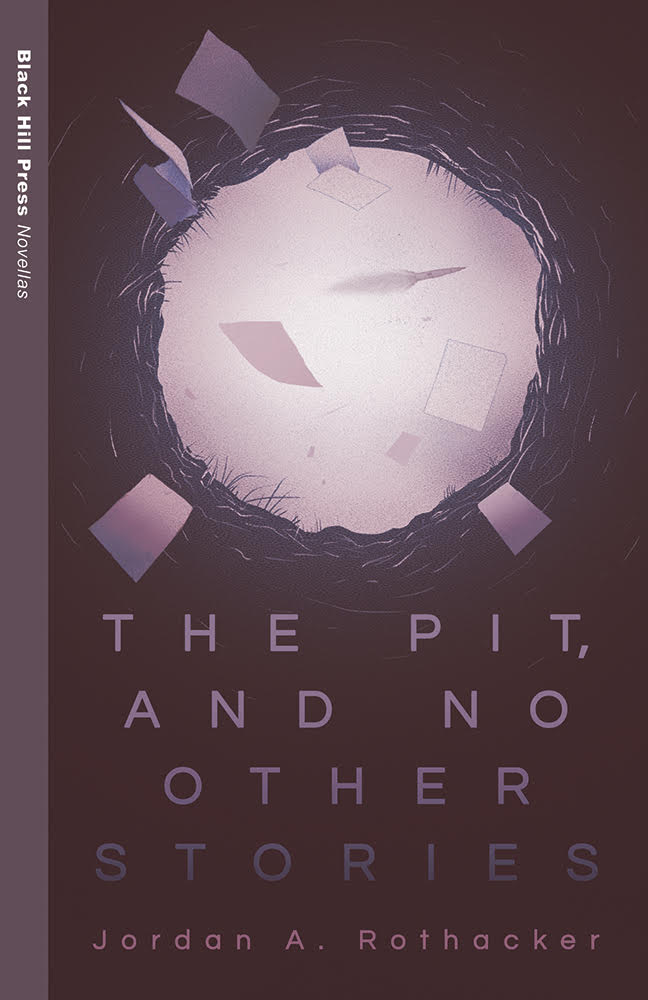
Jordan A. Rothacker’s The Pit, And No Other Stories

1pitcover

Jordan A. Rothacker’s The Pit, And No Other Stories

by Melissa Ximena Golebiowski

“The Pit is a journey in itself, a ride with flashes of life and an ending in a place, in a world, you didn’t quite anticipate.”

Rothacker opens his novella with a vivid image of a small community in which all inhabitants eventually are hurled into, well, a pit. Just as the title suggests, the Pit is our central location. In a town, aptly named Pittsville, our narrator who remains as mysterious as the Pit itself has ventured down below in search of a watch promised to him by his grandfather upon his deathbed. The first chapter pulls the reader into a world where the inevitable is a focal point, and hints at it as something to strive towards. This is not a world of traditional burials and ash scattering; once someone has expired they are given to the Pit in a funereal fashion. After the narrator witnesses his grandfather “going over” with this promised watch still secured to his cold wrist, he sneaks out to see just how far he can reach to get back what was meant for him. As soon as he falls in, Rothacker changes the channel.

We land in 1959 New York City, inside the office of a private investigator in conversation with a potential client who has no more information on his target than a nickname, The Speckled Hen. Not only have the time and place transformed, the way of talking and character’s tones are completely new. There is a hardboiled feeling added to the plot–yet a dark curiosity felt with our first character remains within this American Noir portion of the novella. This curiosity, along with the Pit, continues to rise, fall, and rebuild itself throughout the remainder of the novella.

From the P.I.’s office, we are taken on a wild ride through rainy Shanghai in 1945, fast forward to a Hollywood in 1982, drop down to Chicago in 1956, eventually falling further back in time to 1812 West Africa. There is a natural attempt to piece together the characters encountered in these various time periods and locations but Rothacker turns the corner so rapidly that the threads seem to unravel quicker than they’re sewn. This isn’t a jab at Rothacker as his chapters are packed with enough life to quickly settle you into your new environment. He’s done the research and taken the time to carefully craft the people we experience within a limited space. Many of the voices we find in The Pit are as varied as the stories we find them in. There are moments of West African Islamic Law, Mao’s takeover, and UFO sightings. Some characters return while others make a single yet impactful appearance such as an American Indian grandmother from 180 BC who begins a journey from which she may not return. However, everyone we encounter eventually meets a very similar fate that is difficult to ignore.

The Pit is an existential take on the after-life, the talk of where we go afterwards except modeled by an almost tangible place. The Pit, And No Other Stories is exactly what is presents itself as, it may seem at first as if the first six chapters serve as seven different stories all beginning with our unnamed character who falls into the Pit accidently, but slowly they begin to intertwine and unwind until we realize that there is indeed, only one story here. It is a novella full of histories and ideas. It is a story about the trials and obstacles that fall into our path as we desperately try to unearth the genius within something we deeply care for.

The Pit is a journey in it self, a ride with flashes of life and an ending in a place, in a world, you didn’t anticipate but because of Rothacker’s craftsmanship, you find yourself wholeheartedly accepting.

An Interview With Jordan Rothacker:

M: The Pit, And No Other Stories is just that, what a brilliant title, it takes place within many time periods and places, with a variety of voices. When did you stumble upon this idea? Did you fear for your reader? (Meaning, because there were so many sub plots though they all tied into a bigger portrait…)

J: Thank you. I worry that the title is cumbersome, especially when people ask, “So you wrote a novel, what’s it called?” and I tell them and then they ask, “Is it a story collection?” and I say, “No, it’s a novel. It’s The Pit, and No Other Stories.” I occasionally feared for my reader, but ultimately I trust my reader. Due to television shows like Lost or really so much in film and television and literature, people handle far more non-linear narrative than they realize. And of course it’s linear when it comes down to it. You start at the beginning of the book or film and you read and watch to the end, a straight line. William S. Burroughs used to talk about, in the 50’s and 60’s, how literature was behind visual mediums, but ultimately it is the way humans naturally tell stories, we jump all over the place, we digress, we give flashbacks and even flash forwards as we hint to the punch line of the story before we get there. In some ways I see The Pit as a more accessible or dumbed-down version of what Burroughs has done in so many novels in regards to form or what Italo Calvino had a good time playing with.

M: I’ve studied many religions myself though not to your degree or level. What influence would you say your M.A. in Religion had on this novel? What about the ideas of death within the religions you’ve studied?

J: The first novel I wrote, about ten years ago, is very much a religious novel. I actually took on the M.A. in Religion as research for the book (which is set in Atlanta and the reason why I did the MA in Georgia) and my M.A. thesis was comprised of two chapters from the book followed by an exegesis and annotations. I specialized in religion and literature in my coursework. It’s a discipline mostly coming out of Chicago and it is often said to begin with a text like The Heart of Darkness. Horror and horror in the face of the Modern is explored in this study. I also got into post-colonial studies and now combine that with romanticism in my PhD work and dissertation. Both Romanticism and Post-Colonialism are a reaction to the Enlightenment in their own ways. They seek to return a voice—and power—to those marginalized by the Enlightenment Project, so that includes the feminine, the indigenous, the non-white, the pagan, and often merely the religious, for religions are irrational, like the arts. All the “Others” of the often male, rational, white, Euro-American “Self.” While writing The Pit these thoughts certainly got in there. I thought about Burroughs a lot as I wrote this book and I often think of him in a religious context, as a mythmaker like Borges, Faulkner, Danilo Kis, and Amos Tutuola, like Hesiod, or Snorri Sturluson who wrote the Eddas. The Pit for me is a roundup of how I see different American myths. As far as a religious connection with death, I mean, it’s right there in the first chapter, The Pit is a funereal site. This weird small town gothic setting has a secret from the outside world that involves how it handles death. There is a lot of death and religion in the book, come to think of it. I think you’re on to something…

M: Reading through the novel, I couldn’t help but feel similarities within other greats that I’ve read, particularly Slaughter House Five by Vonnegut. Was this an inspiration for you? What other inspirations did you have writing this?

J: I hadn’t thought of that Vonnegut book, but without giving anything away for someone who hasn’t read The Pit yet, I can kind of see it in the “outside of time” stuff. I do like that book though; I re-read it a few years ago on the plane over on a visit to Dresden. It certainly enhanced my Dresden trip. As for other inspirations, I got to meet Margret Atwood at a reading a few years ago and I was so giddy, she’s so great. One of her books that had a great effect on me I read back when I was like 19. It was a slim collection called, Murder in the Dark. It was the perfect book for that age, too. It showed me how ok it was to break down form in a really interesting way and how much can be done with so little space. The Pit was about me returning to that youthful excitement of playing with form. For some reason in my twenties I couldn’t feel legit without writing a long naturalistic novel. That novel has yet to be published, but direct inspirations for The Pit would be Burroughs’ Cities of the Red Night and Italo Calvino’s If on a Winter’s Night A Traveler.
Romanticism and Post-Colonialism are a reaction to the Enlightenment in their own ways. They seek to return a voice—and power—to those marginalized by the Enlightenment Project, so that includes the feminine, the indigenous, the non-white, the pagan, and often merely the religious, for religions are irrational, like the arts. All the “Others” of the often male, rational, white, Euro-American “Self.” While writing The Pit these thoughts certainly got in there.

M: What about some subconscious inspirations, who are your favorite writers?

J: That’s always a tough question, but I guess it’s a bit easier than asking what my favorite book is. For that question I’d give you a list of books, most likely categorized. Of living writers I have a deep love and appreciation for William T. Vollmann. His brilliance, breadth, and proficiency is really seen in an artist, as well as the heart and social conscience he brings to his work. Reading him makes me a better writer, thinker, and person. Some times I say he is our Tolstoy and Dostoevsky wrapped up in one.  He is one of the great living American writers and for skill and importance I put him up with Toni Morrison, John Edgar Wideman, Cormac McCarthy, and Thomas Pynchon of our country today. As far as other favorites go, Maggie Nelson is brilliant and the way her mind is able to harness great thoughts and deliver them with such style gets me really excited. I really love Steve Erickson and look forward to a new book from him next year and Cesar Aira blows me away. Writers of the past who get me super excited—just the first few that spring to mind—are William S. Burroughs, Anna Akhmatova, Hesiod, Ovid,  Ousmane Sembene, Frantz Fanon.

M: This novel really ignites existential thought, not only through the construction but the ideas presented, ideas many people avoid. I found myself, while reading the novel, constantly thinking and venturing into deeper places. Was this the intention you wanted for your reader? Or did you envision the reader at all?

J: I love that you read it as existential. I mean I finished it after really loving what a perfect creation the first season of True Detective was. That show brought me back to reading Schopenhauer, Nietzsche, E.M. Cioran, as well as the Ligotti and Chapman that inspired it; and Vollmann had just published his gothic masterpiece, Last Stories and Other Stories. Delving into that infectious darkness, letting the pessimism wash all over you can be an engaging journey. I have to live in the world and get up every day and experience the joy and beauty of life and the people I love, but I never stop thinking about how humans are the worst species, that ultimately we are doomed. People love going to these places, the fantasy of darkness, horror movies, and literature. The arts let us tour these dark places. That’s why I think of this as an entertainment or a jive book. I’m glad it made you think and I hope it makes others think and value life in regards to death, but there are a lot of people in this world, this country and abroad, who don’t have the luxury of dabbling in darkness because they live some pretty awful situations. There’s one book that I read last year, which still haunts me deeply entitled The Corpse Exhibition, by Hassan Blasim. He is an Iraqi who now lives in Finland. The book is a collection of stories all set in contemporary war-torn Iraq. They are masterful and horrific, sometimes even surreal, and very hard to characterize. I’ve called them “war-zone gothic” for lack of a better term. Though the stories are macabre and might feel like horror writing, the thing that hits you the hardest is to know that they are based in an awful, awful reality that is part of daily life for so many people.

M: Where does death come into all of this? Does it? You seem to bring a metaphorical sense of death and sit it next to concrete examples.

J: The pit of the title is a funereal site for many who encounter it in the book. For others it involves new life in a weird way—but I’ll give no spoilers. There is a real cyclicality about life and death that flows through this book. It’s hard for me to imagine this giant deep Pit that is described in the first chapter without thinking of Ouroboros. That ancient Greek symbol loved by alchemists. It is the “tail-eater” and like many great serpents of myth—the Midgard serpent comes to mind—it is often associated with beginnings and ends. So, it is all about death but also new life, kind of how the Death card in the tarot just represents change. In some ways, and I don’t want to give too much away, but it seems like, in the book, that inside the Pit is a sort of liminal space, or a bardo, as mentioned in some Buddhist teachings. A between life and death, a place of becoming and potency, the place where the shaman or the artist goes in their practice. Hemingway was asked once what he thought about death, and he replied that it was “just another whore.” Maybe in The Pit it’s “just another trope” or “just another metaphor.”

M: You bring life to characters from many different walks of life (Black Muslims, American Indians, Chinese, even a man who sees a UFO), what sort of research was involved with this?

J: That’s the fun of a book like this and the restrictions I had upon myself: each section and plot line involved its own problem solving. Some sections required research by studying maps, digging through histories and chronologies, and some sections were just pure imagination pouring forth. I’ve taught an African Diaspora Literature class at UGA I think 20 different times over six years and yet still I went in to telling my own original slave narrative from a cautiously researched place. The device of that narrative voice in those sections worked out pretty well.

M: Why did you choose the particular backgrounds and stories you chose?

J: The whole book began for me with that first story and writing it to try my hand at this American trope of the small town gothic, a Shirley Jackson or even Mark Twain type thing. And then it became for me all about exploring all the different American tropes I like, the detective noir, the sc-fi, the southern slave narrative, a nautical/pirate story, Native American folklore, a desert roadtrip, aliens sightings over a cornfield, the tragic Hollywood fall of an actor, and even corporate business. Some are, of course, more serious than others and I spent the most labor and worry over the Native American and the African American slave portions.

M: I took note of some sentences that stood out to me, would you mind elaborating or explaining your thought behind two of them for fun?

J: Sure!

M: “With his father gone, Quentin stopped even pretending to hide how free Amadou really was, or how integral he was to the business… The African-American experience is the most important lens by which to understand America itself.” I was really intrigued by this.

J: In Steve Erickson’s last novel, These Dreams of You, a great book about race in America—so good that I even taught it despite the fact that he is white—he mentions that the American Dream belongs most to the African-American because it was betrayed for them (their ancestors) en route and yet they have stayed for generations and made America home despite the betrayal.

M: “I watched the black bile sparkle and pour from my mouth like stars from a pitcher in the sky… But to her my front was an appetizer. And she was the most frightening and real woman I’d ever met.” The imagery in of a pitcher filled with stars is very poetic.

J: That image just came to me; I think I was picturing something astrological, like a medieval drawing of Aquarius maybe. I guess I also pictured how activated charcoal would look if one were to vomit it. I’ve never tried ayahuasca actually.
The Pit, And No Other Stories is out now from Black Hill Press. You can grab your copy here.

***

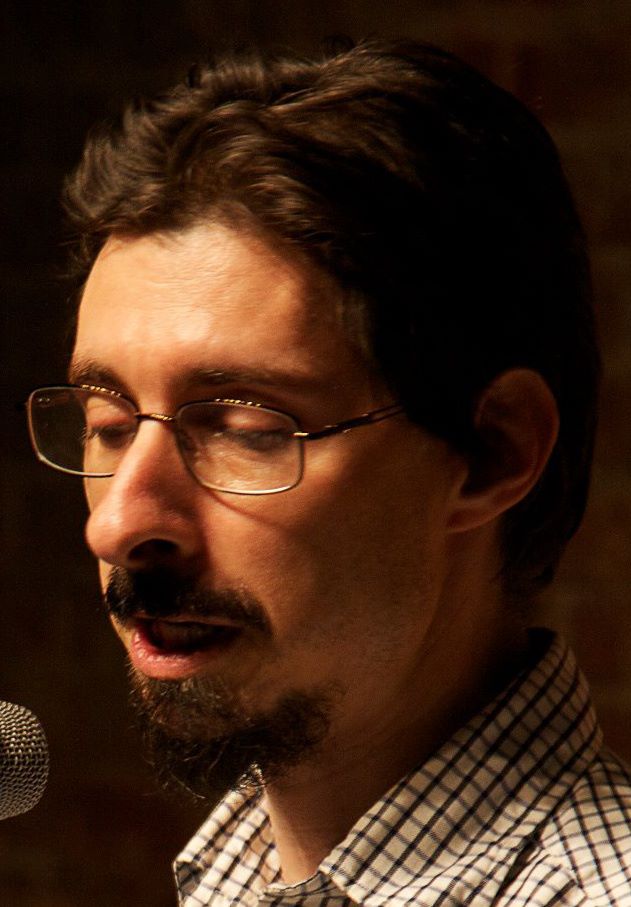
Jordan A. Rothacker is a novelist, poet, and journalist who resides in Athens, Georgia. He received his MA in Religion from the University of Georgia and is currently a doctoral candidate in Comparative Literature. His dissertation-in-progress is titled On Cultural Guerrilla Warfare: Art As Action. Rothacker’s journalism can be found in the pages of magazines as diverse as Vegetarian Times and International Wristwatch and his fiction, poetry, and essays have appeared in such periodicals as The Exquisite Corpse, Mayday, Curbside Splendor, Red River Review, As It Ought To Be, Dark Matter, and Dead Flowers: A Poetry Rag. He was also a contributor to William T. Vollmann: A Critical Companion, which published this past December. Three of his favorite things to talk about are sandwiches, indigenous land rights, and his cat, Whiskey.

Melissa Ximena Golebiowski is a writer and literary marketer based in New York City. Her poetry was most recently published in Noah Literary Magazine. She is currently at work on a novel. @MelissaXimena

Black Hill Press is a publishing collective of a growing family of writers and artists dedicated to the novella—a distinctive literary form that offers the focus of a short story and the scope of a novel. Their independent press produces uniquely curated collections of Contemporary American Novellas.

SATURDAY POETRY SERIES PRESENTS: JEN KARETNICK

Jen Karetnick Head Shot

By Jen Karetnick:


ON THE WAY TO SEDER, MY HUSBAND ANSWERS

phone calls from patients, their parents or partners,
repeating what he has already said half-a-dozen times

in the office—“I know the auras are uncomfortable,
but they’re better than grand mal seizures, and that’s

what the meds will help to prevent”— and dispensing
predictions no one wants to hear—“No, I don’t think

he’ll come home; the stroke was catastrophic”—but
are asked for over and over in the hopes they will change,

while I shush the kids in the backseat, stop them from shouting
with too much apparent joy in their voices, keep the radio

playing Lady Gaga’s “Telephone” turned down. Soon
we will dissect the Seder plate, digest the bitter

herbs, finger the salt dried on the easily torn skin
of faith. We will recite the plagues: boils, murrain,

the lice we have been visited by several times this year.
On this night, we will open the door for a rogue spirit

who might drink our wine but not heal vertigo; on this night
we will recline on a pillow that can’t fuse a broken

spine. On this night, the cell phone chirps and sings,
and there are no miracles beyond what can be doctored.


THE INVENTION OF AMNIOCENTESIS

Mother, in your womb I am an experiment.
You pass on not immunity but its silvery underside,
give permission for the needle like an arrow to
birth holes in this temporary home, sip the fluid
like a taster of fine wines without the benefit of
a visible image. No bigger than a black widow
spider, the doctors must guess where I am,
and agree there is nothing to be done.
I am poison to both of us. Unsafe
harbor, you insist on mooring me to
your designated slip, tossed by rash after
rash of storms. I will remove myself early. Still ill,
of course you will not care for me right away. Of all the
eggs you might have nourished, I am the one who breaks you.


WOMEN ON THE VERGE DISCUSS VIAGRA

Stamina. From the Latin stamen,
meaning thread of woven cloth. Plant parts
resemble the warp and woof, but old farts?
The boost was designed for the impotent,
not the young at heart. They can’t afford
to see the blue of detached retinas
when the sky has already claimed those hues
and the days for viewing them are numbered.
How ‘bout a pill to make them remember
to take out the garbage or mow the lawn?
One to defoliate the nose hairs grown?
Or better: to spark conversational vigor.
No chance of that? Then don’t bring it on.
This is the last thing, the last thing we want.


“On the Way to Seder, My Husband Answers” was previously published in The Healing Muse. Today’s poems are from the forthcoming collection American Sentencing (Winter Goose Publishing), and appear here today with permission from the poet.


Jen Karetnick is the author/co-author/editor of 14 books, two of them forthcoming: American Sentencing (poetry, Winter Goose Publishing) and The Treasures That Prevail (poetry, Whitepoint Press). In addition to poetry, she writes lifestyle books, the most recent of which is the cookbook Mango (University Press of Florida, 2014). Her poems, prose and playwriting have been widely published in literary and commercial outlets including TheAtlantic.com, Cimarron Review, december, Miami Herald, North American Review, Poet’s Market 2013, Poets & Writers, Racked.com, River Styx, Spillway, Submittable.com, Valparaiso Poetry Review and Virgin Atlantic Airlines. Based in Miami with her husband, two teenagers, various rescue pets and 14 mango trees, she works as the Creative Writing Director for Miami Arts Charter School and as the dining critic for MIAMI Magazine.

Editor’s Note: Jen Karetnick expertly catalogues the vast and startling spectrum of life, from the mundane to the monumental, from humor to horror. Amidst the stories that unfold are stunning and heartbreaking moments of lyric: “Soon we will dissect the Seder plate, digest the bitter // herbs, finger the salt dried on the easily torn skin / of faith;” “Of all the / eggs you might have nourished, I am the one who breaks you.” And that beauty is balanced by the hilarious and the absurd. Of viagra, a group of women posit, “How ‘bout a pill to make them remember / to take out the garbage or mow the lawn? / One to defoliate the nose hairs grown? / Or better: to spark conversational vigor. / No chance of that? Then don’t bring it on. / This is the last thing, the last thing we want.”

Want more from Jen Karetnick?
Read poems from Brie Season
Buy Brie Season on Amazon
Buy Prayer of Confession from Finishing Line Press
Buy Landscaping for Wildlife from Big Wonderful Press
Read more of Jen Karetnick’s poems and prose

The Myth of the Apolitical American Poet

1mty

The Myth of the Apolitical American Poet

by Michael T. Young


I recently heard a poet complain that the poets he friended on Facebook seemed more like activists than poets. He was considering leaving Facebook until after the election so he didn’t have to listen to the ranting and debating. I thought this was a good thing—the activism that is. It was also proof of what I’ve always argued: that American poets are deeply engaged in the relevant issues of our day.


There’s an assumption that American poets don’t engage politics or social issues. We’re believed to be only concerned with our personal lives and to write only about that. To most Americans our poets are all confessional in the worst sense of the word and write only an obscure, self-absorbed poetry and this is why they aren’t read. However, this is a myth. Although we engage personal issues, it is through them that we engage the true social and political issues of our day and this is the way to be most fully engaged. Take a poem like “Charlie Howard’s Death” by Mark Doty. Charlie Howard was a teenager who was murdered in 1984 because he was homosexual. Three other teenagers chased him down and threw him over a bridge into a river, though he protested that he couldn’t swim. Doty wrote a poem that is not only personally relevant since he is also a gay man, but one that is emotionally powerful and complex, aesthetically beautiful and socially relevant since gay rights are among the most relevant of socio-political topics of our time. Much of Doty’s poetry deals with gay issues, and these are both personally relevant and relevant to the larger cultural setting of our day.


Another poet who engages both socio-political topics and personal issues simultaneously is Gerald Stern. For instance, in his poem, “The Same Moon Above Us,” he imagines a homeless man as the exiled Ovid, which also allows him to identify with Ovid as a poet and thus the three become one and the poem on one of its levels is a commentary on poverty in America. Poverty is exile, and like the exile they are granted no voice because judged already. Who among the homeless are our exiled Ovids, which of them may be an unsung Milton or Keats? Another of Stern’s poems is “June Fourth,” which with subtlety engages the perspective of a worker and the authority that oppresses him. In a short span it ropes together everything from the metaphysical to the economic in a nuanced language about power and what creates the fertile ground of revolt. The poem is set in the world of factory life for Bethlehem Steel. It confronts the core issues embodied in the Occupy Wall Street Movement though written decades ago.


This kind of socio-political engagement can be found in many contemporary poets such as Cynthia Atkins, Okla Elliott, Barbara Elovic, Richard Levine, Djelloul Marbrook, and Joe Weil, just to name a few. Furthermore, many poets are politically active in some respect. Richard Levine identifies himself as a political activist and is quite busy working against fracking in New York. Djelloul Marbrook is a former journalist and, for many, is a source of alternative views to the standard media outlets like the New York Times or CNN. And it is not only these poets who are not nationally known or winning our biggest prizes who are so engaged. For instance, Wendell Berry, in addition to being a magnificent poet, and a recipient of a National Medal of Arts and Humanities, has spent his life writing about and defending small farmers against large corporations and monopolies. In many ways, he was fighting the power of the 1% long before those in Occupy Wall Street were born.


To highlight both their political activism and their engagement with issues in their poetry, is not to argue that our poets use poetry in service to politics or as a mere linguistic soapbox. Nothing could be worse or a greater artistic torture to endure. Our poets know this. If not explicitly, at least implicitly, they know what George Oppen argued, that “the good life, the thing wanted for itself, the aesthetic, will be defined outside of anybody’s politics, or defined wrongly.” Thus to engage the socio-political concerns of our time or any other, is to do it from the point of view of the personal, of the individual life lived. Our poets are in the position to be more clearly engaged with the real issues because they approach them from the point of view of living and not from the stance of rhetoric.


As the myth about the Romantics being non-political crystalized around their actively creating this image, so too the American poet as an apolitical writer intent only on the reality of his immediate world was created by those poets. Our poets often insist on concrete rather than abstract work, the immediate and visceral rather than the remote and intellectual. I think that insistence in theory has resulted in an image that is not true to practice. One reason for it may be that our poetry’s language is the opposite of political speech, which is always evasive, abstract, an incantation of generalizations meant to charm you to sleep and vote. Poetry is meant to wake you up.


Most of the Romantics were active supporters of the French Revolution, much of Blake’s poetry is charged with socio-political concerns and Byron himself died fighting in the Greek War for independence. The critic, Jacque Barzun, wrote a brilliant book called Classic, Romantic, Modern, which debunked the myths about the Romantic poets, one of those myths being that they had no interest in politics. In much the same way, a book could be written debunking this same myth about American poets. But I think a better thing to do is read American poetry and pay attention to the socio-political realities underlying their themes.


If Americans spent a little time reading their poets, they would wake up to the fact that America is rich with a poetry that engages every relevant issue of our time from the personal to the political, and might even learn that most poets realize these can’t be separated. To live life in a democracy is to be political. To grapple with the issues of your daily life and to write about them is to comment on and confront the reality of the republic in which we live. It might also give us, as a country, pause to wonder why exactly our poets are not more widely read since it is not because they don’t address issues relevant to our lives. They are, in fact, more concerned about what’s happening in our country than most. And maybe that’s really why they aren’t read, not because they don’t engage the important issues but precisely because they do. Most other Americans would rather watch a sitcom, wrapping themselves in its humorous triviality, like a child imagining the blanket he pulls over his head can protect him against anything that might emerge from the darkness while he sleeps.


HAPPY HIGH HOLIDAYS FROM THE SATURDAY POETRY SERIES

ShalomSalamPeaceIsraelisPalestinians


The Saturday Poetry Series will be on hiatus for the Jewish High Holidays while your faithful editor takes a much needed vacation. We will return on Saturday October 3rd.

In the mean time, enjoy some Israeli-Palestinian peace poetry!

SATURDAY POETRY SERIES PRESENTS: EMMA LAZARUS


Emma_Lazarus


1492
By Emma Lazarus

Thou two-faced year, Mother of Change and Fate,
Didst weep when Spain cast forth with flaming sword,
The children of the prophets of the Lord,
Prince, priest, and people, spurned by zealot hate.
Hounded from sea to sea, from state to state,
The West refused them, and the East abhorred.
No anchorage the known world could afford,
Close-locked was every port, barred every gate.
Then smiling, thou unveil’dst, O two-faced year,
A virgin world where doors of sunset part,
Saying, “Ho, all who weary, enter here!
There falls each ancient barrier that the art
Of race or creed or rank devised, to rear
Grim bulwarked hatred between heart and heart!”


Today poem is in the public domain, belongs to the masses, and appears here accordingly.


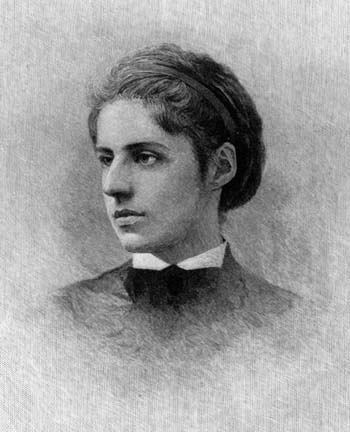
Emma Lazarus (1849 – 1887): A descendant of Sephardic Jews who immigrated to the United States from Portugal around the time of the American Revolution, Emma Lazarus was born in New York City on July 22, 1849. Before Lazarus, the only Jewish poets published in the United States were humor and hymnal writers. Her book Songs of a Semite was the first collection of poetry to explore Jewish-American identity while struggling with the problems of modern poetics. (Annotated biography courtesy of The Academy of American Poets.)


Editor’s Note: I wanted to share with you today a poem for Rosh Hashanah, the Jewish New Year. Rosh Hashanah is a celebration of newness, ushered in by sweet wishes of the year to come. But we spend the days that follow in contemplation of those regrets we have from the year past, in asking for forgiveness, and in letting go. When I came across today’s poem I thought of the Syrian refugees, of how the plight of exile has plagued my own people in the past, and how others are suffering from it today.

5776, the Jewish year that begins at sundown on Sunday September 13th, will be a “two-faced year, Mother of Change and Fate” for countless Syrian refugees. That fate that my own people have suffered in the past is today their reality: “The West refused them, and the East abhorred. / No anchorage the known world could afford, / Close-locked was every port, barred every gate.”

Emma Lazarus is most famous for penning the words that appear at the base of the Statue of Liberty, wherein the “Mother of Exiles” declares, “Give me your tired, your poor, / Your huddled masses yearning to breathe free, / The wretched refuse of your teeming shore. / Send these, the homeless, tempest-tossed to me, / I lift my lamp beside the golden door!” As we celebrate a new year, may the words of the Mother of Exiles find their way into the hearts and minds of ports and borders across Europe and throughout the world, “Saying, ‘Ho, all who weary, enter here!'”


Want to read more by and about Emma Lazarus?
The Academy of American Poets
Jewish Women’s Archive
The Poetry Foundation

SATURDAY POETRY SERIES PRESENTS: ALL DAY, TALKING

allday_1024x1024


From ALL DAY, TALKING
By Sarah A. Chavez:


DEAR CAROLE, I FINALLY DID IT

I cut it all off into a trendy bob
that fades up the back. You told me
not to, said you loved my hair long.
Well, you’re not here anymore.


DEAR CAROLE, TODAY I’M WEARING THAT RING

you stole for me at the art fair
on the green at Fresno State.
God, was I such a baby!
Poor me, I don’t have any money
to buy things.
I kept whining.
I never get to have anything nice.
And most of what we’d seen
iron sculptures, clay dishes fired
for ornament, I was only just
discovering, but still, I thought
I deserved them.
That’s another thing age teaches you –
you ain’t owed shit. There is nothing
on this flying water rock that anyone deserves.
You should’ve smacked me, echoed
my father and told me to suck it up.
But you didn’t.

It was the third time we’d circled
back to that booth. Everything
about it was pretty: the rainbow
canopy, the sunlight glinting off
the semi-precious gems and hued
glass, the hot hippie without a bra
telling every passer-by about Gaia.
I fingered a large red and black
swirled ring, slipped it over
the callouses on my middle finger,
and spread my hand flat to admire it,
its heft impressive for something so lovely.
The hippie told me, the ring
wants to be a ring. I never take
from the Earth without her permission.
I spoke to the stone, told her what
she’d be
and she gave me her blessing.

The hippie looked so sincere
when she spoke, looked into my eyes
with her large cobalt irises, the pupil a pinprick
in the blue with the sun glaring
behind me. I’m sure I said something
stupid. I always get so nervous
around people like that, who walk
through life like an open wound, their blood
and tissue exposed to the elements,
their insides shining on the outside.

I probably said, Cool and behind me,
you probably rolled your eyes.
I put the ring back on the organic
hemp cushion with the other
metamorphisized rocks, then spun
the color-tinted glass of the wind chimes
hanging from the canopy’s aluminum
frame to hear their tingle-tangle
and submerged my hand into the basket
of oddly-shaped beads, feeling what I
imagined the quiet core within a fossilized
stone felt like. As we walked away,
you said Thanks, which was weird, but
I thought maybe it got to you too –
so much unattainable beauty,
the reminder of all the things
we didn’t have and all the things
we couldn’t yet know we wanted.

Walking to 711 for cigarettes,
we stopped at the crosswalk light.
You took my hand and pressed
the weight of the ring into my palm.
I looked up at you, squinting in surprise,
but you just shrugged, said The stone told me
to take it. It said it wanted you to wear it.


DEAR CAROLE, FOR HOURS, IT’S BEEN BURNING

a hole in my gut, the shame
of never saying thank you
twelve years ago for that fucking pizza
you bought with SSI back pay.
It tasted so good: the grease,
the sweet of the tomato sauce,
the salt from the olives prickling
my tongue – I could actually taste it.
They don’t say on those Cymbalta commercials
depression takes away taste.
Sleep, yeah, sex drive, focus, but not taste.
I never told you
how for those months, alone
in my one-bedroom apartment I tried
to eat just about anything,
but it was all so thick and waxen . . .
one night, ravenous and wretched
I tried to eat an entire loaf of bread.
Cross-legged on the kitchen floor
the light from the street lamp cast ghastly
shadows against the apartment blinds
while I took slice after slice
of Wonder Bread from the Hostess overstock
warehouse on Weldon Street and bit
into each one wanting desperately
for the next to taste
like summer,
like 1998,
like the smell of patchouli
in your room, like rain water,
like mud-stained carpet, like midnights
on the front porch,
like lying to our mothers and never getting caught.
Slice after slice – mutilated, the impression
of my teeth embossed on each one’s cottony
flesh – lay scattered
on the linoleum. I couldn’t bring myself
to swallow even the smallest
bite. Just kept spitting
slobbery hunks onto my naked lap,
into my tangled hair, until
I laid down, the floor clammy and smooth
like the palms of your hands.


Today’s poems are from All Day, Talking, published by Dancing Girl Press, copyright © 2014 by Sarah A. Chavez, and appear here today with permission from the poet.


All Day, Talking: “A stunning, gritty, and beautifully irreverent collection of poems, All Day, Talking repeatedly and necessarily corrupts the conventional elegy. Chavez mourns Carole, yes, but she also mourns herself—and all of us, the tragedy of how we see (or don’t see) one another in our contradictory identities and bodies. If you want to know the honest truth about what it means to grieve and to survive, keep these poems close and listen to this ‘all day, talking,’ which is both deeply personal and profoundly political.” — Stacey Waite, author of Butch Geography


Sarah A. Chavez, a mestiza born and raised in the California Central Valley, is the author of the chapbook, All Day, Talking (Dancing Girl Press, 2014), which was featured on Sundress Publications’ book spotlight, The Wardrobe’s Best Dressed. She holds a PhD in English with a focus in poetry and Ethnic Studies from the University of Nebraska – Lincoln. Her work can be found or is forthcoming in North Dakota Quarterly, Stirring: A Literary Collective, Spoon River Poetry Review, Luna Luna Magazine, among others. Her manuscript, This, Like So Much, was an Honorable Mention for the 2013 Quercus Review Press Poetry Book Contest. A selection from her chapbook manuscript All Day, Talking won the Susan Atefat Peckham Fellowship in 2013. She is a proud member of the Macondo Writers Workshop.


Editor’s Note: There is a refreshing honesty to the poems in All Day, Talking that is, in equal measures, surprising, laugh-out-loud funny, and deeply touching. In this collection grief is portrayed–and love remembered–through a lens of realism that mirrors the very real and very unstable experience of loss. Memory is the vehicle through which a life lost is a life recalled, and the speaker addresses the absence with a candor and wit that seems to honor the relationship that gave rise to it when Carole was still living. Amidst a text thick with engaging and humorous stories, within the world of deeply confessional admissions and recollections, there exists the heartbeat of the lyric, “the reminder of all the things / we didn’t have and all the things / we couldn’t yet know we wanted.”


Want to see more from Sarah A. Chavez?
Sarah A. Chavez’s Official blog/website
Buy All Day, Talking directly from the poet
Buy All Day, Talking from the publisher
Rogue Agent
Broadside of “The Day the Alligators Feasted on Time” from Stirring: A Literary Collection
The Poetry Foundation: Irene Lara Silva in conversation with Sarah A. Chavez

SATURDAY POETRY SERIES PRESENTS: CONFLUENCE

Confluence front


From CONFLUENCE
By Sandra Marchetti:


THE RETURN

               “figurations of mist
               at the turn of the corner,
               figurations of time
               at the bend in this pause,”
                              ~ Octavio Paz, trans. Eliot Weinberger

Beyond the body itself
is the thin blue line,
the sky folding back on its spine.

I saw today the paper gold mists,
the terrible last burnings off of morning;

I have an idea that you ate me then,
and slid belching through the fog—

you slicked my breast
on past your teeth and tasted
my unsalted skin.

I’m small; I know when I’ve been
swallowed whole, been rounded out
gold and beaming,

become a curve in your smile,
the element of light—broken on the tide—
the start of day.


FISSURES

By night
my body disconnects, falls,

lies on the bed in bones
and curls of hair.

There is nothing
to join it.

Skin flicks off
through shudders, and furls—

I lay and am unhitched,
unrolled.

I see what is done darkly,
between shadows and the neatest black.

The low lake below
lets go its nets,

from joints I wash toward confluence,
dissolved in a room of night.


MIGRATION THEORY

The womb a tent,
lit from within, flutters
golden on the wind.

I’m given to pregnancy
dreams again.

Sleeping, the world becomes round once more—
sleeping atop my midriff. Sleeping in
silence and veins and skin—a globe, a missive.

I’m told the child
is ghost; instead

the sleep is lifted into,
alight with curiosities
curling out from the hand.

Sleep. The light sheet ruffles within.
White moths in flight
lift from the body—the skin.


Today’s poems are from Confluence, published by Sundress Publications, copyright © 2015 by Sandra Marchetti, and appear here today with permission from the poet.


Confluence: “’Roam the ground where you are’ writes Sandy Marchetti in Confluence, her impressive debut. Mediating the world in between—lover and beloved, day and night, lost and found, now and then—this lyric poetry celebrates the intimate as ebullient, charged. The lyrics, read through imagery and felt through sound, ‘riff in bits and licks.’ Sandy Marchetti has convincingly made us a world.” —Sally Keith, author of The Fact of the Matter and Dwelling Song


Sandra Marchetti is the author of Confluence, a debut full-length collection of poetry from Sundress Publications, and a co-author of Heart Radicals, a collaborative chapbook of love poems. Eating Dog Press published an illustrated letterpress edition of her essays and poetry, A Detail in the Landscape, and her first volume, The Canopy, won Midwest Writing Center’s Mississippi Valley Chapbook Contest. Sandy’s work appears in Subtropics, Sugar House Review, Ecotone, Green Mountains Review, Blackbird, Southwest Review, and elsewhere. She is a Lecturer in Interdisciplinary Studies at Aurora University outside of her hometown of Chicago.


Editor’s Note: Sandra Marchetti’s Confluence is incredibly vivid, electric with unique imagery, and rife with moments of depth and contemplation that force the reader to slow down in wonder. “Beyond the body itself / is the thin blue line, / the sky folding back on its spine;” “I’m small; I know when I’ve been / swallowed whole.” The body is at times singular, existing in pieces, dissolved: “By night / my body disconnects, falls, // lies on the bed in bones / and curls of hair.” The I is the ever-observer, seeing the world as one only can from the lone darkness: “I see what is done darkly, / between shadows and the neatest black.” The lines are blurred between life’s joys and devastations: “I’m given to pregnancy / dreams again;” “I’m told the child / is ghost.” No matter the consideration or the angle of the reflection and the poet’s gaze, forever driving these poems is a rampant lyricism, steady and rhythmic as a heartbeat, fervently alive.


Want to see more from Sandra Marchetti?
Pre-order Confluence from Sundress Publications
Appalachian Heritage
Thrush Poetry Journal
The Rumpus
Words Without Borders

SATURDAY POETRY SERIES PRESENTS: MY FRIEND KEN HARVEY

khcover

From MY FRIEND KEN HARVEY
By Barrett Warner:


MY FRIEND DAVID BOMBA

Screen Shot 2015-08-21 at 11.44.40 PM


MY FRIEND KEITH MARTIN

My friend Keith Martin is dead. He died in early April.
It’s kind of a busy month to die. The ground is softening—
rows raked and sown—jealous hues emerging like rye.

It’s weird that he died the same month I was born.
Now the ghost would be forever Aries, the passionate one,
the one who gets things almost right, who gets in his own way.

A friend is a brick against the sweet hereafter. Lose a friend
and you lose a brick. Lose Keith and you lose a wall.
It’s just a matter of time until the roof falls down.

Marsha his wife sat cold on offers coming quickly on his land.
I don’t blame her holding out for more, but suffered lifetimes
are always cheap. I gave away anything I ever tried to sell.

No one ever wants to buy what you don’t love.

Their house is a quarter mile away, through dense spite trees
planted by our neighbor so he wouldn’t have to look at Keith getting out of his car.

I can’t imagine hating someone so much I’d plant trees.

One dog’s not enough, and two dogs are too many.
That’s how Keith would talk, like Ben Franklin.

He wanted me to feel better, but I never did.


MY FRIEND LARRY MCKEE

My friend Larry McKee notices each leaf in an oak forest.
I see firewood, fence boards, squirrels, squirrel stew.

I hustle through life’s minor beauty to make myself sweat,
wearing work on my face like khol.

I am trying to say I don’t belong here, don’t deserve
this world. I need to earn every second of it.

If I stop sweating I’ll stop earning.
It’s why I’ll always have a job, and Larry, a passion.

Someone ate this, he says.
He holds a 175-year-old raccoon femur.

Someone knelt here in 1841 and prayed for something.
Maybe, yes, there was singing. Listen! Sobs and singing.

I have been sweating all day and all night and all year.
It’s only a matter of time before I exile myself.

It would be nice if Larry could learn from me too
but I have nothing to teach, even about drinking.

Larry grows the mint, makes ice from spring water
collected in caves, smokes the bourbon over apple wood.

He has a special black basalt rock that fits his hand
to crush the beautiful ice into manageable debris.

He takes so long to make a two minute drink
that I’m drunk on beer and hung over before his first sip.

Still, it’s the best I ever tasted.
And of course, the next day, I steal the rock.

The things I’ve bashed. The cars. The lives. The dogs.
The sweat that flew off my brow. The wasted muscle.

One night I pound some lamb into burgers, smother it
with sheep cheese, and I think, Larry would have admired this.

I call him up to brag about the recipe. His wife Hannah
passes over the phone. Sounds delicious, he says.

We haven’t spoken in thirty years. Leftover enchiladas for us,
Always better the second night, filled with grilled chicken cut up

Small mixed with salsa and corn cut off the cob. On the patio,
Watching fireflies and hummingbirds until dark.

Couple extra chairs at the table if you’re ever in the neighborhood.
The things I learned from Larry. The things I never learned.


Today’s poems are from My Friend Ken Harvey, published by PubGen, copyright © 2014 by Barrett Warner, and appear here today with permission from the poet.


My Friend Ken Harvey: “Nostalgia and sentiment were dirty words in poetry until Barrett Warner’s My Friend Ken Harvey came on the scene. Here we have a chapbook that shows us the many forms of love, how relationships can be measured as ‘not enough war or too much war in someone’s life,’ and how the simplest moments can be transcendent, all while dipping in and out of the sepia tint of memory.” —Dakota Garilli, Book Review: MY FRIEND KEN HARVEY by Barrett Warner


Barrett Warner’s poems, stories, and essays have appeared in newsprint, paper and online since 1982, and most recently in Entropy, Revolution John, and Four Chambers. In 2014 he won the Salamander fiction prize and the Cloudbank poetry prize. He has a website where he blogs about bathing, medication, gardening, Proust, and Kalamazoo.


Editor’s Note: Struck by the unique nature of this collection, I asked the author if he would share a few words on his vision and process. “To me,” he replied, “the biographical poem is an ekphrastic poem, but instead of writing about a Hopper painting or a Grecian urn, I’m writing about everyday people with whom I’ve had some moment of fantastic empathy.” What is “fantastic empathy,” and how does it translate from lived experience to poem to reader, I wonder. I find my answer in my own experience in reading these poems. “I’ll have the starfish, Bomba says,” because “Everyone should be allowed to order what they want / even if it’s not on the menu.”

This collection is at times hilarious, at times touching, at times lyric, simple, and stunning. “A friend is a brick against the sweet hereafter. Lose a friend / and you lose a brick. Lose Keith and you lose a wall,” Warner writes of the death of his friend Keith Martin. “I am trying to say I don’t belong here, don’t deserve / this world. I need to earn every second of it,” he writes, from some honest place between existentialism and a search for meaning. In a way, these poems are–as the poet says–ekphrastic, biographical, minute in their reports of human interactions. Yet in another way they are meta, like staring up at the night sky and trying to truly grasp what you are seeing. From the minutiae to the horizon, I suggest reading and rereading these poems and seeing where the experience leads you.


Want to see more from Barrett Warner?
Entropy
Cultural Weekly
Lines + Stars
Quarter After Eight
drafthorse