“War? Rumors of War?” “By John Guzlowski

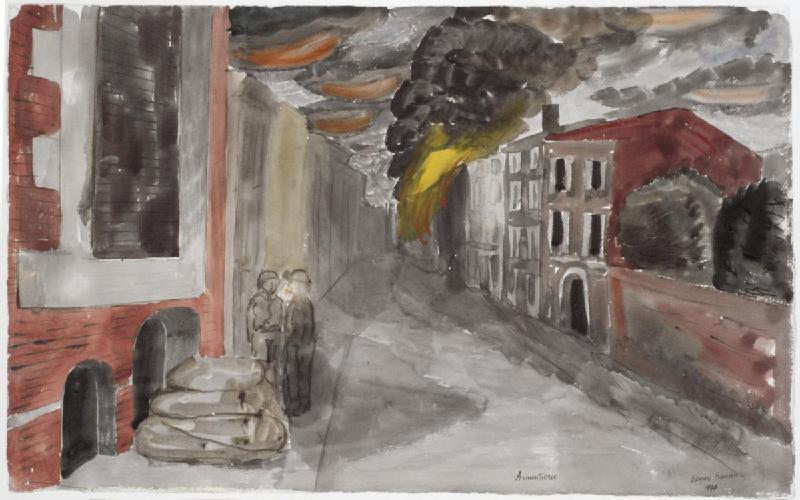
Armentieres_after_Bombing,_May_1940_Art.IWMARTLD175


War? Rumors of War?     


     There’s been a lot of talk in the news about the possibility of war in Iran and the Middle East.  Some people are talking about why we need to go to war with Iran, and some are talking about why war with Iran is a mistake.  

     I’m tired of war.

     I’ve lived through the Korean war, the Vietnam War, the first Gulf War, the second Gulf War, the war on Terror, the Afghan War, and the Iraq War. And this list doesn’t include all the little bitty wars I’ve lived through, like Panama, Grenada, Lebanon, and it doesn’t include all those other little bitty wars I’ve forgotten about and that only the dead remember.

     War is a terrible thing.  I think that’s one of the things I’ve learned from my mother and father and from writing about their lives and the experience of other Poles in World War II.

     In my poem “Landscape with Dead Horses,” I talk about the way the war began in Poland on September 1, 1939.  Here’s what I say:

War comes down like a hammer, heavy and hard
flattening the earth and killing the soft things:
horses and children, flowers and hope, love
and the smell of the farmers’ earth, the coolness
of the creek, the look of trees as they unfurl
their leaves in late March and early April.

     This is war for me.  This is the way I see war. There’s nothing pretty about war, nothing heroic, nothing epic or Homeric.  50 million civilians died in World War II. And you can bet that not one of those deaths was peaceful, not one was a death you would want to wish on your own mother or your father or your children.

     And what I hate to admit about war – but I have to – is that sometimes war is necessary.

     I’m glad that the US went to war against Hitler and dragged him and his soldiers and followers down and tried to bury every single one of them in an unmarked and unmourned grave.

     War, as I see it, was terrible and it was necessary, but the thing I can’t ever forget is that the Germans who fought for Hitler also thought the war was necessary and justified.

    That’s one of the problems with war.

     What brings us together finally – brings together those who don’t want war and those who want war – is that we all end up scratching our heads and grieving over the chaos and the loss.


About the Author: John Guzlowski’s writing appears in Rattle, North American Review, and other journals.  Echoes of Tattered Tongues, his memoir about his parents’ experiences as slave laborers in Nazi Germany, won the Benjamin Franklin Poetry Award and the Eric Hoffer/Montaigne Award.  He is the author of the Hank and Marvin mystery novels and True Confessions, a memoir in poems.


More By John Guzlowski:

Language and Loss

From the Ashes: An Interview With John Guzlowski


Image Credit: Edward Bawden “Armentieres after Bombing, May 1940″ Public Domain


“Language and Loss” By John Guzlowski

The ones we left behind. My mother’s brother and his family. The Soviet Union


Language and Loss

By John Guzlowski

My friend the writer Christina Sanantonioand I have been having a conversation about writing about loss. It’s a conversation fueled in part by the suicide of the novelist David Foster Wallace back in 2008. She wrote me a long letter about how we use or don’t use language to talk about loss, and about how hard it is to write about loss.

One of the things in her letter that really resonated with me was something she said about one of my favorite writers, Primo Levi, the Holocaust survivorand author of Survival in Auschwitz, who, like Wallace, apparently took his own life. Primo Levi frequently talked about the frustration of trying to write about loss and suffering, especially the loss and suffering he and so many othersexperienced in the Nazi camps. He felt we needed a new kind of language to talk about what happened there. Christina wrote that we ache for a language that doesn’t exist.

I’ve spent the last 35 years trying to find words to describe what happened to my Polish-Catholic parents in the German concentration and slave labor camps and what those experiences make me feel. I write about this event or that image; and no matter how powerful the original event described by my mother or father I can’t really describe it, explain it, bring it out of the past. I can’t bring it out of memory into this life. Instead, I’m left pushing around some words, trying to make myself feel what I felt the first time I heard that story when I was a child. Sometimes I think I almost succeed, but most of the time I know I’m not even close.

For me the poems that work best are the ones with my parents’ actual words in them. Those words are the real thing. In my poem “Here’s What My Mother Won’t Talk About,” my mother refuses to tell me anything about the murder of her mother and her sister and her sister’s baby and her own rape. All she will say to me is “If they give you bread, you eat it. If they beat you, you run.Likewise in my poem “The Work My Father Did in Germany,” my dad tells me what he said to the German guards who tormented and beat him and blinded him, “Please, sirs, don’t ever tell your children what you’ve done to me today.” There are bits and pieces of their words scattered throughout my poems, and when I read these words out loud my parents are there with me. I’m again a kid listening to my dad tell me about the day he saw a German soldier cut off a woman’s breast or listening to my mom tell me about the perfect house she lived in in the perfect woods in eastern Poland before the Germans came. My parents’ words are a kind of magic for me.

Continue reading ““Language and Loss” By John Guzlowski”

SATURDAY POETRY SERIES REMEMBERS OKLA ELLIOT WITH JOHN GUZLOWSKI

By John Guzlowski:


LISTENING TO DEATH

How do we listen to death?

We listen to the sound of death
The way we listen to the sound of the sea
To the message the waves pound against the shore
Their soft rush of foam upon the sand

We hear the things we forgot to tell the dead
The questions we forgot to ask them
The enigmatic dreams they will never explain
The useless arguments we will neither win nor lose
The mutual misunderstandings
That will never be clarified
The lies for which we forgot to ask forgiveness
The problems death defers
The unresolved quarrels with the dead

And what can we do in the face of death?

We can leave this house
And keep going
Never to return

We will not even take
The things that have meant
The most to us, our books
The plants we have nursed
The children we have raised
Punished and praised
The clothes (the dark
Blue ties, the tweed jackets
The rakish wool caps)
That make us look
More the man
More the woman
More the hero
More the young lover
Searching for love

We can leave this house
And keep going
Never to return

And what is death?

It is the hand of God
The meal prepared with love
Flowers from the pierced breast
Of the Blessed Virgin
The shore that smells of widows
Studying the foam

And should we fear death?

No, we shouldn’t fear death
We should fear the loud man’s coming

The pain of cancer
That does this or that
To the body

That pain that is longer than sorrow
Stronger than love

The tumor that grows like
A child who then learns
To hate you

A child who will not take
The love and joy you give her

What is as difficult as death?

Nothing

Nothing

Nothing


POET’S NOTE: I met Okla on Facebook.

One day maybe 7 years ago, I got a friend request from him. I didn’t know a thing about him. He was just another fellow asking to be my friend. I said sure.

I’ve never been sorry I did.

Reading Okla’s posts, his status updates, his responses to other people has always been inspiring. What he wrote was smart and funny and engaging. Sometimes he sounded like Jean Paul Sartre, and sometimes he sounded like a kid in love with literature and life and friendship and thinking and dreaming. Both Oklas were wonderful.

And even more wonderful was the Okla I discovered when I started reading his poems and his essays and his fiction.

Okla was the real thing.

He was all the writers I ever admired, and he was right there with me on Facebook.

When I heard he was dead, I couldn’t believe it. He was too filled with life, too good, too dreaming, to be dead.

But he was dead.

But I will not let go of him.

Here [above] is a poem for Okla.


ONLINE MEMORIALS AND TRIBUTES
As It Ought To Be Mourns the Loss of Our Founder
“Some testimonies to Okla Elliott, 1 May 1977 – 19 March 2017” – Days and Memory
“Requiescat in pace: poet, novelist, translator Okla Elliott, 1977-2017” – Book Haven
“Go Read Okla Elliott’s Stuff, Please. (A Remembrance)” – Great Writers Steal
“Remembering Okla Elliott” – Mildred Barya’s House of Life


REMEMBER OKLA WITH AS IT OUGHT TO BE
As It Ought To Be welcomes art and writing in Okla’s memory. Please email sivan.sf [at] gmail [dot] com with your submissions.


“A lesson about the stones that wait to rise in our hearts”: A Review of John Guzlowski’s Echoes of Tattered Tongues

416audhbvkl

.

“A lesson about the stones that wait to rise in our hearts”:

A Review of John Guzlowski’s Echoes of Tattered Tongues

By Eric Kroczek


My first encounter with a John Guzlowski poem was as desultory as anything in life: I was eating a solitary dinner and barely listening to the news on the local public radio station one evening after work in 2007 when I gradually became aware that I was hearing Garrison Keillor read a poem, a good one. The program was The Writer’s Almanac, and the last poem’s stanza haunted me for days:

He believed life is hard, and we should
help each other. If you see someone
on a cross, his weight pulling him down
and breaking his muscles, you should try
to lift him, even if only for a minute,
even though you know lifting won’t save him.

At the time, I didn’t catch the name of the poet; I meant to Google it, but forgot. Life went on.

Fast forward several years. I friended this writer on Facebook, John Guzlowski, who was friends with some of my wife’s writer friends, because I liked some of his comments, and why not, right? In any case, he wrote a lot about Polish immigrants in Chicago, which intersected with a memoir-ish thing I was working on. I bought a couple of his books of poems, and I liked them. Their unpresuming, workmanlike free verse was hard and bleak, with only just enough black humor and sympathy to leaven it. From his poems, I learned that his parents had been slave laborers for the Nazis and his family had come to the U.S. after the War by way of a DP camp and settled in Chicago in the early 1950s. And in his book Lightning and Ashes, I found the poem I’d heard years before over dinner, “What My Father Believed.”

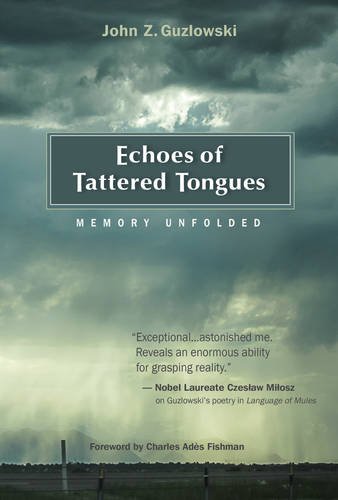
Last year, John published Echoes of Tattered Tongues: Memory Unfolded, an experimental yet deeply satisfying mongrel at the intersection of poetry, history, biography, and memoir—in the same vein as Art Spiegelman’s MAUS, but with poems instead of pictures. Many of its constituent parts have found print in other places, particularly in his previous collections The Language of Mules and the aforementioned Lightning and Ashes. But Echoes of Tattered Tongues isn’t a simple greatest-hits anthology by any means. Rather, Guzlowski resets the older material in a new framework, much as a composer might incorporate musical themes and ideas she’s previously worked out in piano sonatas and string quartets into a new symphony that coheres and magnifies her original pieces.

Echoes is largely the story of Guzlowski’s parents, as well as the story of how he came to learn  from them the parts of that story he didn’t already know. It progresses in three movements, each movement delving deeper into the past—unfolding memory and uncovering missing pieces of the historical record: from his parents’ twilight years, to mid-century—John’s childhood—when they left the DP camp in Germany and emigrated to America, and finally, to the War itself, and the root of the deep unhappiness his parents carried with them to the grave.

Book I introduces us to Guzlowski’s parents in retirement, in Arizona, and gives us glimpses of what happened to them in their early lives, how it haunts them. In “My Mother Reads My Poem ‘Cattle Train to Magdeberg’”, a deft poem that is equal parts hilarious and horrifying, his mother, angry and sardonic, critiques John’s earlier effort at telling her story—a poem that we don’t actually read until Book III:

She looks at me and says
“That’s not how it was.
I couldn’t see anything
except when they stopped
the boxcars and opened the doors.

And I didn’t see any
of those rivers,
and if I did, I didn’t know
their names.[”]

A serious, if wry, indictment, considering the original poem begins “My mother still remembers” and goes on to catalogue everything she supposedly saw from the eponymous cattle train. But then, she goes on to tell him some of what she did see, and to say, “Even though you’re a grown man / and a teacher, we saw things / I don’t want to tell you about.’”

We come to know Guzlowski’s mother well over the course of the book—the asperity of her outlook (“Why My Mother Stayed With My Father” begins “She knew he was worthless the first time / she saw him…” and ends “She knew only a man worthless as mud, / worthless as a broken dog, would suffer / with her through all of her sorrow.”); her violent, abusive rages (“Later in the Promised Land,” “Danusia”); her sardonic bitterness (“My Mother Was 19”—the harrowing denouement of a series of poems, written at different times, that are variations on the story of what happened to her and her family before she was sent to the camps). She stands in contrast to Guzlowski’s passive, sentimental, “worthless” father, who is the viewpoint character of much of the horror we see in the wartime Poland and Germany of Book III.

But before that, in Book II, Guzlowski guides us through his family’s experience as immigrants to America, who brought with them little more than a wooden trunk full of necessities, a heavy burden of trauma, and what few skills they had. As outlined in “What My Father Brought With Him,”

He knew there was only work or death.

He could dig up beets and drag fallen trees
without bread or hope. The war taught him how.
He came to the States with this and his tools,

hands that had worked bricks and frozen mud
and knew the language the shit bosses spoke.

The family slowly finds its bearings in the Polonia Triangle neighborhood in Chicago (made famous by Nelson Algren in The Man with the Golden Arm) in spite of poverty, crime, pedophile priests, his father’s frequent drinking bouts, and his mother’s violent mood swings, in which she lashes out at John, his father, and his sister Danusia—an elusive figure who holds an obvious emotional valence for Guzlowski, but who never comes clearly into focus, and whose story, one of sweetness and innocence lost, is never resolved. Several of these poems are unsettling stories told by or about others who had fled Europe after the War, and one (the charming “Kitchen Polish”) is about being a non-native speaker, who grew up speaking Polish at home and English everywhere else:

I can’t tell you about Kant
in Polish, or the Reformation
or deconstruction

or why the Germans moved east
before attacking west,
or where I came from,

But I can count to ten, say hello
and goodbye, ask for coffee,
bread or soup.

I can tell you people die.

It’s a fact of life,
and there’s nothing

you or I can do about it.
I can say, “Please, God,”
and “Don’t be afraid.”

If I look out at the rain
I can tell you it’s falling.
If there’s snow,

I can say, “It’s cold outside
today, and it’ll most likely
be cold tomorrow.”

Book III takes us into the nightmarish central Europe of Guzlowski’s parents’ wartime experience as prisoners of the Third Reich, and it is among the emotionally keenest of such chronicles. Few war poems I have read equal the intensity of “Landscape with Dead Horses, 1939”:

Look at this horse. Its head torn from its body
by a shell. So much blood will teach you more
about the world than all the books in it.
This horse’s head will remake the world for you—
teach even God a lesson about the stones
that wait to rise in our hearts, cold and hard.

Or of “The German Soldiers” (“We soldiers are only human. We love / to kill. It is the hidden God in each of us.”); or of the surprisingly surreal, sinister beauty of the book’s longest poem, “The Third Winter of War: Buchenwald,” about his father’s imprisonment there:

He remembers a movie he once saw
when he escaped from the camp.

In it, one of the heroes is a fat man,
the other skinny. On a boat lost at sea,
they look at each other in hunger and cry.

Then fatty smiles, and skinny cries harder.

[….]

He dreams dogs change into men
and sit at a table to discuss the war,
why it began and how it will end.

He wants to ask the dogs a question
but they can’t understand his howling.

Guzlowski’s attempt to learn and feel the origins of his parents’ pain thus brings us into closer emotional touch with the entirety of the War in Europe, widening by necessity from the particular to the general. It is a unorthodox way of telling such a story: though there are many examples of poems written by poets who experienced the camps firsthand, examples of secondhand histories told in verse are thin indeed. And yet it works, in ways that defy analysis or easy summary. Guzlowski’s empathy and imagination are extraordinary, at times truly shocking. His verse, which brings to mind variously Charles Bukowski, Charles Simic, and Philip Levine, has a vernacular concreteness and clarity that is all the more startling when it breaks sharply with realism, and he deftly captures those quirks of personality that bring characters into full view. Less than halfway through the book, I had unconsciously slipped from thinking What a novel way to tell this story to I can’t imagine how else it could be told.

And as if that weren’t enough, Aquila Polonica Publishing deserves great credit for producing a book that is a beautiful artifact, from its cloth and leather binding, to its creamy paper, to the stunning photographs that accompany the text. In every respect, Echoes of Tattered Tongues is an achievement that deserves wide recognition and long remembrance.
SATURDAY POETRY SERIES PRESENTS: JOHN GUZLOWSKI

john g
THE WORLD AFTER THE FALL
By John Guzlowski

Eve stood there
for a moment
and watched her grace
dry up like water.

Whatever sunshine
had lingered on her skin
was gone

and when
she looked at Adam’s face
she wondered
what she could say
to him.

They had words
of course—
They learned them together
but neither spoke.

What could
she say?

Sorry?

Next time,
it’ll be different?

I didn’t understand?

She just shook her head
and he did too.


(Today’s poem originally appeared in The 2River View, and appears here today with permission from the poet.)

John Guzlowski’s writing has appeared in Garrison Keillor’s The Writer’s Almanac, The Ontario Review, The Polish Review, Exquisite Corpse, Manhattan Review, Modern Fiction Studies and other journals both here and abroad. Czeslaw Milosz wrote that Guzlowski’s first book of poems, Language of Mules, “astonished” him and that he had “an enormous ability for grasping reality.” Guzlowski’s poems about his parents’ experiences in Nazi concentration camps appear in his book Lightning and Ashes.

Editor’s Note: Today’s poem participates in the ancient tradition of midrash, the questioning of and commenting upon what is written in the Bible. I have been engaged in midrashic studies both in my academic and creative pursuits for many years now, and whenever I come across poems that take part in this ongoing discussion I am drawn to them. The Bible is the foundation of Western civilization, but despite an unconscionable number of narrow-minded of readings and prosthelytizations, The Book is not a static enterprise, not a fixed proscription, but is a living, breathing entity, the questioning of which leads to an understanding of modern (wo)man.

On this series we have seen Betsy Johnson-Miller question the story of the fall, Father Kilian McDonnell question the patriarchal authorship of Genesis, William Kelley Woolfitt explore the story of Samson, and today John Guzlowski joins the mini-midrashic tradition being written within the pages of As It Ought To Be. May the questions be relentless and the conversation never end.

Want to read more by and about John Guzlowski?
Listen to the poet reading today’s selection on The 2River View
Garrison Keillor reading Guzlowski’s poem “What My Father Believed” on The Writer’s Almanac
The poet reading selections from Lightning and Ashes on youtube
Lightning and Ashes blog
Buy Lightning and Ashes on Amazon
Read Okla Elliot’s interview with John Guzlowski here on As It Ought To Be