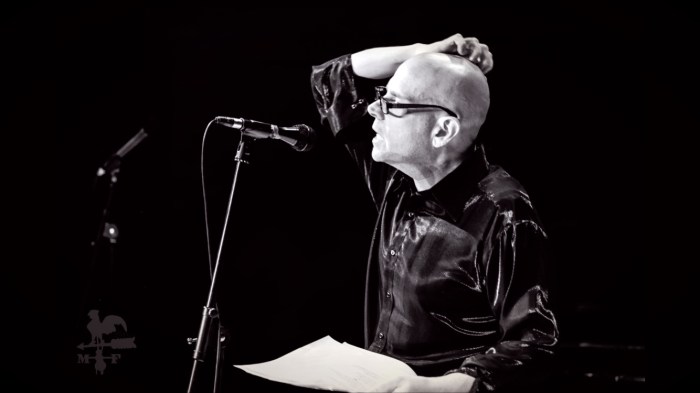
SATURDAY POETRY SERIES PRESENTS: THE NEEDS OF THE MANY BY BRENDAN CONSTANTINE

Photo Credit: Michelle Felix


THE NEEDS OF THE MANY
by Brendan Constantine

On the days when we wept—
and they were many—we did it
over the sound of a television
or radio, or the many engines
of the sky. It was rarely so quiet
we could hear just our sadness,
the smallness of it
that is merely the sound of wind
and water between the many pages
of the lungs. Many afternoons
we left the house still crying
and drove to a café or the movies,
or back to the hospital where we sat
dumb under the many eyes
of Paul Klee. There were many
umbrellas, days when it refused
to rain, cups of tea ignored. We
washed them all in the sink,
dry eyed. It’s been a while,
we’re cried out. We collect pauses
and have taken to reading actual
books again. We go through them
like yellow lights, like tunnels
or reunions, we forget which;
the older you are the more similes,
the more pangs per hour. Indeed,
this is how we break one hour into
many, how healing wounds time
in return. And though we know
there will always be crying to do,
just as there’s always that song,
always a leaf somewhere in the car,
this may be the only sweetness left,
to have a few griefs we cherish
against the others, which are many.


Today’s poem first appeared via The Academy of American Poets’ ‘Poem A Day’ series, was then published in the collection Dementia, My Darling (2016 Red Hen Press), and appears here today with permission from the poet.


Brendan Constantine‘s work has appeared in Prairie Schooner, FIELD, Ploughshares, Virginia Quarterly, and Hotel Amerika, among other journals. His most recent collection is Dementia, My Darling (2016 Red Hen Press). He has received grants and commissions from the Getty Museum, James Irvine Foundation, and the National Endowment for the Arts. He currently teaches poetry at the Windward School and regularly offers classes to hospitals, foster homes, veterans, and the elderly.

Editor’s Note: I’m just going to come out and say it: You need this poem. Right now. At this moment. In the wake of tragedies too hard to hold and too heavy to bear. You have watched the sky fall. You have been broken by the debris of what you thought to be true, of what has and has not been shattered. All that you know in your heart about what is right and what is wrong, about human kindness and decency, about the kind of country you want to live and raise your children and grow old in, the kind of world you want this to be. It’s all fallen apart. And that sadness you feel? That resistance to getting out of bed in the morning? Those spontaneous tears you find yourself bursting into? You are not alone. You. Are. Not. Alone.

But this poem. This poem! This poem knows our suffering. This poem knows our shared grief. This poem knows that “On the days when we wept— / and they were many—we did it / over the sound of a television.” This poem knows that “Many afternoons / we left the house still crying.” And this poem knows, too, that there is a time beyond this time — for better or worse — that the day will come when we are cried out, when we will read books again and reach milestones, and yet. And yet this poem knows that some griefs we will carry with us. Held fast by markers like where you were when Kennedy was shot or when 9/11 happened. This poem knows that there are “a few griefs we cherish / against the others, which are many.” And we know that this moment in American history is one of those griefs we will cherish against the others, which will be many.

Want to see more from Brendan Constantine?
The LA Review of Books on Dementia, My Darling
Muzzle Magazine
The BlueShift Journal
Betty Sargent for Publisher’s Weekly
Video by Sarah Jensen, winner of Write Bloody’s Best Poetry Video award, 2013

Keep Loving. Keep Fighting.

brett1

Keep Loving. Keep Fighting.

Meditations on what has been happening on the University of Illinois at Urbana-Champaign campus after the Trump election win was declared

by

Brett Ashley Kaplan

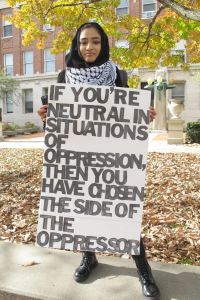
I’d wager that for all of you November 9, 2016 was a day of shock, revulsion, horror, disbelief, tears, confusion and a huge amount of fury. Like most of you, I had a very hard time focusing on anything but the terrifying prospect of TRUMP. I don’t think it is possible to say that this isn’t a racist choice. Even if individual Trump voters may not claim the word “racist” to describe themselves…this is “white nostalgia” (thank you Naomi Taub—Van Jones calls it “white lash”) to hark back to an imagined, fantastical, never happened Eden of whiteness before there was a smart articulate black president who threatened the ascendancy of whiteness. Before all these meddling professors with their diversity muddied the pure white American idyll. This is a return of White Supremacy. It doesn’t matter that the bald fact is that this country, after the genocide or displacement of its original inhabitants, was founded on and built by voluntary and involuntary immigrants and is now enriched by Latino/a/x, black, brown, Muslim, European, Chinese, Korean, Indian, multiracial, white, biracial, Jewish,  and many other immigrants. Facts, in fact, no longer matter because Trump unleashes the masculinist id and allows for trespasses of power and abuses against women’s right to decide when, where, and by whom we get groped and kissed. As Chris Benson rightly pointed out in conversation with Masha Gessen, Trump’s self-proclaimed abuses of power over women augur his abusive of power writ large. It has been part an amazing joy and also profoundly frightening to be part of what’s happening on this campus as we move from shock to action.

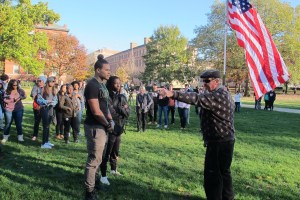
On Wednesday, two men, one with a large American flag and the other with a bible, were spewing supposedly Christian but actually anti-immigrant, pro-Trump, racist rhetoric. A large group of us formed around them—some students were arguing with them and some brett1were just watching the spectacle. I was trying to take the floor away from these two hate-mongers and focus energy in a positive way—finally a brave student took the floor and reminded them that their version of “Christian” actually has nothing to do with what Christ would have espoused.

Right next to all this screaming there were students writing love-filled messages in chalk on the quad: “Spread love, the world needs it;” “Your skin your sex your gender your beliefs ARE VALID;” “Love is the answer.” Unfortunately, another chalking, that I did not brett5see but a student sent me an image of proclaimed: “White Privilege, I (heart) Trump”

Later in the day I saw students forming a chain in front of Lincoln Hall and chanting, “keep loving, keep fighting.” These students were contributing a wonderful energy to the quad, they were joining together to do it. The next day, I saw a student sitting alone, and completely silent in front of the Alma Mater with a sign that read:  “Vow of silence. No voice. No comment. No hate. No tyrant. #Not My President.” I gestured to him (I didn’t want to use words and disrupt his peaceful protest) to ask if I could photograph him, and he nodded yes. Then I wrote him a note: Thank you for your protest. It is very beautiful. Andbrett8 very needed.

Writing on a huge “What are you Thankful For” sign I encountered a Latina student who was chalking that she was thankful for all the solidarity and coalition building opportunities on campus. I asked specifically which resources she was grateful for and she described both La Casa and to the Gender and Women’s Studies center as offering spaces for dialogue and unloading after the election. I was relieved that far from feeling isolated she felt held by these communities.

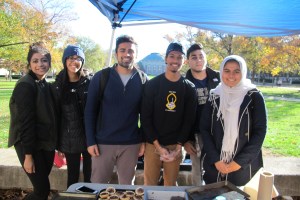
Then I talked with the Muslim Student’s association, out on the quad for a bake sale. They were so happy to have someone approach them and offer solidarity that I wondered if this was rare. The group of students I spoke to had different feelings about the election: one woman said that she did feel safe on this campus but then her friends started chiming in about Islamophobic acts that had happened here since November 8: a Muslim woman had a knife wielded at her on a bus, another woman’s hijab was pulled off, and another student suffered a man shouting brett10“go back to your country” as he walked by. When I asked them how they were feeling about Trump and about all of these revolting acts they said they were shocked but they were ready for action and to fight for what they believe in.
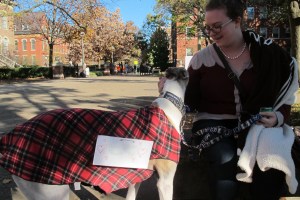
Another solitary protester sat alone in a chair on the quad holding up the sign “Love trumps hate.” I asked him if he knew of other protests happening and how he felt protesting alone and he said yes, there would be soon mass protests and it was just fine for him to protest alone. Yet another lone protester had affixed a sign on her dog that offered him as something like “post-election therapy.” I have to own up to the fact that the solitary protesters made be feel melancholic and protective. But they were all mourning andbrett12 fighting in ways that had an impact, even though they chose to do it alone.
In my graduate seminar I opened class by asking if anyone had anything that he/she/they would like to share about the election. One white student said that she had been crying about it (I’ve seen many, many people crying) and was talking with a black student who “asked if [she] needed a hug and then told her, ‘it’ll be ok, we’ll get through this!’ This sweet gesture brought [her] to tears and made [her] think maybe this terrible outcome will unite us in some important ways.”

Among the incredibly moving and thoughtful and insightful and informative things people have posted on Facebook, I found these words from one of the many Comparative Literature graduate students who make our department so stellar, particularly moving: “I have seen instructors break into tears because they suddenly feel inadequate to protect their most vulnerable students, even in their own classrooms. I have seen new communities forming around the desire to extend compassion, protection and comfort to people who feel threatened and devalued…” (Meagan Smith).

This morning, Friday 11 November, I went to the 31st annual Diversity Breakfast. Chancellor Jones offered there an impassioned, clear rebuke against the disgusting rise in racism we are experiencing now. It was a strong, unequivocal statement and it earned him a standing ovation. After all the awards were given and the speeches made I bee-lined over to the new Chancellor, congratulated him on his moving and wonderful speech, and asked him to send such a strong statement to all the students—several of whom had already told me they needed that from him.

From the diversity breakfast my daughter and I picked up my father from the airport and went straight to a protest at the Alma Mater. Three generations of Kaplans were chanting “hey hey, ho ho Donald Trump has got to go!” “We welcome immigrants!” “Tell us what power looks like! This is what POWER looks like!” My Jewish-American father was part of the Civil Rights movement and always fought for racial justice; my younger daughter is finding her way in the world but already knows that racism is painful and wrong and that Trump and his supporters are spreading racism!

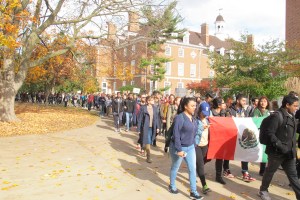
The protest moved from the Alma Mater all the way around the quad and then down Green Street. We stopped traffic and took over the road—there were probably 300 or so peoplebrett13—black, brown, white, gay, straight, trans, young, old—an actually diverse group of people yelling at the top our lungs “THIS IS NOT MY PRESIDENT!”
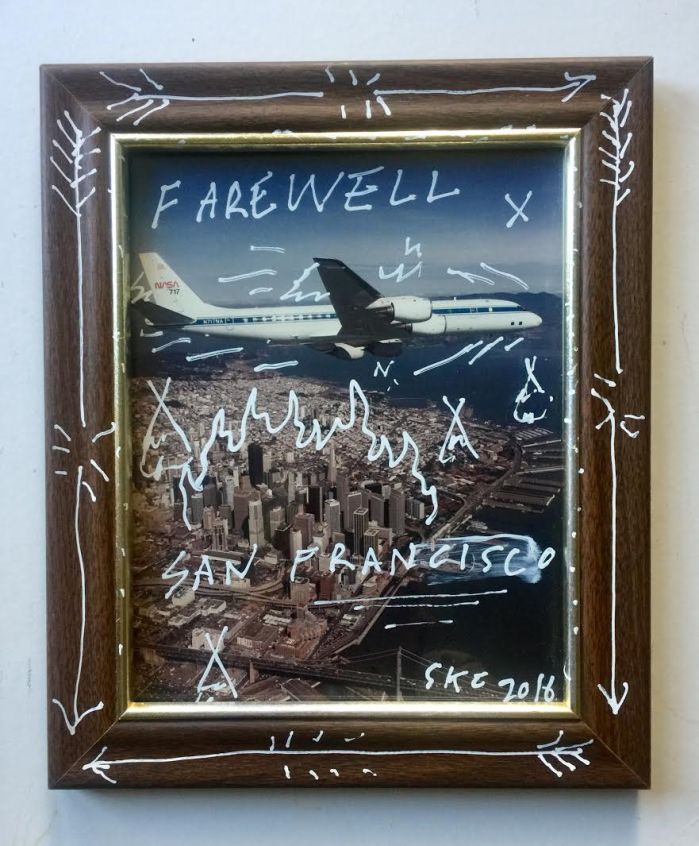
As I write, the KKK has endorsed Trump and plans an enthusiastic welcome rally; a Saudi man has been murdered in Wisconsin; swastikas and other hate symbols proliferate around the nation. My partner, a black physicist from Tobago on his way home from a conference has just texted me the cover of USA Today bearing the headline: “Rise in racist acts follows election.” I cannot predict what sort of fissures the racism Trump and his followers propagate will forge into our family and through our love.

If the see-saw between love and hate as represented in this small sampling from this small college town in the Midwest were to be weighed, love would definitely, certainly, trump hate. But I am not sure I could possibly hazard which one will ascend in the long run.

It is time now for all of us to write to the electoral college delegates and ask them not to vote for hate on December 19. This may be our only chance for peace.

***

Brett Ashley Kaplan is a professor of comparative literature at the University of Illinois at Urbana-Champaign. She is also the author of  Unwanted Beauty, Landscapes of Holocaust Postmemory, and Jewish Anxiety and the Novels of Philip Roth.

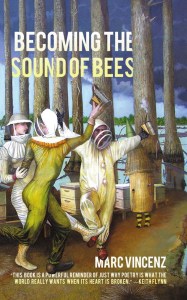
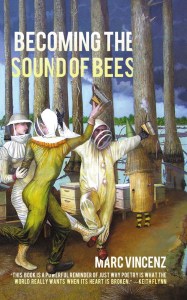
Review Round-Up for Marc Vincenz’s Becoming the Sound of Bees

Poet’s Quarterly: http://www.poetsquarterly.com/2015/11/review-becoming-sound-of-bees-by-marc.html

***

Marc Vincenz is British-Swiss and the author of nine poetry books. Vincenz is also the translator of many poets, including Herman Hesse Prize winner Klaus Merz, Werner Lutz, Erika Burkart, Alexander Xaver Gwerder, Robert Walser and Ion Monoran. His translation of Swiss poet, Klaus Merz’s collection Unexpected Development, was a finalist for the 2015 Cliff Becker Book Translation Prize and is forthcoming from White Pine Press. He has received grants and fellowships from the Swiss Arts Council and the Literarisches Colloquium Berlin. His own work has been translated into eight languages. Most recently a book was released by Tractus Arte Press in Romania. Although he has lived and traveled all over the word, Marc Vincenz now resides, writes, translates and edits in western Massachusetts.

“Ivan Sinks into the Honeycomb” by Marc Vincenz

becoming-the-sound-of-bees


Ivan Sinks into the Honeycomb

After all his yowls and cajoles,
Ivan has lost his chords
and sinks into the shallows,
into the impressions

of mollusks and seasnails,
hangs his head in his hands
as if he wants to hold on to it.
He knows what I think of him,

the hoarder of things he once was,
the hoarder of memories he has become.
It’s too heavy, he mutters
as if to the spinning minnows

and the jellied eggs of crustaceans
yet to become.
And what of Tatjana, he mumbles
scratching a face in the sand;

the shadow of the wall
now hovers over his skull like a hive
burning alive in honeybees—
as if I had answers

as if I might become
soothsayer, groundbreaker
(when all that’s left is you,
you become everything or nothing).

If only we’d always lived cut-
off on an island, he spits,
sinking into the honeycomb,
drifting far away from me.

***

Marc Vincenz is British-Swiss and the author of nine poetry books. Vincenz is also the translator of many poets, including Herman Hesse Prize winner Klaus Merz, Werner Lutz, Erika Burkart, Alexander Xaver Gwerder, Robert Walser and Ion Monoran. His translation of Swiss poet, Klaus Merz’s collection Unexpected Development, was a finalist for the 2015 Cliff Becker Book Translation Prize and is forthcoming from White Pine Press. He has received grants and fellowships from the Swiss Arts Council and the Literarisches Colloquium Berlin. His own work has been translated into eight languages. Most recently a book was released by Tractus Arte Press in Romania. Although he has lived and traveled all over the word, Marc Vincenz now resides, writes, translates and edits in western Massachusetts.

[The above poem appears in Becoming the Sound of Bees and is reprinted here with permission of the author.]

SATURDAY POETRY SERIES PRESENTS: MANISHA SHARMA

sharma-image


Millions of girls continue to vanish pre-birth in India simply because they are girls. The following poems imagine these vanished girls.


DEAR DAUGHTER

In my mind I cradled you in my arms
            I didn’t cage you
you latched onto my breasts
             I didn’t siphon life into you
you mumbled bilabial sounds, m…p
yet my ears did not hear you speak
I know you exist
              waiting to be reborn as my son
then, I will cradle you in my arms
              let you latch onto my breasts
              siphon life into you
              hear you mumble Ma, Pa
              welcome you as the heir
              who will carry your father’s name


WOULD YOU STILL BLAME ME?

You were like circles of incense
It wasn’t that we couldn’t feed another mouth
It was the kind of feeding we would do
For every roti soaked in ghee for your brother
You would get only one not soaked
Every glass of milk that went down his throat
You would drink chai with a hint of milk
Every pair of new clothes he would get each month
You would only get one pair a year
He would utter complex phrases in English
You would say soft words in Hindi and the local tongue
He would earn fancy degrees to do something great
You would master fine skills to please others
He would walk with his head held high
You would walk with your head bent
For you are leased property
Returned to its rightful owner in two decades


Today’s poems appear here today with permission from the poet.


Manisha Sharma: Born and raised in India, Manisha Sharma earned an MFA in Creative Writing from Virginia Tech. A graduate of the Bread Loaf Writers’ Conference, she was a Spring 2016 poetry mentee in AWP’s mentorship program, where Shikha Malaviya mentored her. Her recent poetry and writing has appeared in or is forthcoming from TAB, a journal of poetry and poetics, New Asian Writing, The Bombay Review and The Huffington Post. More of her work can be seen at www.genderedarrangements.com.

Editor’s Note: Between 2000 and 2011 seven-to-ten million girls in India were prevented from being born simply because they were girls. With her important poetry and collaborations, Manisha Sharma tells research-based stories of these girls-who-never-were. Her work goes a step beyond giving voice to the voiceless. Sharma literally gives life — through her art — to those who never came into being because of their sex.

In today’s poems Sharma imagines these “vanished girls” from the perspective of the mothers who carried, but never birthed them. “I know you exist,” one such mother reflects, “waiting to be reborn as my son.” Another considers the gender inequity she wanted to spare her would-be-daughter: “It wasn’t that we couldn’t feed another mouth / It was the kind of feeding we would do/ For every roti soaked in ghee for your brother / You would get only one not soaked / Every glass of milk that went down his throat / You would drink chai with a hint of milk.”

It is heartbreaking to think of the lost souls whose sex alone prevented them from having a chance at life. But it is perhaps more challenging to consider the mothers who conceived, who carried the seeds of life inside them, and who made the choice — if they were given a choice at all — to terminate their pregnancies when they discovered they were carrying girls. One mother harbors no illusions as to the kind of life a girl child in India would have had to lead, while the other acknowledges that, despite the choice made, she suffered a great loss: “In my mind I cradled you in my arms.”

Want to see more from Manisha Sharma?
Gendered Arrangements
“Indian Girl Crumbling” in New Asian Writing
“#17”, “#18”, “#22”, “#23”, and “#25” in The Bombay Review

Spencer Keeton Cunningham

fsf_skc

Farewell for Now: Spencer Keeton Cunningham Departs San Francisco

by Matt Gonzalez

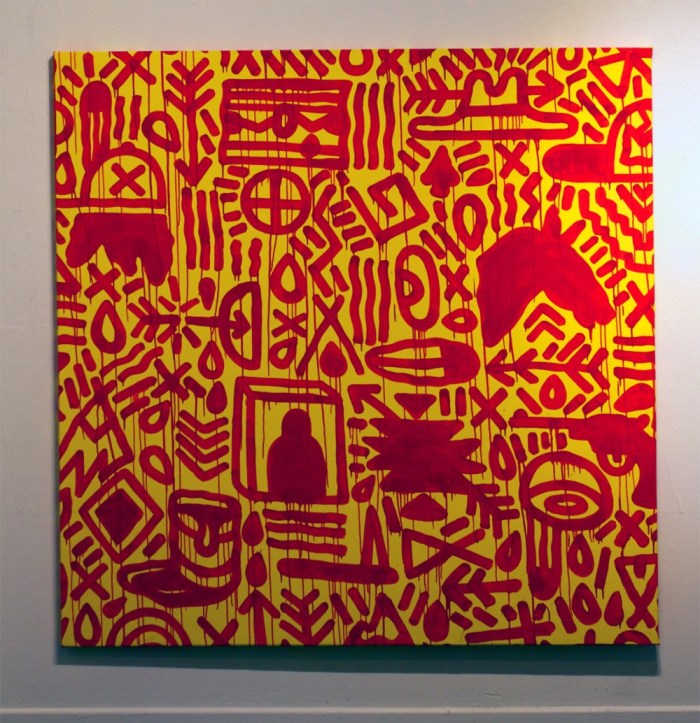
Spencer Keeton Cunningham has been on the road for the last 28 months, but is back in San Francisco for a send-off show at Heron Arts, “Farewell San Francisco: A 12 Year Retrospective”. The exhibit, which ran from October 8 to 30, 2016, presented work from the last dozen years, including pieces made before he attended the San Francisco Art Institute. Facing eviction and escaping a mold-ridden Western Addition apartment, Cunningham is preparing to join Sioux and other Native American activists opposing the Dakota Access pipeline at the Standing Rock Reservation in North Dakota. Surprisingly, after over a decade in San Francisco, this is Cunningham’s first solo show in the city.

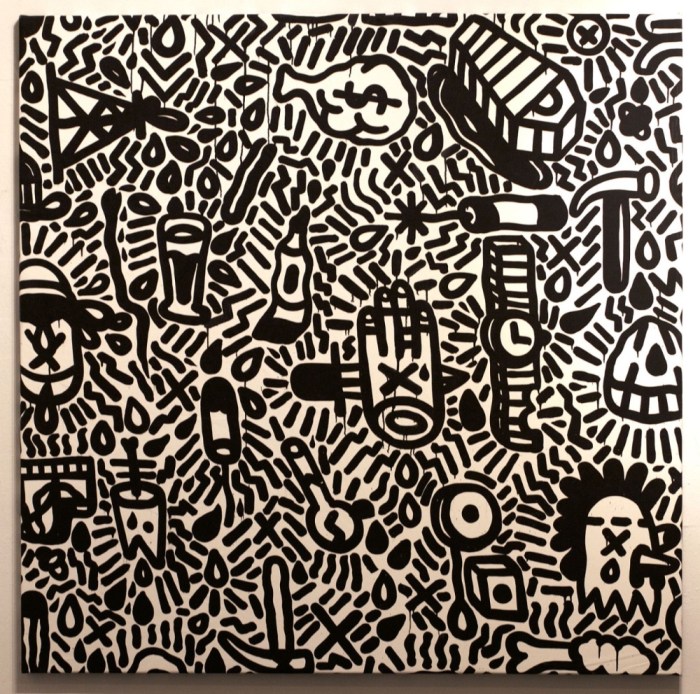
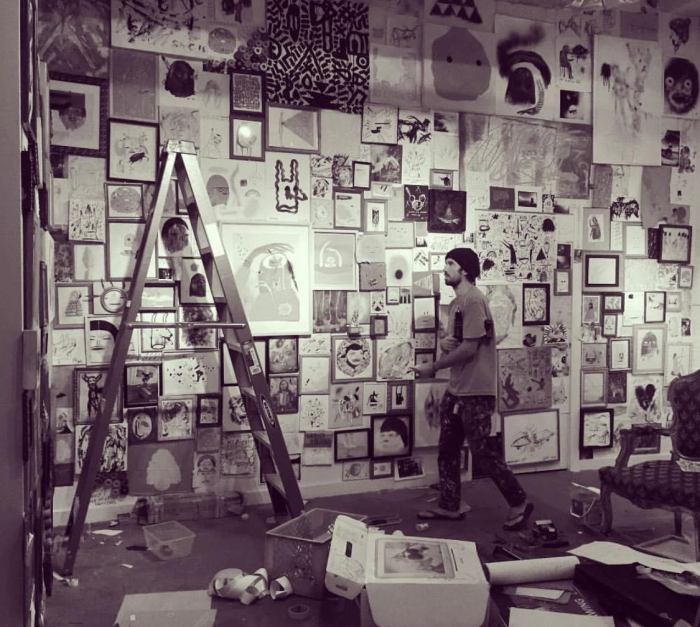
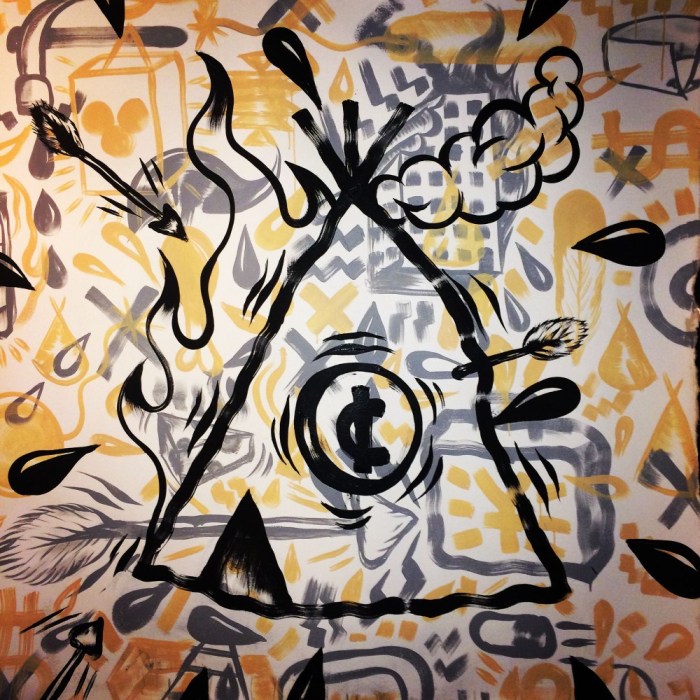
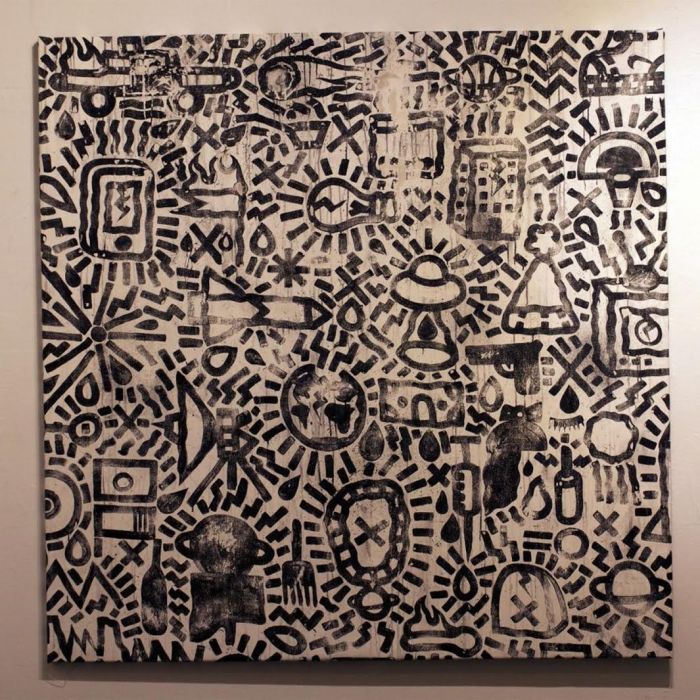
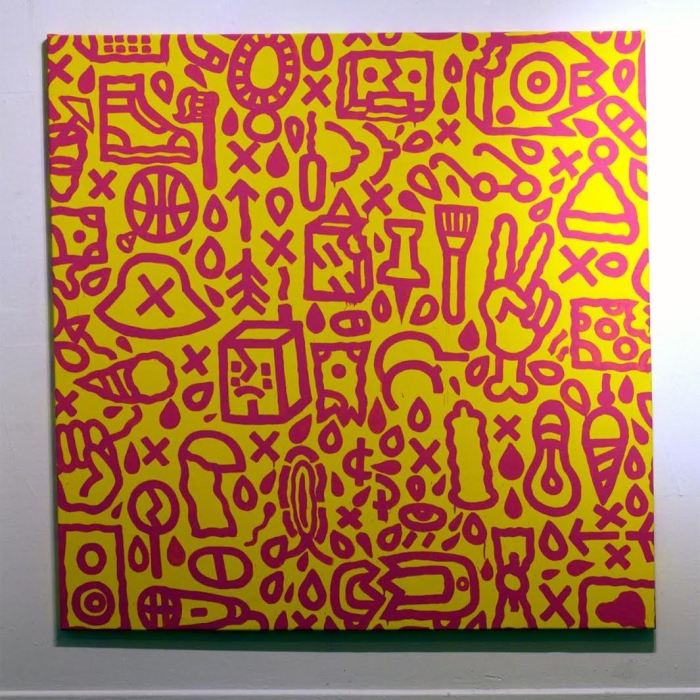
The breadth of work is impressive. Works on paper, paintings, ceramic sculpture, installation, and photography. The themes running through the work focus on gentrification, skateboard culture, environmental degradation, contemporary native identity, endangered species, and most importantly, indigenous people’s rights. Wall to ceiling artworks filled with iconography comprising his own visual language fill the 4,000 sq foot space, with some paintings measuring as large as 77 x 77 inches.

skc_redcountry

Spencer Keeton Cunningham, “Red Country”, acrylic on canvas, 73 x 73 inches.

While Cunningham says goodbye, he hasn’t actually been anchored in San Francisco for some time. Yes, he has strong ties to San Francisco, but he is now a global artist having travelled and painted murals in Mexico, New Zealand, Japan, China, Tasmania, Australia, Cuba, The Netherlands, Canada (British Columbia and the Yukon), Hong Kong, Argentina, and various cities in the United States. The departure from San Francisco is real, yet somehow more symbolic than anything else. It provides a historic moment to present a cohesive body of work that is long overdue for exposure and appraisal.

skc_mexicous

Spencer Keeton Cunningham, “Mexico / Estados Unidos”, acrylic on canvas, 73 x 73 inches.

There is a simple mark-making element in the works, Lascaux-like, yet seemingly very modern. Cunningham utilizes a Keith Haring-esque line in many of the works, an obvious homage, and cartoony renderings suggesting childhood influences (Mickey Mouse and Mighty Mouse cartoons among them), and drawings reminiscent of the Mission School. The combination, particularly in terms of subject matter, are his own however. Cunningham’s imagery captures the political immediacy of contemporary issues, such as artificial nation-state borders, our society’s fascination with sports and pop culture, his on the road lifestyle, and a critique of capitalism, particularly oil production and tech gentrification. Regarding Keith Haring’s influence, it is worth noting that Cunningham painted a mural over 20 advertising billboards, in support of aboriginal rights, in Melbourne next to a mural Haring painted in 1984.

A kind of semiotics is at play in these works, as Cunningham embeds meaning in symbols and asks the viewer to contemplate their striped down meanings. Depictions of oil rigs, sports helmets, dollar signs, a microphone referencing Hip Hop culture, teepees, chicken wings, tomahawks, feathers, paint cans, knives, pizza slices, envelopes, wavy arrows, a wagon on fire, a glass beaker referencing drug manufacturing, WiFi symbols, broken glasses and pencils, and the rendering of sacred animals like horses and coyotes, all litter the art works. Also notable are a triangle in a bowl, which evokes shark fin soup, and logs burning inside of a computer, in reference to the progress of technology. All of these comprise a personal hieroglyphics. The marks have a deeply embedded context that cross language and cultural boundaries, allowing the reader to visually read meaning in the work.

skc_4

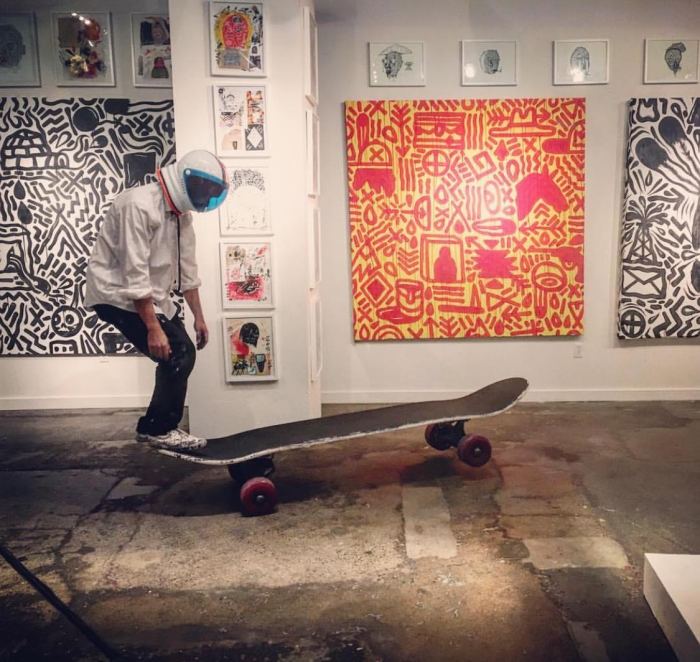
Photo of Spencer Keeton Cunningham taken during the installation at Heron Arts.

The line work itself is often rendered as a flat, two-dimensional image. He uses black paint on a white canvas or saturated colors against a colored background, and outlines many of the symbols he paints with thick brush work, suggesting emphasis and a kind of kinetic movement, even reverberation. There isn’t any text based messaging in the large paintings; he doesn’t need it, given the force of the symbols he employs.

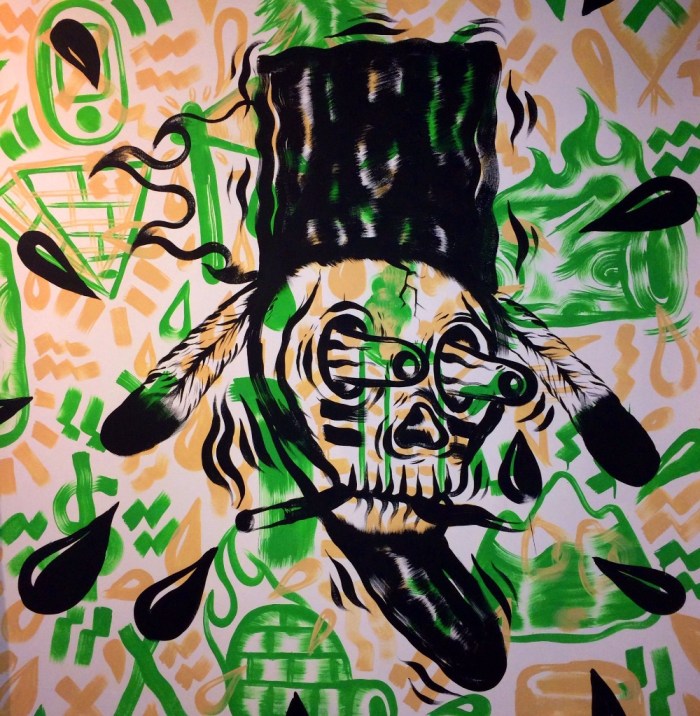
In one grouping of paintings, most of them 52 x 52 inches, including “Gentrification of a Pharaoh” and “Gentrification of Indian Land”, Cunningham deftly layers the painting surface, in effect, making three separate paintings. The triple-layered symbols move from lighter colors (yellow and green in one instance), to a confident black acrylic on the top surface. These works convey gentrification by suggesting a deeper presence of meaning beneath the surface layer of things. In effect, Cunningham proclaims that gentrification and displacement doesn’t erase what stood before just by adding a fresh coat of paint.

skc_gentrificationofapharaoh

Spencer Keeton Cunningham, “Gentrification of a Pharaoh”, acrylic on canvas, 52 x 52 inches.

skc_gentrificationofindianland

Spencer Keeton Cunningham, “Gentrification of Indian Land”, acrylic on canvas, 52 x 52 inches.

One wall is devoted to his close collaborator Haitian-American artist Erlin Geffrard who is known for presenting racially-charged work (under the aka Kool Kid Kreyola), including appropriations of the KKK moniker and clansman hood, which he once wore in a pop-up performance at the SFMoMA. Geffrard’s wife, Daisy Ortiz, and 4-year old child Daylin also contribute to the wall with their own drawings and ceramic artwork, now comprising artifacts of a heart-wrenching story of family displacement.

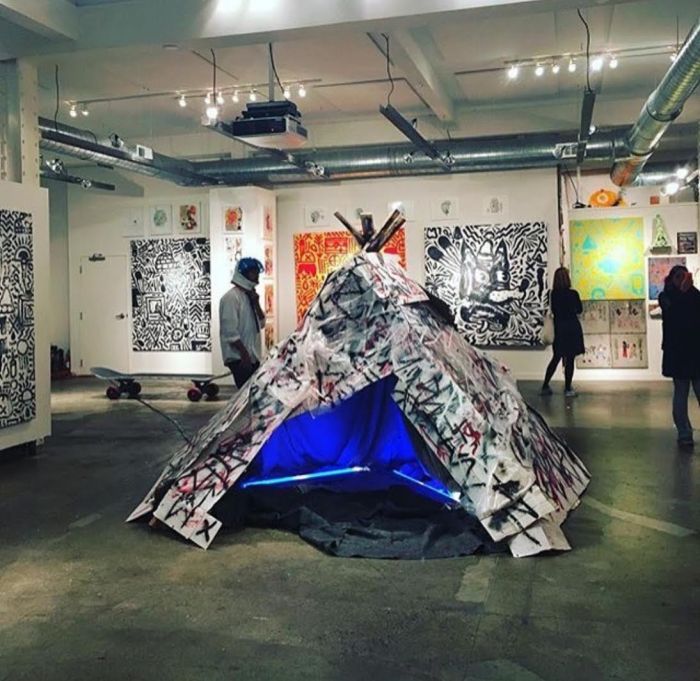
During the closing reception Cunningham erected a teepee in the middle of Heron Arts, something he had done previously at group shows in the Diego Rivera Gallery at SFAI and at the Luggage Store Gallery. Significantly, he made the current structure contemporaneously with the unrest at Standing Rock, during which time police and security guards were using tasers, rubber bullets, and pepper spray against native people as they were evicted from their make-shift campground. Notably, artists and native activists protesting the Dakota Access pipeline (including sometime collaborator Richard Bluecloud Castaneda) were sending real time messages to Cunningham as he offered his performance/installation in San Francisco, thus linking disparate tales of displacement and unrest.

skc_5

Installation photograph.

The teepee, made of plastic and cardboard, had a ramshackle quality referencing homeless structures throughout cities in the United States. The construction materials resemble trash, signifying the prevalence of pollution. The teepee itself was painted in fresh red/purple acrylic paint, still wet to denote fresh bleeding and suffering. An eagle pattern on the teepee itself was split by dollar signs and splatters of paint. Cunningham added LED lights to adorn the inside of the structure, which conveyed a futuristic element and respite from the chaos. The neon element also functioned in dialogue with the faux space helmet that Cunningham wore during the reception, as he cruised around the exhibition floor space on a 9-foot skateboard made by Payson McNett.

skc4

Spencer Keeton Cunningham at Heron Arts.

Hovering nearby his teepee, Cunningham placed his painting “Made In Outerspace” , which posed the question of the role technology plays in our contemporary challenges. It’s worth noting that Cunningham is from the Colville Tribe which is one of 12 tribes of the Confederated Tribes of the Colville Indian Reservation in Northeastern Washington. His blood quantum is 1/4th and he affiliates himself as mixed Native and European heritage. Cunningham’s Native-American ancestors knew something about displacement and he poignantly suggests that the next frontier may be where they will finally find a peaceful home. Cunningham is already dressed like an astronaut, as if in anticipation.

skc_os

Spencer Keeton Cunningham, “MADE IN OUTERSPACE”, acrylic on canvas, 73 x 73 inches.

The quickly put-together show, drawn out of necessity and quick planning, meant that it didn’t receive the promotion and attention it deserved. The gallery was open by appointment only. This important exhibition will nevertheless live through photographs and the memory of the few who experienced it. It’s message and the work itself remains vital, as well as sadly relevant.


Matt Gonzalez


sck_2

Spencer Keeton Cunningham, “Hip Hop History 101”, acrylic on canvas, 73 x 73 inches.


Static by Marc Vincenz

becoming-the-sound-of-bees

Static

In that year
that was not a year

when the days
were not like days

& the sky was bird-
less
we listened

for the sound of bees
& hearing nothing

but the wind boxing the panes
we began to hum & buzz & drone

becoming the grey matter
before words

***

Marc Vincenz is British-Swiss and the author of nine poetry books. Vincenz is also the translator of many poets, including Herman Hesse Prize winner Klaus Merz, Werner Lutz, Erika Burkart, Alexander Xaver Gwerder, Robert Walser and Ion Monoran. His translation of Swiss poet, Klaus Merz’s collection Unexpected Development, was a finalist for the 2015 Cliff Becker Book Translation Prize and is forthcoming from White Pine Press. He has received grants and fellowships from the Swiss Arts Council and the Literarisches Colloquium Berlin. His own work has been translated into eight languages. Most recently a book was released by Tractus Arte Press in Romania. Although he has lived and traveled all over the word, Marc Vincenz now resides, writes, translates and edits in western Massachusetts.

[The above poem appears in Becoming the Sound of Bees and is reprinted here with permission of the author.]

Three Poems by Emily Vogel

122

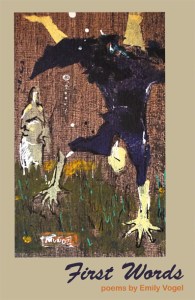
[The following poems appear in First Words (NYQ Books, 2015) and are reprinted here with permission of the author and publisher.]

***

A Small Report

Jesus was crucified yesterday afternoon, or Jesus was crucified
two thousand years ago. The days pass

in the usual sense of days passing:

we eat pork roast and potatoes,
watch clever commercials on the television.

The nature of time is terrifically troubling.

A six-foot Santa rises among some evergreen trees,
among the muck of a dimly lit back road,
among the cold and forthcoming season.

You fall asleep on the floor beneath my feet.
Somewhere is the sound of water.
My womb swells with the bulk of a life.
Stories unfold in a series of images,
people pass in and out as personalities
bereft of names.

At the falling of dusk, Emmanuel comes,
and the traffic on the highway proceeds

in a wild confusion of light.

***

Channel 3

The deepest part of the night is blue noise,
the sound of an infant breathing.
My husband snores beside her on the floor.
Me, I’m an unfathomable crater on the moon,
a vessel that contains conceivable things.
I want to lie in a field of waving wheat
and discuss the mysteries of the universe.
I travel through starlight which appears
on channel 3, my mind a conduit
for traversals, each evasion of the bleeding heart
a fleeting redemption.

***

Despair upon Waking

Late at night, I wait for you in a room
like spring, its urgent rivers roiling
into distances. It is the dark
which is my refuge,
my mind without exact location,
a thing of verbosity.

It begins to reason with itself.
It discerns God, a trace of something dead,
that wild and inconspicuous angel.

Between me and my mind,
a solution has arisen.
I wait for you in a room,
like spring.

Earlier, we watched a show on the TV
about the corruption of the church,
the crimes and sins of ordinary priests.

I wasn’t thinking about this.

Instead, I thought about
a photograph of my mother,
lying in the grass,
holding me above her head
as an infant. She was smiling
and her hair shined.

Later, you enter me like a room,
the dark my refuge, myself the refuge
and the dark, the shape of you
difficult to discern. I love you
like a reoccurrence, a repetition,
so many indiscriminate howls
of grief and desire.

Later, I dream that I am dead.

My mother
is a thing of consolation.

There is the moment of crucifixion,
and my newborn daughter floats
among some disorder
of scattered stars.

***

Emily Vogel’s poetry, reviews, essays, and translations have most recently been published in Omniverse, The Paterson Literary Review, Lips, City Lit Rag, Luna Luna, Maggy, Lyre Lyre, The Comstock Review, The Broome Review, Tiferet, The San Pedro River Review, and 2 Bridges Review, among several others. She is the author of five chapbooks, and a full-length collection, The Philosopher’s Wife, published in 2011 by Chester River Press, a collaborative book of poetry, West of Home, with her husband Joe Weil (Blast Press), and a recently released collection, First Words (NYQ Books). She has work forthcoming in The Boston Review, and a full-length book of poetry, Man, Woman, or Vacillations: Dante’s Unintended Flight, due to be released by NYQ Books in 2017.  She teaches writing at SUNY Oneonta and Hartwick College, and lives with her husband, the poet Joe Weil, and their two children, Clare and Gabriel.

“10 Ways to Murder You with My Yard” by Christy Vlachos Jones

Yes, my pretties.   I can kill any who come along armed with nothing more than my charm and my wits…and a few of the plants that grow on my property. Would you be interested in touring my lovely macabre garden? Actually, it probably looks a lot like yours.  

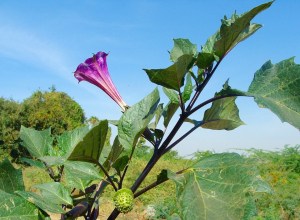
10. Datura

My personal favorite, also known as Jimson weed and Devil’s Snare. It grew up as a weed along the edge of my garden and I let it grow out of curiosity. This was mentioned as the basis of certain darts in the film “XXX,” that caused a victim, if hit, to fall as if struck with a mortal wound, and then wake later with a pounding headache and no idea where he was. cpThey were mentioned more recently in the television series “Underground,” in which the main character threw some of the plant onto the fire and anyone in the vicinity of the smoke became enraptured with vivid hallucinations. The plants name “Jimson weed” is actually said to have derived from the name “James Town weed” because, according to the story, the plant was consumed by British soldiers there who ate the leaves on a salad there in 1676. They miraculously survived their ordeal after eleven days of vivid hallucinations and some reputed naked wackiness. I can grind up some of these seeds in a pepper grinder, and put it in your food.
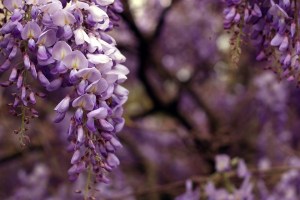
 

9. Wisteria

This beauty’s sweet scent brings me full tilt to my girlhood, to porch swings and warm, sticky late spring evenings. Every Southerner knows that it is as much as blessing as a curse, and you have to keep it in check. The luscious, heady-scented blooms have a woodyc3 vine that, in time, can literally take down a building. Worse, still, it can take you down, too. The seed contain a deadly toxin. The plant self propagates, interestingly, and these seeds actually explode from their pods at a distance of 70 feet, some have claimed. I can sauté some of these up lightly, I suppose, while they are still tender, just enough to flavor them.
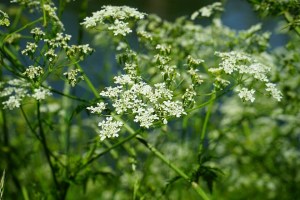
 

8. Hemlock

Hemlock is the notorious poison once used to for ushering condemned prisoners into their hemlocknext lives, such as in the case of Socrates. The pretty white flower is often mistaken for Queen Anne’s Lace (Wild Carrot). Hemlock is quite toxic, and deaths of both humans and livestock continue to be reported. This I can easily mix into a soup, or a salad.



7. English Ivy

Actually, if I could get you to eat any of this, I probably couldn’t convince you to eat english_ivyenough of it to kill you. The saponin Hederin that is present in the leaves irritates the mucous membranes and causes blisters and sores in the mouth so that those that decide to snack on the leaves don’t get far enough into their snack to cause more than vomiting, coughing and diarrhea. I think I could find a way to sneak it into your meal.
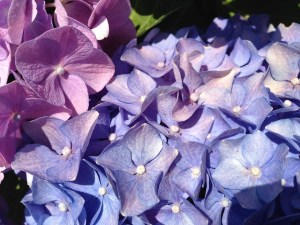
 

6. Hydrangea

hydrangeaInterestingly, these blooms will vary from blue-violet to pink to white depending on the acidity of your soil. These are very pretty, romantic flowers, and so deadly! These have a cyanide-like component in them. Though a case of death by hydrangea would take many leaves, I’m sure with proper dedication we could make that happen.
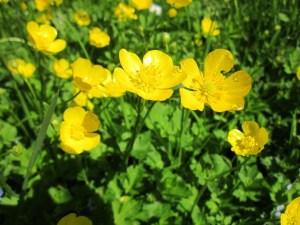
 

5. Buttercups

These harmless-looking flowers are anything but. The pretty, buttery-yellow flowers shine in the sun and you think not “oh, by such means may I die.” But, perhaps you should, dear guest. These contain ranunculin, a glycoside that causes an intense blistering buttercupsthough in mucous membranes, the mouth and throughout the intestinal tract, so I may not be able to convince you to eat enough of these to kill you. They have been problematic for livestock, and have caused vomiting and bloody diarrhea. There is another component that will cause respiratory failure and another that may cause liver damage. Such cute little sunny flowers!
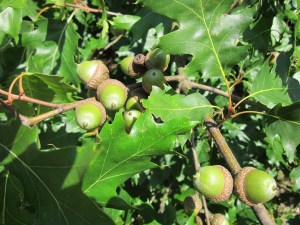
 

4. Oak

oakNative Americans used acorns for food for thousands of years, and it isn’t a bad thing to know how to do in a pinch. Carol, a character in the television series “The Walking Dead” has done this very thing, and made cookies from acorns she found in the woods once when her community was running low on flour. It may take quite a lot for me to kill you with oak, but I can make you bread, cookies, grits and lovely pancakes out of the acorns from the red oak and after a while you will have renal failure due to the tannic acid.

 

3. Foxglove

This exquisite bloom is often found in gardens, and it is the source for the cardiac foxgloveglycoside digoxin. The medicine derived from this plant is given to patients suffering from congestive heart failure. But there is a very low therapeutic margin. This plant will actually stop your heart.
 

***

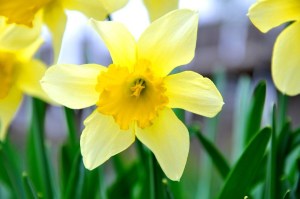
2. Daffodils

daffodilThis bright yellow flower is a welcome sight in the spring, brings hope of a warm season ahead. But if I cut the bulbs and serve them up to you as onions, they can cause vomiting, diarrhea, tremors, convulsions and cardiac arrhythmia.
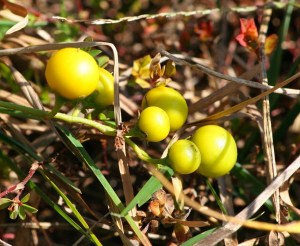


1. Carolina Horsenettle

This plant has little thorns under its leaves, and little flowers from June through August. Then, later, there will be little cherry-tomato like berries, yellow in color that come up horesenettlefrom a two foot tall stem. They contain a glycoalkaloid called solanine that affects the nervous system and irritates the mucous membranes, causing (in sufficient amounts) dilated pupils, weakness, depressed respiration, and eventual collapse and death.  These I will serve to you disguised as little tomatoes, probably served in a nice salad, my dearies.


***

So, who is brave enough to take a walk through my garden? I can show you more…

 ***

References

520, noahtodda. (2013, January 14). Acorns: A great resource. Retrieved September 16, 2016,

from https://survive-prepare.com/2013/01/14/acorns-a-great-resource/


Agriculture, D. of, & Resources, N. (2016). We’ve updated our site. Retrieved September 16,

2016, from http://mgsantaclara.ucanr.edu/site-update-notice/


Editors, the. (2016). How toxic is horse Nettle? Retrieved September 16, 2016, from

http://equusmagazine.com/article/how-toxic-is-this-weed


Standard, N. (2011). Bulbous buttercup (Ranunculus bulbosus) – nutrition house. Retrieved

September 16, 2016, from

http://www.livingnaturally.com/ns/DisplayMonograph.asp?StoreID=3D9D155236034A5

897378F7C5A033221&DocID=bottomline-bulbousbuttercup


Images from: Pixabay. (2016). Free image on Pixabay September 16, 2016, from

https://pixabay.com


Trump Unfriendings by Danusha V. Goska

danusha_goska

John was tall but straight-limbed thin and his baggy Catholic school uniform – blue slacks, white shirt, tie – hid no Darwinian strategy in or appetite for the survival of the fittest. The mob surrounding John moved according to an ancient choreography, as does a murmuration of starlings, but ugly. The other boys had never been trained in fighting, either. They were small-town, bottom-of-the-barrel, poor students in a school with no music, no art, no gym, no air conditioning. Just elaborately costumed nuns wielding long rulers on fifty-five baby boomers per room. But the attackers’ genes skilled them in skinning a fellow human. Smaller boys skipped up ahead to cut off John’s escape – just as wolves corner deer. Others, lackadaisical, languidly brought up the rear. With the same movements, they could have been the tail end of a church procession or a walk to the corner for cigarettes. A more definable scrum of first-stringers ringed John tightly. He’d never escape, even if he tried, but he wasn’t even trying. The alpha delivered direct blows. Over and over. Short, sharp punches, shot out erratically, timed by sadism’s metronome. Blows to John’s arm, his temple, his neck, his cheek. Beta males, not allowed the privilege of striking blows, squealed the worst words at John. Spat on him. With their thumbs and forefingers, pecked at the edges of his clothing. Distracting John, confusing him. Bash: another punch landed.

John, feebly, weirdly, laughed. John was miming, “Please like me. Please allow me to be just one of the guys.”

The playground was a square of macadam surrounded by a chain link fence. Through the fence we could see the gardens, clotheslines, and swing sets of our neighbors. Over the school roof rose the church spire.

I just attempted to google John. I want to know that he recovered and prospered and triumphed over what these monsters did to him. I couldn’t find him. His name really was “John” and his last name was almost as common.

God, people suck.

But there is a world where people are noble, attractive, rational, and kind. An onscreen world. To reach it, all I had to do was walk home from school and switch on our family’s one black-and-white TV. Billy Wilder, Frank Capra, John Ford, Preston Sturges, Victor Fleming, Sam Goldwyn and other filmmakers concocted wit, repartee, romance and adventure.

We all have to come to terms with the dark side in human nature. Me? I have felt best alone. I’m just not equipped. I don’t have the moves, the appetites, or the instincts to be a wolf in a pack. And so I watch a lot of movies. And I struggle with loneliness.

***

And along came the internet. Alleluia. I need never be lonely again.

I thought that the internet would mean, to human relations, what the industrial revolution meant to labor. I thought that much suffering had been caused by misunderstandings. The internet’s means of interaction, typed words on a screen, eliminated that problem. How could we misunderstand each other if our words were right there? Struggle for resources caused problems between people: “Get off my lawn.” But there were no material resources on the internet. Anyone could type in whatever anyone wanted. Finally, we were all equal. Differences in physical appearance aroused hatred and discrimination. Ugly women, black people, white people, people wearing expensive clothing or rags: all these tension-causing differences disappeared. Finally, we connected soul to soul.

I was so naïve.

***

Over twenty years ago I was part of a pioneering internet discussion group. Finally I could write and actually be read. Finally my ugliness and poverty didn’t matter. I could connect with nerds like myself living hundreds or thousands of miles away. Charlie in LA loved films and literature as much as I. We went on for weeks about Brief Encounter.

Humans find the snake under the apple tree no matter what Eden they inhabit.

One day, Larry called Anne fat. Anne asked her allies to denounce Larry. Within a day, there were thousands of posts attacking Larry. This was a virtual feeding frenzy, a lynch mob, a show trial. Bystanders drafted alliances as ironclad as those dominoes that fell into the shape of the First World War – “You are with the Hapsburgs and I am with the Romanovs so I must burn your fields!” Posts meant to be about movies or politics or opera contained hidden references only combatants could decipher that settled this or that score.

I wanted to talk about opera. I wanted to talk about film. I wanted to talk about the history of the Albigensian Crusade. That users hijacked these conversations to settle scores was an abomination to me. A frequently repeated truism never made more sense: great conversations focus on ideas. Average conversations focus on events. Small conversations focus on people.

There were other problems in paradise. I realized that the internet, with its distance communication, was inviting me to commit a great sin: to dehumanize others.

I recognized that I had to practice discipline: I had to constantly remind myself that there was a human at the receiving end of my words. I made it my practice to call people by name, to look at their headshot. To consider how the person would feel if I said this or that to them in person.

The internet grabbed my hand and lured me into the cave of narcissism. I had to stop my ears with wax and smack the siren’s hand away. I committed to focusing on other people’s posts, not just my own.

I looked at photographs of other people’s kids. I care less about few things than photographs of other people’s kids. I don’t have kids and feel some sadness about that (and some relief). It’s not easy for me to look at other people’s kids, especially the adult children of people I went to high school with. Not having had kids, I experience passing time differently. I feel that *I* am the adult, in the prime of life. Other people’s kids tell me I am not, that I am on my way out, and I have let life pass me by.

Looking at photos of other people’s kids is painful but I do it because I want to give back. I do it not because these kids are important to me; they are not. The person posting the photo is important to me. I do it for that person.

But the internet seemed to tear us further away from each other, in inscrutable ways we could not anticipate, name, or penetrate. The intimacy we experienced when typing into and reading content from those little boxes rarely extended beyond those little boxes.

I know Belle better than I know most of my relatives. Belle’s posts are short-story length; she has produced them without pause for over a decade. Her output rivals Charles Dickens. Her topic: her own life. She gave us virtual walking tours of her childhood home. We learned that she was not pretty, overweight, and nerdy. She married an abusive drunk. Divorced him. Yearned for a child. Later in life – and nothing is as rewarding to the reader as late-arriving joy – Belle, through the internet, found Mr. Right, a man as nerdy as she. Marriage. Pregnancy. We clapped our hands! Miscarriage. A devastating medical diagnosis. Abandonment. Belle alone again. We wept.

The strange thing is, after years of reading and responding, with all of my heart, to Belle, I met her. And she treated me as if I were a stranger. Further, when I took a break from our shared internet environment, she and I had no contact at all. No phone calls. Nothing. But when I showed up again on Belle’s internet stage, her presence was a like firehose: “Here I am! Receive me!” She, again, responded to my posts, as if we were best friends forever. She, weirdly, would type things like, “I wish I could see you.” Thing is, she had seen me. And when we were in the same room, she was distant.

That’s not intimacy. I’m not really sure what it is. I don’t think we have yet developed the word for that internet-dependent phenomenon.

I couldn’t take the politics in this internet environment. I feared that something unhealthy and invasive was distorting my spirit. I left. Wary, I didn’t join any other internet groups till Facebook, a few years ago.

***

Being a writer is like being the girl with big boobs. Men want access to the boobs. Many don’t care about the woman behind the boobs.

Sometimes people read something I have written and they feel that my words express what they themselves feel but cannot articulate. They confuse that sense of appreciating a piece of writing with love. They send me a message saying that they love me, but if they had more self-awareness what they would say is, “I love what you wrote.”

I do receive “I love what you wrote” notes from sophisticated readers. These folks address me as “Dr. Goska” and voice their recognition that we don’t know each other and never will. They request no further contact.

The people who say, “I love you” in response to my writing make unspoken demands on me. They want me to continue to voice their unarticulated thoughts. If they read, and liked, something by me that reflects a conservative point of view, they want me to continue to voice, exclusively, a conservative point of view. If I say something that they interpret as liberal, they feel betrayed and they send me hate mail, excoriating me as a “crazy” “bitch.” Always those words, spelled out or insinuated. I am a woman. I speak. I said something they don’t like. I am crazy. I am a bitch. This has happened to me more times than I can count.

No matter how many times a woman is used for her boobs, she gets hurt. No matter how many times a reader says he or she “loves” me because they appreciated something I wrote, and then turns on me because I am not what they wanted me to be – their puppet and mouthpiece – it reaffirms for me my long held conclusion that people suck, and that I don’t have the skills to triumph at that game, and that that which is good in people is as hard to access as any pearl of great price.

***

Which brings me to Dusty, Kristie, Lott, Don, Marty, Zale, Bill and Edna – some of the dozens of Facebook friends who unfriended me because I said critical things about Donald Trump’s 2016 presidential campaign.

Kristie is an upper middle class professional. Like me, she tended to post early in the morning, so I always saw her posts first. I valued her posts because in them I encountered white supremacy such as I had never seen in real life – in fact I didn’t know it existed to that degree in real life. Kristie’s friends, upper middle class professionals like herself, posted images of black people as monkeys; they threw around the n-word as if it were the canned olives in their iceberg lettuce. My anthropological curiosity inspired me to read all of Kristie’s posts.

I made my first anti-Trump comments over a year ago. After I did so, Kristie, without informing me, unfriended me. Given the abundance, the shock value, and the early hour of her posts, I noticed the unfriending immediately. My reaction: “Well, I have one Facebook friend who gives every sign of being a white supremacist and she supports Donald Trump so much that she feels compelled to unfriend someone she never talks to and who never talks to her. Duly noted.”

Zale’s departure was harder to take. The long, slow bleed of former Trump critics crossing over to supporting Trump has been unnerving. Even Senator Ted Cruz took this walk of shame. During the Republican primaries, when they were rivals, Trump insinuated that Cruz’s father played a role in the JFK assassination. Trump called Cruz’s wife ugly and called Cruz “lying Ted.” In a breathtaking move, Cruz stood up to Trump at the July, 2016 Republican National Convention. And then, in September, Cruz caved and endorsed Trump.

Watching former Trump critics succumb to Trump reminded me of a superbly orchestrated scene from the 1956, Cold-War era science fiction classic, Invasion of the Body Snatchers. Those who have surrendered to the selfhood-erasing space pods try to convince two holdouts to give up their individuality and join the collective.

Facebook friend Zale had been right there with me on the frontlines, trying to convince Republican primary voters that Trump was, as Zale passionately argued, the menace the Founding Fathers envisioned as the potential destroyer of the Republic. In more recent days, Zale has been zealously pronouncing his own vote for Trump and the unspeakable possibility of a Hillary Clinton presidency. Zale, without telling me, unfriended me.

I had done a significant favor for Bill. I advanced his career and put money in his pocket. After I made clear that I would never vote Trump, Bill unfriended me.

Dusty and I had exchanged thousands of public and private messages. There was laughing, crying, hugging, spatting, over everything from Andrew Jackson and the Trail of Tears to comparisons of Chet Baker and Miles Davis. I am phone-phobic but when Dusty dialed my little-used number, I picked up, and did my best to entertain.

I feel I know Dusty’s father, who, like my dad, had spent time in a Catholic institution as a boy. I knew of his war-bride mother, and his brother who, like my brothers, had died young and tragically. I did not read these posts because Dusty’s family members were important to me; they are not. I read them because Dusty was important to me.

One night I logged on and found several lengthy posts by Dusty raging against me for my anti-Trump stance. He kept saying things like “You are supposed to be an ‘intelligent’ woman” With “intelligent” in scare quotes. He called me a liar. When I tried to reply, I found that he had not only unfriended me, he had blocked me.

Lott, Edna, Marty and Don had used the “l” word with me. I saved those posts: “I love you Danusha.” Lott called me his mentor – I had helped with his writing. My anti-Trump stance earned this from Lott immediately before he unfriended and blocked me: “You eat shit as if it were chocolate pudding.”

Marty’s photos of elegant dinners and travel by private boat informed me that the internet had allowed me contact with someone with whom I would never, otherwise, rub elbows. My writings critical of Islam pleased Marty. He cozied up to me. “May I call you Dannie?” I have a foreign name; I let people call me whatever approximation of it that is the least intimidating to them. Marty told me I was “smart and on the ball … just too funny.” He said – I’ve still got the post – “I love you.” After his Trump-related unfriending, I saw Marty say to Melinda, one who, like him, is anti-Hillary, “May I call you Melly?”

Edna sent me multiple private messages telling me to leave Facebook altogether, pray for guidance, and stop “bashing Trump.” If I did not, she promised me a lifetime of loneliness.

They had all praised my verbal skills when I was expressing thoughts that reflected their own. When I said something that they disagreed with – that I would not vote for Trump – my verbal skills became the very thing they hated most about me.

***

You are alone in a room behind the keyboard. You are anonymous behind a pseudonym. You will never encounter those at whom your words are directed. You conclude that you have entered a world beyond morality, because it is beyond any consequence you will ever feel.

So you bully a teenager till she kills herself. Or you immerse yourself in porn. Or you post death threats.

The nuns used to tell us that we should leave room for the Holy Spirit between ourselves and our partners when we danced. I’m never alone in a room.

I want to use old-fashioned words to talk about Dusty and Marty, Edna, Don and Lott. Words that carried great weight a century ago, before rapid transportation could remove you from the consequences of your actions. This is what you are: insincere, inconstant, disloyal, fickle, traitors. These are the kind of expired crimes our ancestors fought duels over.

You said you “loved” me. You lied. You have no idea who I am. You think a writer is a Trump. Someone who calculates how to flatter the gullible and market to fear. In fact a writer is someone so hungry for truth she will risk everything to get at it, and to express it. That, you could not love. That you labeled “crazy” and “bitch.”

Oh, and Edna. The older, Midwestern woman who had previously seemed so maternal. You condemned me to a lifetime of loneliness for speaking my mind about Trump. Edna, I’m not lonely because Trump supporters like you are no longer in my life. I’m lonely because so many people are like you. I’m lonely for a different kind of person – someone who values truth.

***

Billy Wilder’s Sabrina, Love in the Afternoon, and The Fortune Cookie let light into my rough childhood. Wilder’s Polish-Jewish mother, stepfather and grandmother were all murdered during the Holocaust. Wilder penned the script for the frothy 1941 romantic comedy Ball of Fire the same year that Nazi Hans Frank said, “I ask nothing of the Jews except that they should disappear.”

Frank Capra, director of It Happened One Night and Mr Deeds Goes to Town, struggled with depression. Watch his films often enough and you can’t help but notice how many characters attempt suicide.

The movies that gave me hope also taught me, even if only through osmosis, that life, as Louis Adamic said, is a process of “licking honey off a thorn.”

Honey: I have two Facebook friends, Sandy and Susan, with whom I agree on nothing. I am a devout Catholic; Sandy mocks my faith. Susan – I forget the word for her religion but it involves nature and folklore. We fight like cats and dogs. They have never unfriended me.

I had hoped that words, visible onscreen, would eliminate misunderstanding; that the screen itself would break down barriers. I just took a break from writing this essay and saw a Facebook message. Lyle had posted something on my wall and I had not yet responded. He was convinced that his post angered me. I have yet to read it. I had said nothing and that nothing was misunderstood.

I scroll past posts alleging that anyone who votes for Hillary Clinton – as I plan to do – is an anti-American slug.

I could unfriend. I could unfollow. I could erase people I once accepted as friends. I don’t. My reasons for not doing so are rooted in my Christianity and the Middle Ages.

Benedictine monks and nuns vow to stability. In addition to being cloistered in Spartan conditions, they inhabit the same space with the same humans for their entire careers. How else to learn the Christian skills of forgiveness, patience, and real love, except from each other’s foibles and failings? Not by erasing. Not by running. But by being next to someone who pisses the hell out of you.

If the Trump supporters posting misogynist hate-Hillary memes and inflammatory conspiracy theories have a moment of awareness, I want to be there when it happens.

As I hope they will be there for me.

***

Danusha V. Goska‘s essay “Political Paralysis” appears in the book “The Impossible Will Take a Little While.” Her memoir “Save Send Delete” tells the true story of her debate about God, and relationship, with a prominent atheist. Julie Davis named “Save Send Delete” one of the ten best books of the year. Goska outlines her reasons for not voting for Donald Trump here