John Macker: “Last Riff for Chet”


Last Riff for Chet

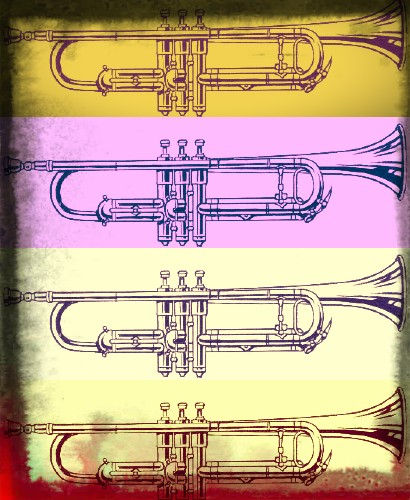
Chet Baker used to bend over
his horn like the saddest, most suffering flower
speak into it like an echo does in dream
coaxing faded blossoms from the air
gathering them in breath to the place
on earth he felt closest to
trembling with shadows
then mutate their fragrances into a
civilization of invisible words as if
every spring, trigger-fingered
April’s bent their music to the ground
coaxing forth rose after rose
their powder-burned faces
bold, fragrant, strained, maverick
delivering echo after echo.

Chet sounded the blues,
riffed circles around the discordant rainbows
of romance in the dark until 
they drifted so close
you could pluck them like strings:
standing there streetlamp insouciant 
smoking the heroin gun of Paris
blowing interstellar lullabies
working his own myth into the 
hard ground
while I’m bent over this ancient
jukebox in the Lariat Bar
hit parade reduced to a row of square
buttons I punch into entropy.

At last, I find Chet as he empties a 
chamber of pure blue language
onto a white tablecloth
opens the window to each new bloom
with his lips
as he always has,
saying something pure to the earth
knowing no surrender is a cliché.
He had chiseled features.  
There’s a plaque for him in Amsterdam
outside the Hotel
Prins Hendrik at the last spot
he soared through life
on his way  
to the ground.


About the Author: John Macker’s latest books are Atlas of Wolves (Stubborn Mule Press, 2019) and The Blues Drink Your Dreams Away: Selected Poems 1983-2018 (Stubborn Mule Press, 2018 and a finalist for a New Mexico/Arizona Book Award.) Macker has lived in Northern New Mexico for 24 years.
Wayne F. Burke: “Ants”

9260118705_91a171d0dc_3k
.
Ants
.
no one to play with or
talk to, nothing
I know to do, a hot summer afternoon
I wandered into the Larson’s yard next door
sat on their walkway and
watched ants come up out the
cracks and ant hills
a flood of them spreading
across the plain of the
walk, and then
other ants, with wings
flew down from the blue sky
in squadrons,
a blitzkrieg attack–
a mighty struggle began,
ferocious as Hastings or
Waterloo–
the Queen of the wingless crew
rolled over her winged-foe
like a tank
the dead and dismembered piled
as the battle raged and
the afternoon slid into shadow:
I did not hear
my grandmother
the first time she called
me
in to supper.
.
.
About the Author: Wayne F. Burke‘s poetry has been widely published online and in print. He is the author of six full-length poetry collections–most recently DIFLUCAN (BareBack Press, 2019). He lives in Vermont (USA)
.
.
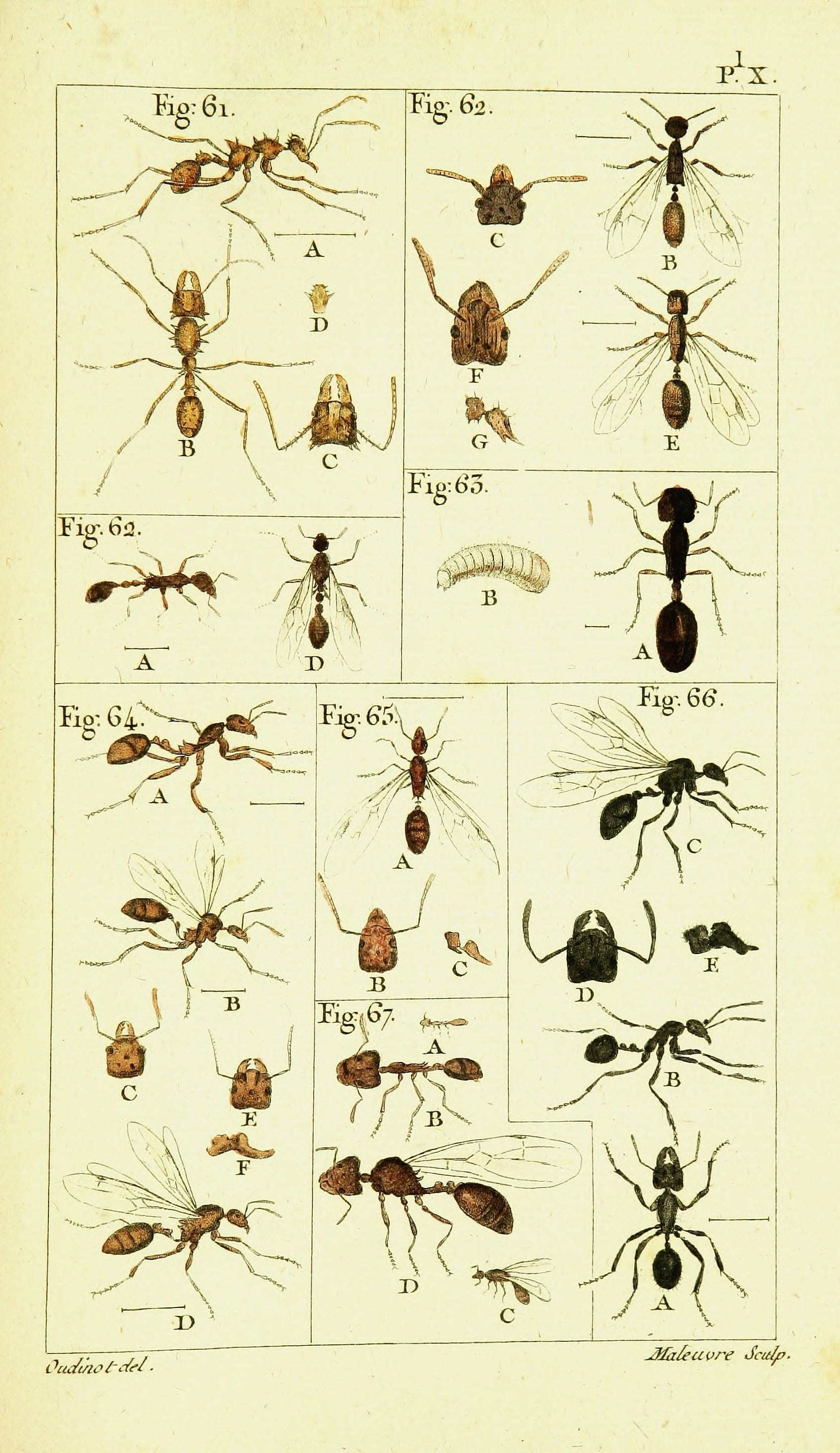
Image Credit: Image from “Histoire naturelle des fourmis, et recueil de mémoires et d’observations sur les abeilles, les araignées, les faucheurs, et autres insectes” Courtesy of the Biodiversity Heritage Library

Mike Acker: “Ill-Defined”

06994001
.
.
Ill-Defined
.
Alive,
in a world of thoughtless matter?
Am I an idea, encased within
a form,
a body, housing thought; or
a breeze of notions,
insecure, uncertain
of its direction;
or but a spark
that spans a lifetime?
Maybe I am the inanimate,
resurrected and, now, lost?
Does the wind not speak to me,
as though to a kindred spirit?
Is the river’s motion not its consciousness,
not unlike mine?
And when I look
into that mirror of myself
I see the ill-defined.
.
.

About the AuthorMike Acker lives in Vancouver, British Columbia. He has lived in various parts of the world; his early education was in German and French. While living in California, he worked as a professional translator. Mike enjoys writing short poetry, especially with the intent of exploring the possibilities latent in a single image.

.
More By Mike Acker:
.
.
Image Credit: André Adolphe-Eugène Disdéri “Le Joueur d’Orgue (The Organ Grinder)”(1853) Digital image courtesy of the Getty’s Open Content Program.

Larry D. Thacker “In the Days of Drones”


In the Days of Drones    

            “And it came to pass that each of them 
            Were given their unique mark, a familiar, 
             A spirit drone following on each action 
            Made by them, as one with their thoughts.”

There is no satisfactory term yet
for the size of these personal drones,
not nano-sized, micro nor mini.

They are not the size of the tiniest  
domesticated animals, teacup Yorkies, 
for instance, but indeed visible. 
Let us say, somewhere between 
a large dragonfly and a fit swamp frog. 
These are, of course, non-technical terms. 

Some hybridized ho-hum miracle 
of organic-electronic-philosophical flesh,
most resemble agile, fragile insects. 
They are very near indestructible. 
They crawl. They fly. They hover and hide.

They do not belong to us. You belong
to them essentially, assigned 
by the Office on Personal Safety. 

It is not a choice. You turn fifteen, 
you get a monitor drone. A third eye 
some call them. There is no fanfare, no 
happy party, no article in the local news 
crawl, no culturally significant ritual 
with drums, dancing. 

                                      No marching 
across a stage, no bowing, transferring 
of drones from one hand to another, 
no mutilating of body parts, no gifts,
handshakes or hugs from an official,  
no new names imagined by a shaman,
no vision quest, sweat lodge, no songs, 
cards with cash. No cake. No ice cream. 

You just wake up from a night’s sleep
and your drone is with you, in sleep mode
on your chest, having already finished 
merging with your brain however it must.   

Who, or what, exists on the other side 
of these creatures, monitoring, recording, 
watching, listening, or not, or whatever, 
remains a great mystery to most of society. 

But there are rumors. Always rumors. 


About the Author: Larry D. Thacker’s poetry is in over 150 publications including SpillwayStill: The JournalValparaiso Poetry ReviewPoetry South, The Southern Poetry Anthology, The American Journal of Poetry, and Illuminations Literary Magazine. His books include three full poetry collections, Drifting in AweGrave Robber Confessional, and Feasts of Evasion, two chapbooks, Voice Hunting and Memory Train, as well as the folk history, Mountain Mysteries: The Mystic Traditions of Appalachia. His fourth full poetry collection, Gateless Menagerie, is forthcoming from Unsolicited Press. His MFA in poetry and fiction is earned from West Virginia Wesleyan College. Visit his website at: www.larrydthacker.com


Image Credit: The Library of Congress

Alex Z. Salinas: “Chicano Poets” and party snacks


“Chicano Poets” and party snacks

Not gonna lie, 
After I read “Chicano Poet”
On the cover of Reyes Cárdenas’ book of poems,
I cringed,
As if his last name weren’t enough 

But I’m lying, 
It was actually the painting of a 
Half-naked Latina that elicited my reaction 

As if the point of Reyes’ being a
“Chicano Poet” was to point out 
The doubly poignant swells of a brown woman

So, if I understand him correctly,
It’s probably that “Chicano Poets” 
Just wanna have fun

And for Christ sake, 
After Chris Columbus,
Cab de Vaca
And all them, why not?

When bastard runs in 
The blood, 
Bust out the Chex Mix
Cuz it’s gonna be a rowdy party 

And “Chicano Poets” should know,
At rowdy parties
It’s always a bright idea 
To have salty, corn-based snacks 
(that almost sound like Chex Mex) 
Available to munch on.


About the Author: Alex Z. Salinas lives in San Antonio, Texas. He serves as poetry editor of the San Antonio Review. His debut feature-length book of poems, Warbles, was released by Hekate Publishing in fall 2019.


Image Credit: Public Domain from Wikipedia

Z.D. Dicks “Sleepless”


Sleepless

In late November 
our children baste
in the Forest of Dean
and we doze in lounge 

The raucous screen 
storms half shuttered
as commentators clatter
in sleep filled ears 

They cuddle soft toys
while we recline
separate on shared sofa
swaddled in dry air

I still feel the burn 
in backs of hands 
cracking gloveless skin
after leaving a cuddle 

It’s only one night
I remind us, face forward
They’ll be back tomorrow 
and I think of roots 

Thousands of trees
stirring as stones 
boar and deer masked 
the moon banished

And I, a sharp lump 
splintered in apathy
tell myself, 
Be a rock, that life 
as the blasting Severn 
will smooth your edges


About the Author: Z. D. Dicks is the author of Malcontent (Black Eye Publishing) described as ‘Uncompromising, sometimes controversial, but always entertaining’ by Clive Oseman and ‘Evocative, atmospheric, breathing new life into the everyday’ by Nicola Harrison. Z. Dicks is the CEO of Gloucestershire Poetry Society and Gloucester Poetry Festival. His work has been accepted by Ink, Sweat and Tears, Three Drops from a Cauldron and Fresh Air Poetry. He frequently reads at poetry events throughout the UK.


More By Z.D. Dicks:

Downpour


Image Credit: Eugène Atget “Sapin, Trianon (Pine Tree Trunks at the Trianon)” (1910) Digital image courtesy of the Getty’s Open Content Program.

Caroliena Cabada: “True Story”


True Story

The river once flooded the K through 8
school in my hometown. When the waters took
weeks to recede, they held classes in the
town’s only peach-colored outlet mall. Lunch
in the food court. Economics in a
house of commerce. Recess playing four-square
in the parking spaces painted white on
greying blacktop, dodging cars. But it won’t
become a storied place. The town let the
mall fall apart, torn down for a Super
Wal-Mart where I once bought crusty bread and
salad greens with my dad on a health kick
and this was the cheapest produce in town.
I attended the new elementary
and middle built out of the old school’s kind
of red brick, Frank Lloyd Wright Prairie Style (it’s
the Midwest) built further from the river
bed. In the sun-soaked nook of the middle
school library I read a book written
about those kids in that mall during that
flood, going to school. I wonder: Next time
the waters rise, what incongruous place
will house our learning? The second amendment
in a Bass Pro Shop, hunting rifles on
the walls. Gladiators in a professional
football stadium after a hurricane.
Science experiments in a farm-to-table
restaurant. A while back, people just called
that home economics.


About the Author: Caroliena Cabada is an MFA candidate for Creative Writing and Environment at Iowa State University. She serves as co-managing editor of Flyway: Journal of Writing and Environment. Her poetry appears in Eunoia ReviewThe Orchards Poetry Journal, and Lyrical Iowa


Image Credit: Carl Mydans “Ohio River in flood, Louisville, Kentucky” (1936) The Library of Congress

Jeff Hardin: “A Namelessness of Starlings”


A NAMELESSNESS OF STARLINGS

Down hollows I go walking, nine years old,
as nameless as starlings on far-away fence posts.
To what larger world do I feel myself drawn?

I thirst after ripples dying out on an inland pond.
I dream a circumference of wandering along
until an answer blooms forth from the call of an owl.

Maybe already I have disappeared, a creek stone
no morning light falls upon. Sycamore leaves
drift and touch down and slide the sky along.

Syllables, too, can lengthen how we listen 
to an afternoon of wind through sage grass
leaning toward so many moments still unknown.

A sapling rises through the dawn come down
to find another fallen cedar, its privacy just one 
more face I’m happy to have mistaken for my own.


About the Author: Jeff Hardin is the author of six collections of poetry: Fall Sanctuary (Nicholas Roerich Prize); Notes for a Praise Book (Jacar Press Book Award); Restoring the Narrative (Donald Justice Prize); Small RevolutionNo Other Kind of World (X. J. Kennedy Prize), and A Clearing Space in the Middle of BeingThe New Republic, The Hudson Review, The Southern Review, Southwest Review, North American Review, The Gettysburg Review, Poetry Northwest, Hotel Amerika, and Southern Poetry Review have published his poems. He teaches at Columbia State Community College in Columbia, TN.


Image Credit: James W. Rosenthal “Close up view across stream to fallen tree – Middle Bridge American Sycamore, Near former site of the historic middle bridge, U.S. Route 34, Sharpsburg, Washington County, MD” (2006) The Library of Congress

Daniel Romo: “The Main Event”


The Main Event

The man standing behind me in Target tells his buddy 
his workplace is creating a fight club.
And I wonder if hands will be thrown in the name of
middle management and manhood 
or if the employees will simply be arguing back and forth,
pointing fingers like political parties stressing 
just how wrong 
         the other one is. 

I recently read about a man dying immediately after
entering a taco-eating contest.
The coroner officially listed choking as the cause of death,
but what are the odds the autopsy would also show 
ego and competition are 
kindred spirits?

           I understand the dynamics of blowing off steam.
           I’ve studied how the mouth forms a shape just small enough 
           to free the air from the toxic body,
           but large enough to proclaim and pronounce 
                                                                              glory.

I struggle with how much of my personal life 
to share in a poem.
Should I say how the fissures from my own darkness 
spread until I was ready to stop lamenting 
the curvature of imperfect lines, 
finally ready to plug the cracks 
and resurrect the foundation?
Or should I just say,
    Earthquakes suck, man.

Is there a Richter scale that ranges from self-pity to rehabilitation?
How well can you withstand 
what is eating you alive?
It’s often a case of self vs. selfless, 
the poet vs. the person,
picking your punches 
as if the next uppercut to the gut
           could end it all. 


About the Author: Daniel Romo is the author of Apologies in Reverse (FutureCycle Press 2019), When Kerosene’s Involved (Mojave River Press, 2014), and Romancing Gravity (Silver Birch Press, 2013). His poetry can be found in The Los Angeles Review, PANK, Barrelhouse, and elsewhere. He has an M.F.A. in Creative Writing from Queens University of Charlotte, and he is an Associate Poetry Editor at Backbone Press. He lives and teaches in Long Beach, CA

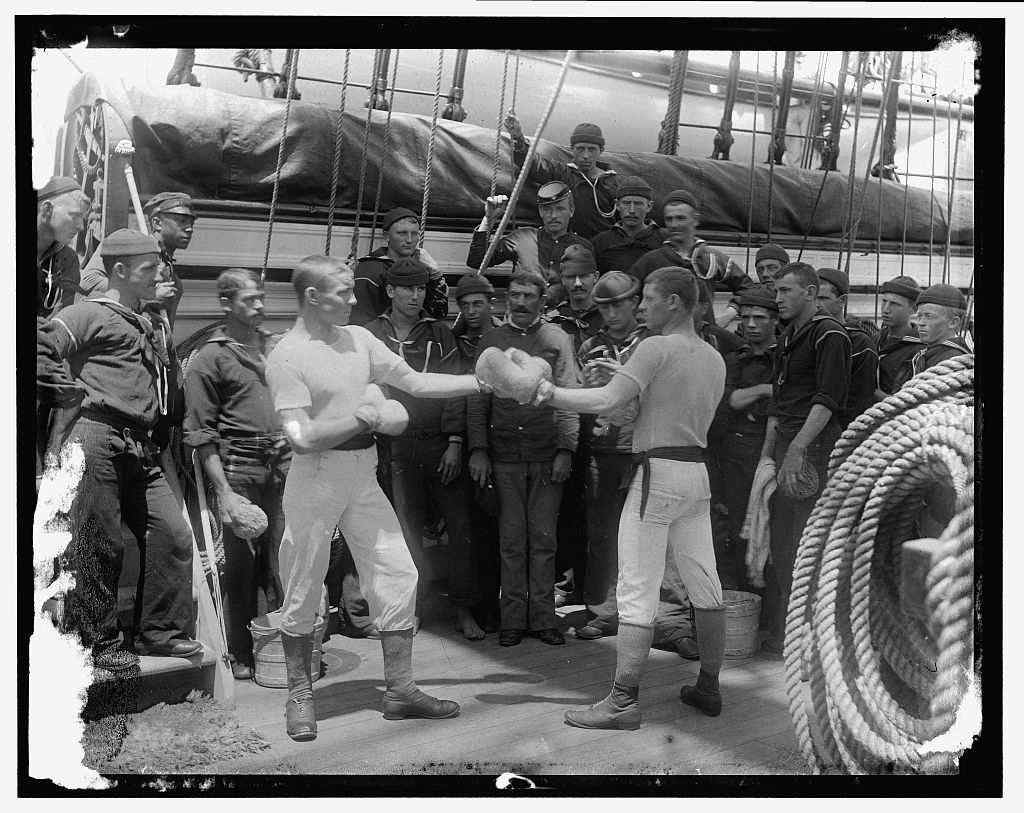
Image Credit: “A Boxing Match” (1890) The Library of Congress

Jason Baldinger: “it was a golden time”


it was a golden time

been on the road
long enough now
to feel like three
mummified frogs
dried in a tejas mudpuddle

a woman in a wal-mart
parking lot shouts
I don’t believe you
should leave a baby
in a car, even if its running

I’m gonna steal what I need
some scoundrel hunter
gatherer from ancient time

there’s a dead bear in an irrigation
ditch, it left me with the strange
feeling I’ve been here before

the windshield grows
a mustache, I see the world
clearer in my dreams
problem is, I never
remember my dreams


About the Author: Jason Baldinger is a poet from Pittsburgh, Pennsylvania.  He was recently a Writer in Residence at Osage Arts Community, and is founder and co-director of The Bridge Series. He has multiple books available including the soon to be released The Better Angels of our Nature (Kung Fu Treachery) and the split books The Ugly Side of the Lake with John Dorsey (Night Ballet Press) as well as Little Fires Hiding with James Benger (Kung Fu Treachery Press). His work has been published widely in print journals and online. You can listen to him read his work on Bandcamp on lps by the bands Theremonster and The Gotobeds.


More by Jason Baldinger:

“I forgot the earth and heaven”

“When Cancer Come to Evansville, Indiana”

“blind into leaving”


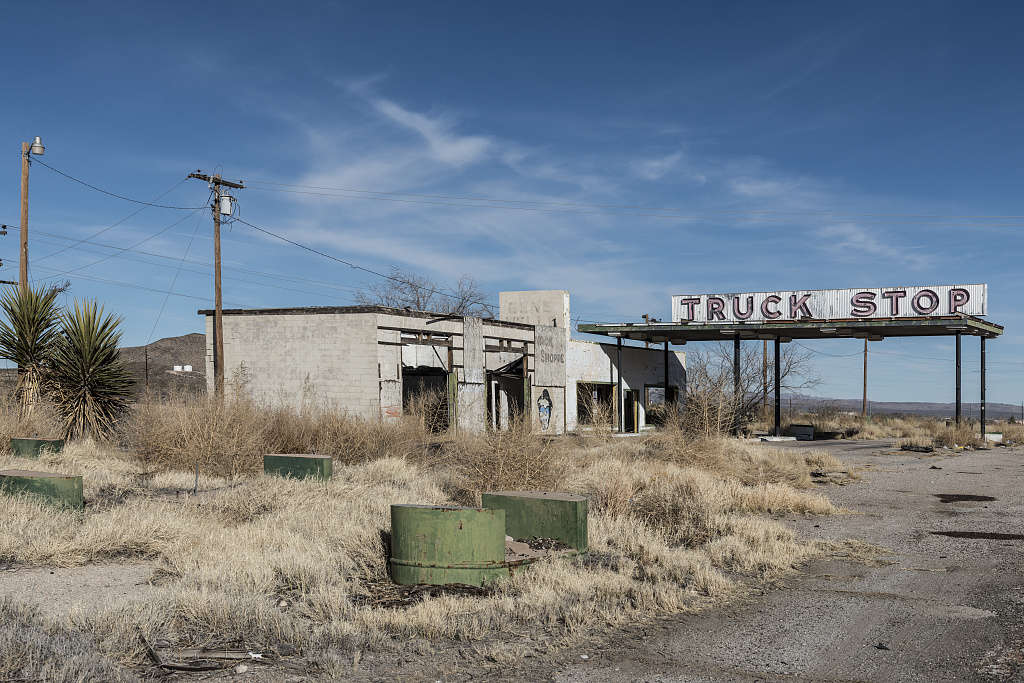
Photo Credit: Carol M. Highsmith “Deserted truck stop in Sierra Blanca, made a virtual ghost town when the interstate highway bypassed it in Hudspeth County, Texas” (2014) The Library of Congress