Loving the Cyborg and the Mushroom


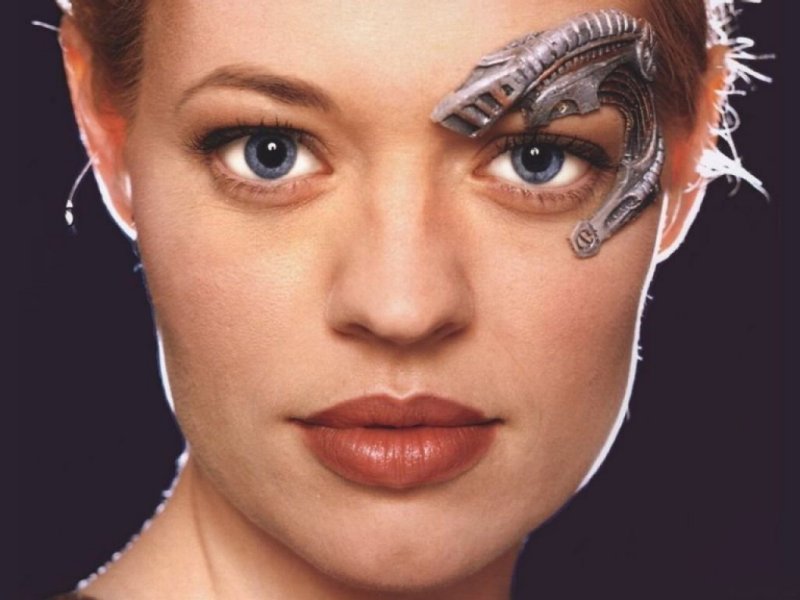
Two things:  Terence Mckenna’s insistence on the human desire to “shed the monkey body”  always scared me and then paradoxically  the cybernetically enhanced Borg of  Star Trek always seemed rather sexy.

Early one morning as I trawled fakecrack I found a friend’s post: an O’Reilly webcast by Amber Case entitled “Cyborg Anthropology: A Short Introduction”. Anthropology’s subject matter has leapt a paradigm since I sat in Joel Kahn’s class watching him smoke a million cigs as I tried to grasp his Marxist analysis of pre-capitalist states but I’ve never stopped being fascinated by the discipline’s theoretic overlay: the attempt to look, without ethnocentric bias, at human societies through a pseudo- philosophical/scientific lens, identifying social phemonena and describing cultural production protocols.  Nowadays cyborg anthropologists are looking at us human cyborgs, those of us (and that’s most of us) who are organisms, “to which exogenous components have been added for the purpose of adapting to new environments.”

As far back as 1941 at the inaugural Macy Conference, cultural theorists, including luminaries like Margaret Mead, discussed the potential impact of evolving technology on cultural reality.

Fast forward to 2010  where our cyborgian reality has developed to consume many of our conscious hours interacting through our exogenous devices, not just for work but also for play. Admittedly we are low-tech cyborgs, most of us are not permanently augmented by our technology- although  many smart phone users seem unwilling  to relinquish the close physical companionship of their hand-held devices. In 1985 in an eerie and precocious essay, “A Cyborg Manifesto,”  Donna Haraway wrote that as “hybrids of machine and organism” we were creatures of both fictive and lived social reality.

This rings very true in regard to online social networking  which is reaching endemic proportions in western society and let me make this quite clear — cyberspace connectivity is intrinsically different to our previous social pathways. Cyborg anthropologists theorize that online we create a “second self”, this is an identity generated in relation to others: if our body in virtual space is appealing to others they will approve and give our second self  “gravity”, for example a status update on Facebook which is “liked” by many increases gravity while being “de-friended” takes away from gravitational credibility. In cyberspace we sample ourselves and the bytes that we report are the ones which shape our identity. We consider our social networking to be useful for promoting ourselves and seek to appeal in our network, this means that we often make decisions not to articulate negative, contentious or questionable items which might also be described as personal truths.  Research from Intel suggests that current social networking protocols don’t often initiate successful new relationships but rather make those relationships  which already exist more visible. This visibility can become problematic, being peer-judged for the opinions of one’s  ‘second self’ might also impact your social reality in the offline world. I feel lucky that I’ve made one new friend through social networking,  I saw his comments on a mutual friend’s page & sent a request to be friended,  this positively counters my overwhelming personal trend of  getting turned off by network personas . Online our second selves are immature and tendencies toward discrimination, passive-aggressiveness and narcissism are often inadvertently exposed or created through sloppy memes, either way the outcome is as obnoxious  as halitosis in real-time.

I hear people offering up the platitude, “Facebook isn’t real” but I utterly disagree, it is hyperreal and what goes down on social networks can have grave implications: fifteen year old Phoebe Prince  killed herself last year after being harassed and abused on Facebook. Personally I feel that my second self and I are still very much conjoined and I don’t like exposure to haters on any platform. When I start to feel uncomfortable with an online friend I “hide” them and try and win a little distance back, after all, we have never been in such a high order of inter-connectivity as a species and while  most people are attractive at some distance, magnified and unedited they often become less appealing.  This kind of social interaction seems distorting and dangerous, the time-honored offline social etiquette which formerly mediated our social relationships is being thrown aside and emerging protocols are not yet beta-tested. Our lives online exist in an ocean of interactive sensations: ideas about time and space (we think nothing  of having multiple simultaneous conversations in different time zones), production of value (ever felt overwhelmed by opportunities to add more 99 cent apps?) social punctuation (like texting in company) or ambient online intimacy (the heady sensation of the collective now).  Offline life is changed by our increased connectivity too, public space now becomes private space when you are chatting on your mobile and places themselves can become “non-places” if we don’t have enough meaning invested in the location.

Fellow cyborgs, are we having fun yet?

It seems that we are amused and often we are engrossed: my husband’s recent edict that our house will go offline at weekends was met with a teen cyborg mutiny. We will not give up our technologically enhanced state of being but we owe it to ourselves to work on understanding what it is that we are doing and what it is we really want to do.

Terence McKenna believed that our species is evolutionarily longing for the Other – we yearn for the unseen mystery of the universe and alien playmates in particular. Our loneliness is as vast as infinity, as Heidigger  described so poignantly, “cast into matter, alone in the universe.” Connecting with each other’s second selves  24/7  helps us to feel better, we hum along to Kraftwerk’s gorgeous Computer Love while we look to artificially extend our ability to reach out into space.

McKenna’s search went off at a tangent into inner space exploration,  a place both vilified and sidelined for the last two thousand years of western culture, designated as the eccentric preserve of religious mystics. As an ethno-botanist studying plant-based shamanism McKenna researched psilocybin and became acquainted with the Other, which he calls the voice of the Logos. Psychedelic mushroom spores like stropharia cubensis can survive the harsh conditions of outer space and thus McKenna thought that maybe they came to us from distant worlds. When humans interact with the mushroom, the Logos communicates with us, drawing back the veils of dimensionality and revealing other realities, this ecstatic experience is fearful and generally undertaken by shamen, wise ones who can deal with this huge unchartered territory.  The historical importance of psychedelics has not yet been acknowledged, McKenna’s theory of human evolution into language through psilocybin use in early societies is regarded as renegade by  most academics. Times are a changing though: breaking news in the mainstream media this week tells us medical research into the treatment of  depressed, anxious, post-traumatic and dying with psychedelics is yielding positive results.   Lucky for us that adventurous McKenna and the Logos had an open bandwidth and his awareness as a scientist and theorist has enabled him to communicate the ideas and perspectives of the Other to us timid creatures in our empirically restrained culture.

In 1987 McKenna spoke of an emerging zeitgeist of hyperspace- he knew that electronic culture would add a dimension that would reverberate through our culture at every level and he saw our 21st century hyperdimensional collectivity coming. When I read Gibson, Dick, Vonnegut and M. T. Anderson  I can imagine the endgame of humanity as we know it. McKenna considered that first Neolithic age, imbued with the psilocybin experience had provided us with the essential tools which brought us to this point, and for him the re-emergence of the mushroom in contemporary times was the second Neolithic Age, the Archaic Revival: our chance to look through the hyperdimensional lens again. This opportunity could slip away from us he warned if we become too enmeshed in a hypertechnological dominator scenario.

Anderson’s  Feed is a futuristic tale of teenage cyborg-humans who have internet implants embedded borg-style in their brains, their software updates them constantly on what to buy, where to get it and who has already got it. This hypertechnological wasteland is highly imaginable and ultimately terrifying especially to those of us who seek the interconnected flipside trajectory for  our species.

It’s just a brilliant psychedelic idea that we can look out and the Other can look in when we commune with psilocybin. The fact that psilocybin  is part of our intrinsic brain chemistry should help us  little techno-monkeys understand that the mushroom  experience is valid. The dimensional envelope is awesome but like our ancestors who would have feared the wormhole of space and time that the telephone represents we stand like Tolkien’s hobbits at the border of the Shire, total scaredy cats. It is frightening to imagine the potentialities of the universe and thats reassuring: we only truly fear the real.

Amber Case “Cyborg Anthropology: A Short Introduction” http://www.youtube.com/watch?v=rCvMWZePS8E

Donna Haraway “A Cyborg Manifesto: Science, Technology & Socialist Feminism in the Late Twentieth Century” Socialist Review, 1985

Marc Auge “Non-Places: Introduction to an Anthropology of Supermodernity” 1995

Terence McKenna ” The Archaic Revival” HarperSanFrancisco, 1991

M.T. Anderson “Feed” Candlewick Press, 2002

The Coming Crisis of Global Food: High Costs, High Fats, and the Age of Globesity

By Liam Hysjulien

I’d like to begin today’s essay by venturing forth into the not-so-distant future and mulling over this prediction:  by 2050, the global population could surpass 9 billion people.  As it currently stands, the world’s population is sitting at around 6.8 billion, with one sixth of those people going to sleep hungry every night.  So far in my research, I have mostly focused on national and local food issues—the Food Stamp Program (or SNAP, as it is now called), the history of the United States welfare system (yes, it still exists), and various anti-hunger and community food security movements and frameworks—but I’m now stepping outside my academic comfort zone to view the global landscape of hunger, food prices, and obesity.   One of my professors, a brilliant political economists and critic of both neo-liberalism and civil society, once remarked, and I’m paraphrasing, that there is no beast quite like the beast of poverty in the developing world.   And while I would never downplay the devastating effect of food insecurities and hunger in the US, it is almost unfathomable to wrap one’s mind around the reality of global hunger.  In an article in last week’s New York Times, Shawn Baker, Regional Director for Africa of Helen Keller International, wrote “[in Niger] 2010 is actually worse than 2005, with recent surveys showing acute malnutrition rates of 17%” (Baker 2010).   Severe acute malnutrition (SAM) in children under five cannot be understood simply in terms of nightly hunger pangs, but a daily lack of nutrients so severe and prolonged that it results in physical stunting and increased susceptibility to preventable diseases.

Beginning in the 1960s with the uniquely titled “War on Hunger” agenda,  the US government decided that the only way to win the hearts and minds of various food crops in the developing world was to use a direct approach: A) massive amounts of pesticides; B) massive amounts of fertilizers; C) monocropping; D) importing genetically modified foods and seeds; E) repeat steps A through E; F) this step is on the horizon, but I’ll return to it  in next month’s article.   All political agenda aside—and I am positive, and hoping, that readers will hardily disagree with me—there is a compelling argument to be made for the necessary advantages that modern science and business offer in increasing global food production.  While I am a food purist at heart, I cannot, at least from the studies that I have read, believe that without some reliance—the degree of reliance being certainly debatable—on scientific (unlike McWilliams, I don’t see GMO and Roundup Ready seeds in this future) and industrial agricultural practices, we’ll be able to increase food production to the predicted 70% yield required to match population growth.  Again, I want to stress the importance of balance over what we have now—which is one of the most unbalanced, out-of-control systems ever created.  So instead of striking a harmonious cord between sustainable, no-till farming practices and modern logistical and scientific advancements, we have decided instead to be as reckless as possible with our global food supply and see where that takes us–for a current example see: half a billion eggs recalled for possible salmonella exposure.

So where has this reckless behavior taken us? I would posit that we are in all likelihood entering, or have always been in, a state of food plutocracy, by which the gap between average caloric intake for developed and developing nations is going to widen, while caloric intake –which had been rising for decades— will continue to remain stagnant and rates of hunger will begin to increase in many less economically developed countries.

The financial and food crisis beginning in 2007 is at the center of this increase in both global food prices and levels of hunger.  In a 2010 report by the United Nations Millennium Development Goal, the number of undernourished people between 2005-2007 rose to levels not seen since the early 1990s (Dhawan 2010).   It should come as no surprise that during this same period, “the international prices of wheat and maize (corn) tripled, and that of rice grew fivefold” (Braun 2008).  To put these numbers in real terms, the global price of rice in 2006 was $216.65 per ton and by 2008 that number had risen to $507.65 (FAO 2010).   As Paul Collier, the Director for the Center for the Study of African Economies at the University of Oxford, writes,

“The unambiguous losers when it comes to high food prices are the urban poor. Most of the developing world’s large cities are ports, and, barring government controls, the price of their food is set on the global market. Crowded in slums, the urban poor cannot grow their own food; they have no choice but to buy it” (Collier 2008: 68).

In the aftermath of these rapid increases in food prices, the food riots of 2007-2008 swept through the developing world, with Mexico, Haiti, and Egypt gaining the most international attention.  By the end of 2008 in Egypt, the price of food and beverages had risen by 27 percent (Salama 2008).

Where were the food riots in the United States?  As an estimated 200 millions people in the world starved, the American food plutocracy remained largely stable.  But why?  First, Americans spend on average ten percent of their income on food and of that merely seven percent of their income eating at home (Department of Labor 2010).  In many countries where people live on less than $1 per day, roughly one sixth of the world population, 50 to 60 percent of their income goes toward food (USAID 2010).  This is not to say that food prices didn’t fluctuate in the US.  As one fifth of the nation’s corn crops were funneled toward biofuel production, grocery prices in the United States increased by five percent during the summer of 2008 (Martin 2008).  As the US entered what is now known as the Great Recession, increase in costs of food were not equally distributed throughout the market.  As eggs went up by 25 percent and milk by 17 percent (Stevenson 2008), the price of junk food—high sugar, high fat foods with little nutritional value—decreased by 1.8 percent (Parker-Pope 2008).  Instead of food riots in the US, consumers were faced with having the to decide between buying cheaper, low-nutritional junk food or buying less, and increasingly more expensive, fruits and vegetables. Not surprisingly, we see during this time rates of obesity increase in 37 states (Washington Post 2008).   But food plutocracy is not simply about what types of food we consume, but the sheer number of calories that Americans intake on a daily basis.  This global bifurcation between daily caloric intakes is at the heart of the future of food debate.

In looking at 2004-2006 data from the Food and Agriculture Organizations (FAO), Americans, on average, consume 3840 calories per day (FAO 2010).  To place this in the global context: Mozambique – 2090; Kenya – 2060; Sudan – 2300 (FAO 2010). While none of these numbers are startlingly low, it is important to remember that the data was collected two years before the beginning of the global economic recession—when food prices were relativity low and stable.

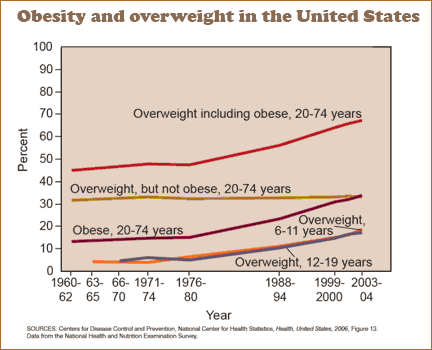
It is also important to note that Americans weren’t always like this.  If you look at any graph on obesity rates in the US, starting around the early 1980s—hello, Reagan—is when that line begins to slowly move upwards.  Beginning in the 1970s, Americans consumption of caloric sweeteners increased on average from 123.7 pounds to 152.4 pounds in 2000. Not only do we have a serious sweet tooth, but in the same year, we also consumed on average 74.5 pounds of total added fats and oil as opposed to 53.4 in the 1970s.  We like our fat and oils too.

What is food plutocracy going to look like by 2050?  As scientist predict that global food production will need to become more mechanized, industrialized and genetically modified (the MIG), we are already beginning to see how drastic swings in food prices are causing ripples of misery and hunger throughout the developing world.   In this new age of population growth and food speculation, we could begin to see the world increasingly more divided between the globally obese and the marginally food insecure.   A couple month ago, PBS commentator Ray Suarez, in a report on the increasing rate of obesity in China, wrote “[in China] portion sizes are getting bigger, Western-style food is widely available in urban areas, and people are eating out more often”(Suarez 2010).  In looking at the FAO’s diet composition numbers, daily percentage of fat consumption in China has increased from 19.5 percent in 1990 to 28.2 percent in 28.2 in 2006.  Additionally, fat consumption per individual in China has increased from 57.9 grams per day to 93.6 grams per day in 2006.  As rates of severe acute malnutrition continue to rise in many African countries, the rest of the developing world seems to be following the United States down the path of a high sugar, high fat, and high empty calorie lifestyle.  Next month, I will continue this theme on global food inequalities, and tackle the rising, and largely under reported, trend of “land grabbing” in Africa. 

References

Baker, Shawn. 2010. “A Famine Looms In Niger”. New York Times. August 9.

Collier, Paul. 2008. “The Politics of Hunger: How Illusion and Greed Fan the Food Crisis.” Foreign Affairs 87(6):67-80.

Dhawan, Himanshi. 2010. “Hunger back to 1990 levels in South Asia: Un report.” The Times of India. June 23.

FAO.2010. World Food Situation.

—. 2010. International Commodity Prices.

Martin, Andrew. 2008. “Biofuels Getting Blame for High Food Prices.” New York Times. April 15.

Parker-Pope, Tara. 2008. “Money is Tight, and Junk Food Beckons.” New York Times. November 3.

Suarez, Ray. 2010. “Reporter’s Notebook: Obesity on the Rise in China.” PBS Newshour. June 1.

Salama, Vivian. 2008. UAE in Farm Talks with Egypt for Food Supply.” The National. July 7.

Stevenson, Kim. 2008. “Some Good News on Food Prices.” New York Times. April 2.

USAID. 2010.  “USAID Responds to Global Food Crisis.”

USDA. 2010. Agricultural Factbook 2001-2002.

von Braun, Joachim. 2008. “The Food Crisis Isn’t Over: Although the Credit Crunch has Lowered the Price of Food, a Global Recession Now Raises the Hunger Pains of the Most Vulnerable. The Stage is Set For the Next International Food Crisis.” Nature 456(7223): 701.

Washington Post. 2008. “Obesity Rates Up in 37 States: Report.”  Washington Post. August 19.

SATURDAY POETRY SERIES PRESENTS: KING SOLOMON


TO EVERYTHING THERE IS A SEASON / EXCERPT FROM KOHELET/ECCLESIASTES
by King Solomon


To every thing there is a season, and a time to every purpose under the heaven:

A time to be born, and a time to die; a time to plant, and a time to pluck up that which is planted;

A time to kill, and a time to heal; a time to break down, and a time to build up;

A time to weep, and a time to laugh; a time to mourn, and a time to dance;

A time to cast away stones, and a time to gather stones together; a time to embrace, and a time to refrain from embracing;

A time to get, and a time to lose; a time to keep, and a time to cast away;

A time to rend, and a time to sew; a time to keep silence, and a time to speak;

A time to love, and a time to hate; a time of war, and a time of peace.

King Solomon was, according to the Hebrew Bible, a King of Israel. The biblical accounts identify Solomon as the son of David. The Hebrew Bible credits Solomon as the builder of the First Temple in Jerusalem and portrays him as great in wisdom, wealth, and power. Solomon had seven hundred wives and three hundred concubines. The wives are described as foreign princesses, including Pharaoh’s daughter and women of Moab, Ammon, Sidon and of the Hittites. He is considered the last ruler of the united Kingdom of Israel before its division into the northern Kingdom of Israel and the southern Kingdom of Judah. According to Jewish tradition, King Solomon wrote three books of the Torah/Bible: Mishlei (Book of Proverbs), Kohelet (Ecclesiastes), and Shir ha-Shirim (Song of Songs). (Annotated biography of King Solomon courtesy of Wikipedia.org, with edits.)

Editor’s Note: Today’s post became most famous in modern popular culture for the version put to music (with six words added) by Pete Seeger in 1962 and made more famous in 1965 when recorded by the Byrds. Thus, today’s post continues our ongoing discussion about where the lines of poetry and music are blurred.

Today’s post takes that discussion a step further, by taking a look at how biblical text and mythology come into play in poetry. Arguably mythological stories and oral storytelling, which later became incorporated into the written word and went on to form important texts such as the Torah, Bible, and Koran (among many others) are the oldest form of poetry. Ideas became stories and songs, stories and songs became the written word, the written word was crafted as a form of art, that art informed and inspired others, and poetry as we know it was born.

On my paternal grandmother’s side of the family a family tree has been kept for so many generations that it traces our lineage to King David. That makes King Solomon my kin, and I am proud to honor him today by celebrating his poetry. Let’s hope his talent runs in the family!

Want to read more by and about King Solomon?
King Solomon on Wikipedia
Turn! Turn! Turn! on Wikipedia
U Penn / Song of Songs

“The Inevitable Waits” by Friedrich Dürrenmatt

Black Lawrence Press, 2010

THE INEVITABLE WAITS

(translated by Daniele Pantano)

The inevitable waits

It’s not coming. You are

You are the mouse. So

Don’t be a hero

When for the fearless

Even the avoidable

Is unavoidable

Fear. Stay human

What belongs to you, doesn’t

What belongs to all, does

The right thoughts

They are friendly

Even when they seem hostile

You cannot think them alone

You cannot check them alone

You don’t strike on them alone

Alone you appear in front of them alone

They are your judges and ours

We are wrong and you, not they

Love their verdict, use it

Perhaps then the dark animal

Lolling under a bed

Or purring, crouched by a street

Will perform humanely

Its inhuman day’s work

And not devour you

In a gas chamber

Friedrich Dürrenmatt (1921-1990) is commonly seen not only as the most prominent Swiss novelist, playwright, and essayist of the twentieth century but as one of the most influential authors of modern literature.

Daniele Pantano is a Swiss poet, translator, critic, and editor born of Sicilian and German parentage in Langenthal (Canton of Berne). His most recent works include The Possible Is Monstrous: Selected Poems by Friedrich Dürrenmatt and The Oldest Hands in the World (both from Black Lawrence Press, 2010). His next books, Oppressive Light: Selected Poems by Robert Walser and The Collected Works of Georg Trakl, are forthcoming from Black Lawrence Press, New York. For more information, please visit http://www.danielepantano.ch.

[The above translation is reprinted here with permission of the translator.]

THE INEVITABLE WAITS

The inevitable waits

It’s not coming. You are

You are the mouse. So

Don’t be a hero

When for the fearless

Even the avoidable

Is unavoidable

Fear. Stay human

What belongs to you, doesn’t

What belongs to all, does

The right thoughts

They are friendly

Even when they seem hostile

You cannot think them alone

You cannot check them alone

You don’t strike on them alone

Alone you appear in front of them alone

They are your judges and ours

We are wrong and you, not they

Love their verdict, use it

Perhaps then the dark animal

Lolling under a bed

Or purring, crouched by a street

Will perform humanely

Its inhuman day’s work

And not devour you

In a gas chamber

Not Your Median Patient: How A Climate Scientist Faced Cancer

Stephen Schneider
Stephen Schneider, climatologist and cancer survivor, died on July 19. Photo credit Patricia Pooladi / National Academy of Sciences; printed in Stanford Magazine, July/Aug 2010.

Not Your Median Patient:
How A Climate Scientist Faced Cancer
By John Unger Zussman

Stephen Schneider, the environmental scientist, died of a heart attack last month at the age of 65. He was a Stanford professor, a member of the Nobel Prize-winning Intergovernmental Panel on Climate Change, and a tireless and articulate advocate for action to counteract the threat of global warming. The blog Realclimate.org has posted a moving “scientific obituary” by Benjamin Santer of the Lawrence Livermore National Laboratory. There was even a tribute on the NPR program Science Friday.

What most of the obituaries mention only in passing (if at all) is that Schneider was a survivor of a rare and often deadly cancer called mantle cell lymphoma. He was diagnosed in 2001 and refused to accept both the medical establishment’s standard treatment and its dismal prognosis. Instead, he diligently applied to his cancer the same principles of decision analysis that he used as a climate scientist, and as a result persuaded his oncologist, Dr. Sandra Horning, to treat him more aggressively than the protocols dictated. In 2005, safely in remission, he published an account of that battle, The Patient from Hell.

I’ve written about cancer in these pages before, recounting what I learned when someone I love, “Bonnie,” was diagnosed with breast cancer, and discussing the role of environmental toxins in causing cancer. If you read that first piece, you might be surprised that Bonnie, who chose to “undertreat” her cancer, looked to Schneider, who chose to “overtreat” his, as a positive model. But she did, and in this essay I want to explain why.

Both Bonnie and Schneider found inspiration, in turn, from Stephen Jay Gould, the late, great evolutionary biologist. At age 41, Gould was diagnosed with abdominal mesothelioma, a cancer from which the median survival was only eight months after diagnosis. Two years later, he published a seminal essay entitled “The Median Isn’t the Message,” in which he interpreted that statistic and explained how he took hope from it. Beautifully written, it’s must reading—especially if you have been diagnosed with a serious illness.

The median, if you remember your college statistics, is a measure of the “average value” of a set of measurements that are distributed on a curve. It refers to the “middle” value if the measurements are sorted, high to low—half the scores are above, half below. It’s useful because it’s less sensitive to extremes than the mean, or mathematical average.

Gould realized that there was nothing magical about the median; it’s a measure of central tendency, but it doesn’t describe the distribution. His own survival might be any data point on that curve. Yes, 50% of abdominal mesothelioma patients survived eight months or less, but another 50% survived longer—some, given the characteristics of the distribution, significantly longer. Rather than despair, Gould set about figuring out how he could get himself on the long end of that curve.

And he did. He beat that cancer and had twenty more healthy and productive years—completing his magnum opus, The Structure of Evolutionary Theory—before he succumbed to an unrelated lung cancer in 2002.

Schneider’s insight was no less profound. He looked at the way the medical profession evaluates cancer treatments based on endpoints—survival or recurrence of the median patient at the end of a clinical trial of one treatment vs. another (or vs. a placebo). A good starting point, he said. But what if the disease is rare (like his) and there are no trials? Or what if a promising new treatment hasn’t yet been tested? Or what if you don’t resemble the median patient?

This situation reminded Schneider of climate science, in which you have a single patient (the Earth) whose symptoms are beginning to alarm you. Unfortunately, you lack good data on endpoints, your predictive models are imperfect, and the error ranges in your forecasts multiply upon each other. You have no other planets to run experiments with. “You can’t do controlled experiments on the future,” Schneider said in his last major interview. “What are we going to do, wait for it? Then apologize to posterity that we did nothing to slow it down?” Of course not. You collect as much data as you can about the climatic processes. You make your best estimates of the probabilities of each outcome, cognizant that they are only estimates, while continuing to monitor the data and update your models. And you make your best recommendations for policy that, you hope, will avoid the most catastrophic outcomes.

Applying these principles to medicine, in place of absent or inadequate clinical trials, or to supplement them, Schneider recommended process knowledge, Bayesian updating, and decision analysis. Process knowledge means that “your doctors should know how various treatments—both mainstream and not—work, how treatments for diseases similar to yours might work for you, what treatments are unlikely to be effective, and how your overall health could be affected.” Bayesian updating is a fancy statistical term for monitoring your response to treatment and adjusting it accordingly. Decision analysis means weighting potential outcomes, risks, and benefits by your doctors’ estimate of the likelihood of their occurrence as well as their confidence in that estimate.

Finally, Schneider, like Bonnie, insisted that his medical decisions were his to make. He treated his doctors as medical advisors, valuable for their knowledge, experience, and intuitions, but ultimately he had to make his own choices based on their advice.

If this sounds abstract, let me try to clarify with an example. One of the treatments Schneider’s doctors recommended, in addition to standard chemo, radiation, and a bone marrow transplant, was a new antibody drug called Rituxan. Rituxan targets a protein called CD20 that is expressed on the surface of B cells, the immune cells that cause mantle cell and other lymphomas. Essentially, Rituxan allows the body’s immune system to recognize B cells as foreign cells, which are then destroyed by the immune system’s NK (natural killer) cells.

The standard protocol was to administer a large dose of Rituxan (along with conventional chemo), then perform a bone marrow transplant, and then—to wait and see if the cancer came back, as detected by a CT scan. If it did—and 50% of patients on this protocol lost remission at least once within four years—they would try it again. But a second remission was harder to achieve than the first.

This didn’t sound like a good idea to Schneider. First, he questioned the means of monitoring his response to treatment. A CT scan won’t detect signs of cancer until there were already hundreds of millions of malignant cells and a detectable lump. Was there a way to monitor him more closely? It turned out there was, a highly sensitive molecular-based diagnostic test called PCR (polymeric chain reaction). PCR would provide a much more accurate measure of Schneider’s cancer cell count.

Schneider also realized that if the protocol didn’t kill the disease completely—and it was a coin toss whether it would—then the remaining cancer cells would keep reproducing, and in a few years he’d be right back where he started. Why not take a different tack, he reasoned, and presume the cancer is still present? It didn’t matter if his cancer was never cured, so long as the malignant cell count was kept below a dangerous level.

So Schneider requested what he called “maintenance therapy.” After the standard chemo, Rituxan, and bone marrow transplant, he wanted to receive low “maintenance” doses of Rituxan at periodic intervals. He also wanted periodic counts of his CD20 cells (to measure whether the Rituxan was wearing off) and cancer cells (via PCR), so that the dosage and interval could be adjusted if necessary. If his cancer cell count crept above negligible levels—signifying that his immune system wasn’t adequately controlling the cells—he would get another dose of Rituxan.

One of his doctors disapproved strongly. “We have no data whatsoever to suggest that low-dose interventions would have any benefit,” he said, “and operating without data would be foolhardy.” If there were no clinical trials showing that a particular treatment worked, it would be risky, idiotic, and even unethical to use it. Besides, side effects of the Rituxan might be damaging or even fatal.

So Schneider took his doctors through a decision analysis hypothetical. “Suppose you brought 100 people in off the street and gave them periodic maintenance doses of Rituxan,” he asked. “How many would die from the treatment?” The docs protested that they didn’t know because there were no trials. But Schneider persisted; he asked them to use their best clinical intuition and judgment. “Probably none, perhaps one,” Dr. Horning finally acknowledged.

“Now suppose you put 100 patients like me on the standard protocol,” Schneider asked. “How many would lose remission within five years?” “Probably eighty,” answered the docs. “And how many of those would not get back into remission with another chemo regime?” “Forty,” estimated the docs. “Who wouldn’t take that risk?” Schneider argued.

Schneider understood that he and his doctors were wandering into uncharted territory with Rituxan maintenance therapy. “There was no telling it would work,” he wrote in The Patient from Hell, “and no previous data that might help us develop a treatment plan.” But those are the risks you have to take when you are essentially running an experiment with incomplete data and a sample size of one. He viewed climate change the same way; with only one earth to experiment with, we’d better choose the treatment with the best chance of avoiding a catastrophic outcome.

This, I think, gives you a flavor of the way Schneider approached problems, both in climate science and in his battle with cancer. Ultimately, Dr. Horning agreed to put him on maintenance therapy—a low dose of Rituxan every three months—and it worked.

But Schneider was also an excellent writer and an engaging speaker, so I should get out of the way and let him explain it himself. Specifically, in 2008, Schneider gave a presentation at Stanford Medical School’s Café Scientifique entitled “Cancer and Climate Change: Parallels in Risk Management,” in which he outlined his approach to both issues. This talk is accessible and informative, and if you’re interested, I urge you to view it on YouTube or download it as a podcast from iTunes (available in the Medcast series from Stanford on iTunes U).

Near the end of the lecture (around 1:11), Schneider speculates, like Bonnie, that one reason doctors are so tied into the “standard treatment” has to do with liability issues. They are sometimes held accountable when, despite their best efforts, things go wrong. “I prescribed the standard treatment” is an almost universally successful defense against malpractice lawsuits. Schneider suggests that legislation is needed to exculpate doctors who, with their patients’ understanding and consent, depart from standard treatment to personalize their care.

One might wonder whether the aggressive treatment of Schneider’s cancer weakened his heart and eventually led to his heart attack. Of course, it’s impossible to know for certain. But it was a risk he took knowingly and voluntarily, believing that without that treatment he would likely be dead.

What Schneider and Bonnie share is their refusal to take the standard protocol on faith, their willingness to get their hands dirty with admittedly limited data, their insistence that their treatment be personalized, and their resolve to take responsibility for their own treatment decisions and outcomes. In the end, Schneider was able to spend his last nine years in good health, with his family, doing his life’s work—trying to make sure that we approach our climate the same way he approached his cancer. And that’s all any of us can ask for.

Copyright © 2010, John Unger Zussman. All rights reserved.

<!–[if !mso]> <! st1:*{behavior:url(#ieooui) } –>

Not Your Median Patient:
How A Scientist Faced Cancer
By John Unger Zussman

Stephen Schneider, the environmental scientist, died of a heart attack last month at the age of 65. He was a Stanford professor, a member of the Nobel Prize-winning Intergovernmental Panel on Climate Change, and a tireless and articulate advocate for action to counteract the threat of global warming. The blog Realclimate.org has posted a moving “scientific obituary” by Benjamin Santer of the Lawrence Livermore National Laboratory. There was even a tribute on the NPR program Science Friday.

What most of the obituaries mention only in passing (if at all) is that Schneider was a survivor of a rare and often deadly cancer called mantle cell lymphoma. He was diagnosed in 2001 and refused to accept both the medical establishment’s standard treatment and its dismal prognosis. Instead, he diligently applied to his cancer the same principles of decision analysis that he used as a climate scientist, and as a result persuaded his oncologist, Dr. Sandra Horning, to treat him more aggressively than the protocols dictated. In 2005, safely in remission, he published an account of that battle, The Patient from Hell.

I’ve written about cancer in these pages before, recounting what I learned when someone I love, “Bonnie,” was diagnosed with breast cancer, and discussing the role of environmental toxins in causing cancer. If you read that first piece, you might be surprised that Bonnie, who chose to “undertreat” her cancer, looked to Schneider, who chose to “overtreat” his, as a positive model. But she did, and in this essay I want to explain why.

Both Bonnie and Schneider found inspiration, in turn, from Stephen Jay Gould, the late, great evolutionary biologist. At age 41, Gould was diagnosed with abdominal mesothelioma, a cancer from which the median survival was only eight months after diagnosis. Two years later, he published a seminal essay entitled “The Median Isn’t the Message,” in which he interpreted that statistic and explained how he took hope from it. Beautifully written, it’s must reading—especially if you have been diagnosed with a serious illness.

The median, if you remember your college statistics, is a measure of the “average value” (central tendency) of a set of measurements that are distributed along a scale. It refers to the “middle” value if the measurements are sorted, top to bottom—half the scores are above, half below. It’s useful because it’s less sensitive to extremes than the mean, or mathematical average.

Gould realized that there was nothing magical about the median; it’s a measure of central tendency, but it doesn’t describe the distribution. His own survival might be any data point on that curve (constrained by the shape of the distribution). Yes, 50% of abdominal mesothelioma patients survived eight months or less, but another 50% survived longer—some, given the characteristics of the distribution, significantly longer. Rather than despair, Gould set about figuring out how he could get himself on the long end of that curve.

And he did. He beat that cancer and had twenty more healthy and productive years—completing his magnum opus, The Structure of Evolutionary Theory—before he succumbed to an unrelated lung cancer in 2002.

Schneider’s insight was no less profound. He looked at the way the medical profession evaluates cancer treatments based on endpoints—survival or recurrence of the median patient at the end of a clinical trial of one treatment vs. another (or vs. a placebo). A good starting point, he said. But what if the disease is rare (like his) and there are no trials? Or what if a promising new treatment hasn’t yet been tested? Or what if you don’t resemble the median patient?

This situation reminded Schneider of climate science, in which you have a single patient (the Earth) whose symptoms are beginning to alarm you. Unfortunately, you lack good data on endpoints, your predictive models are imperfect, and the error ranges in your forecasts multiply upon each other. You have no other planets to run experiments with. “You can’t do controlled experiments on the future,” Schneider said in his last major interview. “What are we going to do, wait for it?” Of course not. You collect as much data as you can about the climatic processes. You make your best estimates of the probabilities of each outcome, cognizant that they are only estimates, while continuing to monitor the data and update your models. And you make your best recommendations for policy that, you hope, will avoid the most catastrophic outcomes.

Applying these principles to medicine, in place of absent or inadequate clinical trials, or to supplement them, Schneider recommends process knowledge, Bayesian updating, and decision analysis. Process knowledge means that “your doctors should know how various treatments—both mainstream and not—work, how treatments for diseases similar to yours might work for you, what treatments are unlikely to be effective, and how your overall health could be effective.” Bayesian updating is a fancy statistical term for monitoring your response to treatment and adjusting it accordingly. Decision analysis means weighting potential outcomes, risks, and benefits by your doctors’ estimate of the likelihood of their occurrence as well as their confidence in that estimate.

Finally, Schneider, like Bonnie, insisted that his medical decisions were his to make. He treated his doctors as medical advisors, valuable for their knowledge, experience, and intuitions, but ultimately he had to make his own choices based on their advice.

If this sounds abstract, let me try to clarify with an example. One of the treatments Schneider’s doctors recommended, in addition to standard chemo, radiation, and a bone marrow transplant, was a new antibody drug called Rituxan. Rituxan targets a protein called CD20 that is expressed on the surface of B cells, the immune cells that cause mantle cell and other lymphomas. Essentially, Rituxan allows the body’s immune system to recognize B cells as foreign cells, which are then destroyed by the immune system’s NK (natural killer) cells.

The standard protocol was to administer a large dose of Rituxan (along with conventional chemo), then perform a bone marrow transplant, and then—to wait and see if the cancer came back, as detected by a CT scan. If it did—and 50% of patients on this protocol lost remission at least once within four years—they would try it again. But a second remission was harder to achieve than the first.

This didn’t sound like a good idea to Schneider. First, he questioned the means of monitoring his response to treatment. A CT scan won’t detect signs of cancer until there were already hundreds of millions of malignant cells and a detectable lump. Was there a way to monitor him more closely? It turned out there was, a highly sensitive molecular-based diagnostic test called PCR (polymeric chain reaction). PCR would provide a much more accurate measure of Schneider’s cancer cell count.

Schneider also realized that if the protocol didn’t kill the disease completely—and it was a coin toss whether it would—then the remaining cancer cells would keep reproducing, and in a few years he’d be right back where he started. Why not take a different tack, he reasoned, and presume the cancer is still present? It didn’t matter if his cancer was never cured, so long as the malignant cell count was kept below a dangerous level.

So Schneider requested what he called “maintenance therapy.” After the standard chemo, Rituxan, and bone marrow transplant, he wanted to receive low “maintenance” doses of Rituxan at periodic intervals. He also wanted periodic counts of his CD20 cells (to measure whether the Rituxan was wearing off) and cancer cells (via PCR), so that the dosage and interval could be adjusted if necessary. If his cancer cell count crept above negligible levels—signifying that his immune system wasn’t adequately controlling the cells—he would get another dose of Rituxan.

One of his doctors disapproved strongly. “We have no data whatsoever to suggest that low-dose interventions would have any benefit,” he said, “and operating without data would be foolhardy.” If there were no clinical trials showing that a particular treatment worked, it would be risky, idiotic, and even unethical to use it. Besides, side effects of the Rituxan might be damaging or even fatal.

So Schneider took his doctors through a decision analysis hypothetical. “Suppose you brought 100 people in off the street and gave them periodic maintenance doses of Rituxan,” he asked. “How many would die from the treatment?” The docs protested that they didn’t know because there were no trials. But Schneider persisted; he asked them to use their best clinical intuition and judgment. “Probably none, perhaps one,” Dr. Horning finally acknowledged.

“Now suppose you put 100 patients like me on the standard protocol,” Schneider asked. “How many would lose remission within five years?” “Probably eighty,” answered the docs. “And how many of those would not get back into remission with another chemo regime?” “Forty,” estimated the docs. “Who wouldn’t take that risk?” Schneider argued.

Schneider understood that he and his doctors were wandering into uncharted territory with Rituxan maintenance therapy. “There was no telling it would work,” he wrote in The Patient from Hell, “and no previous data that might help us develop a treatment plan.” But those are the risks you have to take when you are essentially running an experiment with incomplete data and a sample size of one. He viewed climate change the same way; with only one earth to experiment with, we’d better choose the treatment with the best chance of avoiding a catastrophic outcome.

This, I think, gives you a flavor of the way Schneider approached problems, both in climate science and in his battle with cancer. Ultimately, Dr. Horning agreed to put him on maintenance therapy—a low dose of Rituxan every three months—and it worked.

But Schneider was also an excellent writer and an engaging speaker, so I should get out of the way and let him explain it himself. Specifically, in 2008, Schneider gave a presentation at Stanford Medical School’s Café Scientifique entitled “Cancer and Climate Change: Parallels in Risk Management,” in which he outlined his approach to both issues. This talk is accessible and informative, and if you’re interested, I urge you to view it on YouTube or download it as a podcast from iTunes (available in the Medcast series from Stanford on iTunes U).

Near the end of the lecture (around 1:11), Schneider speculates, like Bonnie, that one reason doctors are so tied into the “standard treatment” has to do with liability issues. They are sometimes held accountable when, despite their best efforts, things go wrong. “I prescribed the standard treatment” is an almost universally successful defense against malpractice lawsuits. Schneider suggests that legislation is needed to exculpate doctors who, with their patients’ understanding and consent, depart from standard treatment to personalize their care.

One might wonder whether Schneider’s aggressive treatment of his cancer weakened his heart and eventually led to his heart attack. Of course, it’s impossible to know for certain. But it was a risk he took knowingly and voluntarily, believing that without that treatment he would likely be dead.

What Schneider and Bonnie share is their refusal to take the standard protocol on faith, their willingness to get their hands dirty with admittedly limited data, their insistence that their treatment be personalized, and their resolve to take responsibility for their own treatment decisions and outcomes. In the end, Schneider was able to spend his last nine years in good health, with his family, doing his life’s work—trying to make sure that we approach our climate the same way he approached his cancer. And that’s all any of us can ask for.

Copyright © 2010, John Unger Zussman. All rights reserved.

Raving On: The Archaic Revival in 2010


On a  recent sunday afternoon my husband was taking a disco nap reclining on faux-fur cushions in a gazebo bedecked with hanging saris and tie-die fabric. Some fifteen hours before he’d been playing records stage left of here, illuminated by crazy visuals projected onto a panoramic screen behind him.

I’m delighted and impressed to see that since 7am, when we left the dirt dance floor and now, a clean up crew has been through and meticulously lifted every cigarette butt and denuded the altar of many beer bottle offerings. We are guests in the un-incorporated town of Belden which used to host biker parties back in the day and has recently embraced the rave scene, giving a new home to the Sunset campout, the favorite event of the year for a crew who throw free parties, boat parties, and club parties all year round. The venue which runs by the side of the Feather River is thoroughly occupied by around seven hundred party people who are either drifting between outdoor dancefloors,  their pop-up tents and the bathrooms  or floating in the cool green river. Hakim Bey would be proud of us; this is a dedicated Temporary Autonomous Zone – folks are eager to do their rave thing, especially their ritual hours on the dancefloor: getting on with being in the moment for as long as the moment can last.

On the cushions here, while dad augments his hour and a half morning snooze  (no more was possible in our unshaded tent) I sit smoking and thinking about how relevant or interesting writing about a rave in 2010 might be. It has been over twenty years since the advent of rave culture when house music, acid house and techno brought  a new all-night underground dance experience replete with mind-expanding  psychedelics  to the masses. The first rave I went to was in an old school building in south London which had been squatted and groovily adapted as a venue. My life transformed as my mind tuned into unknown sensations and my body became a medium for music that drew me and my two left feet into a space I had never imagined existed. My fervor for this experience led me away from the preoccupations of the commercial art world where I’d been busy curating “warehouse shows” this had all seemed quite radical until I segued with rave culture, whose creative modus operandi went far and beyond my callow hopes of  art world success. Raving constituted a full visceral and intellectual experience for me and nothing could hold a candle to it: I threw out my trendy Wittgenstein and Derrida and turned to McKenna and Leary who held the roadmap and the ciphers to this type of boundary-dissolving social phenomena.

Rave never had so much as a honeymoon with the mainstream media, the shock horror stories of Ecstasy use and unlawful, unregulated parties have been standard fare since the get-go. By 1994 in the U.K. the Criminal Justice Act was passed and raves were essentially outlawed, heavy penalties were meted out to organizers and the party scene migrated to the confines of commercial clubs and venues. Though this somewhat compromised the rave atmosphere, there was no going back for many: the combo of  house music, techno and MDMA induced an inexorable desire to dance, laugh, love everybody, wonder fearlessly – basically engage in that elusive boundary-dissolving activity that humans enjoy so much.

Unlike the countercultural movement of the Hippies, whose ideals have entered the mainstream and are seen to have enriched society, Rave has a lousy reputation for irresponsible hedonism.  Despite the tenacity and global reach of the rave scene and the undisputed originality of electronic music, ravers are largely considered to be epicurean knackerbrains of the first order.

So I set aside my notebook, gloomily noticing a spent whippet nestling in the cushions as I liberated a copy of Harpers from underneath my slumbering, raved-out partner.

As I turned pages I could hear the bass bins of the sound system down by the river and imagined the afternoon dance floor teeming with dancers who’d sporadically cool off with a dip in the river or another chilled beer from the cooler.

As soon as I saw the article “Improvable Feasts” I felt the flutter of a synchronic moment in effect—one of those nanoseconds where a glint of the hidden weave of the multi-dimensional cloth of life is revealed.

In this cleverly titled piece, Alain De Botton, ruminates on what greases the wheels of a well-functioning society. Feasts, he believes, were the origin of communal worship; once the average serf was well-fed he was disposed to think more kindly upon the societal strictures which bound him to both neighbor and god. Alain also favors the Judaic mechanism of Yom Kippur, the annual Day of Atonement where a touch of confessional humility will win the man-god’s absolution from most crimes.

I agreed with Alain on the failure of modern social locales (restaurants, nightclubs, art galleries) to promote community or companionability while projecting a simulacrum of that potentiality, but I don’t agree with his analysis of The Feast of Fools. He argues that this festum fatuorum, The Feast of Fools, was like a doctrinal safety value for both the Church and the wider dominator society, where everybody got  to participate in sanctioned anti-social behavior. The priest was at liberty to cavort around with an outsize woolen phallus strapped on, the mothers got loaded and ran off to the woods and the donkey pissed on the altar — after the fest the populace settled back down to another year of medieval drudgery, apparently satiated.

Wild feasting in the name of god and community is a pleasing idea but I believe those early feasts, for example the Agape feasts of the early Christians had other components, perhaps more important than the fatted lamb on the menu. De Botton chooses to ignore the significance that Agape translates as love and that if the fare of these festivals was just food why did the Council of Laodicea in 364 A.D. ban them from the religious calendar? It was the free-form carnal exuberance of Agape that the early Christians sought to eradicate; the vestiges of our ancient pagan practices, our boundary-dissolving  goddess worship that they cleaned up and reinvented as the Eucharist. The medieval incarnation of the festum fatuorum might well have been presented to the peasants as a “chance to be naughty and get away with it” and this is clearly De Botton’s take, but I believe its roots were older and pagan and not anti-social at all. Terence McKenna, beloved of ravers, had a radical theory about human consciousness and societal evolution: he believed that psychedelic excursions on psilocybin and other plants were the catalyst for our adventurous step into language which then gave the means to create the ecstatic rituals, which like social glue, bound us deeply together.

Mckenna and Leary, and other counterculturalists made a point of alerting our raver generation to the importance of boundary dissolution and the nature of psychedelic experience: in the psychedelic landscape we are explorers stepping outside of our cultural programming, looking for usable ideas and perspectives to bring back to our dominant physical reality for consideration.

This lofty task, the heady territory of the ancestors, is a place that boundary-dissolving  ravers are equipped to negotiate, but this rite of dimensional passage is not necessarily for every brain.

Terence often referred to Marshall McLuhan, the philosopher and communications theorist who wrote prophetically in the year I was born that “the medium is the message” – he believed that our contemporary means of communication were the pertinent subject to study rather than what was actually being said.

Thus, as the DJ awoke, craving a vegan wrap and requesting a last late trip to the dancefloor, I grasped the essential idea that has kept so many of us endeared to rave.

The medium is dance and boundary-dissolution – the ecstatic building blocks of culture which has served us throughout time. These psychedelic tools held our early cultures together, in times when true loving kindness,  charity and selflessness were essential to survival.

So turn up the bass, brothers and sisters, we need real community in the face of our imploding dominator society, and the vibe we share on the dancefloor is the one to take home to Mama.

fabulous foto courtesy Alyson Kohn

Andreas Economakis

flickr photo by mira d'oubliette

An Ataxic Minnow Amongst Whales

by Andreas Economakis

I don’t know exactly how or why I decided to buy Laurent’s tiny inflatable boat. Not much of a seaman, I guess I nonetheless always fancied myself owning a boat. Was I trying to recapture my childhood, a sometimes wondrous, oftentimes hazardous and constantly anarchic time replete with memories of our family’s small fiberglass Kris Kraft, my brothers and I whizzing around with wild abandon, water-skiing dangerously, cutting a violent white path through the calm blue waters while the local kids ran along the beach pointing at us like we were nuts?

Laurent’s boat is nowhere near the size of the old “Spitfire ERA,” but hell, it’s a boat. With great joy, I ride my bike down to the docks to meet Laurent and take her out for her first spin. I’m a boat owner at last. Time to start hanging out with yachting types. Should I buy some Nautica threads? One of those big French fisherman’s sweaters? Salt crusted on my face, talking about the big one that got away? Hemingway? I’m a fucking yachtsman at last. A man of the seas. A captain! I’m the first of my generation (or at least of my brothers) to own a boat. That’s got to count for something, right?

I park my bike on the docks like I belong, next to a boat the size of the Queen Mary. I casually stroll onto the Tweety, the powerboat that belongs to Laurent’s employer. Laurent offers me a beer and gets to inflating my boat. I must admit, she looks kind of small on the deck of the Tweety. I lean against the boat rail (portside or seaboard, aft or bow I couldn’t begin to tell you) and squint at my new possession like a well marinated skipper.

Okay, my new boat is definitely small alright, all 2.3 meters of her, with her 5 horsepower Mercury outboard motor. Still, to me, she’s a huge fucking deal. Reflected in my mind’s eyes, my inflatable is the size of one of those enormous cigarette boats on Miami Vice. Pastel poofy suits and blonde hair and 5-o’clock shadows and chicks that smell of Coppertone. Lines of coke on the Formica table down below, Cold War vodka and some crappy 80’s Bananarama synthi tune thumping from small Bose speakers.

Laurent looks at me with a smile. He knows what I’m feeling. He gives me this huge cork and points at the boat. I hold this strange object in my hand and stare at the boat with a blank expression on my face.

“What do you want me to do with this thing?” I meekly ask after twirling it in my hands for a while. It must come from an enormous bottle of champagne Laurent must obviously stock in the Tweety’s kitchen. I smack my lips with glee, ready to ask for champagne glasses.

Laurent grabs the cork from my hands and corks this hole at the base of this board where the engine slides on. “Oh, yeah!” I think to myself, remembering the days of old. You’ve got to cork and drain these fuckers too…. Like a good bottle of French vin. I smile and picture myself motoring into a small, private bay, palm trees hunched over the water. My Coppertone chick, topless of course, dives into the aquamarine waters and comes up like that Channel #5 ad. I pop the top off of a bottle of a vintage Merlot. We sip wine and eat cheese on the sandy beach, my yacht bobbing up and down in front of us. Then we drink some coconut juice from a coconut that has fallen nearby and make salty sandy love on the beach before we go nude spearfishing for octopus.

“Grab the gas can and let’s go,” Laurent blurts out, the coconut disappearing like a puff of smoke from my hands. Back on the docks in Greece, no coconut trees anywhere in sight.

We lug the boat over to the edge and slowly lower her into the water. Shouldn’t there be a brass band and a well-dressed lady with a bottle of champagne hanging from a string somewhere nearby? Who is going to inaugurate this momentous launching?

Laurent asks me what I’m going to call my dinghy.

“Um, ‘The Idefix,’” I stutter.

“That’s good. She is small and she is white.” Uhm, small and white, two things a guy hates to hear. Maybe I should rename her “The Christina 4.” My dad thinks I should name her “The Indefatiguable,” but that’s kind of hard to pronounce in Greek. “The Idefix” it is. He was good dog.

The boat in the water, Laurent jumps in and bids me to follow. I damn near fall face first into The Idefix, my motorcycle boot becoming horribly tangled on the Tweety’s ropes. This yachting business needs attention.

Laurent at the helm, we motor off into the marina, skirting the big yachts. We must look like a minnow amongst whales. After a few rounds, Laurent lets me captain The Idefix. I slide closer to the lever that controls the speed and direction of the craft. With an ease paralleled perhaps only by Bogart in The African Queen, I show my true mettle as a captain. Before long, Laurent asks me to drop him off at the dock, telling me to continue tooling around in order to get the hang of things.

I bring my ship into port like a seasoned skipper and Laurent jumps off. Then I make what turns out to be an almost fatal nautical error. I scoot over to the other side so that I can control the vessel with my left hand like Laurent. Up until now I’ve been piloting my ship with my right hand. To my surprise, when I throttle it, it heads directly into the side of a rather large parked (moored?) skip right next to me. The skip’s captain, who’s there polishing brass, leans over the side and starts yelling at me to back off. Vessel out of control (I’m doing everything backwards), I jet off toward the center of the port, other captains yelling at me to back off, to cease and desist, to abandon ship. Out of control, and rather panicked, I floor it by accident and start doing donuts, woefully glancing at Laurent, who’s bent in two, laughing his head off on the dock.

Eyes streaming with tears, Laurent yells at me to decrease my speed and bring her home. Through his guffaws I can hear him saying that throttle right makes the boat turn left and throttle left vice versa. The instructions are lost one me. Instead, I shoot off towards the open seas, doing an abrupt 180 the moment I see a huge Coast Guard boat with a cannon coming my way. Are they going to open fire on me? I can almost hear them barking commands in their walkie talkies to open fire on the leather clad motorcycle boy who’s obviously stolen somebody’s tender.

I hunch down into the belly of my craft, wind whistling through my thinning hair, arm outstretched and clinging a piece of rope in order to not fall out of the boat. Salt spray coats my motorcycle leathers. I’m hanging on for dear life. How, oh how, am I going to dock this beast? She’s out of control! At top speed I head straight for Laurent. He’s waving his arms frantically, yelling at me to decrease my speed. When I get close, I pull the power safety switch and the boat coasts up to the dock with the engine turned off at last. Laurent grabs the rope and pulls me to safety.

A few neighboring captains approach us to find out what the hell all this fuss is about. I scramble out of my vessel and dust the salt off of my leathers. The captains all look at me like I’m Bowie’s man on the moon. Laurent explains that I’m the new owner of the offending boat that nearly damaged several multi-million dollar yachts. I calmly walk over to my trusty motorcycle and start rolling a smoke to calm my nerves. I overhear one crusty captain ask Laurent what a city boy like me is doing with a boat.

“He’ll get the hang of it,” Laurent replies.

“Not in our marina! He’s ataxic,” another captain scoffs.

“Huh?” Laurent replies. “What’s ataxic?”

“Uncoordinated. His right is my left and so on. He’s a walking, talking, floating hazard. Motorcycle boy’s got boat dylsexia, if there is such a thing.”

Damn yachtsmen. Snobby, upper class boating dishrags. I climb on my bike, wave goodbye to Laurent and squeal off in a cloud of oil petrol smoke. A clumsy yachtsman maybe, but a coordinated motorcycle boy always.

–Andreas Economakis

This piece is part of a collection of stories on blindness entitled: The Blindness of Life.

Copyright © 2010, Andreas Economakis. All rights reserved.

For more stories by Andreas Economakis click on the author’s name below.

On Turning Thirty, by Raul Clement


“It’s impossible for a man to waste any time before thirty-five…” – James Michener, The Drifters

What you don’t do before thirty, you’ll never do.” – John Updike, from…?


I.

The Pixar film Up presents itself as for children. It is animated; it features talking dogs, floating houses, and nefarious schemes.  But for adults it contains one of the most remarkable – and remarkably close-to-the-bone – opening sequences in recent movie history:

In the early part of the twentieth century, a young boy named Carl watches a newsreel about an explorer named Charles Muntz. Afterward, infatuated with Muntz and his trip to Paradise Falls, South America, Carl races up and down the streets near his home pretending to be Muntz. In a nearby abandoned house, he meets a girl named Ellie. She shares his obsession with Muntz and describes to him her dream of moving their clubhouse to Paradise Falls.

Cut to: Carl and Ellie’s marriage. As a sort of montage we see their entire married life – their clubhouse remodeled into their home; their jobs as balloon-maker and zookeeper respectively; a touching scene of a silhouetted Ellie in a hospital room, crying (she has either had a miscarriage or learned she is inferitle). In their living room is a shrine to Paradise Falls, and before this shrine is jar. As the couple grows older, they fill the jar with coins for their trip Paradise Falls, only to see it emptied again in times of financial crisis.

One day, when the couple is old, stooped and gray, Carl finally buys two plane tickets to Paradise Falls. He invites Ellie out for a picnic on their favorite hill in the park, where we have already seen them lying hand-in-hand at various ages, staring up at the clouds. Midway to the top of the hill, Ellie falls and doesn’t get up. She is ill. She is taken to the hospital, where she dies. They never make it to Paradise Falls.

It was John Lennon who most famously said, “Life is what happens to you while you’re busy making other plans.” If I had to choose one phrase to sum up the opening sequence of Up, this would be it. It’s not just that we put things off until it’s too late; it’s that the decisions we make get in the way of the reasons we make them. We go to law school to support our true passion; the law consumes so much of us that we don’t ever get around to pursuing that passion. Or else accidents happen: wives get pregnant; parents get sick; money we intended for other purposes is spent. Sometimes we just keep saying tomorrow until there is no tomorrow left.

As an opening to a major Hollywood production, and one for children at that, the beginning of Up is formally and thematically shocking. We expect our stories to start in media res, but this opening functions as back story, a prelude to the main event. But more than that, it is its bleakness that disarms us. The lack of resolution. Or at least tidy resolution – death resolves us all, of course. But while in the conventional movie, death comes with a speech or one last grand, redemptive gesture, here it comes in the middle of life, leaving many things undone. Words unspoken. Dreams unrealized.

We are disarmed not by the artfulness of the sequence but by a graceful artlessness we recognize as truth. It acts as a corrective to the too-neat narratives of Hollywood that force a calming order on life.


II.

By the time you read this, I will be thirty years old. That’s 10,957 days, counting leap years. 262,968 hours, 15,778,080 minutes, 946,684,800 seconds. Etc. I break it down this way not because it’s an original way of looking at it, but to illustrate how meaningless such a measurement is. Divided into its smallest units, the number becomes as incomprehensible as records of the dead – days fallen, left behind.

Thirty years is, of course, thirty revolutions of the earth around the sun: this is what it generally means to us. Seasons change, holidays come and go, the ball in Time Square drops and we imagine a fresh start. And maybe there is something innate in such a cycle, something our bodies respond to in a way outside the understanding of science. Or maybe it’s just a convenient cultural marker, a way for us to talk about units of change.

Because that’s all time is: a measurement of change.

But does change always – for lack of a better word – change at the same rate? Anyone who has arrived at this number will tell you there are different ways of being thirty. Some people seem to have it all figured out: they are married, or taking the bar exam, or buying their first home. Others work at McDonalds, drink with their friends after work, perhaps move to another town when things get stagnant. Some don’t even make it to thirty. For everyone who has it figured out, there are probably ten who don’t; and those that claim they do are often just striking a confident pose.

What does it even mean to be thirty? What separates it from being twenty- nine years and three hundred and sixty-four days old? Nothing, scientifically. At least nothing that separates it from any other day tacked on– just another step in the slow decomposition of the body that starts at around twenty-five, I’m told.

But culturally, it does mean something. A lot.

Eighteen. Twenty-one. Thirty, forty, sixty-five. I have left out a couple, I’m sure, but these are the big ones – the birthdays that we are judged by. In this society, we don’t have true rites of passage, though we do have unofficial ones. At eighteen you are a man, generally expected to move out of your parent’s house. You can die at war, vote, smoke cigarettes and look at pornography. At twenty-one, you can drink. At thirty…

Ah, but there’s the crux. These first two ages are defined by privileges and their attendant responsibilities. What can you do at thirty that you can’t at twenty-nine? To the best of my reckoning, it’s not what you can do, but what others expect of you. What the pressure of their expectations can do to you.


III.

For the past ten years or so I’ve lived in Greensboro, North Carolina. It’s a city of three hundred thousand, the third biggest in the state. There are two universities, three more colleges. Dozens of bars, plenty of coffee shops, a few used book stores. As a friend of mine puts it, it is a “great place to be in your early twenties, but not such a great place to be in your late twenties.”

This is because it is a college town – as you age, the people around you don’t. Or rather, they graduate, move on, are replaced by another group of undergrads. There is not much reason to stay beside inertia. There are not many jobs for recent graduates – it’s pretty much all bartending or tenure-track professorships. Greensboro is called the Gate City, and though it got this name because it acted as a train hub for much of the state, it has come to mean something different to the current residents: the city as a way station, as a place to catch your breath before diving into real life.

For this reason, those that stay here are generally failures in one way or another. Take, for example, a bar I’ll call the Pizzeria. On any given Friday night – in fact, on any given Monday afternoon – you can find the same five people hunched at the bar, deep in their cups. It’s tempting to judge these people – as, in fact, I now am – because frankly it’s a lot of fun. But more than that, it sets up a distance between you and them – insulates you from becoming one of their ilk. Because when you’re twenty-nine and it’s three o’ clock in the afternoon and you’re in the same bar you’ve been going to since you were allowed to drink (for the braver of us, even earlier than that) you are, to all outside appearances, one of them. A nobody, a failure. A townie. It is only in your mind that you are different.

One day, you tell yourself. One day I will write that novel I have been dreaming of. One day I will meet a nice girl and get married. One day I will leave this place. This is the insidious part of being a twenty-first century American: it’s not just that others judge you by what you have or have not achieved, it’s that you judge yourself. It gets so you don’t want to answer one of the most basic questions: “What have you been doing?” Because the answer, if not nothing, is at least nothing worth talking about. By which you mean: nothing that won’t diminish me in your eyes, and in doing so, in my own.

So you find ways to make yourself sound better, more promising than you are. These are not lies exactly, but a positive spin on reality. You become a PR man for your own life. “I am thinking about applying to grad school,” you say. Translation: I have looked up some schools online and dreamed about how nice it would be to attend one. Or: “I might move to New York. I have some good connections up there.” Translation: I know a few struggling actors.

Still, a young person now has certain freedoms, freedoms our parents gained us through years of costly and painful rebellion (or so the story goes – more likely it was just a gradual loosening of the belt that started generations before).  These freedoms are by and large negative ones: the freedom not to marry at eighteen, not to have three children by twenty-five, not to pick one job and stick with it until your pension kicks in. These are good freedoms – nothing is gained by committing to so much so early, except maybe the illusion of adulthood. But I also wonder if it isn’t part of the problem. You take away all restraints and there’s nothing left. You end up floating in air, untethered as Carl Frederickson’s house in Up. Except instead of floating toward Paradise Falls and a kind of redemption, you are drifting toward nothing at all.


IV.

The themes in the opening of Up are not particularly new. That they can be expressed in a single song lyric by one of our most universally loved musicians proves that. And nor was John Lennon the originator of that aphorism: a quick Wikipedia search shows that William Gaddis, Lily Tomlin, and even Reader’s Digest have been credited with the phrase.

Nor is Up the first work of fiction to dramatize it. One of the great – and until recently, greatly neglected – twentieth-century American novelists, Richard Yates, made dashed hopes the subject of his most affecting fictions. The short story “Oh Joseph, I’m So Tired” deals with a talentless sculptor and mother of two who cannot square the life she dreams of leading with the one she ends up leading. This character, probably based on Yates’s own mother, appears in several others works, including the novels The Easter Parade and A Special Providence. As the title of the latter indicates – and this could be the title of any of Yates’s books – she is the subject of a biting authorial irony, as well as a source of pity and frustration for the people around her.

But mothers are not the only ones to see their hopes dashed. Shattered illusions are Yates’s great theme, and nowhere does he treat them more completely and devastatingly than in his acknowledged masterpiece, Revolutionary Road. Set in the early 1960s, it tells the story of Frank and April Wheeler, a couple who move to suburbia, but consider themselves different from the bland conservatism that threatens to swallow them. April has dreams of acting, while Frank has a desire to do something vaguely artistic; in the meantime, Frank goes to work at the same company his father did and April becomes a housewife. In despair over their failing marriage, they hatch a plan to move to Paris: April will work and Frank will take the time to figure out his “purpose.” But April becomes pregnant and Frank, who was beginning to have doubts about the plan, receives a lucrative job offer. April, desperate not to lose what she sees as their last chance at happiness, administers a self-abortion and dies. Frank is left shattered and empty.

This is Up if the movie ended after the first fifteen minutes – and if Carl and Ellie, and not life’s vagaries, were responsible for the failure to live out their dreams. In Up, Carl is redeemed by his friendship with Russell – a Wilderness Scout who is a younger version of himself – and a belated journey to Paradise Falls, where he learns that the life you dream of leading is not always the one you’re supposed to lead. There is no such redemption for Frank Wheeler: by foolishly clinging to his dreams he destroys the possibility of ever realizing them.

So what is Yates’s solution then? Submit to our bland fate? Apparently not: the reason we identify with the Wheelers is that they are the only characters in the novel who still have the ability to dream. If we give up our dreams, then we are like Mr. Givings, the husband of the Wheelers’ real estate agent. Tired of his wife’s constant gossiping, he turns off his hearing aid so as not to listen to her. This is the novel’s final image: a woman’s lips moving soundlessly, a man engulfed in his own silent world.


V.

My parents divorced when I was two years old. I went to live with my mother. While I was too young to have been traumatized by the event – and the word “trauma” should probably be reserved for events like rape and genocide – I do remember the subsequent years of fatherly neglect. I would wait by the door for him to pick me up; he was hours, sometimes days, late. I don’t remember being upset by this, either – though I do remember the elation when he did arrive – but it must have bothered me on some level, because we still have a hard time interacting.

We’ve only recently begun to repair our relationship. I’ve spent a chunk of the last two summers with him in the small town of Tarboro, North Carolina, helping him renovate his Queen Anne-style home. He pays me in food and lodging and whatever cash I need.  The work needs to be done – and he would have to pay a skilled laborer more – but mostly it’s an excuse for us to hang out.

We talk about our lives, which have taken remarkably similar paths in some ways and have diverged in others. Like me, he took most of his twenties to finish his undergrad (I still have not quite done that). Like me, he spent most of that time flitting from city to city, traveling around Latin America, and working low-paying, unskilled jobs. But he also married my mother when he was twenty-two and had me he was twenty-five – two experiences I can’t imagine going through now, let alone at that age. I can’t help but think that if he had waited he might have been a better father: the proof is that I have two happy, well-adjusted half-brothers, Graham and Jacob, and that he and my step-mother have no intention of divorce. The proof is that he is here for me, finally, now.

It was he who shared with me the Michener quote that is one of the epigraphs of this piece. We were talking about Up, which he had seen with Graham and Jacob when it was in the theater. Their uncle, my father’s brother-in-law, was with them. During the opening sequence, he kept leaning across the aisle and pretending to smack Jacob in the head.

I thought you said this was a funny movie,” he would say.

He was playing around, but there’s some truth there, too. For adults, the opening of this movie registers as a painful recognition: we don’t end up doing most of the things we plan to do. I told my father how, now that I was approaching thirty, I could see the sad truth of this idea.

And that’s when he quoted, or misquoted, Michener to me. “You know Michener said it was impossible for a man to waste any time before thirty,” he said. “So I guess you’ve still got… what? A month?”

But Updike said ‘What you don’t do before thirty, you’ll never do,’” I shot back.

So which is it? And are the two even mutually exclusive? The Michener quote is from a novel about twenty-somethings bumming around Europe, a book that begins with the sentence “Youth is truth.” As such, it embodies the romantic idea that the purpose of youth is not to accomplish anything, but to accumulate experience. That this is, in a way, its own accomplishment.

While I couldn’t find the source of the Updike quote – too many random bits of data floating around in my thirty-year-old skull – I suspect it is from one of the Rabbit novels. Perhaps Rabbit thinks it about himself, as a way of dismissing the whimsy of his own dreams. Or perhaps it is in Rabbit is Rich, and he thinks it about his son Nelson, as a way of dismissing the whimsy of youth. Either way, the meaning is the same – something akin to “strike while the iron is hot.” That this phrase should be uttered by a writer who was printed in the New Yorker while still in college, who published his first novel at twenty-five and his first masterpiece just a few years later, is hardly surprising. It was probably this attitude that allowed him to accomplish such things.

But maybe these two statements can be squared. Maybe the time we spend doing “nothing” can be seen as a way of doing something. We might not publish (or even complete) a novel at twenty-five, but we might make the mistakes and accumulate the experiences which allow us to publish that novel later. And maybe this is what Michener really means: that youth is a time of preparation, that as long as a person spends their formative years, well, being formed, then they are not wasted. If so, it’s not what a person doesn’t do before thirty that they’ll never do, but what a person doesn’t get ready to do.  Hence, Michener and Updike are not expressing opposite sentiments but two shades of the same optimism.

Or maybe this is a last lingering bit of my youthful romanticism. Maybe it’s an elaborate justification for all the time I’ve wasted. Can’t it be these things and also be true?


VI.

Another book turned movie, The Natural, offers us the solution that Yates’s relentlessly bleak Revolutionary Road refuses. Like Up, it focuses on what we do after our dreams are shattered. Roy Hobbs is a preternaturally gifted baseball player who has his career cut short because of a senseless crime. As he lies in a hospital bed, lamenting the choices he made, he receives the following piece of advice from his one-time lover, Iris.

You know, I always thought we had two lives,” she says.

How…what do you mean?” Roy asks.

The life we learn with and the life we live with after that.”

The meaning is clear: Roy is still a young man. There is a lot of life ahead of him – he can lead it with the knowledge he has gained from his past mistakes. He doesn’t have to wait until he is old and alone like Carl for redemption.

I, for one, look forward to a decade of no more wasted time.  Of course, according to Michener – the true version of the quote, not the one my father misremembered – I’ve got five more years.


SATURDAY POETRY SERIES PRESENTS: ANNE SEXTON


THE TRUTH THE DEAD KNOW
by Anne Sexton

For my Mother, born March 1902, died March 1959
and my Father, born February 1900, died June 1959

Gone, I say and walk from church,
refusing the stiff procession to the grave,
letting the dead ride alone in the hearse.
It is June. I am tired of being brave.

We drive to the Cape. I cultivate
myself where the sun gutters from the sky,
where the sea swings in like an iron gate
and we touch. In another country people die.

My darling, the wind falls in like stones
from the whitehearted water and when we touch
we enter touch entirely. No one’s alone.
Men kill for this, or for as much.

And what of the dead? They lie without shoes
in the stone boats. They are more like stone
than the sea would be if it stopped. They refuse
to be blessed, throat, eye and knucklebone.

Anne Sexton (1928 – 1974) was an influential American poet, known for her highly personal, confessional verse. She won the Pulitzer Prize for poetry in 1967. Themes of her poetry include her suicidal tendencies, long battle against depression, and various intimate details from her own private life, including her relationship with her husband and children. (Annotated biography of Anne Sexton courtesy of Wikipedia.org.)

Editor’s Note: Today’s post is dedicated to the poet Norma Liliana Valdez, who recently shared an audio recording of Sexton reading today’s selection. Keep an eye out for the work of Ms. Valdez who, like Sexton, has the ability to transform emotional turmoil into a poetic experience that transforms her readers.

For me, this piece slices as close to the bone as a poem can. That inevitable human experience of losing my parents is my greatest fear.

Despite the inherently personal nature of the poem and of Sexton’s experience, a distance can be felt in her choice of words and images. In another country people die, not in this, her own country. The dead lie in boats, not here with her. And Sexton’s discussion within the poem is directed to her darling, to someone among the living with whom she is sharing an experience of touch, of connection, of living and of not being alone. It feels as though in order to even comprehend the overwhelming experience of losing her parents Sexton has to distance herself from that experience and throw herself into connection with another living being, with the notion that “no one’s alone.”

Want to read more by and about Anne Sexton?
Audio recording of Sexton reading “The Truth the Dead Know”
Modern American Poetry
Poets.org

Andreas Economakis

Shotgun

by Andreas Economakis

11:53 pm.

He’s sitting alone in the living room, alone with his two dogs. His mother is at a cocktail party down the road. Connecticut, the edge of suburbia, where manicured lawns meet the forest, the unknown, the bogeyman. The TV is chattering in the corner of the room but he’s not paying any attention to it.

He looks out the large sliding patio window in front of him, into the deep, dark forest. He can barely make out the abandoned old house that’s rotting by the fork in the little stream that cuts through the woods. That house gives him the creeps. He can feel bad energy coming from it, kind of like the energy of a motel room after a murder. He buried his cat under a tree in the woods the week before, fashioning a crude cross from birch branches. His mother had accidentally crushed her under the garage door. He kept a weary eye on the abandoned house while he dug, running away quickly once the cat was in the ground.

He switches channels on the TV and a movie with dolphins comes on. In one of the scenes, a dead man hangs upside down in a large aquarium, his frozen eyes looking directly at him. He runs upstairs and gets his mom’s shotgun. It’s a single-barrel 20-gauge Harrington and Richardson. He loads it and goes back downstairs. He sits on the couch again, his dogs at his feet, listening to the woods.

At 3 in the morning, 2 cars rumble up the driveway. He tenses, his finger on the trigger, the hammer cocked. A fist pounds on the kitchen door. A large man is holding his mother in his arms. She’s unconscious. He puts the shotgun down and holding the dogs by their chokers, he opens the door.

“Hey kid, is this your mom? She’s drunk,” the man says. After a pause, he adds: “This is the address on her license.”

“Thanks,” he says.

The man lays his mom on the kitchen floor and hands him his mom’s car keys and her purse. He smells of whiskey and cigarettes. He looks around silently, a glint in his eye. He then nods with a slight smile and exits slowly.

He locks the door behind him. He struggles to get his mother into her room. He goes back downstairs and takes the shell out of the shotgun. His mommy is home and he is safe again.

–Andreas Economakis

This piece is part of a collection of stories on blindness entitled: The Blindness of Life.

Copyright © 2010, Andreas Economakis. All rights reserved.

For more stories by Andreas Economakis click on the author’s name below.