Little Known Bible Verses (Preceded by a Rather Long Note) or Why You Won’t Find This Piece on The Good Men Project

Editor’s Note: I knew within minutes of reading Rion Amilcar Scott’s essay that it deserved a home here, and I’m thrilled and proud for this to be the first piece I’ve selected for publication as a recent addition to the editorial team at As It Ought to Be. I am a big fan of The Good Men Project and the meaningful work they’re doing (see here or here or here), and there’s plenty to laud about the conversations in which they’re choosing to engage. (Full disclosure: TGMP reprinted an essay of mine from AIOTB days after I solicited Rion for this excellent piece.) Still, a significant part of community responsibility, even in the wake of our admiration or appreciation, is a willingness to have the tough conversations too. Rion’s experience sheds light on issues that are worthy of our consideration, and I hope that, in sharing them, the TGMP will feel challenged—and supported—to address them in a way that continues to move these many important conversations forward.

-Kirsten Clodfelter

An early draft of this piece.
An early draft of this piece, from the author’s journal

Little Known Bible Verses (Preceded by a Rather Long Note) or Why You Won’t Find This Piece on The Good Men Project

By

Rion Amilcar Scott

Author’s Note: I recently submitted this satirical piece to The Good Men Project, and it was accepted under the condition that I make a few revisions. I was asked, among other things, to cut the last section of the piece that pokes fun at Chick-fil-A.

A piece like this is similar to a game of Jenga, remove too many pieces or put them in the wrong place in the wrong way, and the whole thing topples over. I agreed to a few of his suggestions, but other parts in question were integral to the broader perspective and point-of-view of the piece. I didn’t care too much about getting “killed in the comments section,” since anyone who would take a “no homo” joke seriously in this context just isn’t paying close enough attention anyway. Bite my tongue for no one.

But it turns out that what it came down to for the editor was that we cut the Chik-fil-A reference because, as he put it, “They’re advertisers, so I’m concerned about that one.” 

Um, pause.

The Good Men Project identifies itself as an ongoing conversation about the contours and boundaries of masculinity. A worthy discussion. Playing out the scripts of bad or cartoonish manhood is at the heart of many of the problems our society seems to have a hard time shaking. Homophobia, much like racism, kills.

Participating in such a conversation is the very reason I decided to submit to The Good Men Project in the first place. My piece contains gags about transubstantiation, Halloween, the gluten-free craze, and a bunch of other subjects both serious and trivial, but the heart of the work deals with the very subjects The Good Men Project purports to tackle. Without those sections, it’s just a bunch of jokes about Facebook and football. Of course the Good Men Project needs to keep the heat and the lights on—that explains taking money from Chick-fil-A—but to do so at the expense of their very mission is the highest form of self-defeat.

These conversations make and shape us, and they can also bend and deform us. I’m not ashamed of much, but one of the things that often nags at me is how uncharitable my younger self could be toward classmates I perceived as queer. Many years later, after I had become a man and shed much of my childish homophobia, I heard my father speaking about acceptance and non-judgment toward gays and lesbians, and I wondered if things would have been different if we’d had that conversation much earlier. 

What does it mean when the perspectives and views of this social conversation—a conversation that should benefit everyone—are going unsaid to benefit only certain participants and leaving most others in the dark? More importantly, what does it mean when some of those engaged in the conversation are rape apologists or even anonymous rapists trying to justify their transgressions? What does it mean when a group of men’s rights activists show up to loudly proclaim that [white] men are an oppressed class? What it means is that we’ve ended up with one shitty, useless conversation.

It didn’t make sense to censor myself and mutilate my piece to make Chick-fil-A happy. I mean, all Chick-fil-A has ever given me is stomachaches and diarrhea. And I’m not pining to get accolades from the Chick-fil-A corporate offices. No writer has ever jumped up and said, “They love my work down at Chick-fil-A!” Most of all, even if my work appeared on a website called The Good Men Project, there’s no way I could reasonably call myself a Good Man while silencing my voice so some people somewhere could sell a few more homophobic chicken sandwiches. 

As Method Man would say, “If you can’t join ‘em, beat ‘em”:

*

LITTLE KNOWN BIBLE VERSES

If thou giveth even a single Skittle to a six year old dressed as Spongebob on the 31st of October, then thou hath sinned against the Lord and worshipped mine enemy.

***

Thou shalt surrender ten percent of thy salary to a man in alligator-skin boots so that man may purchase a Rolls Royce, for that is the automobile of the Lord.

***

Thou shalt shout out the Lord thy God three to four times an hour in thy Facebook status.

***

Thee can pray all thou wants for a Superbowl victory, but if thou playest for the Buffalo Bills then thou shalt always lose for I am a petty and vengeful God and a long time ago a cornerback from the Bills cut in front of Me at Subway and then when the sandwich artist finally got to Me they were out of the kind of bread I like. So I turned to this fool, pointed my finger and was like, Thou shalt regret that.

***

On the Monday after the celebration of the resurrection of thy Lord and Savior, thou shalt return to thy sad and soul crushing labor. For on a day in November you will set aside a day for a gigantic meal with people thou don’t really like and that is worthy of a national holiday, but not the return of a man from the dead. Goeth and figureth.

***

And as they were eating, Jesus took bread, and blessed it, and broke it, and gave it to the disciples, and said, “Take, eat—” And before Jesus could finish speaking, the disciple Thomas cut him off and said, “Um, Jesus, you know if this bread is gluten free?”

***

All religions are just different paths to the same destination. Except Scientology. That shit’s crazy. So saith the Lord.

***

And forthwith Judas came to Jesus, and said, “Hail, master”; and kissed him. And there did follow a long awkward silence in which both Judas and Jesus looked first out into the sky and then down at their feet. And Judas did chuckle a bit and Jesus did blush. And Judas swept his hair with his hand and said, “Uh, no homo.”

***

On Easter Sunday and on Christmas day as well, if thou doth believeth, then thou shalt log onto thy social network accounts and proclaim thy superiority over those who do not believe. If thou doth not believe then thou shalt log on and spread the good word about thy fealty to reason and how it makes thou intellectually superior to the believer. And it shall all be very insufferable. And for everyone else—those who don’t really care that much—Facebook and Twitter shall be more unpleasant than usual. Best to just log off and go enjoy thy day.

***

After the Sermon, the disciple Tom raised his hand. “Jesus,” he said. “If your message boils down to ‘Just don’t be a dick,’ then why do so many act like dicks in your name?” Jesus nodded, then Jesus shrugged and then Jesus wept.

***

The animals on Noah’s Ark numbered in the millions—some more flavorsome than even goats and chickens and cows, but Noah’s family dined on the really, really delicious ones and after the flood cleared there were no truly tasty animals left.

***

“Dude, are we drinking your blood?”

***

And Jesus did see Mary Magdalene walking down a street in Galillee and she did look fine as frog’s hair. And He called out: “Turn the other cheek this way, baby!”

***

There came a time when the prophet Mike Huckabee appeareth on Fox News and said: “People, I have spoken to the Lord and he still hates the whole gay thing—I don’t know, something about butt sex. And here’s the bad news: He said you’re either with Him or against Him on this one. But the good news is, there’s a special chicken sandwich you can eat to ward off the gay.”

And the righteous did descend upon Chick-fil-a. After eating the greasy chicken patties upon dry bread, the righteous descended upon the bathroom and there followed much wailing and gnashing of teeth.

And the righteous cried out:

“God, what is this nasty shit?”

“This shit taste like some doodooronemy.”

“Lord, why has thou forsaken thee. Couldn’t you order us to eat at Friday’s or something?”

“Good God, is this nasty; I think I’d rather put a penis in my mouth.”

And the Lord did take pity upon His children, showering them in Barilla pasta. The righteous rejoiced and clapped and sang and waved their arms as their blood sugar spiked from the carbohydrate intake.


A version of this piece originally appeared on Rion Amilcar Scott’s blog, Datsun Flambe.

***

Rion Amilcar Scott has contributed to PANK, Fiction International, The Rumpus, and Confrontation, among others. Raised in Silver Spring, Maryland, he earned an MFA at George Mason University and presently teaches English at Bowie State University. He can also be found at forgottentunneltv.tumblr.com.

SATURDAY POETRY SERIES PRESENTS: NADAV LINIAL

3111359842Left to right: Translator Joanna Chen and poet Nadav Linial. Photo courtesy of Joanna Chen.


PRECISION
By Nadav Linial
Translated by Joanna Chen

At the edge of the garden dew hovers on the iron fence
leaving traces of rust like remembrance

And in the house someone strips artichoke spikes
down to the sweet white heart like layers of forgetfulness.

In the orchard the cells of honeycomb spill over
the hollow body of the tree like tears

And at the edge of the field rain pierces the rock
like yearning.

How can an image capture a name
or speech describe the voice that
broke out when the grain of the soul was
separated from the chaff of the flesh?

I loved you like I loved you.


(Today’s poem originally appeared in the collection Tikrat Haadama [Earth Ceiling] (Keshev Publishing House, 2010) and in Haaretz, and appears here today with permission from the translator.)


Nadav Linial was born in Jerusalem in 1983 and lives in Tel Aviv, teaching in the literature department at Tel Aviv University. His first book, “Tikrat Haadama” (Earth Ceiling), in which this poem appears, was published in 2010 by Keshev Publishing House and was awarded two major prizes for young poets.

Joanna Chen is a British-born poet, journalist and translator. She has written extensively for Newsweek, The Daily Beast, Marie Claire and the BBC World Service. Her poetry and poetic translations were most recently published with Poet Lore, The Bakery, and The Moon Magazine, among others. The translator of today’s poem, Joanna Chen was last week’s featured poet here on the SPS.

Editor’s Note: How can we write about love? Have words ever failed so completely as they do in this? Can a simile adequately describe love? Can a picture painted with words even begin to portray that which is inscribed upon the heart? These are the questions percolating beneath the surface of today’s poem.

For me, as a reader, today’s piece elicits a new kind of love. A love of words themselves, whether or not those words are able to capture that which they seek to describe. How heartbreaking the lyric, how lovely the images. How breathtaking to think of love as physical things, that remembrance can be left like rust, stripped away like forgetfulness. What connection I feel to the powers that be when I imagine the grain of the soul separated from the chaff of the flesh.

In the end, the poet abandons metaphor, admits there are no words that will suffice for love. “I loved you like I loved you.” This, he posits, is the best that words can do. A sparse phrase that tells us nothing and everything at once. I know what it is to have “loved you like I loved you.” Don’t we all?

Want to see more by and about Nadav Linial?
Video: Israeli Center for Libraries (in Hebrew)

Emily Yoffe: Don’t Empower My Rapist

Credit: FreeDigitalPhotos.net

Emily Yoffe: Don’t Empower My Rapist

by

Kirsten Clodfelter

Last week, Emily Yoffe wrote an article urging young women, especially those on college campuses, to stop getting so drunk if they’d like to reduce their risk of being sexually assaulted or raped. Yoffe writes Slate’s popular advice column “Dear Prudence,” of which I am an avid reader. Traditionally, much of Yoffe’s writing has offered at least a thoughtful perspective on issues that are complicated or don’t always have a clear answer, but this piece is not one of them. “College Women: Stop Drinking” is disappointing and dangerous.

As many other writers and bloggers have aptly discussed already, teaching men not to engage in risk-taking behavior that has the potential to hurt or victimize others—educating men not to rape—is the fundamental, and most important, part of abdicating rape culture. In her piece, Yoffe uses Antonia Abbey’s research (some of which, by the way, is more than twenty years old) to note that “more than 80 percent of campus sexual assaults involve alcohol,” though she fails to make clear that the perpetrators of sexual assault are often more likely than the victims to be intoxicated. And even if this weren’t the case, how can it seem acceptable to put the onus of risk avoidance squarely on the shoulders of college-aged girls when the reality is that ALL college students would be safer and better off if they drank responsibly?

As an undergraduate, I was not quite a prime example of the young women Yoffe addresses in her article. I didn’t drink often, and despite what Yoffe claims, when I did choose to drink or party with my friends, these actions were not the product of a post-feminist society in which I was brought up being told that I have every right to match men drink for drink without somehow asking for it (though girls do have this right and are not asking for it). Conversely, I was not any more deterred from drinking by the anxious “advice” I received from my father, a single dad who, as I was growing up, echoed many of the warnings Yoffe offers in her piece.

The summer after my freshman year of college, I traveled with two close male friends whom I’d known for years to Montreal. Our first night there, we were chatted up by Jerimiah, an affable bartender in his early thirties who bought us a round in celebration of our arrival and offered to take us out the first evening he had off work.

When that night came, he escorted us to an impressively popular bar in the city, the line to get in stretching down the block in that forever-long way in which all things are exaggerated when you’re still a teenager. He walked us smugly ahead of everyone else, nodded to the bouncer, generously paid our cover fee, and led us through the door like he owned the place. It’s so mortifyingly obvious now, as an adult, to see how we were targeted. Once inside, he made sure the three of us had drinks in our hands at all times.

As Yoffe’s article suggests, like most victims, I didn’t need anything slipped to me — I took each drink willingly. Despite the dangers of being in an unfamiliar city in another country, I was with two friends whom I trusted. Everyone we had met thus far on our short trip had been extraordinarily friendly. And anyway, I rarely partied. A society full of misinformed, well-meaning grown-ups just like Yoffe had, consciously or otherwise, made me think that rape was something that happened to other girls—ones who were far more reckless and irresponsible and slutty than I was. I felt safe.

I started to black out before the night was over, so getting me out of there was easy. Though my memory of that night is only in pieces, I was told later that Jerimiah asked my friends if they would be able to get home okay on their own and then told them he was taking me to his house. Plenty drunk themselves, they didn’t argue. And why should they have? When we propagate the idea that victims are responsible for their own safety, or even when we target messages about consent only to the men who are themselves engaging in sexual behavior, we fail to encourage (or even acknowledge) the importance of bystander prevention or social responsibility.

But instead of going to Jerimiah’s home as he’d told my friends, I was taken to a hotel. Here, my credit card was used to pay for the room—something I can’t imagine offering on the tip money I made waitressing when I wasn’t in class. At one point as we kissed on the bed, I made it clear that I was not going to have sex with him. I had only slept with one other person in my life, news I delivered half-proudly, half-sheepishly: my high school boyfriend of three years with whom I had recently broken up. I distinctly remember feeling self-consciously young as I offered this explanation. I was interested in some type of hook-up (whether genuinely or because of all the alcohol I had been plied with, I can’t be sure), but for nineteen-year-old me, that kind of intimacy wasn’t going to come in the form of intercourse.

I expected his disappointment, but Jeremiah seemed unfazed. Maybe he responded with, “Sure,” and a shrug of his shoulders; or maybe he said nothing at all and kissed me in a way I might have found, at the time, to be romantic. Maybe his eyes lit with the sudden understanding that this was going to be even easier than he’d thought. We kept kissing. He took off my panties. Then he kissed me some more. When his pants came off and he climbed on top of me, I told him again, “Hey, no sex.” Then I came to with him inside of me.

I panicked, but I didn’t fight him. I’d like to think that I was beginning to realize, finally, that I might be in very real danger, alone in a foreign city with a complete stranger, separated from my friends who would have no idea where to even look for me. More likely, I was probably still too drunk to think rationally and coherently about what to do next. Finally, he stopped having sex with me and passed out on the bed. I waited until I heard snoring, managed—still stunned—to quietly dress and quickly gather my things, and fled.

The part of our brains that helps with sound judgment and realistically processing long-term consequences doesn’t fully develop until our mid-twenties. However naively, I thought that the fun, cool person my friends and I met at the bar on the first night of our summer vacation had a genuine interest in showing us a good time. And though Yoffe warns of predators who act just like this, some with even less obvious warning signs, I have a hard time believing I would have acted differently even if I’d read Yoffe’s article days before our trip. I’m too smart for that kind of manipulation, I surely would have thought, much in the same way that teenagers and young adults often feel inappropriately invincible.

When we fail to account for these relevant factors, articles like Yoffe’s reinforce the terrible idea that if girls didn’t actually want it, they shouldn’t have been out drinking in the first place. In the wake of the horrific news out of Steubenville last year, I came across an article comment from a man who expressed dismay that a teenage girl would dare to feel victimized by the boys who assaulted her while she was intoxicated. When a girl goes to a party with the guys and gets wasted, “this is just the price of admission,” he said, and the casual insistence of his statement, the way in which this seemed so obvious to him, has been impossible for me to forget.

Speaking to this, Andrew Smiler writes for the Good Men Project in “It Takes a Village to Raise These Rapists” that many people within a community (parents, teachers, coaches, peers, the media) contribute to the kind of entitlement that drives teens and young men to target and assault girls, particularly when they’re compromised in some way. Though it’s evident that Yoffe finds such behavior rightfully appalling, she doesn’t spend much time in her piece taking those who participate in it or enable it to task.

In a culture of partying that the author herself admits is not going away any time soon, Yoffe would have done better to take a page from the Amanda Hess Playbook and discuss the more practical and meaningful ways in which we should shift victim blaming to outreach and advocacy instead. The foci of more inclusive social responsibility are many: Reminding young, inexperienced drinkers to keep an eye out for each other; implementing K-12 programs that more fully teach students about consent alongside how to intervene when someone appears unable to give it; a push for policy changes that force universities and communities at large to do better in not failing victims of rape or assault; encouraging professors to use teachable moments to engage students in an honest dialogue about how pervasive our rape culture is; reinforcing the reality that one’s gender does not determine their valuethat women are not objects, and that the responsibility for prevention falls on the shoulders of many people long, long before the first drink is ordered at the bar.

In a response to her critics, Yoffe acknowledges that other action needs to be taken too, particularly in how we educate men about consent, but that “[i]n the meantime, this weekend, some young, intoxicated women will wake up next to guys they never wanted to sleep with.” To warn people (and not just women, but everyone) that predators find drunk, vulnerable girls to be easy targets is not irrelevant to rape prevention. But in the way Yoffe elects to address it, she perpetuates the idea that the women who fall outside of the safest or most conservative standards are, in fact, asking for it, that rape is still just a women’s problem. (Though Yoffe does state emphatically that “perpetrators are the ones responsible for committing their crime,” in a piece that talks almost exclusively about how the best way to prevent rape is for girls to get less drunk, what else can we expect the take-home message to be?) Even worse, to the most twisted and predatory young perpetrators, Yoffe’s sentiments can easily be misinterpreted as yet another justification for these crimes, empowering rapists who seek out and prey on victims who are too drunk to say no.

Not long ago, one of the friends who accompanied me on that trip to Montreal (perhaps forgetting in the intervening decade what happened to me there) casually mentioned that he feels the media makes too big a deal out of rape culture, that although things are surely bad for women in some parts of our country and elsewhere in the world, the hysterical, hypersensitive concerns over objectification, sexism, or victimization don’t very accurately reflect what he’s witnessed or experienced, that rape culture in America hasn’t been his reality. I think articles like Emily Yoffe’s, and the ideas they condone, are likely a big part of the reason why.

***

Kirsten Clodfelter holds an MFA from George Mason University. Her writing has been previously published in The Iowa ReviewBrevity, and Narrative Magazine, among others. A Glimmer Train Honorable Mention and winner of the Dan Rudy Prize, her chapbook of war-impact stories, Casualties, was published this October by RopeWalk Press. Clodfelter teaches in Southern Indiana, where she lives with her partner and their awesome, hilarious daughter. KirstenClodfelter.com

SATURDAY POETRY SERIES PRESENTS: JOANNA CHEN

Joanna head shot
I WILL ALWAYS GO BACK
By Joanna Chen

I will always go back to my brother’s voice, not yet fully broken, counting to ten,

the leaves crackling underfoot, the snag of an oak branch on my old red coat

as I search for a place to hide from him. The smell of damp bracken

from late summer showers, a shudder in the warm air, a whirring of bees,

hundreds of them, whose hive my clumsiness has violated, hunting me down,

swarming full throttle from the depths of the glade, catching up with my awkward

sprint, poison throbbing in their little bodies. They capture me swiftly, clinging

ecstatically to my face, invading my nostrils, attacking my ear lobes, covering the

cuffs of my coat with their rage. When I reach the driveway of our house, I stop

batting my childish hands, stop resisting. I just stand there and let them do it

to me. My brother, hearing my animal screams piercing through the glade,

finds me. He fights them off with his beautiful bare hands.


(Today’s poem originally appeared in Poet Lore Volume 107, Number 3/4 and appears here today with permission from the poet.)


Joanna Chen is a British-born poet, journalist and translator. She has written extensively for Newsweek, The Daily Beast, Marie Claire and the BBC World Service. Her poetry and poetic translations were most recently published with Poet Lore, The Bakery, and The Moon Magazine, among others.

Editor’s Note: Today’s poem pairs pace with alliteration, image with language, and scene with nostalgia to whisk us away to another place and time. Every sense is enlisted so that we are on high alert, in the throes of the events at hand. We are one with the girl, at the mercy of the bees; we, too, know the salvation of a brother and his beautiful bare hands.

Want to read more by and about Joanna Chen?
Joanna Chen’s Official Website
The Ilanot Review
Haaretz
The Bakery

SATURDAY POETRY SERIES PRESENTS: ORIT GIDALI

loml
KOHELET
By Orit Gidali, Translated by Marcela Sulak

I, Kohelet, was king of Jerusalem,
I really was.
Treading over a thousand flowers on my way to the white bed
where my wives waited to remove the crown from my head–
made of marzipan in the biting of sweet tongues–
my silk rubbing against their silk, my flesh would choose among
them, and my flesh was already sweet in their flesh.
Kohelet, I held a thousand women
and I didn’t have a single one
I could recognize by smell
or by her skin or her feet,
her steps as she walked away from me: David’s lament.
Her steps toward me: his song.
I am Kohelet, Solomon,
my linen is the mystery of shrouds
and my bitten crown is above me.


קוהלת

אני קוהלת מלך הייתי בירושלים
באמת הייתי
דורך על אלף פרחים בדרכי למיטה הלבנה
שם חיכו נשותי, שהסירו את כתר ראשי
העשוי מרציפן בנגיסת לשונות מתוקות, משיי
מתחכך במשיין, והייתי בוחר מתוכן לבשרי,
ובשרי כבר מתוק בבשרן.
קוהלת החזקתי אלף נשים
ולא היתה לי אישה יחידה
לזהות את ריחה
ועורה ורגליה
צעדיה ממני: קינת דוד
צעדיה אלי: שירתו
אני קוהלת שלמה
סתרי תכריכים של סדיני
וכתרי הנגוס מעלי.


(Today’s poem originally appeared in The Bakery, was published in the collection Esrim Ne’arot LeKane [Twenty Girls to Envy Me] (Sifriat Poalim, Tel Aviv, 2003), and appears here today with permission from the translator.)

Orit Gidali is an Israeli poet. Her first poetry collection, Esrim Ne’arot LeKane [Twenty Girls to Envy Me], was published by Sifriat Poalim in 2003. Gidali is also the author of Smikhut [Construct State] (2009), and the children’s book Noona Koret Mahshavot [Noona the Mindreader] (2007). She is married to poet Ben-Ari Alex, and is a mother, writing workshop facilitator, and lecturer in the Department of Communication at Tel Aviv University.

Marcela Sulak is the author of two collections of poetry and has translated three collections of poetry from the Czech Republic and Congo-Zaire. Her essays appear in The Iowa Review, Rattle, and The Los Angeles Review of Books, among others. She directs the Shaindy Rudoff Graduate Program in Creative Writing at Bar-Ilan University, where she is senior lecturer in American Literature.

Editor’s Note: Kohelet is the original Hebrew name for Ecclesiastes, one of the Writings that comprises a portion of the Hebrew Bible. The book is an autobiographical account of Kohelet’s search for the meaning of life and the best way to live. Kohelet introduces himself as “son of David, king in Jerusalem,” and is therefore sometimes believed to be Solomon. This book, however, was written anonymously and is believed to have ben penned late in the 3rd century B.C.E., while Solomon’s reign was circa 970 to 931 B.C.E.

In today’s piece the poet associates Kohelet with King Solomon and explores the notion that “heavy is the head that wears the crown.” To get to his marriage bed the king must trample a thousand flowers. He has “held a thousand women” (Solomon had 700 wives and 300 concubines and may have had an affair with the Queen of Sheba), but “didn’t have a single one / [he] could recognize by smell / or by her skin or her feet.” His wives remove his crown from his head—perhaps an allusion to his wives’ polytheism which influenced Solomon and displeased God—and at that his crown is “made of marzipan” and therefore vulnerable to “the biting of sweet tongues.” In the end he is left shrouded in mystery with a bitten crown.

As fascinating as the midrashic element of today’s piece is, it is the vibrant and lyrically explicit language that brings the scene to life. The beauty of the lyric is itself almost biblical: “my silk rubbing against their silk, my flesh would choose among / them, and my flesh was already sweet in their flesh.” It was no small effort on the part of the poem’s translator, Marcela Sulak, whose original work was featured on this series last week, to translate today’s poem from Hebrew into English while still maintaining elements of rhyme, meter, and lyric beauty. This is a piece as rich in English as in the original Hebrew, and which carries as much depth and beauty in both languages.

Want to read more by and about Orit Gidali?
Author’s Official Website (in Hebrew)
The Ilanot Review
Blue Lyra Review
Buy Nora the Mindreader on Amazon
Orit Gidali’s Blog (in Hebrew)

A Marvelous Mosaic: A Review of Budget Travel Through Space and Time


goldbarthA Marvelous Mosaic: A Review of Budget Travel Through Space and Time

by

Vincent Czyz

Albert Goldbarth has been regaling us with his unique experiments in verse for more than 30 years and has twice won the National Book Critics Circle Award—the only poet to do so. Budget Travel Through Space and Time, published in 2004, is perhaps the single best of all of his collections. In other words, if you want to give Goldbarth a try, this is the place to start. A hefty 162 pages, Budget Travel is neutron-star dense (the neutron star is one of those celestial impossibilities likely to show up in a Goldbarth poem: a sphere of crushed-down matter a cubic inch of which weighs tons). Loaded with eye-poppers and jaw-droppers—that is, stunningly pulled-off metaphors and images—his poems also tend to stretch ingenious analogies the length of a three- or four- or even a nine-page poem and leave the reader with the equivalent of that blank, retinal ghost after a camera flash.

My mouth runneth off a bit, perhaps, so a few examples … the Moon in “Budget Travel through the Universe” is described as “the huge,/round resume of the career of light” and as “a curd of afterglow.” In ‘ “Far”: An Etymology’ Goldbarth writes

That handful in our skull might hold more distance
than the lights from the edge where our telescopes
shrug hopelessly and turn around for home.

In “The Sign” he takes as a central image

[…] geese across the sky
at the end of a day—the second when
its brightness is stubbed out on the horizon line.
Now there’s more sun on the bellies of these geese
than anywhere in the world altogether. Incandescent.
Freshly smelted ingots—flying.

In “Hoverers” when he wants to convey the tenor of “circling,” he instructs, “Think of the birds/that migrated back to Atlantis, circling the empty sea.” The image and the language are simple enough and yet the comparison is a perfect fit.

But this is Goldbarth at the micro-level where the skeptic can say, “Yeah, but does he have anything to say?” Herein also lies the beauty of a Goldbarth poem; whereas many are the anthologized poets who made me wonder why they bothered versifying rather trivial observations, Goldbarth is a kind of Samson who, if he doesn’t always bring down the house, at least leaves the columns we’ve come to rely on most—whether erected in the name of science, philosophy, religion or anything else—quivering. He makes us rethink, re-experience, and reassess; taken collectively, a sine qua non of the best art. The fact is, his poems have so much inner resonance, it’s difficult to pull out a few lines and stand them up on their own; a lot of the luster is worn off by this sort of detournement. Any one of the majority of the longish poems in this book—“The Feelers,” “The Sign,” “Into That Story,” “Where the Membrane is Thinnest,” “A Gesture Made in the Martian Wastes” among others—is worth the price of admission. The latter, perhaps my favorite in a book of favorites, begins with an epigraph from a science fiction novel (Goldbarth, with his omnivorous palate, doesn’t spit out comic books or aliens, the futuristic or pulp from the past; it all gets composted in). The poem opens with the image of a “svelte seductress” who is able “to feel her way among the walls and statues of a city/that no longer exists.” This metamorphoses into a scene in Vietnam in which a soldier is

“[…] feeling
gingerly over the ground with one arm
for his other arm, that had been torn off the in darkness. Only seconds
had gone by but already he reached out into that past
of himself as if it were countless centuries.

It ends up with Goldbarth recalling himself as an adolescent enamored of interplanetary adventures:

“…and I reach out
toward that sixteen-year-old boy from forty years ago,
who’s only a hole in the air now, that the wind blows through,
the wind of Mars, in it immemorial quarrel with stone
and skin and the scurf of the planet itself
and our on-loan solar resplendence.

It’s thoroughly refreshing to read poems that end, not obscurely or tritely, but with a line that almost always leave the air humming—sometimes as loudly as a whacked gong, sometimes as subtly as two gold coins touching rims. Equally refreshing that Goldbarth is not afraid to use words that encompass phenomena that generally surpass our ability to comprehend them (universe, supernova, singularity), of made-up words (telecyberfiber, uberglobal, terra mysterium), of rare words (suzerainty, cumulonimbus, ziggurat). He doesn’t feel the need to dumb-down his language so as to admit to his fabulous verbal theme park the so-called “common man” (who is much more likely to read a cereal box than a collection of William Carlos Williams), and yet he can be as colloquial as a blue collar worker sitting down to his beer at Miller Time. His poetry, full of wit and humor—both earthy and sophisticated—shrinks from nothing.

A marvelous mosaic of images, insights, ruminations, erudition, mundane details, quantum leaps of intuition, artifacts of pop culture, and historical anecdotes (Paul Revere and da Vinci both put in appearances), this collection proves you don’t need a machine to travel light years through space and time in the blink of an eye, all you need is a singularity like Albert Goldbarth.

SATURDAY POETRY SERIES PRESENTS: MARCELA SULAK

me.avoda str
By Marcela Sulak:

THE CASTING OF LOTS

1.

Dear Ahasuerus, it is eleven-thirty am and my number is one hundred and eighty-six. I feel the lack of communion striving for a higher purpose in this government assistance office, and it is beyond sadness and feet and the distance of aircraft and tires and inner-tubes on turgid rivers in midsummer with aluminum cans of beer. It’s not just the ones who pick discarded numbers from the floor and say they missed their turn. The flower-selling prepubescent children sniffing glue in paper bags outside the margins of the magazine I’m reading remind me of the laundry I hung up that must be dry by now, filled as they are with warmth and wings and snapping.

This office is a fine line. The wind from the open window rustles the pages of my magazine, pumps the lungs of paper bags, lifts the plastic shopping sacks discarded in the fields, fills the vacant sheets.

When God withdraws, we all must breathe a little harder.

2.

Are these hosts the kind of people who refrigerate red wine? I wasn’t breastfed, I smelled different. I never learned to desire consolation prizes. The water hisses from the tap, sliced by the tips of lettuce leaves. The cut-crystal conversation turns on the tiniest incisions. So little of it is about you, you have to address yourself as one of your second persons. At the click of one of our host’s glances, each woman at the table presses forward, like a bullet into the chamber. It goes without saying, this is how I see myself among the women, Dear Ahasuerus, you fuck.

3.

One of the trafficked prostitutes in the Tel Aviv shelter always carries a book with her. When she’s fucked up she reads it upside down. It’s a best seller, a thriller, a romance, so it doesn’t really matter the order of the events. She can describe them in detail afterwards, which she’ll do for you when you ask about her life.


HEBREW LESSONS: LESHALEM
To pay, to bring to a conclusion, bring to perfection, to make peace.

i.

I am not a piece
of cake—sometimes
the eternal á
la mode, which is
to say, I am
your mouth, not your whole
mouth, just the part
that, when full, worries
about its next meal.

ii.

The eggs must first come
to room temperature,
which is to say for
everything there is
time. While the cotton
opened white fists at her
window, one by one
my grandmother beat
six eggs by hand till
they were stiff. The hands
of the kitchen clock
tapped each fat minute,
the ready spoon curved.
The frothy batter
she poured herself into
the tube pan steadied itself
in the wood-fueled oven
and lifted. Those who ate
a single bite were filled
with an inexplicable
happiness. Sometimes
that was enough.


(Today’s poems originally appeared in The Bakery, and appear here today with permission from the poet.)

Marcela Sulak is the author of two collections of poetry and has translated three collections of poetry from the Czech Republic and Congo-Zaire. Her essays appear in The Iowa Review, Rattle, and The Los Angeles Review of Books, among others. She directs the Shaindy Rudoff Graduate Program in Creative Writing at Bar-Ilan University, where she is senior lecturer in American Literature.

Editor’s Note: While living and working in Israel for the fall semester I have become inspired by the local English-speaking writing community, as well as the plethora of work being done in translation. I hope to be able to share some of the gems the local writers and translators are creating here with you on this series, beginning today with Marcela Sulak.

Of course I am interested in Sulak’s work, in part, because of its biblical interests and midrashic tendencies. Ahasuerus, for instance, from today’s first piece, was a Persian king and husband of Queen Esther. He chose Esther for his queen after kicking out his first wife, Queen Vashti, for refusing to display herself naked before his guests. The process of choosing Esther as Vashti’s predecessor was more like a casting call; all of the eligible virgins were gathered together, put through months of rigorous beauty rituals, then paraded around for Ahasuerus to choose his favorite from among them. Today, Sulak’s bent on this tale has her channeling these young women on display, noting the lack of communion among women under such competitive circumstances. Sulak eloquently sums up the experience: “It goes without saying, this is how I see myself among the women, Dear Ahasuerus, you fuck.”

But beyond the biblical explorations lie moments of brilliant lyric and philosophy. Moments that stop you dead in your tracks: “When God withdraws, we all must breathe a little harder,” “I am / your mouth, not your whole / mouth, just the part / that, when full, worries / about its next meal,” “which is to say for / everything there is / time.” Sulak’s is writing that considers the historical, the human, and the astronomical through the lens of the day-to-day. Her vivid imagery brings to life the scenes she paints, while the ideas she plants take the reader from the microscopic to the telescopic.

Want to read more by and about Marcela Sulak?
Marcela Sulak’s Official Website
Guernica Mag
Drunken Boat
The Cortland Review
Verse Daily

SATURDAY POETRY SERIES PRESENTS: JOHN BREHM

John Brehm author photo
TIME OUT
By John Brehm

I cannot save her, she will be broken, is broken,
will be broken again and again, this little girl,
five or six, in a grubby pink dress,
black hair, fat cheeks, hard black eyes
on her father—a giant version of herself
inflated by time and half-controlled
rage—who grabs her shoulders
and shoves her down on the sidewalk,
against the brick wall of the bookstore
I’m about to enter, and stands back
waiting as she gets up, tries to run
past him, unstoppable force,
immovable object, and grabs her again,
slams her down, the exact same motions
but harder this time, both of them
like marionettes the god who rules over
ruined childhoods guides with gnarled fingers,
and my hard-wired, Paleolithic radar
for violence flares inside me, turns me
towards them, makes me want to slam him
into the next universe, and horrible things
will happen today that none of us can stop,
savage human fear everywhere in full swing,
the need for comfort never-ending,
need beyond all depth and measure—
everything will happen and none can stop it
but this will not happen, not here, not now,
though she will be broken, and I say,
“Hey, man, you do that again, I’m calling
the cops—what is going on here?”
and he says, “She’s having a time-out,
call the cops if you want to,” and the raspy
mother smoking on the street corner says,
“She’s having a time-out, that’s good discipline,
daddy,” and I stand there, held in this moment,
and then he starts to gentle her, sets her
softly down, and she snarls her lip, sputters
up at him, five-year-old for go fuck yourself,
and I think good for you and he calls her
honey, kneels down close to talk to her,
and I can’t tell if it’s a show for me or if it’s real,
though I can feel he feels my eyes on him,
and I’m not going anywhere, until he takes
her hand and walks her inside the bookstore,
a shimmering mirage of loving father
and trusting child, and I follow them
to where all the helpless words are kept
and time itself rests inside the covers
waiting to be set free now
and forever and he lets
me walk away.


(Today’s poem originally appeared in Rattle, where it was a 2012 Rattle Poetry Prize Finalist, and appears here today with permission from the poet.)

John Brehm is the author of two books of poems, Help Is On the Way and Sea of Faith, and the the associate editor of The Oxford Book of American Poetry. His poems have appeared in Poetry, The Gettysburg Review, Gulf Coast, Prairie Schooner, The Southern Review, Boulevard, The Missouri Review, and many other journals and anthologies. He is a freelance writer and lives in Portland, Oregon.

Editor’s Note: Today’s poem captures a moment, and within that moment the history of the life of the poet. The artificial lines we humans create with the idea of time become blurred. Space vanishes. A child becomes everyone’s child. A man becomes as powerful and ineffective as a god. And the whole of the world retreats “to where all the helpless words are kept / and time itself rests inside the covers / waiting to be set free.”

Want to read more by and about John Brehm?
John Brehm’s Official Website
Buy Help Is On the Way on Amazon
Buy Sea of Faith on Amazon

Men Go to Battle, Women Wage War

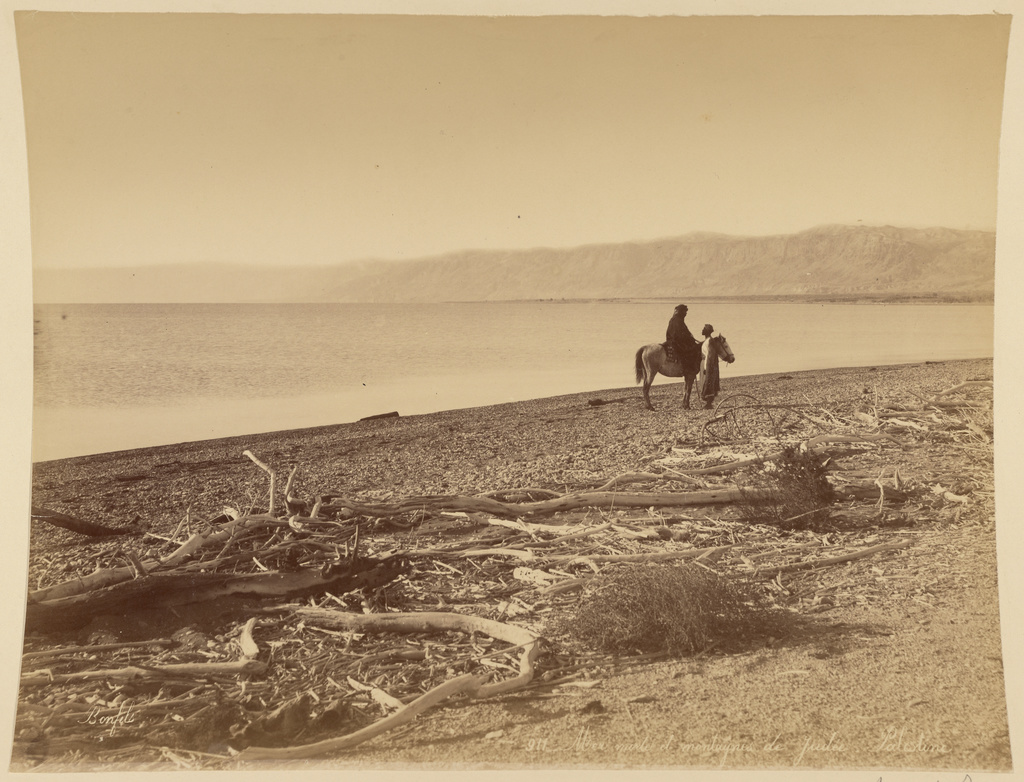
“Mer morte et montagnes de Judée, Palestine” By Félix Bonfils (1867) Digital image courtesy of the Getty’s Open Content Program

Men Go to Battle, Women Wage War: A Review of The White Queen on STARZ

by

Kurt Baumeister


Following an established pattern on premium cable, The White Queen (Saturdays at 8 PM EST on STARZ) combines breathy, bodice-popping romance with hints of war, intrigue, and just enough period history to convince you your night hasn’t been a complete intellectual bonfire. Based on Philippa Gregory’s series of historical novels, The Cousins’ War, The White Queen’s milieu is England’s civil strife of the Late Middle Ages, otherwise known as the War of the Roses. As the Houses of Lancaster and York vie for the English throne, everyone from the French to the Scots looms off-screen, promising to make trouble in coming episodes.

As far as The White Queen’s history is concerned, there’s plenty in spirit; but never so much attention to canonical accuracy that you’re sure what’s going to happen. Taking a cue from genre forerunners, The Tudors and The Borgias, the thrill and latitude of dramatic license come before the facts. And maybe this has been the point of period dramas like The White Queen all along. Maybe these high-end soaps are designed to show us just how malleable history can be; how easy it is to take dramatic half-truths; sex, skulk, and bloody them up; and turn them into the stuff of reality, or, more than that, legend. Maybe…but, then again, probably not…

After all, even if there aren’t any actual “commercials;” this is commercial television. With the supposedly more scholarly History Channel running everything from Cajun Pawn Stars to Ice Road Ax Men to Mutant Neanderthal Strippers (2015?), we can hardly expect a network that calls itself STARZ (with a Z!) to act as some sort of PBS Premium. All the ingredients for high ratings are there with The White Queen, except perhaps for its timeslot.

Rather than sticking with Friday night for the airing of its original programming (a successful recipe for Spartacus, DaVinci’s Demons, and Magic City) STARZ will show The White Queen on Saturday nights, opposite the first-run movies on other premium cable channels. While this doesn’t amount to the kamikaze mission of going up against the likes of Homeland and Boardwalk Empire on Sunday nights, the change doesn’t entirely make sense. Maybe programming executives at STARZ have done their homework and see an opportunity. Only time, and ratings, will tell.

With a breathtaking number of scenic transformations and costume changes sprinkled between bouts of vigorous soft-core, The White Queen focuses on the love of King Edward IV (Max Irons, son of Academy Award winner/Borgia Pope, Jeremy) and his future Queen-Consort, Elizabeth Woodville (Swedish beauty, Rebecca Ferguson). In the first one-hour episode alone, the action roves from woodland picnic to secret nuptials to a hunting lodge honeymoon that literally goes on for days. Tresses of hair flow, fields of flowers bloom, and there’s no shortage of bare, writhing flesh.

There are, of course, moments when love takes a back seat, when intrigue rears its toothy head. For that, Irons and Ferguson give way to older sub-leads, most notably in the first several episodes, English actor, James Frain. Sneering from horseback, stalking through castle and field, issuing fiery pronouncements to his nephew the King; Frain (The Tudors and Elizabeth) plays Richard Neville, 16th Earl of Warwick. Known as “the Kingmaker,” Neville has been responsible for putting Edward on the throne. With courtly manners, a simmering will to power, and facial expressions that seem always to be hiding a scheme, the Kingmaker’s machinations promise to be a dramatic driver early on.

The meat for a “real life” version of the game of thrones is definitely there, the history behind The White Queen covering a conflict Shakespeare himself devoted four plays to (Henry VI, 1-3 and the more famous Richard III). As the future Richard, Welsh stage actor Aneurin Barnard appears in only one scene of The White Queen’s first episode; however, the bemused malice he shows suggests a villain in the making, one ready to accept the mantle of principle antagonist from Uncle Kingmaker. Both history and The White Queen’s first season plot synopsis promise more of a role for Richard as the series unfolds.

Beyond the usual genre conventions of beauty vs. ugliness and good versus evil, The White Queen seems to be looking for thematic resonance in its exploration of gender roles. As its advertising tagline reads, “Men go to battle. Women wage war.” Though this suggests grand ambition, the question remains as to whether there’s any “there” there. Thus far, women’s only real realm of dominance seems to be “magic,” a power that may or may not be real within the show’s cosmology.

Early in the first episode, we see Elizabeth having misty, potentially prophetic dreams. We later learn that her mother (played by Janet McTeer) fancies herself a bit of a witch and seems convinced she has passed her powers along to her daughter. Spells are casts, mirrors are gazed into, and things seem to work out as “magic” suggests they will. Still, enough ambiguity is maintained that the viewer can’t be certain this magic has any potency at all. In this, magic stands in opposition to the very real political and military power we see wielded by men. This difference points to the fact that, “Men go to battle. Women wage war,” may be nothing more than a marketing ploy; that in The White Queen magic may become the stuff of imagination, religious persecution, or perhaps even “feminine madness.”

Only as the series evolves will we learn whether the show’s pretensions to fresh thematic territory are sincere or, like the treatment of history so common to its forerunners, easily dispensed with in favor of ratings. Either way, The White Queen’s top-notch cast and large production budget have produced something exciting to watch; a worthy successor to The Tudors and The Borgias, at least on a visceral level.

***

A former international finance professional, Kurt Baumeister holds an MFA in Creative Writing from Emerson College. His first novel, a satirical spy thriller entitled PAX AMERICANA, is forthcoming. He is currently at work on his second book, LOKI’S GAMBIT, a modern fantasy told from the viewpoint of the diminished and fundamentally misunderstood Norse God of Evil, Loki. Kurt Baumeister lives in Virginia.

SATURDAY POETRY SERIES PRESENTS: DANUSHA LAMÉRIS

Author Web Photo
ARABIC
By Danusha Laméris

I don’t remember the sounds
rising from below my breastbone
though I spoke that golden language
with the girls of Beirut, playing hopscotch
on the hot asphalt. We called out to our mothers
for lemonade, and when the men
walking home from work stooped down,
slipped us coins for candy, we thanked them.
At the market, I understood the bargaining
of the butcher, the vendors of fig and bread.
In Arabic, I whispered into the tufted ears
of a donkey, professing my love. And in Arabic
I sang at school, or dreamt at night.
There is an Arab saying,
Sad are only those who understand.
What did I know then of the endless trail
of losses? In the years that have passed,
I’ve buried a lover, a brother, a son.
At night, the low drumroll
of bombs eroded the edges of the city.
The girls? Who knows what has been taken
from them.

For a brief season I woke
to a man who would whisper to me
in Arabic, then tap the valley of my sternum,
ask me to repeat each word,
coaxing the rusty syllables from my throat.
See, he said, they’re still here.
Though even that memory is faint.
And maybe he was right. What’s gone
is not quite gone, but lingers.
Not the language, but the bones
of the language. Not the beloved,
but the dark bed the beloved makes
inside our bodies.


(Today’s poem originally appeared in Rattle and appears here today with permission from the poet.)

Danusha Laméris’s work has been published in Alaska Quarterly Review, Poetry Northwest, Rattle, The Sun and Crab Orchard Review as well as in a variety of other journals. She was a finalist for the 2010 and 2012 New Letters Prize in poetry and has been nominated for a Pushcart Prize four times. Her first book, The Moons of August, was chosen by Naomi Shihab Nye as the winner of the Autumn House Press poetry contest, and is set for release in early 2014. She lives in Santa Cruz, California and teaches an ongoing poetry workshop.

Editor’s Note: What riches lie within today’s poem. How alive the market of the poet’s memory. Reading this piece is like walking through a souq; the corridors are buzzing and vibrant, but be aware. Keep your eyes wide open. In the caverns below the language lie both treasures and warnings. Both the language and the bones.

Want to read more by and about Danusha Laméris?
Author’s Official Website