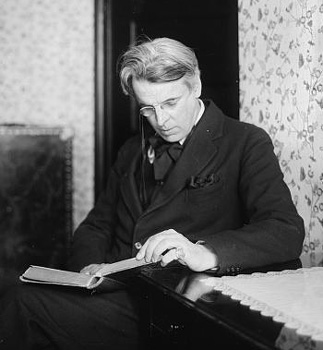
By William Butler Yeats:
NO SECOND TROY
Why should I blame her that she filled my days
With misery, or that she would of late
Have taught to ignorant men most violent ways,
Or hurled the little streets upon the great,
Had they but courage equal to desire?
What could have made her peaceful with a mind
That nobleness made simple as a fire,
With beauty like a tightened bow, a kind
That is not natural in an age like this,
Being high and solitary and most stern?
Why, what could she have done, being what she is?
Was there another Troy for her to burn?
“No Second Troy” is reprinted from The Green Helmet and Other Poems. W.B. Yeats. Dundrum: Cuala Press, 1910.
ON BEING ASKED FOR A WAR POEM
I think it better that in times like these
A poet’s mouth be silent, for in truth
We have no gift to set a statesman right;
He has had enough of meddling who can please
A young girl in the indolence of her youth,
Or an old man upon a winter’s night.
“On Being Asked for a War Poem” is reprinted from The Wild Swans at Coole. W.B. Yeats. New York: Macmillan, 1919.
William Butler Yeats (1865-1939) was an Irish poet, dramatist, and one of the foremost figures of 20th century literature. A pillar of both the Irish and British literary establishments, in his later years Yeats served as an Irish Senator for two terms. He was a driving force behind the Irish Literary Revival, and along with Lady Gregory and Edward Martyn founded the Abbey Theatre, serving as its chief during its early years. In 1923, he was awarded a Nobel Prize in Literature for what the Nobel Committee described as “inspired poetry, which in a highly artistic form gives expression to the spirit of a whole nation.” He was the first Irishman so honored. Yeats is generally considered one of the few writers whose greatest works were completed after being awarded the Nobel Prize; such works include The Tower (1928) and The Winding Stair and Other Poems (1929). (Annotated biography of William Butler Yeats courtesy of Wikipedia.org.)
Editor’s Note: I’ll be honest, I do not tend to be a fan of rhyming poetry. As a result, I tend to overlook many of the greats of yesteryear, such as Longfellow, Keats, and Yeats – to name a few. However, my mother informs me that William Butler Yeats was a relative of ours, being of the same Butlers from which my family comes. Having presented me with that information, my mother promptly informed me that I should feature Mr. Yeats on my Saturday Poetry Series. Well, what kind of a Jewish daughter would I be if I did not heed the subtly guilt-ridden instructions of my mother?
Of course I would not publish something that I do not stand behind, so I perused Mr. Yeats’ work and found two pieces that I am pleased to share here today. “No Second Troy” I adore for both its story and its end line. “On Being Asked For a War Poem” I find wholly appropriate for As It Ought To Be in that it explores the relationship between the poet and politics. I was doubly pleased as I learned more about Yeats to find that he himself was a politician in addition to a poet.
May the relationship between poetry and politics live long and prosper, and may poets have the power to make the change we want to see in the world, as it ought to be.
Want to read more by and about William Butler Yeats?
The National Library of Ireland Presents The Life and Works of William Butler Yeats
NobelPrize.org
Poets.org
The Literature Network
The Poetry Archive
Poetry Archive


One of my favorite Yeats’ poems, also from _Wild Swans_ (I have many 🙂
THE BALLOON OF THE MIND
Hands, do what you’re bid:
Bring the balloon of the mind
That bellies and drags in the wind
Into its narrow shed.
–William Butler Yeats.
–from: The Wild Swans at Coole, 1919.
LikeLike
A (very) little more Yeats, on a somewhat related theme.
LikeLike
I rather disagree with Yeats regarding silence and war (or poverty, homelessness, avarice and greed – any of those nasty, nefarious concepts … would he (k)not speak of those, or did I miss the (peace)?) … although I, too love the last line … He looks like my grandfather.
LikeLike
I wonder if he was being facetious or serious in his ‘war poem’. I am interested in his politics – though would probably make it clear.
And his war poem takes on an interesting meaning when put alongside this famous line from another poem (The Second Coming):
“The best lack all conviction, while the worst
Are full of passionate intensity”
LikeLike
But not too long afterwards, he wrote Easter 1916, plainly political, self-critical, courageous and beautiful. Here’s the often-quoted last part where he proclaims the names of those revolutionaries later executed:
Too long a sacrifice
Can make a stone of the heart.
O when may it suffice?
That is Heaven’s part, our part
To murmur name upon name,
As a mother names her child
When sleep at last has come
On limbs that had run wild.
What is it but nightfall?
No, no, not night but death;
Was it needless death after all?
For England may keep faith
For all that is done and said.
We know their dream; enough
To know they dreamed and are dead;
And what if excess of love
Bewildered them till they died?
I write it out in a verse –
MacDonagh and MacBride
And Connolly and Pearse
Now and in time to be,
Wherever green is worn,
Are changed, changed utterly:
A terrible beauty is born.
LikeLike
Not so much interested in his politics as his fascinnating life and friends. My Ph.D. research was on ‘writers who hung out together’ in the early 20th century, including Yeats and co. My favorite line of his, from his poem written when Lady Gregory’s son was killed in WWI: ‘What made us dream that he could comb grey hair?’ Check out my blog where I update each day what writers were doing in the early part of the 20th century, including the Irish Literary Renaissance.
LikeLike