Shawn Pavey Reviews
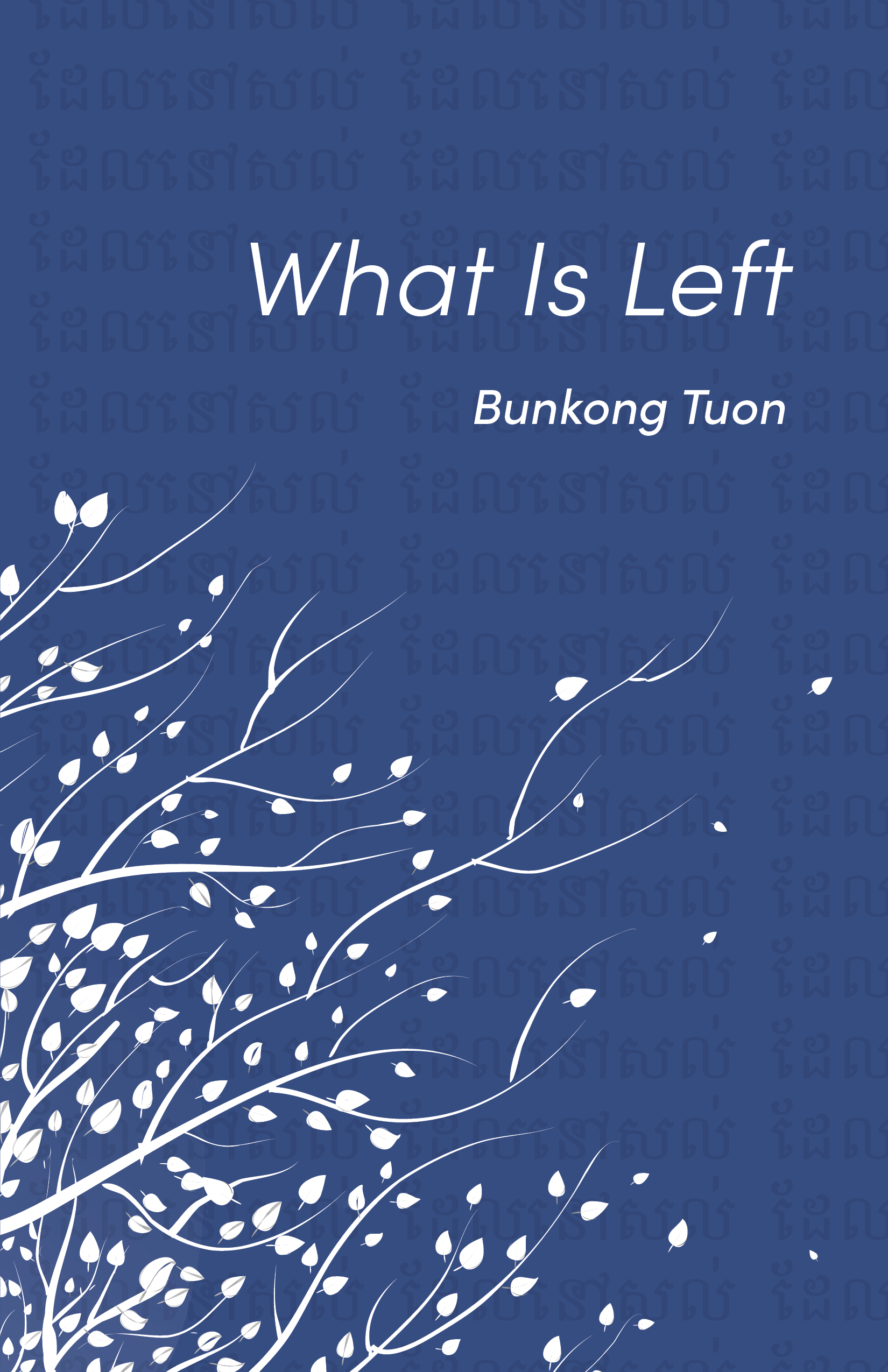
What is Left
By Bunkong Tuon
…
In What Is Left, part of Jacar Press’ “Greatest Hits” chapbook series, Bunkong Tuon brings us on his personal journey as a child refugee of the Khmer Rouge’s atrocities in his homeland of Cambodia. As David Rigsby states in his insightful foreword, “Bunkong Tuon’s childhood took place in a country whose national life in the 1970s underwent unimaginable depredation at the hands of the Khmer Rouge: slaughter, torture, starvation, and the forceful smashing and separation of families.”
To set the tone for the entire collection, the titular opening poem, recently announced as a winner of the 2024 Pushcart Prize, begins:
What is left after war is the gratitude for what is left.
My dreams are filled with ghosts looking for home.
The dead speak to the living through my poetry.
Each time I write, I rebuild. Retrieve what was stolen.
Tuon, while being open about struggle and loss and deep, deep pain, infuses each of these poems with an almost incessant sense of hope. This is one of the most surprising aspects of this work: how Tuon navigates the telling of his story yet, somehow, gives the reader a sense that the life he leads now is both unexpected and a joy. However, as this first poem continues, Tuon, soberly, informs the reader:
Nothing is dead until I let it. English is not the language
Of my birth. It is the language of death. More bombs
Dropped on Cambodia's countryside than in Hiroshima
And Nagasaki. I was bombarded by this language.

I had no choice but to use it.
Tuon references, of course, the covert bombing of Cambodia by the United States from 1969 to 1973 designed to minimize the capabilities of the People’s Army of Vietnam. Tuon as a small child knows America as bombs, destruction, and death. During the reign of the Khmer Rouge, more than a million people were executed – more than 13% of the country’s total population. Families were shattered and much of the country’s population fled the atrocities as refugees.
This is the historical backdrop for Tuon’s poems. The second poem, Under the Tamarind Tree, Tuon reveals a memory of sitting on the lap of an aunt – a child herself – witnessing the funereal rites performed by monks for his mother.
The tree stands still, quiet,
indifferent. The house sways
on stilts.

Monks in saffron robes
and nuns with shaved heads,
lips darkened with betel-nut stain,

sit chanting prayers
for the child’s mother.
Incense perfumes the hot dry air.
The image is heartbreaking but the true marvel is Tuon’s sparse yet musical language. He writes these poems with an almost journalistic detachment, avoiding the temptation to overwrite the emotional vulnerability. Tuon shows us, with his carefully chosen lexicon, the sheer tragedy and loss of this moment experienced by a child in the care of a slightly older aunt. The poem concludes:
Each time the child hears prayers
coming from the house, he cries;
each time he cries, the aunt, a girl herself,
pinches the boy’s thigh.
It is that last line that shares with the reader the absolute cruelty of the moment. The funeral is witnessed as a result of institutional cruelty, but that tiny act of violence, the thigh-pinch of the aunt on the crying boy’s thigh shows that in that moment, there was little time to grieve. Survival of what lies ahead will require its own toughness.
The next few poems detail Tuon’s refugee journey. In “The Carrying,” he gives us a glimpse of their long journey – on foot – as his grandmother carried the small boy on her back to the refugee camp. In the poem “Gruel,” Tuon recalls a conversation with his uncle about survival.
“When you were young,
we had nothing to eat.
Your grandmother saved for you
the thickest part of her rice gruel.
Tasting that cloudy mixture
of salt, water, and grain, you cried out,
‘This is better than beef curry.’”

All my life I told myself I never knew
suffering under the regime, only love.
This is still true.
The last two lines of this poem may be the true heart of this collection. What carried Tuon through all of this tragedy and trauma was knowing he was loved by extended family members who gave him this, the only thing they had left to their names, this love and this belonging in love, desperate as it was. Tuon’s poem “Debt” shows us a glimpse of his father begging the Khmer Rouge, after they slaughtered children and cut open the bodies to eat the livers.
My father got down
on his knees,
clasped hands over head,
and begged them
for a sliver of a victim’s liver
so that I would not starve.
While everyone was sleeping
my father snuck into the kitchen,
stole a branch of coconuts,
and buried them in the woods.
Each time I cried from hunger
he disappeared into the night,
dug up a coconut,
gave me the juice to drink
and with dirt-encrusted fingers
spooned out the flesh
for me, his only child.
This terrible memory ends the poems specifically about fleeing terror. The following poems in the book deal with how Tuon built a life and is, in a way, relaying his experience to his children but, also, to the readers. There is a poem about how air conditioning in a library hurts to breathe after fleeing jungles. There are poems to his daughter and son. There are poems trying to find purpose in living and moving on from unspeakable loss.
And there is so very much hope.
This hope, deeply ingrained in every single poem, drives this collection. These poems are intimate, they are deeply personal, they reveal the vilest atrocities, and these poems do all that while holding tightly to hope and love and never once slip into maudlin self-pity. While these poems, at least on the surface, could be considered confessional, they never feel like confessional poems. Autobiographical, certainly, which is a type of confessionalism, but they avoid writing about emotion in favor of stark imagery. Tuon shows us the horror and despair and struggle of living through and in spite of the Khmer Rouge. He shows us the life he built because of the sacrifice of the family members who kept him alive. And, ultimately, Tuon shows us the joy that life can hold in contrast to experienced evil.
What Is Left
by Bunkong Tuon,
2024, Jacar Press.
ISBN: 978-0-936481-56-2,
28 pages.
About the Author: Shawn Pavey is the author of Talking to Shadows (Main Street Rag Press, 2008), Nobody Steals the Towels From a Motel 6 (Spartan Press, 2015), and Survival Tips for the Pending Apocalypse (2019, Spartan Press) which was 1st runner up for the 2020 Thorpe Menn Literary Excellence Award. He co-founded The Main Street Rag Literary Journal and served as an Associate Editor. Recently, he was featured in the second anthology by THE NU PROFIT$ OF P/O/E/T/I/C/ DI$CHORD entitled, And Even If We Did, So What!? from OAC Books. His infrequently updated blog is at http://www.shawnpavey.com.
 As It Ought To Be