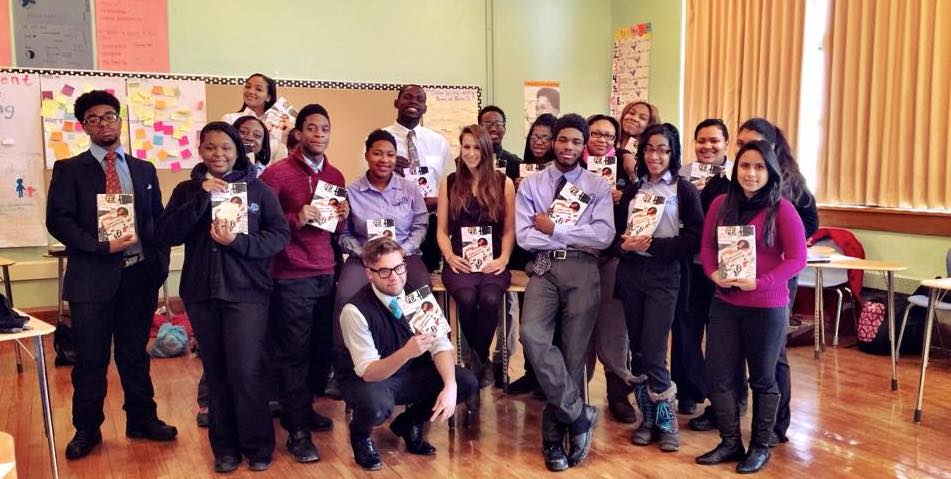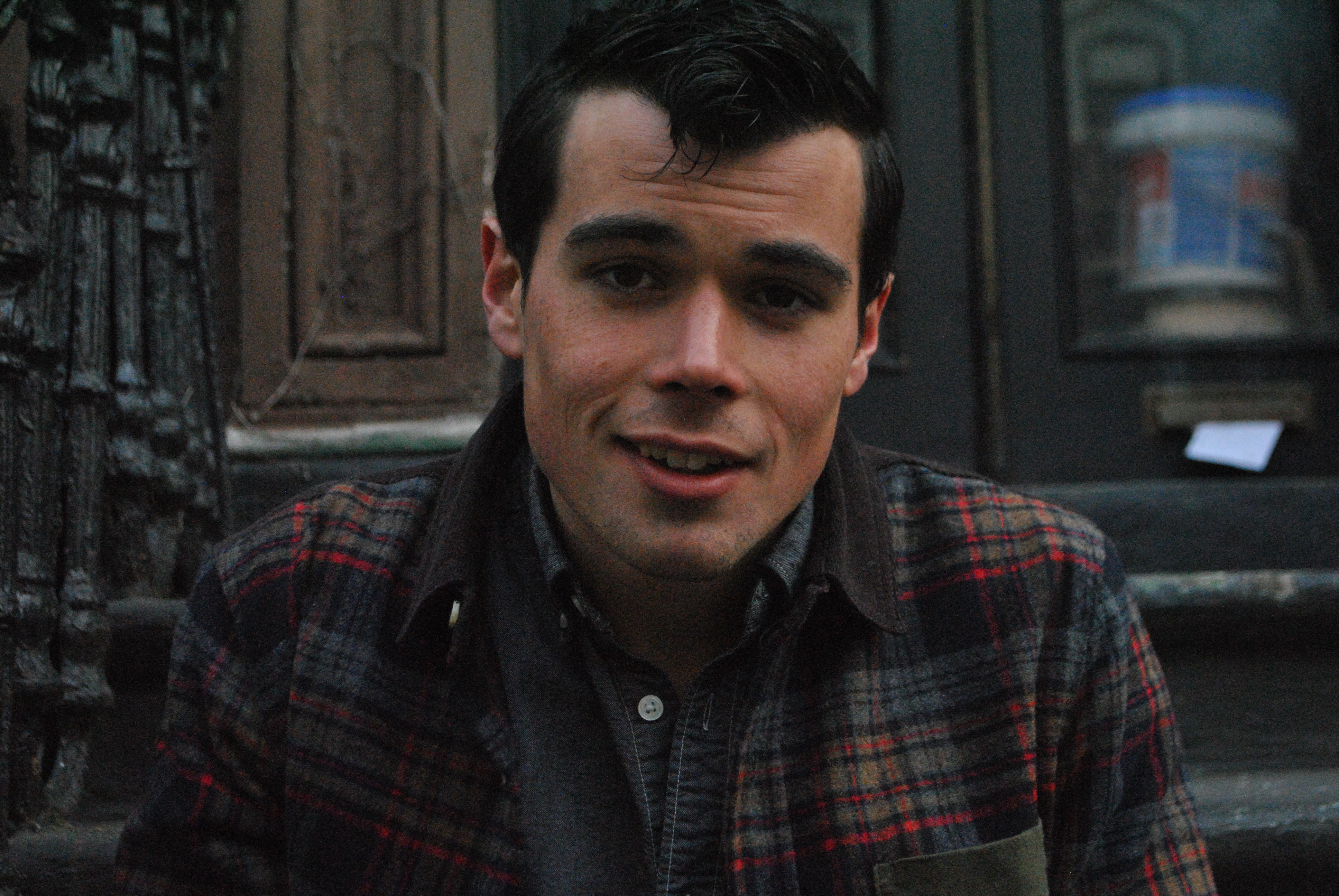
SATURDAY POETRY SERIES PRESENTS: DEVIN KELLY


DSC_0759


FEAR OF
By Devin Kelly

We are discussing the roots of things. How phobia
means fear of, and we make them up. Bookaphobia.
Classroomaphobia. Girlaphobia. I say there will be
a quiz. They laugh. It is evening in a small room
in Queens where the desks are miniatures
of the things they should be and the children
sitting in them too close to me and my coffee
so soon done. Then I ask them if they are afraid.
Then I ask them of what. The word penis. Spiders.
The people who hate me for my name. How a moment
turning stills to a moment stilled. How silence,
even in silence, breathes. Their pages of homework
loiter upon their desks. Fifteen words they had
never seen before, and fifteen meanings, written out
beside. Benevolent. Ailurophile. I spoke, upon the hearing,
of opposites, to think of words as people, rooted,
experimenting with different prefixes. To think of words
as lovers, hungry for what it might be they want.
What is her name? It lingers a moment before
it hassles its way out of my mouth. The shape it takes,
unfamiliar, awkward. A word I have never spoken before.
And her skin brown. How she taught me the way
to count to ten in Arabic. The people who hate me
for my name. The people who hate me. The people.
Across an ocean, a man kneeling does not see the hand
that holds the gun that fires the bullet that splits
his head in two. Across an ocean, someone laughs
at a fence of severed heads. I do not know
what to teach anymore. Graphophobia. Philophobia.
Fear of writing, fear of love. And all these children
who do not have a name for their sorrow. At night,
in bed, I turn her name for the hundredth time
and find its beauty. The soft grace of wanting
to be held. A child, scared, moving in dark
from room to room to find the mother who named her,
the father, too, and their reasons why.


Today’s poem originally appeared in Rattle and appears here today with permission from the poet.


Devin Kelly earned his MFA from Sarah Lawrence College. His collaborative chapbook with Melissa Smyth, This Cup of Absence, is forthcoming from Anchor & Plume Press. His poetry, fiction, and essays have appeared or are forthcoming in Gigantic Sequins, Armchair/Shotgun, Post Road, RATTLE, The Millions, Appalachian Heritage, Midwestern Gothic, The Adirondack Review, and more, and his essay “Love Innings” was recently nominated for a Pushcart Prize. He co-hosts the Dead Rabbits Reading Series in Manhattan, teaches Creative Writing and English classes to high schoolers in Queens, and lives in Harlem. You can find him on twitter @themoneyiowe.

Editor’s Note: June 26, 2015 was a day of imperative progress in American history. A day of change. A day when love triumphed. I celebrated this historic event in the most wonderful way I could have imagined, at the wedding of two women whose love is beshert. But when one of the brides gave her speech, she reminded us that there is still more to be done. “Today we celebrate,” she said, “but tomorrow, we keep fighting.” Even amidst a joy so great she shared it with the entire country, the blushing bride reminded us that we can—and should—always be working to make the world a better place.

Today’s poem was written in response to Islamophobia. A Muslim girl in a classroom. What is she afraid of? “The people who hate me for my name.” The families of the victims of a racist hate crime—a terrorist act—in Charleston, SC have what to teach us about love and forgiveness. But what are they truly the victims of? “The people who hate me. The people.” We speak words today that carry with them the chalk outlines of the hatred that flows from fear: Black Lives Matter; I can’t breathe. “I do not know / what to teach anymore,” writes the poet, but he knows “all these children / who do not have a name for their sorrow.”

Let us shout our joy from the rooftops and dance in the streets because yesterday love won. And today, tomorrow, and in the days to come, let us fight until love triumphs over fear and hatred, until there is justice and equality for all.

Want more from Devin Kelly?
The Adirondack Review
District Lit
Little Fiction
Warscapes
Devin Kelly – Published Work

SATURDAY POETRY SERIES PRESENTS: GERARD MANLEY HOPKINS


Gerard_Manley_Hopkins


MOONRISE
By Gerard Manley Hopkins

I awoke in the Midsummer not to call night, in the white and the walk of the morning:
The moon, dwindled and thinned to the fringe of a finger-nail held to the candle,
Or paring of paradisaïcal fruit, lovely in waning but lustreless,
Stepped from the stool, drew back from the barrow, of dark Maenefa the mountain;
A cusp still clasped him, a fluke yet fanged him, entangled him, not quit utterly.
This was the prized, the desirable sight, unsought, presented so easily,
Parted me leaf and leaf, divided me, eyelid and eyelid of slumber.


(Today’s poem is in the public domain, belongs to the masses, and appears here today accordingly.)


Gerard Manley Hopkins (1844 – 1889) was an English poet, Roman Catholic convert, and a Jesuit priest, whose posthumous fame established him among the leading Victorian poets. His experimental explorations in prosody (especially sprung rhythm) and his use of imagery established him as a daring innovator in a period of largely traditional verse. (Annotated biography of Gerard Manley Hopkins courtesy of Wikipedia.)

Editor’s Note: Today’s poem appears here on the recommendation of my mother, a faithful reader of this series. As this coming Monday is her birthday, and the moon her ruling planet, I wanted to share this poem with you today in her honor. Happy Birthday, Mama! May you forever shine as brightly as the moon.

Want to read more by and about Gerard Manley Hopkins?
The Poetry Foundation
Academy of American Poets
Bartleby.com

SATURDAY POETRY SERIES PRESENTS: PATTY PAINE

10259779_10152027363561933_7567284404520260511_n copy

ANTIPHONY
By Patty Paine

Go back to that stream, touch
your lips to the cold, clear quivering,
draw into yourself a time when it was simple
as this to be quenched, to draw in what was
needed. Walk back over the dewed grass
of your past, past the water tower you filled
with dark imaginings, feel
the air crisp & clean on your skin, call
this hope, and carry it
to these moments when a photograph
can send you spiraling, your husband
now six months gone, waiting at the bottom
of an escalator in some airport
or another, everyone hurrying to be somewhere
else, except for this one man, waiting
for you to descend. How a face can be
indelible, yet fade so quickly, is an alchemy
best left unknowable. Hold that sting
of hope, and call out
the name of one who ministered
to you, over & over, until from the dark
you hear your own name return
to you, wild, and rising and clear.


Today’s poem originally appeared in Thrush and appears here today with permission from the poet.


Patty Paine is the author of Grief & Other Animals (Accents Publishing), The Sounding Machine (Accents Publishing), Feral (Imaginary Friend Press), Elegy & Collapse (Finishing Line Press), and co-editor of Gathering the Tide: An Anthology of Contemporary Arabian Gulf Poetry (Garnet Publishing & Ithaca Press) and The Donkey Lady and Other Tales from the Gulf (Berkshire Academic Press). Her poems, reviews, and interviews have appeared in Blackbird, Verse Daily, The Atlanta Review, Gulf Stream, The Journal and many other publications. She is the founding editor of diode poetry journal and Diode Editions. She is an Assistant Professor of English at Virginia Commonwealth University in Qatar where she teaches writing and literature, and is Interim Director of Liberal Arts & Sciences.

Editor’s Note: Today’s poem is one I encourage you to read over and over. For each reading is like opening the next layer of a Russian doll, and there is always more waiting to be discovered within. While one reading simply does not do the poem justice, you honor yourself, dear reader, each time you slip deeper into these words.

Start in media res. Start in motion. Begin not at the beginning, but by turning back. The world of the poem is visceral. Go on, touch the stream, feel the “cold, clear quivering.” Go deeper now. “[D]raw into yourself a time when it was simple / as this to be quenched, to draw in what was / needed.” Move backwards; a poem—a life—in rewind. Let the story unfold in this way—cinematic, emotive, devastating. Let the reverse motion be what propels you forward. You are Lot’s Wife. You are Orpheus. There is only looking back, but looking back leaves you alone in the dark, “hear[ing] your own name return / to you, wild, and rising and clear.”

What a fraught landscape, yes, but what a gift to have been taken on such a journey by such a guide.

Want more from Patty Paine?
Buy The Sounding Machine from Amazon
Buy Feral from Imaginary Friend Press
diode poetry journal
Diode Editions
Interview on The Best American Poetry blog

SATURDAY POETRY SERIES PRESENTS: AMORAK HUEY

IMG_3503

By Amorak Huey:


THE POND IN THE CORNER OF THE YARD

It seems so important that I get this right—

memory choked with algae,
memory dried to nothing in the summer,

memory’s post-dawn sky already fevered with desire,
memory’s grass grabbing wet at my hungry ankles.

I remain the same lonely child I was,

never having learned the rules of prayer. Instead I offer
this uncurling body, this frog-song,
tornado-spike, voice-from-the-trees:

the word green
the word green
the word green
.


THE CORN IN THE VALLEY

A sea of silk, a sky of stalk, a sun of ear and song.

There is a season for planting,
a season for harvest,

a moon-color for the storms between.

The lightning has something to do with nourishment,
something to do with need.


THE DOGWOOD AT THE CORNER OF THE PORCH

By our presence we alter the shape of the tree,

crook its looping limbs to suit our prayers,
our psalms and songs,
our cautionary tales.

It’s not the tree asking forgiveness
for its part in our most thoughtless acts—

our blossom-burst and leaf-turn,
our self-inflicted separations.


“The Pond in the Corner of the Yard” originally appeared in Thrush. Today’s poems appear here today with permission from the poet.


Amorak Huey is author of the chapbook The Insomniac Circus (Hyacinth Girl Press, 2014) and the forthcoming poetry collection Ha Ha Ha Thump (Sundress Publications, 2015). A former newspaper editor and reporter, he teaches writing at Grand Valley State University in Michigan. His poems appear in The Best American Poetry 2012, The Cincinnati Review, The Southern Review, The Collagist, Menacing Hedge, and many other print and online journals. Follow him on Twitter: @amorak.

Editor’s Note: I have had the pleasure of featuring Amorak Huey here on the Saturday Poetry Series before, and I am as struck by his poetry today as I was when I encountered it all those years ago. Is it the way he infuses the everyday with a touch of magic? Is it the fine line he conjures between nature and spirit and prayer? Perhaps it is the world he harvests, words sprouting from the earth as if from seeds, the quiet calm of the farm balanced by the weight of repetition, alliteration, form. It is as if you could part the corn stalks and encounter the poem. As if the poem could be turned over like earth, fertile ground for all the words that have yet to be planted.

Want more from Amorak Huey?
“Self-Portrait Following a Trail of Reese’s Pieces” in Radar
“When They Serialize My Life They’re Going to Have a Problem with 1993” in disquieting muses quarterly
“The Fathers at the Little League Field” in Hobart
“Melon Heads” in Stirring from Sundress Publications

SATURDAY POETRY SERIES PRESENTS: SARA BIGGS CHANEY

BiggsChaneyauthor

ST. EUGENIA DECLARES HER ALLEGIANCES
By Sara Biggs Chaney

The girl said: I am not skin,
but sackcloth.

She said: I am not spoke,
but symphony.

My rib bones, how they burn
for the Son.

For Him, I will suffer
this harmonic ache–

I will pin my maiden head,
a moth wing,

I will bear the shames
of a thousand men,

I will wear the hands
of a healer.


Today’s poem was originally published in Thrush and appears here today with permission from the poet.


Sara Biggs Chaney received her Ph.D. in English in 2008 and currently teaches first-year and upper-level writing in Dartmouth’s Institute for Writing and Rhetoric. Her most recent chapbook, Ann Coulter’s Letter to the Young Poets, was released from dancing girl press in November, 2014. Sara’s poems have recently appeared or are forthcoming in RHINO, Sugar House Review, [PANK], Juked, and elsewhere. You can catch up with Sara at sarabiggschaney.com.

Editor’s Note: Today’s poem, like the famous Walt Whitman quote, contains multitudes. Relaying an epic history in a few swift couplets, the interplay between referentiality and alliteration is as precise as it appears effortless. Discreet moments—brilliant vignettes—are carefully pieced together to reveal the story of a life: “The girl said: I am not skin, / but sackcloth;” “I will bear the shames / of a thousand men, // I will wear the hands / of a healer.” As readers, we are as transported by the world of the poem as we are transformed.

Want more from Sara Biggs Chaney?
“St. Barbara, Locked Away” in Atticus Review
“St. Theodora in the Brothel” in Tinderbox Poetry

High School Poetry Series: Gender, Identity, & Race — Jazmyn Alexander

Poet and teacher Sarah Marcus with her high school students.

A note from Series Editor Sarah Marcus: Born from a powerful in-class discussion that we had about gender, race, and the role of masculinity in rape culture, “Be A Man/Be A Woman” poems are an analysis of gendered personal experience and a study of our intersectionality. This poetry series was inspired by a HuffPost essay I wrote called, “Why I Teach Feminism at an Urban High School.” The poets featured here are students from my 12th Grade Resistance Writing class whose work I found to be brave, fearless, and progressive. Please help me support their crucial and influential voices.

*

Jazmyn Alexander is a senior poet in my Creative Writing class. She loves hair, hanging out with friends, shopping, and reality T.V. shows. To be perfectly honest, Jazmyn and I got off to a rough start this year, but as the year progressed, Jazmyn felt incredibly connected and engaged with the material that we were learning. She says, “Before this class, I really didn’t care about feminism or women being treated poorly in the media. I didn’t pay much attention. I just thought a woman being degraded was the norm. When we learned about it, I felt like women have so much more to offer than being objectified for men. And we’re beautiful; we don’t have to get naked to show that we’re beautiful.”

Jazmyn’s rap is incredibly powerful. She addresses the wrongful deaths of Trayvon Martin, Eric Garner, and Mike Brown. She says: “Writing this rap came easy. I knew I wanted to tell a story about justice. I wanted to stick to one person for each verse.” I feel especially connected to this poem’s chorus. I love the way it subverts our conception of what a contemporary rap encompasses.

See Jazmyn read her poem here.

He’s Gone

Verse 1:
Now Trayvon walkin down the street, swagged out with a hood and J’s on his feet.
Ain’t doing nothing but lookin at his phone, no worries but it was gone be a long way home.
He wasn’t ready for what was comin, if he only knew that he was gone get into somethin.
Tryna fight… for his life, with Zimmerman on his back he knew that something wasn’t right.
So he kept on walking, noticed he was being followed so he started talking…
The man was cruel, knew what he wanted to do.
With all the break-ins on his street this was a justice move.
Tray’s girl on the line, she wanna know if it’s okay, is it all fine?
He let her know, he had to call back, time to fight for his life cus he under attack.

Chorus:
And he’s gone, Tray lost his precious life to a bullet hole
Not smokin’ on nothin’, nor sippin on somethin’
But the color of his skin showed that his life wasn’t nothing

And he’s gone
Yeah he’s gone
And he’s gone
Trayvon is gone

And wasn’t smokin’ on nothin’, nor sippin’ on something
But the color of his skin showed his life wasn’t nothing, alright.

Verse 2:
Then there was Eric too, chilled on the block listening to the humming blues.
He didn’t know how this day would go… Wasn’t knowing that he wasn’t gonna make it home.
Then a fight broke out, he tried to break it up but he got struck out.
(Make noise) he gasp for air, I can’t breathe, please let me go, please let me go
Cus I can’t breathe!
The police they choked him tight, aware of his asthma as he gasped for his life.
They didn’t care, they didn’t stop
Black man down, was the evidence that they got.
Taking this man’s life away, the public watched like dim to a brighter day.
This gotta end, where do we begin?
Rest in peace… Tray, Eric, Mike, and all black men.

Chorus:
And he’s gone, Eric lost his precious life to a choke hold
Not smokin’ on nothin’, nor sippin’ on somethin’
But the color of his skin showed that his life wasn’t nothing

And he’s gone
Yeah he’s gone
And he’s gone
Eric is gone

And wasn’t smokin’ on nothin’, nor sippin’ on something
But the color of his skin showed his life wasn’t nothing, alright.

SATURDAY POETRY SERIES PRESENTS: HEMISPHERE

hemisphere


From HEMISPHERE
By Ellen Hagan:


RIVER. WOMAN.

I.
Downriver is always long
& always flailing, finding

where our lives begin,
intersect?  You, your bones

the humped slope of nose
browned skin of home.

You, sand. You, ocean.
You, bending & me.

How many nights we sleep
alone, our bodies rising—

what it means to miss you.
What it means to expand.
What it means to be birthed.
What it means to be sacred.
What it means to go home.

Place of birth, birthing
ground. Ground that is sacred.
You that is sacred.

Bones that hold together.  Bind.
Bound to you.  My mother.

II.
Me
I am bound to you.  My mother.
You stitch me from inside.  Hollowed.
your split sheath of self, your letters
the slow cursive of your language,
can’t I hear your voice, always?

Her
Lock the doors.  Latch the locks.
Shut the windows.  Close the blinds.
Cover up.  Clean your room.  Do
the dishes.  Wash the clothes.  Behind
your ears, yourself.  Clean the floor.  
Scrub.  Mop the remains every day
is one that you can use to erase all
the mistakes.  Blemish free.
Shine the doorknobs, pine, every
crease of space.  Cabinets.  Don’t leave
food out.  Food brings mice.  Mice
bring disease.  You will die.  You could 
die.  Don’t die.  Don’t ever die.  You 
stitch me from inside.  I am bound
to you.  Can’t you always hear
my voice?


LESSONS ON SPELLING

Bring the snakes in their skins, sly
& surrender. Simple bodies of grass
& clover, their slithering and sleuth-ness.
& the earth & the dusty fisherman
in from their boats, bobbing. Bring
piano, bring pain. That yellow skirt
pocked w/ fuchsia & the halter
of your mother’s pixie 60’s ways.
Let out the hems from your dresses,
the vertebrae in your back, body
forget skeleton—be loose, let it be dirty.
Get there. Call the black cat promenade,
lazy through the streets. Let your hair
down. Let it crawl, crowd the length
of your back. Bring soca & fiddle,
that record player your father bought
your mother in 1974. Bring all the days
from 1974 & on because time is a revolver.
A bag of limes on your back porch
squeezed & bitter & neon & orbiting
over you. Is your neighbor calling.
Is satsumas bursting on your tongue.
Bring your shiny shoes & arched soles
for the flapping pageant of second line
parade, the 100 parades from now until.
Autumnal. Hymns. Prayers.
Ways to say yes. Bring with you
your rope of hide, your many rings
of muscle & the washcloth
for your stomach, your feet
for the laying nape of your neck.
Bring danger & ways to hold your lips,
your lips, bring them too.
Spanning the whole of you.
You become.


WATER SIGN

Already a lullaby inside.
Your palms to belly, breath
on hip.  You are changing,
beginning. Too.  And you,
baby girl, or boy. Or two.
Are just gills. Still. Heart in
mouth. Red burst of newness.
Fins.  Fish or fowl. Shrimp
are larger than you.

Still, you are breaking me
apart. Him too. Our hearts
and lungs, and gills. Bursting 
You are stretching all,
all of us. Open.


Today’s poems are from Hemisphere, published by TriQuarterly Press/Northwestern University Press, copyright © 2015 by Ellen Hagan, and appear here today with permission from the poet.


Hemisphere: The poems in Hemisphere explore what it means to be a daughter and what it means to bear new life. Ellen Hagan investigates the world historical hemispheres of a family legacy from around the globe and moves down to the most intimate hemisphere of impending motherhood. Her poems reclaim the female body from the violence, both literal and literary, done to it over the years. Hagan acknowledges the changing body of a mother from the strains of birth from the growing body of a child, to the scars left most visibly by a C-section €”as well as the changes wrought by age and, too often, abuse. The existence of a hemisphere implies a part seeking a whole, and as a collection, Hemisphere is a coherent and cogent journey toward reclamation and wholeness. —TriQuarterly Press/Northwestern University Press


Ellen Hagan is a writer, performer, and educator. Her latest collection of poetry, Hemisphere, was released by Northwestern University Press in Spring 2015. Ellen’s poems and essays can be found in the pages of Creative Nonfiction, Underwired Magazine, She Walks in Beauty (edited by Caroline Kennedy), Huizache, Small Batch, and Southern Sin. Her first collection of poetry, Crowned, was published by Sawyer House Press in 2010. Ellen’s performance work has been showcased at The New York International Fringe and Los Angeles Women’s Theater Festival. She is the recipient of the 2013 NoMAA Creative Arts Grant and received grants from the Kentucky Foundation for Women and the Kentucky Governor’s School for the Arts. National arts residencies include The Hopscotch House and Louisiana Arts Works. Ellen recently joined the po­etry faculty at West Virginia Wesleyan in their low-residency MFA program. She teaches Memoir, Poetry & Nature, and co-leads the Alice Hoffman Young Writer’s Retreat at Adelphi University. She is Poetry Chair of the DreamYard Project and a regular guest artist at the Kentucky Governor’s School for the Arts.


Editor’s Note: I fell in love with the poems in Ellen Hagan’s Hemisphere for their language: earthy, sensual, gritty. Unafraid of blood and birth, of mud and heat, of nature, of relationship, of what is real and lush and vivid, of what is primal and complex. I am reminded of the swamp, of the first creatures that dragged themselves forth from the murky depths, crawling forward, always, evolving for the sake of life. I am reminded, also, of witchcraft, of alchemy, of drawing down the moon. Of things my mother taught me, of that which has been handed down from woman to woman through the ages.

Today’s poems were meant to be, here, today. Because they are about the twin experience of birth—both as child and mother. Because much of this book is about the relationship between mother and daughter, the circle of life as only mother and daughter experience it: “where our lives begin, / intersect;” “what it means to miss you. / What it means to expand. / What it means to be birthed. / What it means to be sacred. / What it means to go home.”

In honor of Mother’s Day, and of the magic that grows from the rich soil of today’s poems, today’s feature is dedicated to my mother, the water sign, from your daughter, the water sign. “You that is sacred… I am bound to you. My mother.”


Want to see more from Ellen Hagan?
Ellen Hagan’s Official Website
Ellen Hagan’s Blog
Duende
Drunken Boat
Buy Hemisphere from Indie Bound

High School Poetry Series: Gender, Identity, & Race — Dion Pride

Poet and teacher Sarah Marcus with her high school students.

A note from Series Editor Sarah Marcus: Born from a powerful in-class discussion that we had about gender, race, and the role of masculinity in rape culture, “Be A Man/Be A Woman” poems are an analysis of gendered personal experience and a study of our intersectionality. This poetry series was inspired by a HuffPost essay I wrote called, “Why I Teach Feminism at an Urban High School.” The poets featured here are students from my 12th Grade Resistance Writing class whose work I found to be brave, fearless, and progressive. Please help me support their crucial and influential voices.

*

Dion Pride is an eighteen-year-old senior poet in my Creative Writing class. In his free time he enjoys writing, watching film, and participating in Cleveland’s community advocacy. At school he is involved with our Take Back the Night Campaign and event, he is an active member of Campus Ministry, and he participates as a member of the Men of Strength Organization.

I am constantly inspired by Dion’s compassion towards his family and his classmates. He is an activist who cultivates a culture of empathy in our classroom and community alike. I most enjoy the imagined conversation that takes place in this poem. This vital dialogue considers the courage needed to empower each other to stand up for equality.

In his own words: “Like in the past, no one person can get us there, we have to get us there. The energy of the youth and the wisdom of our elders. Together we can be the greatest force of change. Today, let us make the negro proud and show them how far the African American can go. Show them we won’t stop this time, until we are all free at last.”

See Dion read his poem here.

Be A Man

Yea, I’m a FEMINIST, I believe in equality.
So you believe that a woman is just as equal as you?
I do.

Do you think that we can have a woman leader?
There’s this real smart sweetie that live on Cedar
She can do the job.

There’s no way a woman can lead our nation–
We’ll be at World War III by her next menstrual cycle.
You say that now, but you would follower her
Like a boy on his bicycle
While you try to catch her in that Benz.

Women need to stay in they place.

So what is their place?

In the pages of a Secret catalog.
Let me tell you a secret real fast,

That girl is way more than a pretty face.
She can out school you and fool you.

When you were getting C’s and D’s,
She was getting A’s and B’s, trust and believe.
More than just a pretty face,
All women of all shapes and sizes
Meant to be equal by our God the highest.

But girls with bodies should show them and expose them.
Not for you, it’s not slavery, their sexuality is not for you to own.

But the media says…
Forget what the media says.
But politicians say…
Forget what politicians say,
They remind me of Homer from The Simpsons: rude, crude, and dumb.

It’s time for the wake up call,
It’s time to put your glasses on,
You don’t have to be worried about those wolves.
You have to worry about those foxes, those vixens–
Not those video vixens.


High School Poetry Series: Gender, Identity, & Race — Johnny Ward

Poet and teacher Sarah Marcus with her high school students.

A note from Series Editor Sarah Marcus: Born from a powerful in-class discussion that we had about gender, race, and the role of masculinity in rape culture, “Be A Man/Be A Woman” poems are an analysis of gendered personal experience and a study of our intersectionality. This poetry series was inspired by a HuffPost essay I wrote called, “Why I Teach Feminism at an Urban High School.” The poets featured here are students from my 12th Grade Resistance Writing class whose work I found to be brave, fearless, and progressive. Please help me support their crucial and influential voices.

*

Johnny Ward is a senior in my Resistance Writing class. His life is music. He enjoys working out and good food. He follows sports and the news, and he constantly sends me relevant and funny BuzzFeed lists and videos. He says that our class has opened his eyes to what feminism actually meant.  “I thought it meant you were feminine, or a lesbian, or pro-women to the point that you were anti-men. Now, I know it means standing up for women’s rights and being conscious to the fact that lack of equality is a problem and that anyone can be a feminist.” His advice to young writers is to practice, have confidence, practice, and perform.

I especially love this poem for its insistent and aggressive repetition. Johnny maintains a sturdy rhythm that serves to highlight the contradictory messages we send young men. He writes about the struggle to come out of the cold and embrace connection. This poem commands our respect on many levels.

See Johnny read his poem here.

Be A Man

I’m young
I’m young but
I feel so old
If I may be so bold let me say
It’s more than just cold out here
You need more than just a coat out here
You need coats out here

Men!
They coming for your throats out here
But be a man
Tell me what are tears?
I’m unfamiliar
I ain’t been able to cry since… eh, can’t remember

I’m seventeen, look at me
Still manhood’s a puzzle
I carry a whole household on my back with back trouble
and still going through black struggles
But anyway be a man
Showing emotion is weak
or it’s how you show it
If so, then please explain that to me
Like what do I do whenever I see
My friend going through it?
Walk up and just give her a hug then leave?
I wasn’t taught to console nor to be consoled
By God!
It took Jesus 16 years to even reach my soul
Pardon my rude mouth he forgave it already
I’m making the change
I prayed it already

Wish I could forgive but I hold grudges
Like that one time
One time said “your father was a joke n****, you the punch line!”

Life ain’t easy it’s full of opinions
“You ain’t a man until you first had sex”
“You ain’t a man until you gotcha first check”
“You ain’t a man till you known through respect”
“You ain’t a man till you build intellect”
“You ain’t a man till you made yo first band”
“Think you a man with that gun in yo hand?”
“You ain’t a man till yo words ain’t see through”
“You ain’t a man till we believe you”
“You ain’t a man till yo actions speak for you”
“You ain’t a man till these women adore you”
“You ain’t nothing till you love yourself”
“Aye you a man, man why you need help?!”

We what we want we just got to connect
We’ll be alright we just need to respect
We what we want we just got to connect
We’ll be alright we just need to respect.

High School Poetry Series: Gender, Identity, & Race — DeJuan Brooks

Poet and teacher Sarah Marcus with her high school students.

A note from Series Editor Sarah Marcus: Born from a powerful in-class discussion that we had about gender, race, and the role of masculinity in rape culture, “Be A Man/Be A Woman” poems are an analysis of gendered personal experience and a study of our intersectionality. This poetry series was inspired by a HuffPost essay I wrote called, “Why I Teach Feminism at an Urban High School.” The poets featured here are students from my 12th Grade Resistance Writing class whose work I found to be brave, fearless, and progressive. Please help me support their crucial and influential voices.

*

DeJuan Brooks is a senior writer in my Resistance Writing Class. His work has previously appeared in As It Ought To Be as part of a collective response to the prompt “We Can’t Breathe.”  He enjoys good music, playing  sports, and writing. His favorite author is Alex Haley. DeJuan is committed to bettering his Cleveland community. He says, “A lot of people don’t  want to change anything. They get complacent with the way things are. If no one’s going to help, I might as well try.” In the following poem, I most admire his careful attention to rhyme and the natural rhythm that highlights and reinforces the idea that we are trapped in an insidious cycle of repressed emotion and stereotypes. This poem was the poem that inspired this series. I am consistently impressed by DeJuan’s persistence, poise, and maturity. I hope you enjoy this work as much as I do.

See DeJuan read his poem here.

Be A Man

The face of a young black man in the inner city. The growing pains that make him “strong.”
The fights, the bruises, the cuts, the scrapes. The tears that came and were told to go away.
We internalize pain for an image we portray. Cuz we all know if you emotional as a girl
your dad gets ashamed. People may think that’s crazy, he just a baby,
but we all know that boy in the 4th or 5th grade who at recess played patty cake
or double dutched way too much. So your dad gives you that look to stay away,
cuz he knows what you don’t, and he’s keeping you “safe.”
And we don’t try to even exercise our free right and go over there and play,
cuz we supposed to be growing to be men, and not that way. Cuz the way we raised,
boys don’t cry, boys don’t walk that way, boys stay strong, boys portray men who are
messed up themselves, cuz that’s how we was raised.
Your dad gets more proud when you fight, then when you tell em’ bout your pain.
When you fall down, you stand up. You crying, then man up. We release pain on others,
we’re supposed to be brothers, but I gotta figure out how to release this some other way.
They say fight like a man, but what people don’t understand is if you’ve never seen
my mom throw hands, you’ll never understand what a real fight is.
A whole theory deferred.
I know men, women, even children who would kill to have as much pride as her.
I lived my whole life knowing my worth, so when they tell me to man up,
like men set the precedent of the world, like this woman who brought me into the world
isn’t stronger than any man or boy. I was raised as a boy and I turned into a man,
but when they tell me I’m acting like a girl, I think of the fight my mom endured.
So, when they say I’m acting like a girl, I feel like I’m the strongest man in the world.