DADDY, WE’RE ENGAGED

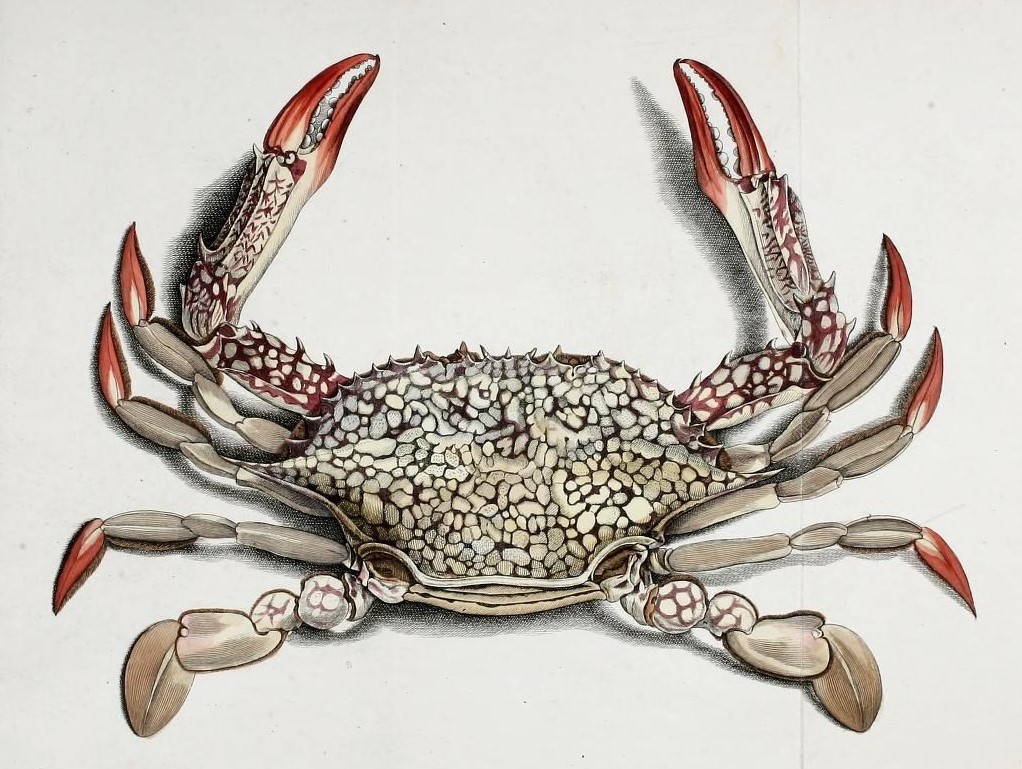
His expression is like a crab
moving sideways and backwards
and forwards at will.
The eyes, the nose,
the mouth, are as restless as small dogs.
They can’t settle on a frown.
And a smile is seemingly beyond them.
We stand before him,
our fingers clutching and unclutching,
together elsewhere,
but insecurely tethered here.
We came to tell him
but it feels as if we’re asking his permission.
I know my own mind.
You know yours.
But that’s still one mind short.
About the Author: John Grey is an Australian poet, US resident, recently published in Sheepshead Review, Stand, Poetry Salzburg Review and Hollins Critic. Latest books, “Leaves On Pages” “Memory Outside The Head” and “Guest Of Myself” are available through Amazon. Work upcoming in Ellipsis, Blueline and International Poetry Review.
.
Image Credit: Versuch einer Naturgeschichte der Krabben und Krebse: Berlin ;Bei Gottlieb August Lange,1782-1804. Image courtesy of the Biodiversity Heritage Library
Author’s Note: These poems, along with several hundred others, are part of a larger erasure collection entitled Pocatello Wildflower, which examines the words of a group of Idaho writers who worked primarily from the 1970’s to the 1990’s, including the late Bruce Embree, who really got the ball rolling in my head and heart, with a few still working today. It is my great hope that folks will be interested in the original writers work, in addition to my own. Pocatello Wildflower will be available in 2023 from Crisis Chronicles Press. Thanks for reading.
My Parents

strangers raised us
in ditchbank weeds
on combat rations

it was love
& bruises
no pity
in the blowing dust.


Moving Past the Fetish

last year’s growing storm
a lost friend

famous people
not humping boulders
like me
in the foolish
september moon.


The River of Lovers

could burn enough nostalgia
to find comfort
in our past

a whirl of wind.


Rosie Died

goats
river rock

his father never blinked
feet first

alley shadows
lilacs

a bad dream
catches in his throat.


Pocatello Tattoo

i lost my horse

my body
a boxcar
of coaldust

pocatello
pocatello
pocatello

this country of shame
died in the trees

rolled west
in shoshone
in boise

in pocatello
pocatello
pocatello

april whiskey
on the spot

where the sun goes down
like a red-hot needle.
About the Author: John Dorsey lived for several years in Toledo, Ohio. He is the author of several collections of poetry, including Teaching the Dead to Sing: The Outlaw’s Prayer (Rose of Sharon Press, 2006), Sodomy is a City in New Jersey (American Mettle Books, 2010), Tombstone Factory, (Epic Rites Press, 2013), Appalachian Frankenstein (GTK Press, 2015) Being the Fire (Tangerine Press, 2016) and Shoot the Messenger (Red Flag Poetry, 2017),Your Daughter’s Country (Blue Horse Press, 2019), Which Way to the River: Selected Poems 2016-2020 (OAC Books, 2020), Afterlife Karaoke (Crisis Chronicles Press, 2021) and Sundown at the Redneck Carnival, (Spartan Press, 2022).. His work has been nominated for the Pushcart Prize, Best of the Net, and the Stanley Hanks Memorial Poetry Prize. He was the winner of the 2019 Terri Award given out at the Poetry Rendezvous. He may be reached at archerevans@yahoo.com.
After surgery

he surfaces drowsy
from anesthesia
sees his wife
by his bedside
reaches out
his hand feels
her shoulder blade
relieved he sighs
“No wings!
I am alive!”
About the Author: Agnes Vojta grew up in Germany and now lives in Rolla, Missouri where she teaches physics at Missouri S&T and hikes the Ozarks. She is the author of Porous Land (Spartan Press, 2019) and The Eden of Perhaps (Spartan Press, 2020), and her poems have appeared in a variety of magazines.
Stay a Spell

The cicadas kissed the curves of my ears,
pale fingers fighting nothing but air and the thinness of wings.
Chop, shift, I split the wood again
chop, shift, the butterscotch chips catching in the frays
of an old knitted coat.

Skillet fried dinner blends to skillet fried dessert—
What was that?
A rustle of leaves yields sunny-sides filled with shell
and the squirrel chuckles up his chestnuts.
He picks his shells with ease.

The warm fire deepens the orange of my hair
and blushes the apples of my cheeks.
Oxygen and black smoke trickle through my lungs—
carbon dioxide bleaching the fumes clear.
We need more tinder.

My eyes meet a doe dancing behind the flame.
Thin ankles locked straight to the left and chin whiskers
quirked to the right; she stood firm.
Who was I to stay a spell in her living room?
I didn’t even take off my shoes.
About the Author: Hannah Bagley lives and attends the University of North Georgia in Dahlonega, Georgia. An English literature major and German minor, she has also been published in The Chestatee Review. Hannah draws inspiration from her upbringing in Southern Appalachia and its rich history. She plans to continue poetry in the pursuit of nature, life, and expression of the human experience.
Image Credit: Winslow Homer “Campfire” (1880) Public domain image courtesy of Artvee
“New Highway Promises Development for Local Communities”
                                     The Starkville Daily News

The new highway skirts struggling towns obscured
by second-growth—black jack saplings, pin oak,
scrub pine decked with hand-struck signs for still-born
cafes, yard sales, deer skinners, promises
of God’s wrath, purchases non-refundable.

I wonder who could live in these small towns.
I tell the trees, Not me.  I still look, though,
still try to see how, within their limits,
mysteries keep them seething.  Having failed
with farming, having wheeled to fail at retail,

their faith’s in resurrection.  New highways.
In buyers who’ll slab jack foundations,
true frames, gingerbread all the worn storefronts.
Paint the whole into a groggy, pastel wet dream
with awnings, stratocumulus, lighting subdued

to shade by day, illuminate by night.
The latest iterations in gutter
technology, sewers gussied up.
Rains falling like money will hurry away,
down to the channelized river. Its banks

will blossom with summer homes.  Angelic
water skiers’ wash will lap the cut bank,
will rinse mulish roots, will swamp the hand-struck
signs I’d have placed there:  “No trespassing.”
“Free rooster.”  “Chickens, fresh brown eggs for sale.”
About the Author: Samuel Prestridge, a post-aspirational man, lives and works in Athens, Georgia. He sometimes plays acoustic blues and jazz in local bars under an assumed name. He has been published in Literary Imagination, The Arkansas Review, Southern Humanities Review, As It Ought to Be, Better Than Starbucks, Autumn Skies, among others.
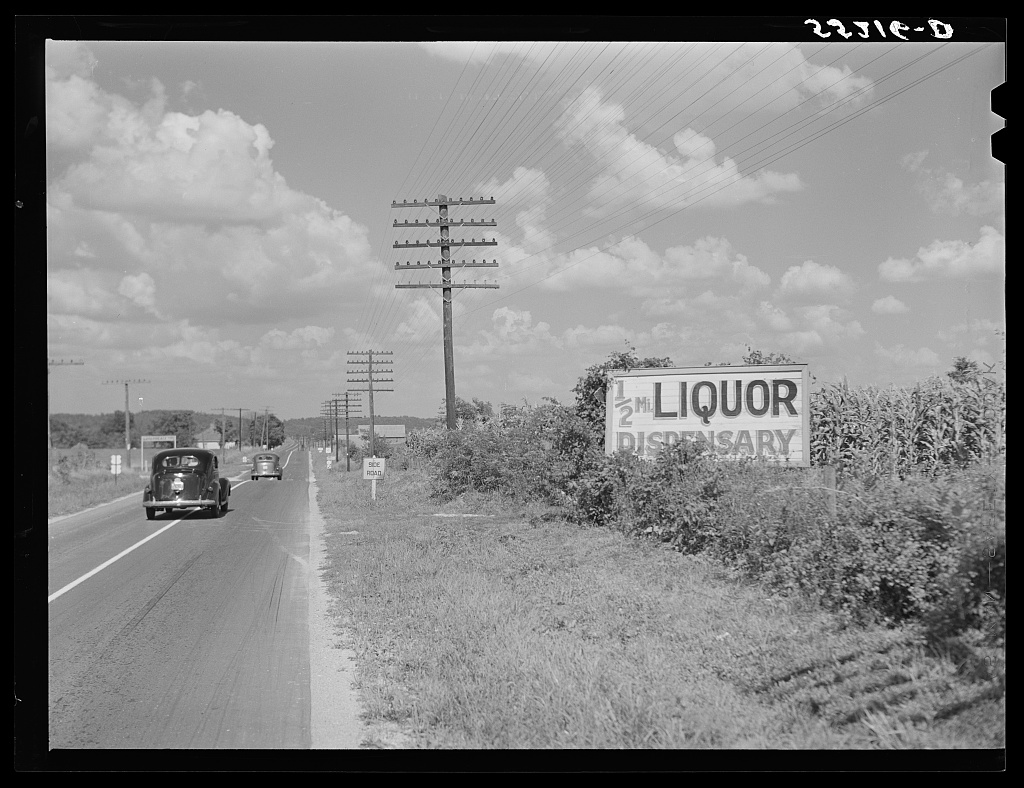
Image Credit: Marion Post Walcott “Signs advertising liquor stores are seen frequently along all Kentucky highways. South of Bardstown” (1940) Public domain image courtesy of the Library of Congress
When I talk about this housesitting gig, which I don’t often, people smile and stare at their shoelaces. They wrap things up, label me “once spunky, now sad”. His cats are throwing up everywhere. It is raining. The problem is that I am standing in his kitchen; in an apartment on a sinister street on a landfill-ridden plot covered in drab apartment complexes. The town is called Baggageport. Not worse than Intercourse, Pennsylvania or Hell, Michigan. Sighing and smoking and huddling there next to the cats… peeking out at the neat world.
About the Author: Meg Pokrass is the author of 8 collections of flash fiction.
Image Credit: Harris & Ewing “Cats” (1923) Public domain photo courtesy of the Library of Congress
collection days

it seems as archaic
as kids carrying newspapers now

but they used to give us
a thick ring full of cardboard paper
cut into perforated tabs

they acted as receipts
when people paid you for their papers

once a week
in summer or after school

i had to walk my paper route
with the ring of cardboard tabs
knocking on people’s doors
to get the post-gazette’s money

in winter
i saw the dark on both ends of the day

i was the great interrupter of dinners
sexy time after long days at work
of infants falling asleep after hours of struggle

the great ruiner of
children’s birthdays and underage parties

i stood at closed doors
listening to hushed voices
hoping that i’d just go away

while the same dogs that barked at me in the morning
got a second chance to go at me in the evening

the people who condescended
to open their doors
looked at me as if they didn’t understand

like their newspaper just arrived
by some voodoo or magic

and not by some fat kid
trudging along in the rain or snow
or the humid damp of summer heat

i delivered to rich people with big houses
but no one ever had the money to pay me

next week, they’d say
and i’d walk away from their homes
my labor given away free for another week

left to explain to my angry dispatcher
why i didn’t have his cash some saturday

promising him
i’d have his money come next monday

like i was some errant tenant
or a goddamned junky begging to a dealer

a feeble man with empty pockets
and a huge-ass gambling debt

who’d let his life fall off the rails
yet again.
About the Author: John Grochalski is the author of the poetry collections, The Noose Doesn’t Get Any Looser After You Punch Out (Six Gallery Press 2008), Glass City (Low Ghost Press, 2010), In the Year of Everything Dying (Camel Saloon, 2012), Starting with the Last Name Grochalski (Coleridge Street Books, 2014), The Philosopher’s Ship (Alien Buddha Press, 2018), and Eating a Cheeseburger During End Times (Kung Fu Treachery, 2021). He is also the author of the novels, The Librarian (Six Gallery Press 2013), Wine Clerk (Six Gallery Press 2016), and P-Town: Forever (Alien Buddha Press, 2021). Grochalski currently lives in Brooklyn, New York. You can read his baseball card ramblings at his Junk Wax Jay blog https://junkwaxjay.blogspot.com/
.
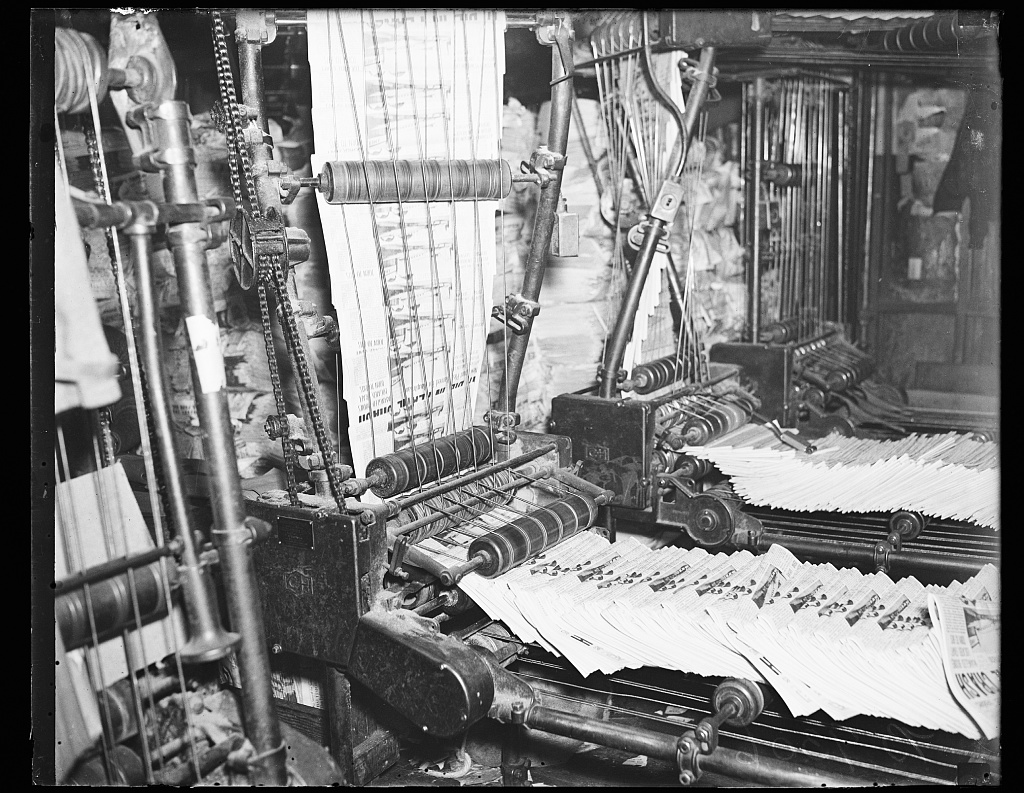
Image Credit: Harris& Ewing “Newspapers Coming Off Press” (1936) Public domain photograph courtesy of the Library of Congress
In his essay, “Reflections on Wallace Stevens,” the poet and critic Randall Jarrell wrote, “A good poet is someone who manages, in a lifetime of standing out in thunderstorms, to be struck by lightning five or six times; a dozen or two dozen times and he is great.” James Dickey was fond of quoting Jarrell’s line to students and in interviews. The quote encapsulates Dickey’s ambition as well as the luck involved in literary reputations.
Gordon Van Ness offers the definitive biography of James Dickey and reviews how the reputation of Dickey’s work has collapsed since the 1960’s when he was, with Robert Lowell, considered one of the two most important poets in America. For those who are familiar with Dickey’s life, either through literary gossip or from the previous hatchet work of Henry Hart’s biography, it offers a familiar rise and fall.
During the 1950’s and 1960’s, James Dickey published an extraordinary number of well received poems, essays, and book reviews. His work regularly appeared in magazines such as the New Yorker and the Atlantic. His 1965 collection, Buckdancers’s Choice, won the National Book Award. Then, in 1970, he published his first novel Deliverance. The adventure story of four men going down a river was a tremendous best-seller. Two years after the novel’s publication it became a hit movie. Dickey wrote the screenplay and even had a memorable role as the sheriff. It was at this point that celebrity began to replace the artist.
Van Ness makes clear that Dickey enjoyed fame. He wrote several lucrative coffee table books and accepted commissions for a few occasional poems. One of these, “The Strength of the Fields,” was read by Dickey as part of Jimmy Carter’s 1976 inaugural. (The poem is one of the best examples of a “public poem” and has aged better than similar pieces from other inaugural poets.)
What Van Ness also makes clear is that after the summation of his work in Poems: 1957-1967 Dickey became interested in a different kind of poetry. Dickey’s work, in what he referred to as his “early motion,” ranges from the narrative to the lyric, from the mystic to the confessional, from the formal to the experimental. A reader would be hard pressed to find a more various or successful book of poetry and Poems: 1957-1967 remains comparable to Pound’s Personae and Steven’s Harmonium.
The later poetry (the work after 1967) is both more rhetorical and more visual. The poems often range across the page with word and image clusters which sometimes mirror a speaker’s breath units and sometimes mirror high energy synapses firing. While many individual passages often stand out, the poems are less successful and more indulgent. Dickey’s later work often asks more of the reader than it gives.
Van Ness does a fine job of covering the later work and how it relates to Dickey’s life. He reviews the critical and public reception of Dickey’s two later novels, Alnilam and To the White Sea, as well as the wildly mixed response to his late poetry collection Puella. He also spends a considerable amount of time discussing Dickey’s role as a teacher at the University of South Carolina. Van Ness was a student of Dickey’s in the 1980’s and the exuberance Dickey often brought to the classroom is apparent.
Exuberance is a key word for describing Dickey’s best work. In poems like “Cherrylog Road,” “On the Hill Below the Lighthouse,” “Adultery,” “The Performance,” “The Lifeguard,” and “To Be Done in Winter” Dickey’s work seems bathed in vitality and life joy. His poetry is not concerned with mundane, small moments. It is concerned with transcendence.
There are many reasons why Dickey’s reputation has dimmed over the last fifty years. Van Ness covers all of them. His womanizing and alcoholism wrecked many of his friendships and some readers and critics remain willing to dismiss his work based on the numerous misbehaviors of his life. Also, unlike one of his contemporaries, James Wright, Dickey outlived most of his best work. To quote Nietzsche out of context, Dickey did not “die at the right time.” Finally, the type of masculinity Dickey publicly embodied (think John Wayne and Ernest Hemingway combined with erudition and southern twang) is now out of fashion.
Van Ness does a fine and necessary job of separating Dickey’s indulgences from his art. He focuses on key early works and adds understanding and appreciation to later, overlooked gems. As someone who has edited two volumes of Dickey’s letters, his early notebooks, and a posthumous collection of late poems, Van Ness is a worthy guide to Dickey’s work. In writing this biography he sends the reader back to Dickey’s poetry and fiction. Dickey remains a poet with a lightning rod, wide awake as he walks through a crackling summer field.
.
James Dickey: A Literary Life, by Gordon Van Ness
Mercer University Press, 2022
Biography, $45
About the Author: Mike James makes his home outside Nashville, Tennessee. He has published in numerous magazines, large and small, throughout the country. His most recent book, Portable Light: Poems 1991-2021, was published by Red Hawk in April 2022. Mike’s previous poetry collections include: Leftover Distances (Luchador), Parades (Alien Buddha), Jumping Drawbridges in Technicolor (Blue Horse), and Crows in the Jukebox (Bottom Dog.)
.
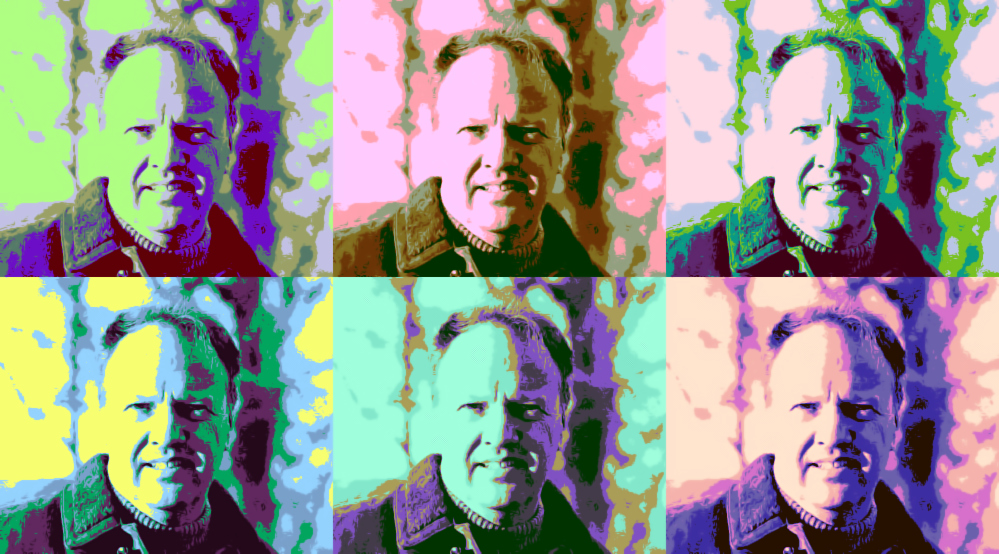
Image Credit: Digitally remixed image of a public domain James Dickey photo
The Prodigal Daughter Searches for Her Home


I am repulsed by the city:
the noise, the filth
the way you can see it from space.
Yet it is as natural as
a bird’s nest or
a prairie dog town
as natural as I am.
For if it is not natural
then I, born of the species
who made it,
am nothing but an alien
on the world of my birth.

In order to reconcile myself to me
I placed my hand on a large building
with its steel, concrete
and glass upon glass that doesn’t open.
I tried to feel as I have felt
when I have placed my hand on a tree
and felt that it was part of me
part of the world.
Its right to exist not open to question.

I failed my test.
I cannot feel the life in this building.
I cannot feel the buzzing of its
electrons connecting with the palm
I have placed upon it.

I have run, hidden, stayed away
from the city for years.
But it is part me
as much as anything else is.
If I cannot own this part of me
how much of myself will I have lost?
How can I be part of this world
if I don’t own this building?

Or must I forever
be an exile
in my own body?
About the Author: Sally Dunn’s poetry has appeared in Schuylkill Valley Journal, North Dakota Quarterly, Plainsongs and Glass Mountain among others. Her poetry won third place in the Joe Gouveia Outermost Poetry Contest. She lives on Cape Cod.
.
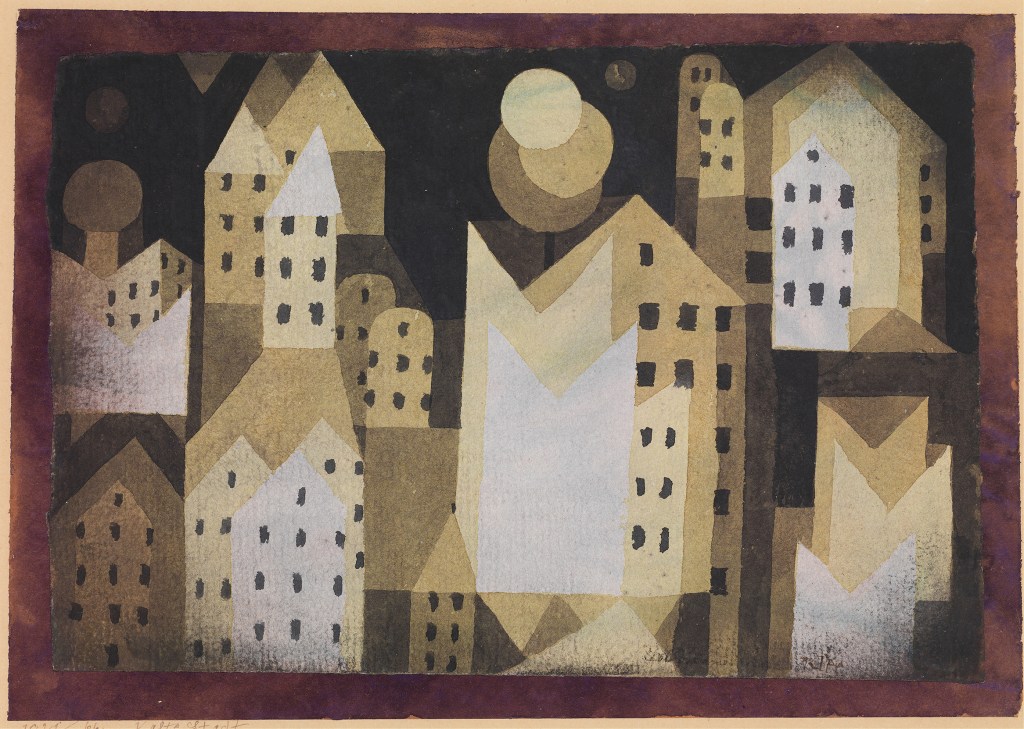
Image Credit: Paul Klee “Cold City” (1921) Public Domain
The Scientist After the Operation

A couple weeks after the operation,
he finally can sit outside,
under the enormous black walnut tree
that hasn’t yet succumbed to a storm
although it loses limbs each time.
He holds in his lap a biography
of Gregor Mendel, the monk
who cross-bred plants
and discovered genetic inheritance.

At one point, he had thought about
the church as a career. His mother had
suggested it would be a good place
for someone with his “proclivities,”
a comment so complicated he kept
returning to the statement for years
trying to determine if it was caring,
Machiavellian or something else.
He had studied science instead.

She doesn’t know he’s sick.
They haven’t talked since the wedding
when the state finally allowed him
and Greg to be a legal couple,
and yet, this was when
his grandmother began talking
openly to him about relationships
in the months before her death.
Some things skip a generation.
Some things never get passed down.

He sees Greg glancing out
the kitchen window, checking
to make sure he’s okay,
awake, still alive,
and he waves the book
to reassure his partner,
like a preacher with a bible
About the Author: A faculty member at the University of North Carolina School of the Arts, Joseph Mills holds the Susan Burress Wall Distinguished Professorship in the Humanities. He has published seven volumes of poetry, most recently Bodies in Motion. His collection This Miraculous Turning was awarded the North Carolina Roanoke-Chowan Award for Poetry for its exploration of race and family.



 As It Ought To Be
