FRIDAY POETRY SERIES PRESENTS: Kenneth Fearing

X Minus X

by Kenneth Fearing


Even when your friend, the radio, is still; even when her dream, the magazine, is finished; even when his life, the ticker, is silent; even when their destiny, the boulevard, is bare;
And after that paradise, the dance-hall, is closed; after that theater, the clinic, is dark,

Still there will be your desire, and hers, and his hopes and theirs,
Your laughter, their laughter,
Your curse and his curse, her reward and their reward, their dismay and his dismay and her dismay and yours—

Even when your enemy, the collector, is dead; even when your counsellor, the salesman, is sleeping; even when your sweetheart, the movie queen, has spoken; even when your friend, the magnate, is gone.


Kenneth Fearing(1902-1961) was an American poet, novelist, speechwriter, editor, and journalist. One literary critic named him “the chief poet of the American Depression.” He helped found the Partisan Review and took an active interest in leftist politics while also churning out pulp fiction that sometimes bordered on the pornographic under the pseudonym Kirk Wolff. His poetry uses contemporary vernacular to probe the grotesque in the urban landscape.

SATURDAY POETRY SERIES PRESENTS: JIMMY SANTIAGO BACA


THEY ONLY CAME TO SEE THE ZOO

by Jimmy Santiago Baca


Our muscles warped and scarr’d
Wrap around our skeletons
Like hot winds
That sweep the desert floor
In search of shade,
Sleeping each night
In the hollow of petrified
Skulls.
And from our mouths
Words of love would come
If we let them,
Like molten stones shrieking
From the belly of a volcano
But standing at these bars
We watched you leave
And only wondered…
You looked up at us with passion
As we stood at the bars.
A vacuum swelled at our hands
Went pale, our fingers cold
The gray pity of our lot
Made you turn away
But our spirits met that moment
Faraway in the land of Justice
And we whispered with our eyes,
”Come closer”
But you did not.
It’s been so long now
Since you left.
Did you tell them?
Hell is not a dream
And that you’ve been there?
Did you tell them


Jimmy Santiago Baca was born in Santa Fe, New Mexico in 1952 where he lived in a two-room shack with his alcoholic father, his mother, and his brother and sister. When he was two years old, Baca’s parents abandoned him and he and his siblings moved into their grandparent’s shack. Baca eventually moved into an orphanage and later, a detention center. Finally—when Baca was only 15 years old—he graduated to living on the streets. When Baca was 21, he was sentenced to five to ten years in a maximum-security prison in Arizona for dealing drugs. In prison, Baca taught himself how to read and write and developed a passion for writing poetry. Baca, who corresponded with several established poets while he was in prison, first published his poetry while he was still incarcerated. After he was released, he publishing his first major collection of poetry, Immigrants in Our Own Land, which is based on his prison experience. Since then Baca has released several other books of poetry, a collection of essays and stories, screenplays, and a memoir. Additionally, Baca conducts writing workshops at numerous schools and correctional facilities across the county. In 2003, Baca received his PhD in Literature from New Mexico University. (Annotated biography of Jimmy Santiago Baca courtesy of Youngstown State University.)

Editor’s Note: This post was by request, and it was requested that this poem be dedicated to all prisoners everywhere. If you have a request of your own please feel free to post it as a comment.

I love the idea of poetry as a means of redemption and as a means of finding your voice. I hope this post inspires people to find their own voices and their own freedom through poetry and art. “And from our mouths words of love would come, if we let them.”

Want to read more by and about Jimmy Santiago Baca?
Official Website
Poets.org
Youngstown State University

FRIDAY POETRY SERIES PRESENTS: Lawrence Raab

Marriage

by Lawrence Raab


Years later they find themselves talking
about chances, moments when their lives
might have swerved off
for the smallest reason.
What if
I hadn’t phoned, he says, that morning?
What if you’d been out,
as you were when I tried three times
the night before?
Then she tells him a secret.
She’d been there all evening, and she knew
he was the one calling, which was why
she hadn’t answered.
Because she felt—
because she was certain—her life would change
if she picked up the phone, said hello,
said, I was just thinking
of you.
I was afraid,
she tells him. And in the morning
I also knew it was you, but I just
answered the phone
the way anyone
answers a phone when it starts to ring,
not thinking you have a choice.


Lawrence Raab employs refreshingly simple language to explore memory, love, and a mysterious inevitability.   “Marriage” appeared in his collection of poems titled, What We Don’t Know About Each Other. The book won the National Poetry Series and was a finalist for the 1993 National Book Award. His latest work, A History of Forgetting, may not be as flashy as some of his earlier poetry, but finds the poet settled into a moody pathos that has some critics drawing comparisons to Thomas Hardy.

FRIDAY POETRY SERIES PRESENTS: William Wordsworth

A Slumber Did My Spirit Seal

by William Wordsworth


A slumber did my spirit seal;
I had no human fears:
She seemed a thing that could not feel
The touch of earthly years.
No motion has she now, no force;
She neither hears nor sees;
Rolled round in earth’s diurnal course,
With rocks, and stones, and trees.


William Wordsworth (1770 – 1850) was an English Romantic poet who defined poetry as “the spontaneous overflow of powerful feelings: it takes its origin from emotion recollected in tranquility.” Unconventional for his time, he advocated the use of everyday language in verse. Also unusual was his choice of subject matter – primarily nature, but also women, children, the poor, and the oppressed. This revolutionary style gradually transformed into mainstream acceptability and Wordsworth was eventually named Poet Laureate of England in 1843.

SATURDAY POETRY SERIES PRESENTS: ANI DIFRANCO


FUEL

by Ani Difranco


They were digging a new foundation in Manhattan
And they discovered a slave cemetery there
May their souls rest easy
Now that lynching is frowned upon
And we’ve moved on to the electric chair
And I wonder who’s gonna be president, tweedle dum or tweedle dummer?
And who’s gonna have the big blockbuster box office this summer?
How about we put up a wall between houses and the highway
And you can go your way, and I can go my may

Except all the radios agree with all the tvs
And all the magazines agree with all the radios
And I keep hearing that same damn song everywhere I go
Maybe I should put a bucket over my head
And a marshmallow in each ear
And stumble around for
Another dumb-numb waiting for another hit song to appear

People used to make records
As in a record of an event
The event of people playing music in a room
Now everything is cross-marketing
Its about sunglasses and shoes
Or guns and drugs
You choose
We got it rehashed
We got it half-assed
We’re digging up all the graves
And we’re spitting on the past
And you can choose between the colors
Of the lipstick on the whores
Cause we know the difference between
The font of 20% more
And the font of teriyaki
You tell me
How does it… make you feel?

You tell me
What’s … real?
And they say that alcoholics are always alcoholics
Even when they’re as dry as my lips for years
Even when they’re stranded on a small desert island
With no place within 2,000 miles to buy beer
And I wonder
Is he different?
Is he different?
Has he changed? what’s he about?..
Or is he just a liar with nothing to lie about?

Am I headed for the same brick wall
Is there anything I can do about
Anything at all?
Except go back to that corner in Manhattan
And dig deeper, dig deeper this time
Down beneath the impossible pain of our history
Beneath unknown bones
Beneath the bedrock of the mystery
Beneath the sewage systems and the PATH train
Beneath the cobblestones and the water mains
Beneath the traffic of friendships and street deals
Beneath the screeching of kamikaze cab wheels
Beneath everything I can think of to think about
Beneath it all, beneath all get out
Beneath the good and the kind and the stupid and the cruel
There’s a fire just waiting for fuel

There’s a fire just waiting for fuel


You can listen to “Fuel” by clicking on the “Play song from Lala.com” link here.


Ani Difranco is an American singer, guitarist, and songwriter. She has released over twenty albums, is a Grammy Award winner, and is a feminist icon.

Editor’s Note: This post was by request. If you have a request of your own please feel free to post it as a comment.

Today’s post continues our conversation about music and poetry, and whether songs are, in fact, poetry. The consensus from our earlier discussion seems to be a resounding yes, and I agree.

For me, some songwriters are really getting at the heart of poetry with their lyrics. Ani Difranco is at the top of this list for me. My personal favorite Ani Difranco lyric is from “32 Flavors” and reads “and god help you if you are an ugly girl / course too pretty is also your doom / cause everyone harbors a secret hatred / for the prettiest girl in the room / and god help you if you are a phoenix / and you dare to rise up from the ash / a thousand eyes will smolder with jealousy / while you are just flying past.” I simply cannot see that as anything other than poetry.

I think today’s piece is extremely exemplary of how a song can be poetry. If you listen to the recorded version you will see that Difranco essentially speaks the entire song. This is almost more of an example of spoken word poetry with accompanying music than it is a song, and yet, it is featured as a song on the artist’s album “Little Plastic Castle.” Beyond that, the song covers topics such as politics and the state of the world today – topics traditionally covered in poetry.

Want to read more by and about Ani Difranco?
Ani Difranco lyrics from a devoted fan
MySpace
Wikipedia

FRIDAY POETRY SERIES PRESENTS: Amy Fleury

At Twenty-Eight

by Amy Fleury


It seems I get by on more luck than sense,
not the kind brought on by knuckle to wood,
breath on dice, or pennies found in the mud.
I shimmy and slip by on pure fool chance.
At turns charmed and cursed, a girl knows romance
as coffee, red wine, and books; solitude
she counts as daylight virtue and muted
evenings, the inventory of absence.
But this is no sorry spinster story,
just the way days string together a life.
Sometimes I eat soup right out of the pan.
Sometimes I don’t care if I will marry.
I dance in my kitchen on Friday nights,
singing like only a lucky girl can.


Amy Fleury’s upbringing in rural Kansas shaped her unadorned poetic style and her appreciation for the outdoors. Her first book of poetry, Beautiful Trouble, received the Crab Orchard Series in Poetry First Book Award. She is currently the poet-in-residence at her alma mater, McNeese State University.


SATURDAY POETRY SERIES PRESENTS: MAC OLIVER


A pen-and-ink drawing of Wallace Stevens by Mac Oliver.


ANOTHER DEATH TO BRAVE

by Mac Oliver


And soon enough, foreseeably, you’ve lost
Another one you love, another death
To brave, more ashes thrust into your face,
More thoughts about the walks, forgotten nights,
More dust to walk upon, to think of ghosts
Of the departed, real as a dream
From which you had no wish to wake, in which
They breathe & blink again. I’m vexed at his
Brown study now, as Ransom wrote, a poem
Present in a half a dozen books,
Anthologies, he gave as Christmas gifts.
He left a stack of ancient magazines,
A trunk he tagged for me before he died,
A simple note attached to it, unseen
At first, left hidden in the flat, that said
“These items are for Ham, to be preserved.”
He made his living room, entire place,
Hospitable to poetry, to keep
A kind of purity at heart, in mind.
The rest, as Hazlitt quotes from As You Like It,
Is mere oblivion, a dead letter.


Mac Oliver is a bit of a mystery. As I can piece together, he earned his degree from Tulane in 1994 and went on to study poetry in the Doctoral program at the University of Minnesota. His first book of poems, Ham & Mercury, was printed privately, and another book of poetry, Savior of the Netherlands, is available in full online for free. Oliver is also a pen-and-ink artist, and, at least in 2008, a resident of Santa Barbara, California.

Editor’s Note: This poet was by request. If you have a request of your own please feel free to post it as a comment.

This happens to be my favorite request thus far on the Saturday Poetry Series, which is why I jumped at the opportunity to post it straight away. It was requested that I post any poem by this poet “because he is beautiful and I love him but I’ll never be able to tell him.” Now, the hopeless romantic in me was instantly won over. Unrequited love, a mystery love story, and a poet who is himself a mystery. How could I possibly resist?

What I can glean from the limited information about Mac Oliver on the web is that Oliver is a poet influenced by the poets of yore. He seems to like to explore poetry in form and uses antiquated language to create poems that are vignettes and that function like flash fiction. He also was strongly influenced by his uncle, to whom his book Savior of the Netherlands is dedicated, and who makes a number of appearances throughout Oliver’s work. I believe, from the context of the book, that “Another Death to Brave” may be about his uncle as well. Oliver was also strongly influenced by T.S. Eliot, James Joyce, Wallace Stevens, and Ezra Pound, which I think is evident in his use of form and choice of language.

Want to read more by and about Mac Oliver?
Savior of the Netherlands
Pen Drawings by Mac Oliver at Elsie’s
Maverick Magazine

FRIDAY POETRY SERIES PRESENTS: John Surowiecki

What I Know About Epistemology

by John Surowiecki


As the light goes, go.
Be the rustling in the grass, the fall from
convention’s good graces: learn, or someone
will have you filing files or writing writs,
demonstrating cutlery or selling knowledge

door to door; someone might even drop
your lovely life into a factory and have you
derusting rings on the coolant-spouting
turntable of a vertical lathe.
It’s best for everyone that what you know

is generally thought of as general knowledge.
You can find it in pool rooms and roadside bars,
in meadows as inviting as beds, in bedrooms
where it whispers like a ribbon untying;
you can even find it in schools. But be careful:

it’s dangerous, inescapable and exact
down to every atom of everything there is,
to every name each thing goes by and every
law each thing obeys. And the best part is,
you always know more than you know.


John Surowiecki works as a freelance writer from his home in Connecticut. His work has appeared in numerous journals and anthologies. Author of six chapbooks and three books of poetry, his most recent work is Barney and Gienka (CustomWords, 2010).


[Image: White Noise/White Light, Athens, by Höweler + Yoon/MY Studio].

SATURDAY POETRY SERIES PRESENTS: ANTONIO MACHADO

LAST NIGHT, AS I WAS SLEEPING, I DREAMT MARVELOUS ERROR!

by Antonio Machado


Last night, as I was sleeping,
I dreamt — marvelous error! –
that a spring was breaking
out in my heart.
I said: Along which secret aqueduct,
Oh water, are you coming to me,
water of a new life
that I have never drunk?

Last night, as I was sleeping,
I dreamt — marvelous error! –
that I had a beehive
here inside my heart.
And the golden bees
were making white combs
and sweet honey
from my old failures.

Last night, as I was sleeping,
I dreamt — marvelous error! –
that a fiery sun was giving
light inside my heart.
It was fiery because I felt
warmth as from a hearth,
and sun because it gave light
and brought tears to my eyes.

Last night, as I slept,
I dreamt — marvelous error! –
that it was God I had
here inside my heart.


Antonio Machado (1875-1939) was one of Spain’s most esteemed modern poets. He has been referred to as “a poet of time and memory.” Machado was prominent in the Spanish literary movement known as The Generation of ’98. He published a number of works during his lifetime, beginning with Soledades in 1903 and ending with Juan de Mairena in 1936. Machado’s death was related to the Spanish Civil War. When he died, in his pocket was found his last poem, “Estos días azules y este sol de infancia.

Editor’s Note: This poem was a request. If you have a request of your own please feel free to post it as a comment. Of course, I will not post a poem that I do not stand behind. But how can one not stand behind a poem by one of Spain’s greatest modern poets, especially one with such a line as: “And the golden bees were making white combs and sweet honey from my old failures.” I have yet to find poets that blow me away in quite the way that Spanish poets do.

Want to read more by and about Antonio Machado?
Poetry Chaikhana
Famous Poets and Poems
Green Integer

SATURDAY POETRY SERIES PRESENTS: FEDERICO GARCIA LORCA


SONG OF THE BARREN ORANGE TREE

by Federico Garcia Lorca


Woodcutter.
Cut my shadow from me.
Free me from the torment
of seeing myself without fruit.

Why was I born among mirrors?
The day walks in circles around me,
and the night copies me
in all its stars.

I want to live without seeing myself.
And I will dream that ants
and thistleburrs are my
leaves and my birds.

Woodcutter.
Cut my shadow from me.
Free me from the torment
of seeing myself without fruit.

“Song of the Barren Orange Tree” by Federico García Lorca, from THE SELECTED POEMS OF FEDERICO GARCÍA LORCA. Translated by W. S. Merwin, copyright © 1955 by New Directions Publishing Corp.

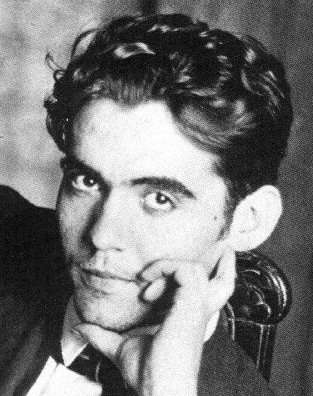
Federico Garcia Lorca (1898-1936) was a Spanish poet, dramatist and theatre director. García Lorca achieved international recognition as an emblematic member of the Generation of ’27. He is thought to be one of the many thousands who were ‘disappeared’ and executed by Nationalists at the beginning of the Spanish Civil War.
(Annotated biography of Federico Garcia Lorca courtesy of Wikipedia.org.)

Editor’s Note: I think few poems have achieved what this poem does. This poem both inspires me to want to be a better poet and intimidates me with its greatness.

Want to read more by and about Federico Garcia Lorca?
Poets.org
The NY Times
Repertorio.org