SATURDAY POETRY SERIES PRESENTS: AMY WATKINS

MURMURATION
By Amy Watkins

An osprey beats the wind with bowed wings,
steady till it drops and shakes in flight.
The wind catches and it rises again.
I watch from the porch where I’ve come early
to stop avoiding our father’s call. Last night,
I turned the ringer off then on then off again,
swiped down to ignore but texted back.
There are two birds in the tree across the street
and a third circling and circling, rising and falling
in the wind from a distant hurricane.
The phone rings. He wants to talk about you.

They say each bird attends to just seven others, and,
in this way, a thousand starlings turn together
like one creature. I’ll try not to make this a metaphor.
Once, you and I climbed the hills outside
Florence, Italy. Our dearest ones climbed with us
and, because we were few and each one loved
by all the others, I thought we made a kind of net
that might hold the breaking world together.
A murmuration of starlings unfurled like the aurora
borealis, a sheer curtain caught in wind,
twisting, tracing a path through twilight.

A hawk swoops low over the osprey nest.
I think it might land, but it doesn’t. You ask to meet
for coffee. Our father calls, and I don’t answer.


Today’s poem previously appeared in SWWIM and appears here today with permission from the poet.


Amy Watkins grew up in central Florida surrounded by saw palmetto and sugar sand and a big, close-knit, religious family: the kind of upbringing that’s produced generations of southern writers. She married her high school sweetheart, had a baby girl, and earned her MFA in writing from Spalding University. She is the author of two chapbooks forthcoming in 2019: Wolf Daughter (Sundress Publications) and Lucky (Bottlecap Press). Follow her on Twitter @amykwatkins.

Contributing Editor’s Note: Amy Watkin’s poem, “Murmuration,” is a coming together of worlds. First, there’s the easy mixture of nature and the modern digital world. She closely watches ospreys, how one “drops and shakes in flight. / The wind catches and it rises again.” and then “two birds in a tree across the street / and a third circling, rising and falling.” These innate animal behaviors echo her own modern-day habits with her cell phone—“I turned the ringer on then off again, / swiped down to ignore but texted back.”

She also employs the world of the sacred and the secular, which she hints at through controlled and purposeful ambiguity in word choice. For instance, Watkins selects the homonym “bowed” for the angle of the osprey’s wings in flight. When she decides to finally take a phone call from her dad, it becomes a holy act when she arrives “early / to stop avoiding our father’s call.” Her level of her control and precision is astonishing when, for a moment, she takes herself out of the poem and cautions the reader “I’ll try not to make this a metaphor.” Of course, this line has just the opposite effect and we focus more intensely on the rich metaphors throughout the poem.

Watkins pays pays off the title of the poem in grand style describing “A murmuration of starlings unfurled like the aurura / borealis,”—a startling and beautiful image that ties everything gracefully together. “Murmuration” is an emotional and beautifully crafted poem that works on many levels. The poem rewards deeply upon close reading.

Want to read more by and about Amy Watkins?
Red Lion Sq.
Burrow Press
Glass: A Journal of Poetry
Drunk Monkeys
Emrys Journal


Contributing Editor Alan Toltzis is the author of The Last Commandment. Recent work has appeared in print and online publications including Hummingbird, Right Hand Pointing, IthacaLit, r.k.v.r.y. Quarterly, and Cold Noon. Find him online at alantoltzis.com.


A NOTE FROM THE MANAGING EDITOR:

After nearly ten years as Contributing Editor of this series, it is an honor and a unique opportunity to share this space with a number of contributing editors, including the one featured here today. I am thrilled to usher in an era of new voices in poetry as the Managing Editor of this series.

Viva la poesia!
Sivan Butler-Rotholz, Managing Editor
Saturday Poetry Series, AIOTB
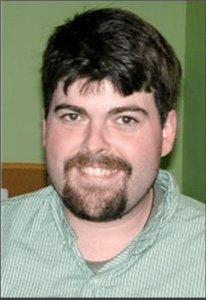
 

SATURDAY POETRY SERIES PRESENTS: CL BLEDSOE

DREAMCATCHER
By CL Bledsoe

Her hair is a tangled field of sweet straw
knocked crooked in heavy winds, catching
any light that stumbles nearby. Maybe this
is why she radiates heat, when I’m trying
to nap, sick, on the couch and she perches high
on my side watching screaming cartoons. Dazzled
strangers stop us on sidewalks to remind us
in case we’ve forgotten: life isn’t always gray. It’s not.
Bees follow us to get at the pollen they can smell
trapped in the mess. I thump them away
when they get too close and scare her. If I had time,
I’d learn to collect their honey, walk her through
the sweetest fields, open a boutique to pay
for college. But I can barely remember to stop smiling
long enough to thank the policeman for the speeding
ticket most mornings. Brushes are an enemy to her,
the confining toil of hair ties lead to tears. Stickers lost
are found. Twigs. Fuzz. All of it down the drain with
the bath water. It won’t last.


Today’s poem previously appeared in Mockingheart Review and appears here today with permission from the poet.


CL Bledsoe‘s most recent books are the poetry collections Trashcans in Love and King of Loneliness and the novel The Funny Thing About… He lives in northern Virginia with his daughter and blogs (with Michael Gushue) at How To Even…

Guest Editor’s Note: There are not many poems full of unabashed joy and magic, but CL Bledsoe’s “Dreamcatcher” is one of them. The language continually surprises as it turns a little girl’s head of blonde hair into a dreamcatcher, full of wonderment and mystery. Bledsoe moves with alacrity and agility from the initial simile that describes his daughter’s hair “as a tangled field of sweet straw / knocked crooked in heavy winds, catching / any light that stumbles nearby.” Nothing in this poem feels forced, even though he never lets an opportunity go by without pushing the language and imagery as hard as he can, to capture the girl’s spirit as she “radiates heat” or “perches high” when “watching screaming cartoons” to reveal the joy he experiences simply by being open to the wonders of his daughter’s essence. This is a poem that truly shows us that “life isn’t always gray” and the wonder that occurs as “Bees follow us to get at the pollen they can smell / trapped in the mess.” Read it, smile, and bask in the sunlight that Bledsoe has captured.

Want to read more by and about CL Bledsoe?
Amazon Author Page
How To Even blog
Not Another TV Dad blog
Not Another TV Dad column


Guest Editor Alan Toltzis is the author of The Last Commandment. Recent work has appeared in print and online publications including Hummingbird, Right Hand Pointing, IthacaLit, r.k.v.r.y. Quarterly, and Cold Noon. Find him online at alantoltzis.com.


A NOTE FROM THE MANAGING EDITOR:

After nearly ten years as Contributing Editor of this series, it is an honor and a unique opportunity to share this space with a number of guest editors, including the editor featured here today. I am thrilled to usher in an era of new voices in poetry as the Managing Editor of this series.

Viva la poesia!
Sivan Butler-Rotholz, Managing Editor
Saturday Poetry Series, AIOTB
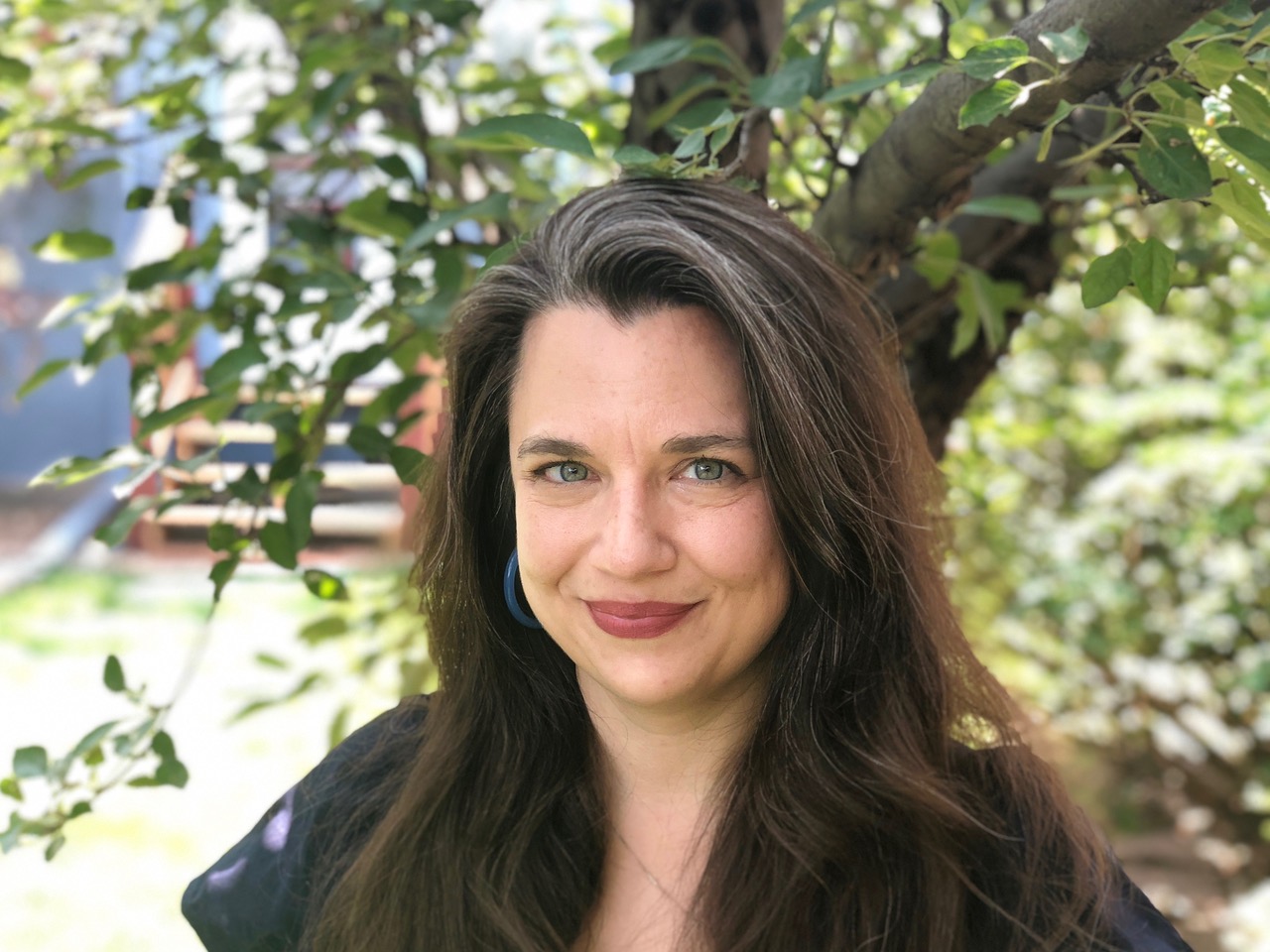
 

SATURDAY POETRY SERIES PRESENTS: NICKY BEER

By Nicky Beer:


DEAR BRUCE WAYNE,

My parents are dead, too.
A dirty, self-cannibalizing Gotham—
I also claim it, its city limits
built by my skin. I slough
and slough, but the city remains.
Tell me, if you’d watched
your mother’s face go
a slow yellow after they cut
off her breast, if you’d watched
your father’s mind get chewed down
to spasms, who would
you fight then? What broken
string of pearls would you chase
into the gutter? Lucky boy
to have an enemy.

*
Admit it—what bugs you
the most about the Joker
is his drag. You suspect
his crayoned mouth a lampoon
of your dead mother.
But don’t you crave,
sometimes, to be a little
tacky? Doesn’t the all-black
bore after a while?
Even your sweet ride can’t help
but leave a little fart of flames
in its wake.
How many others
glare from the shadows
at a one-man parade
in a loud costume, blowing
glitter kisses at grim Justice?
You just think you want
to kill him for better reasons.
What kind of person would trade
laughter for righteousness?

*
Every woman goes out
knowing what you think
you alone had sussed:
the world is a dark alley
hiding a gun in its mouth.
It has more than enough
reasons to make you
cover your face.
The moon waxes. The bruise
wanes. Every woman
is Batman.


Today’s poem first appeared in Issue Four of Cherry Tree, February 2018, and is reprinted here with permission from the poet.


Nicky Beer is the author of The Octopus Game (Carnegie Mellon, 2015) and The Diminishing House (Carnegie Mellon 2010), both winners of the Colorado Book Award for Poetry. She has received awards and fellowships from the National Endowment for the Arts, the Poetry Foundation, the MacDowell Colony, and the Bread Loaf Writers’ Conference. She is an associate professor at the University of Colorado Denver, and a poetry editor for the journal Copper Nickel. You can find her on Twitter at @nbeerpoet.

Guest Editor’s Note: As with all epistolary poems, this one is meant not only for the recipient—in this case Bruce Wayne—but is addressed to readers located in this complicated and frustrating time and place in history. The first line is reminiscent of a fan letter, choosing a shared experience between fan and celebrity that brings them together in some way, but the feeling that they are kindred spirits stops there. What follows in that stanza are philosophical questions about death and justice in the voice of someone who needs to find an enemy to rail against and a tragedy to seek retribution for in order to feel heroic power associated with that “Lucky boy” in line 14. The first stanza braces the reader for more questions for this hero who everyone has been led to believe fights diabolic evil in the world wherever it rears its head and who seems to have misunderstood what it is he is fighting against.

The two stanzas that follow further distance the hero from the letter writer and anyone who holds him in heroic esteem. The second stanza brilliantly questions Mr. Wayne about what really bugs him about the Joker and suggests that perhaps he harbors some jealousy for the evildoer’s colorful style, reducing the Batmobile to a “sweet ride” that can only leave “a little fart of flames / in its wake.” The speaker uses some cunning psychoanalysis on the Caped Crusader, deflating his motives and weakening his stature as a revered hero. The third stanza reveals truths women have always known about the nature of this “dirty, self-cannibalizing Gotham” we live in and how women cope every day in a world that “is a dark alley / hiding a gun in its mouth.” The final lines are a punch just below Batman’s utility belt that knocks the air out of his alter ego, reducing him to a bruise that wanes.

Want to read more by and about Nicky Beer?
Nicky Beer’s Official Website


Guest Editor Anne Graue is the author of Fig Tree in Winter (Dancing Girl Press), and has published poems in literary journals and anthologies, including The Book of Donuts (Terrapin Books), Blood and Roses: A Devotional for Aphrodite and Venus (Bibliotheca Alexandrina), Gluttony (Pure Slush Books), The Plath Poetry Project, One Sentence Poems, Random Sample Review, Into the Void Magazine, Allegro Poetry Magazine, and Rivet Journal.

A NOTE FROM THE MANAGING EDITOR:

After nearly ten years as Contributing Editor of this series, it is an honor and a unique opportunity to share this space with a number of guest editors, including the editor featured here today. I am thrilled to usher in an era of new voices in poetry as the Managing Editor of this series.

Viva la poesia!
Sivan, Managing Editor
Saturday Poetry Series, AIOTB


SATURDAY POETRY SERIES PRESENTS: ERRIC EMERSON

MOTHERLESS

If I try eyes-shut hard;
recall the misty likeness of a stretcher
and air mask, a trailer lined with
ice-fangs in Napanoch, a red ball
I worshipped at three years old.

How your legacy sits in two boxes.
Poor math, crayoned stick-people,
tidy poems you wrote in the 80’s
That are all
formatted
like this.

Pour upon the wording, to have
known you. I scrounge your experiences
to exonerate my own.
The exactness of your malady, father’s
a How-To guide on being in one’s cups.

You get dry in centers and rooms,
found something God-like,
pressed petals between pages,
all piecemealed at my fingertips.

I’m faint praise as a pushing thirty
dry spell. Oh how our quenching throats beg,
didn’t and don’t they?

Pour upon the wording, to
know how. Yet, I’ll remain séance-less.
I’ve found something myself.

How to speak.

TURNCOAT

I put my head on pillow
and wake up with the birds.

When I dream:

I’m adrift in a flowing sea
of rainbow-flavored liquor,
in a boat made from cheap cigarette
cartons, next to a whopper of an impression
of her, who loved my wrong,
who reminds me it’s 2007,
and promises I don’t have
to work tomorrow
or do anything else
ever again.

Today’s poems appear here today with permission from the poet.

Erric Emersony is a poet residing in South Philly, PA. He is a founding member of Duende literary journal for which he also served as poetry editor for the inaugural issue. He’s currently guest editor at Aji literary journal. Erric is a graduate of Goddard College’s Bachelor of Fine Arts Creative Writing program. His first collection, Counting Days, was published in December of 2017. He has published 40+ poems in 20+ magazines including: TL;DR, Crab Fat, The Black Napkin, The Disconnect, FIVE:2:ONE, Beautiful Losers, Prairie Margins, Neon, The Hungry Chimera, Control, Mead: Literature & Libations, Angry Old Man, Rat’s Ass Review, Gingerbread House, Willawaw, and Visitant.

Guest Editor’s Note: Erric Emerson’s poems build mood, feeling, and context by selecting precise details that tell deeply personal and emotional stories. In “Motherless,” Emerson combines distant memories–“the misty likeness of a stretcher / an air mask, a trailer with / ice fangs in Napanoch, a red ball”–with immediate sensations–“how our quenching throats beg”–to link a mother and son. Fragmented recollections from a harsh past and present connect mother and son without resorting to blame or sentimentality, creating a portrait of the two and their relationship both decades ago and today. “Turncoat” recreates a moment of waking when dream and reality combine in a guided wish for unconditional love from “her, who loves my wrong” with the need to escape–“promises I don’t have to / work tomorrow / or do anything else / ever again.” These poems and others in Counting Days are filled with fresh language and harsh realities that create moments and stories filled with deep emotion and angst.

Want to read more by and about Erric Emerson?
Buy Counting Days: Poems on Amazon
“Follow Suit” in Willawaw Journal
“Day One (Zero)” in The Black Napkin, Issue 6
“My Go-To’s” in Visitant

Guest Editor Alan Toltzis is the author of The Last Commandment. Recent work has appeared in print and online publications including Hummingbird, Right Hand Pointing, IthacaLit, r.k.v.r.y. Quarterly, and Cold Noon. Find him online at alantoltzis.com.

A NOTE FROM THE MANAGING EDITOR:

After nearly ten years as Contributing Editor of this series, it is an honor and a unique opportunity to share this space with a number of guest editors, including the editor featured here today. I am thrilled to usher in an era of new voices in poetry as the Managing Editor of this series.

Viva la poesia!
Sivan, Managing Editor
Saturday Poetry Series, AIOTB

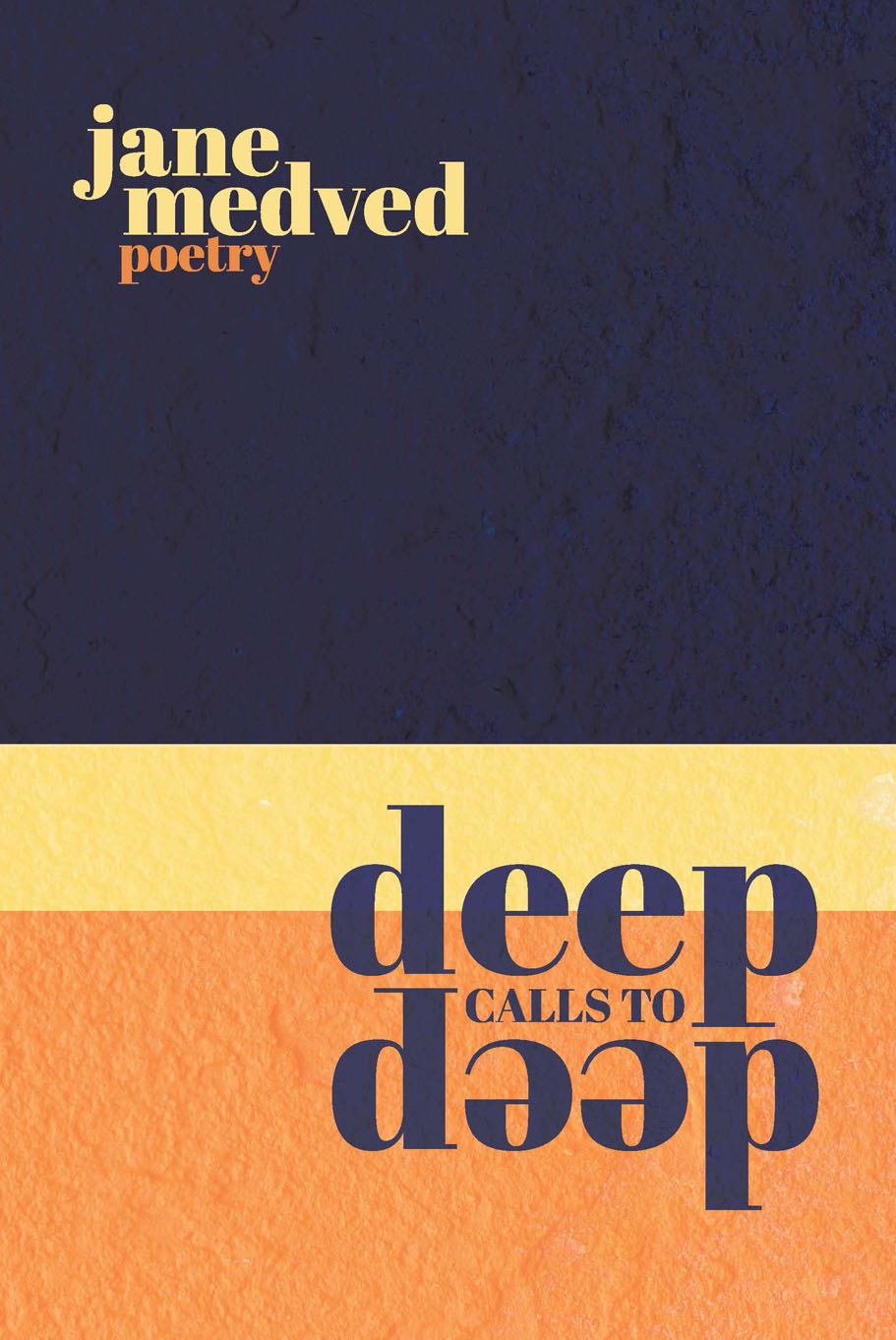
SATURDAY POETRY SERIES PRESENTS: DEEP CALLS TO DEEP


From DEEP CALLS TO DEEP
By Jane Medved:


WINTER BURIAL

For the sky that reaches into its hushed pocket,
                                           for the bridle of winter waiting to be released.

For the ghost face which slips over everyone,
                                           for the tusk of the same white beginning.

For crystals that shape themselves while falling,
                                           for the storm’s icy laugh.

For the charred bars of the petting zoo,
                                           whose cages were made out of wood and went up fast.

For the twin goats trapped, for the small fire they turned their back on,
                                           the bread burning, the coffee.

For the one surviving goose housed in a Little Tikes kitchen,
                                           the black centers of his eyes and the string closing the door.

For the fenced-in storage area now zoned for a park,
                                           where there used to be patches of dried grass.

For the last time it snowed on the Jerusalem highway,
                                           and they wouldn’t let anyone in or out.

For the holiday makers who were stranded
                                           without fun.

For my niece’s baby who never woke up that day,
                                           she was an angel in her crib.

For they got her into the ground just before it froze,
                                           but no one knows where.

For the hidden ear of the tzaddik she is buried next to,
                                           for the cooing she drops into the ground where it melts.

For her small breaths, none of which are
                                           shaped the same.

For the soul, which cracks open the body,
                                           for the body, which is told what it must carry.

For when the ice let me back down the hill,
                                           I found my niece in her kitchen, forgiving everyone.


from THE LAST TIME I SAW HEROD

I. Women’s shelter, Miriam HaHashmonait St., Jerusalem

He was banging on the gate
even though there is no way
to know that we are in here.

He was looking for his wife,
aren’t they all, which is why
we make the children play

in the yard and of course
he knew her real name,
which makes me wonder

what’s the point of being
a princess if even that
can be taken away. I’m not

sorry he looked thin. I used
to feed my own husband
but I never watched him eat.

In my mind he was gulping
me down, tearing everything
apart so as not to miss a piece.


EVERYTHING WILL TELL ITS OWN STORY

sooner or later, coins, a copper lantern,
bits of colored glass, Napoleon’s diary
on loan from Harvard and the endless
lap of water at the world’s toothless edge.

These were found in the Phoenician port
where Napoleon threw his cannonballs
into the Mediterranean to lighten the load.
He wised up soon enough and tossed
his soldiers overboard instead.

The metal balls are shocked into rust
and stare like thick black eyeballs
from their shelf in the dusty museum.
History ignores the bodies though,
their bones turn to fine sand
that tricks the treasure hunters
with its unpredictable lapses. Never mind.

We are all one part ocean anyway,
which is why sex smells like fish, and waves
always come back to a dry river bed.

We are all one part earth, which is why
snow angels cannot fly but lose themselves
to the ground, only the children
leave a clue, a small piece of spine
that still remains even if they are forced into ashes.

We are all one part fire, angry
as a kidney stone, a fist, absolutely certain,
a blaze that hides for months in the smoking
roots of the rotem tree, waiting
to be lifted out, spoken into flame and taken.

We are all one part wind, did you notice
how birds spread out like notes
when they fly, faithful as radio beams
to their unseen connections.

I inhale the invisibility of it, using up
my appointed breaths, certain
that the air will always pass through me
cold and hot and justified.


WHICH IS TO SAY,

                               there is another way home.
                                                                                Just
yesterday, I saw the beating arc of starlings

who migrate to the Negev every year. It was late
and you have to take my word for this. They

became a single body that exhaled a melody
of startled scales made out of bones and feathers,

a flock of notes that scattered to swoop and play,
then reassemble in a different serenade, a fist of

sky squeezing its shape, or the curve of a swan’s
neck.
                   It was remarkable,
                                                      how soundless waves
could cart away the distance,
                                               and how I forgave,
in that moment, everyone.
                                                             Which is to say,

that the desert is a grave and lonely place,
where silence reappears as another kind of music.


Today’s poems are from Deep Calls to Deep (New Rivers Press, 2017), copyright © 2017 by Jane Medved, and appear here today with permission from the poet.


Deep Calls to Deep: “Taking its title from Psalm 42, Deep Calls to Deep explores the nexus between the depths of biblical history and the depths of the self, and the twin powers of faith and doubt that drive them both. Building from a masterful sequence exploring the legacies of Herod to a final richly lyrical sequence, Deep Calls to Deep becomes richer with multiple readings. With stunning formal variety and skill, it enacts not only the struggle to maintain faith, but to ground it equally in past and present, chaos and void, self and other.” — Leslie Adrienne Miller, author of Y and The Resurrection Trade

Jane Medved is the author of Deep Calls to Deep (winner of the Many Voices Project, New Rivers Press 2017) and the chapbook Olam, Shana, Nefesh (Finishing Line Press, 2014) Her recent essays and poems have appeared or are forthcoming in Queen Mob’s Teahouse, The Tampa Review, The Atticus Review, The Cortland Review, 2River View and Vinyl. She is the poetry editor of the Ilanot Review, the on-line literary magazine of Bar Ilan University, Tel Aviv. She lives and teaches creative writing in Jerusalem, Israel.

Editor’s Note: “History ignores the bodies,” but Jane Medved does not. It is through her own determined lens on history that the poet shapes this stunning new collection. The history she embraces is personal and familial, ancient and deeply entrenched, a history of people and place, of nature and land, of violence and loss. One might approach this work like an archaeologist, gentle and sifting, knowing that “coins, a copper lantern, bits of colored glass” are all precious, that every word and artifact you come across has a story to tell.

Deep Calls to Deep is ambitious, provocative, heart-wrenching and sacred. Within its pages the spiritual commingles with the archaeological, and words lay bare lost treasures like a desert wind revealing fact and fiction from beneath centuries of sand. The collection is divided into four sections, each so distinct and compelling that I could only begin to give you a taste of the whole by sharing a poem from each.

How visceral it is to read this collection. How engrossing. How evident on every page the capable hand of the poet who wrought the work, her knowledge and skill as writer and reader, how in tune she is with the human experience. Deep Calls to Deep is a masterpiece of the lyric, overflowing with stunning language and accessible imagery, at once startling in its beauty and reassuring in its familiarity. “Which is to say, // there is another way home… Which is to say, // that the desert is a grave and lonely place, / where silence reappears as another kind of music.”

Want more from Jane Medved?
Buy Deep Calls to Deep from Amazon
Queen Mob’s Teahouse
Cortland Review
2River View


A NOTE FROM THE MANAGING EDITOR:

After nearly ten years as Contributing Editor of this series, I am thrilled to expand my role to Managing Editor and provide the opportunity for fresh voices to contribute to this ongoing dialogue. It is an honor and a unique opportunity to now share this series with a number of guest editors, and we’ll be hearing more from them in the coming weeks. Today’s feature, however, is a labor of love from yours truly.

Viva la poesia!
Sivan, Managing Editor
Saturday Poetry Series, AIOTB
 

SATURDAY POETRY SERIES PRESENTS: RACHEL HEIMOWITZ


REFRESH
By Rachel Heimowitz

We raise them in lemons, in buttercream, in cornmeal,
we cut the crust off every loaf and serve blueberries
to those who can’t abide the crumbs. We let them

ride our arms like cowboys, and when their imaginations
cry elephants, we give them elephants, thick skinned
and wrinkled, but theirs. We sail them off due west,

into the froth of their own desires, tell them their lives
will roll like the hills behind the hills behind the hills
into a mist the color of tamarind and smoke. Lovely

parenthood, open and bright, sunlight through a window,
a hand smoothing sheets, Lego basketed in a corner.
The refresh button under my index finger, set to the local news site

pressed over and over and over to discover
if my child has gone to war.


Today’s poem previously appeared in the Winter 2017 issue of Prairie Schooner (Volume 91 Number 4) and appears here today with permission from the poet.

Rachel Heimowitz is the author of the chapbook, What the Light Reveals (Tebot Bach Press, 2014.) Her work has appeared or is forthcoming in Crab Orchard Review, Spillway, Prairie Schooner and Georgia Review. She was recently a finalist for the COR Richard Peterson Prize, winner of the Passenger Prize and she has been nominated for The Pushcart Prize. Rachel received her MFA from Pacific University in Spring 2015 and is currently a doctoral candidate at the University of Southern California.

Guest Editor’s Note: This is a poem of immense restraint, power, and impact. How we are lulled by its lyric, set softly adrift amid its imagery, then gutted by its simple, brutal truth. How effortless the poet makes it appear to live this unbearable life, to write this poem.

Today’s poem is dedicated to the children’s lives lost to gun violence. It is offered as a battle cry as we take to the streets today with the #NeverAgain movement to save our children, to march for their lives. So that the next time this poem is written it does not end: “The refresh button under my index finger, set to the local news site // pressed over and over and over to discover / if my child has died at school.”

Want to read more by and about Rachel Heimowitz?
Rachel Heimowitz Official Website
Buy What the Light Reveals from Amazon
Atticus Review
Twyckenham Notes
Tinderbox Poetry Journal
Cutthroat
The Missing Slate


A NOTE FROM THE MANAGING EDITOR:

After nearly ten years as Contributing Editor of this series, I am thrilled to expand my role to Managing Editor and provide the opportunity for fresh voices to contribute to this ongoing dialogue. It is an honor and a unique opportunity to now share this series with a number of guest editors, and we’ll be hearing more from them in the coming weeks. Today’s feature, however, is a labor of love from yours truly.

Viva la poesia!
Sivan, Managing Editor
Saturday Poetry Series, AIOTB


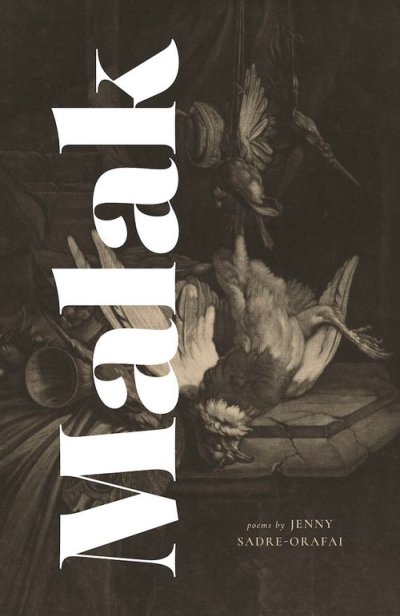
SATURDAY POETRY SERIES PRESENTS: MALAK


From MALAK
By Jenny Sadre-Orafai:


LAST READING

There is a pregnant bird in the cup.
Malak looks at me like she has never looked

at that in a cup before. My father looks at me
like there are things I’m not telling him.

She crochets baby caps, square blankets,
booties in Neapolitan ice cream colors.

If I ever have these babies, if I’m the bird
in the cup, I’ll want to devour them.

After the last reading she leaves the cup turned up,
daring the bird to forget I was pregnant.


MOTHER SPELL

I felt for mountain
and ocean, my first globe.

Mouth or beak. Arm or wing.
Skin or feather. Feet or feet.

Who brought these to me
to dress in booties and caps.

I didn’t ask to know a belly
so tight.

I didn’t ask if it was girl
or boy or bird.


LANGUAGE OF SIGNS

I slept the whole day
without remembering, Malak.

I dreamt I had a son
growing so fast,

a tomato plant sprawled
everywhere, unstoppable.

I held him at my hipline.
And I fed his hunger.

Now he’s a pitcher
of water.


Today’s poems are from Malak (Playtpus Press, 2017), copyright © 2017 by Jenny Sadre-Orafai, and appear here today with permission from the poet.


Malak is an invocation of past and future. With familial lament and childish wonder, the words lay tribute to the infinite—to the beauty in descent and the heartache that binds us to place. To our smallness in death and the importance of conjuring anew.

Jenny Sadre-Orafai is the author of Paper, Cotton, Leather and five chapbooks. Her poetry has appeared in Cream City Review, Ninth Letter, The Cortland Review, Hotel Amerika, The Pinch, and other journals. Her prose has appeared in Los Angeles Review, The Rumpus, South Loop Review, Fourteen Hills, The Collagist, and other journals. She is co-founding editor of Josephine Quarterly and an Associate Professor of English at Kennesaw State University.

Editor’s Note: Birds, tea leaves, foxes. If there are talismans that illuminate the path Jenny Sadre-Orafai’s Malak lays out for the reader, these may be those divining objects. There is magic within these pages — the kind that is conjured up in Gypsy tents and over old world kitchen tables, magic from a time and place when women were believed. But the future is always uncertain, and the tales that unfurl within Malak‘s pages curve and splinter like the lines on a palm.

What is inheritance, this collection asks. What is lived? What is lost? Do we inherit even that which cannot be passed down? Are predictions only as good as their fruition?

Malak is a book that pairs loss with beauty, future with past, the certainty of fate with the unknown and the unknowable. Throughout its pages, a sense of familiarity is established that both grounds and destabilizes. Its stories are told in the dark of night, but under the light of a full and generous moon. When Malak‘s truths reveal themselves, you bask in their luminosity and marvel at the careful magic of their making. You do not ask if they are boy or girl or bird.

Want more from Jenny Sadre-Orafai?
Buy Malak in paperback from Platypus Press
Buy Malak on Kindle from Amazon
Jenny Sadre-Orafai’s Official Website

SATURDAY POETRY SERIES PRESENTS: #METOO POETRY


Editor’s Note: As the #metoo movement that originated ten years ago with Tarana Burke reached a critical mass this week, together we bore witness to innumerable traumas. Perhaps, like me, you felt far more than you were able to articulate. In times like these I turn to poetry to find the words there are no words for. To that end, today I turn to poetry of witness and testimony. To poems that are unafraid to call out sexual assault and its aftereffects. To poetry that says: me, too.


“Seized” by Rachel Heimowitz

“I Should Quit Teaching” by Lois Roma-Deeley

Rupi Kaur’s #metoo poem

“bone” by Yrsa Daley-Ward

Nayyirah Waheed

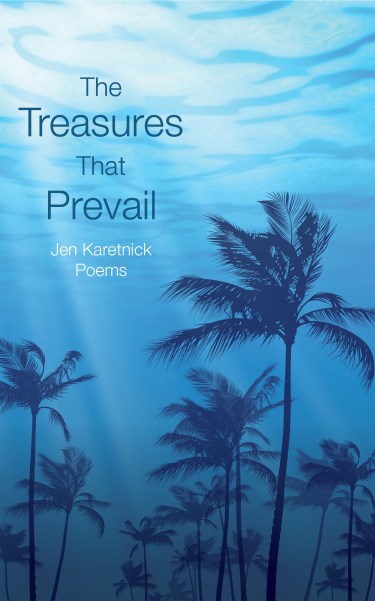
SATURDAY POETRY SERIES PRESENTS: THE TREASURES THAT PREVAIL


From THE TREASURES THAT PREVAIL
By Jen Karetnick:


ADVISE AND CONSENT

It seems to fall to men to create
disasters and women to mop up after.

The first thing people have to forget

is their sense of the senatorial

desk, the deep leather armchair.

There’s always
somebody screaming

off stage or window-shopping for the ridiculous,
arm in arm. Sooner or later these moments come.

We have seen this happen and cannot refrain.


UNDER MANGO CAMOUFLAGE

They bloomed too soon, pistils coral,
hung green like left-behind seawater
well into the sodden fall, ripened
into a bilirubinous yellow.

Falling, they broke themselves
open into Cyrillic letters on the unearthed
limestone as if they were envelopes
stuffed too full of possibilities.

Now marked only with a flag of memory,
this is where we buried the bits
of flesh snipped as easily as a stem
from an eight-day-old son, disguising

the dreams that in the wrong hands
could have been so readily rewritten.


THE OPPOSITE OF MECCA

Oh, the darkness of it all—black cat, black dog,
black monkey on the black-eyed woman’s shoulder,

rocking on a boat dock over water so absent of light
even our dreams have lost their shadows. In this house

made of books and planks, under the art of thatch
and weave, we are birds nesting together who have closed

our throats to song. This is where, without definition, we pin
the horizon as the center on a map of our always new world.


Today’s poems are from The Treasures That Prevail (Whitepoint Press, 2016), copyright © 2016 by Jen Karetnick, and appear here today with permission from the poet.


The Treasures That Prevail is about climate change and its effects on Miami; the poems in this collection confront the ills of modern society in general, mourn both public and personal losses, and predict the difficulties of a post-modern life in a flooded, Atlantis-like lost city. The narrators are two unnamed women, married with a teenage daughter and a teenage son, who live in a part of Miami that will be underwater unless action is taken. The Treasures That Prevail is a parable about what could happen to any of our low-lying coastal cities if we don’t start to make changes now.

Jen Karetnick is the author of seven poetry collections, including American Sentencing (Winter Goose Publishing, May 2016)–which was a long-list finalist for the Julie Suk Award from Jacar Press–and The Treasures That Prevail (Whitepoint Press, September 2016). She received an MFA in poetry from University of California, Irvine and an MFA in fiction from University of Miami. Her poetry, prose, playwriting and interviews have appeared recently or are forthcoming in TheAtlantic.com, The Evansville Review, Foreword Reviews, Guernica, The McNeese Review, Negative Capability, One, Painted Bride Quarterly, Prairie Schooner, Spillway, Valparaiso Poetry Review, Waxwing and Verse Daily. She is co-director for the reading series, SWWIM (Supporting Women Writers in Miami). Jen works as the Creative Writing Director for Miami Arts Charter School and as a freelance writer, dining critic and cookbook author. She lives in Miami Shores on the remaining acre of a historic mango plantation with her husband, two teenagers, three dogs, three cats and fourteen mango trees.

Editor’s Note: How fearfully prescient this collection has proven to be as California is burning, as large swathes of the world are recovering from hurricanes and earthquakes, as Harvey Weinstein has been outed as a sexual predator, as man after man shows us what it really mean to be “senatorial” in his “deep leather armchair,” as the world is melting and our future threatens to emerge underwater.

With The Treasures That Prevail Jen Karetnick has penned a collection that is beautiful and terrifying, that is lyric and devastating, that rings of Cassandra in the ways its truths fall upon deaf, ignorant, or apathetic ears. The language within these pages is thick and malleable, painting with words a picture that you might cut back with a machete in a valiant effort to combat the vengeful wrath of a raped and battered Mother Earth. For even the best among us — in the age of capitalism and consumerism and selfish, self-destructive climate change — are but “birds nesting together who have closed // our throats to song.”

Want more from Jen Karetnick?
Buy The Treasures That Prevail from Amazon
Jen Karetnick’s Writing Portfolio
Buy American Sentencing from Amazon

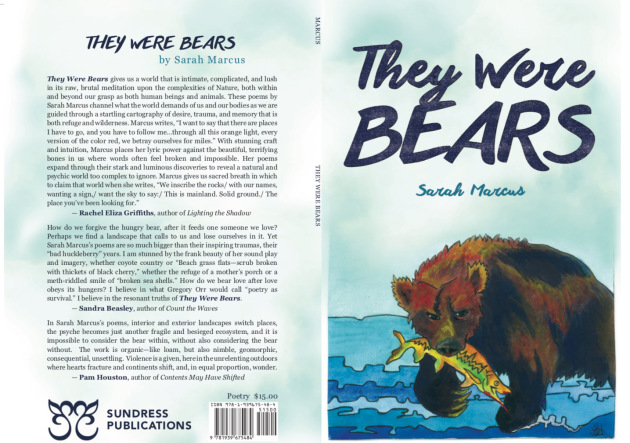
SATURDAY POETRY SERIES PRESENTS: THEY WERE BEARS


From THEY WERE BEARS
By Sarah Marcus:


PEOPLE HAVE ALWAYS KNOWN BEARS

You said you were afraid of bears—

we weren’t safe until there was ice
along the shoreline. I said we all need trauma,

and my heart breaks every Autumn, so we broke
ourselves against those rocks until the cave mouth opened:

a womb for blind crayfish,
a passageway harboring beetles.

I want you to reach into the depths of your backwoods
and remember our Winters. We need the bears, ourselves

ursine sleeping in dens—the caverns drip-stoned and stunning.
I was and still am in search of a great bear

because people have always known bears—
we will always be shelter for each other.

When we first met, I told you that a long time ago,
grizzlies came down from the Rockies—

they were poisoned on the range, trapped,
hounded, shot out—we found cranial fragments.

We still listen to those legends of bounties paid
to mountain men, harboring that ancient fear of

the bears that made meat of us, boar and sow,
mauled and gnawed away. Our bones resting in caves,

because you were born to hunt, and I was
born of hunting: a witness of great fires.


LOVE POEM

First snow of the season—
your eyes say
there’s not much oxygen
                  in the mountain air
.

I have never wanted someone
                  as much as I want you.

I devalued the damage:
you won’t belong—stay gone longer—

                  let it melt.


I’ve been thinking about you
                  because we cannot be separate.
The gravitational pull defies
                  the thousands of miles between us.

Even in the deepest woods,
                  we kneel beside the rill,
the river’s riffle,
the spruce’s mantle of rime,

                  until the point of rock
                                  swells tightly around us.

There’s a chant building in the forest: I won’t be your secret.

Everyone knows how to leave,
but I don’t know how to be
in this city
without you.


MYTHOLOGY FOR DESERT LOVERS II

These things are real:
you are a desert moon rising a hundred mornings away.
My horses paw a cracked Earth.
The air threatening Winter.
The solitude of sand.
We can smell the danger

of you and her
in that house.
In every house.

When you are so strongly connected
to another person, what did you call it? Rare?
It’s like the sunset.
No one can hold that kind of beauty
for more than a moment.

Our small ribs are thick
enough to take on a prairie panic.
The fear of too much open space.
So many acres;
we can never catch up.

You say I’m always on your side
and this will always mean more
to a woman.

I try to explain that love is a violence,
even when it’s beautiful.
When you enter someone,
you must also leave them.

And there’s always that moment of relief
when I realize that I’ve always known—
I am a hundred deserts.

I will wait for you or some version of you
to become sky.


Today’s poems are from They Were Bears (Sundress Publications, 2017), copyright © 2017 by Sarah Marcus, and appear here today with permission from the poet.


They Were Bears gives us a world that is intimate, complicated, and lush in its raw, brutal meditation upon the complexities of Nature, both within and beyond our grasp as both human beings and animals. These poems by Sarah Marcus channel what the world demands of us, and our bodies as we are guided through a startling cartography of desire, trauma, and memory that is both refuge and wilderness. Marcus writes, ‘I want to say that there are places I have to go, and you have to follow me…through all this orange light, every version of the color red, we betray ourselves for miles.’ With stunning craft and intuition, Marcus places her lyric power against the beautiful, terrifying bones in us where words often feel broken and impossible. Her poems expand through their stark and luminous discoveries to reveal a natural and psychic world too complex to ignore. Marcus gives us sacred breath in which to claim that world when she writes, ‘We inscribe the rocks/with our names, wanting a sign,/want the sky to say:/This is mainland. Solid ground./The place you’ve been looking for.’” -Rachel Eliza Griffiths, author of Lighting the Shadow


Sarah Marcus is the author of They Were Bears (2017, Sundress Publications), Nothing Good Ever Happens After Midnight (2016, GTK Press), and the chapbooks BACKCOUNTRY (2013) and Every Bird, To You (2013). Her other work can be found at NPR’s Prosody, The Huffington Post, McSweeney’s, Cimarron Review, Spork, The Establishment, Cosmopolitan.com, and Marie Claire.com SA, among others. She is an editor at Gazing Grain Press and the Series Editor for As It Ought To Be’s High School Poetry Series: Gender, Identity, & Race. She holds an MFA in poetry from George Mason University and currently teaches and writes in Cleveland, OH.


Editor’s Note: In the Jewish calendar, the days between Rosh Hashanah and Yom Kippur are a surreal and reflective time of reckoning. During these days we are introspective, coming to terms with our true selves before turning outward and asking forgiveness from those who we have wronged. It is in these Days of Awe that I come back to a collection I have been meaning to review for quite some time. It is in this magical time of brutal honesty that I dive deeply into a carefully-wrought world that is far beyond my comfort zone, with eyes and heart wide open to its savage and beautiful truths.

They Were Bears is one of the most thoughtful–if not the most thought-provoking–poetry collections to be released in recent memory. Rife with hunger and blood and animal instinct, this work pulsates at the intersection of nature and violence, family, sex, and love. They Were Bears drags us mercilessly back to our animal nature, honoring vulnerability and calling out sexual violence. This book pulls no punches, spares us little. What is reflected in its waters is our truest selves, as beautiful and terrifying as they are wont to be.

The tender, ravenous, brutal honesty of the book’s thematic spectrum is brought to life by the true craftsmanship of the poet. This is an absolutely stunning collection on every level–its words and images thrash and breathe, fly and tether. The poems are lush in their soundscape, and on the page they mark their territory distinctly. And the moments. The breathtaking moments. How true their revelation, declarations, and admissions: “because you were born to hunt, and I was / born of hunting: a witness of great fires;” “I try to explain that love is a violence, / even when it’s beautiful. / When you enter someone, / you must also leave them.”

Mazal tov to Sarah Marcus on this incredible work, and may we all start anew together in these Days of Awe.


Want more from Sarah Marcus?
Sarah Marcus’ Official Website