SATURDAY POETRY SERIES PRESENTS: ANTONIO MACHADO

LAST NIGHT, AS I WAS SLEEPING, I DREAMT MARVELOUS ERROR!

by Antonio Machado


Last night, as I was sleeping,
I dreamt — marvelous error! –
that a spring was breaking
out in my heart.
I said: Along which secret aqueduct,
Oh water, are you coming to me,
water of a new life
that I have never drunk?

Last night, as I was sleeping,
I dreamt — marvelous error! –
that I had a beehive
here inside my heart.
And the golden bees
were making white combs
and sweet honey
from my old failures.

Last night, as I was sleeping,
I dreamt — marvelous error! –
that a fiery sun was giving
light inside my heart.
It was fiery because I felt
warmth as from a hearth,
and sun because it gave light
and brought tears to my eyes.

Last night, as I slept,
I dreamt — marvelous error! –
that it was God I had
here inside my heart.


Antonio Machado (1875-1939) was one of Spain’s most esteemed modern poets. He has been referred to as “a poet of time and memory.” Machado was prominent in the Spanish literary movement known as The Generation of ’98. He published a number of works during his lifetime, beginning with Soledades in 1903 and ending with Juan de Mairena in 1936. Machado’s death was related to the Spanish Civil War. When he died, in his pocket was found his last poem, “Estos días azules y este sol de infancia.

Editor’s Note: This poem was a request. If you have a request of your own please feel free to post it as a comment. Of course, I will not post a poem that I do not stand behind. But how can one not stand behind a poem by one of Spain’s greatest modern poets, especially one with such a line as: “And the golden bees were making white combs and sweet honey from my old failures.” I have yet to find poets that blow me away in quite the way that Spanish poets do.

Want to read more by and about Antonio Machado?
Poetry Chaikhana
Famous Poets and Poems
Green Integer

FRIDAY POETRY SERIES PRESENTS: Max Beckmann

Excerpt from “Letters to a Woman Painter”

by Max Beckmann


It is necessary for you, you who now draw near to the motley and tempting realm of art, it is very necessary that you also comprehend how close to danger you are. If you devote yourself to the ascetic life, if you renounce all worldly pleasures, all human things, you may, I suppose, attain a certain concentration; but for the same reason you may also dry up. Now, on the other hand, if you plunge headlong into the arms of passion, you may just as easily burn yourself up! Art, love, and passion are very closely related because everything revolves more or less around knowledge and the enjoyment of beauty in one form or another. And intoxication is beautiful, is it not, my friend?

Have you not sometimes been with me in the deep hollow of the champagne glass where red lobsters crawl around and black waiters serve red rumbas which make the blood course through your veins as if to a wild dance? Where white dresses and black silk stockings nestle themselves close to the forms of young gods amidst orchid blossoms and the clatter of tambourines? Have you never thought that in the hellish heat of intoxication amongst princes, harlots, and gangsters there is the glamour of life? Or have not the wide seas on hot nights let you dream that we were glowing sparks on flying fish far above the sea and the stars? Splendid was your mask of black fire in which your long hair was burning – and you believed, at last, at last, that you held the young god in your arms who would deliver you from poverty and ardent desire!

Then came the other thing – the cold fire, the glory. Never again, you said, never again shall my will be a slave to another. Now I want to be alone, alone with myself and my will to power and to glory…And uneasy you walk alone through your palace of ice. Because you still do not want to give up the world of delusion, that little “point” still burns within you – the other one! And for that reason you are an artist, my poor child! And on you go, walking in dreams like myself…You dream of my own self in you, you mirror of my soul…


Max Beckmann (1884 – 1950) was a German painter, sculptor, printmaker, and writer. Although often described as an Expressionist, Beckmann disagreed with Expressionist aims, finding their tendency to abstraction frustrating. Hundreds of his works were confiscated by Hitler in 1937, and several were featured in the Degenerate Art exhibition produced by the Nazis in an attempt to denigrate Modern art. Driven into exile, Beckmann eventually found himself in the U.S. The above passage is excerpted from a speech he gave at Stephens College in 1948 explaining his approach to art.

Want to read more by and about Max Beckmann?
Wikipedia
Artchive

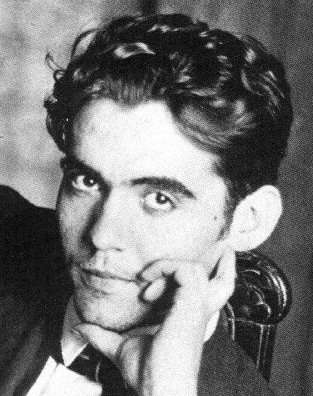
SATURDAY POETRY SERIES PRESENTS: FEDERICO GARCIA LORCA


SONG OF THE BARREN ORANGE TREE

by Federico Garcia Lorca


Woodcutter.
Cut my shadow from me.
Free me from the torment
of seeing myself without fruit.

Why was I born among mirrors?
The day walks in circles around me,
and the night copies me
in all its stars.

I want to live without seeing myself.
And I will dream that ants
and thistleburrs are my
leaves and my birds.

Woodcutter.
Cut my shadow from me.
Free me from the torment
of seeing myself without fruit.

“Song of the Barren Orange Tree” by Federico García Lorca, from THE SELECTED POEMS OF FEDERICO GARCÍA LORCA. Translated by W. S. Merwin, copyright © 1955 by New Directions Publishing Corp.

Federico Garcia Lorca (1898-1936) was a Spanish poet, dramatist and theatre director. García Lorca achieved international recognition as an emblematic member of the Generation of ’27. He is thought to be one of the many thousands who were ‘disappeared’ and executed by Nationalists at the beginning of the Spanish Civil War.
(Annotated biography of Federico Garcia Lorca courtesy of Wikipedia.org.)

Editor’s Note: I think few poems have achieved what this poem does. This poem both inspires me to want to be a better poet and intimidates me with its greatness.

Want to read more by and about Federico Garcia Lorca?
Poets.org
The NY Times
Repertorio.org

SATURDAY POETRY SERIES PRESENTS: SOLOMON IBN GABIROL


I’M PRINCE TO THE POEM

by Solomon Ibn Gabirol


I’m prince to the poem my slave,
I’m harp to the court musicians,
my song is a turban for viziers’ heads,
a crown for kings in their kingdoms:

and here I’ve lived just sixteen years,
and my heart is like eighty within them.

© Translation: 2001, Princeton University Press.

Solomon Ibn Gabirol (approx. 1021 – approx. 1058), one of the greatest liturgical poets of the Middle Ages, was a Hebrew poet whose entire life was spent in Spain. He was born in Málaga in Andalusia in the third decade of the 11th century and died approximately thirty years later in Valencia. (Annotated biography of Solomon Ibn Gabirol courtesy of Israel – Poetry International Web.)

Editor’s Note: As I move toward graduate school I am contemplating what specific areas of poetry interest me and what I might want to spend the duration of my PhD program working on. As an Israeli-American poet whose parents were founding members of Shalom Acshav, a prominent peace movement in Israel in the 1970’s and 1980’s, I feel drawn toward middle eastern poetry, and particularly poetry that contemplates Israeli-Palestinian peace struggles. Poets have been political activists and anti-war protesters for nearly as long as poetry has existed as an art form. Poets throughout history have played an important role in peace struggles, as well they should given their ability to manipulate language and be heard. As I embark on this journey into this particular subset of poetry you will see more posts that explore middle eastern poets, and particularly those who contemplate politics and peace.

Want to read more by and about Solomon Ibn Gabirol?
Article by Yehuda Ratzaby
Jewish Encyclopedia
SOLOMON IBN GABIROL: AN ANDALUSIAN ALPHABET
Poetry Chaikhana

SATURDAY POETRY SERIES PRESENTS: WILLIAM BUTLER YEATS

By William Butler Yeats:

NO SECOND TROY

Why should I blame her that she filled my days
With misery, or that she would of late
Have taught to ignorant men most violent ways,
Or hurled the little streets upon the great,
Had they but courage equal to desire?
What could have made her peaceful with a mind
That nobleness made simple as a fire,
With beauty like a tightened bow, a kind
That is not natural in an age like this,
Being high and solitary and most stern?
Why, what could she have done, being what she is?
Was there another Troy for her to burn?

“No Second Troy” is reprinted from The Green Helmet and Other Poems. W.B. Yeats. Dundrum: Cuala Press, 1910.

ON BEING ASKED FOR A WAR POEM

I think it better that in times like these
A poet’s mouth be silent, for in truth
We have no gift to set a statesman right;
He has had enough of meddling who can please
A young girl in the indolence of her youth,
Or an old man upon a winter’s night.

“On Being Asked for a War Poem” is reprinted from The Wild Swans at Coole. W.B. Yeats. New York: Macmillan, 1919.

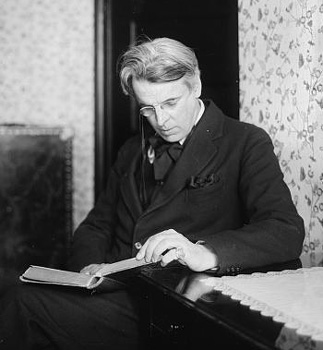
William Butler Yeats (1865-1939) was an Irish poet, dramatist, and one of the foremost figures of 20th century literature. A pillar of both the Irish and British literary establishments, in his later years Yeats served as an Irish Senator for two terms. He was a driving force behind the Irish Literary Revival, and along with Lady Gregory and Edward Martyn founded the Abbey Theatre, serving as its chief during its early years. In 1923, he was awarded a Nobel Prize in Literature for what the Nobel Committee described as “inspired poetry, which in a highly artistic form gives expression to the spirit of a whole nation.” He was the first Irishman so honored. Yeats is generally considered one of the few writers whose greatest works were completed after being awarded the Nobel Prize; such works include The Tower (1928) and The Winding Stair and Other Poems (1929). (Annotated biography of William Butler Yeats courtesy of Wikipedia.org.)

Editor’s Note: I’ll be honest, I do not tend to be a fan of rhyming poetry. As a result, I tend to overlook many of the greats of yesteryear, such as Longfellow, Keats, and Yeats – to name a few. However, my mother informs me that William Butler Yeats was a relative of ours, being of the same Butlers from which my family comes. Having presented me with that information, my mother promptly informed me that I should feature Mr. Yeats on my Saturday Poetry Series. Well, what kind of a Jewish daughter would I be if I did not heed the subtly guilt-ridden instructions of my mother?

Of course I would not publish something that I do not stand behind, so I perused Mr. Yeats’ work and found two pieces that I am pleased to share here today. “No Second Troy” I adore for both its story and its end line. “On Being Asked For a War Poem” I find wholly appropriate for As It Ought To Be in that it explores the relationship between the poet and politics. I was doubly pleased as I learned more about Yeats to find that he himself was a politician in addition to a poet.

May the relationship between poetry and politics live long and prosper, and may poets have the power to make the change we want to see in the world, as it ought to be.

Want to read more by and about William Butler Yeats?

The National Library of Ireland Presents The Life and Works of William Butler Yeats
NobelPrize.org
Poets.org
The Literature Network
The Poetry Archive
Poetry Archive

SATURDAY POETRY SERIES PRESENTS: MARTIN CAMPS

By Martin Camps:

DO YOU STILL WRITE POETRY?

They ask
               sometimes
as if it were a demise
in need
           of a cure
No one asks a doctor
are you still curing people?
             Yes,
I have not
been cured at all.


PERSISTENCE OF WATER

Poetry is not carried in vessels of mud.
I said: I will stop writing, one or two years,
Let poetry speak through other mouths.
I will forget. I will not be called a poet.
Now I will be a teacher, a laborer, an employee.
I will not listen to the inner anthill,
this noise of sheets waved by the wind.
But poetry finds its way,
Like water that filters through
a wall of plaster.
And to begins again,
as if from fear, to suffocate
the noise of the leaves.
Poetry does not spill like wine,
it is not exchanged for thirty silver coins,
it does not even hide like talents in the ground.
Poetry shatters your mouth.


T. REX AT THE ACADEMY OF SCIENCES

How
hungry
time
is
to
leave
us
these
clean
bones


Martin Camps has published three books of poetry in Spanish: Desierto Sol (Desert Sun, 2003), La invencion del mundo (The Invention of the World, 2008), and La extincion de los atardeceres (The Extintion of Twilight, 2009). Has is the recipient of two poetry prizes from the Institute of Culture of Mexico and an Honorable Mention in the Bi-National Poetry Prize Pellicer-Frost in 1999. His poems have been published in The Bitter Oleander (Pemmican Press), Alforja, and Tierra Adentro, among others. He answers all email at markampz@hotmail.com.

Editor’s Note: Martin is one of the most innovative poets I know. I have seen his poems in video format, power point, as if an investment brochure, and laid out on the page so that form mirrors meaning. Sometimes political, often comedic, and always heartbreakingly good, Martin masterfully illuminates both his own experience and that of the Poet at large.

Want more of Martin Camps?

Buy his books online, or email markampz@hotmail.com to buy them directly from the poet for $6 each.
Peticao a NASA
La Belleza de No Pensar
Mosquitoes

THE ART OF FAILURE: POETRY IN TRANSLATION

[This piece previously appeared in Poet’s Market 2010 and Poet’s Market 2011.]

THE ART OF FAILURE: POETRY IN TRANSLATION

by Okla Elliott

“Translators are the shadow heroes of literature, the often forgotten instruments that make it possible for different cultures to talk to one another.”—Paul Auster

Introduction

The historical importance of translation for English language poetry is undeniable. Henry Howard, the Earl of Surrey, invented blank verse in order to translate Virgil’s Æneid in 1554, because the Latin original was unrhymed yet metered, and no equivalent existed in English. Blank verse, brought to us by a translator’s ingenuity, allowed for Shakespeare’s plays to be written as we know them. The sonnet (sonetto or “little song” in Italian) was created by Giacomo da Lentini and enjoyed a boom among Italian poets such as Calvalcanti, Dante, and Petrarch in the mid-13th and early 14th centuries. It was not until the 16th century that sonnets began appearing in English, in translations from Italian and from French. And the list of gifts translators have brought English poetry goes on—couplets, villanelles, sestinas, and, some have argued, even free verse via attempts to translate Chinese poetry. The question now is: What is the cultural and artistic place of translation in the age of globalization?

According to a Center for Book Culture study on the number of books translated into English between 2000-2006, it’s a pretty dismal place. Most countries had fewer than one book per year translated into English, and literary heavyweights such as France, Italy, and Germany had fewer than ten books per year translated into English—and this includes novels and nonfiction as well as poetry. The percentage of books in translation tends to be estimated, by such organizations as the NEA and PEN, at about three percent of the total published in America. (Incidentally, there is an excellent blog about translation, out of the University of Rochester, called Three Percent.) Does this mean the effort of translation is hopeless or unimportant? Not necessarily.

Translation is very complex; the process, the need, and the market for it are not so easily summed up. To understand the landscape, we have to look at the differences between publishing translation as books or in journals, translating contemporary or older work, working alone or collaboratively. Likewise, the politics and ethics of translation play a role. And perhaps most importantly, the process and joys of translation need to be understood.

The Process of Translation

The primary goal of translation is to recreate the effect of the original poem in the target language (the language into which you are translating). The problem, of course, is that if the poet did her work properly in the original (or source) language, then she made use of every available trick and tactic, thus making the job of recreating the poem almost impossible. This is why Umberto Eco calls translation “the art of failure.” But while perfection is perhaps not possible, there are thousands of excellent translations in existence. So, how were they done?

You have to determine whether you want to transport the source text into the target language or transport the reader of your translation to the source culture. If you are translating, for example, a contemporary Mexican poet, and the word buñuelo appears, you have to decide whether to replace this very specific Mexican sweet bun made with orange juice with some American equivalent (a honeybun perhaps) or to simply leave the Spanish word in the English translation and hope the reader knows what a buñuelo is. A third option is to retain the Spanish word and footnote it, though footnotes can ruin the effect of a poem if there are too many of them. The general rule is to avoid them when possible. Of course, the problem with replacing a Mexican pastry with a traditional American pastry is that—forgive the pun—you damage the original flavor of the poem, though you do not run the risk of losing or confusing your reader. But both tactics lead to problems, as nearly everything in translation does. I don’t mean to suggest that a translation can’t do both. In fact, most good translations do, but each successful translation, in order to have its singular effect as the original had its singular effect, ought to privilege one effort over the other.

Depending on the source text, your level of mastery of the source language, and whether there are pre-existing translations, the first stages of working on a new translation of a poem will differ wildly. When translating Latin and Greek literature, David Slavitt uses pre-existing literal prose translations of the poems as well as his personal knowledge of Latin and Greek “to turn the prose translations back into poems.” Slavitt says, “When you translate prose, you are the original author’s clerk, but when you translate poetry, you are his partner.”

Frequently, translation is also done collaboratively. Likely the most famous contemporary duo is Richard Pevear and Larissa Volokhonsky, who have redone many of the Russian prose masterpieces. A notable team in poetry translation is Peter Burian and Alan Shapiro, who collaborate on translations of ancient literature. The make-up of the team is frequently a scholar of the source language/text and a poet who knows the tricks of English verse and who might have some knowledge of the source language.

But no matter your tactics or whether you work alone or with a collaborator, tough choices will have to be made. My translation of Jürgen Becker’s poem “Oderbruch,” which appeared in the Indiana Review, offers a simple example of the issues a translator runs into in nearly every line. I had translated “[g]elb graue Dämmerung” as “[g]old gray twilight” which caused the faculty member consulted about the accuracy of my translation to suggest that I change it to the more literal “[y]ellow gray twilight.” In one sense, he was right—“gelb” means “yellow.” But I felt that “gold” was close enough to the literal meaning, but it had the added poetic benefit of retaining the consonance and the number of syllables in the original. Ultimately, the poetry editors at the Indiana Review agreed with me, but not because I was unquestionably right. We were both right about how to translate the line. It was simply that I was willing to make a small sacrifice in literalness to retain the music, whereas he was willing to make a small sacrifice of the music to retain a more exact meaning. Every poem will present a dozen or more moments where the translator must sacrifice one thing for another. Only rarely does a poem submit easily to transfer into a new language/culture. That, however, is also part of the joy. Nearly every translator speaks of the joy of finding an elegant solution to a seemingly insoluble problem.

Slavitt says, “I didn’t take a Hippocratic Oath when I signed on to be a writer. I feel no obligation to the literal meaning of the text whatsoever.” It’s the pleasure of the original he is after. Does that mean Twinkies show up in Ovid? Well, fine, let it be so. Or so Slavitt says. But the business of translation is a highly contentious one, and one where opinions are unusually strong and criticisms often bitter.

One of the joys of translation is what you can learn by doing it. Slavitt went to the Eclogues and Georgics of Virgil in order to learn how to make a paragraph work in verse. Matthew Zapruder, author of The Pajamaist and translator of the Romanian poet Eugen Jebeleanu, reports, “I also had a sense right away that it would be a good thing for me, a poet just starting to find his way, to be inside the seriousness of the voice and the directness and implacable structure of the poems.”

Publishing Translations

The report on the market for poetry in translation is mixed. A recent New York Review of Books article points out that Iran publishes more literature in translation than the United States does—as do all European countries and most Latin American ones. That said, however, it has been my experience that original poetry and fiction are comparably hard to place in journals, whereas translation and nonfiction are much easier to place. This has, predictably, to do with the volume and quality of submissions in each genre, as well as current demand. Brett Fletcher Lauer, a poetry editor at A Public Space and an advisory editor at Columbia University’s Circumference, a journal dedicated largely to poetry in translation, offers the following theory on why translations tend to be better and therefore more likely to be accepted: “A Public Space receives a relatively small number of submissions of poetry in translation compared with the thousands of submissions of English-language poetry. That being said, the overall quality of translations submitted is very high. I’m not sure how to account for this fact.” He goes on to speculate, “The process of translating and the dedication it requires makes it so that it cannot be casual work, but, instead, a sort of over-time, and what we receive reflects this.”

“Generally journals were happy to publish the poems,” says Zapruder of his translations of Jebeleanu. “I had more difficulty publishing the book; in fact, I finished the translations in 1998, and it took almost ten years for the book to eventually come out with Coffee House Press.”

Slavitt says, “If you translate a standard classic and are lucky enough to get it adopted as a text in enough courses, it will do much better than original poetry.” But he adds, “If you translate someone who needs translating—Ausonius for instance—it’s about even [with sales of original collections of poetry].” Given the generally poor sales of poetry collections, this might not be very heartening, but it ought to be. Either a book of translation will sell about the same as an original collection or considerably better, especially if you can recast a classic poet in a new translation.

Some of the journals most supportive of poetry in translation are Absinthe, The Bitter Oleander, Circumference, Indiana Review, International Poetry Review, The Literary Review, Natural Bridge, New Letters, Poetry International, and A Public Space. There are others, of course, but these are journals that are dedicated to translation solely or that publish some translation in nearly every issue. And presses that publish translation regularly include Dalkey Archive Press, Northwestern University Press, Red Hen Press, Sheep Meadow Press, and Ugly Duckling Presse. If a new translator wants to discover what is happening in translation today, she would do well to peruse these publications.

Advice for Getting Started

If you’re a first-time translator, it is unlikely that you’ll get the rights to translate and publish the work of a major author whose work is still under copyright—e.g., Günter Grass or Pablo Neruda. Mark Smith-Soto, the editor of International Poetry Review and a poet/translator in his own right, advises that a new translator find an author who enjoys a good reputation in his/her home country but who hasn’t yet been translated into English. “If you ask a poet whether he’d like to be translated, the answer is generally going to be yes,” Smith-Soto says. And here is where the unfortunate state of literature in translation can actually be a plus. Since there is so much excellent literature that has yet to be translated, you’ll have plenty to choose from. But since you’ll be spending many hours living in the poet’s work, it’s important to find work you admire. Otherwise, what should be a joy will become a chore. Once you’ve established yourself, then the larger gigs will come.

It’s also worthwhile to have a working knowledge of translation theory, which sounds daunting but which in fact can be attained by reading two excellent books out from University of Chicago Press, The Craft of Translation and Theories of Translation, both edited by John Biguenet and Rainer Schulte. These two reasonably sized volumes will bring you from Dryden’s thinking on translation through Goethe’s and up to Gregory Rabassa’s with excellent stops at Nietzsche’s, Benjamin’s, and others’.

So, read the journals that publish translations, read these two seminal texts on the theory and craft of translation, find poetry you admire, and get to work. It’s rewarding for both the translator and for the literary culture as a whole.