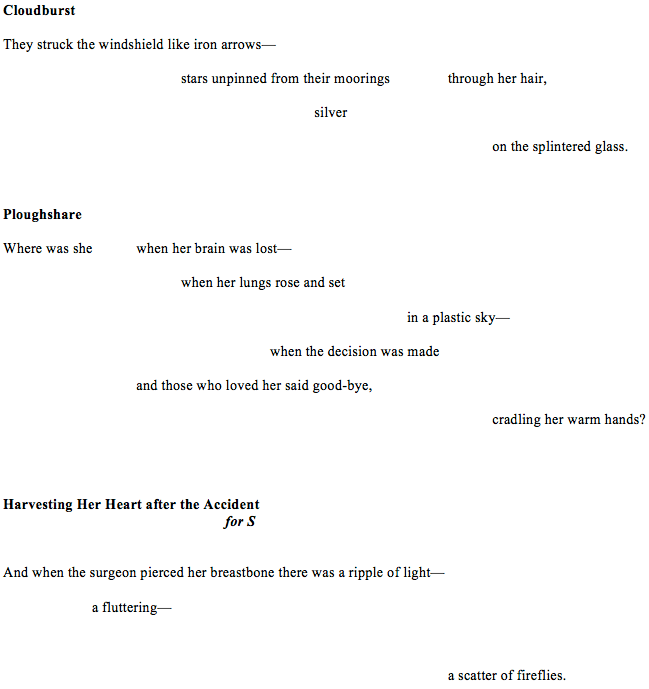
“Harvesting Her Heart after the Accident” first appeared in The Journal of Compressed Creative Arts/Matter Press. All other pieces are previously unpublished. Today’s poems appear here today with permission from the poet.
Stacy R. Nigliazzo‘s debut poetry collection Scissored Moon was published in 2013 by Press 53. It was named Book of the Year by the American Journal of Nursing. It was also short-listed as a finalist for the Julie Suk Poetry Prize (Jacar Press) and the Texas Institute of Letters First Book Award for Poetry/Bob Bush Award. She is co-editor of Red Sky, an anthology addressing the global epidemic of violence against women.
Editor’s Note: Stacy R. Nigliazzo imagines the unimaginable, writes those words which cannot be spoken. An emergency room nurse, it is when her personal losses make their way to the page that her experience becomes poetry, and that poetry becomes an act of healing for poet and reader alike. How visual her imagery, how visceral her grief. And yet her poems leave us not in darkness, but with the necessary reminder that even in our darkest hour there is a “ripple of light.”
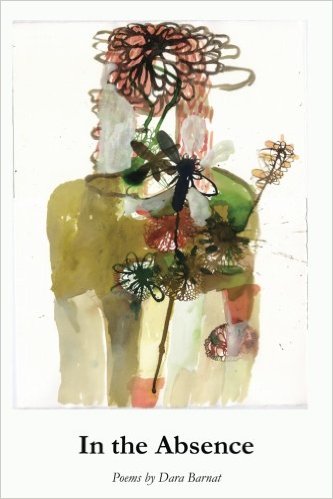
In the Absence: Dara Barnat’s In the Absence evokes a yearning of the spirit so strong that it becomes presence, its light unstopped.
Dara Barnat is the author of the poetry collection In the Absence (Turning Point, 2016), as well as Headwind Migration, a chapbook (Pudding House, 2009). She also writes critical essays on poetry and translates poetry from Hebrew. Her research explores Walt Whitman’s influence on Jewish American poetry. Dara holds a Ph.D. from The School of Cultural Studies at Tel Aviv University. She currently teaches at Tel Aviv University and Queens College, CUNY.
Editor’s Note: Dara Barnat’s first full-length collection begins by declaring that “Dark is just dark.” But the assertion casts a shadow question: Is dark just dark? For it is light that is at the heart of this work: “I close my hand around a filament of sun as it filters / through the window, try to catch / its meaning, / but light is just light.”
But “light is just light” is no more the truth of these poems — and the poet’s journey that unfolds across them — than “dark is just dark.” This work is neither a book of questions nor of answers. Instead, In the Absence is an honest experience of grief that explores the inevitable, never-ending pilgrimage inherent within loss: “I hear you’re gone and I fall with you. / In that place part of me stays, / like a hand in clay.”
Not since Li-Young Lee’s Rose have I been so slain by a book of mourning. Like Rose, In the Absence mourns the loss of a father while acknowledging that such a loss is anything but simple, that the complications of life remain a reckoning for the living. “The imprint holds the loss of everything. / It holds what we thought was joy.”
Held close within this incredibly moving and painstakingly wrought collection is a poem titled “Walt Whitman.” I had the honor of featuring this poem here on the Saturday Poetry Series in 2013 as I marked my father’s first yahrzeit (Jewish death anniversary). Tomorrow will be five years since my father’s death. What at one year could be commemorated with a single poem, five years later needs an entire book. Such is the nature of grief — it does not diminish; it grows. And in its growing it becomes more painful and more beautiful all at once.
In the Absence transforms the poet’s personal grief into communion. I will re-read this book tomorrow as I remember my father on his five-year yahrzeit, and I will grieve. But, more than that, I will say a prayer that is the poet’s and is my own: “May we live / a thousand years together, / in another life.”
Poet’s Note: “This poem was written well before [the 2017] Presidential Inauguration and without this event in mind. But it seems a day worth remembering the fate of our shared planet and all its beings, human and beyond.” —Jane Hirshfield, via The Academy of American Poets
Editor’s Note: Today I defer to Jane Hirshfield and The Academy of American Poets. Listen to the poet read this important work of protest. Read the poem in its entirety.
Today’s poem is dedicated to those who are marching with the Million Woman March and those who stand with us in solidarity.
Editor’s Note: Each year for Hanukkah I make sufganiyot. Measuring out the ingredients from my mother’s recipe, I will myself to have the patience necessary to wait for yeast to rise. I knead the dough with equal parts pressure and love then apply more patience, more waiting, before rolling and cutting “pale circles,” transforming them in oil into “doughy moons inflating.” Each year I make sufganiyot, and each year when I do, I think of this poem. It has been four years since I first featured this poem on the Saturday Poetry Series, and it has been with me each year since, an indelible part of my Hanukkah tradition.
As sensual as this poem is — as hot — it is very much a poem about tradition, about ritual, and about the coming together of women. For it is women who have traditionally ruled the domain of the Jewish kitchen, and women who, year in and year out since time immemorial, have applied their pressure and patience, their love and their care, to wright the delicious sustenance that is Jewish holiday food. And what, really, brings us together in our rituals and traditions more than food?
Each year as my best friend and I make our sufganiyot together, my mother makes the same recipe 2,500 miles away. Meanwhile, women all over the world are doing the same: “There, and here, / a million women finger / these cupped curves.” Each year, today’s poem reminds me of that disparate togetherness of women. This year I reprint this poem in honor of the women all over the world who do the work necessary to make the holiday season what it is.
May this season of light be a beacon in the darkness, and may the new year be better than the last.
On the days when we wept—
and they were many—we did it
over the sound of a television
or radio, or the many engines
of the sky. It was rarely so quiet
we could hear just our sadness,
the smallness of it
that is merely the sound of wind
and water between the many pages
of the lungs. Many afternoons
we left the house still crying
and drove to a café or the movies,
or back to the hospital where we sat
dumb under the many eyes
of Paul Klee. There were many
umbrellas, days when it refused
to rain, cups of tea ignored. We
washed them all in the sink,
dry eyed. It’s been a while,
we’re cried out. We collect pauses
and have taken to reading actual
books again. We go through them
like yellow lights, like tunnels
or reunions, we forget which;
the older you are the more similes,
the more pangs per hour. Indeed,
this is how we break one hour into
many, how healing wounds time
in return. And though we know
there will always be crying to do,
just as there’s always that song,
always a leaf somewhere in the car,
this may be the only sweetness left,
to have a few griefs we cherish
against the others, which are many.
Today’s poem first appeared via The Academy of American Poets’ ‘Poem A Day’ series, was then published in the collection Dementia, My Darling (2016 Red Hen Press), and appears here today with permission from the poet.
Brendan Constantine‘s work has appeared in Prairie Schooner, FIELD, Ploughshares, Virginia Quarterly, and Hotel Amerika, among other journals. His most recent collection is Dementia, My Darling (2016 Red Hen Press). He has received grants and commissions from the Getty Museum, James Irvine Foundation, and the National Endowment for the Arts. He currently teaches poetry at the Windward School and regularly offers classes to hospitals, foster homes, veterans, and the elderly.
Editor’s Note: I’m just going to come out and say it: You need this poem. Right now. At this moment. In the wake of tragedies too hard to hold and too heavy to bear. You have watched the sky fall. You have been broken by the debris of what you thought to be true, of what has and has not been shattered. All that you know in your heart about what is right and what is wrong, about human kindness and decency, about the kind of country you want to live and raise your children and grow old in, the kind of world you want this to be. It’s all fallen apart. And that sadness you feel? That resistance to getting out of bed in the morning? Those spontaneous tears you find yourself bursting into? You are not alone. You. Are. Not. Alone.
But this poem. This poem! This poem knows our suffering. This poem knows our shared grief. This poem knows that “On the days when we wept— / and they were many—we did it / over the sound of a television.” This poem knows that “Many afternoons / we left the house still crying.” And this poem knows, too, that there is a time beyond this time — for better or worse — that the day will come when we are cried out, when we will read books again and reach milestones, and yet. And yet this poem knows that some griefs we will carry with us. Held fast by markers like where you were when Kennedy was shot or when 9/11 happened. This poem knows that there are “a few griefs we cherish / against the others, which are many.” And we know that this moment in American history is one of those griefs we will cherish against the others, which will be many.
The moon was a sliver of itself
the first night I thought of you
combing a new year’s honey
through our hair.
We are taught to repent, but
it’s a poor translation,
for Teshuvah is to return
to ourselves,
to come back to who we really are,
to return
to an original state
where we have nothing
but possibility laid before us.
And it is written
as everything will be:
someone’s grandmother’s hands
smelling of cinnamon and clove,
a testament to a world
created as an expression
of limitless love,
of refinement.
The Rabbi says that when you share your words
you are sharing a part of your soul. Each moment
has the potential to be deeply spiritual, my children,
stand in the hugeness of it all.
Autumn has lingered years
for your arrival,
each leaf turned
in anticipation,
even the branches
held their breath
waiting for us to ask the right questions,
for us to stop looking to the sky.
Today’s poem originally appeared in the Green Briar Review and appears here today with permission from the poet.
Editor’s Note: But this is so much more than a Rosh Hashanah poem. This is a poem of the sacred and the secular. Of belief and being. Of awareness and action. This is the moment when memory becomes contemplation, when contemplation becomes questioning, when questioning demands more from us. Yes, this poem is stunning in its imagery and lyric. Yes, it is evocative and moving. Yes it is visceral and philosophical and spiritual. But it is so much more than that. For while “we have nothing / but possibility laid before us,” the very leaves hold their breath “waiting for us to ask the right questions, // for us to stop looking to the sky.”
Shanah Tovah u’Metukah to you, the faithful readers of this series. May the new year be sweet, and may you be the change you want to see in the world.
Susan Rich is the author of four poetry collections including Cloud Pharmacy, recently shortlisted for the Julie Suk Poetry Prize and the Indi Fab Award. Other books include the The Alchemist’s Kitchen, a Finalist for the Washington Book Prize, Cures Include Travel, and The Cartographer’s Tongue: Poems of the World (White Pine). She is a co-editor of an essay collection, The Strangest of Theatres: Poets Crossing Borders published by The Poetry Foundation and McSweeney’s. Susan’s poems have been published in 50 States and 1 District including journals such as New England Review, The Gettysburg Review, Poetry International, and World Literature Today.
Editor’s Note: Today’s poem is a stunning and moving commentary on racism in America today. A thoughtful reflection, now, with the 15th anniversary of September 11th this past weekend. How far have we come in moving past anti-Islamic sentiment in America? In the world? And how many steps backward have we taken in America’s racism against black men? What of the poem’s notion that “the best protection” is “to be a black man / born in America, more invisible than / Somali, Muslim, asylum seeker”? And what of those asylum seekers? How, in a country whose emblem bears the words “Give me your tired, your poor, your huddled masses yearning to breathe free,” have we opened our doors to Syrian refugees? And what of those Americans who are threatening to vote for a man whose response to our neighbors is to build a wall to keep them out?
Today, as much as it did when it was written, this poem asks: Who are we, America? Who are we, and how do we treat our fellow human? I, for one, fear that this America–this world–is “the world / we did not want to know.”
The heart of a woman goes forth with the dawn,
As a lone bird, soft winging, so restlessly on,
Afar o’er life’s turrets and vales does it roam
In the wake of those echoes the heart calls home.
The heart of a woman falls back with the night,
And enters some alien cage in its plight,
And tries to forget it has dreamed of the stars
While it breaks, breaks, breaks on the sheltering bars.
(Today’s poem is in the public domain, belongs to the masses, and appears here today accordingly.)
Editor’s Note: No matter who you voted for in the primaries nor who you plan to vote for come November, there is no denying that this was an historic week in American history.
In this vein, I dedicate today’s poem–written by a black woman in a white age–to Michelle Obama, a black woman running the White House who reminded us this week that: “I wake up every morning in a house that was built by slaves. And I watch my daughters, two beautiful, intelligent black young women, playing with their dogs on the White House lawn.” And I dedicate this poem to the fact that, for the first time in American history, a woman has been nominated by a major party to run for President of the United States of America.
Any (reasonable) reservations you (or I) may have about Hillary Clinton and our two-party system aside, this is a moment to pause and marvel, to appreciate what we have accomplished and to believe that this can–and should–be just the beginning of progressive progress. This is a moment to celebrate that the heart of a woman need not try “to forget it has dreamed of the stars,” for it need not break, break, break “on the sheltering bars.”
Georgia Douglas Johnson: A member of the Harlem Renaissance, Georgia Douglas Johnson wrote plays, a syndicated newspaper column, and four collections of poetry: The Heart of a Woman (1918), Bronze (1922), An Autumn Love Cycle (1928), and Share My World (1962). (Annotated biography courtesy of The Poetry Foundation.)
“It is not necessary that you believe that the officer who choked Eric Garner set out that day to destroy a body. All you need to understand is that the officer carries with him the power of the American state and the weight of an American legacy, and they necessitate that of the bodies destroyed every year, some wild and disproportionate number of them will be black.” ― Ta-Nehisi Coates
Editor’s Note: Every word I have attempted to write here has been wholly inadequate. I can only offer you poetry written by those who have lived an experience that I have only witnessed from the sidelines, in abject horror.
“England – English Summer Woods” courtesy of Jacopo Werther via Creative Commons: http://bit.ly/1qRZ81t
LILY-BELL AND THISTLEDOWN SONG
By Louisa May Alcott
Awake! Awake! for the earliest gleam
Of golden sunlight shines
On the rippling waves, that brightly flow
Beneath the flowering vines.
Awake! Awake! for the low, sweet chant
Of the wild-birds’ morning hymn
Comes floating by on the fragrant air,
Through the forest cool and dim;
Then spread each wing,
And work, and sing,
Through the long, bright sunny hours;
O’er the pleasant earth
We journey forth,
For a day among the flowers.
Awake! Awake! for the summer wind
Hath bidden the blossoms unclose,
Hath opened the violet’s soft blue eye,
And awakened the sleeping rose.
And lightly they wave on their slender stems
Fragrant, and fresh, and fair,
Waiting for us, as we singing come
To gather our honey-dew there.
Then spread each wing,
And work, and sing,
Through the long, bright sunny hours;
O’er the pleasant earth
We journey forth,
For a day among the flowers.
SUMMER RAIN
By Fannie Isabel Sherrick
Oh, what is so pure as the glad summer rain,
That falls on the grass where the sunlight has lain?
And what is so fair as the flowers that lie
All bathed in the tears of the soft summer sky?
The blue of the heavens is dimmed by the rain
That wears away sorrow and washes out pain;
But we know that the flowers we cherish would die
Were it not for the tears of the cloud-laden sky.
The rose is the sweeter when kissed by the rain,
And hearts are the dearer where sorrow has lain;
The sky is the fairer that rain-clouds have swept,
And no eyes are so bright as the eyes that have wept.
Oh, they are so happy, these flowers that die,
They laugh in the sunshine, oh, why cannot I?
They droop in the shadow, they smile in the sun,
Yet they die in the winter when summer is done.
The lily is lovely, and fragrant her breath,
But the beauty she wears is the emblem of death;
The rain is so fair as it falls on the flowers,
But the clouds are the shadows of sunnier hours.
Why laugh in the sunshine, why smile in the rain?
The world is a shadow and life is a pain;
Why live in the summer, why dream in the sun,
To die in the winter, when summer is done?
Oh, there is the truth that each life underlies,
That baffles the poets and sages so wise;
Ah! there is the bitter that lies in the sweet
As we gather the roses that bloom at our feet.
Oh, flowers forgive me, I’m willful to-day,
Oh, take back the lesson you gave me I pray;
For I slept in the sunshine, I woke in the rain
And it banished forever my sorrow and pain.
(Today’s poems are in the public domain, belong to the masses, and appear here today accordingly.)
Louisa May Alcott: (1832-1888) was an American novelist and poet best known as the author of the novel Little Women (1868). Raised by her transcendentalist parents, Abigail May and Amos Bronson Alcott in New England, she grew up among many of the well-known intellectuals of her day. (Annotated biography of Louisa May Alcott courtesy of Wikipedia, with edits.)
Fannie Isabel Sherrick: (Lived circa mid-to-late 19th c.) was a native of St. Louis. Much of her early life was spent in California and Colorado, where many of her best productions in verse were written. Her collected poems were published in 1888, in a volume entitled Star Dust. Poor health caused her–at least temporarily–to give up literary endeavors. (Annotated biography of Fannie Isabel Sherrick courtesy of Evenings with Colorado Poets: an Anthology of Colorado Verse, with edits.)
Editor’s Note: Technically summer is not for another month yet, but here in New York the sun is shining, and Memorial Day weekend is the official start of our summer season, so “O’er the pleasant earth / We journey forth, / For a day among the flowers.” And, while summer rain was not a common occurrence in California–from whence I came–here in New York the sky opens up to quench the grasses, the flowers, the rivers and streams, all summer long: “Oh, what is so pure as the glad summer rain, / That falls on the grass where the sunlight has lain? / And what is so fair as the flowers that lie / All bathed in the tears of the soft summer sky?”







 As It Ought To Be