SATURDAY POETRY SERIES PRESENTS: A ROSH HASHANAH POEM BY SARAH MARCUS

12027738_10102555892782248_2229857784916307758_n

By Sarah Marcus:


ROSH HASHANAH, 5774

The moon was a sliver of itself
the first night I thought of you
combing a new year’s honey
through our hair.

We are taught to repent, but
it’s a poor translation,
for Teshuvah is to return
to ourselves,
to come back to who we really are,
to return
to an original state

where we have nothing
but possibility laid before us.

And it is written
as everything will be:

someone’s grandmother’s hands
smelling of cinnamon and clove,
a testament to a world
created as an expression
of limitless love,
of refinement.

The Rabbi says that when you share your words
you are sharing a part of your soul. Each moment
has the potential to be deeply spiritual, my children,
stand in the hugeness of it all.

Autumn has lingered years
for your arrival,
each leaf turned
in anticipation,
even the branches
held their breath

              waiting for us to ask the right questions,
                      for us to stop looking to the sky.


Today’s poem originally appeared in the Green Briar Review and appears here today with permission from the poet.


Sarah Marcus is the author of Nothing Good Ever Happens After Midnight (2016, GTK Press) and the chapbooks BACKCOUNTRY (2013) and Every Bird, To You (2013). Her next book, They Were Bears, is forthcoming from Sundress Publications in 2017. She is an editor at Gazing Grain Press, a spirited VIDA: Women in Literary Arts volunteer, and the Series Editor for As Is Ought To Be’s High School Poetry Series: Gender, Identity, & Race. Find her at sarahannmarcus.com.

Editor’s Note: But this is so much more than a Rosh Hashanah poem. This is a poem of the sacred and the secular. Of belief and being. Of awareness and action. This is the moment when memory becomes contemplation, when contemplation becomes questioning, when questioning demands more from us. Yes, this poem is stunning in its imagery and lyric. Yes, it is evocative and moving. Yes it is visceral and philosophical and spiritual. But it is so much more than that. For while “we have nothing / but possibility laid before us,” the very leaves hold their breath “waiting for us to ask the right questions, // for us to stop looking to the sky.”

Shanah Tovah u’Metukah to you, the faithful readers of this series. May the new year be sweet, and may you be the change you want to see in the world.

Want to see more from Sarah Marcus?
Spork Press
Booth
Nashville Review
The EstablishmentHuffington Post

SATURDAY POETRY SERIES PRESENTS: JEN LAMBERT


JenLambert


DINNER FOR THE DYING
By Jen Lambert


When the boy comes inside
with blood on his ripe hands
and a quiver of pointed explanations
on his back, I’m chopping yellow onions.

When he says it’s a doe, that she lies
on the edge of the wood, and that he knows
she was pregnant, my skin tightens.
The scar on my belly, that battered, barbwire grin
that opened like a window for him, twitches
for the dying mother and the calf like a love note in her womb.

When he hangs his knife on his belt
and heads toward the wood, I boil water, crush garlic.
I remember when the doctor pulled him, screaming,
from my belly. I remember the howl in my womb
as he sewed me shut. I remember my first meal
as a mother. Nothing could satisfy.
I salt the vegetables. Crush the mint.


Today’s poem was originally published in Boxcar and appears here today with permission from the poet.


Jen Lambert is a founding editor of Spark Wheel Press and burntdistrict magazine. She received an MFA from the University of Nebraska, and her work has appeared in journals such as Pank, The Los Angeles Review, Sugar House Review, and Redactions, among others.

Editor’s Note: As a new mother, I recently began a search for today’s best poems about motherhood. Jen Lambert’s “Dinner for the Dying” came highly recommended and does not disappoint. And so today we kick off a series of poems within this Saturday Poetry Series that will consider motherhood and hopefully leave their mark upon the reader as today’s poem has left its mark upon me.

There is something of Naomi Shihab Nye in this work. In the salted vegetables and crushed mint. In the intersection of the natural, the familial, and the body. This is a poem of quiet power, wherein tragedy is gently stitched to memory, where life and loss are depicted as two sides of the same coin. Moments of radiant lyric emerge from the subtlety and strength of today’s poem: “a quiver of pointed explanations,” “that battered, barbwire grin / that opened like a window for him, twitches / for the dying mother and the calf like love note in her womb.”

Want more from Jen Lambert?
Official Website
Heart Journal
Tahoma Literary Review

SATURDAY POETRY SERIES PRESENTS: LOUDER THAN EVERYTHING YOU LOVE


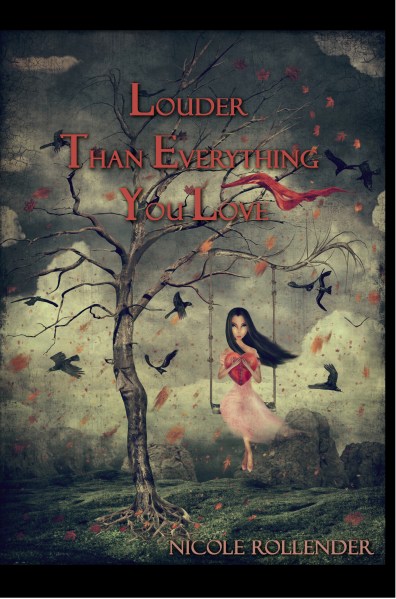
Louder_Cover


From LOUDER THAN EVERYTHING YOU LOVE
By Nicole Rollender:


SCATTERING

I remember your clavicle pressed like a blade
under your skin, the moon

pooling in your cheeks’ hollows. You wanted
to be buried in the green dress

you always wore with pearls. We’d sit outside your back
door, watching bats swing over the lake.

Once you were like a weather vane twisting
at the edge of a field as you watched tornados spin

toward your house, your mother asleep on the couch.
I suppose you couldn’t tell me you wanted

her dead. But now you’re gone like she is.
I listen for your voice in the church

inside me, where a priest’s hands outline the shape
of a death. Yes, he believes vertebrae have ghosts.

This luminous pew, where a bird can earn a spot
in paradise—but I’m told the earth

can’t perform the miracle of giving you back.
I know the music your bone shards

make in the urn. You could be an old woman
shaking fish skeletons to conjure the dead.

You could be this fish skeleton.
I should know when a body need not be resurrected—

when the ways we said our names between us,
quietly near the azaleas, trying not to startle

robins (now, now they’re singing on your spine),
stop being music I can hear in my mind,

but become something other: how I scatter
the notes, adagio, pianissimo, and what answers

as the wind scatters white feathers into the lake.


PSALM TO BE READ WHILE MY DAUGHTER CONSIDERS MARY

A swaddling, a manger: but what happened before all this, my
daughter says: when Mary was a girl: I said yes: did she feel an
undersea tug on her spirit: did she think she might be able to move
jugs of water with her mind: I said yes: to birth a man who would
walk on water: a man who would tattoo his image in blood and sweat
on a shroud: did she, in the night fields, look for a star that would
lead seven shadows as colors into her life: what is wine: what are
these fishes, these loaves: for, he entered and exited her as light: her
waters stayed intact: yet, she swaddled a baby who would nurse, laid
him in prickly hay next to goats’ stiff fur: I said yes: listen to this: your
great-grandmother saw Mary appear next to my mother’s crib: my
mother caught measles as a baby: your great-grandmother was a seer:
she walked with Mary back to the stable: comets circling as angels in
a flock overhead: Joseph, wondering: I said yes: Mary, whose baby
pierced through her as light: holding a boy who’d be lanced with a
sword: who would bleed, pee, sweat and groan: who contained God:
who contained her blood: who contained everything in the world:
yet, held out his hand and cried for her milk.


THE LIGHT MAKES MY GRANDMOTHER CRY

Her stories still smoke up the kitchen, a dead woman
cooking peasant soup. Pigeons, lightning boiling

for the living. What kind of truth-telling do we expect
to fall off bird bones? Her death was supposed to be

a leaving, except it wasn’t. Her mutterings clack on
the backs of my teeth. She’s learning what dead women

do: swim the blood of their daughters, spread themselves
on ceilings like giant moths radiating light. The solstice

lights the halo-less among us. Her gap-teeth swallow ashes
in the urn. The coffee grounds won’t settle. She pushes

her hands up into mine, slides her ghost bones under
my skin, and watches my fingers dance the shadow-

-woman-waltz-grasping-at-spoons. She remembers
the day Pinky the poodle was nabbed from her front

yard, pretends to pet his wooled head. That’s why you
need fences to keep the dark ones out
. She uses her skull

as a pot, hissing up, Give back the life I gave you. The sink
runs red angry water. She tiptoes up my spine in her

old slippers, knocking on every vertebra she sees.
It’s true that the dead get younger. Some nights she’s

a skinny girl waking from a bad dream, calling for
a winged mother, the saint of lost dogs, to come down

from a parapet. It’s this girl I let stay, because she also
cries at the stars, whose light goes right through her,

for the dead woman she will grow up to be. That new
blaze, coming from as far away as blue stars going nova,

the lesson in the death-light: The dead learn
to smell what’s sweetest among all the rotting.


Today’s poems are from Louder Than Everything You Love (ELJ Publications, 2015), copyright © 2015 by Nicole Rollender, and appear here today with permission from the poet.


Louder Than Everything You Love: Nicole Rollender’s poems balance on the uneasy boundary between third eye and communion wafer. Beside an “old woman shaking fish skeletons to conjure the dead,” the poet as body becomes a conduit for the generations in both directions, such that her “body is full of holes the dead / look in and out,” while of her daughter she says, “my ribs / were her scaffolding.” Rollender alternately glories and suffocates in her holy entanglement with her lineage, with her God. And when she comes up for air, she ululates a hauntingly familiar song. —Jessica Goodfellow, author of Mendeleev’s Mandala


Nicole Rollender’s work has appeared or is forthcoming in The Adroit Journal, Alaska Quarterly Review, Best New Poets, The Journal, Memorious, THRUSH Poetry Journal, West Branch, Word Riot and others. Her first full-length collection, Louder Than Everything You Love, was published by ELJ Publications in 2015. She’s the author of the poetry chapbooks Arrangement of Desire (Pudding House Publications, 2007), Absence of Stars (dancing girl press & studio, 2015), Bone of My Bone, a winner in Blood Pudding Press’s 2015 Chapbook Contest, and Ghost Tongue (Porkbelly Press, 2016). She has received poetry prizes from CALYX Journal, Ruminate Magazine and Princemere Journal. ​​


Editor’s Note: Nicole Rollender’s first full-length collection is haunting and haunted, tender and tendrils, eye of newt and mother’s milk. The poems contemplate generations and generation. Death and little deaths. The ways we go on, the ways we are remembered. How birds alight on our remnants after we are gone. Its pages are rife with the inheritance of seers and magic, wisdom and sight. With what is passed down amongst women through the ages, from mother to daughter again and again and beyond.

The book’s moments of stunning lyric are interwoven with its major themes so that they become “the music… bone shards // make in the urn.” On the theme of death, the poet writes: “I listen for your voice in the church // inside me, where a priest’s hands outline the shape / of a death” and “I’m told the earth // can’t perform the miracle of giving you back.” When contemplating Mary as mother, she notes the real miracle, that Mary birthed a god “who contained her blood: who contained everything in the world: / yet, held out his hand and cried for her milk.”


Want to see more from Nicole Rollender?
Author Website
Author Blog
Order a signed copy of Louder Than Everything You Love and get a bonus broadside
“How to Stop Drowning” in Muzzle Magazine
“Aperture” in A-Minor Magazine

SATURDAY POETRY SERIES PRESENTS: STATE OF GRACE: THE JOSHUA ELEGIES

41oGCGJb2kL._SX331_BO1,204,203,200_


From STATE OF GRACE: THE JOSHUA ELEGIES
By Alexis Rhone Fancher:


DYING YOUNG

Midnight, and again I’m chasing
sleep: its fresh-linen smell and
deep sinking, but when I close my eyes I see
my son, closing his eyes. I’m afraid of that dream,
the tape-looped demise as cancer claims him.

My artist friend cancels her L.A. trip. Unplugs the
internet. Reverts to source. If cancer
will not let go its grip, then she will
return its embrace. Squeeze the life out of
her life. Ride it for all it’s worth.

By the time his friends arrive at the cabin
my son is exhausted, stays behind while
the others set out on a hike. He picks up the phone.
“Mom, it’s so quiet here. The air has never
been breathed before. It’s snowing.”

I put on Mozart. A warm robe. Make a pot
of camomile tea. The view from my 8th floor
window, spectacular, the sliver moon, the stark,
neon-smeared buildings, their windows dark.
Sometimes I think I am the only one not sleeping.

My artist friend wants to draw the rain. She
wants to paint her memories, wrap the canvas
around her like a burial shroud.

Tonight, a girl in a yellow dress stands below
my window, top lit by a street lamp, her long shadow
spilling into the street. She’s waiting for someone.

I want to tell my friend I’ll miss her.
I want to tell my son I understand.
I want to tell the girl he won’t be coming.
That it’s nothing personal. He died young.


SNOW GLOBE

Despair arrived, disguised as
nine pounds of ashes in a
velvet bag, worried so
often between my fingers
that wear-marks now stain
the fabric.

Is it wrong to sift
the remains of my dead son,
bring my ashen finger to my
forehead, make the mark of
the penitent above my eyes?

His eyes, the brown of mine,
the smooth of his skin, like mine.
Unless I look in the mirror
I can’t see him.

Better he’d arrived
as a snow globe, a small figure,
standing alone at the bottom of his
cut-short beauty.

Give him a shake, and watch
his life float by.


OVER IT

Now the splinter-sized dagger that jabs at my heart has
lodged itself in my aorta, I can’t worry it
anymore. I liked the pain, the
dig of remembering, the way, if I
moved the dagger just so, I could
see his face, jiggle the hilt and hear his voice
clearly, a kind of music played on my bones
and memory, complete with the hip-hop beat
of his defunct heart. Now what am I
supposed to do? I am dis-
inclined toward rehab. Prefer the steady
jab jab jab that reminds me I’m still
living. Two weeks after he died,
a friend asked if I was “over it.”
As if my son’s death was something to get
through, like the flu. Now it’s past
the five-year slot. Maybe I’m okay that he isn’t anymore,
maybe not. These days,
I am an open wound. Cry easily.
Need an arm to lean on. You know what I want?
I want to ask my friend how her only daughter
is doing. And for one moment, I want her to tell me she’s
dead so I can ask my friend if she’s over it yet.
I really want to know.


Today’s poems are from State of Grace: The Joshua Elegies (KYSO Flash, 2015), copyright © 2015 by Alexis Rhone Fancher, and appear here today with permission from the poet.


State of Grace: The Joshua Elegies: “Alexis Rhone Fancher’s book, State of Grace: The Joshua Elegies, maps in searing detail a landscape no parent ever wants to visit—a mother’s world after it’s flattened by her child’s death. Though her son’s early passing was ‘nothing personal,’ her poems howl with personal devastation. They insist that the reader take the seat next to hers in grief’s sitting room and ‘imagine him in his wooden forever.’ Fancher grapples with how to reconcile oneself to the slow loss of memory’s fade-out, and with how to go on living without betraying the dead, how to ‘[s]queeze the life out of / her life.’ You’ll need tissues when you read this book, but it’s well worth rubbing your heart raw against the beauty of these poems and their brave, fierce honesty.” — Francesca Bell, eight-time nominee for the Pushcart Prize in poetry, and winner of the 2014 Neil Postman Award for Metaphor from Rattle


Alexis Rhone Fancher is the author of How I Lost My Virginity To Michael Cohen and Other Heart Stab Poems, (Sybaritic Press, 2014). Find her work in Rattle, Menacing Hedge, Slipstream, Fjords Review, H_NGM_N, great weather for media, River Styx,The Chiron Review, and elsewhere. Her poems have been published in over twenty American and international anthologies. Her photos have been published worldwide. Since 2013 Alexis has been nominated for three Pushcart Prizes and two Best of The Net awards. She is photography editor of Fine Linen, and poetry editor of Cultural Weekly, where she also publishes The Poet’s Eye, a monthly photo essay about her ongoing love affair with Los Angeles. www.alexisrhonefancher.com


Editor’s Note: The poems in today’s collection slew me. Long after I finished reading them, they stayed with me, a specter. As I nursed my young son, worried over his maladies, rejoiced in his small accomplishments, there in the shadows was the poetry of Alexis Rhone Fancher reminding me that life is precious, fleeting, that nothing should be taken for granted, that anything–no matter how dear–can be taken away.

It is impossible not to be moved by these poems. By “a girl in a yellow dress [who] stands below / my window, top lit by a street lamp, her long shadow / spilling into the street… waiting for someone.” By the poet, the mother, who wants “to tell the girl he won’t be coming. / That it’s nothing personal. He died young.” By the admission, “Unless I look in the mirror / I can’t see him.” By the callousness of a friend who would ask if a mother is “over” her son’s death. By a mother’s very human reaction to such a question: “I want to ask my friend how her only daughter / is doing. And for one moment, I want her to tell me she’s / dead so I can ask my friend if she’s over it yet. / I really want to know.”

State of Grace: The Joshua Elegies is raw, brave, honest. It rips you apart as you read it–and leaves you grieving long after–because of the very vulnerable and wounded place from whence the poems arose. This is an incredibly compelling collection that does what lyric, confessional, narrative poetry does best: invites the reader into a human experience that is at once personal and shared, pairing vivid imagery and beautiful language with a story so moving that the reader is forever changed by the very act of having read it.


Want to see more from Alexis Rhone Fancher?
Buy State of Grace: The Joshua Elegies from Amazon
Four poems in Ragazine, including “When I turned fourteen, my mother’s sister took me to lunch and said:,” chosen by Edward Hirsch for inclusion in The Best American Poetry, 2016
Broad (“Dying Young” was first published in Broad)
Alexis Rhone Fancher’s Official Website / link to published works

SATURDAY POETRY SERIES PRESENTS: CHANEL BRENNER

Photo by The POD Photography


A POEM FOR WOMEN WHO DON’T WANT CHILDREN
By Chanel Brenner


I won’t preach about the rewards of motherhood.
I won’t say it’s the best thing that ever happened to me.
I won’t say it’s the best job I’ve ever had.
I won’t say you’ll regret not having a child.
I won’t say you’ll forget what life was like before.
I won’t say it makes life worth living.
What I will say
is my son died.
What I will say
is I would still do it again.


Today’s poem was originally published in Rattle and appears here today with permission from the poet. Hear the poet read today’s poem aloud via Rattle.


Chanel Brenner is the author of Vanilla Milk: a memoir told in poems, (Silver Birch Press, 2014). Her poems have appeared in Poet Lore, Rattle, Cultural Weekly, Diverse Voices Quarterly, Anderbo, West Trestle Review, and others. Her poem, “July 28th, 2012” won first prize in The Write Place At the Write Time’s contest, judged by Ellen Bass. In 2014, she was nominated for a Best of the Net award and a Pushcart Prize.

Editor’s Note: I won’t say it’s because I first read today’s poem while pregnant. I won’t say it’s because three weeks ago I became a mother for the first time. I won’t say it’s because I did not want children myself. I will say that my son is an amazing human being and that I am honored to be in his service. I will say that today’s incredibly moving, incredibly brave poem breaks my heart each and every time I read it.

Want to read more from Chanel Brenner?
Chanel Brenner’s Official Website
Deep Water Literary Journal
Cultural Weekly
Women’s Voices for Change
Silver Birch Press
Buy Vanilla Milk on Amazon

SATURDAY POETRY SERIES PRESENTS: ALAN TOLTZIS

pic 003

FORTY-TWO PLACES
By Alan Toltzis

As time passed,
they didn’t need to study love,
pray for it,
or even speak its name.

Instead,
they lived their love
silently.
Secrets remained secret

as love sank into unbending bones,
fused with supple corpuscles,
and seeped through soft skin
beneath their fingernails.

Only by looking back
and naming each
of the 42 places (in order)
they had journeyed

did they realize they had grown
into an old couple
who survived a long-forgotten stopover
of bickering and concession

and the should-
and should-not-have-saids
they should never
have crossed

leaving only unspoken love
perpetuated by the comfort and intimacy
of taking each other
for granted.


Today’s poem is from the collection The Last Commandment, published by Poetica Publishing, copyright © 2015 by Alan Toltzis, and appears here today with permission from the poet.


Alan Toltzis is the author of the book of poems, The Last Commandment (Poetica Publishing, 2015). His work appears in print and online publications including The Provo Canyon Review, Poetica Magazine, Burningword Literary Journal, Soul-Lit, and Red Wolf Journal. Alan is working on his second book of poems and is developing The Psalm Project, to teach poetry to middle- and high-school students.

Editor’s Note: There is something of a prayer in today’s poem. A thanksgiving. Something quiet, humble, and honest. Something lived, understood, known. What it is to journey throughout a lifetime of relationship. What it is to look back and reflect upon “the should- / and should-not-have-saids … leaving only unspoken love / perpetuated by the comfort and intimacy / of taking each other / for granted.”

Want to read more from Alan Toltzis?
Alan Toltzis’ Official Website
“Miles Away” in the Red Wolf Journal
The Provo Canyon Review
“Noah” in the Red Wolf Journal
“Elegy for 107696” via Poetica Publishing

SATURDAY POETRY SERIES PRESENTS: FALL POEMS

By Someone35 (Own work) [CC BY-SA 3.0 (http://creativecommons.org/licenses/by-sa/3.0)], via Wikimedia Commons
By Someone35 (Own work) [CC BY-SA 3.0 (http://creativecommons.org/licenses/by-sa/3.0)%5D, via Wikimedia Commons


AFTER APPLE-PICKING
By Robert Frost

My long two-pointed ladder’s sticking through a tree
Toward heaven still,
And there’s a barrel that I didn’t fill
Beside it, and there may be two or three
Apples I didn’t pick upon some bough.
But I am done with apple-picking now.
Essence of winter sleep is on the night,
The scent of apples: I am drowsing off.
I cannot rub the strangeness from my sight
I got from looking through a pane of glass
I skimmed this morning from the drinking trough
And held against the world of hoary grass.
It melted, and I let it fall and break.
But I was well
Upon my way to sleep before it fell,
And I could tell
What form my dreaming was about to take.
Magnified apples appear and disappear,
Stem end and blossom end,
And every fleck of russet showing clear.
My instep arch not only keeps the ache,
It keeps the pressure of a ladder-round.
I feel the ladder sway as the boughs bend.
And I keep hearing from the cellar bin
The rumbling sound
Of load on load of apples coming in.
For I have had too much
Of apple-picking: I am overtired
Of the great harvest I myself desired.
There were ten thousand thousand fruit to touch,
Cherish in hand, lift down, and not let fall.
For all
That struck the earth,
No matter if not bruised or spiked with stubble,
Went surely to the cider-apple heap
As of no worth.
One can see what will trouble
This sleep of mine, whatever sleep it is.
Were he not gone,
The woodchuck could say whether it’s like his
Long sleep, as I describe its coming on,
Or just some human sleep.


AUTUMN: A DIRGE
By Percy Bysshe Shelley

The warm sun is falling, the bleak wind is wailing,
The bare boughs are sighing, the pale flowers are dying,
And the Year
On the earth is her death-bed, in a shroud of leaves dead,
Is lying.
Come, Months, come away,
From November to May,
In your saddest array;
Follow the bier
Of the dead cold Year,
And like dim shadows watch by her sepulchre.

The chill rain is falling, the nipped worm is crawling,
The rivers are swelling, the thunder is knelling
For the Year;
The blithe swallows are flown, and the lizards each gone
To his dwelling.
Come, Months, come away;
Put on white, black and gray;
Let your light sisters play–
Ye, follow the bier
Of the dead cold Year,
And make her grave green with tear on tear.


AUTUMN LEAVES
By Juliana Horatia Ewing

The Spring’s bright tints no more are seen,
And Summer’s ample robe of green
Is russet-gold and brown;
When flowers fall to every breeze
And, shed reluctant from the trees,
The leaves drop down.

A sadness steals about the heart,
–And is it thus from youth we part,
And life’s redundant prime?
Must friends like flowers fade away,
And life like Nature know decay,
And bow to time?

And yet such sadness meets rebuke,
From every copse in every nook
Where Autumn’s colours glow;
How bright the sky! How full the sheaves!
What mellow glories gild the leaves
Before they go.

Then let us sing the jocund praise,
In this bright air, of these bright days,
When years our friendships crown;
The love that’s loveliest when ’tis old–
When tender tints have turned to gold
And leaves drop down.


Today’s poems are in the public domain, belongs to the masses, and appears here accordingly.


Editor’s Note: Today we celebrate another change in seasons. As the leaves turn red, yellow, orange and gold, as they fall from the trees and blanket the ground, as Mother Earth sheds her summer splendor and Persephone prepares to go underground, may we bid farewell through poetry. And may we meet again in spring when life blooms anew.


Want to read more fall poetry?
Academy of American Poets
The Poetry Foundation

SATURDAY POETRY SERIES PRESENTS: MOVEMENT NO. 1: TRAINS


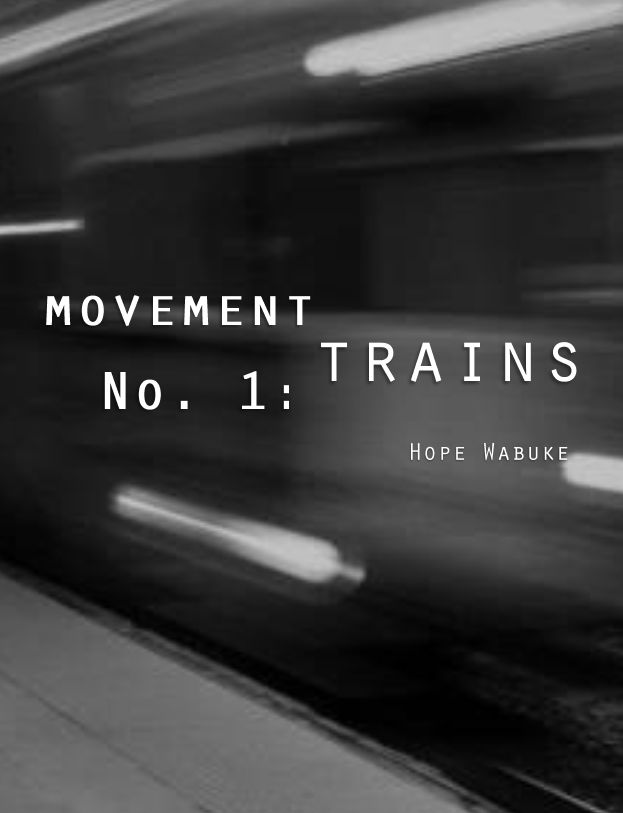
movement_1024x1024


From MOVEMENT NO. 1: TRAINS
By Hope Wabuke:


and when she waits, knowing its coming by the movement of light
across rusted metal, the dirty white tiles of tunnel wall almost
beautiful in the light sliding closer through darkness, approaching
rumble and tearing, metal wheel against track, gears shifting; halt.

in the loud echo still, vibrations pulsing—the only thing. she
imagines the sound she hears is breathing.


it is only when she thinks of him that her body becomes soft; she is
so conscious, then, of the movement of his body pressed against
hers’. so now she slides slightly, left, right, with the swaying motions
of the car. the train is stopped on the bridge, a windy day. the
intercom voice presses through static and she lifts arms above head,
stretches out her body to touch fingertips light to metal pole in
aisle’s center. the violence of the train’s starting and picking up, of
speed. in the meeting of the many tiny bones in her wrist against the
cold hardness, in the press of fingers soft against metal pole. she is
understanding pain in increments of waves, the pulsing slow
softening in rhythm with the traincar, rocking—her body, pushed
backwards, against scratched plexiglass window.

and in the moment of the train’s descent underground, her last view
a mirrored body, lines like chain links against grey sky, grey water.
the shape of their structures, repeating, suspended: a half-circle, a
half-closed eye .


and on the day after his leaving. she notices his absence in the
awkward stillness of her legs, the way her arms hang stiffly at her
sides. this is when she will remember how, as he would touch
drumsticks to upside-down white buckets to make beats, she would
see sound touch tile in tunnel walls and touch heels to ground.
rocking upward in tiny motions, she would lift hands lightly; she
would move her body in tiny circles of his rhythm.


Today’s poems are from Movement No. 1: Trains, published by dancing girl press, copyright © 2015 by Hope Wabuke, and appear here today with permission from the poet.


Movement No. 1: Trains is a city symphony of New York, where the author lived for many years–the daily rhythm of riding the subway and dancing between people walking the streets. Blurring the lines between past and the present, these prose poems explore the movement between love, loss and longing in a young woman’s memory.


Hope Wabuke: Born in exile to Ugandan refugees, Hope Wabuke is a writer, essayist and poet based in California. Hope is a contributing editor for The Root and a contributing writer for the Kirkus Reviews. Her poetry has also appeared in Lit Hub, The North American Review, Potluck Magazine, Ruminate Magazine, Fjords Literary Journal, Salamander Literary Journal, NonBinary Review, JoINT Literary Journal, Weave Magazine, Cease Cows, Kalyani Magazine, Split this Rock and Literary Mama. Her essays and criticism have appeared in Newsweek’s The Daily Beast, Salon, Gawker, Guernica, Dame, The Root, Ozy, The Hairpin, Ms. Magazine online, The Rumpus, Los Angeles Magazine and The Feminist Wire. Her fiction has been featured in the anthology All About Skin. Her chapbook Movement No. 1: Trains was published in June 2015 by dancing girl press. Her second chapbook, The Leaving, will be published in 2016 by Akashic Press as part of Kwame Dawes and Chris Abani’s New Generation African Poets series.


Editor’s Note: Part train ride, part memory, Movement No. 1: Trains takes the reader on a journey through which narrative blends with past, history is distorted by the present, and the tracks of the mind become one with the train lines of the New York subway system. Disjointed in a halting motion that mirrors the jerky movements of an underground train, the sway and lurch of this collection is tempered by moments of clarity and thoughtful reflection: “she / imagines the sound she hears is breathing;” “it is only when she thinks of him that her body becomes soft;” “she / would move her body in tiny circles of his rhythm.”


Want to see more from Hope Wabuke?
Hope Wabuke’s Official Website
Hope Wabuke’s Twitter
Buy Movement No. 1: Trains from dancing girl press
Literary Hub
The Hairpin

SATURDAY POETRY SERIES PRESENTS: HISTORIES OF THE FUTURE PERFECT


HOTFP-cover-front-only


From HISTORIES OF THE FUTURE PERFECT
By Ellen Kombiyil:


CERBERUS AND PERSEPHONE

It’s audible to the three-headed dog:
her fear a high-pitched shriek

held in her throat. Pre-unleashed. The thought
of the shriek and not the shriek itself.

It’s freaking her out, this mind-reader dog,
how he tracks muscle-twitch, her intent to act,

pre-synapsed. He demands to know the before,
before the before: she was plucking flowers,

yes, when the ground opened its mouth,
but how she arrived at this exact spot,

how slowly she chewed and what she ate
for breakfast, how she slipped, stepping

onto the bathmat, her precise existence
at this particular moment—the two-, no

three-second pause at the four-way stop.
Indelible decisions. The luck

of the draw. The dog deciphers
eye-flicker, delves past thought in search of

the anatomy of thought, which moves
like starlight, born but the reaching delayed,

which moves like the gorgeous dark.
He’s doing it again, she thinks,

and he reads that, too. In his pupil-black,
black surrounded by gold flecks, she sees

the pre-patterned repetition
of next and next and next: her mouth, stained red;

she will not be leaving this place, not yet.
This future splits away like a cannon-

boom of sound. Calla lilies, held fast,
she lets drop. The great winding of a clock.


WHILE SIPPING LEMON TEA ON SATURN’S ICE-CLOUD DECK

The distant sun rises, the size of a dime.
Red light looks warm but is cold, the opposite of what I know.

What can’t be unknown: encrypted DNA, curling inside me.
What I google: Orbit: 29 years, 167 days. Rotation: 10.233 hours.

Dizzy days and sleepless nights—elongated years.
I’ve forgotten the outline of my body against you

how I’d reach across your warmth to the nightstand for water.
I am an untethered moon, unloosed from the sun.

Now is no time to panic: remember Sherlock Holmes.
He discards the superfluous, keeps room for important truths.

Human contact is what I’m lacking, so far from home.
Can you see me on the cloud deck, waving my arms?

I’m calling out for connection, any Watson will do:
It’s elementary, my dear; come here. I need you.


JULIET DREAMS OF THE CRYPT

Is it joy, waking to tall ceilings
painted white, inlaid with the smell

of almonds? The blind see colors,
cool heft of objects hand-held.

They do not see what is tarnished.
I’d be lying if I said I knew how

to get to the other side of my heart.
I rehearsed my speech as a child—Love

is a heavy wheelbarrow crushed with
hibiscus
—before pretending to plunge

the knife into my chest. My mouth
at the moment of loss unbinds a thousand

mouths all making the same sound. I practiced
for the day I am blind, when

I will trade myself for one
dram of bottled summer, a lawn

that tickles my neck when I lie down
next to you without expectation.


Today’s poems are from Histories of the Future Perfect, published by The (Great) Indian Poetry Collective, copyright © 2015 by Ellen Kombiyil, and appear here today with permission from the poet.


Histories of the Future Perfect by Ellen Kombiyil is a book of poetry inspired by concepts in astrophysics. Canvassing across time and space to provide a luminescence unafraid of the big ideas, the book itself has what Kombiyil calls a quantum structure. Here we find Galileo’s thumbprint, Kurt Cobain Las Vegas, and Mary Lincoln communing with the dead. The poems themselves are never narrowly historical but rather cosmic in their inflections, taking on subatomic particles, DNA, and black holes, not simply as scientific props but as the very impetus for lyric motion.


Ellen Kombiyil is the author of Histories of the Future Perfect (2015). She is a recent transplant from Bangalore, India, where she lived for nearly eleven years, teaching creative writing and yoga. A fellow at the University of Iowa’s International Writing Program in 2013, Kombiyil’s poetry and fiction have appeared in many journals, including BOOTH, Spillway, Cordite, and Poemeleon. She is a four-time Pushcart Prize nominee and has read, performed or taught workshops at the annual Prakriti Poetry festival in Chennai, the Raedleaf Poetry Awards in Hyderabad, and Lekhana in Bangalore. She is the co-Founder of The (Great) Indian Poetry Collective, a mentorship-model poetry press, publishing innovated voices from India/Indian diaspora. Originally from Syracuse, New York, and a graduate of the University of Chicago, she now lives in New York City with her husband and two children.


Editor’s Note: Ellen Kombiyil’s Histories of the Future Perfect is an absolutely stunning collection, from its opening image to its closing word, soaring and shining with every star and feather in-between. In truth, I am like “the tarot-reading parrot” in the gorgeous cover image by Kalyani Ganapathy, selecting today’s poems by divination rather than choice, because there is far, far too much that is worthy of sharing in this book.

Enter a world where nothing is off limits for exploration: history, mythology, love. Dive to the deepest depths of the ocean and travel as far as the imagined reaches of outer space. Slip into the skin of the philosopher, historian, astronaut, necromancer, classicist, adventurer–all as imagined by the contemplative mind and lyric lilt of the poet. Give yourself over to moments as beautiful as they are thought-provoking–“My mouth / at the moment of loss unbinds a thousand // mouths all making the same sound”–and know that these are the ripples circling out across the waters of this one-of-a-kind collection.

Buy this book. Revel in its beauty. Let your mind drift, weightless. Be carried away.


Want to see more from Ellen Kombiyil?
The (Great) Indian Poetry Collective
Buy Histories of the Future Perfect on Amazon
POEMELEON
Booth

SATURDAY POETRY SERIES PRESENTS: ALL DAY, TALKING

allday_1024x1024


From ALL DAY, TALKING
By Sarah A. Chavez:


DEAR CAROLE, I FINALLY DID IT

I cut it all off into a trendy bob
that fades up the back. You told me
not to, said you loved my hair long.
Well, you’re not here anymore.


DEAR CAROLE, TODAY I’M WEARING THAT RING

you stole for me at the art fair
on the green at Fresno State.
God, was I such a baby!
Poor me, I don’t have any money
to buy things.
I kept whining.
I never get to have anything nice.
And most of what we’d seen
iron sculptures, clay dishes fired
for ornament, I was only just
discovering, but still, I thought
I deserved them.
That’s another thing age teaches you –
you ain’t owed shit. There is nothing
on this flying water rock that anyone deserves.
You should’ve smacked me, echoed
my father and told me to suck it up.
But you didn’t.

It was the third time we’d circled
back to that booth. Everything
about it was pretty: the rainbow
canopy, the sunlight glinting off
the semi-precious gems and hued
glass, the hot hippie without a bra
telling every passer-by about Gaia.
I fingered a large red and black
swirled ring, slipped it over
the callouses on my middle finger,
and spread my hand flat to admire it,
its heft impressive for something so lovely.
The hippie told me, the ring
wants to be a ring. I never take
from the Earth without her permission.
I spoke to the stone, told her what
she’d be
and she gave me her blessing.

The hippie looked so sincere
when she spoke, looked into my eyes
with her large cobalt irises, the pupil a pinprick
in the blue with the sun glaring
behind me. I’m sure I said something
stupid. I always get so nervous
around people like that, who walk
through life like an open wound, their blood
and tissue exposed to the elements,
their insides shining on the outside.

I probably said, Cool and behind me,
you probably rolled your eyes.
I put the ring back on the organic
hemp cushion with the other
metamorphisized rocks, then spun
the color-tinted glass of the wind chimes
hanging from the canopy’s aluminum
frame to hear their tingle-tangle
and submerged my hand into the basket
of oddly-shaped beads, feeling what I
imagined the quiet core within a fossilized
stone felt like. As we walked away,
you said Thanks, which was weird, but
I thought maybe it got to you too –
so much unattainable beauty,
the reminder of all the things
we didn’t have and all the things
we couldn’t yet know we wanted.

Walking to 711 for cigarettes,
we stopped at the crosswalk light.
You took my hand and pressed
the weight of the ring into my palm.
I looked up at you, squinting in surprise,
but you just shrugged, said The stone told me
to take it. It said it wanted you to wear it.


DEAR CAROLE, FOR HOURS, IT’S BEEN BURNING

a hole in my gut, the shame
of never saying thank you
twelve years ago for that fucking pizza
you bought with SSI back pay.
It tasted so good: the grease,
the sweet of the tomato sauce,
the salt from the olives prickling
my tongue – I could actually taste it.
They don’t say on those Cymbalta commercials
depression takes away taste.
Sleep, yeah, sex drive, focus, but not taste.
I never told you
how for those months, alone
in my one-bedroom apartment I tried
to eat just about anything,
but it was all so thick and waxen . . .
one night, ravenous and wretched
I tried to eat an entire loaf of bread.
Cross-legged on the kitchen floor
the light from the street lamp cast ghastly
shadows against the apartment blinds
while I took slice after slice
of Wonder Bread from the Hostess overstock
warehouse on Weldon Street and bit
into each one wanting desperately
for the next to taste
like summer,
like 1998,
like the smell of patchouli
in your room, like rain water,
like mud-stained carpet, like midnights
on the front porch,
like lying to our mothers and never getting caught.
Slice after slice – mutilated, the impression
of my teeth embossed on each one’s cottony
flesh – lay scattered
on the linoleum. I couldn’t bring myself
to swallow even the smallest
bite. Just kept spitting
slobbery hunks onto my naked lap,
into my tangled hair, until
I laid down, the floor clammy and smooth
like the palms of your hands.


Today’s poems are from All Day, Talking, published by Dancing Girl Press, copyright © 2014 by Sarah A. Chavez, and appear here today with permission from the poet.


All Day, Talking: “A stunning, gritty, and beautifully irreverent collection of poems, All Day, Talking repeatedly and necessarily corrupts the conventional elegy. Chavez mourns Carole, yes, but she also mourns herself—and all of us, the tragedy of how we see (or don’t see) one another in our contradictory identities and bodies. If you want to know the honest truth about what it means to grieve and to survive, keep these poems close and listen to this ‘all day, talking,’ which is both deeply personal and profoundly political.” — Stacey Waite, author of Butch Geography


Sarah A. Chavez, a mestiza born and raised in the California Central Valley, is the author of the chapbook, All Day, Talking (Dancing Girl Press, 2014), which was featured on Sundress Publications’ book spotlight, The Wardrobe’s Best Dressed. She holds a PhD in English with a focus in poetry and Ethnic Studies from the University of Nebraska – Lincoln. Her work can be found or is forthcoming in North Dakota Quarterly, Stirring: A Literary Collective, Spoon River Poetry Review, Luna Luna Magazine, among others. Her manuscript, This, Like So Much, was an Honorable Mention for the 2013 Quercus Review Press Poetry Book Contest. A selection from her chapbook manuscript All Day, Talking won the Susan Atefat Peckham Fellowship in 2013. She is a proud member of the Macondo Writers Workshop.


Editor’s Note: There is a refreshing honesty to the poems in All Day, Talking that is, in equal measures, surprising, laugh-out-loud funny, and deeply touching. In this collection grief is portrayed–and love remembered–through a lens of realism that mirrors the very real and very unstable experience of loss. Memory is the vehicle through which a life lost is a life recalled, and the speaker addresses the absence with a candor and wit that seems to honor the relationship that gave rise to it when Carole was still living. Amidst a text thick with engaging and humorous stories, within the world of deeply confessional admissions and recollections, there exists the heartbeat of the lyric, “the reminder of all the things / we didn’t have and all the things / we couldn’t yet know we wanted.”


Want to see more from Sarah A. Chavez?
Sarah A. Chavez’s Official blog/website
Buy All Day, Talking directly from the poet
Buy All Day, Talking from the publisher
Rogue Agent
Broadside of “The Day the Alligators Feasted on Time” from Stirring: A Literary Collection
The Poetry Foundation: Irene Lara Silva in conversation with Sarah A. Chavez