Angela Townsend: “Hugs to Chance”

Hugs to Chance
by Angela Townsend

It is there in my own script. “Hugs to Chance!” If there is anything we should entrust to the lottery, it is not hugs.

But fifteen givers call their creatures Chance, so I ballpoint my embraces. “Hugs to Chance!” This is what you do when you are the Development Director for a cat sanctuary. You buy blue pens in bulk so you can add personal notes to every tax receipt. You remember the names of donors’ pets. You send the animals hugs. You send hugs to Chances.

Hugs to Roxy are one thing. Hugs to Vercingetorix require careful cursive. The personal touch will be lost if I misspell the cat’s name. I practice on sticky notes before committing caresses to letterhead. Hugs to Vercingetorix, the warrior of nineteen ginger pounds. Hugs to Vercingetorix, whose name was Pumpkin until he was diagnosed with cancer.

When I tuck hugs between the signature line and the benediction that no goods or services were exchanged, givers write back.

Joan accuses me. “You know I can’t resist.” If I send Joan a photograph, even if I assure her that the kitten is fine, she will send fifty dollars. The kitten called Dumpling may sit fat in love’s stew. Joan still sees the wet and ragged. She boils over. She signs for the delivery of my hugs and sends a thank-you note with another fifty dollars. I wonder if Joan switches to no-name detergent when she can’t resist kittens. I wonder if she stops long enough to hug Roxy for me.

Gert’s ink bleeds. Vercingetorix is no more. “I don’t know when I am going to be okay again.” Gert does not say “if,” but “when.” She has been here before. Her Boots once became Genghis, and Tigger became Valkyrie. Their urns bear both names. Gert, in paisley pull-on pants, rode beside them into war. Gert gave insulin at twelve-hour increments and purchased Cornish hens for cats on hunger strikes. She rides with a ghost army to teach Sunday School and stack cans at the food bank. She does not know when she will adopt again. “If” would be the wrong word. She bought a stuffed animal the size of a nineteen-pound cat. She holds it in her arms so she can fall asleep.

Anthony knows it’s risky to name a cat “Chance.” His daughter once brought home a stray she called “Lucky,” and Anthony made her change it. Why tempt the stars, you know? Anthony’s letters have so many rhetorical questions, he has to type them out. His maintenance man found a cat in the boiler room and fed him Chef Boyardee. Anthony is not making this up. The maintenance man worried he would get in trouble. The cat’s eyes were all pupils, blind as Ray Charles. He’d been in the dark too long. That’s what happens. Anthony caught the maintenance man. The cat was eating toddler pasta from a spoon. The maintenance man cried, saying, “we give him a chance, we give him a chance.” So, “Chance” is a finger in fate’s eye. Do I understand? He can’t give Chance hugs, because Chance will bite his face. He’ll translate “hugs” into Chance.

When you are the Development Director, stories tattoo you. I try to tell donors that they ride in my front pocket, and some days I can’t stand up straight for the weight. I am not sending hugs so they will give us more money. I am sending hugs because they are inked into my skin. I want to invite all fifteen Chance people to a holy convocation. I want them to compare notes on how the Chances came. I want to collect all the naming ceremonies in a single volume. I want the story with the big arms.

I don’t tell them my story. When you are the Development Director, it is not about you. I start sentences with the word “you,” because the donor needs to know that they are the hero. They may not know when they will be okay again, but they know that they are the reason Dumpling will live. Love answers to “when,” not “if.”

About the Author: Angela Townsend is the Development Director at Tabby’s Place: a Cat Sanctuary. She graduated from Princeton Seminary and Vassar College. Her work appears or is forthcoming in Arts & Letters, Chautauqua, CutBank, Lake Effect, New World Writing Quarterly, Paris Lit Up, The Penn Review, Pleiades, The Razor, and Terrain.org, among others. Angie has lived with Type 1 diabetes for 33 years, laughs with her poet mother every morning, and loves life affectionately.

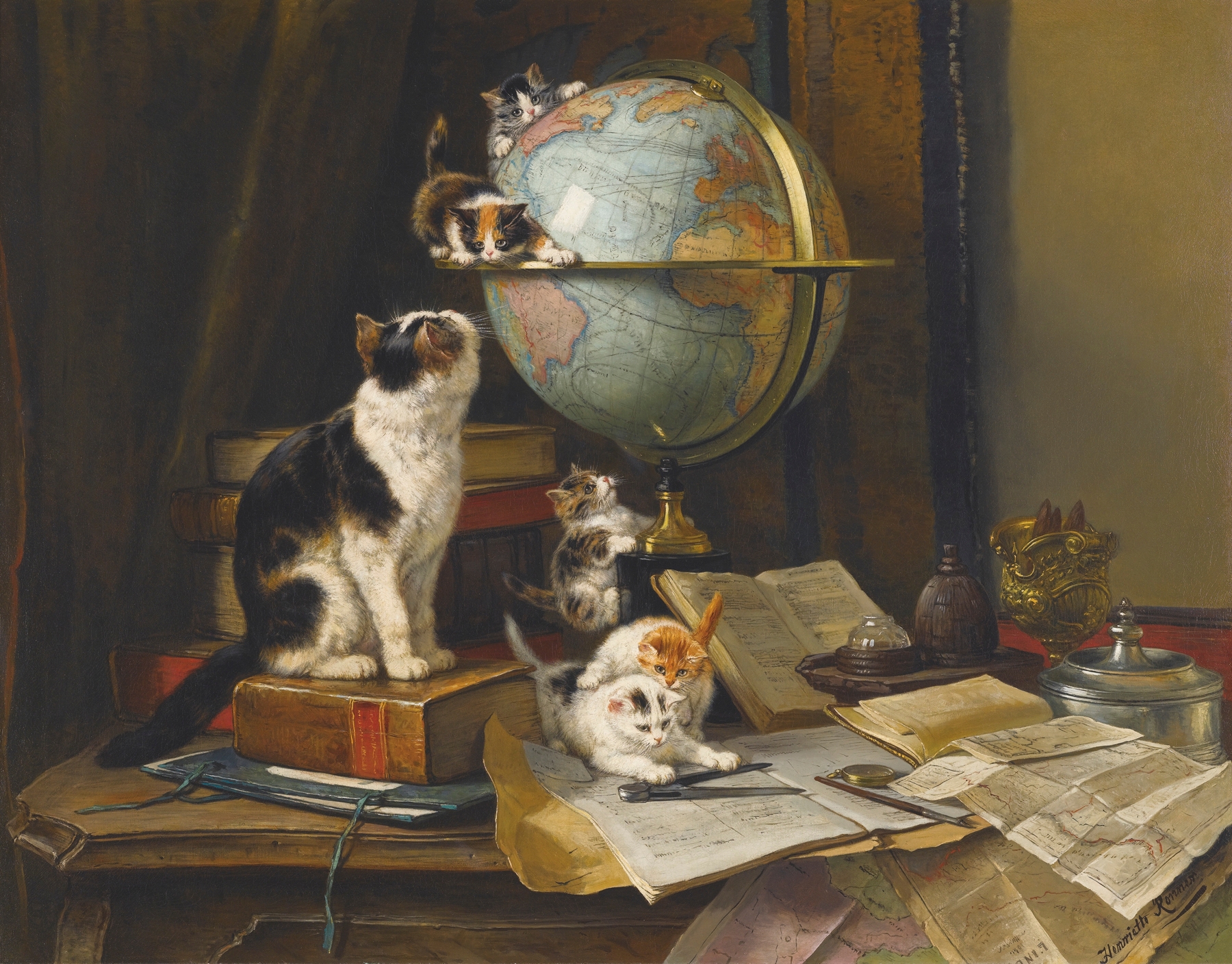
Image Credit: Henriëtte Ronner-Knip “The Globetrotters” Public domain image courtesy of Artvee
J.D. Isip: “Cope”

Cope

By J.D. Isip

for Jeff Albers

Who by aspersions throw a stone
At th’ head of others, hit their own.

– George Herbert, “Charms and Knots”

“Professor Isip,” my student is a little angry, holding up her laptop to me, a wiki for David Foster Wallace, the bandana photo, “You didn’t tell us he killed himself?”

It’s not the first time a student has confronted me about this. I’ve assigned Wallace’s 2005 Kenyon graduation speech, “This Is Water,” for well over a decade. Generally, maybe because these are freshmen who need something to believe in, maybe because it’s just that good, they fall in love. And, as they do, they dive all the way in—want to know everything about him. 

“Does that make a difference?” I ask, still curious myself.

She is shocked, “Yes!” She thinks about what to say, “I’m not saying he’s bad for killing himself. I know… I have a friend” she wrote about this friend in her first paper. There’s a lot of them who have a high school friend who committed suicide. A lot of them want to write about it.

When Infinite Jest came out, I didn’t know who David Foster Wallace was or that he was important. I was at a military base in Turkey trying not to be gay. When I went back to get my MA, it was 2008. I was in Dr. Bonca’s class getting ready to talk about postmodernism when he sat down at the front table and cried. He’d met him. Maybe they were friends, I can’t remember. I just know he meant that much to Bonca.

Wallace opens the speech with a story about two fish swimming and an older fish asks them, “How’s the water?” They wait for the older fish to pass and ask one another, “What the hell is water?”

“But if you’re worried that I plan to present myself here as the wise older fish explaining what water is to you younger fish, please don’t be,” though this is exactly what Wallace does for the next twenty or so minutes of the speech. I let my students listen to the speech in class. Recently, I’ve picked up on the eeriness of listening to the dead.

A large part of graduate school, for me, was bitching about how postmodernists got it all wrong. What the fuck did all of that deconstruction have to offer any of us after September 11th? Sometimes students ask me about 9-11 like it’s some far off time recorded in a textbook, certainly nothing the living know about firsthand, “How did you get over it?”

These days they mean September 11th, but they also mean what should have been their formative years spent locked inside, spent behind a mask, spent stuck. I think of President Bush saying we needed to go to Walt Disney World to beat the terrorists, so we went. We got back to living. We pantomimed what we remembered about living.

Continue reading “J.D. Isip: “Cope””

Laura Grace Weldon: My Father’s Battle

My Father’s Battle
By Laura Grace Weldon

“Life as a whole expresses itself as a force that is not to be contained within any one part. . . . The things we call the parts in every living being are so inseparable from the whole that they may be understood only in and with the whole.”  

-Goethe

My 83-year-old father and I meet regularly at a quiet small-town eatery. Large windows light up the whole place. He remarried after my mother’s long illness and death, now able to relax back into bird watching and church choir.

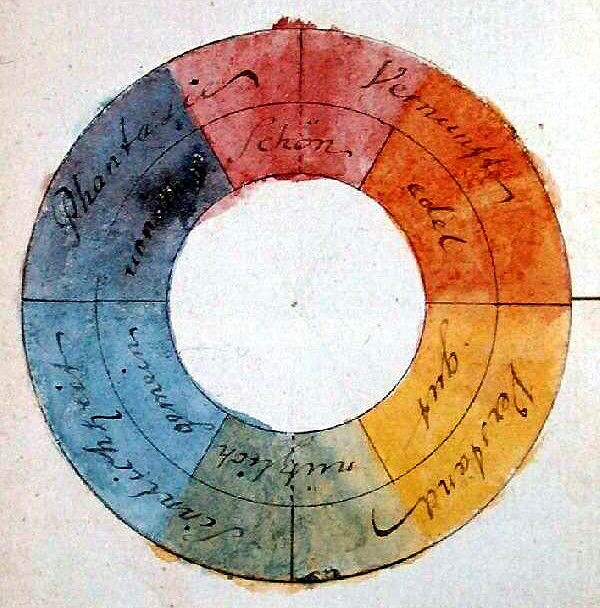
For years he made lists of things to talk about on the phone or in-person, an eccentric way to handle his shyness, but now we talk easily. While he eats a cherry pastry, I tell him about a biography of Johann Wolfgang von Goethe I’m reading. Goethe believed personal observation was more vital than conventional knowledge. “Colors,” he said, “are light’s suffering and joy.” He scoffed at critics who insisted he didn’t understand scientific theories about color. Instead, he asserted that color required both darkness and light.

My dad, a retired teacher, disagrees. He says theories must be mastered before making advancements. Goethe would have enjoyed debating that point. As we talk, beveled glass decorations at the windows break light into rainbows that bounce from my father’s face to the walls around him.

I’m grateful things have become close-friend comfortable between us. We talk and laugh companionably, happy to be sitting together rather than separated by the miles of our daily phone call. My father had been ratcheted tight by early adversity but something loosened in him recently.

Continue reading “Laura Grace Weldon: My Father’s Battle”

The Cat that Wears the Night Sky for Skin: Charles Bowden and the Northern Jaguar

The Cat that Wears the Night Sky for Skin:
Charles Bowden and the Northern Jaguar

By John Macker

I’ve never seen a northern jaguar in the flesh, across from me or crossing the border or anywhere else, but then, I’ve never witnessed the birth of the blues or border author Chuck Bowden’s feral ghost. But I believe in them both. Just as I believe in the hot dry ground that sings under its breath for rain; that fantasizes with all of its stoic forbearance: one day it’ll ride the storm out once again.

It still gathers itself at the horizon for the redundant miracles of twilight. The cooling, the operatic softening. Perhaps, for the jaguar’s silent tracks as well: south of the border but close, so close, slowed on its journey by drought, or human predation, the wall. Maybe a sordid combination of all three.

The Mayans believed if you spread out the skin of the jaguar, you’d see a map of the celestial heavens.

In a perfect world, their range would include the American Southwest all the way down into Argentina as it did a thousand years ago. They’re considered endangered in Mexico and in the U.S. if they ever make it that far north. There are rumors. Some legitimate sightings over the years. In northern Mexico, in the Sierra Madre Occidental, his home territory, the Northern Jaguar Reserve⸺ the wildest, most isolated place, where between 8 and 20 of them roam, mate, raise their young and survive⸺ is located about 125 miles south of the U.S./Mexico border and is a protected space. It is 56,000 remote acres of canyons, perennial streams, sheer cliffs, jagged mountains and forests. It is managed by the non-profit Northern Jaguar Project, headquartered in Tucson.

Continue reading “The Cat that Wears the Night Sky for Skin: Charles Bowden and the Northern Jaguar”

Jaclyn J. Reed: “I Can’t Bring Myself to Birth You Yet”

I Can’t Bring Myself to Birth You Yet

By Jaclyn J. Reed

The world is not ready for you. Neither am I.

I’m not the woman I wanted to be at 27. I’m still learning to reread my story without reliving it, to write a better tomorrow without losing today, drowning in yesterday, obsessing over what may – more likely, may not – cross my path. I don’t yet know how to replace my broken parts without ending up in pieces – to keep despair from decaying into despondence. Even if I can call myself sane, what then? Where do I fit in when each morning I wake, watch the news, wonder if our country still stands? If, when I find it does, I’m disappointed, frustrated, exhausted by the convenience afforded deviants with deep pockets keeping us apart?

My mother raised me to do / be / experience more than her, so I trek life the long way round, ease into things, cross my T’s and dot my I’s, say please and thank you and apologize – own my shit. Where her wings were built of distressed leather and aluminum, she built mine from steel; knew life would temper me, the way it tempers us all, the way it will temper you.

I do not want to temper you. I want to coddle you when no one else will, lend you my calm when the world gets too big, too polluted, too unfair. Not to shield you from modernity or harsh eventualities, just equip you for real life, provide weapons for an arsenal I hope you’ll never have to use.

You must choose the hills you die on carefully and be brave enough to let things go. Take on midterms, toxic masculinity, racism and bigotry, erratic hormones, and palatine adults with a pleasing smile, a daring gaze, a quick wit. As quick as your draw, if they still wish to fight. You’ll learn that coming to the table cannily creates more conflict than it solves, that intolerance must be intolerable if we want justice / peace / equity. There’s a whole world outside your bubble, and the truth is: people are usually better than they believe themselves to be. Your peers’ personas on playgrounds – virtual and in the real – just shadows on cave walls, more fearsome than the ones projecting them, the children just as dazed and disheartened as you will be.

You’ll be from a different generation than me, see things I haven’t, pick up tricks that took me eons to grasp. You’ll grow up too fast. All I ask is that you take up space and build boundaries of rose bushes, not bricks. Know what you deserve, trust yourself enough to accept it. Being yourself is a constant effort, as is any love – so much harder than hate, so much easier to waste. Do not define yourself by ideas and ideals; such idyllics always let you down. Question your perspectives, the filters through which you experience, the trauma in which you are rooted, the moments that make up your foundation. People change so often, and why shouldn’t they when life grows stranger by the hour?

Fluidity is how humanity survives. I’ll do my best to help you flow, teach you how to move again after long pauses, how to wake up the day after devastation and reintroduce yourself in the mirror without shattering the glass. And when inevitably you cut yourself, I will be there to help you embrace the scar.

But first the world and I have to stop falling apart.

About the Author: Jaclyn J. Reed received her MFA in Writing from Carlow University and her BA in English from the University of Pittsburgh. Her work has appeared or is forthcoming in Adelaide, Northern Appalachia Review, The Sunlight Press, and Prime Number Magazine, among others. She works in e-commerce merchandising and lives across the way from a Hershey’s Reese’s factory.

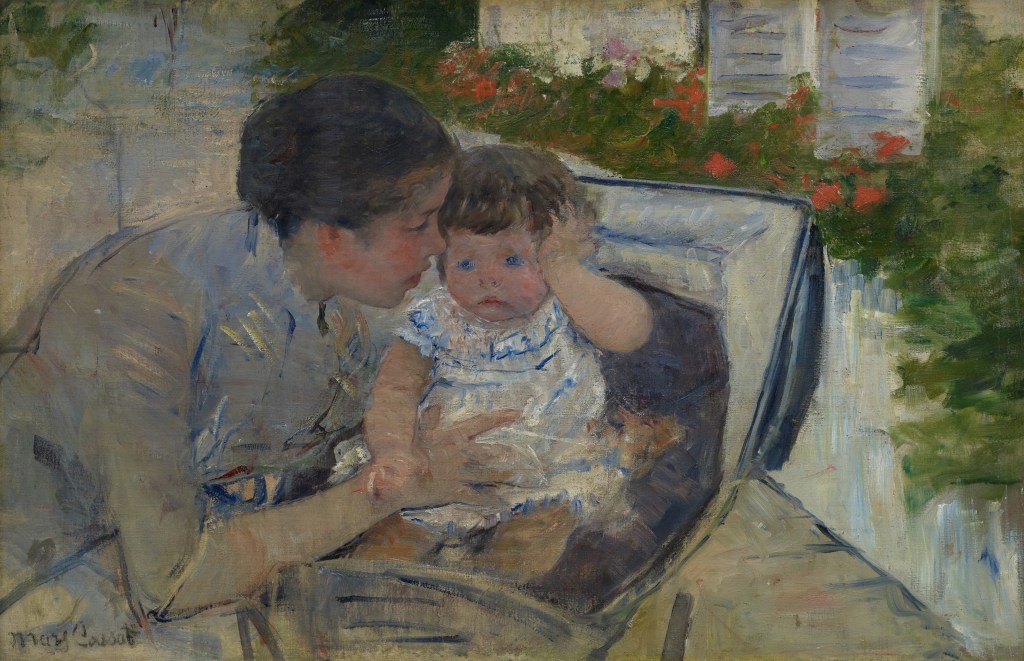
Image Credit: Mary Cassatt “Susan Comforting the Baby” (1881) Public Domain image courtesy of Artvee

Fay L. Loomis: “Bathtub Prayers”

BAthTub Prayers

By Fay L. Loomis

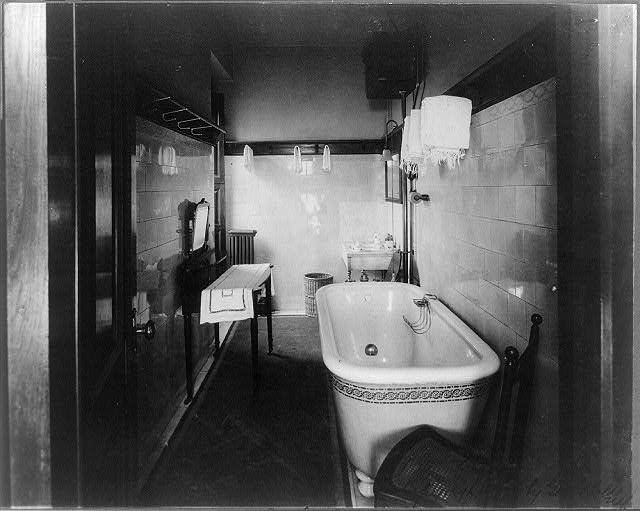
Mom had to sell eggs on the sly to get the money for tickets the day we took the bus from Coldwater to Battle Creek, Michigan. Dad would never have approved of us traveling. If he had caught wind of our secret trip, he would have said, “Hell, no, you can’t go. Praying is for crazy people. Stay home where you belong.”

When we got off the bus, Mom pointed toward a tower in the distance. “That’s Dr. Kellogg’s famous Battle Creek Sanitarium. The tower, high above soaring trees, seemed to nod in our direction, the flags atop wave at us.

We turned and walked at a fast clip in the opposite direction, until we came to a white mansion with fish scales in the pointed gable. “Mrs. Reynolds lives here,” Mom said. “Her husband is a doctor. He works at the sanitarium.”   

Mom softly tapped on the door, and Mrs. Reynolds said, “Come in Mrs. Miller. Isn’t it wonderful that the Lord brought us together at Reverend Safford’s prayer meeting when I visited my sister in Coldwater?  Let’s have tea in the parlor, and then we’ll pray.”   

Mrs. Reynolds looked over the top of her glasses at me and said, “I’m glad you are traveling with your mother. It’s never too early to learn about the Lord’s work.”  She paused for a moment to let her words sink in, before asking, “How old are you, young lady? Would you like a glass of milk?” Continue reading “Fay L. Loomis: “Bathtub Prayers””

Brian Connor “Baseball: Back”

.

service-pnp-pan-6a29000-6a29700-6a29710v

.

Baseball: Back

By Brian Connor

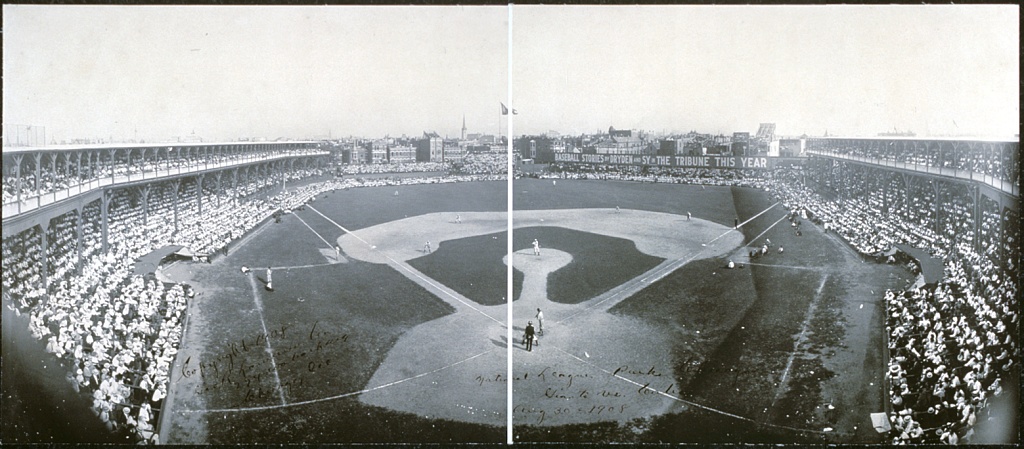
They started testing out the stadium lights last week, at least the top row. Most important and oldest of the things first. Next I came home from work to see the blue neon glow of the Wintrust sign atop the jumbotron visible again: I say jumbotron because to call it a scoreboard gives it the impression it could even compete with its iconic counterpart in center. Finally they turned that TV on in full, testing templates for what looked like starting pitchers before turning it off. This week all parts will be firing on all cylinders.

I live about as east as you can go in Chicago, in a northern enough disposition that allows Wrigley Field to be visible from my apartment. For reasons I’m not quite sure of, the team leaves the stadium lights on all night following any home games, day or night. It’s worth mentioning the irony of my particular rooting interest- I sing a song of good guys wear black, of winning ugly, na na hey hey, he gone, gaaaaaaaaaaasssss- but it’s something I caught onto quick having moved there the first full attendance allowed game at the stadium last year. 

I’d get used to coming home and looking out to see the stadium lights on in full. Some days it would be after a long work day with the pinkish summer sunset as the backdrop, some nights it would be about that witching hour time when that “one last bar” welcomed us for probably too long. And, frankly, Wrigley is the dame I recognize as beautiful but isn’t my type, and I’ve often thought someone who’s an actual fan of the team would appreciate that view and those endless stadium lights more than I who fell for the team who chose the faceless fireworks factory façade as a ballpark theme. But there’s something to coming home every time the team’s in town and seeing those stadium lights dwarf the apartments barely putting up a fight below in a summer night. 

It’s been a long six months of seeing nothing but the neon “Chicago CUBS” sign- designed, I would have to think, to beckon the attention of the bleacher creatures to let them know that, in their drunken stupor, they’d found it- on and forever and always on. We were, for a while, in danger of having that happen for an even longer time: the disputes over the collective bargaining agreement between the league and the player’s association over the winter came to a lockout, and grew uglier by the day for quite some time. I can’t recall the day that I thought of penning “Baseball Bastardized II” for this site, but I had definitely made my mind up on number vs. roman numerals and the list of talking points. Continue reading “Brian Connor “Baseball: Back””

Daniel Vollaro: “Riot of the Fiftysomethings”

.

Embed from Getty Images

.

Riot of the Fiftysomethings

By Daniel Vollaro

.

When I watched the news footage of the Capitol insurrection in January, my first thought was “there are a lot of people around my age out there.”

I am 56 years old, born two weeks before the Baby Boom officially ended and Gen X began, right on the cusp of a new generation but unable to claim membership in either. Maybe because of this generational liminality, I could not help noticing that many of the insurrectionists who broke into the U.S. Capitol, stole stuff, took selfies, chased down and beat cops, built a noose outside, and trashed the place were white men “of a certain age,” in their late forties, fifties, and early sixties. Someday, researchers will pin down the demographics of that riotous mob, but for now, I will trust my powers of observation when I say that it was not a young crowd.

What were they doing out there, so many lost souls from my age cohort?

Full disclosure: I have never identified with Trumpism—not even a little, not even in jest. He sounded like a fascist when he descended those escalator steps in 2015 and he went out like a fascist five years later by summoning his brownshirts to sack the U.S. Capitol. I have always believed he was a con man and a person of low character, and I have never understood his appeal—the meanness, the trolling, the compulsive lying. I want to believe that my opinion of the man is shared by others who possess a rational perspective on the world, yet I have watched smart, well-educated people around my age tumble down the MAGA, QAnon, and “Plandemic” rabbit holes, descending into unfathomable depths of irrationality.

Like so many other Americans, I wonder how the insurrection could have happened. Some of the causes are obvious. The insurrectionists had been lied to and manipulated by powerful people in government, including President Trump. And there were the militias and hate groups and keyboard warriors who whipped up the crowd, in some cases organizing small groups to break into the building itself. Racism was another ingredient in the toxic mixture that day. Some white people, when the chips are down, fall backwards into believing that being white is a zero sum game, with winners and losers. Trump is a master manipulator of their sense of racial grievance.

But there is more to it. The anger, frustration, and alienation evidenced in that crowd is shared by many late middle-aged Americans who would never have gone near that demonstration. Despite the MAGA hats and the politically charged context, the Capitol riot felt to me more like the symptom of a spiritual crisis than a political one. And if a “spiritual” crisis sounds too fuzzy and granola for you, think of it instead as a crisis of meaning. A crisis of meaning revolves around existential questions: Where do I fit into this world order? Economy? Society? Culture? What is my life worth? My children’s lives? Like I said, I despise Trump and Trumpism, but I feel like I have lived inside of that kind of spiritual crisis for most of my life. Continue reading “Daniel Vollaro: “Riot of the Fiftysomethings””

Cody Sexton “Diary in Reverse: Boys Will Be Boys”

.

service-pnp-habshaer-ca-ca2700-ca2747-photos-327445pv

.

.

Diary in Reverse: Boys Will Be Boys

By Cody Sexton


“Are you going to cry?”

“No.”

“You know you are.”


The boy sat in silence not knowing what to say or do in response to this comment. He had fantasized about hitting the boy, several times, or any of the other children who made fun of him, but he knew he wouldn’t do it. Not really.

Another runner was batted home and took his place on the bench among his peers, being sure not to sit too close to the boy — the “pussy” — wearing the off-brand cleats.

He felt alone. He was alone. But it was the kind of alone where nothing anyone could have done would have changed anything, would have made a difference. He was just different, and how do you change that?

That boy was me. And this was the summer I, for whatever impulsive reason, decided it would be “fun” to play on our local little league team.

I’m still not sure why I decided to play. At the time the school I attended didn’t even have a little league team so I had to go to the next school over to sign up. I guess it just seemed like a good idea at the time, it’s what my “friends” were doing. I wanted to quit practically as soon as I started. 

“You start something you finish it.” My father told me.

I’m guessing he thought that it would help build or reinforce strong character traits? He couldn’t have been more wrong however. The experience taught me precisely nothing, except maybe how to hate someone properly.

Even the coaches seemed to not like me. I obviously wasn’t like any of the other boys, introverted, perhaps even a little shy, so they never understood know how to interact with me. Either because they didn’t know or simply didn’t care to know. With the other boys it was easy, with me it was hard. So they ignored me as much as they possibly could, silently wishing I’m sure, that I would quite the team.

Once during a particularly bad game for the opposing team, the pitcher had managed to walk the first two batters at plate, I was one of them, and as the next batter stepped up to the plate he caught a low one inside grounding it out to right field. That’s when I got the signal from the third base coach to run home so I took off, and crossing the home plate, managed to actually put another point on the board for our team.

However, back inside the dugout I was met with silence. My other teammates had ran the exact same play as I had, several times over throughout the season, making it across home plate either by hitting a home run themselves or were batted in as I was and whenever they did they were without fail met with applause from both the team and the teams coaches. Triumphantly greeted as hero’s with high fives and ass slaps. But there I was sitting at the end of the bench like an uninvited guest at a bridal shower. I actually began to question if I even made it home:

Did I even score?

Did I imagine the whole thing?

Had I never left the bench? 

As my doubt grew I sought to release it by asking our teams statistician if I had in fact made it across home plate, putting us ahead by another two points. She pulled herself away from the game long enough to say:

“Yeah”

And then promptly returned to cheering for her son. (Who, surprise, surprise, was also our teams pitcher). She never even turned her head to look at me.

So much for team building.

So much for camaraderie.

I got the hint and found my spot on the bench again. I had expected as much from my teammates, but at that age was still too naive enough to expect it from the adults.

I’ve likewise been told for years to “be the better person” towards people who’ve treated me like this, like shit, most of them have been relatives. I get told this because they of course know the other person won’t do it for me. (And why is it that we always demand introverted children to be more outgoing? Why can’t the extroverts at least meet us half way for a change?)

Still, I stuck it out and when the season was finally over I was more relieved than I’d ever been in my life. As I said I learned nothing and never meet anyone that later became a “lifelong friend” as my father had assured me would happen. One of those friends with which to share a few beers and talk about the “good ole’ days” when we played out on the same field as our fathers had before us and as our sons would after us.

You might remember the quote about how parents will usually let their children become anything they want, except themselves? I think about this a lot. And I think this is maybe why I was always so ashamed of who I was as a kid. I was never allowed to be myself. As you might imagine this can lead to ever varying amounts of resentment over time and as a result anger has been one of the only guiding sources of encouragement in my life. I could always count on anger. Anger was the only thing that made me strong enough to leave the only home I knew. I held onto it and nurtured it every night, reciting the litany of offenses over and over into the darkness of my room. I needed to leave. I needed my anger to help me leave. Anger has been the only thing of use my father has ever given to me. (And I’ll be damned if I ever let anyone take that away from me).

Nevertheless, I never again played any other team sport, having decided instead to dedicate my life to more bookish pursuits so that one day I might be able to live life as I am.

.

.

About the Author: Cody Sexton is the managing editor for A Thin Slice of Anxiety. His work has been featured at The Indie View, Writer Shed Stories, The Diverse Perspective, Detritus, Revolution John, Due Dissidence, and As It Ought To Be Magazine where he is a regular contributor. In addition he is also a 2020 Best of the Net Nominee for his essay: The Body of Shirley Ann Sexton.

.

More by Cody Sexton:

The Body of Shirley Ann Sexton

Heathen

.

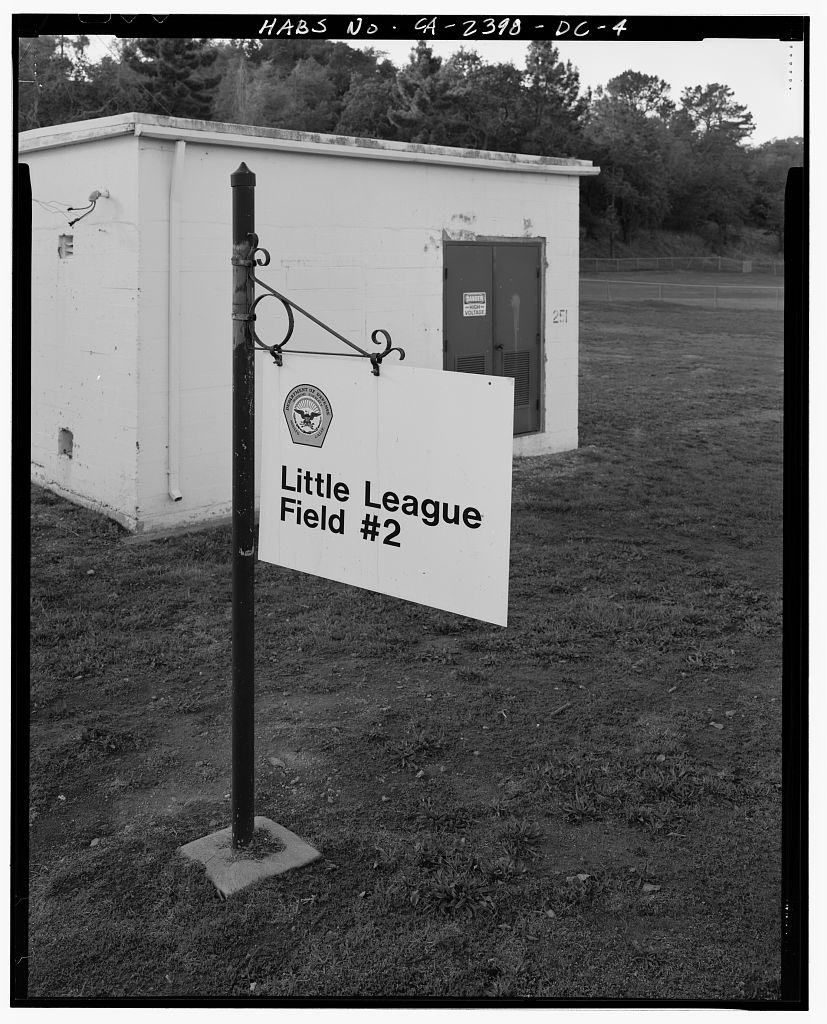
Image Credit: “SINGLE BRACKET SIGN: “LITTLE LEAGUE FIELD #2.” – Hamilton Field, Base Street Signs, East of Nave Drive, Novato, Marin County, CA” (Library of Congress)


Diana Rosen: “A life. Of sorts. Or, 18 ways to remember my love”

.

20210407062306_IMG_1499

.

.

A life. Of sorts. Or, 18 ways to remember my love. 

  1. My love is in the kitchen, baking popovers. The heat of the kitchen, or the intensity of his concentration, makes him sweat from head to toe. He delivers mine on a gold-rimmed plate, so proud. I break it apart, dab it in the accompanying jam and butter, offer proper oohs and ahs. He beams.
  2. My love is standing at the toilet, right shoulder to the wall, howling with laughter at the note I taped to the bottom of the seat reminding him to put it down when he is done. He doesn’t fail to forget ever again, and often giggles leaving the bathroom.
  3. My love loved and lost someone, that’s why there’s a fence of mistrust between us. I chip away. It takes so long, but he finally believes.
  4. He’s cleaned up the living room, set out candles mid-afternoon, made scones and tea for the wife of a friend who’s brought her diminished boy to spend the afternoon. My love coos and bills. The toddler giggles. The woman tries not to cry.
  5. He wants a child, but I’m no longer able. He misses his little boy with the hole in his heart that ended his life at three.
  6. My love and I play Santa and Mrs. Claus for the village holiday festival. Grown women sit on his lap, share intimate details of their lives. Children climb up, each totally astonished that he knows their names, not realizing it’s their parents’ friend Alexander underneath the red velour suit and snowy beard. Everyone wants a photo. I accommodate.
  7. My love looks like the Elephant Man, pustules of shingles up and down the left side of his face. Eventually, they go away but leave a post-herpetic pain I cannot take away. Nothing I do helps. I feel bereft.
  8. He brings me flowers. Picked by the highway. Brings me Japanese boxes, the amethyst ring, always unusual, pretty things. That they were bargains made me love them more.
  9. My love refuses to go to a girlfriend’s significant birthday. She lives way up in the hills during an era devoid of Lyft and Uber and I don’t have enough money for a cab and it’s too late to call mutual friends for a ride. She holds that against me for years. He does not apologize. This is my first view into the depression that comes and goes.
  10. My love and I tango in our gallery kitchen, belt out the soundtracks of operas, Broadway shows. He tapes me singing which was sweet, tapes me snoring, not so sweet. Shares thousands of words with me, their roots, pronunciations, he seems a veritable human dictionary. It’s not the same looking up words myself even in my mammoth Random House which sits on a stand he makes for it. We play word games in bed until one of us fallsin asleep. Usually him.
  11. His mother was beautiful and spent many hours admiring herself at her vanity table. Such a well-named piece of furniture, he says. He spent hours braiding her hair, fetching her ribbons, avoiding her temper. His father loved alcohol more than his wife or sons. His mother sent him to fetch his father from the neighborhood bar. He was five. This father, a sailor, and my love, a Marine who lied about his age, unexpectedly meet up in Japan. They drink together, of course. My love soon finds himself face to face with a Japanese soldier. No one else is around. My love bowed. Was bowed to in return. Each turned and walked away. He still thought the act was cowardice. I’m grateful his drinking stopped before we met. He quit his five-pack-a-day cigarette habit, too, then says he won’t kiss me until I stop my half-pack habit. Longest two weeks in my life.
  12. A girlfriend admits she’s never had a birthday party. We invite others, one friend brings a cake, my love makes dinner, all the women take their time hugging him goodbye.
  13. My love becomes old, age-wise, but the personality is so strong, no one believes his numerical age. The powerful energy still bristles, announces itself when he enters the room.
  14. My love reconnects with his oldest child, a daughter. They even appear on a daytime talk show on reunification. He is not who he was. I’m unsure how I feel.
  15. My love and I separate.
  16. My love recovers from a stroke but won’t let me visit. He feels diminished yet the strength of his voice, that deep radio voice, is still there, the mind is still there, his arms still work. These reminders fall on deaf ears.
  17. My love has a second stroke that puts him in a coma. His daughter comes to whisper love in his ear until there is no hearing left. I am the last to hear he died.
  18. Age fades the bad memories and leaves us with the good. He’d love today’s sunshine, hurry me up so we could go “saling” – – his dry-ground adventure visiting every garage sale in the neighborhood until the treasures surface. When I first trek through the swap meet in my new hometown, I laugh, walking countless aisles, recognizing all the many things we’d collected, then sold. As I left the arena, an ocean breeze brushed my shoulders as if to say, “Didn’t we have fun?”

.

.

About the Author: Diana Rosen is a journalist and avid tea enthusiast, with six books on the topic, who writes poetry, essays, and flash fiction and creative nonfiction. Her work appears in RATTLE, Tiferet Journal, Mad Swirl, PIF Magazine, and Potato Soup Journal, among others. She loves exploring Los Angeles’s Griffith Park, the country’s largest public green space, which is her 4,000-acre “backyard.” To read more of her work, please visit www.authory.com/dianarosen

.

More by Diana Rosen:

Dinner at Six

Hollywood Freeway

Mrs. Reagan, Who Lived Next Door

.

Image Credit: Chase Dimock “Spring Rose” (2021)