SATURDAY POETRY SERIES PRESENTS: ABRIANA JETTÉ


abeheadshotphtocredchrisjette


LIES OUR MOTHER TOLD US
By Abriana Jetté


I do not believe in the story of the virgin
but in the value of the human: the body —

because no matter what you were told
that soul is not yours. But the body,

the body is yours. The slight round
of the breast like the sun or the depth of your

toes to your crown: these are the ways
we measure ourselves. I do not want to

believe she was a vehicle. Tell me
there was pleasure; there were moans.

Tell me when she was fully grown
she remembered a wave a release an ecstasy

that entered her, that she could feel it in her
teeth. Motherhood means you are no longer

maiden but Queen. Tell me the story of the one
who smiled at the rustling of her sheets.


Today’s poem was published in the The Journal for Compressed Creative Arts, Spring 2015, and appears here today with permission from the poet.


Abriana Jetté: Born and raised in Brooklyn, New York Abriana Jetté is an internationally published poet and essayist and educator. Her anthology 50 Whispers: Poems by Extraordinary Women debuted as a #1 best seller on Amazon, and her work has appeared or is forthcoming in The Seneca Review, River Teeth, Barrelhouse, The Moth, and many other places. She teaches for St. John’s University, for the College of Staten Island, and for the nonprofit organization Sponsors for Educational Opportunity.

Editor’s Note: And then there was the poet who reimagined the Virgin Mary. Not as virgin, but as human, as woman, capable of “a wave a release an ecstasy // that entered her, that she could feel it in her / teeth.” Advocating for agency, the poet insisted, “I do not want to // believe she was a vehicle.” Reverent of the woman’s transformation, she taught us that “Motherhood means you are no longer // maiden but Queen.” And we saw her as the poet saw her. And it was good.

Want to see more from Abriana Jetté?
Hermeneutic Chaos Journal
Truthdig
Abriana Jetté’s Official Website
Stay Thirsty Publishing
Barrelhouse Mag

SATURDAY POETRY SERIES PRESENTS: KELLY HANSEN MAHER

IMG_0480

CO-SLEEPING
By Kelly Hansen Maher


Accepting the rise and fall of boxcars heaving
across the city, our industrial neighborhood.
Old neighborhood, in which immigrants,
studying for citizenship exams,
named the streets in the order of the presidents.
Trains make their slow move uphill, Fillmore,
Pierce, Buchanan, measuring each breath taken,
the newborn on my chest. Her small head
in the dark room, nose and mouth open,
sleeping. We stir; we are steady as train yards, lids
flutter. I hear insects at the open windows, the out
and in of her breath, my husband’s
deep twitching, the dog’s snore. Our bed
smells of human milk, which is lean
of fat and protein so that she will wake frequently
and want me. She has this one country.
I’m on an incline, never fully prone,
kept my word, kept her head
above the blankets, on the pillow of my arm,
kept her face to the air of the room all spring, all
summer. It’s before dawn when the birds…
the light in the room doesn’t change, but the trains
have stopped rolling over the narrow
bridges… birds must know… the pale yellow
beyond the yard… what first birds? chickadees
or sparrow, or thrush? I have small dreams
all night, it’s a covenant to keep her
breathing. Her new system in delicate
crating at the rail of my clavicle,
she’ll track with me, start again after stopping.
I don’t miss depth, tuned from sleep, Lincoln,
Johnson, Ulysses, anything could happen
to her in that other room
without me, and god help me,
there will be no more death in this house.


Today’s poem was was previously published in the Blue Mesa Review and appears in the collection Tremolo (Tinderbox Editions, 2016, copyright Kelly Hansen Maher). It appears here today with permission from the poet.


Kelly Hansen Maher is originally from Minneapolis, Minnesota but now lives in Grinnell, Iowa. She is the author one book of poetry, Tremolo (Tinderbox Editions, 2016), and is currently working on a second collection, as well as a book of memoir/essays. Her poems have been published by the New Orleans Review, Briar Cliff Review, and others journals. She teaches creative writing courses with the Minnesota Prison Writing Workshop.

Editor’s Note: With its evocative imagery and haunting ending, today’s poem is motherhood poetry that resonates, that stays with the reader. There are truths here all mothers of infants know: “I have small dreams / all night, it’s a covenant to keep her / breathing.” Time is measured like breath. Breath is the promise that life will go on, one breath at a time. Sound functions on the level of the line, the scene, the moment, propelling the poem forward, pacing the reader to go on expectantly, breath slow, aware and uncertain.

Want to read more by and about Kelly Hansen Maher?
Kelly Hansen Maher’s Official Website
Buy Tremolo from Tinderbox Editions
New Orleans Review
Midway Journal
Tinderbox Poetry Journal

SATURDAY POETRY SERIES PRESENTS: NAN COHEN

nan cohen

A NEWBORN GIRL AT PASSOVER
By Nan Cohen


Consider one apricot in a basket of them.
It is very much like all the other apricots–
an individual already, skin and seed.

Now think of this day. One you will probably forget.
The next breath you take, a long drink of air.
Holiday or not, it doesn’t matter.

A child is born and doesn’t know what day it is.
The particular joy in my heart she cannot imagine.
The taste of apricots is in store for her.


Today’s poem was was first published on the Academy of American Poets website and appears here today with permission from the poet and publisher.


Nan Cohen is the author of Rope Bridge, a collection of poems. Her work has appeared in Gulf Coast, The New Republic, Ploughshares, Poetry International, and Tikkun, among other magazines and anthologies. She is the recipient of a Wallace Stegner Fellowship, a Rona Jaffe Writer’s Award, and a Literature Fellowship from the National Endowment for the Arts. A high school teacher and English department chair in Los Angeles, she is also the Poetry Director of the Napa Valley Writers’ Conference.

Editor’s Note: Simple, yet revelatory. A personal experience that belongs to one and to many. The day you will likely not remember. The apricot that is like all the others–unique. “The particular joy in my heart she cannot imagine.” The way that line bowls you over. How unadorned it is, yet how stunning. This poem. This poem. This poem.

Want to read more by and about Nan Cohen?
Rope Bridge
Nan Cohen’s Blog
“The Fear of the Dark” (with audio) at Slate
“Storm” at The New Republic
“Girder” at Verse Daily

SATURDAY POETRY SERIES PRESENTS: JEN LAMBERT


JenLambert


DINNER FOR THE DYING
By Jen Lambert


When the boy comes inside
with blood on his ripe hands
and a quiver of pointed explanations
on his back, I’m chopping yellow onions.

When he says it’s a doe, that she lies
on the edge of the wood, and that he knows
she was pregnant, my skin tightens.
The scar on my belly, that battered, barbwire grin
that opened like a window for him, twitches
for the dying mother and the calf like a love note in her womb.

When he hangs his knife on his belt
and heads toward the wood, I boil water, crush garlic.
I remember when the doctor pulled him, screaming,
from my belly. I remember the howl in my womb
as he sewed me shut. I remember my first meal
as a mother. Nothing could satisfy.
I salt the vegetables. Crush the mint.


Today’s poem was originally published in Boxcar and appears here today with permission from the poet.


Jen Lambert is a founding editor of Spark Wheel Press and burntdistrict magazine. She received an MFA from the University of Nebraska, and her work has appeared in journals such as Pank, The Los Angeles Review, Sugar House Review, and Redactions, among others.

Editor’s Note: As a new mother, I recently began a search for today’s best poems about motherhood. Jen Lambert’s “Dinner for the Dying” came highly recommended and does not disappoint. And so today we kick off a series of poems within this Saturday Poetry Series that will consider motherhood and hopefully leave their mark upon the reader as today’s poem has left its mark upon me.

There is something of Naomi Shihab Nye in this work. In the salted vegetables and crushed mint. In the intersection of the natural, the familial, and the body. This is a poem of quiet power, wherein tragedy is gently stitched to memory, where life and loss are depicted as two sides of the same coin. Moments of radiant lyric emerge from the subtlety and strength of today’s poem: “a quiver of pointed explanations,” “that battered, barbwire grin / that opened like a window for him, twitches / for the dying mother and the calf like love note in her womb.”

Want more from Jen Lambert?
Official Website
Heart Journal
Tahoma Literary Review

SATURDAY POETRY SERIES PRESENTS: KEETJE KUIPERS

30_DSC5432

GETTING THE BABY TO SLEEP
By Keetje Kuipers


Sometimes the baby can’t reconcile
the self with the self: too hungry
to eat, too tired to sleep. I know

the feeling. O, America, on those nights
when you are too beautiful for me
to continue to forgive you any longer—

for allowing us to kill each other
with your graceless bullets, or exile
our neighbors across your fictitious

border, or argue over the ownership
of each young girl’s body as if its freedom
is a lie she must stop telling herself—

I go out into your radiant embrace.
The baby and I drive through your streets,
over the bridge and its light-chipped

waters, under a moon so big, so full
of itself that though I know it belongs
to the world, it can’t be anything but

American. I hang my arm out the window
and skim the air like touching skin.
I breathe you in, and the baby sleeps.


Today’s poem was originally published in Blackbird and appears here today with permission from the poet.


Keetje Kuipers has been the Margery Davis Boyden Wilderness Writing Resident, a Stegner Fellow at Stanford, and the Emerging Writer Lecturer at Gettysburg College. A recipient of the Pushcart Prize, her poems, essays, and fiction have appeared in numerous magazines and anthologies, including Best American Poetry. Her first book of poetry, Beautiful in the Mouth, won the 2009 A. Poulin, Jr. Poetry Prize and was published by BOA Editions. Her second collection, The Keys to the Jail, was published by BOA in 2014. Keetje is an Assistant Professor at Auburn University where she is Editor of Southern Humanities Review.

Editor’s Note: Today’s poem absolutely blows me away. It is too powerful to contain, and yet it is perfectly wrought as if chiseled from marble. It is metaphor and life, politic and country, as near as a closely-held infant and as far as the moon. It is the American affliction: needless gun violence, our backs turned and hearts hardened against immigrants and refugees, our deep seated fear of women’s sexuality, freedom, independence. “O, America, on those nights… you are too beautiful for me / to continue to forgive you any longer.” Absolutely stunning. Heartbreaking. An outcry in the form of a quiet, contemplative drive, cruising America in an attempt to get the baby to sleep.

Want more from Keetje Kuipers?
www.keetjekuipers.com

SATURDAY POETRY SERIES PRESENTS: STATE OF GRACE: THE JOSHUA ELEGIES

41oGCGJb2kL._SX331_BO1,204,203,200_


From STATE OF GRACE: THE JOSHUA ELEGIES
By Alexis Rhone Fancher:


DYING YOUNG

Midnight, and again I’m chasing
sleep: its fresh-linen smell and
deep sinking, but when I close my eyes I see
my son, closing his eyes. I’m afraid of that dream,
the tape-looped demise as cancer claims him.

My artist friend cancels her L.A. trip. Unplugs the
internet. Reverts to source. If cancer
will not let go its grip, then she will
return its embrace. Squeeze the life out of
her life. Ride it for all it’s worth.

By the time his friends arrive at the cabin
my son is exhausted, stays behind while
the others set out on a hike. He picks up the phone.
“Mom, it’s so quiet here. The air has never
been breathed before. It’s snowing.”

I put on Mozart. A warm robe. Make a pot
of camomile tea. The view from my 8th floor
window, spectacular, the sliver moon, the stark,
neon-smeared buildings, their windows dark.
Sometimes I think I am the only one not sleeping.

My artist friend wants to draw the rain. She
wants to paint her memories, wrap the canvas
around her like a burial shroud.

Tonight, a girl in a yellow dress stands below
my window, top lit by a street lamp, her long shadow
spilling into the street. She’s waiting for someone.

I want to tell my friend I’ll miss her.
I want to tell my son I understand.
I want to tell the girl he won’t be coming.
That it’s nothing personal. He died young.


SNOW GLOBE

Despair arrived, disguised as
nine pounds of ashes in a
velvet bag, worried so
often between my fingers
that wear-marks now stain
the fabric.

Is it wrong to sift
the remains of my dead son,
bring my ashen finger to my
forehead, make the mark of
the penitent above my eyes?

His eyes, the brown of mine,
the smooth of his skin, like mine.
Unless I look in the mirror
I can’t see him.

Better he’d arrived
as a snow globe, a small figure,
standing alone at the bottom of his
cut-short beauty.

Give him a shake, and watch
his life float by.


OVER IT

Now the splinter-sized dagger that jabs at my heart has
lodged itself in my aorta, I can’t worry it
anymore. I liked the pain, the
dig of remembering, the way, if I
moved the dagger just so, I could
see his face, jiggle the hilt and hear his voice
clearly, a kind of music played on my bones
and memory, complete with the hip-hop beat
of his defunct heart. Now what am I
supposed to do? I am dis-
inclined toward rehab. Prefer the steady
jab jab jab that reminds me I’m still
living. Two weeks after he died,
a friend asked if I was “over it.”
As if my son’s death was something to get
through, like the flu. Now it’s past
the five-year slot. Maybe I’m okay that he isn’t anymore,
maybe not. These days,
I am an open wound. Cry easily.
Need an arm to lean on. You know what I want?
I want to ask my friend how her only daughter
is doing. And for one moment, I want her to tell me she’s
dead so I can ask my friend if she’s over it yet.
I really want to know.


Today’s poems are from State of Grace: The Joshua Elegies (KYSO Flash, 2015), copyright © 2015 by Alexis Rhone Fancher, and appear here today with permission from the poet.


State of Grace: The Joshua Elegies: “Alexis Rhone Fancher’s book, State of Grace: The Joshua Elegies, maps in searing detail a landscape no parent ever wants to visit—a mother’s world after it’s flattened by her child’s death. Though her son’s early passing was ‘nothing personal,’ her poems howl with personal devastation. They insist that the reader take the seat next to hers in grief’s sitting room and ‘imagine him in his wooden forever.’ Fancher grapples with how to reconcile oneself to the slow loss of memory’s fade-out, and with how to go on living without betraying the dead, how to ‘[s]queeze the life out of / her life.’ You’ll need tissues when you read this book, but it’s well worth rubbing your heart raw against the beauty of these poems and their brave, fierce honesty.” — Francesca Bell, eight-time nominee for the Pushcart Prize in poetry, and winner of the 2014 Neil Postman Award for Metaphor from Rattle


Alexis Rhone Fancher is the author of How I Lost My Virginity To Michael Cohen and Other Heart Stab Poems, (Sybaritic Press, 2014). Find her work in Rattle, Menacing Hedge, Slipstream, Fjords Review, H_NGM_N, great weather for media, River Styx,The Chiron Review, and elsewhere. Her poems have been published in over twenty American and international anthologies. Her photos have been published worldwide. Since 2013 Alexis has been nominated for three Pushcart Prizes and two Best of The Net awards. She is photography editor of Fine Linen, and poetry editor of Cultural Weekly, where she also publishes The Poet’s Eye, a monthly photo essay about her ongoing love affair with Los Angeles. www.alexisrhonefancher.com


Editor’s Note: The poems in today’s collection slew me. Long after I finished reading them, they stayed with me, a specter. As I nursed my young son, worried over his maladies, rejoiced in his small accomplishments, there in the shadows was the poetry of Alexis Rhone Fancher reminding me that life is precious, fleeting, that nothing should be taken for granted, that anything–no matter how dear–can be taken away.

It is impossible not to be moved by these poems. By “a girl in a yellow dress [who] stands below / my window, top lit by a street lamp, her long shadow / spilling into the street… waiting for someone.” By the poet, the mother, who wants “to tell the girl he won’t be coming. / That it’s nothing personal. He died young.” By the admission, “Unless I look in the mirror / I can’t see him.” By the callousness of a friend who would ask if a mother is “over” her son’s death. By a mother’s very human reaction to such a question: “I want to ask my friend how her only daughter / is doing. And for one moment, I want her to tell me she’s / dead so I can ask my friend if she’s over it yet. / I really want to know.”

State of Grace: The Joshua Elegies is raw, brave, honest. It rips you apart as you read it–and leaves you grieving long after–because of the very vulnerable and wounded place from whence the poems arose. This is an incredibly compelling collection that does what lyric, confessional, narrative poetry does best: invites the reader into a human experience that is at once personal and shared, pairing vivid imagery and beautiful language with a story so moving that the reader is forever changed by the very act of having read it.


Want to see more from Alexis Rhone Fancher?
Buy State of Grace: The Joshua Elegies from Amazon
Four poems in Ragazine, including “When I turned fourteen, my mother’s sister took me to lunch and said:,” chosen by Edward Hirsch for inclusion in The Best American Poetry, 2016
Broad (“Dying Young” was first published in Broad)
Alexis Rhone Fancher’s Official Website / link to published works


SATURDAY POETRY SERIES PRESENTS: A WINTER POEM BY ALFRED AUSTIN

"Mit Reif vom Nebel belegte Rose." Photographer: Armin Kübelbeck, CC-BY-SA, Wikimedia Commons
“Mit Reif vom Nebel belegte Rose.” Photographer: Armin Kübelbeck, CC-BY-SA, Wikimedia Commons

MY WINTER ROSE
By Alfred Austin

Why did you come when the trees were bare?
Why did you come with the wintry air?
When the faint note dies in the robin’s throat,
And the gables drip and the white flakes float?

What a strange, strange season to choose to come,
When the heavens are blind and the earth is dumb:
When nought is left living to dirge the dead,
And even the snowdrop keeps its bed!

Could you not come when woods are green?
Could you not come when lambs are seen?
When the primrose laughs from its childlike sleep,
And the violets hide and the bluebells peep?

When the air as your breath is sweet, and skies
Have all but the soul of your limpid eyes,
And the year, growing confident day by day,
Weans lusty June from the breast of May?

Yet had you come then, the lark had lent
In vain his music, the thorn its scent,
In vain the woodbine budded, in vain
The rippling smile of the April rain.

Your voice would have silenced merle and thrush,
And the rose outbloomed would have blushed to blush,
And Summer, seeing you, paused, and known
That the glow of your beauty outshone its own.

So, timely you came, and well you chose,
You came when most needed, my winter rose.
From the snow I pluck you, and fondly press
Your leaves ‘twixt the leaves of my leaflessness.


Today poem is in the public domain, belongs to the masses, and appears here accordingly.


Alfred Austin (1835 – 1913) was an English poet and journalist who succeeded Alfred, Lord Tennyson, as poet laureate. His acerbic criticism and jingoistic verse in the 1870s led Robert Browning to dismiss him as a “Banjo-Byron,” and his appointment to the laureateship in 1896 was much mocked. He also published a series of stiff verse dramas, some novels, and a good deal of lyrical but very minor nature poetry. A patriotic poet of the most confident phase of the British Empire, his work lacked the resonance of Rudyard Kipling’s. (Annotated biography courtesy of Encyclopedia Britannica, with edits.)


Editor’s Note: I love the use of metaphor in today’s poem, and the playful way language is paired with it. Moments like “And the year, growing confident day by day, / Weans lusty June from the breast of May.” I am taken, as well, by the allusion to the beloved, depicted as a winter rose arriving at what appears to be an inopportune time. But the poet eventually realizes that love–as it inevitably does–arrived exactly when it was most needed, occupying a space that had been waiting for just such an arrival: “You came when most needed, my winter rose. / From the snow I pluck you, and fondly press / Your leaves ‘twixt the leaves of my leaflessness.”


Want to read more winter poetry?
The Academy of American Poets
The Poetry Foundation

SATURDAY POETRY SERIES PRESENTS: CHANEL BRENNER

Photo by The POD Photography


A POEM FOR WOMEN WHO DON’T WANT CHILDREN
By Chanel Brenner


I won’t preach about the rewards of motherhood.
I won’t say it’s the best thing that ever happened to me.
I won’t say it’s the best job I’ve ever had.
I won’t say you’ll regret not having a child.
I won’t say you’ll forget what life was like before.
I won’t say it makes life worth living.
What I will say
is my son died.
What I will say
is I would still do it again.


Today’s poem was originally published in Rattle and appears here today with permission from the poet. Hear the poet read today’s poem aloud via Rattle.


Chanel Brenner is the author of Vanilla Milk: a memoir told in poems, (Silver Birch Press, 2014). Her poems have appeared in Poet Lore, Rattle, Cultural Weekly, Diverse Voices Quarterly, Anderbo, West Trestle Review, and others. Her poem, “July 28th, 2012” won first prize in The Write Place At the Write Time’s contest, judged by Ellen Bass. In 2014, she was nominated for a Best of the Net award and a Pushcart Prize.

Editor’s Note: I won’t say it’s because I first read today’s poem while pregnant. I won’t say it’s because three weeks ago I became a mother for the first time. I won’t say it’s because I did not want children myself. I will say that my son is an amazing human being and that I am honored to be in his service. I will say that today’s incredibly moving, incredibly brave poem breaks my heart each and every time I read it.

Want to read more from Chanel Brenner?
Chanel Brenner’s Official Website
Deep Water Literary Journal
Cultural Weekly
Women’s Voices for Change
Silver Birch Press
Buy Vanilla Milk on Amazon

SATURDAY POETRY SERIES PRESENTS: ALAN TOLTZIS

pic 003

FORTY-TWO PLACES
By Alan Toltzis

As time passed,
they didn’t need to study love,
pray for it,
or even speak its name.

Instead,
they lived their love
silently.
Secrets remained secret

as love sank into unbending bones,
fused with supple corpuscles,
and seeped through soft skin
beneath their fingernails.

Only by looking back
and naming each
of the 42 places (in order)
they had journeyed

did they realize they had grown
into an old couple
who survived a long-forgotten stopover
of bickering and concession

and the should-
and should-not-have-saids
they should never
have crossed

leaving only unspoken love
perpetuated by the comfort and intimacy
of taking each other
for granted.


Today’s poem is from the collection The Last Commandment, published by Poetica Publishing, copyright © 2015 by Alan Toltzis, and appears here today with permission from the poet.


Alan Toltzis is the author of the book of poems, The Last Commandment (Poetica Publishing, 2015). His work appears in print and online publications including The Provo Canyon Review, Poetica Magazine, Burningword Literary Journal, Soul-Lit, and Red Wolf Journal. Alan is working on his second book of poems and is developing The Psalm Project, to teach poetry to middle- and high-school students.

Editor’s Note: There is something of a prayer in today’s poem. A thanksgiving. Something quiet, humble, and honest. Something lived, understood, known. What it is to journey throughout a lifetime of relationship. What it is to look back and reflect upon “the should- / and should-not-have-saids … leaving only unspoken love / perpetuated by the comfort and intimacy / of taking each other / for granted.”

Want to read more from Alan Toltzis?
Alan Toltzis’ Official Website
“Miles Away” in the Red Wolf Journal
The Provo Canyon Review
“Noah” in the Red Wolf Journal
“Elegy for 107696” via Poetica Publishing

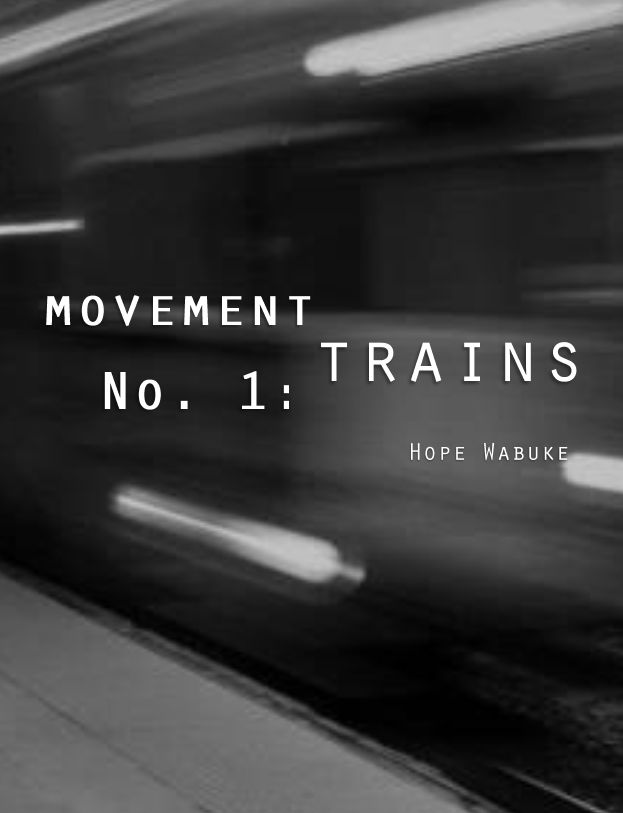
SATURDAY POETRY SERIES PRESENTS: MOVEMENT NO. 1: TRAINS


movement_1024x1024


From MOVEMENT NO. 1: TRAINS
By Hope Wabuke:


and when she waits, knowing its coming by the movement of light
across rusted metal, the dirty white tiles of tunnel wall almost
beautiful in the light sliding closer through darkness, approaching
rumble and tearing, metal wheel against track, gears shifting; halt.

in the loud echo still, vibrations pulsing—the only thing. she
imagines the sound she hears is breathing.


it is only when she thinks of him that her body becomes soft; she is
so conscious, then, of the movement of his body pressed against
hers’. so now she slides slightly, left, right, with the swaying motions
of the car. the train is stopped on the bridge, a windy day. the
intercom voice presses through static and she lifts arms above head,
stretches out her body to touch fingertips light to metal pole in
aisle’s center. the violence of the train’s starting and picking up, of
speed. in the meeting of the many tiny bones in her wrist against the
cold hardness, in the press of fingers soft against metal pole. she is
understanding pain in increments of waves, the pulsing slow
softening in rhythm with the traincar, rocking—her body, pushed
backwards, against scratched plexiglass window.

and in the moment of the train’s descent underground, her last view
a mirrored body, lines like chain links against grey sky, grey water.
the shape of their structures, repeating, suspended: a half-circle, a
half-closed eye .


and on the day after his leaving. she notices his absence in the
awkward stillness of her legs, the way her arms hang stiffly at her
sides. this is when she will remember how, as he would touch
drumsticks to upside-down white buckets to make beats, she would
see sound touch tile in tunnel walls and touch heels to ground.
rocking upward in tiny motions, she would lift hands lightly; she
would move her body in tiny circles of his rhythm.


Today’s poems are from Movement No. 1: Trains, published by dancing girl press, copyright © 2015 by Hope Wabuke, and appear here today with permission from the poet.


Movement No. 1: Trains is a city symphony of New York, where the author lived for many years–the daily rhythm of riding the subway and dancing between people walking the streets. Blurring the lines between past and the present, these prose poems explore the movement between love, loss and longing in a young woman’s memory.


Hope Wabuke: Born in exile to Ugandan refugees, Hope Wabuke is a writer, essayist and poet based in California. Hope is a contributing editor for The Root and a contributing writer for the Kirkus Reviews. Her poetry has also appeared in Lit Hub, The North American Review, Potluck Magazine, Ruminate Magazine, Fjords Literary Journal, Salamander Literary Journal, NonBinary Review, JoINT Literary Journal, Weave Magazine, Cease Cows, Kalyani Magazine, Split this Rock and Literary Mama. Her essays and criticism have appeared in Newsweek’s The Daily Beast, Salon, Gawker, Guernica, Dame, The Root, Ozy, The Hairpin, Ms. Magazine online, The Rumpus, Los Angeles Magazine and The Feminist Wire. Her fiction has been featured in the anthology All About Skin. Her chapbook Movement No. 1: Trains was published in June 2015 by dancing girl press. Her second chapbook, The Leaving, will be published in 2016 by Akashic Press as part of Kwame Dawes and Chris Abani’s New Generation African Poets series.


Editor’s Note: Part train ride, part memory, Movement No. 1: Trains takes the reader on a journey through which narrative blends with past, history is distorted by the present, and the tracks of the mind become one with the train lines of the New York subway system. Disjointed in a halting motion that mirrors the jerky movements of an underground train, the sway and lurch of this collection is tempered by moments of clarity and thoughtful reflection: “she / imagines the sound she hears is breathing;” “it is only when she thinks of him that her body becomes soft;” “she / would move her body in tiny circles of his rhythm.”


Want to see more from Hope Wabuke?
Hope Wabuke’s Official Website
Hope Wabuke’s Twitter
Buy Movement No. 1: Trains from dancing girl press
Literary Hub
The Hairpin