SATURDAY POETRY SERIES PRESENTS: STATE OF GRACE: THE JOSHUA ELEGIES

41oGCGJb2kL._SX331_BO1,204,203,200_


From STATE OF GRACE: THE JOSHUA ELEGIES
By Alexis Rhone Fancher:


DYING YOUNG

Midnight, and again I’m chasing
sleep: its fresh-linen smell and
deep sinking, but when I close my eyes I see
my son, closing his eyes. I’m afraid of that dream,
the tape-looped demise as cancer claims him.

My artist friend cancels her L.A. trip. Unplugs the
internet. Reverts to source. If cancer
will not let go its grip, then she will
return its embrace. Squeeze the life out of
her life. Ride it for all it’s worth.

By the time his friends arrive at the cabin
my son is exhausted, stays behind while
the others set out on a hike. He picks up the phone.
“Mom, it’s so quiet here. The air has never
been breathed before. It’s snowing.”

I put on Mozart. A warm robe. Make a pot
of camomile tea. The view from my 8th floor
window, spectacular, the sliver moon, the stark,
neon-smeared buildings, their windows dark.
Sometimes I think I am the only one not sleeping.

My artist friend wants to draw the rain. She
wants to paint her memories, wrap the canvas
around her like a burial shroud.

Tonight, a girl in a yellow dress stands below
my window, top lit by a street lamp, her long shadow
spilling into the street. She’s waiting for someone.

I want to tell my friend I’ll miss her.
I want to tell my son I understand.
I want to tell the girl he won’t be coming.
That it’s nothing personal. He died young.


SNOW GLOBE

Despair arrived, disguised as
nine pounds of ashes in a
velvet bag, worried so
often between my fingers
that wear-marks now stain
the fabric.

Is it wrong to sift
the remains of my dead son,
bring my ashen finger to my
forehead, make the mark of
the penitent above my eyes?

His eyes, the brown of mine,
the smooth of his skin, like mine.
Unless I look in the mirror
I can’t see him.

Better he’d arrived
as a snow globe, a small figure,
standing alone at the bottom of his
cut-short beauty.

Give him a shake, and watch
his life float by.


OVER IT

Now the splinter-sized dagger that jabs at my heart has
lodged itself in my aorta, I can’t worry it
anymore. I liked the pain, the
dig of remembering, the way, if I
moved the dagger just so, I could
see his face, jiggle the hilt and hear his voice
clearly, a kind of music played on my bones
and memory, complete with the hip-hop beat
of his defunct heart. Now what am I
supposed to do? I am dis-
inclined toward rehab. Prefer the steady
jab jab jab that reminds me I’m still
living. Two weeks after he died,
a friend asked if I was “over it.”
As if my son’s death was something to get
through, like the flu. Now it’s past
the five-year slot. Maybe I’m okay that he isn’t anymore,
maybe not. These days,
I am an open wound. Cry easily.
Need an arm to lean on. You know what I want?
I want to ask my friend how her only daughter
is doing. And for one moment, I want her to tell me she’s
dead so I can ask my friend if she’s over it yet.
I really want to know.


Today’s poems are from State of Grace: The Joshua Elegies (KYSO Flash, 2015), copyright © 2015 by Alexis Rhone Fancher, and appear here today with permission from the poet.


State of Grace: The Joshua Elegies: “Alexis Rhone Fancher’s book, State of Grace: The Joshua Elegies, maps in searing detail a landscape no parent ever wants to visit—a mother’s world after it’s flattened by her child’s death. Though her son’s early passing was ‘nothing personal,’ her poems howl with personal devastation. They insist that the reader take the seat next to hers in grief’s sitting room and ‘imagine him in his wooden forever.’ Fancher grapples with how to reconcile oneself to the slow loss of memory’s fade-out, and with how to go on living without betraying the dead, how to ‘[s]queeze the life out of / her life.’ You’ll need tissues when you read this book, but it’s well worth rubbing your heart raw against the beauty of these poems and their brave, fierce honesty.” — Francesca Bell, eight-time nominee for the Pushcart Prize in poetry, and winner of the 2014 Neil Postman Award for Metaphor from Rattle


Alexis Rhone Fancher is the author of How I Lost My Virginity To Michael Cohen and Other Heart Stab Poems, (Sybaritic Press, 2014). Find her work in Rattle, Menacing Hedge, Slipstream, Fjords Review, H_NGM_N, great weather for media, River Styx,The Chiron Review, and elsewhere. Her poems have been published in over twenty American and international anthologies. Her photos have been published worldwide. Since 2013 Alexis has been nominated for three Pushcart Prizes and two Best of The Net awards. She is photography editor of Fine Linen, and poetry editor of Cultural Weekly, where she also publishes The Poet’s Eye, a monthly photo essay about her ongoing love affair with Los Angeles. www.alexisrhonefancher.com


Editor’s Note: The poems in today’s collection slew me. Long after I finished reading them, they stayed with me, a specter. As I nursed my young son, worried over his maladies, rejoiced in his small accomplishments, there in the shadows was the poetry of Alexis Rhone Fancher reminding me that life is precious, fleeting, that nothing should be taken for granted, that anything–no matter how dear–can be taken away.

It is impossible not to be moved by these poems. By “a girl in a yellow dress [who] stands below / my window, top lit by a street lamp, her long shadow / spilling into the street… waiting for someone.” By the poet, the mother, who wants “to tell the girl he won’t be coming. / That it’s nothing personal. He died young.” By the admission, “Unless I look in the mirror / I can’t see him.” By the callousness of a friend who would ask if a mother is “over” her son’s death. By a mother’s very human reaction to such a question: “I want to ask my friend how her only daughter / is doing. And for one moment, I want her to tell me she’s / dead so I can ask my friend if she’s over it yet. / I really want to know.”

State of Grace: The Joshua Elegies is raw, brave, honest. It rips you apart as you read it–and leaves you grieving long after–because of the very vulnerable and wounded place from whence the poems arose. This is an incredibly compelling collection that does what lyric, confessional, narrative poetry does best: invites the reader into a human experience that is at once personal and shared, pairing vivid imagery and beautiful language with a story so moving that the reader is forever changed by the very act of having read it.


Want to see more from Alexis Rhone Fancher?
Buy State of Grace: The Joshua Elegies from Amazon
Four poems in Ragazine, including “When I turned fourteen, my mother’s sister took me to lunch and said:,” chosen by Edward Hirsch for inclusion in The Best American Poetry, 2016
Broad (“Dying Young” was first published in Broad)
Alexis Rhone Fancher’s Official Website / link to published works

SATURDAY POETRY SERIES PRESENTS: CHANEL BRENNER

Photo by The POD Photography


A POEM FOR WOMEN WHO DON’T WANT CHILDREN
By Chanel Brenner


I won’t preach about the rewards of motherhood.
I won’t say it’s the best thing that ever happened to me.
I won’t say it’s the best job I’ve ever had.
I won’t say you’ll regret not having a child.
I won’t say you’ll forget what life was like before.
I won’t say it makes life worth living.
What I will say
is my son died.
What I will say
is I would still do it again.


Today’s poem was originally published in Rattle and appears here today with permission from the poet. Hear the poet read today’s poem aloud via Rattle.


Chanel Brenner is the author of Vanilla Milk: a memoir told in poems, (Silver Birch Press, 2014). Her poems have appeared in Poet Lore, Rattle, Cultural Weekly, Diverse Voices Quarterly, Anderbo, West Trestle Review, and others. Her poem, “July 28th, 2012” won first prize in The Write Place At the Write Time’s contest, judged by Ellen Bass. In 2014, she was nominated for a Best of the Net award and a Pushcart Prize.

Editor’s Note: I won’t say it’s because I first read today’s poem while pregnant. I won’t say it’s because three weeks ago I became a mother for the first time. I won’t say it’s because I did not want children myself. I will say that my son is an amazing human being and that I am honored to be in his service. I will say that today’s incredibly moving, incredibly brave poem breaks my heart each and every time I read it.

Want to read more from Chanel Brenner?
Chanel Brenner’s Official Website
Deep Water Literary Journal
Cultural Weekly
Women’s Voices for Change
Silver Birch Press
Buy Vanilla Milk on Amazon

SATURDAY POETRY SERIES PRESENTS: VALERIE BACHARACH


Untitled


GENESIS
By Valerie Bacharach

I flew across the international
date line to yesterday.
Stayed on the plane,
circumnavigated the world,
arrived at time’s beginning.

A garden of wildness.

No need of that man
whose rib I stole,
no need of knowledge,
or apples,
or snakes,
or God…

Only this—
solitude
grace
pure air

before pain found me.


Today’s poem was originally published in Poetica‘s “Poem of the Week” series and appears here today with permission from the poet.


Valerie Bacharach is a poet and teacher in Pittsburgh, Pennsylvania. She is a member of Carlow University’s Madwomen in the Attic poetry workshops and has attended Chatham University’s Summer Community of Writers. In 2015, she participated in Chautauqua Institution’s Writers Festival, and worked with the poet, Tony Hoagland. She conducts weekly poetry workshops with the women of Power House, a halfway house for women in recovery from drug and alcohol addiction. Her poetry has appeared or is forthcoming in Voices from the Attic, Pittsburgh City Paper Chapter and Verse, Uppagus, U. S. 1 Worksheets, and Poetica.

Editor’s Note: Today’s poem is epic in its sparse simplicity. Rife with the unsaid, with what does not need to be written. At the same time, the poem is laden with intertextuality, the Bible doing the heavy lifting of connectivity and association, allowing what appears on the page to be ripe with the weight of ancient tales. Amid these rich layers, a lyric beauty emerges: “[I] circumnavigated the world, / arrived at time’s beginning,” “A garden of wildness,” “before pain found me.”

Want to read more from Valerie Bacharach?
Uppagus
Pittsburgh City Paper

SATURDAY POETRY SERIES PRESENTS: ALAN TOLTZIS

pic 003

FORTY-TWO PLACES
By Alan Toltzis

As time passed,
they didn’t need to study love,
pray for it,
or even speak its name.

Instead,
they lived their love
silently.
Secrets remained secret

as love sank into unbending bones,
fused with supple corpuscles,
and seeped through soft skin
beneath their fingernails.

Only by looking back
and naming each
of the 42 places (in order)
they had journeyed

did they realize they had grown
into an old couple
who survived a long-forgotten stopover
of bickering and concession

and the should-
and should-not-have-saids
they should never
have crossed

leaving only unspoken love
perpetuated by the comfort and intimacy
of taking each other
for granted.


Today’s poem is from the collection The Last Commandment, published by Poetica Publishing, copyright © 2015 by Alan Toltzis, and appears here today with permission from the poet.


Alan Toltzis is the author of the book of poems, The Last Commandment (Poetica Publishing, 2015). His work appears in print and online publications including The Provo Canyon Review, Poetica Magazine, Burningword Literary Journal, Soul-Lit, and Red Wolf Journal. Alan is working on his second book of poems and is developing The Psalm Project, to teach poetry to middle- and high-school students.

Editor’s Note: There is something of a prayer in today’s poem. A thanksgiving. Something quiet, humble, and honest. Something lived, understood, known. What it is to journey throughout a lifetime of relationship. What it is to look back and reflect upon “the should- / and should-not-have-saids … leaving only unspoken love / perpetuated by the comfort and intimacy / of taking each other / for granted.”

Want to read more from Alan Toltzis?
Alan Toltzis’ Official Website
“Miles Away” in the Red Wolf Journal
The Provo Canyon Review
“Noah” in the Red Wolf Journal
“Elegy for 107696” via Poetica Publishing

SATURDAY POETRY SERIES PRESENTS: DERRICK TYSON


1442353318186_1441927095124

POEM
By Derrick Tyson


My eyes
are so green that when

I look at you, your face
becomes an emerald,

or like a meadow
that is so completely absorbed

in its color that
it catches in your throat.

Flowers never need
alterations.

Sometimes
the sky is so beautiful

that even the windows
are in awe,

not letting me
see it clearly.

Windows
built into us, into our limbs,

my feet have bricked wells
built into them,

Thus
I fall into myself.


Today’s poem was previously published in SHAMPOO, and appears here today with permission from the poet.


Derrick Tyson is a a Visual Artist/Poet currently residing in the Atlanta-area. He has been published in various online and printed magazines nationwide, and has several books of poetry out. As an artist, he has been exhibited internationally in four different countries (Israel, China, Australia and Italy) and has had many of his photographs published in online and printed magazines. He loves co-mingling, cross-pollinating Fine Art with his love of Poetics, Literature, World Cinema and the Oneiric. He refers to this as Visual Poetry. He believes that all things are interconnected, whether or not we can visually render the connections. Since “Time” is inelastic, he cherishes every second with a passion. He’s easily-amused and takes nothing for granted.

Editor’s Note: Today’s poem is full of moments of stunning, impactful surprise. In the instant of connection, is it the watcher or the watched who becomes transformed? How perfect the flower, created by the hand of science or Mother Nature, that it never needs alterations. How beautiful the sky that not even the transparency of windows will allow it to be truly seen. How deep or burdened we are, that we fall into ourselves? Built moment by moment, each its own deep thought, each its own discreet image, today’s poem asks us to slow down, to reflect, to envision and imagine and contemplate. There is layer upon layer to consider and play with, if we will open our minds and take the time.

Want to see more from Derrick Tyson?
POETRY:
      Lispy Whispers
      Isolated Lightships
ART:
      flickr
      Artitbe

SATURDAY POETRY SERIES PRESENTS: FALL POEMS

By Someone35 (Own work) [CC BY-SA 3.0 (http://creativecommons.org/licenses/by-sa/3.0)], via Wikimedia Commons
By Someone35 (Own work) [CC BY-SA 3.0 (http://creativecommons.org/licenses/by-sa/3.0)%5D, via Wikimedia Commons


AFTER APPLE-PICKING
By Robert Frost

My long two-pointed ladder’s sticking through a tree
Toward heaven still,
And there’s a barrel that I didn’t fill
Beside it, and there may be two or three
Apples I didn’t pick upon some bough.
But I am done with apple-picking now.
Essence of winter sleep is on the night,
The scent of apples: I am drowsing off.
I cannot rub the strangeness from my sight
I got from looking through a pane of glass
I skimmed this morning from the drinking trough
And held against the world of hoary grass.
It melted, and I let it fall and break.
But I was well
Upon my way to sleep before it fell,
And I could tell
What form my dreaming was about to take.
Magnified apples appear and disappear,
Stem end and blossom end,
And every fleck of russet showing clear.
My instep arch not only keeps the ache,
It keeps the pressure of a ladder-round.
I feel the ladder sway as the boughs bend.
And I keep hearing from the cellar bin
The rumbling sound
Of load on load of apples coming in.
For I have had too much
Of apple-picking: I am overtired
Of the great harvest I myself desired.
There were ten thousand thousand fruit to touch,
Cherish in hand, lift down, and not let fall.
For all
That struck the earth,
No matter if not bruised or spiked with stubble,
Went surely to the cider-apple heap
As of no worth.
One can see what will trouble
This sleep of mine, whatever sleep it is.
Were he not gone,
The woodchuck could say whether it’s like his
Long sleep, as I describe its coming on,
Or just some human sleep.


AUTUMN: A DIRGE
By Percy Bysshe Shelley

The warm sun is falling, the bleak wind is wailing,
The bare boughs are sighing, the pale flowers are dying,
And the Year
On the earth is her death-bed, in a shroud of leaves dead,
Is lying.
Come, Months, come away,
From November to May,
In your saddest array;
Follow the bier
Of the dead cold Year,
And like dim shadows watch by her sepulchre.

The chill rain is falling, the nipped worm is crawling,
The rivers are swelling, the thunder is knelling
For the Year;
The blithe swallows are flown, and the lizards each gone
To his dwelling.
Come, Months, come away;
Put on white, black and gray;
Let your light sisters play–
Ye, follow the bier
Of the dead cold Year,
And make her grave green with tear on tear.


AUTUMN LEAVES
By Juliana Horatia Ewing

The Spring’s bright tints no more are seen,
And Summer’s ample robe of green
Is russet-gold and brown;
When flowers fall to every breeze
And, shed reluctant from the trees,
The leaves drop down.

A sadness steals about the heart,
–And is it thus from youth we part,
And life’s redundant prime?
Must friends like flowers fade away,
And life like Nature know decay,
And bow to time?

And yet such sadness meets rebuke,
From every copse in every nook
Where Autumn’s colours glow;
How bright the sky! How full the sheaves!
What mellow glories gild the leaves
Before they go.

Then let us sing the jocund praise,
In this bright air, of these bright days,
When years our friendships crown;
The love that’s loveliest when ’tis old–
When tender tints have turned to gold
And leaves drop down.


Today’s poems are in the public domain, belongs to the masses, and appears here accordingly.


Editor’s Note: Today we celebrate another change in seasons. As the leaves turn red, yellow, orange and gold, as they fall from the trees and blanket the ground, as Mother Earth sheds her summer splendor and Persephone prepares to go underground, may we bid farewell through poetry. And may we meet again in spring when life blooms anew.


Want to read more fall poetry?
Academy of American Poets
The Poetry Foundation

SATURDAY POETRY SERIES PRESENTS: LANDON GODFREY

landongodfreynewglasses2014bw

By Landon Godfrey:


INKWELL

When the antique inkwell arrives after making the journey from its dead owner’s estate, the other objects in the atomic ranch house observe it with cool attitudes. Clearly, they think, those curves and etched filigrees bespeak an affection for philosophy or power. Therefore, they shun the inkwell, keeping their own straight lines and unadorned exteriors to themselves. What they never guess: the lonely inkwell is illiterate. Only the masterful sterling silver pen can read.


RECIPE

A moment: when the dough, formed into a ball with greased hands, rests to rise, it exhibits what seems possible in the stone—expansion into space like a star exploding into the full spheroidal grandeur of a self-luminous celestial body. But the mundane violence of the next step overtakes our recognition of energetic brilliance—when we punch the dough and put its deflated body into a furnace, where it will grow again. The stone can grow only smaller and smaller, eroding. It keeps its opinions secret. But hoping to abrade the delusion that traps us in fantasies of an ideal past, sometimes the stone whispers our own noxious monologues to us: I was young and beautiful, my grandmother a princess, her father courageous, our vast estates filled with people who served us, suffering in a gorgeous absence of justice.


SUBTLE HORROR MOVIES

Monster

An immense lizard standing on two legs does not devour the city. The creature nibbles on it at night, while we are sleeping, but we never notice.

Pathogen

Some of us are not immune. We cough and sweat. Our hero is immune. To what, we do not know.

Visitor From Outer Space

We argue about the existence of God. Evidence for both sides: a church that fills with prayer only when it is empty.


Today’s poems are from the chapbook In the Stone, copyright Landon Godfrey 2014, and appear here today with permission from the poet.


Landon Godfrey’s collection of poems, Second-Skin Rhinestone-Spangled Nude Soufflé Chiffon Gown (Cider Press Review, 2011), was selected by David St. John for the 2009 Cider Press Review Book Award. She is also the author of two limited-edition letterpress chapbooks, In the Stone (RAPG-funded artist’s book, 2013) and Spaceship (Somnambulist Tango Press, 2014). Her poems have or will appear in Slice, Bombay Gin, The Collagist, Beloit Poetry Review, Best New Poets, Verse Daily, and other places, and her fiction has been published in Waxwing. A lyric essay is forthcoming in Tupelo Quarterly. Also an artist, she co-edits, -designs, and -publishes Croquet, a letterpress postcard broadside poetry journal. Born in Washington, DC, she lives in Black Mountain, NC.

Editor’s Note: Today’s poems are surprising and full of wonder. Bringing to life the inanimate, telling fantastical stories of that which can only be born of boundless imagination, what unfolds in the storylines of these poems is tempered by carefully wrought syntax, by painstaking word choice, by a sonic soundscape that mirrors and illuminates the worlds it is creating. There is a beauty and a heartbreak to the lyric that is so carefully interwoven with the poems’ narrative that one must be careful not to miss it. But a reader who slows down and savors today’s poems will be treated to moments such as “The stone can grow only smaller and smaller, eroding. It keeps its opinions secret,” and “a church that fills with prayer only when it is empty.”

Want more from Landon Godfrey?
Landon Godfrey’s Official Website
Purchase Second-Skin Rhinestone-Spangled Nude Soufflé Chiffon Gown
View In the Stone chapbook
Twitter

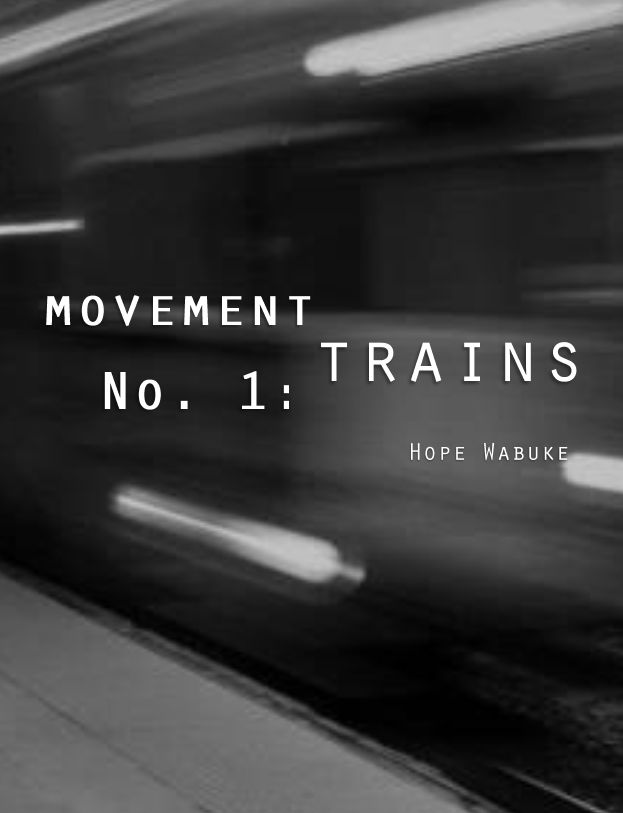
SATURDAY POETRY SERIES PRESENTS: MOVEMENT NO. 1: TRAINS


movement_1024x1024


From MOVEMENT NO. 1: TRAINS
By Hope Wabuke:


and when she waits, knowing its coming by the movement of light
across rusted metal, the dirty white tiles of tunnel wall almost
beautiful in the light sliding closer through darkness, approaching
rumble and tearing, metal wheel against track, gears shifting; halt.

in the loud echo still, vibrations pulsing—the only thing. she
imagines the sound she hears is breathing.


it is only when she thinks of him that her body becomes soft; she is
so conscious, then, of the movement of his body pressed against
hers’. so now she slides slightly, left, right, with the swaying motions
of the car. the train is stopped on the bridge, a windy day. the
intercom voice presses through static and she lifts arms above head,
stretches out her body to touch fingertips light to metal pole in
aisle’s center. the violence of the train’s starting and picking up, of
speed. in the meeting of the many tiny bones in her wrist against the
cold hardness, in the press of fingers soft against metal pole. she is
understanding pain in increments of waves, the pulsing slow
softening in rhythm with the traincar, rocking—her body, pushed
backwards, against scratched plexiglass window.

and in the moment of the train’s descent underground, her last view
a mirrored body, lines like chain links against grey sky, grey water.
the shape of their structures, repeating, suspended: a half-circle, a
half-closed eye .


and on the day after his leaving. she notices his absence in the
awkward stillness of her legs, the way her arms hang stiffly at her
sides. this is when she will remember how, as he would touch
drumsticks to upside-down white buckets to make beats, she would
see sound touch tile in tunnel walls and touch heels to ground.
rocking upward in tiny motions, she would lift hands lightly; she
would move her body in tiny circles of his rhythm.


Today’s poems are from Movement No. 1: Trains, published by dancing girl press, copyright © 2015 by Hope Wabuke, and appear here today with permission from the poet.


Movement No. 1: Trains is a city symphony of New York, where the author lived for many years–the daily rhythm of riding the subway and dancing between people walking the streets. Blurring the lines between past and the present, these prose poems explore the movement between love, loss and longing in a young woman’s memory.


Hope Wabuke: Born in exile to Ugandan refugees, Hope Wabuke is a writer, essayist and poet based in California. Hope is a contributing editor for The Root and a contributing writer for the Kirkus Reviews. Her poetry has also appeared in Lit Hub, The North American Review, Potluck Magazine, Ruminate Magazine, Fjords Literary Journal, Salamander Literary Journal, NonBinary Review, JoINT Literary Journal, Weave Magazine, Cease Cows, Kalyani Magazine, Split this Rock and Literary Mama. Her essays and criticism have appeared in Newsweek’s The Daily Beast, Salon, Gawker, Guernica, Dame, The Root, Ozy, The Hairpin, Ms. Magazine online, The Rumpus, Los Angeles Magazine and The Feminist Wire. Her fiction has been featured in the anthology All About Skin. Her chapbook Movement No. 1: Trains was published in June 2015 by dancing girl press. Her second chapbook, The Leaving, will be published in 2016 by Akashic Press as part of Kwame Dawes and Chris Abani’s New Generation African Poets series.


Editor’s Note: Part train ride, part memory, Movement No. 1: Trains takes the reader on a journey through which narrative blends with past, history is distorted by the present, and the tracks of the mind become one with the train lines of the New York subway system. Disjointed in a halting motion that mirrors the jerky movements of an underground train, the sway and lurch of this collection is tempered by moments of clarity and thoughtful reflection: “she / imagines the sound she hears is breathing;” “it is only when she thinks of him that her body becomes soft;” “she / would move her body in tiny circles of his rhythm.”


Want to see more from Hope Wabuke?
Hope Wabuke’s Official Website
Hope Wabuke’s Twitter
Buy Movement No. 1: Trains from dancing girl press
Literary Hub
The Hairpin

SATURDAY POETRY SERIES PRESENTS: KAREN PAUL HOLMES

Karen Paul Holmes with dog

By Karen Paul Holmes:


VISITOR

A bare branch lounges
in my Adirondack chair
under the Japanese maple–
gray, elegant:
Comforting to me,
now without a husband,
a good omen
in my walled garden
cocooned by snow.


LIFE, ACT 3

Time knows its lines
has spoken them
across our foreheads.
In this stage of living
we censor the critic,
applaud the comedy,
watch the script unfold.
Gravity plays upon
these bodies, while
souls move inward,
heavenward.
The star in me
celebrates the star in you.


“Visitor” first appeared in Town Creek Poetry. Today’s poems are from the collection Untying the Knot (Aldrich Press 2014) and appear here today with permission from the poet.


Karen Paul Holmes is the author of the poetry collection, Untying the Knot (Aldrich Press, 2014), which tells a story of loss and healing with a voice that “pushes readers forward into the unknown with confidence, precision, and empathy,” according to Poet Dorianne Laux. Karen received an Elizabeth George Foundation emerging writer grant in 2012 and was nominated for Best New Poets 2014. Publishing credits include Poetry East, Atlanta Review, Caesura, The Sow’s Ear Poetry Review, Every Day Poems, The Southern Poetry Anthology Vol 5: Georgia, and Stone, River, Sky: An Anthology of Georgia Poems.

Editor’s Note: Today’s poems are full of dichotomies: simple and complex, small and epic. They contain all at once the quiet contemplation of nature, of meditation, of breath, yet their gentile reflectiveness is balanced precisely by the weight of a life lived. This is a life–and a poetry–as simple as a bare branch under a Japanese maple, yet as complex as the comfort of being “now without a husband,” and that being “a good omen.” This is a human experience as small as the lines time “has spoken… across our foreheads,” and as epic as the idea that “The star in me / celebrates the star in you.”

Want more from Karen Paul Holmes?
Blue Fifth Review
Verse-Virtual
Extract(s)
Amarillo Bay
See inside Untying the Knot

SATURDAY POETRY SERIES PRESENTS: JEN KARETNICK

Jen Karetnick Head Shot

By Jen Karetnick:


ON THE WAY TO SEDER, MY HUSBAND ANSWERS

phone calls from patients, their parents or partners,
repeating what he has already said half-a-dozen times

in the office—“I know the auras are uncomfortable,
but they’re better than grand mal seizures, and that’s

what the meds will help to prevent”— and dispensing
predictions no one wants to hear—“No, I don’t think

he’ll come home; the stroke was catastrophic”—but
are asked for over and over in the hopes they will change,

while I shush the kids in the backseat, stop them from shouting
with too much apparent joy in their voices, keep the radio

playing Lady Gaga’s “Telephone” turned down. Soon
we will dissect the Seder plate, digest the bitter

herbs, finger the salt dried on the easily torn skin
of faith. We will recite the plagues: boils, murrain,

the lice we have been visited by several times this year.
On this night, we will open the door for a rogue spirit

who might drink our wine but not heal vertigo; on this night
we will recline on a pillow that can’t fuse a broken

spine. On this night, the cell phone chirps and sings,
and there are no miracles beyond what can be doctored.


THE INVENTION OF AMNIOCENTESIS

Mother, in your womb I am an experiment.
You pass on not immunity but its silvery underside,
give permission for the needle like an arrow to
birth holes in this temporary home, sip the fluid
like a taster of fine wines without the benefit of
a visible image. No bigger than a black widow
spider, the doctors must guess where I am,
and agree there is nothing to be done.
I am poison to both of us. Unsafe
harbor, you insist on mooring me to
your designated slip, tossed by rash after
rash of storms. I will remove myself early. Still ill,
of course you will not care for me right away. Of all the
eggs you might have nourished, I am the one who breaks you.


WOMEN ON THE VERGE DISCUSS VIAGRA

Stamina. From the Latin stamen,
meaning thread of woven cloth. Plant parts
resemble the warp and woof, but old farts?
The boost was designed for the impotent,
not the young at heart. They can’t afford
to see the blue of detached retinas
when the sky has already claimed those hues
and the days for viewing them are numbered.
How ‘bout a pill to make them remember
to take out the garbage or mow the lawn?
One to defoliate the nose hairs grown?
Or better: to spark conversational vigor.
No chance of that? Then don’t bring it on.
This is the last thing, the last thing we want.


“On the Way to Seder, My Husband Answers” was previously published in The Healing Muse. Today’s poems are from the forthcoming collection American Sentencing (Winter Goose Publishing), and appear here today with permission from the poet.


Jen Karetnick is the author/co-author/editor of 14 books, two of them forthcoming: American Sentencing (poetry, Winter Goose Publishing) and The Treasures That Prevail (poetry, Whitepoint Press). In addition to poetry, she writes lifestyle books, the most recent of which is the cookbook Mango (University Press of Florida, 2014). Her poems, prose and playwriting have been widely published in literary and commercial outlets including TheAtlantic.com, Cimarron Review, december, Miami Herald, North American Review, Poet’s Market 2013, Poets & Writers, Racked.com, River Styx, Spillway, Submittable.com, Valparaiso Poetry Review and Virgin Atlantic Airlines. Based in Miami with her husband, two teenagers, various rescue pets and 14 mango trees, she works as the Creative Writing Director for Miami Arts Charter School and as the dining critic for MIAMI Magazine.

Editor’s Note: Jen Karetnick expertly catalogues the vast and startling spectrum of life, from the mundane to the monumental, from humor to horror. Amidst the stories that unfold are stunning and heartbreaking moments of lyric: “Soon we will dissect the Seder plate, digest the bitter // herbs, finger the salt dried on the easily torn skin / of faith;” “Of all the / eggs you might have nourished, I am the one who breaks you.” And that beauty is balanced by the hilarious and the absurd. Of viagra, a group of women posit, “How ‘bout a pill to make them remember / to take out the garbage or mow the lawn? / One to defoliate the nose hairs grown? / Or better: to spark conversational vigor. / No chance of that? Then don’t bring it on. / This is the last thing, the last thing we want.”

Want more from Jen Karetnick?
Read poems from Brie Season
Buy Brie Season on Amazon
Buy Prayer of Confession from Finishing Line Press
Buy Landscaping for Wildlife from Big Wonderful Press
Read more of Jen Karetnick’s poems and prose