SATURDAY POETRY SERIES PRESENTS: RHIANNON CONLEY

MURMUR
by Rhiannon Conley


“Did You Know? You can swim through the aorta
of a blue whale.” I watched as two children
swam, their soft hands like fins pushing themselves
out of the open chamber of the imagined whale’s
red ventricle and back into the museum showcase.
The heavy plastic held on to the throb of their laughter.

I could fit, I thought. I could be held in this heart
like blood. I could be pumped through the veins
and organs of the whale, let it take me, flowing,
my arms at my sides gliding head first
through the enormous animal’s body.

Your heart, just the size of your soft infant fist
which fits twofold into my own, holds a small
whispering defect. The pediatrician presses air
between his teeth – tsst tsst – to mimic the sound
he hears on the stethoscope. “It’s nothing,”
he says, “Just relax.” Tsst tsst. Just a leak,
a little mist pressed through a tiny spout,
a space as tight as teeth.

You are supposed to outgrow the hole,
supposed to grow muscle around the flaw,
supposed to be as strong as hard plastic,
the murmur shrinking so that you never
have to think about the way your body
is whispering its defects. I am supposed to relax.

I could fit. Inside your body, remembering how you
once fit into me. I could repair you
with my own body, the way my body prepared you
in the first place, with all your flaws.
The pediatrician says it gets louder – tsst tsst –
as it shrinks. He says your heart is much louder.

I’ll take you someday to see the whale’s heart
and watch as you swim through its ventricles
and out of the oversized aorta like a fish, unaware
of your heart moving blood through your body
like waves, little echoes, like the plastic heart
holding onto your laughter.


Today’s poem previously appeared in Whale Road Review and appears here today with permission from the poet.

Rhiannon Conley is a poet and writing instructor living in North Dakota. She was nominated for a Pushcart Prize in 2016. Her first chapbook, Less Precious, was published by Semiperfect Press in 2017. She currently has work forthcoming in Literary Mama and Longleaf Review. She writes an irregular newsletter of short poetic essays called Smol Talks and more regularly Tweets @RhiannonAdmidas.

Guest Editor’s Note: The echoes throughout this poem are its heart beating, whispering the emotions of the speaker told to relax when listening to a diagnosis of a leak in her daughter’s heart. Like so many mothers, she wants to fix the problem and also shoulder some of the burden. The following lines repeat words and sounds and serve as a mantra that comes from the deepest and most profound feelings of helplessness: “I could fit. Inside your body, remembering how you / once fit into me. I could repair you / with my own body, the way my body prepared you / in the first place, with all your flaws.” The repetition of “body” and “you” is natural, seamless, barely above a whisper. The second appearance of “I could fit” is a rhythmic reminder of the speaker’s profound wish.

The model whale heart is the perfect opening for this poem, set in a familiar place to observe children perhaps on a field trip or visit to the museum. The imagery of swimming through “the imagined whale’s red ventricle” in the first stanza begins a narrative that circulates through thought and lands back on hope for future visits in spite of a mother’s fear. The well-crafted stanzas and lines serve the poem and its theme and create a circular effect that emanates from the narrative, its imagery and metaphors.

Want to read more by and about Rhiannon Conley?
ND Quarterly
Moonsick Magazine
Occulum
Buy Less Precious from semiperfect press
Smol Talks


Guewst Editor Anne Graue is the author of Fig Tree in Winter (Dancing Girl Press), and has published poems in literary journals and anthologies, including The Book of Donuts (Terrapin Books), Blood and Roses: A Devotional for Aphrodite and Venus (Bibliotheca Alexandrina), Gluttony (Pure Slush Books), The Plath Poetry Project, One Sentence Poems, Random Sample Review, Into the Void Magazine, Allegro Poetry Magazine, and Rivet Journal.

A NOTE FROM THE MANAGING EDITOR:

After nearly ten years as Contributing Editor of this series, it is an honor and a unique opportunity to share this space with a number of guest editors, including the editor featured here today. I am thrilled to usher in an era of new voices in poetry as the Managing Editor of this series.

Viva la poesia!
Sivan, Managing Editor
Saturday Poetry Series, AIOTB


“The Mark Twain Speech” By John Dorsey

.

.

The Mark Twain Speech
for mark mcclane

you talk about frontiers
that only dead men
& drunks can see

not about the blood
& sweat that goes
into words that won’t sell
the stories of heartbreak
& what time can do
to beautiful things

everything turned to bone

words careening off your tongue
& down a river
slow to offer amnesty
to those in a sinking ship.

.

Check out our interview with John Dorsey on his book, Letting the Meat Rest.

.

About the Author: John Dorsey lived for several years in Toledo, Ohio. He is the author of several collections of poetry, including Teaching the Dead to Sing: The Outlaw’s Prayer (Rose of Sharon Press, 2006), Sodomy is a City in New Jersey (American Mettle Books, 2010), Tombstone Factory, (Epic Rites Press, 2013), Appalachian Frankenstein (GTK Press, 2015) Being the Fire (Tangerine Press, 2016) and Shoot the Messenger (Red Flag Press, 2017). He is the current Poet Laureate of Belle, MO. His work has been nominated for the Pushcart Prize. He may be reached at archerevans@yahoo.com


More By John Dorsey:

Punk Rock at 45

Creatures of Our Better Nature


Image Credit:  Chase Dimock “The Mississippi River in Cape Girardeau”

SATURDAY POETRY SERIES PRESENTS: EMILY BLAIR


By Emily Blair:


Today’s poems previously appeared in cream city review (vol. 41.1) and Indiana Review (vol. 39, no.1) and appear here today with permission from the poet.

Emily Blair’s poetry has appeared in Gulf Coast, Sixth Finch, Juked, Indiana Review, New Ohio Review, cream city review, Gettysburg Review and the Brooklyn Poets Anthology, among other places. She received a New York Foundation of the Arts Fellowship in Poetry in 2014 and in Fiction in 2006, and is the author of the illustrated chapbook Idaville (Booklyn Artists’ Alliance, 2010). Also a visual artist, she creates multimedia books and collaborates with social practice artist Michelle Illuminato under the name Next Question.

Guest Editor’s Note: To begin reading a poem by Emily Blair is to step onto a sturdy roadway only to find halfway along that you are swaying wildly on a rickety rope bridge, your foot’s about to fall through the rotting jute, and there’s no going back. All you can do is rush forward and hope you make it to the other side before it collapses behind you. She pulls you along with brilliant wordplay: “—were the heavens ablaze—was there a topiary maze—” and half-recognized allusions to the plot points of movies you probably slept through while you were babysitting those demon kids across the street. Toward the end of the poem you realize that the poet is cleverly yet subtly addressing some of your most mundane and commonly shared fears and despite all signs to the contrary–is every single sentence a question?–the poet gives us a temporary reprieve from that anxiety in the form of a quirky answer: “Are you going to haunt me forever? I’m free every night this week.”

Want to read more by and about Emily Blair?
Barrel House Mag
Juked


Originally from MN, Guest Editor Julie Hart has lived in London, Zurich and Tokyo and now in Brooklyn Heights. Her work can be found in PANK Magazine, The Rumpus, Vol. 1 Brooklyn, the Brooklyn Poets Anthology and at juliehartwrites.com. She is a founder with Mirielle Clifford and Emily Blair of the poetry collective Sweet Action.

A NOTE FROM THE MANAGING EDITOR:

After nearly ten years as Contributing Editor of this series, it is an honor and a unique opportunity to share this space with a number of guest editors, including the editor featured here today. I am thrilled to usher in an era of new voices in poetry as the Managing Editor of this series.

Viva la poesia!
Sivan, Managing Editor
Saturday Poetry Series, AIOTB


Under the Tamarind Tree

Francisco Manuel Blanco: “Tamarindus Indica”
.

Under the Tamarind Tree

By Bunkong Tuon

.

Editor’s Note: This past week, the nation witnessed devastating images from detention centers and heard hateful rhetoric spewed about immigration. Now, more than ever, it is important to humanize immigration and emphasize empathy. It is in this spirit that we are proud to present the final post in a series of poems about the immigrant experience in America.

Our late Managing Editor, Okla Elliott, featured Bunkong Tuon’s work on As It Ought To Be back in January of 2017. Okla was particularly concerned about the anti-immigration rhetoric heating up in the country and he hoped to showcase the voices of immigrants on our site. In honor of Okla’s memory, Tuon has allowed us to feature more of his poetry about his experience as an immigrant from Cambodia in the United States. All of the poems from this series can be found linked at the end of this article.

.

Under the Tamarind Tree

The child sits on the lap
of his aunt, under the old tamarind tree
outside the family home.

The tree stands still, quiet,
indifferent. The house sways
on stilts.

Monks in saffron robes,
and nuns with shaved heads,
lips darkened with betel-nut stain,

sit chanting prayers
for the child’s mother.

Incense perfumes the hot dry air.

There emerges a strange familiar song
between the child and his aunt that day—
a distant one, melodic but harsh,
as if the strings are drawn too tight—

Each time the child hears prayers
coming from the house, he cries;
each time he cries, the aunt, a girl herself,
pinches the boy’s thigh.

.

Previous poems from Bunkong Tuon’s series on the immigrant experience in America:

Fragments

Our Neighborhood in Revere, MA

Snow Day

An Elegy for a Fellow Cambodian

Halloween, 1985

Dancing Fu Manchu Master

Fishing for Trey Platoo

Lies I Told About Father


.

About the Author: Bunkong Tuon is the author of Gruel (2015) and And So I Was Blessed (2017), both poetry collections published by NYQ Books, and a regular contributor to Cultural Weekly  He is also an associate professor of English and Asian Studies at Union College, in Schenectady, NY.

SATURDAY POETRY SERIES PRESENTS: LAURA READ


RIP, LAURA’S VAGINA
By Laura Read


Your vagina is beginning to devitalize,
the doctor explained, when I asked him why
I had had so many urinary tract infections lately.
The first thing I thought was that I should say
No, your vagina is devitalizing, because I have
two teenage sons, and that is what passes for wit
in our house. But then I got lost in the fact
that he didn’t, in fact, have a vagina,
and I thought I should point that out instead
because in some circles—say, mine—
that would be an insult. Then, in the little
room inside my mind where Dorothy Parker
was holding court at the Algonquin,
I thought maybe devitalize is just a medical term,
give the guy a break. But I didn’t even know
this man. Couldn’t he just give me a prescription
and say something vague about aging?
What about euphemism? I guess devitalize
was one because he went on to more vividly
explain that my tissues were, frankly, deteriorating.
At that point, I was thinking But you haven’t even
seen the area in question
and How did you get
this far without knowing how to talk to women?

Devitalize reminds me of de-ice which is what
I was doing just before this tricky moment
at the Urgent Care. My son was late to Algebra
because it’s really cold and it took a while
to clean the car. And at 8:00 the door
where he usually goes in automatically closes,
so I had to take him around to the front,
and he dropped his phone in the snow
and it got run over, so now there’s a crack
in the screen. He wants me to replace it,
but I said, No, it still works.


Today’s poem previously appeared in the Beloit Poetry Journal, Volume 68, No. 1. Winter 2018, and appears here today with permission from the poet.

Laura Read’s first collection of poems, Instructions for My Mother’s Funeral, was published in 2012 by the University of Pittsburgh Press. Her second collection, Dresses from the Old Country, will be published by BOA in fall of 2018. She teaches English at Spokane Falls Community College.

Guest Editor’s Note: This poem moves through thought and returns to previous memory in a deceptively effortless progression, as if listening to someone recount an experience in conversation. The speaker fixates on a word that informs the tone of the experience and the poem: devitalize. This word takes her down a linguistic path that leads to another path and another, but, unlike Robert Frost, she returns to the fork in the road at the end of the poem with her response to her son that is meant for the insensitive doctor: “No, it still works.”

The allusive dark humor of Dorothy Parker is conjured as a familiar satirical connection and an anchor for association or a metaphorical leap. The “little room” inside the speaker’s mind is where pithy retorts are stored for occasions such as the encounter at the Urgent Care clinic, but she doesn’t respond in the way that she wants to, keeping her thoughts to herself, as many women do in these situations when they are being told that their bodies have failed them in some way by doctors who make assumptions without being completely sure.

The significant linguistic turn the speaker takes to a new word: “Devitalize reminds me of de-ice” leads her to recent memory, and the experience of taking her son to school that morning evokes mournful anger and defiance in the face of a doctor’s proclamation that a vital part of her female-ness is deteriorating. The details are important in her reliving the moments with her son as she is sitting in the clinic, and seemingly mundane facts become the thematic crux, informing the reader how life and language connect to produce intense emotion when we least expect it.

Want to read more by and about Laura Read?
Laura Read’s Official Website


Guest Editor Anne Graue is the author of Fig Tree in Winter (Dancing Girl Press, 2017), and has published poems in literary journals and anthologies, including The Book of Donuts (Terrapin Books), the Plath Poetry Project, One Sentence Poems, and Rivet Journal.

A NOTE FROM THE MANAGING EDITOR:

After nearly ten years as Contributing Editor of this series, it is an honor and a unique opportunity to share this space with a number of guest editors, including the editor featured here today. I am thrilled to usher in an era of new voices in poetry as the Managing Editor of this series.

Viva la poesia!
Sivan, Managing Editor
Saturday Poetry Series, AIOTB


“Ringo Starr Answers Questions on Larry King Live about the Death of George Harrison” By Roy Bentley

.

Ringo Starr Answers Questions on Larry King Live
about the Death of George Harrison

First, Larry King mistakenly calls Ringo
George then asks him whether his passing,
George’s, was expected. He answers that it was.
Says they knew he was sick. Had lung cancer.
I’m watching, though it’s none of my business
how grief-stricken Ringo Starr was and likely
still is or whether he was there, at the bedside,
at the moment George left his life for some other,
if you can believe what George believed, which
was that we keep coming back till we get it right.
And when Ringo is about to let down his guard
and be a bit more self-disclosing, even honest,
Larry interrupts, asking, Do you ever want to
pinch yourself? And Ringo Starr says, Sure.
In 1988, years before, in another interview,
with George, this years after Lennon’s death,
Ringo confessed that he was the poorest Beatle
then laughed and blew cigarette smoke upward.
Which must’ve seemed terribly funny to George,
an inside joke, because he said Hello, John to
the smoke like it was Lennon (by virtue of his
acknowledged wealth) or some spirit he used to
conquer worlds with. Ringo says he was shocked
upon hearing the news of the death of John Lennon,
but that George’s death was another thing entirely.
He doesn’t quote from the Bhagavad Gita, but it’s
as if he wants to say we continue on, are these spirits,
a sort of outrageous bliss even to think it, dumb luck
on the order of being hired as the Beatles’ drummer.
Maybe he would have said it, with respect to George
or ventured his own beliefs, if Larry hadn’t butted in
to ask him which of the Beatles was the best musician.
You mean, now? And I want to laugh now because
maybe Ringo’s imagining how hard it is to move
your hands after you’re dead, or to move at all,
and how impossible it must be to keep time
and tempo in all that anonymous blankness,
the dark become your most imploring fan.

.
This poem first appeared in Rattle

.

About the Author: Roy Bentley has published five books of poems, including Walking with Eve in the Loved City, which was selected as a finalist for the 2018 Miller Williams Poetry Prize and is available from the University of Arkansas Press or at Amazon. Bentley’s poems have appeared in Able Muse, Rattle, Blackbird, Shenandoah, Prairie Schooner, The Southern Review, and elsewhere. He is the recipient of a Creative Writing Fellowship in Poetry from the National Endowment for the Arts, as well as fellowships from the Florida Division of Cultural Affairs and the Ohio Arts Council.


More by Roy Bentley:

Nosferatu in Florida

Saturday Afternoon at The Midland Theatre in Newark, Ohio


Image Credit: photo collage of Ringo Starr on Larry King Live by Chase Dimock

SATURDAY POETRY SERIES PRESENTS: LYNN POWELL


By Lynn Powell:


THE MOON RISING

Sly old guru, Rorschach moon,
you’re calling me again with your round riddle,
your paradox of Ohm and moan.
All day the sun was up on its soapbox, a Pollyanna
casting out the darkness in everybody else.
Now we’re back at the window where we started—
me with my midnight weakness, and you
with your sleight-of-silver ministry
to anyone unguarded and alone.

Slow moon, you’ve lingered near the cloister and the dance hall,
laid your soft law down on wide and narrow beds.
You’ve faced yourself in ponds, thrown yourself
on the mercy of a moody sea. You’ve been the slick
Houdini of horizons, sliding out of each tight spot
the night has tried to trap you in.
What’s left for me to misconstrue?

I’m tired of my mind and its whitewash,
tired of your low-light revelations.
And how will I find the dark forest if you keep
murmuring silky nothings to the trees?

Cold moon, unmake me
in your image. Pare me down
to the bleak beatitude, the black sum
of all you know for sure.


AT THE EQUINOX

             Has the rain a father, or who has begotten the drops of dew?
                                                                         —Job 38:28

From the car window, after the fog lifts,
the autumn fields flash with sudden flowers—

              like filigrees of mirror, like alloys of lace and light.

A weird miracle? Some brilliant, manic manna?
Until, of course, it’s only spiders—ten thousand

              that have worked the dark with rigs of silk

to snag a fly and then, surprising themselves,
have step-fathered the dew.

              And so, for an odd hour, hunger

glistens in galaxies, sieved
from passing thoughts of lake and air.


Today’s poems are from the collection Season of the Second Thought (University of Wisconsin Press, 2017), copyright Lynn Powell, and appear here today with permission from the poet.

Lynn Powell has published three books of poetry: Season of the Second Thought (winner of the 2017 Felix Pollak Prize), The Zones of Paradise, and Old & New Testaments. Her nonfiction book Framing Innocence won the Studs & Ida Terkel Award from The New Press in 2010. A native of East Tennessee, Powell teaches in the Creative Writing Program of Oberlin College.

Guest Editor’s Note: Lynn Powell’s work is reminiscent of “The Parable of the Sunfish” in Ezra Pound’s ABC of Reading. Powell is a poet who gains deep understanding and insight into her subjects, examining them over and over from unique angles until she has observed their essence. In “The Moon Rising,” for instance, the moon is a “Sly, old guru” a “Rorschach,” a “slick/Houdini of the horizons.” It possesses a “slight of hand ministry” or can lay its “soft law down on wide and narrow beds.”

Throughout her collection Seasons of the Second Thought, line by line Powell examines, prods, and dissects until she has mastered her subject, rewarding her readers with an intimacy and understanding that is both profound and revealing. In “At the Equinox,” she observes the world with such intensity that she is able to see the creators of the miracle she is viewing not as their mundane selves — “only spiders—ten thousand” — but as creatures that “have step-fathered the dew.” Powell’s work is an enlightenment that allows the reader to see the world for what it can be when observed fully.

Want to read more by and about Lynn Powell?
Buy Seasons of the Second Thought from University of Wisconsin Press
POETRY Magazine
Bellingham Review
Shenandoah
American Literary Review


Guest Editor Alan Toltzis is the author of The Last Commandment. Recent work has appeared in print and online publications including Hummingbird, Right Hand Pointing, IthacaLit, r.k.v.r.y. Quarterly, and Cold Noon. Find him online at alantoltzis.com.

A NOTE FROM THE MANAGING EDITOR:

After nearly ten years as Contributing Editor of this series, it is an honor and a unique opportunity to share this space with a number of guest editors, including the editor featured here today. I am thrilled to usher in an era of new voices in poetry as the Managing Editor of this series.

Viva la poesia!
Sivan, Managing Editor
Saturday Poetry Series, AIOTB


SATURDAY POETRY SERIES PRESENTS: HEATHER WHITED

A MAY EVENING, EVERYTHING IS OK
By Heather Whited


A pink and white bloom
Split open
splayed to look
like a pair
Of lungs breathing
on the sidewalk.
All cars
are diamonds
in glittering rows.
It is the sun
tonight;
It is the
lift
of my dog’s ears.


Today’s poem first appeared in the winter 2018 issue of The Broke Bohemian and appears here today with permission from the poet.

Heather Whited graduated from Western Kentucky University in 2006 with a BA in creative writing. She lived in Japan and Ireland before returning to her hometown of Nashville, Tennessee to get her graduate degree. She now lives in Portland, Oregon. She has been published in the literary magazines Straylight, Lingerpost, The Timberline Review, A Door is Ajar, Allegro, Foliate Oak, Adelaide Literary Magazine, Windmill; The Hofstra Journal of Art and Literature, Chantwood Literary Magazine, Cricket, Storm CellarForge, Gravel, and soon The Hungry Chimera and The Broke Bohemian. In 2015, she was an honorable mention in Gemini Magazine’s annual short story contest. She is a contributor to The Drunken Odyssey podcast and Secondhand Stories Podcast.

Guest Editor’s Note: Matthew Zapruder in Why Poetry writes, “A poem, literally, makes a space to move through. To read a poem is to move through that constructed space of ideas and thinking.” Whited has constructed such a space with short lines packed with sensory impressions of air, heat, color, and light. The speaker takes the lead from a position of sharpened perceptions of what someone else might pass by without noticing. Sound plays a significant role too, and the words progress in a softness: “Split… splayed… sidewalk… sun.” These and the ending s’s of the plural nouns make walking through this poem’s space a spontaneous and instinctive experience.

Reminiscent of H.D., imagery breathes through every line. Whited guides readers through familiar visuals, such as “A pink and white bloom” and “diamonds/ in glittering rows,” that in combination instruct a post-spring feeling following the discovery of a flower forgotten on a sidewalk. Simile and metaphor arrive smoothly in succession like a warm breeze at sunset. The speaker appears only at the end, and the final effect is far reaching.

Want to read more by and about Heather Whited?
Storm Cellar
The Timberline Review


Guest Editor Anne Graue is the author of Fig Tree in Winter (Dancing Girl Press, 2017), and has published poems in literary journals and anthologies, including The Book of Donuts (Terrapin Books), the Plath Poetry Project, One Sentence Poems, and Rivet Journal.

A NOTE FROM THE MANAGING EDITOR:

After nearly ten years as Contributing Editor of this series, the time has come for change. I am thrilled to expand my role to Managing Editor and provide the opportunity for fresh voices to contribute to this ongoing dialogue. It is an honor and a unique opportunity to share this series with a number of guest editors, including the editor featured here today.

Viva la poesia!
Sivan, Managing Editor
Saturday Poetry Series, AIOTB


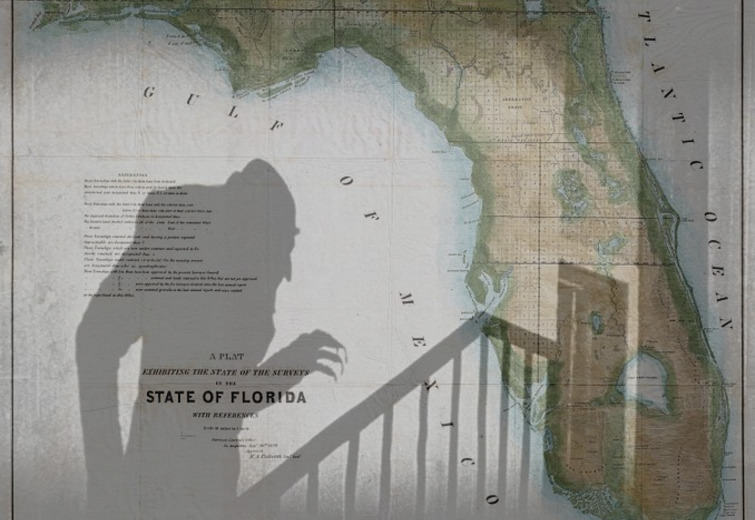
Nosferatu in Florida

Nosferatu in Florida

By Roy Bentley

.

Maybe vampires hear an annunciatory trumpet solo.
Maybe they gather at the customary tourist traps
like a blanket of pink flamingos plating a lake
and lake shore by the tens of thousands to drink.
The whole, tacky blood circus is theme-park stuff
and as Disneyesque as lifting the lid on a casket
to flit about sampling the inexhaustible offerings
of O Positive like the Sunday brunch at IHOP.
But if you had a booming, amphitheatrical voice
and had been recently rescued from the grave—
if you wore the republic of the dark like a cape
at Halloween, all bets would be off by the signage
for Paradise Tire & Service, a neon-green royal palm.
Bela Lugosi could materialize on a trailer-park lawn
and the locals would miss it, though lap dogs howled
as kingdoms rose and fell. You could say a kingdom
of fangs glows and drips red by the broken temples
and wide, well-lit aisles of Best Buy and Wal-Mart.
By the shadowed homeless holding up placards
hand-lettered in English, as if the kind-hearted
of the nations of the world spoke one language
and could be counted on to forgive misspellings,
bad syntax that announces one life is never enough.
The resurrection of the body is tough everywhere.
In the Sunshine State, despite eons to shake off loss,
a body carries the added burden of perpetual labor
and cyclical, inescapable debt. The dead know this.

(This poem first appeared in Shenandoah)

.

About the Author: Roy Bentley has published five books of poems, including Walking with Eve in the Loved City, which was selected as a finalist for the 2018 Miller Williams Poetry Prize and is available from the University of Arkansas Press or at Amazon. Bentley’s poems have appeared in Able Muse, Rattle, Blackbird, Shenandoah, Prairie Schooner, The Southern Review, and elsewhere. He is the recipient of a Creative Writing Fellowship in Poetry from the National Endowment for the Arts, as well as fellowships from the Florida Division of Cultural Affairs and the Ohio Arts Council.

Bunkong Tuon: “Our Neighborhood in Revere, MA”

Our Neighborhood in Revere, MA

By Bunkong Tuon

.


Editor’s Note: This is the first of a series of poems about the immigrant experience in America. Our late Managing Editor, Okla Elliott, featured Bunkong Tuon’s work on As It Ought To Be back in January of 2017. Okla was particularly concerned about the anti-immigration rhetoric heating up in America and he hoped to showcase the voices of immigrants on our site. In honor of Okla’s memory, Tuon has allowed us to feature more of his poetry about his experience as an immigrant from Cambodia to the United States. The full series can be found below.

.


Our Neighborhood in Revere, MA
(circa 1984 and 2008)

Listen, you have seen it before
in countless movies and TV shows.
No matter which city it is,
the markers are the same:

The sneakers on telephone wires,
the cracked sidewalks, the potholes
you try so hard to avoid
you almost hit the double-parked cars,
the graffiti on street signs and public buildings,
the apartment complex and family houses slumped
so close together that you can smell
your neighbor’s fried pork with rice,
where you can taste the lemongrass, fish sauce,
red chilies, and brown golden garlic,
as if your grandmother is cooking next door.
Houses where English is not spoken,
and the first image greeting you might not be Christ,
where you need to lift up the reservoir’s lid and pull
the string to flush the toilet,
where young men hang out on the front porch
with broken windows and no future.
An air conditioner sits on the brown grass.
A mother walks down the sidewalk,
with some of her children running ahead of her,
a baby in only a diaper, cradled to her chest.

You have seen it on the local news.
A young reporter staring wide-eyed
speaking with anxiety and concern
about a shooting that claimed the lives
of young bystanders, about a drug bust
where police found some untold
amount of coke, and you’re shaking
your head, wondering what the world
has come to, now that these foreigners
are ruining our America.

I was in the old neighborhood the other day
with my fiancée. Fresh from graduate school
studying postcolonial literature and theory
we went there to pick up some curry.
I scanned, trying to get a sense of the scene,
making sure the car doors are locked.
The streets, the smells, the sights reminded
me of the old days, the markers were all there,
but the people that I knew were gone.
Now there were Middle Easterners.
I guess the United States was no longer at war
with Southeast Asia.

.


About the Author: Bunkong Tuon is the author of Gruel (2015) and And So I Was Blessed (2017), both poetry collections published by NYQ Books, and a regular contributor to Cultural Weekly  He is also an associate professor of English and Asian Studies at Union College, in Schenectady, NY.


Previous poems from Bunkong Tuon’s series on the immigrant experience in America:

Our Neighborhood in Revere, MA

Snow Day

An Elegy for a Fellow Cambodian

Halloween, 1985

Dancing Fu Manchu Master

Fishing for Trey Platoo

Lies I Told About Father