I meet a man I've always known who is taller than his voice We walk among a silent crowd and talk of ancient poetry.
A long lost love dwells in the attic of his heart an Italian sports car that never leaves his garage.
In an orchard we toast with glasses of pink champagne The wine begins to tremble tangerines dance in the trees.
A car alarm cries in the parking lot complains over and over to no one but the birds shaken from frightened limbs of crape myrtles and sycamores
mountains crumble before our eyes but we care most about the wine running between our fingers like time we smile and embrace in fond goodbye.
About the Author: Sam Culotta is retired and lives in Southern California. He is the author of two books of personal essays and a book of poetry. His prose and poems have appeared in The Write Place At The Write Time. Buffalo Spree Magazine, Avalon Literary Review and Rockvale Review, as well as an anthology of works with Joe Green and Timothy Smith.
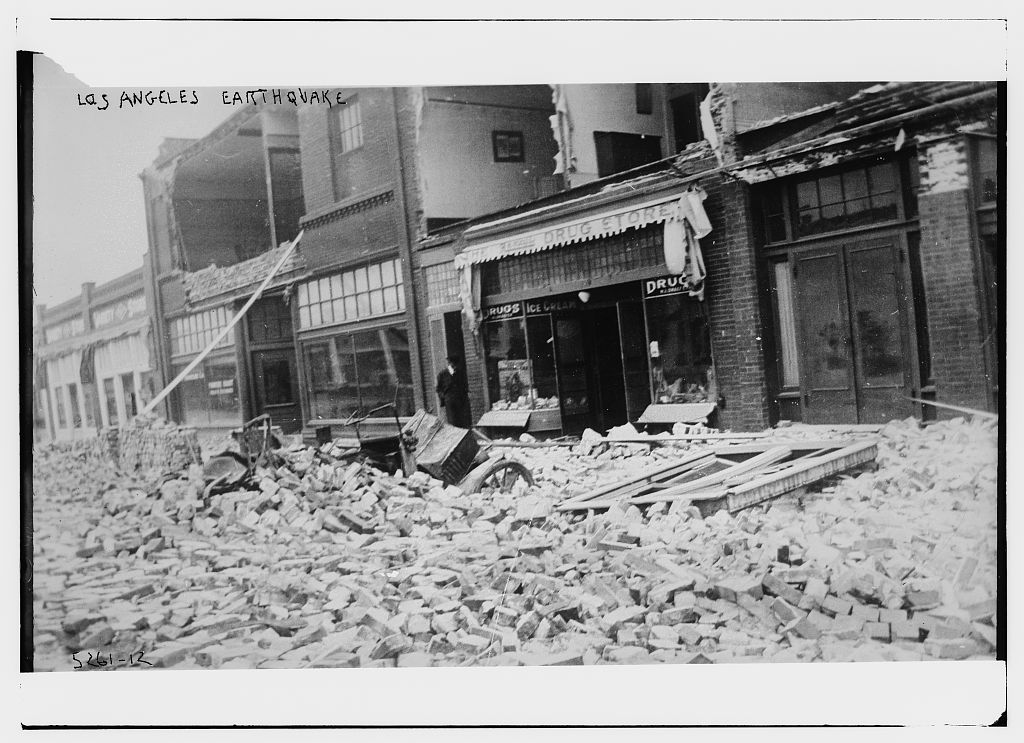
Image Credit: Bain News Service “Los Angeles Earthquake” (1920) Public domain photograph courtesy of the Library of Congress
The Way We Know Before We Know
             for Mike James, poet (d. 12/17/23)

You were dying and I was dreaming
of you, something nice. I wish I could
be there again, a last time with you.
You were thinner, shirt weighing you down
like in recent photos I’d seen,
and dying in the dream, but still lively,
saying something Mike-like to me.

Mid-December chill, covered in layers,
I lay awake, my husband (whom you
highly approved of) deep into
his pain-pill sleep. His stillness
worried my fretful night. And finally,
the dream, then waking from it
only to get the news an hour later.

In the blackness of subconscious,
I now know: a questioning.
Were you still in the blur of hospice?
Your eyes awake, wife touching
your hand, five kids all around.
Like the five of us ringed Mother’s bed,
singing a Slavonic prayer, the priest
anointing her with attar of rose.
Was it serene that way for you, for them?

Your wife, those children, now dazed
with the dizzying grief I’ve known,
no easier even with death expected.
You’d told me it wouldn’t be long,
after all those doctors, knives, cocktails
of cruel chemicals.

You had hoped to see Christmas,
but felt thankful for so much—
soulmate, children, job, poems
you were supposed to write and did.
And I know you weren’t just saying it
(you never said anything just to please).

My last text to you was I love you.
You’ll always be my poetry buddy.
Your response: a heart icon, red and beating.
About the Author: Karen Paul Holmes won the 2023 Lascaux Poetry Prize and received a Special Mention in The Pushcart Prize Anthology. She has two books: No Such Thing as Distance (Terrapin)and Untying the Knot (Aldrich). Poetry credits include The Writer’s Almanac, The Slowdown, Verse Daily, Diode, and Plume. She hosts the Side Door Poets in Atlanta and is grateful to Mike James who was the second member way back when it started.
Dr. Buñuel clamps open my eyes. I am an Andalusian dog, I am Clockwork’s Alex. If macular disease is a crime, I am chastised with needles from which I cannot avert my gaze. If diabetic retinopathy is a sin, my penance is lying still before lasers and being made to stare repeatedly into the sun.
On weekends, Dr. B. is a pretend cop for fun: “Did you know they call drowned men floaters?” — like the dark flurries swirling through my own flawed Christmas globes. I won’t go blind tonight, a gift if not a cure, but I know there’s no escape (except this poem) from another snowstorm of whirling angels.
About the Author: Dudley Stone’s poetry has recently appeared online in NiftyLit, Spare Parts, and Wilderness House Poetry Review. His writing for the theatre has been seen on stages from California to Connecticut. He has a B.A. in Theatre from the University of Kentucky and studied playwriting at the University of Massachusetts in Amherst. Mr. Stone lives in Lexington, KY.
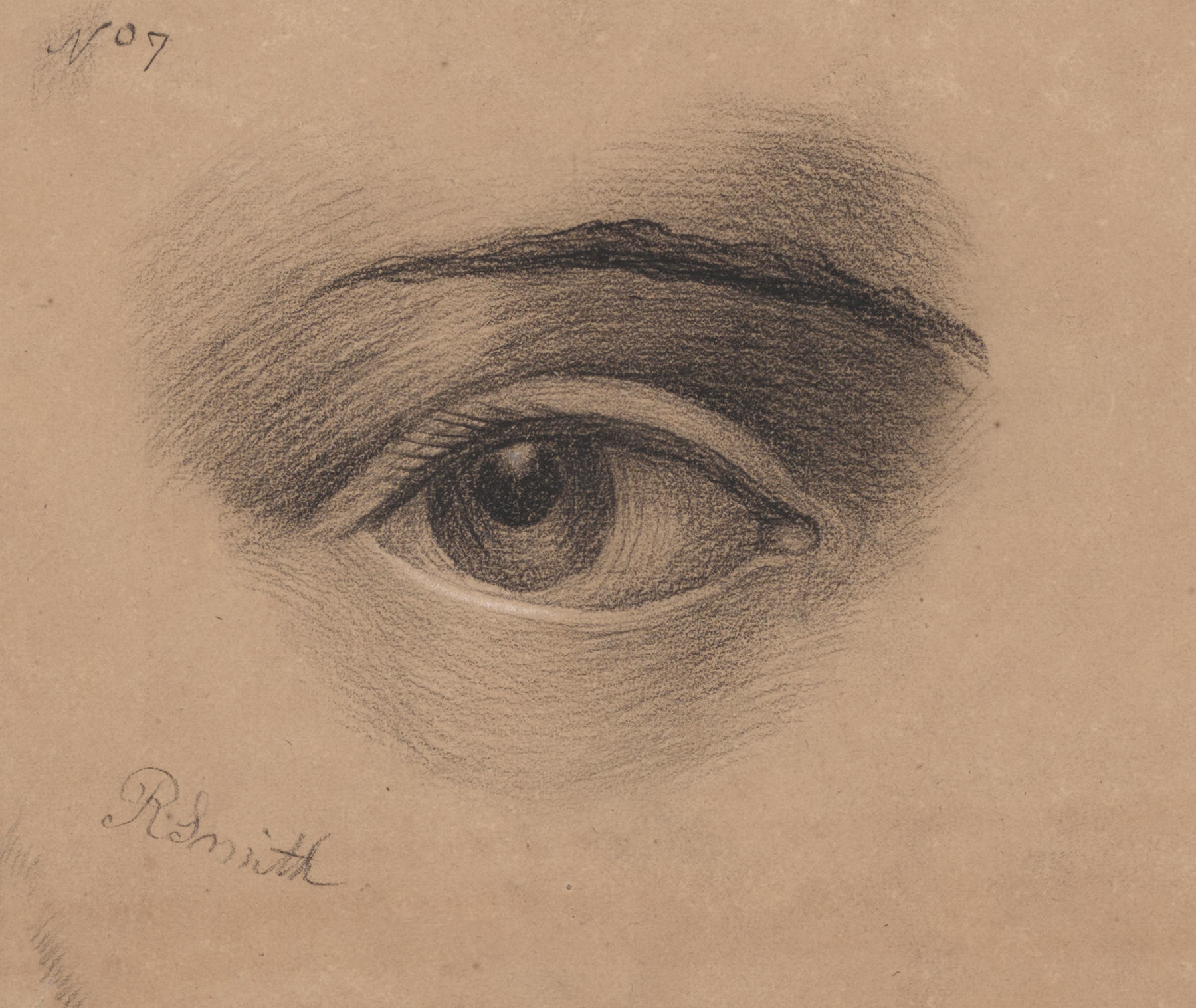
Image Credit: Richard Sanger Smith “Eye Study No 7” (1840) Public domain image courtesy of Artvee
He was seriously committed to his sexual life, like a deep-sea diver married to the hose, until lungs became luggage a lover unpacked, after round number one of the flogger’s straps.
What some call the body politic, that faint ideology of bashful & blush, he had no tolerance for, no pleasure in teasing the Velcro restraint with the artificial sweetener of rescue.
Fifty shades of vanilla, he said, curls the tongue like a witch’s feet beneath a house from Kansas. His ice cream had to be burnt and blue, the way church on Sunday smells like skin with a wall
of candles fornicating flames scorching the eyes with desire. If no one has anything more to share, feel free to come forward and touch his hand. For some it may be the very first time the
bones in your hand will sing. For others the scars from the night you met will remind you how to get home. Lost in the Wilderness was his favorite game. Being chased by a bear, pure joy.
About the Author: Daniel Edward Moore lives in Washington on Whidbey Island. His work is forthcoming in The Meadow, The Chiron Review, Drunk Monkeys, Sandy River Review, Xavier Review, Delta Poetry Review, Third Street Review and North American Review. His book, “Waxing the Dents, “is from Brick Road Poetry Press.
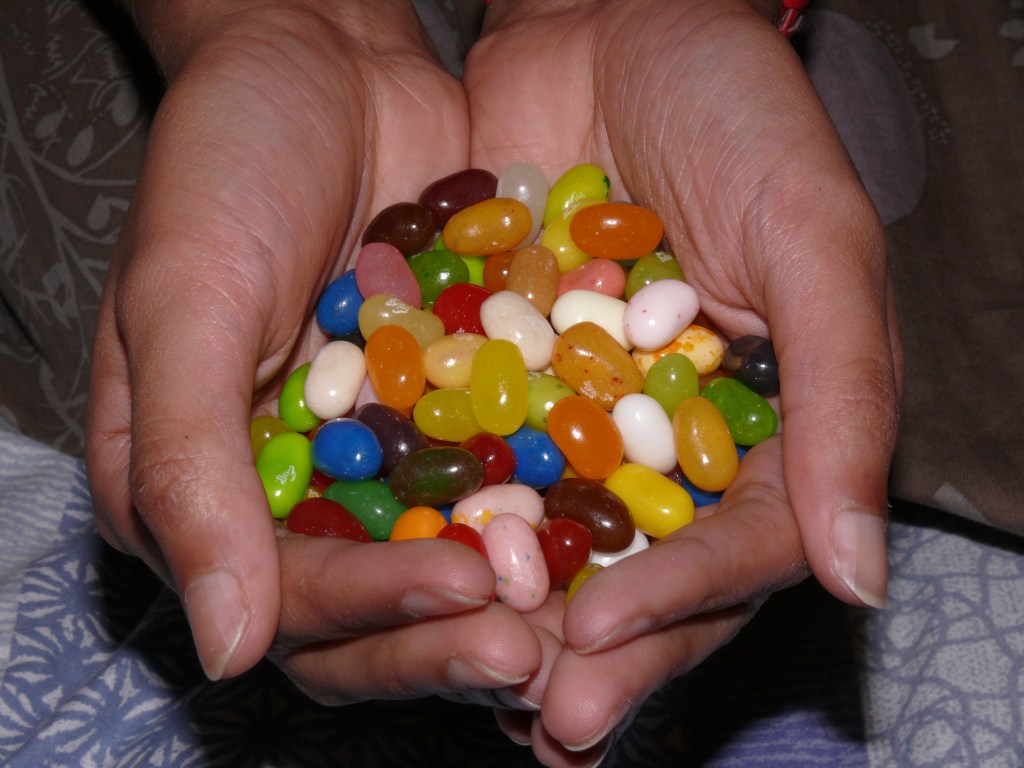
Some penguins build their nests on piles of rocks and partners exchange gifts of stones. You ask for jelly beans every time I visit, cookies, as if life has lost its sweetness. Like a bewitched pregnant woman, so strange are you, with your cravings, the wrong sex, and way too old. You used to call me “Sweets.” I deny you
nothing. My father always told me, “It’s no good to be alone.” While mother kept repeating, “Learn to type, so you’ll have something to fall back on.” If she didn’t like my boyfriend it was simply, “Play the field,” or when I went out a whispered, “Have you got your Mad Money?” Had she told me things she never did, things she wished she’d done to lay the breadcrumbs? Stones in moonlight? Meanwhile, in a case of utter irony, Dad was an insurance
salesman. I had a friend who volunteered to help install exhibits in a gallery where we worked side by side, talking, laughing. She told me that she thought a white panel van with veggies pictured on the side was some covert operation, it passed by so many times each day. We called nothing something. Imbued it with menace, omen. It was all fun and games. Until it wasn’t,
really. Years later I’d still find myself shaking my head remembering this, long after she moved away. But then I started seeing a different white van, over and over and everywhere, painted: “Loss Prevention Specialists.” I told myself that surely they installed alarms, but every time I saw the truck, I thought: Well wouldn’t it be great? Put them on speed-dial for your loved one’s cancer diagnosis, a break-up,
a death. The last time I left you I thought, next time I’ll ask you about the difference between jackdaw and crow. Wondering if I should tell you, in your fragile state, that the Montana brookies and rainbows are in steep decline. Knowing no poultice, no tincture, no prayer could save you. No
garlic necklace. But I ask myself now, what cause for alarm? So useless are we all against the leaving. The hummingbird’s heart races 20 beats per second, wings fly in the symbol of infinity, and just so, I raced to you that Tuesday, too late. I pass the black cows, all lying down, on the long drive home alone.
About the Author: Artist/poet Mary Kathryn Jablonski is most recently author of “Sugar Maker Moon,” from Dos Madres Press. Her poems and collaborative video/poems have appeared in numerous literary journals, exhibitions, screenings and film festivals, including Atticus Review, Beloit Poetry Journal, Poetry Film Live (UK), Poetry Ireland Review (IRE), Quarterly West, and Salmagundi, among others. She was recently awarded a NYSCA Individual Artist’s Grant in Poetry to complete a video/poem “chapbook” and is Senior Editor in Visual Art at Tupelo Quarterly.
I claimed the kitchen table that was a gift from my aunt six months before her death.
You claimed the loveseat and couch, the only possessions you owned that had belonged to your deceased father.
The entertainment center was a joint purchase. We flipped a coin. You won.
The TV a gift from your mother. The DVD player a gift from mine.
We each purchased a bookshelf, placed them side by side in the sunroom. We thought, cute—a metaphor.
While you watched, I trashed the journal you gifted me on our first Christmas. The inscription became a joke: Looking forward to memories together, future husband.
I retrieved the journal when you were out of sight. I never saw it again. I refused to look in the fireplace.
I slipped your copy of Plato: Complete Works into one of my boxes. You marked so many passages over the years— some to share with students and friends, some to serve as your own inspiration.
You asked for months that I return the book. I lied for months until you stopped asking.
Here’s the truth— I’ll never regret stealing your book.
About the Author: Dustin Brookshire is the 2024 recipient of the Jon Tribble Editors Fellowship awarded by Poetry by the Sea. His chapbooks include Never Picked First For Playtime (Harbor Editions, 2023), Love Most Of You Too (Harbor Editions, 2021), and To The One Who Raped Me (Sibling Rivalry Press, 2012). Dustin is the co-editor of Let Me Say This: A Dolly Parton Poetry Anthology (Madville Publishing, 2023). Find him online at dustinbrookshire.com.
I think of Lynyrd Skynyrd With all their little boy names. Ronnie, Billy, Artie, what Hardscrabble hit licks like ax In oak, famous for Discourteous whickering, For stomping on Jagger’s tongue, For unbecoming without Their boss man’s whipping voice, No one to hold the kite string In the storm sky when they die.
About the Author: A past winner of the Jim Harrison Award for contributions to baseball literature, Tim Peeler has also twice been a Casey Award Finalist (baseball book of the year) and a finalist for the SIBA Award. He lives with his wife, Penny in Hickory, North Carolina, where he directs the academic assistance programs at Catawba Valley Community College. He has published close to a thousand poems, stories, essays, and reviews in magazines, journals, and anthologies and has written sixteen books and three chapbooks. He has five books in the permanent collection at the Baseball Hall of Fame Library in Cooperstown, NY. His recent books include Rough Beast, an Appalachian verse novel about a southern gangster named Larry Ledbetter, Henry River: An American Ruin, poems about an abandoned mill town and film site for The Hunger Games, and Wild in the Strike Zone: Baseball Poems, his third volume of baseball-related poems.
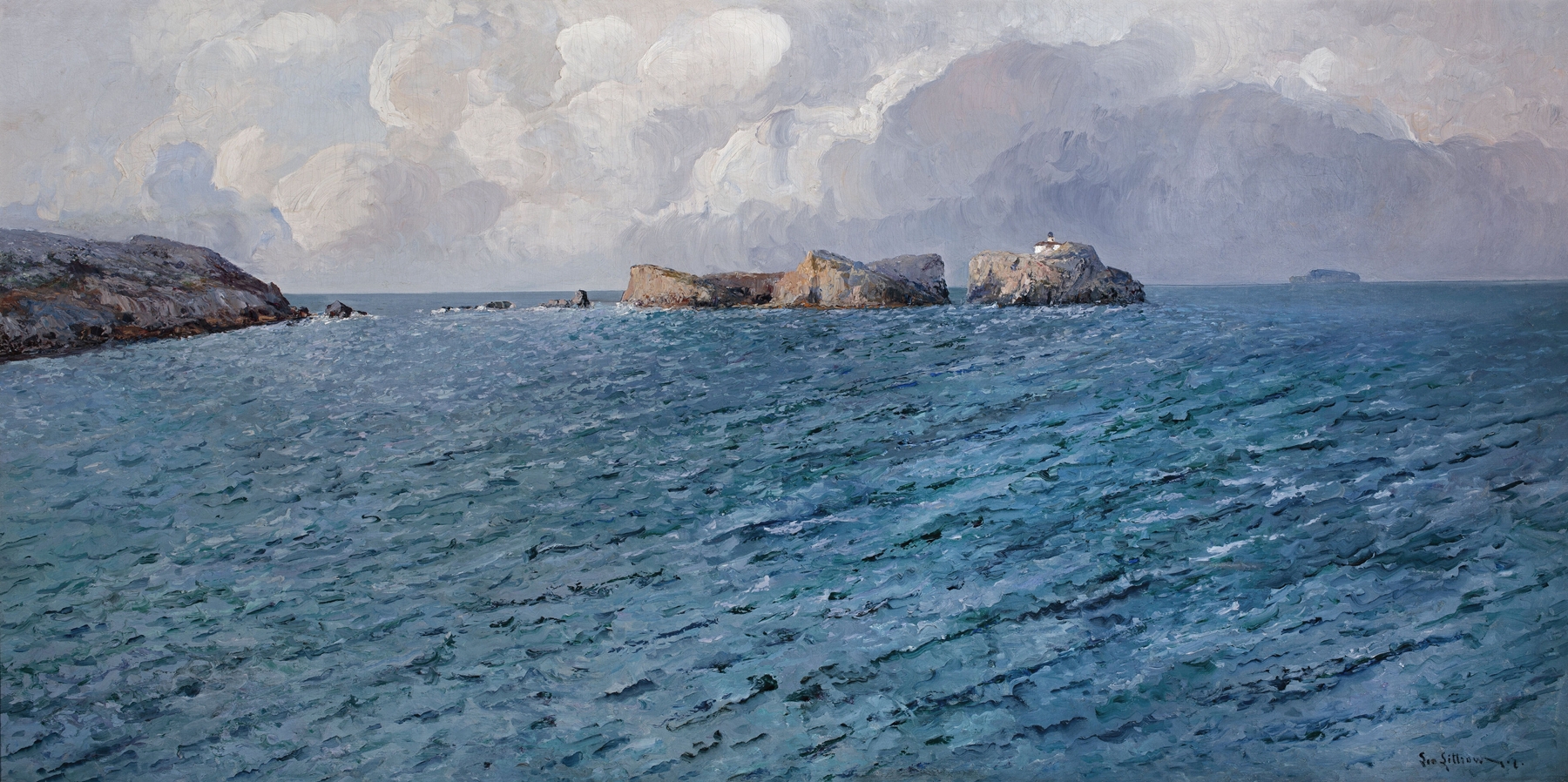
I sample the sea for her. I swirl it around in the glass, curl it around my mouth, smack it on my tongue. The bouquet is briny; high notes are fish and sand; aftertaste is cold depths.
I drink the sea for her, so she won’t have to drink and she can stay safe as she looks down from the picture window of her house lifted high off the ground. She peers at my small shape by the water’s edge – sees my feet are wet.
I toast her with the ocean, lift high the foamy glass, drain it dry and toss it into the surf behind me. She has a glass of golden wine she raises to her lips, peers over the rim, but does not drink.
I dive into the ocean for her. I brave the rip tide, the undertow, all for her, my clothes drag at me like mermaids’ hands and slither off. All she can see now is my naked body surfacing through the waves heading away and out to sea.
About the Author: Alice Teeter studied poetry at Eckerd College with Peter Meinke. She graduated with a degree in creative writing/literature. She is a member of Alternate ROOTS, a service organization for artists doing community-based work in the Southeast; a member of the Artist Conference Network, a national coaching community for people doing creative work; and a member of the Atlanta Women’s Poetry Collective. She taught poetry writing at Emory University in Atlanta, Georgia, from 2011 to 2016. With Lesly Fredman, she leads Improvoetry workshops combining theatrical improvisation with poetry writing.
Image Credit:Leontine von Littrow “Rocky Seaside” Public domain image courtesy of Artvee
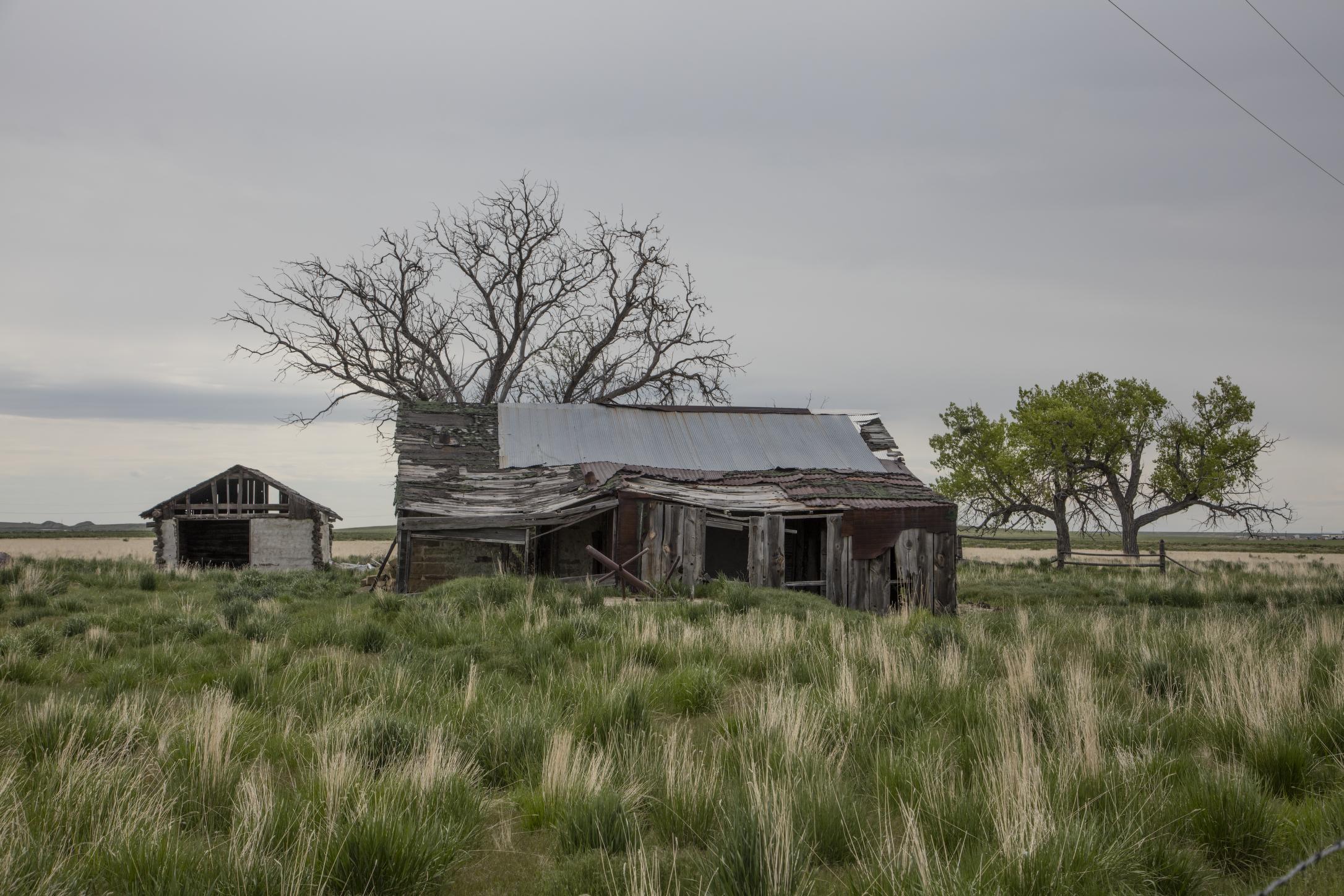
horses watch from roadside fences riders pass by wheels turning
inside, outside pronghorn pay no mind to fences, a leap of faith takes them where they will
washboard road holds no one to their promises one slip, and the shoulder is gone
down the road and up the drive a house nearly empty waits for change
mule deer watch through glass doors as we empty it before taking one last ride
About the Author: Ken Gierke is a retired truck driver, transplanted to mid-Missouri from Western New York. His poetry has been published or is forthcoming both in print and online in such places as The Rye Whiskey Review, Amethyst Review, Rusty Truck, Trailer Park Quarterly, The Gasconade Review, and River Dog Zine. His first collection of poetry, Glass Awash, was published by Spartan Press. His second collection, Heron Spirit, is forthcoming. His website: https://rivrvlogr.com/
Image Credit: Carol M. Highsmith “Abandoned ranch or farmstead west of Casper in Natrona County, Wyoming” (2015) Public domain image courtesy of the Library of Congress
Within a week of burying my husband, I took all his clothes, minus three shirts, from hangers and drawers, stuffed them into garbage bags and hauled them off to a church donation bin. I took down pictures of him, of us. I slipped into my extra-large meatsuit each morning and went to work, took care of my sick mother and my daughters. I believed that getting through the day was enough, then it wasn’t and there he was. To find that kind of love again, to cradle that love in my bones, a baby in a carriage, a love I’ll raise knowing everything here is ephemeral. Babe, these are just meatsuits, this new love promises, love never dies. I want to believe that we can raise love high above the bulky restrictions we inhabit, a dozen balloons floating above us like angels instead of a tumor resting at the base of a skull, a tombstone, a marker, these meatsuits.
About the Author: Rebecca Schumejda is the author of several full-length collections including Falling Forward (sunnyoutside press), Cadillac Men (NYQ Books), Waiting at the Dead End Diner (Bottom Dog Press), Our One-Way Street (NYQ Books) Something Like Forgiveness, a single epic poem accompanied by collage art by Hosho McCreesh (Stubborn Mule Press) and her new collection Sentenced (NYQ Books). She is the co-editor at Trailer Park Quarterly. She received her MA in Poetics from San Francisco State University and her BA from SUNY New Paltz. She lives in New York’s Hudson Valley with her family. You can find her online at: rebecca-schumejda.com
Image Credit: Ben Shahn “Clothes hanging in house at farmland auction, New Carlisle [i.e. Marysville], Ohio” (1938) Public domain image courtesy of the Library of Congress

 As It Ought To Be

