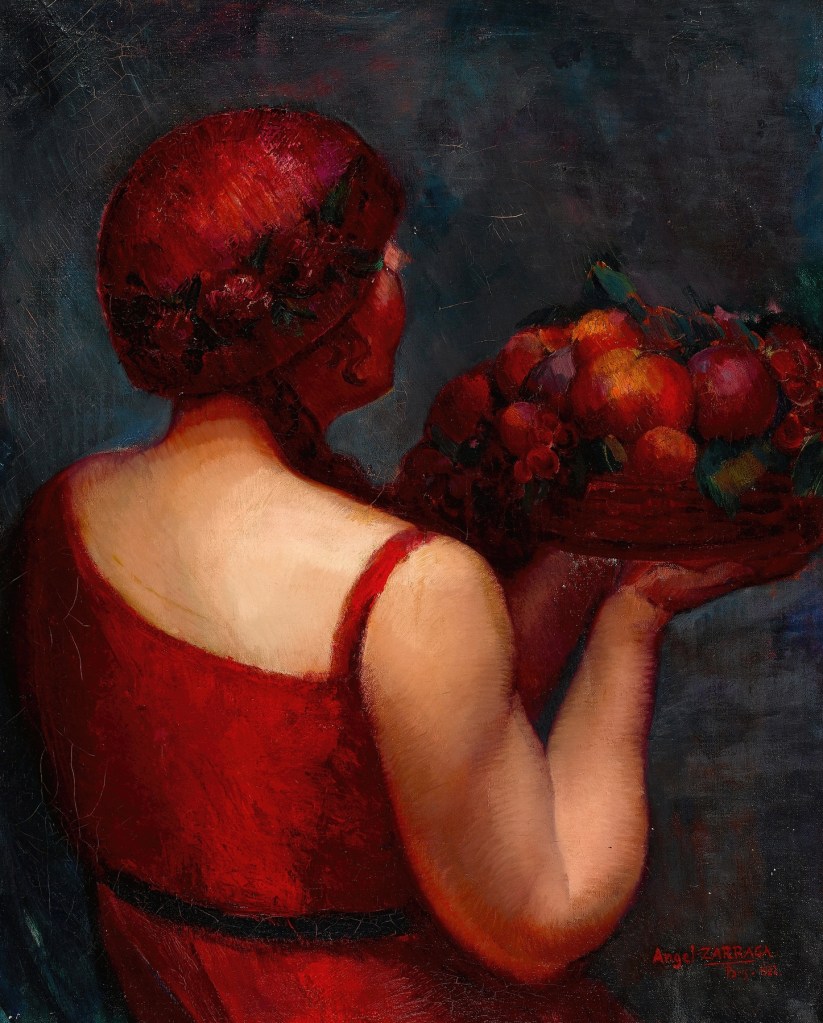
Marlena Maduro Baraf: “memoir”

memoir

she was a piece of us like a nose
feeling with her tongue for little bones,
if it was fish
mami's skin mingles with the drooping gown
a teta is not a breast
not even a teat
there’s a white gazebo
and the seesaw,
but we’ve come to fish,
papi said

               we passed his books
               brooding in the dark
               the bed was empty
               if I had touched him or
               called to him,
               he would have listened to me
               and not be dead
               like the moon except that
               it is almost square

About the Author: Marlena Maduro Baraf’s stories and poems have been published in Sweet Lit, the Ekphrastic Review, On the Seawall, Night Heron Barks, Poets Reading the News, and elsewhere. She immigrated to the United States from her native Panama and is author of the memoir At the Narrow Waist of the World and co-author of Three Poets/Tres Poetas. She writes the blog, Breathing in Spanish, that features conversations with Latinos from all walks of life.   

Image Credit: Ángel Zárraga “Basket of Plenty” (1922) Public Domain image courtesy of Artvee.
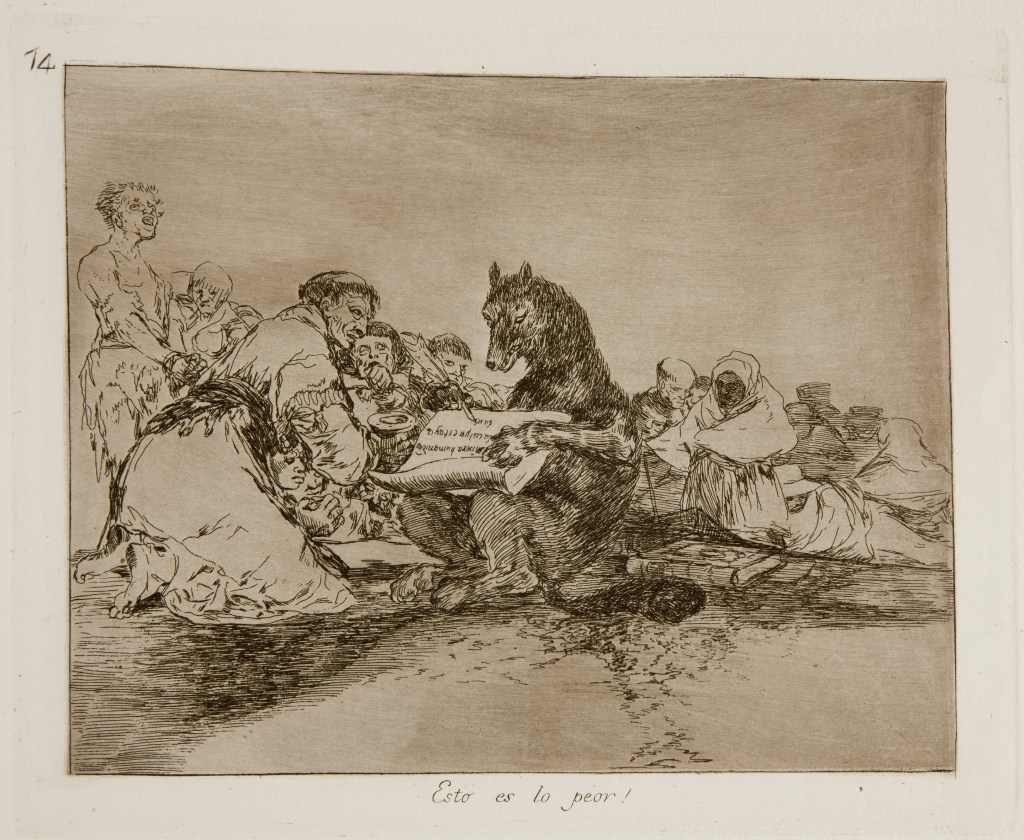
John Brantingham: “Francisco Goya’s The Disasters of War: This Is the Worst”

Francisco Goya's The Disasters of War: This Is the Worst

My dead stand with me before Goya’s piece,
where a wolf conspires with priests to write down
orders for the poor, suffering behind
them. The poor here starve. They beg. They freeze.
The poor are not forgotten, and that’s the trouble
with people who put on frocks and play
at sanctity. It’s the trouble with the way
wolves wait and watch their desperate struggle.
But my dead whisper to me that he’s wrong.
The trouble is also that we think beasts
walk among us, but they’re ordinary
men who have discovered that if you’re strong,
you can have your way with the weak.
We have to tamp down our own cruelty.

About the Author: John Brantingham was Sequoia and Kings Canyon National Parks’ first poet laureate. His work has been featured in hundreds of magazines. He has nineteen books of poetry and fiction including his latest, Life: Orange to Pear (Bamboo Dart Press) and Kitkitdizzi (Bamboo Dart Press). He lives in Jamestown, New York.

Image Credit: Francisco Goya, “Esto es lo peor! (This is the worst!)” Public Domain

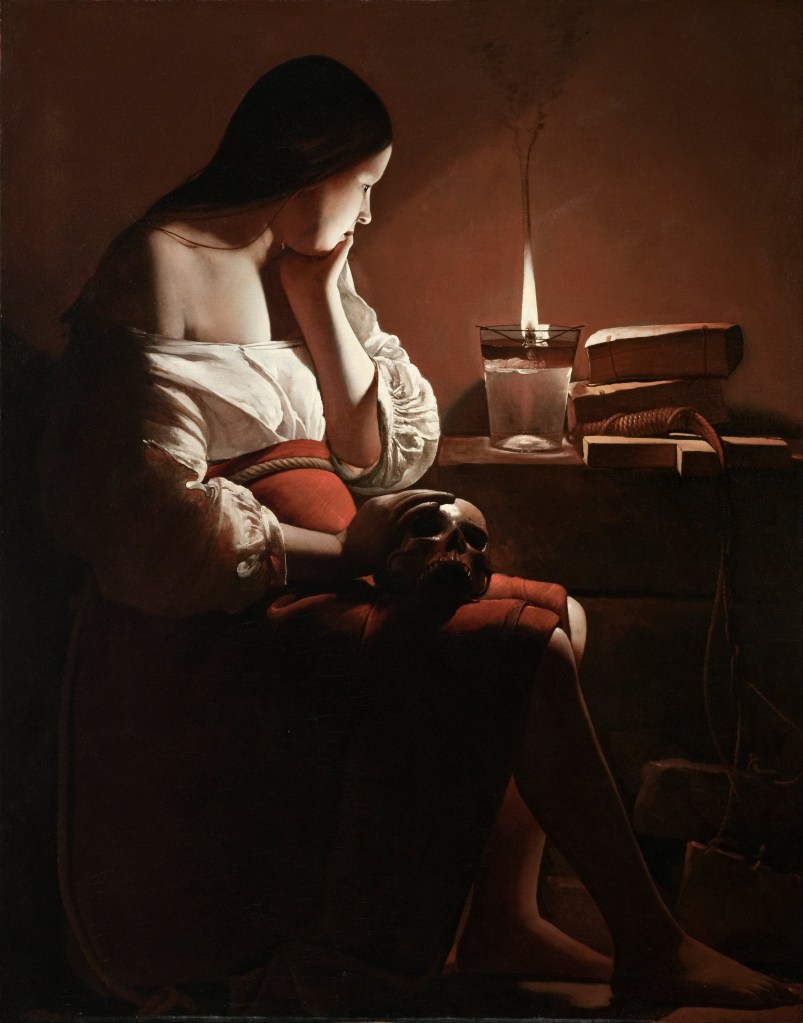
Susan Cossette: “Magdalen with the Smoking Flame”

Magdalen with the Smoking Flame
-after Georges de la Tour


You see the polished skull
settled under my now-empty womb,
the books of scripture on the desk,
the unadorned wooden cross.

You see the leather scourge.
I am the perfect lover of Christ,
correcting myself daily,
now perfect penitent.

You will not see the red welts
on my back or upper thighs,
only remorse in lowered eyes.
Sweet burn, delectable wound.

The oily candle plays its tricks,
slim shafts of light on cave walls.
Peering into shadows,
I pay respect to the power of the dark.

My mind plays tricks on me.
Is it mother, laid out at solstice,
her face plump and purple,
the monsignor saying rosary?

Or something else drawn
out of the dark night of the soul,
longing for light.

About the Author: Susan Cossette lives and writes in Minneapolis, Minnesota. The Author of Peggy Sue Messed Up, she is a recipient of the University of Connecticut’s Wallace Stevens Poetry Prize. A two-time Pushcart Prize nominee, her work has appeared or is forthcoming in Rust and Moth, The New York Quarterly, ONE ART, As it Ought to Be, Anti-Heroin Chic, The Amethyst Review, Crow & Cross Keys, Loch Raven Review, and in the anthologies Fast Fallen Women (Woodhall Press) and Tuesdays at Curley’s (Yuganta Press).

Image Credit: Georges de La Tour “Magdalene with the Smoking Flame” (1640) Image courtesy of Wikimedia

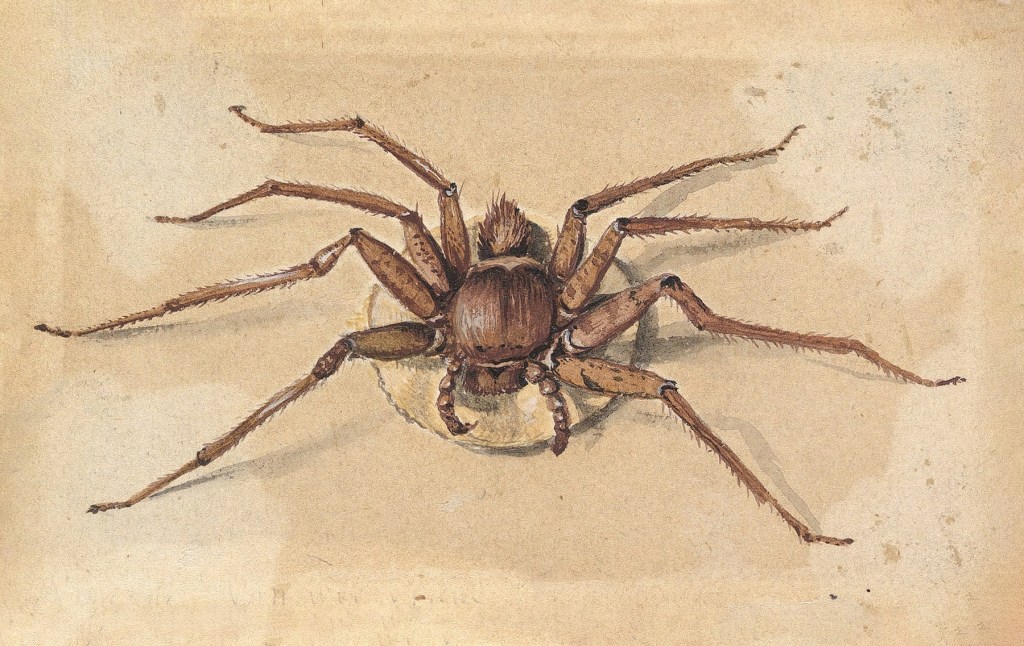
Dan MacIsaac: “Garden Spider”

Garden Spider

She spins her
own soft maze,

snare haloed
like an old radio

microphone
ON THE AIR,

rippling thin
aural rings,

oval waves
of sonic silk.

At the transit heart,
catching fine

veins of light,
she waits

for the pluck
of a male,

tiny harpist,
blindly orphic,

so tender
on a woven

strand of her
high-strung web

that will pulse
under his touch

like a radiant
and terrible lyre.

Note: The diminutive suitor, even if successful in courtship, often becomes dinner
to his cannibalistic mate.

About the Author: Dan MacIsaac writes from Vancouver Island. Brick Books published his collection, Cries from the Ark. His poetry has appeared in many journals and anthologies, including, most recently, in AmericaValley VoicesManzano Mountain Review and Poetica’s Rosenberg Award Collection.

Image Credit: Jan Vincentsz van der Vinne “A Spider” (late 17th–early 18th century) Public domain image courtesy of Artvee

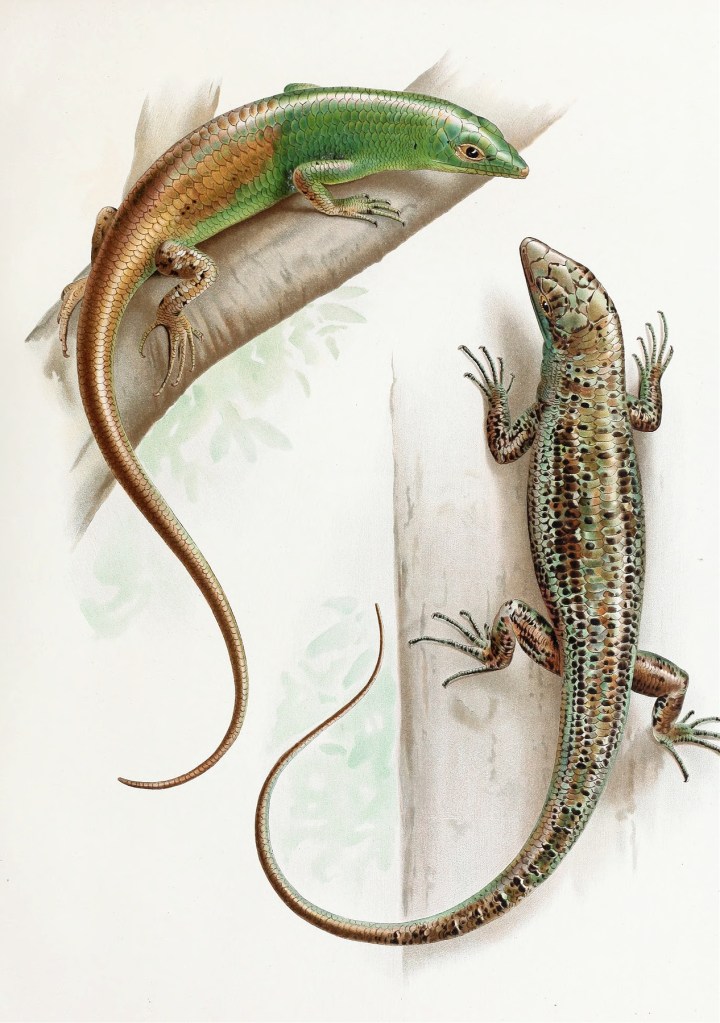
Luis Cuauhtemoc Berriozabal: “The Green Lizard”

The Green Lizard

I felt like a prisoner
in my dreams. I was
under lock and key
at a prison in Paris
like Verlaine, Villon,
and Voltaire. In a dark
cell drawing sketches
was a green lizard.
It spoke French and a
little Spanish. The
sketches were painted
on the walls. The green
lizard was my cell mate.
Its bleeding tongue was
its brush and the walls
were graffitied with red
moons, red stars, and
red mountains. Through
a window in the prison,
the green lizard would
come in and leave through
the bars in the window.
The prison guards would
beat me mercilessly
every morning, never
believing that it was
the green lizard that
bloodied the walls with art.
They asked me where
I hid the paint and why
the sketches were red.

About the Author: Born in Mexico, Luis lives in California and works in the mental health field. His poems have appeared in Blue Collar Review, Escape Into Life, Kendra Steiner Editions, Mad Swirl, and Unlikely Stories. His latest poetry book, Make the Water Laugh, was published by Rogue Wolf Press in 2021.

Image Credit: Thomas Barbour “Dasia Smaragdinum” (1912) Public domain image courtesy of Artvee

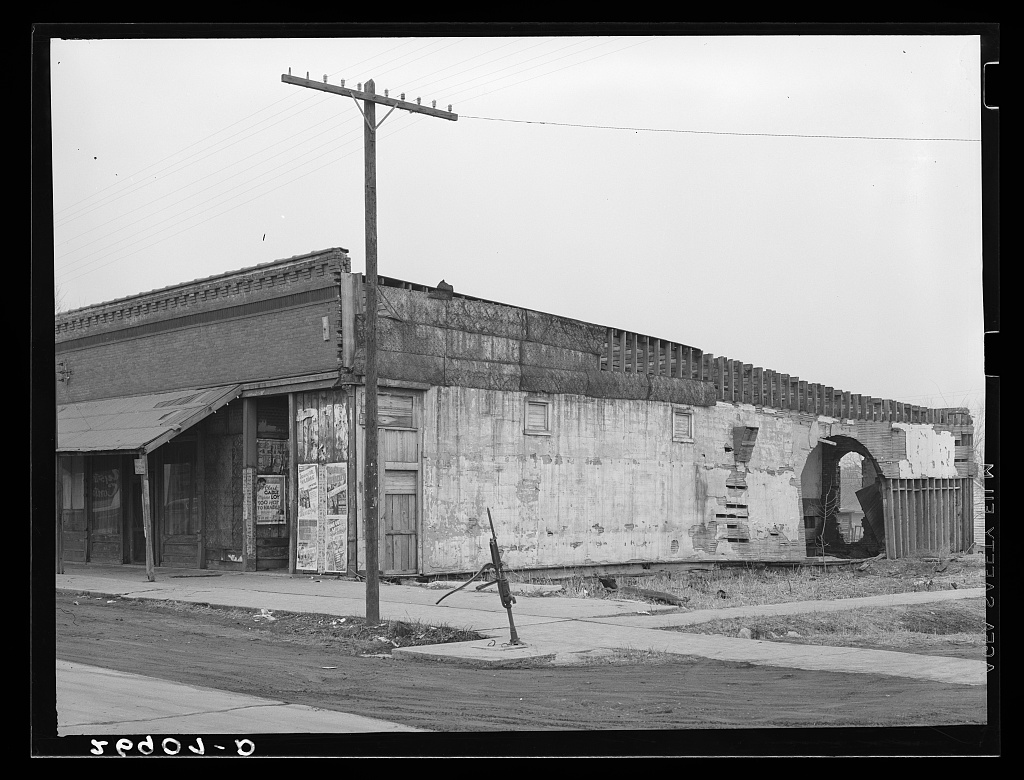
Jeanette Hutzell: “Wasting Disease”

Wasting Disease

The CDC states that the symptoms of Wasting Disease are
drastic weight loss, stumbling, and listlessness.

I saw a dead deer in the middle of Route 31 driving home,
and his insides were sucked in till his bones stuck out.

My dad tells me in a curious tone during our weekly calls
that the wasting comes in and eats them from the inside out.

He then informs me, in an even more drastic way,
that it can definitely spread to humans from the meat,

but I think, driving back to small town United States,
it’s already here.

I passed by my favorite restaurant during deep dusk,
and the windows were boarded up and already vandalized.

The main road into town is starting to wash away,
and flood control can’t hold anymore of its rubble.

That bridge they claimed they would fix became a crater,
and the orange work sign has become a vague, plastic white.

I turn on my high beams and catch the eyes of a young buck,
breaking quickly so I don’t catch him on my car.

He blinks at me and his fog breath hitches out in the fall air,
and I see his sides sucked in like an empty duffle bag.

I watch him leave and then sit for awhile longer realizing
the sign for the street I live on has been stolen.

I’m driving through a hot carcass that isn’t even dead yet.

About the Author: Jeanette Hutzell works part time as a server while studying English Literature and English Writing at the University of Pittsburgh-Greensburg. She grew up on her family farm in Meyersdale, Pennsylvania.

Image Credit: Arthur Rothstein “Abandoned store. Cambria, Illinois” (1939) Public domain image courtesy of the Library of Congress

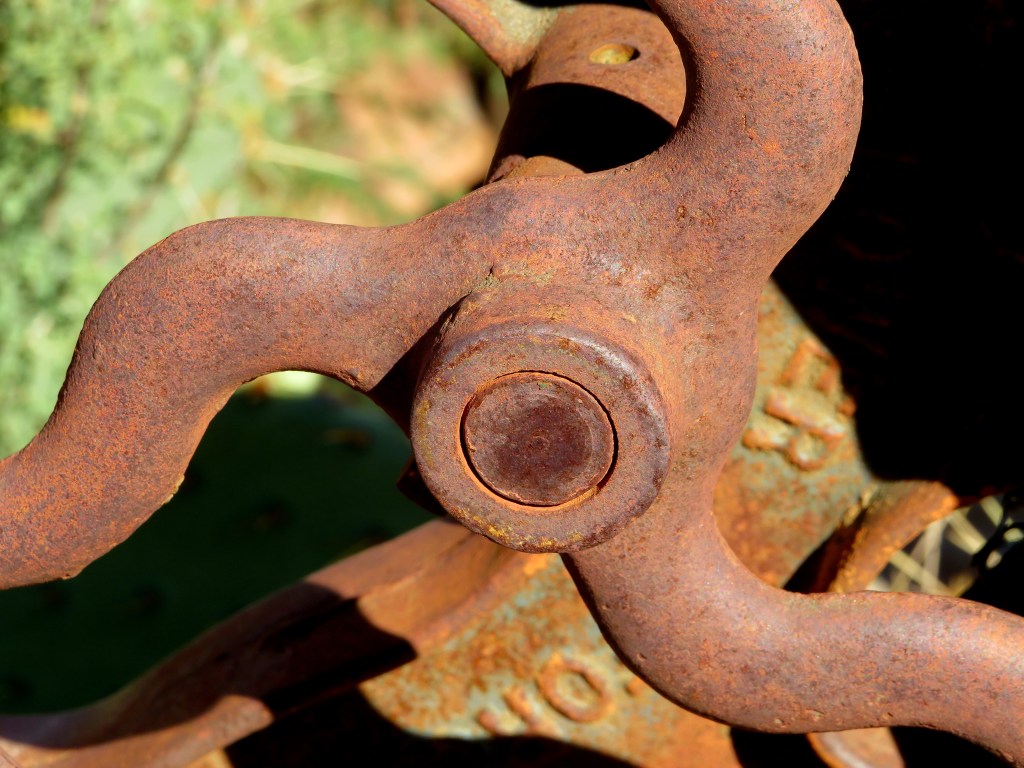
R.T. Castleberry: “Items from the Wreckage”

ITEMS FROM THE WRECKAGE

The chant sounded overhead 
is a rosary of wails 
pitched upon the sea.
Feasting days are over.
As bodies, like incantations,
return as denial, as disbelief,
there is a need between us
to act the abandoned child.
We must appear as 
orphans of mothers, of fathers
who could not see us
except at drink or night brutality.

I have spoken to your fears
as best I could;
taken and turned what I know
to some attempt at service.
It is never enough. 
I must seem a fool
to attempt a patch upon a 
part that slips daily, grinding 
ever finer, ever closer.

Feasting days are finished.
And we are left consoling
our fathers, our mothers weeping 
in raging lines along the shore.
We must take the unkind step to
leave them to their grieving.
You and I must learn a new answer,
another offering to the tides.
In movement, past regret,
past unspent days and seasons,
we will lay claim to our own lives.

About the Author: R.T. Castleberry, a Pushcart Prize nominee, has work in Steam TicketVita BrevisAs It Ought To BeTrajectorySilk RoadStepAway, and The River.  Internationally, he’s had poetry published in Canada, Wales, Ireland, Scotland, France, New Zealand, Portugal, India, the Philippines and Antarctica. His poetry has appeared in the anthologies: Travois-An Anthology of Texas PoetryTimeSliceAnthem: A Tribute to Leonard Cohen, and Level Land: Poetry For and About the I35 Corridor. He lives and writes in Houston, Texas.

Image Credit: Chase Dimock “Flywheel, Oatman” (2023)

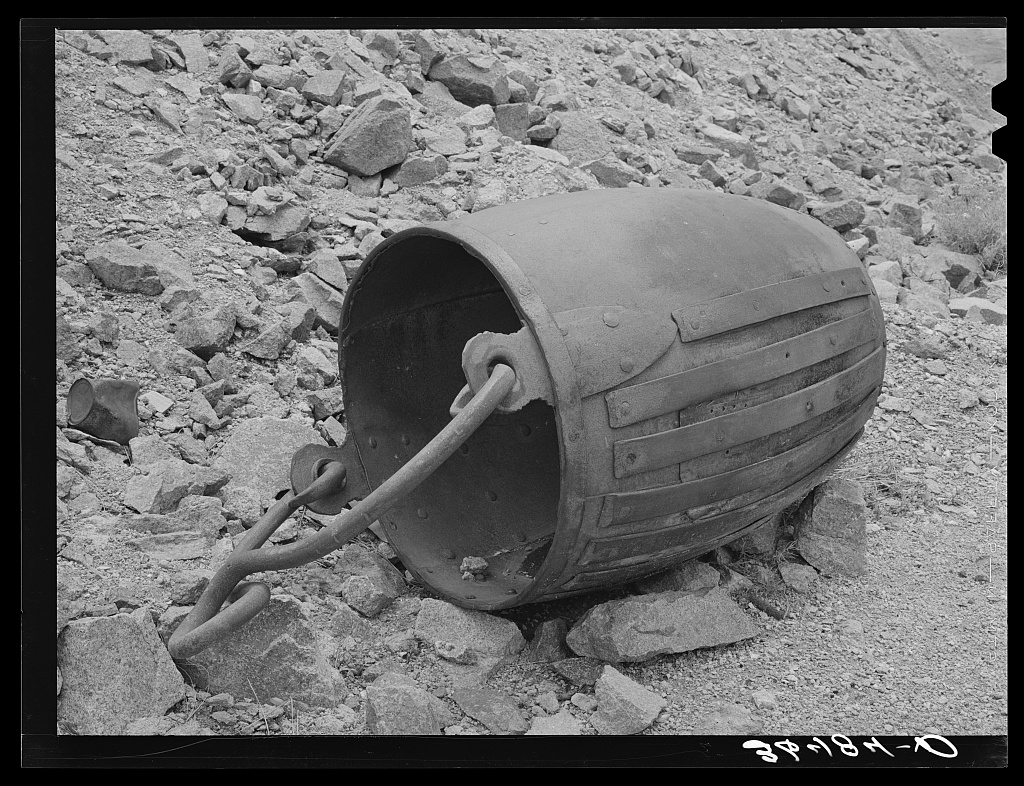
Sterling Warner: “Kick the Bucket”

Kick the Bucket

Like a hollowed-out pumpkin
an empty orange bucket
sat on my back-porch stoop,
job completed, five-gallon
contents exhausted, container
just a lonely remnant inviting
children to flick it over, palm
the pleated bottom like a tabla
or pound corners with garden stakes
as if playing a floor tom-tom;
the pail’s white plastic handle
arced like an anemic tambourine
erect, bending indifferently
once flipped horizonal.

Oh, days came & went, tasks evolved,
trash stuffed space where machines
filled paint cans, shook pigment,
stamped a slogan that pealed
off the vessel’s exterior; creative
uses expanded, cobwebs cluttered
the uncovered lid before kicked
sideways so Scott could practice
golf putts till winter snowdrifts 
buried its Halloween semblance
welcomed springtime renewal
as rodents huddled, built nests
& guarded offspring oblivious
of their Home Depot connection.

About the Author: A Washington-based author, educator, and Pushcart nominee for poetry, Sterling Warner’s works have appeared in many international literary magazines, journals, and anthologies such as Street Lit., The Ekphrastic ReviewAnti-Heroin Chic, The Fib Review, and Sparks of Calliope. Warner also has written seven volumes of poetry, including Without Wheels, ShadowCat, Memento Mori: A Chapbook Redux, Edges, Rags & Feathers, Serpent’s Tooth, Flytraps,  and  Cracks of Light: Pandemic Poetry & Fiction (2022)—as well as. Masques:Flash Fiction & Short StoriesCurrently, he writes, turns wood, and hosts virtual poetry readings. 

Image Credit: Russell Lee “Old gold ore bucket at abandoned mine. Pinos Altos, New Mexico” (1940) Public domain image courtesy of the Library of Congress

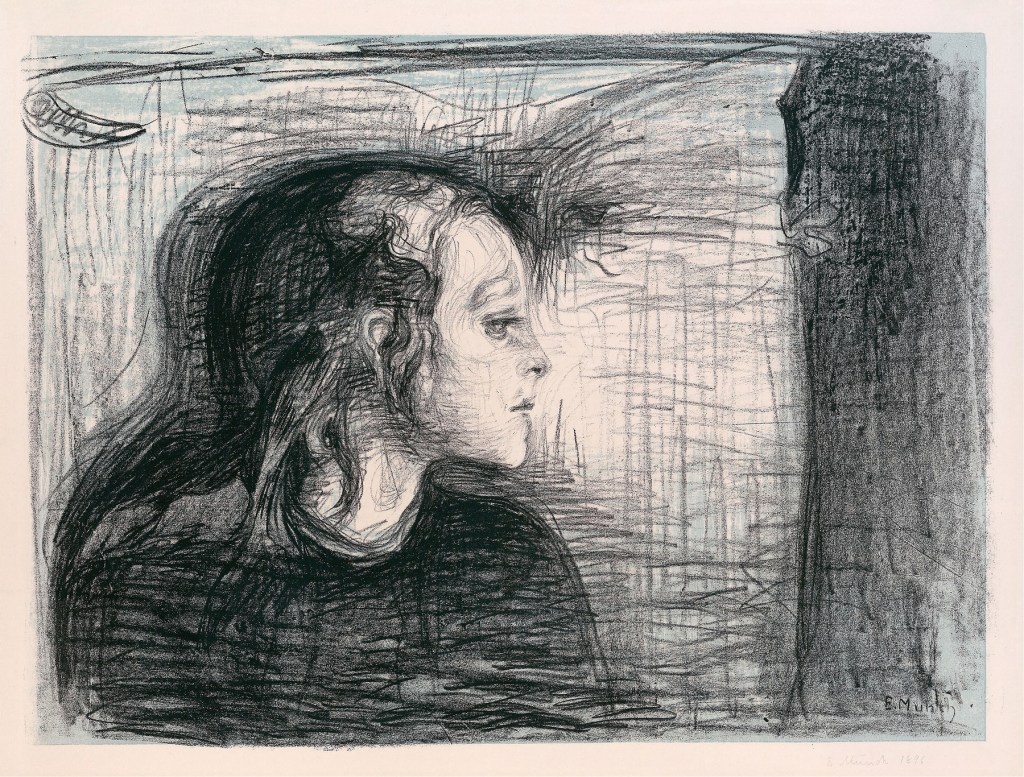
Howie Good: “Childhood’s End”

Childhood’s End


How would you describe your pain? Stabbing? Aching? Sharp? Dull? I would describe mine as a skeletal tree with twisted limbs rattling in the wind. Every day seems a bad imitation of the day before. If I look ahead, I see myself walking on corpses instead of the ground, and if I look back, I see night and fog, and my father angrily clenching the steering wheel and my mother locked in cold silence beside him, while alone in the backseat, I watch through the side window the black-veiled moon follow us home.

About the Author: Howie Good’s latest poetry book is The Horse Were Beautiful (2022), available from Grey Book Press. Redhawk Publications is publishing his collection, Swimming in Oblivion: New and Selected Poems, later this year.

Image Credit: Edvard Munch “The Sick Child I” (1896) Public domain image courtesy of Artvee

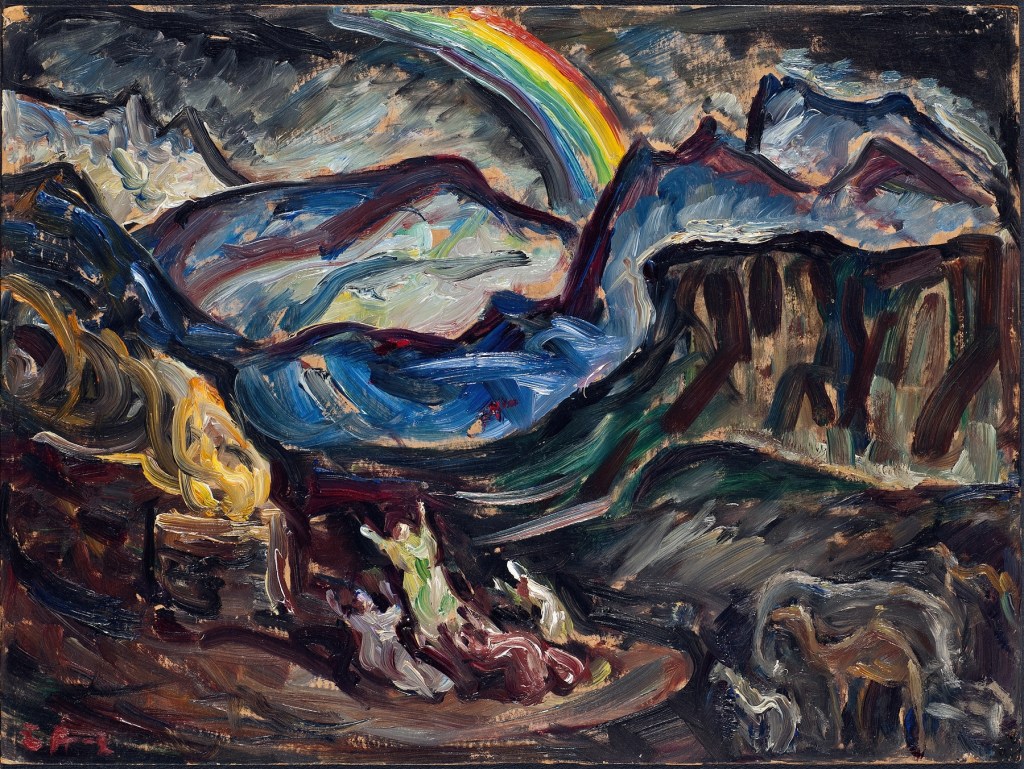
John Barnes: “Noah’s Bones”

Noah’s Bones

The jasper skeleton of fallen Noah
Fossilized in mineral rich mud
Not so far from the chalcedony beams
That buoyed a sprig cut from the 
Tree of life over the vast empire 
Of whale and shark and seaweed groves.

His skeleton may remember what the flesh 
Forgets.  Crustaceans devouring the drowned 
Bodies of soft skinned leopards and 
Once ferocious bears.   The sharks smell
Leaking blood and rend flesh with razor teeth. 
Sunken cities shelter fish schools in tedious numbers.

And yet one tender sprig of olive, severed by
Dove teeth returning to a vista of gray on gray
Prophesies a retreat by the watery empire,
A beachhead outpost for the kingdom of the firmament,
And wings and legs and hands and sharpened swords.

Was it a sword left Noah on his back in the mud?
Was it contempt or jealousy or bitterness 
Behind the hand that struck? What evil did that
Great flood wash from the sticky nature of man?

About the Author: John Barnes has been writing poetry for 42 years and has been published in The Chained MuseThe Minison Project Sonnet Collection Series and received the Winter 2022 quarterly award for his submission to The Lyric. He recently performed a featured reading at ArtNewCo in Columbus, Ohio.  He is a student of verse and believes in the value of self-education.

Image Credit: Ester Almqvist “Noah’s Thank-offering” Public domain image courtesy of Artvee