HELLO FRIENDS OF AIOTB,
Okla Elliott is assuming the duties of
Managing Editor!
(Matt Gonzalez is taking his leave & promises to write more)

Frans Masereel woodcut, 1921.

1876 frontispiece for Tom Sawyer.
Magazine
Frans Masereel woodcut, 1921.
1876 frontispiece for Tom Sawyer.

THE AFTERMATH OF THE FLOTILLA
By Anna Baltzer
Last night marked one week since Israel’s attack in international waters on the Mavi Marmara Turkish humanitarian ship bound for Gaza, killing nine. One by one, the hundreds of witnesses aboard the vessels have been returning home to tell their stories after being stripped of any and all footage. By confiscating all non-military evidence of the incident, Israel has been able to successfully dominate the narrative, at least in the US where news of the attack had begun to dwindle by the time witnesses were released. One wonders, if Israel is conveying the whole story of what happened that night, why eliminate every single other piece of documentation? What does Israel have to hide?
According to hundreds of eyewitnesses, the Navy shot at the boat and threw tear gas and sound bombs before boarding the ship, and then hit the ground shooting. The videos released by Israel show those aboard the ship attacking soldiers with sticks. Israel claims that the deaths were an accident, that the soldiers were startled by the sticks and thus forced to shoot people to defend themselves.
Now let’s put things into perspective. In 2005, the Israeli Army removed 8,000 ideological settlers from Gaza, many of them kicking and screaming with sticks and rocks in hand. The Army managed not to kill or even shoot a single one of them. Do sticks from Turks hurt more, or is it not about the sticks at all?
As Dr. Norman Finkelstein pointed out, Israeli officials met for an entire week prior to the flotilla to plan precisely what they intended to do. The Israeli Ambassador to the US Michael Oren himself stated that the Mavi Marmara was simply “too large to stop with nonviolent means.” It’s hard to believe that this was an accident.
While the world focuses on the flotilla and Gaza, Israel’s restrictions on Palestinian rights in the rest of Palestine continue to tighten. On Friday, soldiers surrounded the Old City in Jerusalem to prevent Muslim men from praying at Al-Aqsa mosque. Only those younger than 15 or older than 40 were allowed through. Hundreds of men gathered outside the metal bars installed by the Army around the city gates. Frustrated, many men sat down to wait to pray on the sidewalk, but soldiers on horseback pushed through the crowd, forcing the men to scatter.
It’s important to note that many Palestinians wait for years to receive a permit to visit Jerusalem for just one day. Sometimes the permits are valid only for a few hours. I saw a woman in Beit Sahour whom I’d met in Syracuse last Fall. She said it’s easier for her to travel to New York than to go 10 miles away to Jerusalem. She said often permits are sent to the wrong village and families fall over themselves to get the permit to the right person in time, often failing. At the gates, some men argued with the soldiers, close to tears, not knowing if they would ever get another chance to realize a life-long dream of praying at their country’s holiest site.
Eventually, hundreds of men began to gather next to the wall of the Old City and across the street. If they could not enter, they would pray as close as they could. As the call to prayer rang out (at least sound can overcome walls), a noticeable calm came over the space as they bowed down in unison. The soldiers stood over the group, some filming with cameras. In the middle of the group were an olive tree and a young child who stood by himself, watching.
When the prayers ended, those who hadn’t brought prayer mats wiped the dirt off their foreheads and gathered with others across the street where an imam had started to speak. Lara, a Palestinian delegate in our group translated bits and pieces of what he said.
The sermon was about the importance of compassion and justice in Islam. There they were, being denied their religious freedom, and they were talking about compassion. The imam asked that their prayers be accepted even though they could not be in the house of God. At one point, he raised his finger and called out the following: “Someday, we will live in a place where it doesn’t matter what color your skin is, or where you’re from.” With every sentence the group resounded in a collective “Amen.”
After the prayers, hundreds of women and older men poured out, one of whom told me he’d seen a man beaten by the Army for calling out against Israel’s attacks on the flotilla. This is likely precisely what the Army wanted to avoid by keeping Muslims from congregating at the mosque, and they had been largely successful, at least so they thought.
Just as I was turning to return to the hotel, I heard a chorus of women’s voices coming from inside the city walls. Soon a large group of women emerged carrying a Turkish flag and singing out familiar calls for justice and praising those who gave their lives to free Gaza. The soldiers thought that keeping the men out would be enough, but they had underestimated the women.
Israel has also underestimated the international civilian community, which continues to speak out. Day and night, we watch protests around the world unfold one after another, seemingly stronger and larger by the day: Japan, Paris, India, Oslo, Australia, and beyond. This is being called “Israel’s Kent State.”
Far more significant than protests is the fact that worldwide disapproval has been transforming into concrete rejection of normalization with Israel, including major victories for the Palestinian movement for boycott, divestment, and sanctions (BDS) on Israel until it complies with international law.
This past week, the student body at Evergreen College voted to divest from “Israel’s illegal occupation.” Before she was run over by Israeli soldiers in a US-made Caterpillar bulldozer in Gaza, Rachel Corrie had attended Evergreen. Along with divesting, students have voted for a “Caterpillar free” campus. You can support the students by clicking here.
A week before the flotilla, Italy’s largest supermarkets COOP and Nordiconad announced a boycott of the Israeli produce company, Carmel Agrexco. Four days later, Deutsche Bank (Germany’s largest bank, worth more than $1 trillion) announced divestment from Elbit Systems, an Israeli firm that supplies technology for Israel’s military, settlements, and Wall (as well as the Wall between the US and Mexico). Deutsche Bank was one of the company’s largest share-holders.
The next day, it was announced that Sweden’s largest national pension funds were also divesting from Elbit. (Norway did the same more than one year ago.) Going a step further, the Swedish Port Workers Union announced last Wednesday that it would temporarily stop handling Israeli cargo in response to the attacks on the flotilla.
On the same day, Britain’s largest union, Unite, passed a unanimous motion “to vigorously promote a policy of divestment from Israeli companies” and to boycott Israeli goods and services as in “the boycott of South African goods during the era of apartheid.”
Then yesterday, the Pixies canceled of their upcoming concert in Israel in response to Israel’s attack on the flotilla. Musical artists Klaxons and Gorillaz canceled as well. This on the heels of cancellations by Santana, Gil Scott-Heron, Snoop Dog, Sting, and Elvis Costello.
These are but a few of the BDS victories that have happened just in the last month. The movement that officially began in 2005 crossed its first threshold in 2009 (having gained in four years the same momentum it took the BDS movement against South Africa 20 years to achieve), but 2010 has brought it to a new level.
Last month marked 62 years since 80% of the families in Gaza were displaced during Israel’s creation, the Palestinian Nakba. And this week marks 43 years since Israel occupied the Gaza Strip and West Bank. The Occupation has been in place 70% of Israel’s life-span so far. It is not temporary. And it is but one part of the problem. Along with Israel’s discrimination against Palestinians within Israel’s de-facto borders and outside historic Palestine, the Occupation will not be stopped voluntarily by Israel. As Dr. Martin Luther King, Jr. said: “Freedom is never voluntarily given by the oppressor; it must be demanded by the oppressed.” I spoke with a member of Boycott from Within (Israelis supporting the Palestinian BDS Call) paraphrased a common phrase during the anti-Apartheid struggle in South Africa: We will bring them to their senses, or we will bring them to their knees. For Israel, as was the case for the South African Apartheid government, the former has simply never worked.
This was orginally published at Anna’s Eyewitness Reports from Palestine on Monday, June 7, 2010.
Anna Baltzer is a Jewish American who has been documenting human rights abuses and supporting nonviolent direct action in the West Bank with the Int’l Women’s Peace Service. Witness In Palestine is the title of her book detailing her experiences

Flickr photograph by super-structure.
I’ve always been a little superstitious. Okay, I don’t wig out if a black cat crosses my path (maybe because I once read that the Portuguese consider the black cat a sign of good luck), but I do make a point of putting on my left sock first every morning. I don’t know why I do this, it’s just that I’ve been doing it for as long as I can remember. Call it a part of my routine, call it some kind of DNA signature, this left sock thing has never done me wrong. I’m alive and kicking to prove it.
I guess you could say I believe in signs. So you can imagine what was running through my head when my girlfriend Justina mentioned that our 8-year relationship was in trouble on the exact same day that our cat Buddy was run over in the driveway by our idiot neighbor Quentin. Yup, the meaning of this wasn’t lost on me. After all, Buddy had been our very first kitten and he was probably the sweetest of our cats. People need symbols and Buddy became a symbol of our relationship, a symbol of our budding love. At least for me. And as anyone who’s ever believed in something will tell you, when a symbol dies, well then the thing that it represents dies as well.
Justina moved out shortly after Buddy’s death, the very day after I celebrated my thirtieth birthday. It was nice of her not dumping me on my birthday, all in all. Okay, it sucked that I had to spend the day all alone (Justina had once again feigned a heavy work load at school, leaving me a cupcake and a pink Hallmark card by the key dish), and it also sucked that my free birthday eggs at Denny’s were watery, cold and tasteless, but at least I was still in a relationship. Or so I believed. When my girlfriend showed up with a moving van the next day, I worried that this cataclysmic event would influence all of my thirties. I shivered in dread.
How would the relationship ads read? “30 year old male, shy, not too bald, with nice smile, totally dependent and mono-focused on his ex-girlfriend, is now totally and utterly alone and looking for companionship. A pretty decent cook, likes animals and enjoys romantic Sunday afternoon hikes up Runyan Canyon.” “Ugh, just shoot me here and now and get it over with,” I thought to myself. Ads aside, a bigger dilemma was now at hand: what does one do with oneself when not in a relationship?
Suddenly the accidental bachelor, I hit the streets looking for answers. All I saw were happy couples and groups of friends, everyone smiling and jocular and together. The only solitary people I came across were either crazy or passed out from drugs or alcohol or poverty. That’s when it occurred to me. Insanity is the quickest way out of a broken heart. Everyone feels pity for a young man who loses his marbles, even if those marbles were all there but a week before. And what’s even better is that when one does actually go crazy, nothing is expected of him. It’s like total freedom. How cool is that? I decided to go insane without further ado. I rushed home all excited, eager to set my new plan in motion.
First off, I would have to get rid of my cats, for a crazy man cannot follow a routine of feeding pets and cleaning up after them. I loved them dearly and so deliberated a long time before leaving them and the remaining supply of cat food on my girlfriend’s doorstep (I was still having a hard time annunciating the prefix “ex”). Justina may not love me anymore, but she must surely have a soft spot in her heart for the cats. Right? I mean, they’d been with us for so many years and they slept with us every night, albeit on my side of the bed (Justina always insisted that they preferred my side, though I knew she swished and swooshed her feet under the covers to chase them away). I decided to not leave a note as that would give her an opportunity to return the cats with a reply.
The next step was to clear out of the apartment. I meticulously gathered all the shreds of my life and bagged them in Smart & Final jumbo garbage bags (“curiously spot on this company name,” I thought as I stuffed my outdated cd collection and utilitarian Ikea cd racks in one of the bags). I hauled the bags a few blocks away, tossing them in a restaurant dumpster. Almost like an omen, Fabio, the faux-Italian longhaired model/actor smiled and waved at me as I walked in front of his shiny peach-colored sports car just off of Melrose. “I’m friends with Fabio?” I wondered as he drove away. I was now more than ever convinced that my plan must be working, that surely I must be going insane.
I drank my last celebratory beer on the dusty floor of my apartment, staring at the clumps of cat hair that floated about the now empty living room. As a token to my new found life, I bit down on the can until my mouth started to bleed. I smeared the sticky blood all over my face, screamed at the top of my lungs and rushed out of the apartment all bleary-eyed but determined, leaving the door wide open. That was the last time I ever went through that door. My new life snatched me up and propelled me forward.
I found a safe place to sleep next to a burnt out building on Spaulding. I dreamt that my girlfriend was trying to wake me up by tickling my eyelashes with her hair. I kept brushing her hair away, trying to prolong the dream of her tickling my eyelashes. I woke up shivering after swatting my nose. A huge cockroach fell off my face and scurried under my jacket. I jumped up and started ripping my clothes off, trying to find the roach. I couldn’t find it and so I decided to shuffle off, cursing and trying to rearrange my torn clothes. I quickly realized that I was barefoot. Someone had stolen my shoes and my socks while I slept. The significance of my new predicament didn’t escape me. Without a left sock to put on first, what did fate have in store for me?
I walked on, vowing to take a straight line down Spaulding, vowing to go straight until I could go straight no longer. I could not for the life of me fathom making a right or a left. That would be calamitous. Two nervous women walked by, stepping on the grass next to the sidewalk so as not to come too close to me (oh, you think I didn’t notice, but I did…). I decided to mimic them and stepped on the grass as well. Shit, I inadvertently made a right! I cringed and quickly shielded my head, expecting a lightning bolt to scream out of the sky and strike me between the eyes. That’s when I stubbed my toe on a sawed-off tree trunk. I fell without grace, clutching my injured toe and tipping backwards. I smacked my head on the edge of the sidewalk, snapping my neck in the process. I died a couple of minutes later, amused by all the confused voices and sirens competing for space in my increasingly tranquil brain.
–Andreas Economakis
This piece is part of a collection of stories on blindness entitled: The Blindness of Life.
Copyright © 2010, Andreas Economakis. All rights reserved.
For more stories by Andreas Economakis click on the author’s name below.

Between going and staying the day wavers,
in love with its own transparency.
The circular afternoon is now a bay
where the world in stillness rocks.
All is visible and all elusive,
all is near and can’t be touched.
Paper, book, pencil, glass,
rest in the shade of their names.
Time throbbing in my temples repeats
the same unchanging syllable of blood.
The light turns the indifferent wall
into a ghostly theater of reflections.
I find myself in the middle of an eye,
watching myself in its blank stare.
The moment scatters. Motionless,
I stay and go: I am a pause.
Octavio Paz (1914-1998) was a Mexican writer, poet, and diplomat. Under the encouragement of Pablo Neruda, Paz began his poetic career in his teens by founding an avant-garde literary magazine, Barandal, and publishing his first book of poems, Luna Silvestre (1933). In 1962, Paz became Mexico’s ambassador to India and resigned six years later in protest when government forces massacred student demonstrators in Mexico City. Paz was awarded the Cervantes Award in 1981, the Neustadt Prize in 1982, and the Nobel Prize for Literature in 1990.
Editor’s Note: This post is both in line with my love for great Spanish poets and with an ongoing discussion here on As It Ought To Be of the role of artists in politics. In a time of great turmoil – the new racist police state law in Arizona, the BP oil catastrophe, and Israel’s attack on those trying to aid occupied Palestine, to name a few – we as artists have a responsibility to use our voices for the greater good. May Octavio Paz serve as an inspiration to do so.
Want to read more by and about Octavio Paz?
Poets.org
NobelPrize.org
Britannica Online

Even when your friend, the radio, is still; even when her dream, the magazine, is finished; even when his life, the ticker, is silent; even when their destiny, the boulevard, is bare;
And after that paradise, the dance-hall, is closed; after that theater, the clinic, is dark,
Still there will be your desire, and hers, and his hopes and theirs,
Your laughter, their laughter,
Your curse and his curse, her reward and their reward, their dismay and his dismay and her dismay and yours—
Even when your enemy, the collector, is dead; even when your counsellor, the salesman, is sleeping; even when your sweetheart, the movie queen, has spoken; even when your friend, the magnate, is gone.
Kenneth Fearing(1902-1961) was an American poet, novelist, speechwriter, editor, and journalist. One literary critic named him “the chief poet of the American Depression.” He helped found the Partisan Review and took an active interest in leftist politics while also churning out pulp fiction that sometimes bordered on the pornographic under the pseudonym Kirk Wolff. His poetry uses contemporary vernacular to probe the grotesque in the urban landscape.

The Spanish war has probably produced a richer crop of lies than any event since the Great War of 1914-18, but I honestly doubt, in spite of all those hecatombs of nuns who have been raped and crucified before the eyes of DAILY MAIL reporters, whether it is the pro-Fascist newspapers that have done the most harm. It is the left-wing papers, the NEWS CHRONICLE and the DAILY WORKER, with their far subtler methods of distortion, that have prevented the British public from grasping the real nature of the struggle.
The fact which these papers have so carefully obscured is that the Spanish Government (including the semi-autonomous Catalan Government) is far more afraid of the revolution than of the Fascists. It is now almost certain that the war will end with some kind of compromise, and there is even reason to doubt whether the Government, which let Bilbao fail without raising a finger, wishes to be too victorious; but there is no doubt whatever about the thoroughness with which it is crushing its own revolutionaries. For some time past a reign of terror–forcible suppression of political parties, a stifling censorship of the press, ceaseless espionage and mass imprisonment without trial–has been in progress. When I left Barcelona in late June the jails were bulging; indeed, the regular jails had long since overflowed and the prisoners were being huddled into empty shops and any other temporary dump that could be found for them. But the point to notice is that the people who are in prison now are not Fascists but revolutionaries; they are there not because their opinions are too much to the Right, but because they are too much to the Left. And the people responsible for putting them there are those dreadful revolutionaries at whose very name Garvin quakes in his galoshes–the Communists.
Meanwhile the war against Franco continues, but, except for the poor devils in the front-line trenches, nobody in Government Spain thinks of it as the real war. The real struggle is between revolution and counter-revolution; between the workers who are vainly trying to hold on to a little of what they won in 1936, and the Liberal-Communist bloc who are so successfully taking it away from them. It is unfortunate that so few people in England have yet caught up with the fact that Communism is now a counter-revolutionary force; that Communists everywhere are in alliance with bourgeois reformism and using the whole of their powerful machinery to crush or discredit any party that shows signs of revolutionary tendencies. Hence the grotesque spectacle of Communists assailed as wicked ‘Reds’ by right-wing intellectuals who are in essential agreement with them. Mr Wyndham Lewis, for instance, ought to love the Communists, at least temporarily. In Spain the Communist-Liberal alliance has been almost completely victorious. Of all that the Spanish workers won for themselves in 1936 nothing solid remains, except for a few collective farms and a certain amount of land seized by the peasants last year; and presumably even the peasants will be sacrificed later, when there is no longer any need to placate them. To see how the present situation arose, one has got to look back to the origins of the civil war.
Franco’s bid for power differed from those of Hitler and Mussolini in that it was a military insurrection, comparable to a foreign invasion, and therefore had not much mass backing, though Franco has since been trying to acquire one. Its chief supporters, apart from certain sections of Big Business, were the land-owning aristocracy and the huge, parasitic Church. Obviously a rising of this kind will array against it various forces which are not in agreement on any other point. The peasant and the worker hate feudalism and clericalism; but so does the ‘liberal’ bourgeois, who is not in the least opposed to a more modern version of Fascism, at least so long as it isn’t called Fascism. The ‘liberal’ bourgeois is genuinely liberal up to the point where his own interests stop. He stands for the degree of progress implied in the phrase ‘la carrière ouverte aux talents’. For clearly he has no chance to develop in a feudal society where the worker and the peasant are too poor to buy goods, where industry is burdened with huge taxes to pay for bishops’ vestments, and where every lucrative job is given as a matter of course to the friend of the catamite of the duke’s illegitimate son. Hence, in the face of such a blatant reactionary as Franco, you get for a while a situation in which the worker and the bourgeois, in reality deadly enemies, are fighting side by side. This uneasy alliance is known as the Popular Front (or, in the Communist press, to give it a spuriously democratic appeal, People’s Front). It is a combination with about as much vitality, and about as much right to exist, as a pig with two heads or some other Barnum and Bailey monstrosity.
In any serious emergency the contradiction implied in the Popular Front is bound to make itself felt. For even when the worker and the bourgeois are both fighting against Fascism, they are not fighting for the same things; the bourgeois is fighting for bourgeois democracy, i.e. capitalism, the worker, in so far as he understands the issue, for Socialism. And in the early days of the revolution the Spanish workers understood the issue very well. In the areas where Fascism was defeated they did not content themselves with driving the rebellious troops out of the towns; they also took the opportunity of seizing land and factories and setting up the rough beginnings of a workers’ government by means of local committees, workers’ militias, police forces, and so forth. They made the mistake, however (possibly because most of the active revolutionaries were Anarchists with a mistrust of all parliaments), of leaving the Republican Government in nominal control. And, in spite of various changes in personnel, every subsequent Government had been of approximately the same bourgeois-reformist character. At the beginning this seemed not to matter, because the Government, especially in Catalonia, was almost powerless and the bourgeoisie had to lie low or even (this was still happening when I reached Spain in December) to disguise themselves as workers. Later, as power slipped from the hands of the Anarchists into the hands of the Communists and right-wing Socialists, the Government was able to reassert itself, the bourgeoisie came out of hiding and the old division of society into rich and poor reappeared, not much modified. Henceforward every move, except a few dictated by military emergency, was directed towards undoing the work of the first few months of revolution. Out of the many illustrations I could choose, I will cite only one, the breaking-up of the old workers’ militias, which were organized on a genuinely democratic system, with officers and men receiving the same pay and mingling on terms of complete equality, and the substitution of the Popular Army (once again, in Communist jargon, ‘People’s Army’), modelled as far as possible on an ordinary bourgeois army, with a privileged officer-caste, immense differences of pay, etc. etc. Needless to say, this is given out as a military necessity, and almost certainly it does make for military efficiency, at least for a short period. But the undoubted purpose of the change was to strike a blow at equalitarianism. In every department the same policy has been followed, with the result that only a year after the outbreak of war and revolution you get what is in effect an ordinary bourgeois State, with, in addition, a reign of terror to preserve the status quo.
This process would probably have gone less far if the struggle could have taken place without foreign interference. But the military weakness of the Government made this impossible. In the face of France’s foreign mercenaries they were obliged to turn to Russia for help, and though the quantity of arms sup–plied by Russia has been greatly exaggerated (in my first three months in Spain I saw only one Russian weapon, a solitary machine-gun), the mere fact of their arrival brought the Communists into power. To begin with, the Russian aeroplanes and guns, and the good military qualities of the international Brigades (not necessarily Communist but under Communist control), immensely raised the Communist prestige. But, more important, since Russia and Mexico were the only countries openly supplying arms, the Russians were able not only to get money for their weapons, but to extort terms as well. Put in their crudest form, the terms were: ‘Crush the revolution or you get no more arms.’ The reason usually given for the Russian attitude is that if Russia appeared to be abetting the revolution, the Franco-Soviet pact (and the hoped-for alliance with Great Britain) would be imperilled; it may be, also, that the spectacle of a genuine revolution in Spain would rouse unwanted echoes in Russia. The Communists, of course, deny that any direct pressure has been exerted by the Russian Government. But this, even if true, is hardly relevant, for the Communist Parties of all countries can be taken as carrying out Russian policy; and it is certain that the Spanish Communist Party, plus the right-wing Socialists whom they control, plus the Communist press of the whole world, have used all their immense and ever-increasing influence upon the side of counter-revolution.
In the first half of this article I suggested that the real struggle in Spain, on the Government side, has been between revolution and counter-revolution; that the Government, though anxious enough to avoid being beaten by Franco, has been even more anxious to undo the revolutionary changes with which the outbreak of war was accompanied.
Any Communist would reject this suggestion as mistaken or wilfully dishonest. He would tell you that it is nonsense to talk of the Spanish Government crushing the revolution, because the revolution never happened; and that our job at present is to defeat Fascism and defend democracy. And in this connexion it is most important to see just how the Communist anti-revolutionary propaganda works. It is a mistake to think that this has no relevance in England, where the Communist Party is small and comparatively weak. We shall see its relevance quickly enough if England enters into an alliance with the U.S.S.R.; or perhaps even earlier, for the influence of the Communist Party is bound to increase–visibly is increasing–as more and more of the capitalist class realize that latter-day Communism is playing their game.
Broadly speaking, Communist propaganda depends upon terrifying people with the (quite real) horrors of Fascism. It also involves pretending–not in so many words, but by implication–that Fascism has nothing to do with capitalism. Fascism is just a kind of meaningless wickedness, an aberration, ‘mass sadism’, the sort of thing that would happen if you suddenly let loose an asylumful of homicidal maniacs. Present Fascism in this form, and you can mobilize public opinion against it, at any rate for a while, without provoking any revolutionary movement. You can oppose Fascism by bourgeois ‘democracy, meaning capitalism. But meanwhile you have got to get rid of the troublesome person who points out that Fascism and bourgeois ‘democracy’ are Tweedledum and Tweedledee. You do it at the beginning by calling him an impracticable visionary. You tell him that he is confusing the issue, that he is splitting the anti-Fascist forces, that this is not the moment for revolutionary phrase-mongering, that for the moment we have got to fight against Fascism without inquiring too closely what we are fighting for. Later, if he still refuses to shut up, you change your tune and call him a traitor. More exactly, you call him a Trotskyist.
And what is a Trotskyist? This terrible word–in Spain at this moment you can be thrown into jail and kept there indefinitely, without trial, on the mere rumour that you are a Trotskyist–is only beginning to be bandied to and fro in England. We shall be hearing more of it later. The word ‘Trotskyist’ (or ‘Trotsky-Fascist’) is generally used to mean a disguised Fascist who poses as an ultra-revolutionary in order to split the left-wing forces. But it derives its peculiar power from the fact that it means three separate things. It can mean one who, like Trotsky, wished for world revolution; or a member of the actual organization of which Trotsky is head (the only legitimate use of the word); or the disguised Fascist already mentioned. The three meanings can be telescoped one into the other at will. Meaning No. I may or may not carry with it meaning No. 2, and meaning No. 2 almost invariably carries with it meaning No. 3. Thus: ‘XY has been heard to speak favourably of world revolution; therefore he is a Trotskyist; therefore he is a Fascist.’ In Spain, to some extent even in England, ANYONE professing revolutionary Socialism (i.e. professing the things the Communist Party professed until a few years ago) is under suspicion of being a Trotskyist in the pay of Franco or Hitler.
The accusation is a very subtle one, because in any given case, unless one happened to know the contrary, it might be true. A Fascist spy probably WOULD disguise himself as a revolutionary. In Spain, everyone whose opinions are to the Left of those of the Communist Party is sooner or later discovered to be a Trotskyist or, at least, a traitor. At the beginning of the war the POUM, an opposition Communist party roughly corresponding to the English ILP., was an accepted party and supplied a minister to the Catalan Government, later it was expelled from the Government; then it was denounced as Trotskyist; then it was suppressed, every member that the police could lay their hands on being flung into jail.
Until a few months ago the Anarcho-Syndicalists were described as ‘working loyally’ beside the Communists. Then the Anarcho-Syndicalists were levered out of the Government; then it appeared that they were not working so loyally; now they are in the process of becoming traitors. After that will come the turn of the left-wing Socialists. Caballero, the left-wing Socialist ex-premier, until May 1937 the idol of the Communist press, is already in outer darkness, a Trotskyist and ‘enemy of the people’. And so the game continues. The logical end is a régime in which every opposition party and newspaper is suppressed and every dissentient of any importance is in jail. Of course, such a régime will be Fascism. It will not be the same as the fascism Franco would impose, it will even be better than Franco’s fascism to the extent of being worth fighting for, but it will be Fascism. Only, being operated by Communists and Liberals, it will be called something different.
Meanwhile, can the war be won? The Communist influence has been against revolutionary chaos and has therefore, apart from the Russian aid, tended to produce greater military efficiency. If the Anarchists saved the Government from August to October 1936, the Communists have saved it from October onwards. But in organizing the defence they have succeeded in killing enthusiasm (inside Spain, not outside). They made a militarized conscript army possible, but they also made it necessary. It is significant that as early as January of this year voluntary recruiting had practically ceased. A revolutionary army can sometimes win by enthusiasm, but a conscript army has got to win with weapons, and it is unlikely that the Government will ever have a large preponderance of arms unless France intervenes or unless Germany and Italy decide to make off with the Spanish colonies and leave Franco in the lurch. On the whole, a deadlock seems the likeliest thing.
And does the Government seriously intend to win? It does not intend to lose, that is certain. On the other hand, an outright victory, with Franco in flight and the Germans and Italians driven into the sea, would raise difficult problems, some of them too obvious to need mentioning. There is no real evidence and one can only judge by the event, but I suspect that what the Government is playing for is a compromise that would leave the war situation essentially in being. All prophecies are wrong, therefore this one will be wrong, but I will take a chance and say that though the war may end quite soon or may drag on for years, it will end with Spain divided up, either by actual frontiers or into economic zones. Of course, such a compromise might be claimed as a victory by either side, or by both.
All that I have said in this article would seem entirely commonplace in Spain, or even in France. Yet in England, in spite of the intense interest the Spanish war has aroused, there are very few people who have even heard of the enormous struggle that is going on behind the Government lines. Of course, this is no accident. There has been a quite deliberate conspiracy (I could give detailed instances) to prevent the Spanish situation from being understood. People who ought to know better have lent themselves to the deception on the ground that if you tell the truth about Spain it will be used as Fascist propaganda.
It is easy to see where such cowardice leads. If the British public had been given a truthful account of the Spanish war they would have had an opportunity of learning what Fascism is and how it can be combated. As it is, the News Chronicle version of Fascism as a kind of homicidal mania peculiar to Colonel Blimps bombinating in the economic void has been established more firmly than ever. And thus we are one step nearer to the great war ‘against Fascism’ (cf. 1914, ‘against militarism’) which will allow Fascism, British variety, to be slipped over our necks during the first week.
–George Orwell
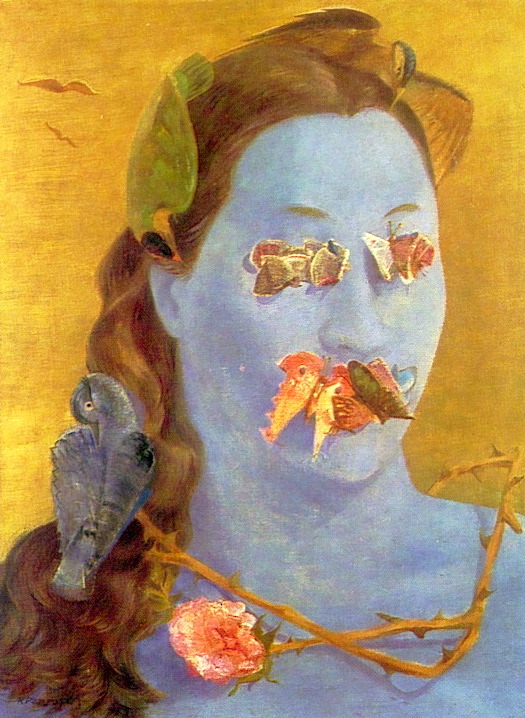
“Winged Domino: Portrait of Valentine” by Roland Penrose, 1938.
Inspiration. How does one get it? Inspiration is such an elusive thing. There are days when you just can’t shut up, shut your mind off. Hyper aware. Hyper expressive. Everything inspires you then. A leaf, the way dust settles on the leaf, your cat’s quivering white whiskers, the way a hunk of cheese falls on the floor, how your cats react to it, how you react to them reacting to the cheese, the fact that you run to the computer to write it down, only to stare at the screen vacantly, your fingers frozen over the keyboard, mind drifting, wondering whether you should check your e-mail first and what should I have for dinner (?) and man, better wash that thought down with a beer, yeah, comfortable again in front of the screen, going online, nope, no messages, sign off, open Microsoft Word and stare at the vacant screen, nothing written yet, boldly typing the title, swig of beer, highlight, hit the bold-underline keys and lean back, INSPIRATION, feet on desk and another swig of beer, better go check on the plants, see if they’ve grown another millimeter, and what are the cats doing now and why is Billy always hungry (?), is it because he has a cancerous lump in his stomach, poor little guy and I can’t really do anything about the lump because he’s almost 15 and one just can’t cut into a cat at that age, but wait, they cut into my old man when he was 69, and, my oh my, my phone number starts with 69 and, oh wait, that’s the sign of the crab and, frankly, a position that’s pretty fun in bed except I don’t really do it all that often, I don’t know why, I should talk to my girlfriend about this and, shit, I should get back to writing about the cats and the cheese and, swig of beer, I’m just not really inspired to write anything today, just inspired in general and you stare at the title on the screen and, hands frozen above the keyboard you write “How does one get it?” Shit if I know, you think, it’s like your cat looking at his plate when he isn’t hungry, or a butterfly landing on your cheek, which is a good metaphor for how love strikes and how beautiful it is, and the moment you try and possess the butterfly it flies off, leaving your cheeks tingling and slightly dusted with butterfly dust, and you sit and stretch your face out into the air, waiting for the next butterfly to land, but it won’t ever land while you’re waiting, no, it will only land when you’ve given up completely and aren’t thinking about it, kind of like when you’re doing something you really like, say like snorkeling, and you aren’t thinking about sex, or the last meal you ate, or how it felt when you got that good luck phone call, or when you fell in love that time, or when that butterfly landed on your cheek earlier, no, it will come while you’re looking at a plate of fried fish, or severed cow heads bobbing slowly up and down in the sea, barely touching the billowing, drifting sand, or when you kick the pebble out of your flip-flop and then voila, the butterfly of inspiration, like the butterfly of love, will land on your cheek and send your heart into palpitations, your mind into alertness, aware, aware that your are staring at your computer screen and your fingers have just finished this story.
–Andreas Economakis
This piece is part of a collection of stories on blindness entitled: The Blindness of Life.
Copyright © 2010, Andreas Economakis. All rights reserved.
For more stories by Andreas Economakis click on the author’s name below.

Our muscles warped and scarr’d
Wrap around our skeletons
Like hot winds
That sweep the desert floor
In search of shade,
Sleeping each night
In the hollow of petrified
Skulls.
And from our mouths
Words of love would come
If we let them,
Like molten stones shrieking
From the belly of a volcano
But standing at these bars
We watched you leave
And only wondered…
You looked up at us with passion
As we stood at the bars.
A vacuum swelled at our hands
Went pale, our fingers cold
The gray pity of our lot
Made you turn away
But our spirits met that moment
Faraway in the land of Justice
And we whispered with our eyes,
”Come closer”
But you did not.
It’s been so long now
Since you left.
Did you tell them?
Hell is not a dream
And that you’ve been there?
Did you tell them
Jimmy Santiago Baca was born in Santa Fe, New Mexico in 1952 where he lived in a two-room shack with his alcoholic father, his mother, and his brother and sister. When he was two years old, Baca’s parents abandoned him and he and his siblings moved into their grandparent’s shack. Baca eventually moved into an orphanage and later, a detention center. Finally—when Baca was only 15 years old—he graduated to living on the streets. When Baca was 21, he was sentenced to five to ten years in a maximum-security prison in Arizona for dealing drugs. In prison, Baca taught himself how to read and write and developed a passion for writing poetry. Baca, who corresponded with several established poets while he was in prison, first published his poetry while he was still incarcerated. After he was released, he publishing his first major collection of poetry, Immigrants in Our Own Land, which is based on his prison experience. Since then Baca has released several other books of poetry, a collection of essays and stories, screenplays, and a memoir. Additionally, Baca conducts writing workshops at numerous schools and correctional facilities across the county. In 2003, Baca received his PhD in Literature from New Mexico University. (Annotated biography of Jimmy Santiago Baca courtesy of Youngstown State University.)
Editor’s Note: This post was by request, and it was requested that this poem be dedicated to all prisoners everywhere. If you have a request of your own please feel free to post it as a comment.
I love the idea of poetry as a means of redemption and as a means of finding your voice. I hope this post inspires people to find their own voices and their own freedom through poetry and art. “And from our mouths words of love would come, if we let them.”
Want to read more by and about Jimmy Santiago Baca?
Official Website
Poets.org
Youngstown State University

Years later they find themselves talking
about chances, moments when their lives
might have swerved off
for the smallest reason.
What if
I hadn’t phoned, he says, that morning?
What if you’d been out,
as you were when I tried three times
the night before?
Then she tells him a secret.
She’d been there all evening, and she knew
he was the one calling, which was why
she hadn’t answered.
Because she felt—
because she was certain—her life would change
if she picked up the phone, said hello,
said, I was just thinking
of you.
I was afraid,
she tells him. And in the morning
I also knew it was you, but I just
answered the phone
the way anyone
answers a phone when it starts to ring,
not thinking you have a choice.
Lawrence Raab employs refreshingly simple language to explore memory, love, and a mysterious inevitability. “Marriage” appeared in his collection of poems titled, What We Don’t Know About Each Other. The book won the National Poetry Series and was a finalist for the 1993 National Book Award. His latest work, A History of Forgetting, may not be as flashy as some of his earlier poetry, but finds the poet settled into a moody pathos that has some critics drawing comparisons to Thomas Hardy.
 As It Ought To Be

