John Dorsey: “On the Prospect of Dying in December”

On the Prospect of Dying in December

not the end of the year
but maybe the end of your life
& you don’t know 
if you should buy another calendar
you didn’t buy the one you have now
given away by the local bank
curling at the bottom 
after an already brutal summer
you think about the winter of 1996
just before your grandfather 
closed his eyes one last time
while smiling 
knowing the battle 
was almost over
thinking about when you sold calendars 
over the holidays for the local bookstore
mostly of swimsuit models 
who are grandmothers now
& kittens that are long dead
& butterflies that have flown away
& you wonder 
how long it will be for you
on an unusually cool august morning
waiting for your ride

it won’t be long now.

About the Author: John Dorsey is the former poet laureate of Belle, Missouri and the author of Pocatello Wildflower. He may be reached at archerevans@yahoo.com.

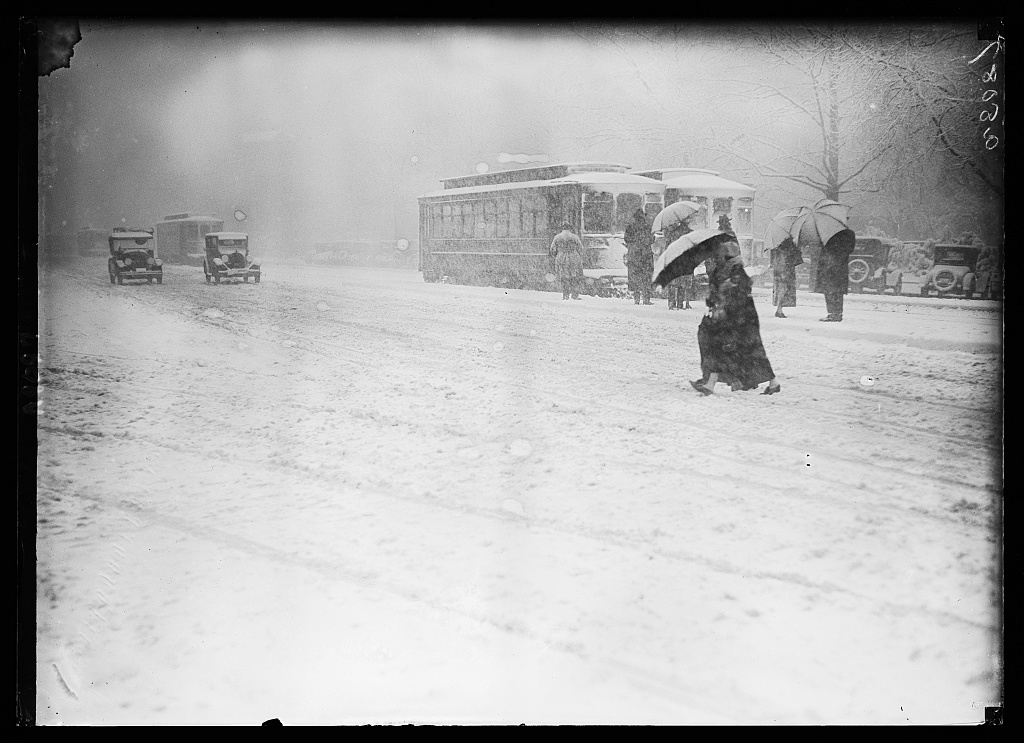
Image Credit: Harris & Ewing “Washington Snow Scenes” (1924) Public domain image courtesy of the Library of Congress

Michael G. O’Connell: “On the Loss of a Daughter”


On the Loss of a Daughter	

It is summer.
The creek works its way through the world 
carefully,
lazily,
thoughtlessly.
It slices through fields and forests,
in sunshine and dark places,
and though dark,
is still painted by the sun
slowly, mostly,
yet still towards that bigger place it has to go.

Creeks become streams.
Streams, rivers.
Rivers, lakes,
and, ultimately, all become lost in the sea, 
but, do they really?

Does the creek that moves through this world, 
gathering bits and pieces of the earth—
rocks, wood, and sometimes even sky—
does that creek truly become lost in the ocean? 
Or is it part of that ocean? 
Something else? 

Sometimes the creek travels alone 
until it reaches the end.
Others mix and mingle 
and split and reinvent themselves along the way—
encountering rocks, fallen trees, and dams, 
and still, it is able to reclaim itself.

It is summer.
Sunlight dances on waves.
Children play in shallows—
splashing, digging, lazing, 
fighting.

The sun shines 
warming all it touches 
sending reddened visitors back into the ocean 
where just below the surface lies cooling waters
and things that bite and sting.

The sun shines.
Waters warm
until they rise on cobbled wings
and fly.
And
ultimately 
fall

back

About the Author: Michael G. O’Connell is an author, illustrator, and an award-winning poet. Having been published in various formats worldwide, his latest work can be found in the poetry anthology, Moss Gossamer. He is currently working on an illustrated middle grade book.

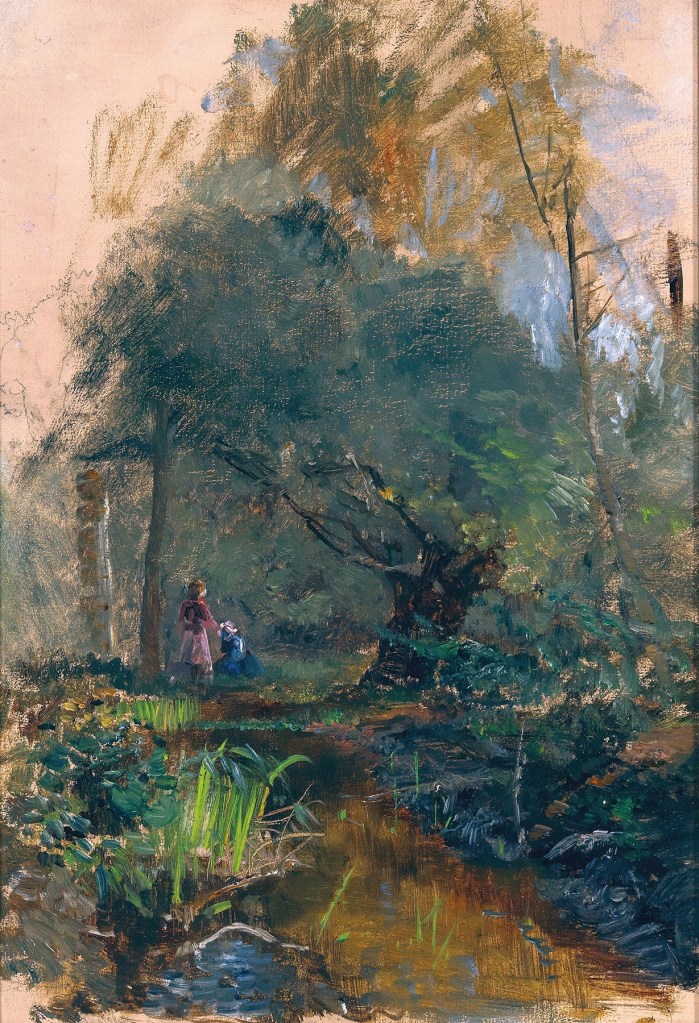
Image Credit: Marie Egner “Children by a Mountain Creek” Public domain image courtesy of Artvee

Sue Blaustein: “Who Wrote the Book of Love?”

Who Wrote the Book of Love?

To discover laws, you need facts.
           Of course. But laws! 
Laws are about relationships.

The cast from my childhood biographies – pea plant and pigeon
breeders, lens grinders and collectors 
           would testify:

that you can discover anything if you’re patient enough.

If you’re imaginative enough 
           and tough. Curious.
If you vibrate and resonate, hyper-able to read signs…
perceiving the tiniest swerve or oddity –
	  flash, whiff or residue.

If your study feels like courtship!
	  All new. You know. You know
what you saw. What it means. How delicious it could be to verify!

The miners and mechanics, the alchemists,
	  taxidermists –
they’d testify!
 	 
	  That if you’re receptive,
if you’re in love or some similar state, if you have to know. If you want
	  that knowledge,
you’ll devise the means – titrations, 
          equations, dissections...
Calculations and equilibrations. Instruments.

Those restless cooks and brewers! Observant healers…
	  Astronomers and microscopists.

They proved that sooner or later, you’ll detect
          what’s too small, too far,
too big or too quiet, too subtle!

You’ll get there. You’ll coax the remote into
touching – moving things you can 
          see. And you’ll measure
and record, measure and compare,
          and relationships
          come clear.

About the Author: Sue Blaustein is the author of “In the Field, Autobiography of an Inspector”. Her information can be found at www.sueblaustein.com. Recently she contributed a poem to a “The Subtle Forces” podcast episode and was interviewed on the “Blue Collar Gospel Hour”. A retiree, she blogs for Milwaukee’s  Ex Fabula, serves as an interviewer/writer for the “My Life My Story” program at the Zablocki VA Medical Center, and chases insects at the Milwaukee Urban Ecology Center.

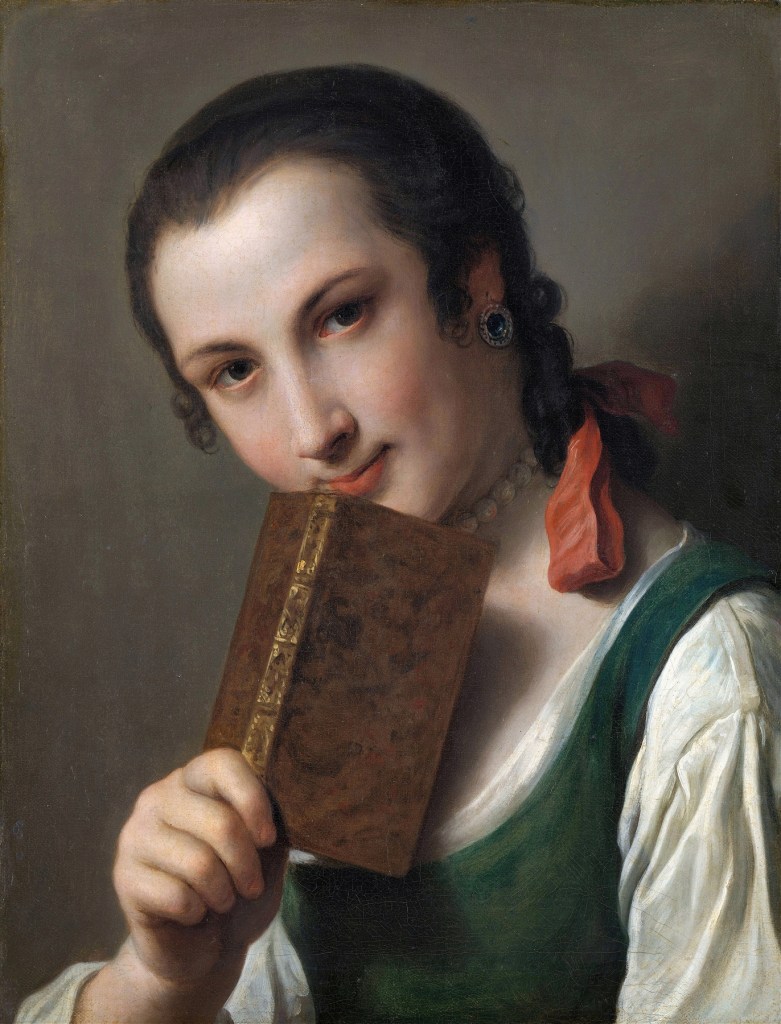
Image Credit: Pietro Rotari “A Young Woman with a Book” (1756) Public domain image courtesy of Artvee

Robert S. King “Head Waiter”

Head Waiter

A waiter hurries up, then waits.
The customer is always right.
Carnivores love more-than-you-can-eat deals.
Their table manners grunt greedy sounds.
They might even eat me who has no taste.

The only tip they leave trickles down
from their lips. Maybe I’d like
my own pound of flesh, even sitting down
with cannibal capitalists to the richest
food for thought.

But I’ll have to wait on that.

About the Author: Robert S. King lives in Athens, GA, where he serves on the board of FutureCycle Press. His poems have appeared in hundreds of magazines, including Atlanta Review, California Quarterly, Chariton Review, Hollins Critic, Kenyon Review, Main Street Rag, Midwest Quarterly, Negative Capability, Southern Poetry Review, and Spoon River Poetry Review. He has published eight poetry collections, most recently Developing a Photograph of God (Glass Lyre Press, 2014) and Messages from Multiverses (Duck Lake Books, 2020) His personal website is www.robertsking.info.

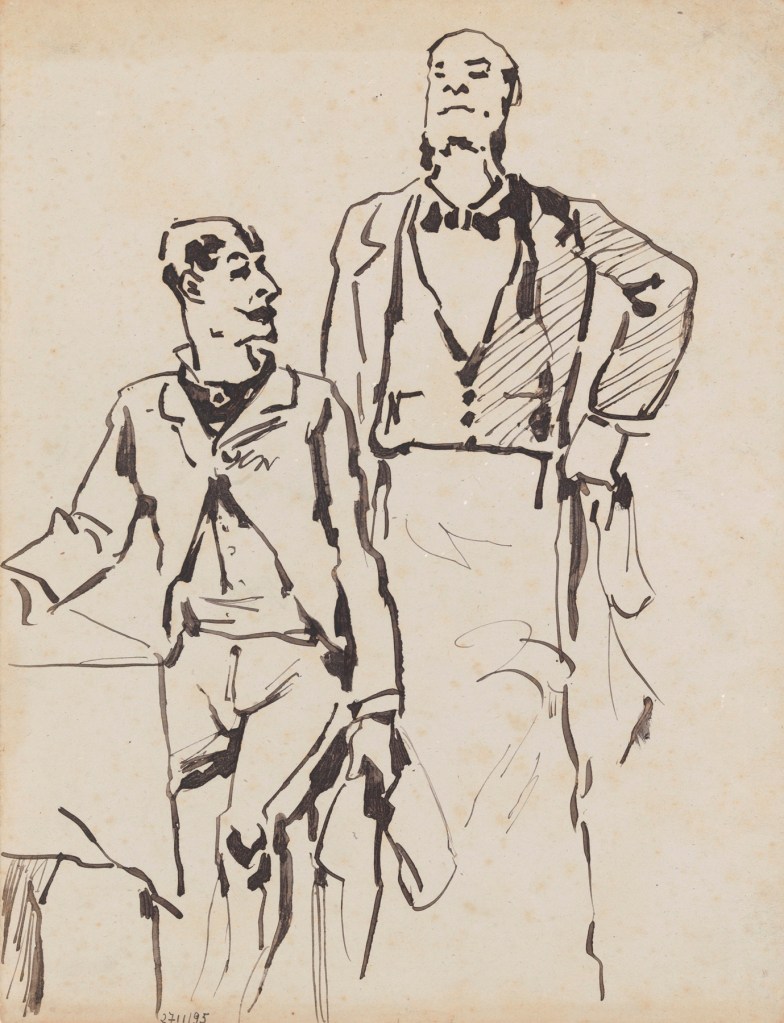
Image Credit: James Ensor “Gentleman and Waiter” Public domain image courtesy of Artvee

Jason Ryberg: “Scarecrow Standing at a Crossroads”

Scarecrow Standing at a Crossroads

There’s a blackbird between the shadows
of two white houses,

the midnight train is a silver river
of moonlight,

the cornfield is now a haunted forest
of skeletal husks,

and it would appear that the old, madcap,
vaudeville, soft-shoe dancer of a scarecrow,
who, one day who knows how many years ago,
just seemed to have showed-up, out there,
outta nowhere,

has moved on, now

(his past finally
catching up with him, I guess).

About the Author: Jason Ryberg is the author of eighteen books of poetry, six screenplays, a few short stories, a box full of folders, notebooks and scraps of paper that could one day be (loosely) construed as a novel, and, a couple of angry letters to various magazine and newspaper editors. He is currently an artist-in-residence at both The Prospero Institute of Disquieted P/o/e/t/i/c/s and the Osage Arts Community, and is an editor and designer at Spartan Books. His latest collection of poems is The Great American Pyramid Scheme (co-authored with W.E. Leathem, Tim Tarkelly and Mack Thorn, OAC Books, 2022). He lives part-time in Kansas City, MO with a rooster named Little Red and a billygoat named Giuseppe and part-time somewhere in the Ozarks, near the Gasconade River, where there are also many strange and wonderful woodland critters.

Image Credit: John Vachon “Scarecrow, North Carolina” (1938) Public domain image courtesy of the Library of Congress
Jean Biegun: “Olives”

Olives

I have a grocery list with olives
on it. Meanwhile you have

an issuance of pain aching
somewhere in your left hip

and the x-ray showed nothing but it
makes you think of Esther.

How tentatively I would step around
her and she, mean in her broadcast,

wide-shouldered through each game
we played. Yes, I recall she needed

to win every time.
I’m going to make a big salad with your

favorite marinated artichoke hearts
and fresh dill dressing. Want to come over?

We’ll walk to the pond—good exercise
for you. Remember that old photo

where she caught the biggest fish? It was
the only instance you did not smile

even though Pa told us to. He always said
we should smile whatever storm

blows at the door. I’ll mix up corn muffins
from scratch. We’ll have a healthy meal.

About the Author: Jean Biegun’s poetry has appeared in numerous journals and anthologies. In 2022, her chapbook HITCHHIKERS TO EDEN was published, she received a Pushcart Prize nomination and the Christine Award for Best Prose Poem of 2021(EASTERN IOWA REVIEW). Poems have been in AS IT OUGHT TO BE MAGAZINE, GYROSCOPE REVIEW, MUDDY RIVER POETRY REVIEW, AS ABOVE SO BELOW, UNBROKEN, and other places.

Image Credit: Image originally published in Pomologie française: Paris: Langlois et Leclercq, 1846. Public domain image courtesy of the Biodiversity Heritage Library

Erika Seshadri: “Flooded”

Flooded

After ten days,
    the water receded
leaving mud beneath
our feet—
caking our shoes,
    pulling us
slick and sinking into
memories of what was:
before.

The weight was too much.

I wallowed up to my ankles
    in muck
drowning frustration and
standing as a
    deadweight,
imagining tree roots
and fewer
    responsibilities.

With a slurp of suction
I stepped free,
    leaving
my shoes
to fend for themselves,
    as mud
seeped through my socks
and between my toes.

About the Author: Erika Seshadri lives on an animal rescue ranch in Florida with her family. When not caring for tame critters or feral children, she can be found writing. Her work has appeared with Stonecrop Magazine, Funicular, Nine Cloud Journal, Quibble Lit, Hare’s Paw Literary Journal, Dreamer’s Magazine, and many others.

Image Credit: “Flood” (1924) Public domain image courtesy of the Library of Congress
Cord Moreski: “Night Swimming”

Night Swimming 

After working another shift 
in the oppressive Jersey heat 
taking food orders from the privileged 
and counting tips so I can make
my rent that just went up again

any ghost from Roman literature 
would definitely point out that 
I haven’t been very carpe diem
as of lately

so I make my way 
to North End beach 
surrounded by teenagers making out 
past their curfews in the sand
and stoners hot-boxing 
beneath overturned lifeguard boats 

I take off my work clothes 
while this drunken couple 
on the shoreline beside me
continue their post-bar conversation 

about the fate of the world
the fate of us all, fire and ice,
as if they were knocking back 
a few earlier with Robert Frost

they try to ask me what I think
but I’m already diving into the surf 
and by the time I resurface they leave
and all I’m left with is just this darkness 
as I float on the calmness of the water

I don't know what’ll happen I think to myself
but the stars sure do look pretty tonight.

About the Author: Cord Moreski is a poet from the Jersey Shore. Moreski is the author of Confined Spaces (Two Key Customs, 2022), The News Around Town (Maverick Duck Press, 2020), and Shaking Hands with Time (Indigent Press, 2018). When he is not writing, Cord waits tables for a living and teaches middle school children that poetry is awesome. His next chapbook Apartment Poems will be released by Between Shadows Press in late 2022. You can follow Cord here: www.cordmoreski.com

Image Credit: Léon Spilliaert “Beachview at Night” (1905) Public domain image courtesy of Artvee

Rocío Iglesias: “How to Own Nothing”

How to Own Nothing

When you gave me a drawer at your place to keep my things
I told you I don’t keep anything except my promises,
I told you the only thing I’ve ever truly owned is my heavy heart
But still you gave me this one drawer to come home to

I searched the ghost town of my personal possessions
And exhumed the things I was too afraid to admit I loved
The only photo of my mother pregnant with me
An old dictionary annotated with English to Spanish translations
My Saint Lazarus pendant
The first letter you ever wrote me

I placed them in the drawer and I was home

About the Author: Rocío Iglesias is a queer Cuban-American poet. Her work has appeared in various print and electronic publications and can most recently be found in Cuento Magazine and the Piker Press. She lives, breathes, and works in Minneapolis, MN.

Image Credit: Russell Lee “Dresser in farmhouse. Williams County, North Dakota” (1937) Public domain image courtesy of the Library of Congress
Ken Gierke: “Riding With Monk”

Riding with Monk

Epistrophy, apostrophe,
brush these blues off of me.
Lift me off this loneliest of roads,
beyond these bare trees.

Even in their beauty,
these bones of winter
hold no answers,
only questions.

On this road of introspection,
you tease me with those keys.
I don’t blame you, but
I’ve had all the blues I can abide.

I’m not in the mood.
Give it to me straight.
I’m tired of chasing dreams.
Lend me yours.

It doesn’t have to be easy,
but these streets would look
a whole lot better with
blue skies and just a little green.

About the Author: Ken Gierke is retired and has lived in Missouri since 2012, when he moved from Western New York, where the Niagara River fostered a love for nature. He writes primarily in free verse and haiku, often inspired by hiking and kayaking. His poetry has been published or is forthcoming both in print and online in such places as Ekphrastic Review, Amethyst Review, Silver Birch Press, Trailer Park Quarterly, The Gasconade Review, and River Dog Zine. Glass Awash, published by Spartan Press, is his first collection of poetry. His website: https://rivrvlogr.com/

Image Credit: “Nachtconcert van Thelonious Monk in het Concertgebouw Datum” (1961) Public domain image courtesy of Wikimedia, CC0