SATURDAY POETRY SERIES PRESENTS: LANDON GODFREY

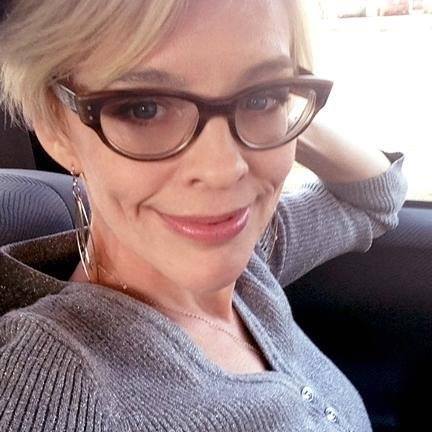
landongodfreynewglasses2014bw

By Landon Godfrey:


INKWELL

When the antique inkwell arrives after making the journey from its dead owner’s estate, the other objects in the atomic ranch house observe it with cool attitudes. Clearly, they think, those curves and etched filigrees bespeak an affection for philosophy or power. Therefore, they shun the inkwell, keeping their own straight lines and unadorned exteriors to themselves. What they never guess: the lonely inkwell is illiterate. Only the masterful sterling silver pen can read.


RECIPE

A moment: when the dough, formed into a ball with greased hands, rests to rise, it exhibits what seems possible in the stone—expansion into space like a star exploding into the full spheroidal grandeur of a self-luminous celestial body. But the mundane violence of the next step overtakes our recognition of energetic brilliance—when we punch the dough and put its deflated body into a furnace, where it will grow again. The stone can grow only smaller and smaller, eroding. It keeps its opinions secret. But hoping to abrade the delusion that traps us in fantasies of an ideal past, sometimes the stone whispers our own noxious monologues to us: I was young and beautiful, my grandmother a princess, her father courageous, our vast estates filled with people who served us, suffering in a gorgeous absence of justice.


SUBTLE HORROR MOVIES

Monster

An immense lizard standing on two legs does not devour the city. The creature nibbles on it at night, while we are sleeping, but we never notice.

Pathogen

Some of us are not immune. We cough and sweat. Our hero is immune. To what, we do not know.

Visitor From Outer Space

We argue about the existence of God. Evidence for both sides: a church that fills with prayer only when it is empty.


Today’s poems are from the chapbook In the Stone, copyright Landon Godfrey 2014, and appear here today with permission from the poet.


Landon Godfrey’s collection of poems, Second-Skin Rhinestone-Spangled Nude Soufflé Chiffon Gown (Cider Press Review, 2011), was selected by David St. John for the 2009 Cider Press Review Book Award. She is also the author of two limited-edition letterpress chapbooks, In the Stone (RAPG-funded artist’s book, 2013) and Spaceship (Somnambulist Tango Press, 2014). Her poems have or will appear in Slice, Bombay Gin, The Collagist, Beloit Poetry Review, Best New Poets, Verse Daily, and other places, and her fiction has been published in Waxwing. A lyric essay is forthcoming in Tupelo Quarterly. Also an artist, she co-edits, -designs, and -publishes Croquet, a letterpress postcard broadside poetry journal. Born in Washington, DC, she lives in Black Mountain, NC.

Editor’s Note: Today’s poems are surprising and full of wonder. Bringing to life the inanimate, telling fantastical stories of that which can only be born of boundless imagination, what unfolds in the storylines of these poems is tempered by carefully wrought syntax, by painstaking word choice, by a sonic soundscape that mirrors and illuminates the worlds it is creating. There is a beauty and a heartbreak to the lyric that is so carefully interwoven with the poems’ narrative that one must be careful not to miss it. But a reader who slows down and savors today’s poems will be treated to moments such as “The stone can grow only smaller and smaller, eroding. It keeps its opinions secret,” and “a church that fills with prayer only when it is empty.”

Want more from Landon Godfrey?
Landon Godfrey’s Official Website
Purchase Second-Skin Rhinestone-Spangled Nude Soufflé Chiffon Gown
View In the Stone chapbook
Twitter

SATURDAY POETRY SERIES PRESENTS: LITTLE SPELLS

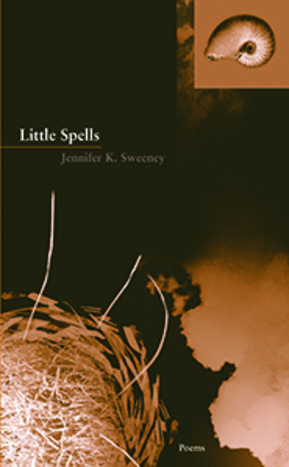
Little Spells Cover

From LITTLE SPELLS
By Jennifer K. Sweeney:


LITTLE SPELLS

We are not witches as fable stoops us
hunchback over caldrons, not women
hobbled sinister by absence though we know
there are tides in our blood that lean us
toward some ancient clock. Still
if ox marrow soup is suggested, the pot readies
and if we return from the Chinese market
with a rough bag of earth tea, our house steep
in the dank reduction of bark and root,
cold air cut heavy with mist.
We may have eaten goose eggs, raw
garlic and sweetbreads, charged our bathwater
with carnelian and held our noses as we threw
back shots of chlorophyll and kombucha.
We may have made closet altars,
placed bowls of royal pollen beneath our beds
and because someone swore it worked,
our underwear may have all gone orange, pockets
filled with quartz turtles, a moonstone at the throat.
If we turn out to be the end of the line,
there are other circles that will flare
like a small cosmos, we know that
creation is a field and a cave and we will be there
churning some broad-winged flurry from the ether.
We know we are not dying but we are
wading in a time-out-of-time
kept afloat by little spells. When will we again
be so studious with our will, omnipresent
of spark and silence and all the rough
honey it takes to set a life in motion?
We are not witches but we know
how to flick the last seeds
of air from a needle
and ease it into the womb
with reverie and we know magic
is its own making,
the power, if there be one,
not in the sung pot or expelled frog
but the fastidious busying
through the terrible
artistry of so fierce a care
as did my dear friend when her boy was born still,
secretly pumping milk through the spring
so that daily she poured a blue cup
over her garden until the blooms ached through.


RAPUNZEL

               beware witches with opulent gardens/be fair wife of increased longing/come
               back to the hunger that undoes/come back to pleasure always the woman/in
               once-upon towers braiding the consequences/be unborn/eat/grow your own rope


TORNADO SIREN

I will remember clutching the ice packs
to my breasts, the way the milk came in,
throttle and burn, so suddenly present
it was a kind of action lunging my body
forward and how the Midwest sky was swollen
with humidity, the cumulonimbus gone
green-black by evening. Four days old,
your body all liquid and howl I gathered
awkwardly in my arms and rocked
past midnight which meant nothing to you
tornado sirens spinning blue circles
across the city and the ground churned
beneath our dilapidated craftsman.
I will remember how we carried you
down to the rickety cobweb dark where you nursed
next to the hundred-year boiler
as the sky wailed and the bare bulb cut
on and off. To have given everything we had
to get you this side of earth and the wind
funneling up a destruction with no god in it,
how terribly small we became
in a throwaway lawn chair
waiting for a freight train
to snatch the house like a dry husk
or pass us by indifferent. I never rested easy
in your pre-life and here, throbbingly new, the world
continued to bleat forsake nothing.
I saw the way anyone would scream
after what they loved in the moment
before the roof fell up or in
as I later watched the faces of Joplin, Missouri
of those who had stashed themselves in salvaged
corners peering out in the wrecked silence
of morning. I will remember
how I understood nothing of what I saw,
the splayed neighborhoods and flattened depots,
love spared or taken,
and how we were raw with beginning, the sobriety
of motherhood anchored me inside
where a white fortress of love and milk
began to shudder into place.


Today’s poems are from Little Spells, published by New Issues Press, copyright © 2015 by Jennifer K. Sweeney, and appear here today with permission from the poet.


Little Spells: “Perhaps the physical and metaphysical are most perfectly one in a woman’s desire to have a child. Jennifer K. Sweeney’s Little Spells makes a stunningly powerful lyric journey into the realm of this desire in poems that engage language, image, myth, medicine, fairy tale and potion as tickets to the depths. She is a poet wooed by the abstraction of transformation and she finds for it a local habitation in the figure of the egg: chicken, ostrich, loon, rotten and that most remarkable totem of all, the human egg as the source of us all. At the level of image, line and vision, this book resounds with ‘the terrible artistry of so fierce a care.’” —Alison Hawthorne Deming


Jennifer K. Sweeney is the author of three poetry collections: Little Spells, newly released from New Issues Press, How to Live on Bread and Music, which received the James Laughlin Award, the Perugia Press Prize and a nomination for the Poets’ Prize, and Salt Memory. She is the recipient of a Pushcart Prize, a grant from the San Francisco Arts Commission, a Hedgebrook residency, the Elinor Benedict Poetry Award from Passages North and two Dorothy Sargent Rosenberg awards. Recent poems have appeared in Academy of American Poets’ Poem-a-Day series, American Poetry Review, Cimarron Review, Linebreak, Mid-American Review, New American Writing, Pleiades, and Verse Daily. Visit her at www.jenniferksweeney.com.


Editor’s Note: It was by sheer coincidence that today’s feature appeared here today–on Halloween. But it is the happiest of coincidences. For today’s collection is rife with magic. Brimming with little spells. Filled with witches and fall leaves turning. Deep-rooted with gnarled and potent tendrils that tap into longing and power. This is a collection that reclaims women’s voices and stories from history, fairy tale, personal and shared experience. Its tales are vivid, its lyric riveting, its essence enchanted. This book is a phenomenal read, and today, on Halloween, it rises from the page, stunning, as if conjured.


Want to see more from Jennifer K. Sweeney?
Jennifer K. Sweeney’s Official Website
Poems With Audio Recordings
Interview about Little Spells
Poem in the Kenyon Review
Interview

Notes Toward a Politico-Sexual Psychology of Consuming Animals

amariehouser3

Notes Toward a Politico-Sexual Psychology of Consuming Animals

by A. Marie Houser

[The following is part one of a two-part essay that begins to articulate, in halting and preliminary ways, a psychology that underpins the consumption of nonhuman animal bodies. Part one articulates that psychology. Part two turns to the ramifications of our efforts as activists and advocates to undo it.]


“The crypt itself is built by violence.”

—Derrida, in the foreword to The Wolf Man’s Magic Word, by Nicholas Abraham and Maria Torok


  1. Black sites & crypts

The black-site pastoral of the farm. Waves of veal stalls, and calves lying on forelegs in segregated patches of grass. There is a specific scene of violence: the farm, its pasture, the slaughterhouse. There are bodies rendered, the vomiting, defecating bodies of sentient chickens hung upside-down, throats slit. These are the physical spaces of the known unknown, where scenes of interrogation play out. Who am I that I am human? On the bodies of animals[1], the question[2] is hammered, filleted, the double question: Who am I that I am human doing this? Who am I that I am not animal?

Follow the question back: a cloud floating inside the cranium of every carnist and former carnist. There is another, closed pasture there. It is a crypt. This crypt precedes consumption of bodies; it exceeds consumption; it accompanies consumption. In the parlance of psychoanalysis, the crypt denotes a space within the ego in which repression buries its desire. The pastoral is a sunshattered crypt.

The crypt is the repository of incorporation. In The Shell and the Kernel and The Wolf Man’s Magic Word, Abraham and Torok, following Ferenczi, define incorporation as a pathological inability to mourn; more, an inability to acknowledge that a loss has occurred in the first place. Incorporation happens when cathexis, of which the loss serves as a reminder, feels so shameful that the only alternative is to secret away the “objective correlative”: the effigy of the beloved. Rather than synthesize aspects of the beloved into the self, the beloved is ejected from consciousness and entombed within the unconscious self.

We are all ghost ships.

The dead cling like confection.

Experiencing other beings is a pleasure—the pleasure of love, care, vulnerability, precarity—the carnist turns from, ashamed, only to resurrect that pleasure in the mutated phantom of cooked flesh. But the suggestion of the libidinal that accompanies any psychoanalytic concept references other pleasures, pleasures with which even advocates and activists are sometimes uncomfortable: aggression, sex. To be animal is to experience both, as Freud said, articulating a human psychology that is at home with and in tension with its animality. The aggression of carnism is itself a phantom form of aggression, distributed through the political and the economic, erecting politico-economic crypts outside the self: the very pastures and sheds and chutes that articulate a vast geometry of suffering, the very rostrums and halls from which flow the laws and economic subsidies that underwrite and perpetuate the shit-and-ammonia-tinged crypts.

There can be no repatriation of cows and other farmed animals. There is only removal to other pastures; safer, we hope, kinder. But there can be no repatriation. That is the saddest fact of all our efforts at activism—a fact known and unknown, both; we keep that fact both known and unknown, removed and at a distance, as we must. Removal is from a space within the human to another space within the human, itself more domestic, itself more pastoral than the pastoralism of the strawbale lie and tractor entendre.

Their homeland is yet human.

Spindles of animals we wind around and around as thread.

***

[1] Shorthand for “nonhuman animals.”

[2] We might say, keeping in mind that the laborers working in slaughterhouses often do so as a last resort, enduring abominable conditions, that the question was placed at the end of the hammer and the knife for them, though undoubtedly, such questions emerge in the course of having to kill and dismember, often with sorrow and regret if not with dissociation and denial, lives and bodies so anatomically close to our own.

SATURDAY POETRY SERIES PRESENTS: MOVEMENT NO. 1: TRAINS


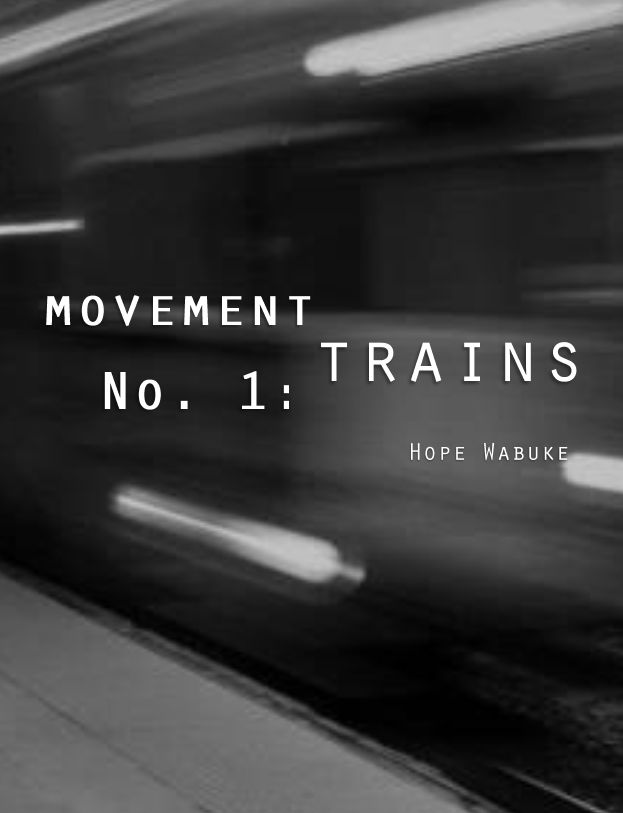
movement_1024x1024


From MOVEMENT NO. 1: TRAINS
By Hope Wabuke:


and when she waits, knowing its coming by the movement of light
across rusted metal, the dirty white tiles of tunnel wall almost
beautiful in the light sliding closer through darkness, approaching
rumble and tearing, metal wheel against track, gears shifting; halt.

in the loud echo still, vibrations pulsing—the only thing. she
imagines the sound she hears is breathing.


it is only when she thinks of him that her body becomes soft; she is
so conscious, then, of the movement of his body pressed against
hers’. so now she slides slightly, left, right, with the swaying motions
of the car. the train is stopped on the bridge, a windy day. the
intercom voice presses through static and she lifts arms above head,
stretches out her body to touch fingertips light to metal pole in
aisle’s center. the violence of the train’s starting and picking up, of
speed. in the meeting of the many tiny bones in her wrist against the
cold hardness, in the press of fingers soft against metal pole. she is
understanding pain in increments of waves, the pulsing slow
softening in rhythm with the traincar, rocking—her body, pushed
backwards, against scratched plexiglass window.

and in the moment of the train’s descent underground, her last view
a mirrored body, lines like chain links against grey sky, grey water.
the shape of their structures, repeating, suspended: a half-circle, a
half-closed eye .


and on the day after his leaving. she notices his absence in the
awkward stillness of her legs, the way her arms hang stiffly at her
sides. this is when she will remember how, as he would touch
drumsticks to upside-down white buckets to make beats, she would
see sound touch tile in tunnel walls and touch heels to ground.
rocking upward in tiny motions, she would lift hands lightly; she
would move her body in tiny circles of his rhythm.


Today’s poems are from Movement No. 1: Trains, published by dancing girl press, copyright © 2015 by Hope Wabuke, and appear here today with permission from the poet.


Movement No. 1: Trains is a city symphony of New York, where the author lived for many years–the daily rhythm of riding the subway and dancing between people walking the streets. Blurring the lines between past and the present, these prose poems explore the movement between love, loss and longing in a young woman’s memory.


Hope Wabuke: Born in exile to Ugandan refugees, Hope Wabuke is a writer, essayist and poet based in California. Hope is a contributing editor for The Root and a contributing writer for the Kirkus Reviews. Her poetry has also appeared in Lit Hub, The North American Review, Potluck Magazine, Ruminate Magazine, Fjords Literary Journal, Salamander Literary Journal, NonBinary Review, JoINT Literary Journal, Weave Magazine, Cease Cows, Kalyani Magazine, Split this Rock and Literary Mama. Her essays and criticism have appeared in Newsweek’s The Daily Beast, Salon, Gawker, Guernica, Dame, The Root, Ozy, The Hairpin, Ms. Magazine online, The Rumpus, Los Angeles Magazine and The Feminist Wire. Her fiction has been featured in the anthology All About Skin. Her chapbook Movement No. 1: Trains was published in June 2015 by dancing girl press. Her second chapbook, The Leaving, will be published in 2016 by Akashic Press as part of Kwame Dawes and Chris Abani’s New Generation African Poets series.


Editor’s Note: Part train ride, part memory, Movement No. 1: Trains takes the reader on a journey through which narrative blends with past, history is distorted by the present, and the tracks of the mind become one with the train lines of the New York subway system. Disjointed in a halting motion that mirrors the jerky movements of an underground train, the sway and lurch of this collection is tempered by moments of clarity and thoughtful reflection: “she / imagines the sound she hears is breathing;” “it is only when she thinks of him that her body becomes soft;” “she / would move her body in tiny circles of his rhythm.”


Want to see more from Hope Wabuke?
Hope Wabuke’s Official Website
Hope Wabuke’s Twitter
Buy Movement No. 1: Trains from dancing girl press
Literary Hub
The Hairpin

SATURDAY POETRY SERIES PRESENTS: HISTORIES OF THE FUTURE PERFECT


HOTFP-cover-front-only


From HISTORIES OF THE FUTURE PERFECT
By Ellen Kombiyil:


CERBERUS AND PERSEPHONE

It’s audible to the three-headed dog:
her fear a high-pitched shriek

held in her throat. Pre-unleashed. The thought
of the shriek and not the shriek itself.

It’s freaking her out, this mind-reader dog,
how he tracks muscle-twitch, her intent to act,

pre-synapsed. He demands to know the before,
before the before: she was plucking flowers,

yes, when the ground opened its mouth,
but how she arrived at this exact spot,

how slowly she chewed and what she ate
for breakfast, how she slipped, stepping

onto the bathmat, her precise existence
at this particular moment—the two-, no

three-second pause at the four-way stop.
Indelible decisions. The luck

of the draw. The dog deciphers
eye-flicker, delves past thought in search of

the anatomy of thought, which moves
like starlight, born but the reaching delayed,

which moves like the gorgeous dark.
He’s doing it again, she thinks,

and he reads that, too. In his pupil-black,
black surrounded by gold flecks, she sees

the pre-patterned repetition
of next and next and next: her mouth, stained red;

she will not be leaving this place, not yet.
This future splits away like a cannon-

boom of sound. Calla lilies, held fast,
she lets drop. The great winding of a clock.


WHILE SIPPING LEMON TEA ON SATURN’S ICE-CLOUD DECK

The distant sun rises, the size of a dime.
Red light looks warm but is cold, the opposite of what I know.

What can’t be unknown: encrypted DNA, curling inside me.
What I google: Orbit: 29 years, 167 days. Rotation: 10.233 hours.

Dizzy days and sleepless nights—elongated years.
I’ve forgotten the outline of my body against you

how I’d reach across your warmth to the nightstand for water.
I am an untethered moon, unloosed from the sun.

Now is no time to panic: remember Sherlock Holmes.
He discards the superfluous, keeps room for important truths.

Human contact is what I’m lacking, so far from home.
Can you see me on the cloud deck, waving my arms?

I’m calling out for connection, any Watson will do:
It’s elementary, my dear; come here. I need you.


JULIET DREAMS OF THE CRYPT

Is it joy, waking to tall ceilings
painted white, inlaid with the smell

of almonds? The blind see colors,
cool heft of objects hand-held.

They do not see what is tarnished.
I’d be lying if I said I knew how

to get to the other side of my heart.
I rehearsed my speech as a child—Love

is a heavy wheelbarrow crushed with
hibiscus
—before pretending to plunge

the knife into my chest. My mouth
at the moment of loss unbinds a thousand

mouths all making the same sound. I practiced
for the day I am blind, when

I will trade myself for one
dram of bottled summer, a lawn

that tickles my neck when I lie down
next to you without expectation.


Today’s poems are from Histories of the Future Perfect, published by The (Great) Indian Poetry Collective, copyright © 2015 by Ellen Kombiyil, and appear here today with permission from the poet.


Histories of the Future Perfect by Ellen Kombiyil is a book of poetry inspired by concepts in astrophysics. Canvassing across time and space to provide a luminescence unafraid of the big ideas, the book itself has what Kombiyil calls a quantum structure. Here we find Galileo’s thumbprint, Kurt Cobain Las Vegas, and Mary Lincoln communing with the dead. The poems themselves are never narrowly historical but rather cosmic in their inflections, taking on subatomic particles, DNA, and black holes, not simply as scientific props but as the very impetus for lyric motion.


Ellen Kombiyil is the author of Histories of the Future Perfect (2015). She is a recent transplant from Bangalore, India, where she lived for nearly eleven years, teaching creative writing and yoga. A fellow at the University of Iowa’s International Writing Program in 2013, Kombiyil’s poetry and fiction have appeared in many journals, including BOOTH, Spillway, Cordite, and Poemeleon. She is a four-time Pushcart Prize nominee and has read, performed or taught workshops at the annual Prakriti Poetry festival in Chennai, the Raedleaf Poetry Awards in Hyderabad, and Lekhana in Bangalore. She is the co-Founder of The (Great) Indian Poetry Collective, a mentorship-model poetry press, publishing innovated voices from India/Indian diaspora. Originally from Syracuse, New York, and a graduate of the University of Chicago, she now lives in New York City with her husband and two children.


Editor’s Note: Ellen Kombiyil’s Histories of the Future Perfect is an absolutely stunning collection, from its opening image to its closing word, soaring and shining with every star and feather in-between. In truth, I am like “the tarot-reading parrot” in the gorgeous cover image by Kalyani Ganapathy, selecting today’s poems by divination rather than choice, because there is far, far too much that is worthy of sharing in this book.

Enter a world where nothing is off limits for exploration: history, mythology, love. Dive to the deepest depths of the ocean and travel as far as the imagined reaches of outer space. Slip into the skin of the philosopher, historian, astronaut, necromancer, classicist, adventurer–all as imagined by the contemplative mind and lyric lilt of the poet. Give yourself over to moments as beautiful as they are thought-provoking–“My mouth / at the moment of loss unbinds a thousand // mouths all making the same sound”–and know that these are the ripples circling out across the waters of this one-of-a-kind collection.

Buy this book. Revel in its beauty. Let your mind drift, weightless. Be carried away.


Want to see more from Ellen Kombiyil?
The (Great) Indian Poetry Collective
Buy Histories of the Future Perfect on Amazon
POEMELEON
Booth

SATURDAY POETRY SERIES PRESENTS: KAREN PAUL HOLMES

Karen Paul Holmes with dog

By Karen Paul Holmes:


VISITOR

A bare branch lounges
in my Adirondack chair
under the Japanese maple–
gray, elegant:
Comforting to me,
now without a husband,
a good omen
in my walled garden
cocooned by snow.


LIFE, ACT 3

Time knows its lines
has spoken them
across our foreheads.
In this stage of living
we censor the critic,
applaud the comedy,
watch the script unfold.
Gravity plays upon
these bodies, while
souls move inward,
heavenward.
The star in me
celebrates the star in you.


“Visitor” first appeared in Town Creek Poetry. Today’s poems are from the collection Untying the Knot (Aldrich Press 2014) and appear here today with permission from the poet.


Karen Paul Holmes is the author of the poetry collection, Untying the Knot (Aldrich Press, 2014), which tells a story of loss and healing with a voice that “pushes readers forward into the unknown with confidence, precision, and empathy,” according to Poet Dorianne Laux. Karen received an Elizabeth George Foundation emerging writer grant in 2012 and was nominated for Best New Poets 2014. Publishing credits include Poetry East, Atlanta Review, Caesura, The Sow’s Ear Poetry Review, Every Day Poems, The Southern Poetry Anthology Vol 5: Georgia, and Stone, River, Sky: An Anthology of Georgia Poems.

Editor’s Note: Today’s poems are full of dichotomies: simple and complex, small and epic. They contain all at once the quiet contemplation of nature, of meditation, of breath, yet their gentile reflectiveness is balanced precisely by the weight of a life lived. This is a life–and a poetry–as simple as a bare branch under a Japanese maple, yet as complex as the comfort of being “now without a husband,” and that being “a good omen.” This is a human experience as small as the lines time “has spoken… across our foreheads,” and as epic as the idea that “The star in me / celebrates the star in you.”

Want more from Karen Paul Holmes?
Blue Fifth Review
Verse-Virtual
Extract(s)
Amarillo Bay
See inside Untying the Knot

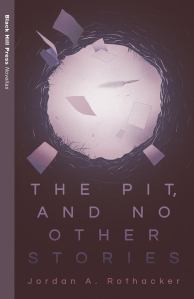
Jordan A. Rothacker’s The Pit, And No Other Stories

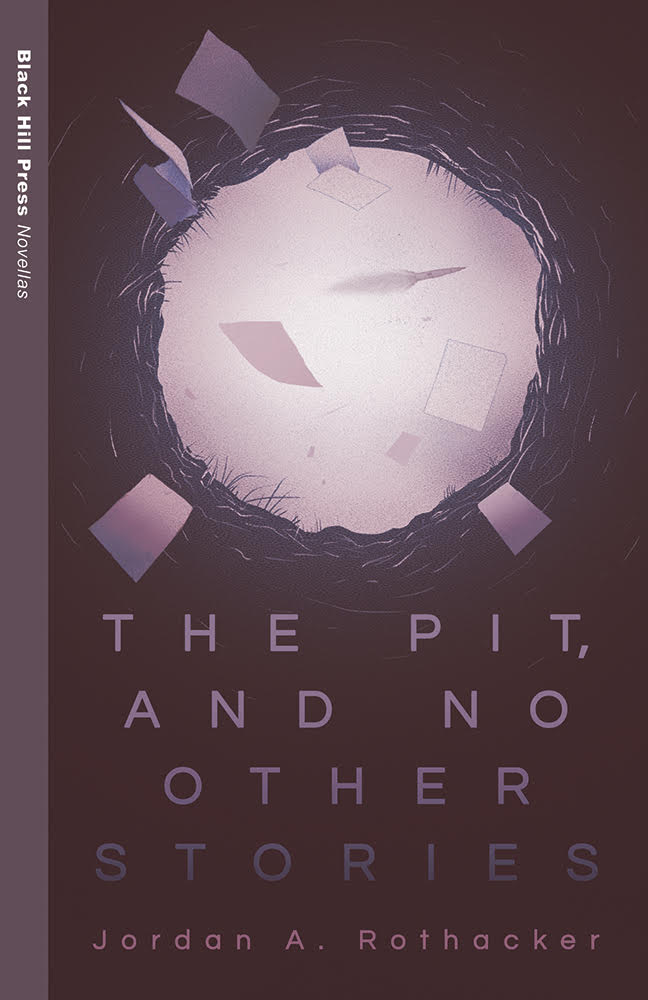
1pitcover

Jordan A. Rothacker’s The Pit, And No Other Stories

by Melissa Ximena Golebiowski

“The Pit is a journey in itself, a ride with flashes of life and an ending in a place, in a world, you didn’t quite anticipate.”

Rothacker opens his novella with a vivid image of a small community in which all inhabitants eventually are hurled into, well, a pit. Just as the title suggests, the Pit is our central location. In a town, aptly named Pittsville, our narrator who remains as mysterious as the Pit itself has ventured down below in search of a watch promised to him by his grandfather upon his deathbed. The first chapter pulls the reader into a world where the inevitable is a focal point, and hints at it as something to strive towards. This is not a world of traditional burials and ash scattering; once someone has expired they are given to the Pit in a funereal fashion. After the narrator witnesses his grandfather “going over” with this promised watch still secured to his cold wrist, he sneaks out to see just how far he can reach to get back what was meant for him. As soon as he falls in, Rothacker changes the channel.

We land in 1959 New York City, inside the office of a private investigator in conversation with a potential client who has no more information on his target than a nickname, The Speckled Hen. Not only have the time and place transformed, the way of talking and character’s tones are completely new. There is a hardboiled feeling added to the plot–yet a dark curiosity felt with our first character remains within this American Noir portion of the novella. This curiosity, along with the Pit, continues to rise, fall, and rebuild itself throughout the remainder of the novella.

From the P.I.’s office, we are taken on a wild ride through rainy Shanghai in 1945, fast forward to a Hollywood in 1982, drop down to Chicago in 1956, eventually falling further back in time to 1812 West Africa. There is a natural attempt to piece together the characters encountered in these various time periods and locations but Rothacker turns the corner so rapidly that the threads seem to unravel quicker than they’re sewn. This isn’t a jab at Rothacker as his chapters are packed with enough life to quickly settle you into your new environment. He’s done the research and taken the time to carefully craft the people we experience within a limited space. Many of the voices we find in The Pit are as varied as the stories we find them in. There are moments of West African Islamic Law, Mao’s takeover, and UFO sightings. Some characters return while others make a single yet impactful appearance such as an American Indian grandmother from 180 BC who begins a journey from which she may not return. However, everyone we encounter eventually meets a very similar fate that is difficult to ignore.

The Pit is an existential take on the after-life, the talk of where we go afterwards except modeled by an almost tangible place. The Pit, And No Other Stories is exactly what is presents itself as, it may seem at first as if the first six chapters serve as seven different stories all beginning with our unnamed character who falls into the Pit accidently, but slowly they begin to intertwine and unwind until we realize that there is indeed, only one story here. It is a novella full of histories and ideas. It is a story about the trials and obstacles that fall into our path as we desperately try to unearth the genius within something we deeply care for.

The Pit is a journey in it self, a ride with flashes of life and an ending in a place, in a world, you didn’t anticipate but because of Rothacker’s craftsmanship, you find yourself wholeheartedly accepting.

An Interview With Jordan Rothacker:

M: The Pit, And No Other Stories is just that, what a brilliant title, it takes place within many time periods and places, with a variety of voices. When did you stumble upon this idea? Did you fear for your reader? (Meaning, because there were so many sub plots though they all tied into a bigger portrait…)

J: Thank you. I worry that the title is cumbersome, especially when people ask, “So you wrote a novel, what’s it called?” and I tell them and then they ask, “Is it a story collection?” and I say, “No, it’s a novel. It’s The Pit, and No Other Stories.” I occasionally feared for my reader, but ultimately I trust my reader. Due to television shows like Lost or really so much in film and television and literature, people handle far more non-linear narrative than they realize. And of course it’s linear when it comes down to it. You start at the beginning of the book or film and you read and watch to the end, a straight line. William S. Burroughs used to talk about, in the 50’s and 60’s, how literature was behind visual mediums, but ultimately it is the way humans naturally tell stories, we jump all over the place, we digress, we give flashbacks and even flash forwards as we hint to the punch line of the story before we get there. In some ways I see The Pit as a more accessible or dumbed-down version of what Burroughs has done in so many novels in regards to form or what Italo Calvino had a good time playing with.

M: I’ve studied many religions myself though not to your degree or level. What influence would you say your M.A. in Religion had on this novel? What about the ideas of death within the religions you’ve studied?

J: The first novel I wrote, about ten years ago, is very much a religious novel. I actually took on the M.A. in Religion as research for the book (which is set in Atlanta and the reason why I did the MA in Georgia) and my M.A. thesis was comprised of two chapters from the book followed by an exegesis and annotations. I specialized in religion and literature in my coursework. It’s a discipline mostly coming out of Chicago and it is often said to begin with a text like The Heart of Darkness. Horror and horror in the face of the Modern is explored in this study. I also got into post-colonial studies and now combine that with romanticism in my PhD work and dissertation. Both Romanticism and Post-Colonialism are a reaction to the Enlightenment in their own ways. They seek to return a voice—and power—to those marginalized by the Enlightenment Project, so that includes the feminine, the indigenous, the non-white, the pagan, and often merely the religious, for religions are irrational, like the arts. All the “Others” of the often male, rational, white, Euro-American “Self.” While writing The Pit these thoughts certainly got in there. I thought about Burroughs a lot as I wrote this book and I often think of him in a religious context, as a mythmaker like Borges, Faulkner, Danilo Kis, and Amos Tutuola, like Hesiod, or Snorri Sturluson who wrote the Eddas. The Pit for me is a roundup of how I see different American myths. As far as a religious connection with death, I mean, it’s right there in the first chapter, The Pit is a funereal site. This weird small town gothic setting has a secret from the outside world that involves how it handles death. There is a lot of death and religion in the book, come to think of it. I think you’re on to something…

M: Reading through the novel, I couldn’t help but feel similarities within other greats that I’ve read, particularly Slaughter House Five by Vonnegut. Was this an inspiration for you? What other inspirations did you have writing this?

J: I hadn’t thought of that Vonnegut book, but without giving anything away for someone who hasn’t read The Pit yet, I can kind of see it in the “outside of time” stuff. I do like that book though; I re-read it a few years ago on the plane over on a visit to Dresden. It certainly enhanced my Dresden trip. As for other inspirations, I got to meet Margret Atwood at a reading a few years ago and I was so giddy, she’s so great. One of her books that had a great effect on me I read back when I was like 19. It was a slim collection called, Murder in the Dark. It was the perfect book for that age, too. It showed me how ok it was to break down form in a really interesting way and how much can be done with so little space. The Pit was about me returning to that youthful excitement of playing with form. For some reason in my twenties I couldn’t feel legit without writing a long naturalistic novel. That novel has yet to be published, but direct inspirations for The Pit would be Burroughs’ Cities of the Red Night and Italo Calvino’s If on a Winter’s Night A Traveler.
Romanticism and Post-Colonialism are a reaction to the Enlightenment in their own ways. They seek to return a voice—and power—to those marginalized by the Enlightenment Project, so that includes the feminine, the indigenous, the non-white, the pagan, and often merely the religious, for religions are irrational, like the arts. All the “Others” of the often male, rational, white, Euro-American “Self.” While writing The Pit these thoughts certainly got in there.

M: What about some subconscious inspirations, who are your favorite writers?

J: That’s always a tough question, but I guess it’s a bit easier than asking what my favorite book is. For that question I’d give you a list of books, most likely categorized. Of living writers I have a deep love and appreciation for William T. Vollmann. His brilliance, breadth, and proficiency is really seen in an artist, as well as the heart and social conscience he brings to his work. Reading him makes me a better writer, thinker, and person. Some times I say he is our Tolstoy and Dostoevsky wrapped up in one.  He is one of the great living American writers and for skill and importance I put him up with Toni Morrison, John Edgar Wideman, Cormac McCarthy, and Thomas Pynchon of our country today. As far as other favorites go, Maggie Nelson is brilliant and the way her mind is able to harness great thoughts and deliver them with such style gets me really excited. I really love Steve Erickson and look forward to a new book from him next year and Cesar Aira blows me away. Writers of the past who get me super excited—just the first few that spring to mind—are William S. Burroughs, Anna Akhmatova, Hesiod, Ovid,  Ousmane Sembene, Frantz Fanon.

M: This novel really ignites existential thought, not only through the construction but the ideas presented, ideas many people avoid. I found myself, while reading the novel, constantly thinking and venturing into deeper places. Was this the intention you wanted for your reader? Or did you envision the reader at all?

J: I love that you read it as existential. I mean I finished it after really loving what a perfect creation the first season of True Detective was. That show brought me back to reading Schopenhauer, Nietzsche, E.M. Cioran, as well as the Ligotti and Chapman that inspired it; and Vollmann had just published his gothic masterpiece, Last Stories and Other Stories. Delving into that infectious darkness, letting the pessimism wash all over you can be an engaging journey. I have to live in the world and get up every day and experience the joy and beauty of life and the people I love, but I never stop thinking about how humans are the worst species, that ultimately we are doomed. People love going to these places, the fantasy of darkness, horror movies, and literature. The arts let us tour these dark places. That’s why I think of this as an entertainment or a jive book. I’m glad it made you think and I hope it makes others think and value life in regards to death, but there are a lot of people in this world, this country and abroad, who don’t have the luxury of dabbling in darkness because they live some pretty awful situations. There’s one book that I read last year, which still haunts me deeply entitled The Corpse Exhibition, by Hassan Blasim. He is an Iraqi who now lives in Finland. The book is a collection of stories all set in contemporary war-torn Iraq. They are masterful and horrific, sometimes even surreal, and very hard to characterize. I’ve called them “war-zone gothic” for lack of a better term. Though the stories are macabre and might feel like horror writing, the thing that hits you the hardest is to know that they are based in an awful, awful reality that is part of daily life for so many people.

M: Where does death come into all of this? Does it? You seem to bring a metaphorical sense of death and sit it next to concrete examples.

J: The pit of the title is a funereal site for many who encounter it in the book. For others it involves new life in a weird way—but I’ll give no spoilers. There is a real cyclicality about life and death that flows through this book. It’s hard for me to imagine this giant deep Pit that is described in the first chapter without thinking of Ouroboros. That ancient Greek symbol loved by alchemists. It is the “tail-eater” and like many great serpents of myth—the Midgard serpent comes to mind—it is often associated with beginnings and ends. So, it is all about death but also new life, kind of how the Death card in the tarot just represents change. In some ways, and I don’t want to give too much away, but it seems like, in the book, that inside the Pit is a sort of liminal space, or a bardo, as mentioned in some Buddhist teachings. A between life and death, a place of becoming and potency, the place where the shaman or the artist goes in their practice. Hemingway was asked once what he thought about death, and he replied that it was “just another whore.” Maybe in The Pit it’s “just another trope” or “just another metaphor.”

M: You bring life to characters from many different walks of life (Black Muslims, American Indians, Chinese, even a man who sees a UFO), what sort of research was involved with this?

J: That’s the fun of a book like this and the restrictions I had upon myself: each section and plot line involved its own problem solving. Some sections required research by studying maps, digging through histories and chronologies, and some sections were just pure imagination pouring forth. I’ve taught an African Diaspora Literature class at UGA I think 20 different times over six years and yet still I went in to telling my own original slave narrative from a cautiously researched place. The device of that narrative voice in those sections worked out pretty well.

M: Why did you choose the particular backgrounds and stories you chose?

J: The whole book began for me with that first story and writing it to try my hand at this American trope of the small town gothic, a Shirley Jackson or even Mark Twain type thing. And then it became for me all about exploring all the different American tropes I like, the detective noir, the sc-fi, the southern slave narrative, a nautical/pirate story, Native American folklore, a desert roadtrip, aliens sightings over a cornfield, the tragic Hollywood fall of an actor, and even corporate business. Some are, of course, more serious than others and I spent the most labor and worry over the Native American and the African American slave portions.

M: I took note of some sentences that stood out to me, would you mind elaborating or explaining your thought behind two of them for fun?

J: Sure!

M: “With his father gone, Quentin stopped even pretending to hide how free Amadou really was, or how integral he was to the business… The African-American experience is the most important lens by which to understand America itself.” I was really intrigued by this.

J: In Steve Erickson’s last novel, These Dreams of You, a great book about race in America—so good that I even taught it despite the fact that he is white—he mentions that the American Dream belongs most to the African-American because it was betrayed for them (their ancestors) en route and yet they have stayed for generations and made America home despite the betrayal.

M: “I watched the black bile sparkle and pour from my mouth like stars from a pitcher in the sky… But to her my front was an appetizer. And she was the most frightening and real woman I’d ever met.” The imagery in of a pitcher filled with stars is very poetic.

J: That image just came to me; I think I was picturing something astrological, like a medieval drawing of Aquarius maybe. I guess I also pictured how activated charcoal would look if one were to vomit it. I’ve never tried ayahuasca actually.
The Pit, And No Other Stories is out now from Black Hill Press. You can grab your copy here.

***

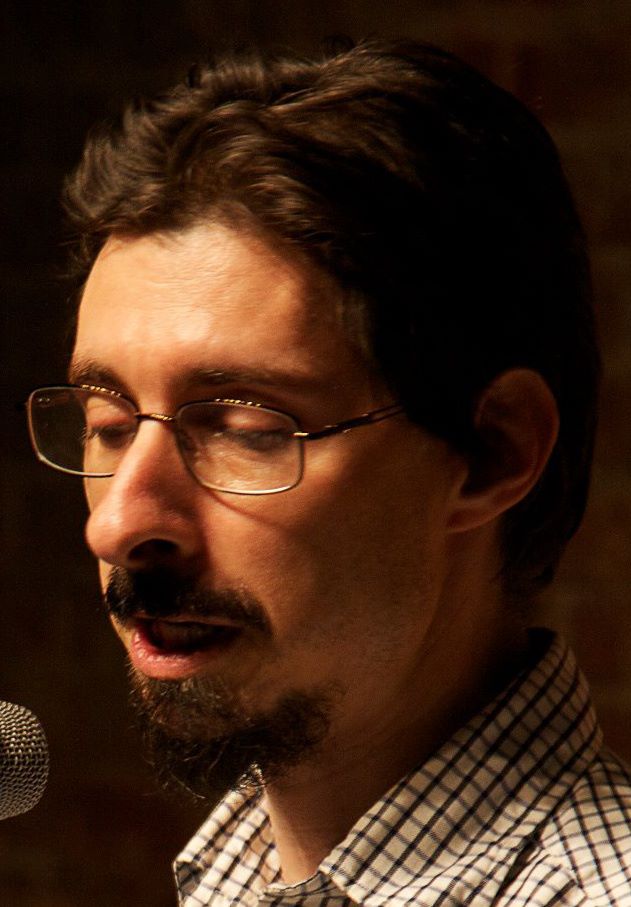
Jordan A. Rothacker is a novelist, poet, and journalist who resides in Athens, Georgia. He received his MA in Religion from the University of Georgia and is currently a doctoral candidate in Comparative Literature. His dissertation-in-progress is titled On Cultural Guerrilla Warfare: Art As Action. Rothacker’s journalism can be found in the pages of magazines as diverse as Vegetarian Times and International Wristwatch and his fiction, poetry, and essays have appeared in such periodicals as The Exquisite Corpse, Mayday, Curbside Splendor, Red River Review, As It Ought To Be, Dark Matter, and Dead Flowers: A Poetry Rag. He was also a contributor to William T. Vollmann: A Critical Companion, which published this past December. Three of his favorite things to talk about are sandwiches, indigenous land rights, and his cat, Whiskey.

Melissa Ximena Golebiowski is a writer and literary marketer based in New York City. Her poetry was most recently published in Noah Literary Magazine. She is currently at work on a novel. @MelissaXimena

Black Hill Press is a publishing collective of a growing family of writers and artists dedicated to the novella—a distinctive literary form that offers the focus of a short story and the scope of a novel. Their independent press produces uniquely curated collections of Contemporary American Novellas.

SATURDAY POETRY SERIES PRESENTS: JEN KARETNICK

Jen Karetnick Head Shot

By Jen Karetnick:


ON THE WAY TO SEDER, MY HUSBAND ANSWERS

phone calls from patients, their parents or partners,
repeating what he has already said half-a-dozen times

in the office—“I know the auras are uncomfortable,
but they’re better than grand mal seizures, and that’s

what the meds will help to prevent”— and dispensing
predictions no one wants to hear—“No, I don’t think

he’ll come home; the stroke was catastrophic”—but
are asked for over and over in the hopes they will change,

while I shush the kids in the backseat, stop them from shouting
with too much apparent joy in their voices, keep the radio

playing Lady Gaga’s “Telephone” turned down. Soon
we will dissect the Seder plate, digest the bitter

herbs, finger the salt dried on the easily torn skin
of faith. We will recite the plagues: boils, murrain,

the lice we have been visited by several times this year.
On this night, we will open the door for a rogue spirit

who might drink our wine but not heal vertigo; on this night
we will recline on a pillow that can’t fuse a broken

spine. On this night, the cell phone chirps and sings,
and there are no miracles beyond what can be doctored.


THE INVENTION OF AMNIOCENTESIS

Mother, in your womb I am an experiment.
You pass on not immunity but its silvery underside,
give permission for the needle like an arrow to
birth holes in this temporary home, sip the fluid
like a taster of fine wines without the benefit of
a visible image. No bigger than a black widow
spider, the doctors must guess where I am,
and agree there is nothing to be done.
I am poison to both of us. Unsafe
harbor, you insist on mooring me to
your designated slip, tossed by rash after
rash of storms. I will remove myself early. Still ill,
of course you will not care for me right away. Of all the
eggs you might have nourished, I am the one who breaks you.


WOMEN ON THE VERGE DISCUSS VIAGRA

Stamina. From the Latin stamen,
meaning thread of woven cloth. Plant parts
resemble the warp and woof, but old farts?
The boost was designed for the impotent,
not the young at heart. They can’t afford
to see the blue of detached retinas
when the sky has already claimed those hues
and the days for viewing them are numbered.
How ‘bout a pill to make them remember
to take out the garbage or mow the lawn?
One to defoliate the nose hairs grown?
Or better: to spark conversational vigor.
No chance of that? Then don’t bring it on.
This is the last thing, the last thing we want.


“On the Way to Seder, My Husband Answers” was previously published in The Healing Muse. Today’s poems are from the forthcoming collection American Sentencing (Winter Goose Publishing), and appear here today with permission from the poet.


Jen Karetnick is the author/co-author/editor of 14 books, two of them forthcoming: American Sentencing (poetry, Winter Goose Publishing) and The Treasures That Prevail (poetry, Whitepoint Press). In addition to poetry, she writes lifestyle books, the most recent of which is the cookbook Mango (University Press of Florida, 2014). Her poems, prose and playwriting have been widely published in literary and commercial outlets including TheAtlantic.com, Cimarron Review, december, Miami Herald, North American Review, Poet’s Market 2013, Poets & Writers, Racked.com, River Styx, Spillway, Submittable.com, Valparaiso Poetry Review and Virgin Atlantic Airlines. Based in Miami with her husband, two teenagers, various rescue pets and 14 mango trees, she works as the Creative Writing Director for Miami Arts Charter School and as the dining critic for MIAMI Magazine.

Editor’s Note: Jen Karetnick expertly catalogues the vast and startling spectrum of life, from the mundane to the monumental, from humor to horror. Amidst the stories that unfold are stunning and heartbreaking moments of lyric: “Soon we will dissect the Seder plate, digest the bitter // herbs, finger the salt dried on the easily torn skin / of faith;” “Of all the / eggs you might have nourished, I am the one who breaks you.” And that beauty is balanced by the hilarious and the absurd. Of viagra, a group of women posit, “How ‘bout a pill to make them remember / to take out the garbage or mow the lawn? / One to defoliate the nose hairs grown? / Or better: to spark conversational vigor. / No chance of that? Then don’t bring it on. / This is the last thing, the last thing we want.”

Want more from Jen Karetnick?
Read poems from Brie Season
Buy Brie Season on Amazon
Buy Prayer of Confession from Finishing Line Press
Buy Landscaping for Wildlife from Big Wonderful Press
Read more of Jen Karetnick’s poems and prose

The Myth of the Apolitical American Poet

1mty

The Myth of the Apolitical American Poet

by Michael T. Young


I recently heard a poet complain that the poets he friended on Facebook seemed more like activists than poets. He was considering leaving Facebook until after the election so he didn’t have to listen to the ranting and debating. I thought this was a good thing—the activism that is. It was also proof of what I’ve always argued: that American poets are deeply engaged in the relevant issues of our day.


There’s an assumption that American poets don’t engage politics or social issues. We’re believed to be only concerned with our personal lives and to write only about that. To most Americans our poets are all confessional in the worst sense of the word and write only an obscure, self-absorbed poetry and this is why they aren’t read. However, this is a myth. Although we engage personal issues, it is through them that we engage the true social and political issues of our day and this is the way to be most fully engaged. Take a poem like “Charlie Howard’s Death” by Mark Doty. Charlie Howard was a teenager who was murdered in 1984 because he was homosexual. Three other teenagers chased him down and threw him over a bridge into a river, though he protested that he couldn’t swim. Doty wrote a poem that is not only personally relevant since he is also a gay man, but one that is emotionally powerful and complex, aesthetically beautiful and socially relevant since gay rights are among the most relevant of socio-political topics of our time. Much of Doty’s poetry deals with gay issues, and these are both personally relevant and relevant to the larger cultural setting of our day.


Another poet who engages both socio-political topics and personal issues simultaneously is Gerald Stern. For instance, in his poem, “The Same Moon Above Us,” he imagines a homeless man as the exiled Ovid, which also allows him to identify with Ovid as a poet and thus the three become one and the poem on one of its levels is a commentary on poverty in America. Poverty is exile, and like the exile they are granted no voice because judged already. Who among the homeless are our exiled Ovids, which of them may be an unsung Milton or Keats? Another of Stern’s poems is “June Fourth,” which with subtlety engages the perspective of a worker and the authority that oppresses him. In a short span it ropes together everything from the metaphysical to the economic in a nuanced language about power and what creates the fertile ground of revolt. The poem is set in the world of factory life for Bethlehem Steel. It confronts the core issues embodied in the Occupy Wall Street Movement though written decades ago.


This kind of socio-political engagement can be found in many contemporary poets such as Cynthia Atkins, Okla Elliott, Barbara Elovic, Richard Levine, Djelloul Marbrook, and Joe Weil, just to name a few. Furthermore, many poets are politically active in some respect. Richard Levine identifies himself as a political activist and is quite busy working against fracking in New York. Djelloul Marbrook is a former journalist and, for many, is a source of alternative views to the standard media outlets like the New York Times or CNN. And it is not only these poets who are not nationally known or winning our biggest prizes who are so engaged. For instance, Wendell Berry, in addition to being a magnificent poet, and a recipient of a National Medal of Arts and Humanities, has spent his life writing about and defending small farmers against large corporations and monopolies. In many ways, he was fighting the power of the 1% long before those in Occupy Wall Street were born.


To highlight both their political activism and their engagement with issues in their poetry, is not to argue that our poets use poetry in service to politics or as a mere linguistic soapbox. Nothing could be worse or a greater artistic torture to endure. Our poets know this. If not explicitly, at least implicitly, they know what George Oppen argued, that “the good life, the thing wanted for itself, the aesthetic, will be defined outside of anybody’s politics, or defined wrongly.” Thus to engage the socio-political concerns of our time or any other, is to do it from the point of view of the personal, of the individual life lived. Our poets are in the position to be more clearly engaged with the real issues because they approach them from the point of view of living and not from the stance of rhetoric.


As the myth about the Romantics being non-political crystalized around their actively creating this image, so too the American poet as an apolitical writer intent only on the reality of his immediate world was created by those poets. Our poets often insist on concrete rather than abstract work, the immediate and visceral rather than the remote and intellectual. I think that insistence in theory has resulted in an image that is not true to practice. One reason for it may be that our poetry’s language is the opposite of political speech, which is always evasive, abstract, an incantation of generalizations meant to charm you to sleep and vote. Poetry is meant to wake you up.


Most of the Romantics were active supporters of the French Revolution, much of Blake’s poetry is charged with socio-political concerns and Byron himself died fighting in the Greek War for independence. The critic, Jacque Barzun, wrote a brilliant book called Classic, Romantic, Modern, which debunked the myths about the Romantic poets, one of those myths being that they had no interest in politics. In much the same way, a book could be written debunking this same myth about American poets. But I think a better thing to do is read American poetry and pay attention to the socio-political realities underlying their themes.


If Americans spent a little time reading their poets, they would wake up to the fact that America is rich with a poetry that engages every relevant issue of our time from the personal to the political, and might even learn that most poets realize these can’t be separated. To live life in a democracy is to be political. To grapple with the issues of your daily life and to write about them is to comment on and confront the reality of the republic in which we live. It might also give us, as a country, pause to wonder why exactly our poets are not more widely read since it is not because they don’t address issues relevant to our lives. They are, in fact, more concerned about what’s happening in our country than most. And maybe that’s really why they aren’t read, not because they don’t engage the important issues but precisely because they do. Most other Americans would rather watch a sitcom, wrapping themselves in its humorous triviality, like a child imagining the blanket he pulls over his head can protect him against anything that might emerge from the darkness while he sleeps.


HAPPY HIGH HOLIDAYS FROM THE SATURDAY POETRY SERIES

ShalomSalamPeaceIsraelisPalestinians


The Saturday Poetry Series will be on hiatus for the Jewish High Holidays while your faithful editor takes a much needed vacation. We will return on Saturday October 3rd.

In the mean time, enjoy some Israeli-Palestinian peace poetry!