Sunday Poetry Series Presents: Leonard Kress

.

CHARLES AZNAVOUR’S GOT SOUL LIKE A MOTHERFUCKER

by Leonard Kress


My shortcomings are my voice, my height, my gestures, my lack of culture and education, my frankness and my lack of personality…. I am incorrigible … I say ‘merde’ to anybody, however important he is, when I feel like it.

—Charles Aznavour

***

“Come to my suite at the Bellevue-Stratford,”

Grossman said, urgent and tense. “I’ll treat

you to the most splendid meal I can afford.”

In Philadelphia, this was the seat

of glitz: grand chandeliers in the lobbies,

plushness to end all plush, crushed velvet

Bellhops and clerks from earlier centuries—

spit-polished pumps, braided epaulets.

Then came the plague of Legionnaire’s Disease

and scores of legionnaires from upstate hamlets

died or nearly died. And their survivors,

dumpy in their fezzes, downing shots

between tall drafts, slim-jims, popping beer

nuts—why did this plague choose us, they wonder?

“Come to my suite,” said Grossman. This was before

all that, before the grand hotel went under,

auctioned off, renamed. I went to visit

him that night, explained to him with candor

why I quit my job at the psychiatric

hospital, where he’d been in the men’s

locked ward, treated with electric shock

while I held down his charged and flapping limbs.

When he arrived he was too medicated

to talk, his chart so chock-full of nonsense

like all charts there, narratives created

by English majors serving as COs

opposed to Vietnam. I loved James Hood’s, which stated

he’d never known a night that didn’t come to blows

or sex, and always with a different foe

or girl, and skeptical he’d ever lose

count—an entourage he kept in tow

to keep his tally. Dark with greased-back hair,

hobnailed boots and tight jeans, a pack or two

of smokes twisted into his tee, not a care

that he was, in fact, locked up. I suspected

that a fellow aide, a Curtis voice major,

who’d just seen Don Giovanni, concocted

the tale, for James was scarless and his skin

smooth, a stipple of bristles that never connected

to form a beard. Emerging from a thorazine

stupor, Grossman was thrust into my ward

where I would be his keeper. Written in

his chart—“patient delusional, declared

a vibrator was stuck in his posterior,

and turned on high, implanted there, he feared

by homosexual aliens to mate with inferior

beings like him.” Another prank, I thought,

too many English majors working here

avoiding the draft. But here he was, slippers

and robe, amphetamine-buzzed, among the dead

slugs of my ward. On TV Charles Aznavour

was singing “I hate Sundays,” and when someone said,

“Change the channel, I hate everything French,”

Grossman flew into a dreamy rage that turned sad,

“that guy’s got soul like a motherfucker,”

as Aznavour crooned: I’m drunk/And staggering

I shout loudly/ That the little cops are

all my friends. Grossman ignored the badgering

ward—their voices and conspiracy of death wishes—

and won me over, crooning along, hugging

himself to intensify longings to smother his

demons. Weeks later when we meet

at the Bellevue, he storms the lobby, thrashes

his arms, demanding that I cover his bill and treat

him to the meal he’d promised me. Grossman grown

shorter, rat-like, like he’d been groomed in the street

since his release. As though he’d been kicked in the groin

repeatedly, his rounded shoulders like a hump

under his suit. I’d come, he thought, to join

his ratty rampage—soulful, belligerent, and tortured.


Leonard Kress’s 4th poetry book, The Orpheus Complex, was just published by Main Street Rag.  He is also the author the chapbook Orphics (Kent State Univ Press). He has published poetry, fiction, and translations in APR, Iowa Review, Massachusetts Revew, Crab Orchard Review, etc.  He has also completed a new verse translation of the 19th century Polish Romantic epic, Pan Tadeusz, by Adam Mickiewicz, and was recently a guest at the International Poetry Festival in Warsaw, Poland.  He teaches creative writing, philosophy, and religion at Owens College in northwest Ohio. The above poem is used by permission of the author and of Another Chicago Magazine, where it was originally published.

SATURDAY POETRY SERIES PRESENTS: MARTIN CAMPS

By Martin Camps:

DO YOU STILL WRITE POETRY?

They ask
               sometimes
as if it were a demise
in need
           of a cure
No one asks a doctor
are you still curing people?
             Yes,
I have not
been cured at all.


PERSISTENCE OF WATER

Poetry is not carried in vessels of mud.
I said: I will stop writing, one or two years,
Let poetry speak through other mouths.
I will forget. I will not be called a poet.
Now I will be a teacher, a laborer, an employee.
I will not listen to the inner anthill,
this noise of sheets waved by the wind.
But poetry finds its way,
Like water that filters through
a wall of plaster.
And to begins again,
as if from fear, to suffocate
the noise of the leaves.
Poetry does not spill like wine,
it is not exchanged for thirty silver coins,
it does not even hide like talents in the ground.
Poetry shatters your mouth.


T. REX AT THE ACADEMY OF SCIENCES

How
hungry
time
is
to
leave
us
these
clean
bones


Martin Camps has published three books of poetry in Spanish: Desierto Sol (Desert Sun, 2003), La invencion del mundo (The Invention of the World, 2008), and La extincion de los atardeceres (The Extintion of Twilight, 2009). Has is the recipient of two poetry prizes from the Institute of Culture of Mexico and an Honorable Mention in the Bi-National Poetry Prize Pellicer-Frost in 1999. His poems have been published in The Bitter Oleander (Pemmican Press), Alforja, and Tierra Adentro, among others. He answers all email at markampz@hotmail.com.

Editor’s Note: Martin is one of the most innovative poets I know. I have seen his poems in video format, power point, as if an investment brochure, and laid out on the page so that form mirrors meaning. Sometimes political, often comedic, and always heartbreakingly good, Martin masterfully illuminates both his own experience and that of the Poet at large.

Want more of Martin Camps?

Buy his books online, or email markampz@hotmail.com to buy them directly from the poet for $6 each.
Peticao a NASA
La Belleza de No Pensar
Mosquitoes

DENNIS KUCINICH

Jello Biafra at the Variety Theatre in Cleveland, Ohio, 1986, wearing a slogan in support of  ousted Mayor Dennis Kucinich who had refused to sell Cleveland’s publicly owned electric utility. Photograph by Steve Wainstead.

WHY I VOTED NO

by Dennis Kucinich


Washington, Nov 7 –

After voting against H.R. 3962 – Affordable Health Care for America Act, Congressman Dennis Kucinich (D-OH) today made the following statement:

“We have been led to believe that we must make our health care choices only within the current structure of a predatory, for-profit insurance system which makes money not providing health care.  We cannot fault the insurance companies for being what they are.  But we can fault legislation in which the government incentivizes the perpetuation, indeed the strengthening, of the for-profit health insurance industry, the very source of the problem. When health insurance companies deny care or raise premiums, co-pays and deductibles they are simply trying to make a profit.  That is our system.

“Clearly, the insurance companies are the problem, not the solution.  They are driving up the cost of health care.  Because their massive bureaucracy avoids paying bills so effectively, they force hospitals and doctors to hire their own bureaucracy to fight the insurance companies to avoid getting stuck with an unfair share of the bills.  The result is that since 1970, the number of physicians has increased by less than 200% while the number of administrators has increased by 3000%.  It is no wonder that 31 cents of every health care dollar goes to administrative costs, not toward providing care.  Even those with insurance are at risk. The single biggest cause of bankruptcies in the U.S. is health insurance policies that do not cover you when you get sick.

“But instead of working toward the elimination of for-profit insurance, H.R. 3962 would put the government in the role of accelerating the privatization of health care.  In H.R. 3962, the government is requiring at least 21 million Americans to buy private health insurance from the very industry that causes costs to be so high, which will result in at least $70 billion in new annual revenue, much of which is coming from taxpayers.  This inevitably will lead to even more costs, more subsidies, and higher profits for insurance companies — a bailout under a blue cross.

“By incurring only a new requirement to cover pre-existing conditions, a weakened public option, and a few other important but limited concessions, the health insurance companies are getting quite a deal.  The Center for American Progress’ blog, Think Progress, states “since the President signaled that he is backing away from the public option, health insurance stocks have been on the rise.”  Similarly, healthcare stocks rallied when Senator Max Baucus introduced a bill without a public option. Bloomberg reports that Curtis Lane, a prominent health industry investor, predicted a few weeks ago that “money will start flowing in again” to health insurance stocks after passage of the legislation.  Investors.com last month reported that pharmacy benefit managers share prices are hitting all-time highs, with the only industry worry that the Administration would reverse its decision not to negotiate Medicare Part D drug prices, leaving in place a Bush Administration policy.

“During the debate, when the interests of insurance companies would have been effectively challenged, that challenge was turned back.  The “robust public option” which would have offered a modicum of competition to a monopolistic industry was whittled down from an initial potential enrollment of 129 million Americans to 6 million.  An amendment which would have protected the rights of states to pursue single-payer health care was stripped from the bill at the request of the Administration.  Looking ahead, we cringe at the prospect of even greater favors for insurance companies.

“Recent rises in unemployment indicate a widening separation between the finance economy and the real economy.  The finance economy considers the health of Wall Street, rising corporate profits, and banks’ hoarding of cash, much of it from taxpayers, as sign of an economic recovery. However in the real economy — in which most Americans live — the recession is not over.  Rising unemployment, business failures, bankruptcies and foreclosures are still hammering Main Street.

“This health care bill continues the redistribution of wealth to Wall Street at the expense of America’s manufacturing and service economies which suffer from costs other countries do not have to bear, especially the cost of health care.   America continues to stand out among all industrialized nations for its privatized health care system.  As a result, we are less competitive in steel, automotive, aerospace and shipping while other countries subsidize their exports in these areas through socializing the cost of health care.

“Notwithstanding the fate of H.R. 3962, America will someday come to recognize the broad social and economic benefits of a not-for-profit, single-payer health care system, which is good for the American people and good for America’s businesses, with of course the notable exceptions being insurance and pharmaceuticals.”

–Dennis Kucinich

This piece first appeared on Kucinich’s congressional office website.

HITCHHIKING & TRAINHOPPING–Part IX

THE CONFESSIONS OF FOFI LITTLEPANTS

PART IX

by Fofi Littlepants

IX. OF DREAMS AND SPIRIT

There is a certain type of “dream”, a moment between wakefulness and sleep, that some people say is a portal to another dimension. People report having very intense experiences in these “cross over” moments. They frequently seem very real, but the person often cannot move or wake. Some explain it as a dream coupled with sleep paralysis, and others are convinced they are visitations or encounters with other worlds.

A trucker we met said he had this kind of moment a few years ago, when parked in his truck at night at a truck stop. He was about to go to sleep, and was right on the brink ~ when before him appeared a vision ~ a large, green face, with horns ~ it looked like the devil. It hovered above his hood; it was so real to him, he tried to call out to the other truckers, but he could not speak. He was stupefied; then it disappeared. Later, he asked others if they had seen it, and they had not. I asked him if he has any sense of why that might have happened. He said he thought it was because at the time, he was engaged in a dishonest life.

(I told him I had had a similar experience once which seemed like a tête-à-tête with evil. Except that embarrassingly, my Face of Evil looked like Bert from Sesame Street, but in the form of a doll shaped like a foot-long capsule that was bobbing up and down in my room…)

Another disturbing “cross-over” type of experience was recounted by my friend I visited in Virginia. She told me that she thinks she was psychically raped by her boss when she was living in his house as an au pair, when he came to her room in one of those moments between sleep and consciousness.

Joey had a scary one when we were in Rhode Island, in which she felt like someone had fired a bullet into the back of her head.

I had one during the trip, which occurred in a moment during a night of camping on the side of a freeway. In it, a friend in California suddenly fell ill and died. I had a sense that my action or inaction carried some responsibility for his death, which had the effect of tearing a gaping hole into the fabric of the universe. It felt incredibly real, and when I woke up, I was disoriented and terrified. I texted him, and waited anxiously convinced of the worst, but after a couple of hours he texted me back that he was just fine, leaving me feeling silly and melodramatic (though thankfully so.)

***

Heȟáka Sápa (Black Elk) said, “Sometimes dreams are wiser than waking.” I have no doubt that some people have dreams of insight and clairvoyance, but that my dreams tend toward the delusional rather than insightful seemed to be confirmed near the end of my trip, when I had another fantastical dream in which an illustrious guest appeared, our friend Matt Gonzalez, founding editor of this blog, and many other things besides.

It was a jawdropping encounter. In the dream, me and Joey stayed at his house, on the floor with our sleeping bags and backpacks, and upon awaking in the morning, found him sitting in the living room, on an armchair reading a newspaper, dressed in a ~ I can’t think of how else to describe it ~ a giant, purple bodysuit. It had large black polka dots and flourescent yellow frills. After some confused whispering, our swift intelligence discerned that he was dressed as a bacteria. It was not that he was a bacteria, mind you ~ he was dressed as a bacteria. It wasn’t the tight Marvel hero spandex that other women (and men) might have pictured him in, but rather, something quite like a Gumby suit ~ crafted of foam, it flared around the head and body, looked like a bad three dimensional rendition of a bad two dimensional cartoon, and had an oval cut out for the face. After a good long while of watching him read the paper this way while sitting cross-legged in the armchair, I finally worked up the courage to approach him and ask the burning question:

“Um…” I inquired as politely as I could, “…so are you… uh… going to work like that?”

Ridiculous, I know. However, before we completely discard my dreams as hallucinatory idiocy, perhaps Matt can write in to inform us whether or not he has in fact been lounging in his living room recently in a giant purple bodysuit, or appearing before the 9th Circuit in one.

***

Are there other dimensions of existence? Is there a God or Gods? Spirit? Self? Soul? A universal plan? Goodness, truth, justice? What about heaven, hell, an afterlife, ghosts, aliens, parallel dimensions, other universes? Purpose, meaning, enlightenment? Reality?

I’m still ruminating on these and related questions, in a continuation of a semi-perpetual existential crisis I have been in on and off for quite a long time. But I can say that based on conversations with lots of people, too much reading, varied experimentation, and some strange life experiences, I do now believe that things exist beyond the boundaries of current mainstream rationality. And that some of those things can be characterized as being spiritual in character, though I’m not even necessarily clear to myself what that means.

I didn’t get any comprehensive answers in this journey, but I have some vague sense that the voyage as a whole was good for me, and that I grew spiritually in some ways, though imperceptible to me in my current state. In hopeful moments I want to believe that such growth is always happening, through the entire course of every person’s life.

I also felt, for some reason, that I was protected through the length of the odyssey, from some source or sources outside of myself. I think Joey would say the same.

***

At a truck stop outside of Richmond, Virginia, a truck pulled over for us. Joey went to talk to the driver, and when she came back, she looked disturbed. When I inquired, she said that for some reason, she had a bad feeling about the driver. So we turned down the ride, making up some story, and then we went and sat at a bench with a pomegranate juice that Joey had bought earlier; the guy hung around for a while and then finally drove away.

A bit after he left, Joey said, “You know, it’s really weird, but right when the truck pulled up, I drank my juice and I swear it tasted like blood. It was so strong I wanted to go wash my mouth out. And now, it tastes just fine.” She said this wasn’t the reason she had wanted to turn down that ride ~ the bloody juice thing didn’t occur to her till later; she had gotten a very bad feeling from the driver for other unfathomable reasons.

Joey and I found this episode to be chilling, and felt that it might have been a brush with a genuine possibility of danger ~ the only one we had in this entire journey. But a friend I told this to later, who has her feet more firmly in the ground than I, laughed that we were taking it so seriously.

***

The serialkiller-turning-pomegranate-juice-to-blood story is but one reason we felt protected. That Joey and I, with all our stupidity and clumsiness, survived this journey at all would be evidence to some people that there really is a God. I wouldn’t go that far, though I do think it’s remarkable we made it. But I have to say that I never truly doubted that we would. And it’s not just because I ran less objective risk than others might have. I can’t really explain why, it’s just a feeling that I had.

***

One of the people we couchsurfed with was a successful musician and songwriter in New York. A committed Buddhist, he was into all sorts of meditation, yoga, Eastern philosophy, and such. He was also into numerology. He read my numbers (based on some kind of combination of my name and birthdate), and pronounced that I was a “99”, a number of power, also called the Secret Number, the Dharma Number and the Universal Number. It was the end of all numbers he said; this lifetime would be my last, before I move on to another (better) world.
I told him that I hope that will be true, but I was in existential crisis and was a bit worried that I was squandering this lifetime on silly things (such as this trip), and thus would not be able to reach the completion that I was meant to.

“Don’t worry,” he said. “You think everything in your life is random, but it’s not. You’ll come to see that there is a reason why all that has happened in your life has happened. Everything will become clear when you’re 42.”

I thought this was very interesting and cheerful, both because I only have a few years to go till 42, and also because 42 is the number revealed by the Hitchhiker’s Guide to the Galaxy to be that which contains the entirety of the meaning of life, the universe and everything.

So everything comes back around in the end. I took it as message that I should apply hitchhiking rules to my existential crisis, beginning with: DON’T PANIC!

***

In Maine, the fog rolls in so thick that when you stand at the edge of a small dock in early morning, the sea and sky meld into a single dreamy unity and you feel like you’re floating in nothingness. There, I felt like I was receiving a presage of what heaven, or enlightenment, must look like ~ this may be where I will end up at after this lifetime (hopefully).

But the most powerful transcendental moment came when I was on a freeway in Vermont. I was suddenly possessed by a feeling that the whole landscape, including the freeway, median and all, was unbearably radiant. It lasted for a good while, and then it passed. The landscape then returned to its earthly beauty, which was quite pretty, but clearly but a shadow of the painful exquisiteness that had almost drawn tears.

***

A prayer that is distributed by the Red Cloud Indian School in the Pine Ridge Reservation in South Dakota reads,

O’ GREAT SPIRIT,

Whose voice I hear in the winds,

And whose breath gives life to all the world,

hear me! I am small and weak, I need your strength and wisdom.

LET ME WALK IN BEAUTY, and make my eyes ever behold the red and purple sunset.

MAKE MY HANDS respect the things that you have made and my ears sharp to hear your voice.

MAKE ME WISE SO that I may understand the things that you have taught my people.

LET ME LEARN the lessons you have hidden in every leaf and rock.

I SEEK STRENGTH, not to be greater than my brother, but to fight my greatest enemy ~ myself.

MAKE ME ALWAYS READY to come to you with clean hands and straight eyes.

SO WHEN LIFE FADES, as the fading sunset, my spirit may come to you without shame.

–Fofi Littlepants

_________________________________________

Read the complete:

CONFESSIONS OF FOFI LITTLEPANTS

I  Trainhopping

II  Hitchhiking

III  Other Particulars

IV  The Journey

V  Society I ~ Native America

VI  Society II ~ Identity

VII  People

VIII  Penises

IX  Of Dreams And Spirits

X  Conclusion

Sunday Poetry Series Presents: Robert Archambeau

Black Dog’s Bedside Manner

by Robert Archambeau

for John Matthias in a losing season,
the black dog depression at his side

The black dog’s in the room with you,
and what to do but wait until he bites?
He’ll wolf your dinner, spill your whiskey,
piss in the fireplace when you try to write.
He’ll bar the door, he’ll stretch and lean, stare cross-eyed
at your daughters and then leer at your wife.
He’s slipped the Bishop’s muzzle, he’s gnawed the lawyer’s cat.
Despite the best prescriptions, he’s made the doctors’ cough.
The black dog’s in your bed with you,
and what to do but wait until he bites?
Spurt-sprinting in his sleep, he dreams you’re prey,
caught, clutched and carried, cradled in his gentle jaw back home.
In your dream you run from him, or write
“sit, boy” or “beg” or “heel” or “fetch.”
And in your dream the black dog takes his bitch.
Beside your bed and fevered sleep
he rests his paw upon your sweating head,
he leans in to hear you muttering
“Play dead, play dead, play dead…”

_______

Robert Archambeau is the author of Word Play Place (Ohio/Swallow), Home and Variations (Salt), and Laureates and Heretics (Notre Dame). He is one of the editors of The &NOW Awards: The Best Innovative Writing (Lake Forest/&NOW), and professor of English at Lake Forest College. He blogs at www.samizdatblog.blogspot.com. The above poem is used by permission of the author and originally appeared in Another Chicago Magazine.

HITCHHIKING & TRAINHOPPING–Part VIII

THE CONFESSIONS OF FOFI LITTLEPANTS

PART VIII

by Fofi Littlepants

VIII. PENISES

One strange theme that manifested during our journey was that of penises. Yes, that part of the male genitalia. This was not because we were getting lots of play along the voyage, but for much less titillating reasons. I am including a description of these here so that these Confessions are saved from being given a G-rating (but even so, it probably still only reaches a PG-13 level at best ~ sorry to disappoint those who were expecting a Kerouaquesque sex and drug romp from a trainhopping/hitchhiking story.)

***

The penis theme started before I even left on the journey, when I was getting together my gear. I shopped around quite a bit to buy a backpack, because it was hard for me to find one that fit my frame – I was too small for most of them. Finally, after torturing the REI person for hours, I decided on an Osprey Talon 44 backpack. It was essentially constructed as a long tube with a drawstring at the top, over which an adjustable cover, into which one can stuff various things, flaps over onto the tube.

After a trial packing of it, I showed it proudly to my friend, who looked at it quizically for a long moment and then said, “You know, it looks like a penis…”

And I realized that it did! It looked like a long shaft with a mushroomy head at the top. I considered returning it for another type, but I had really tried out pretty much all the backpacks in the store. So I kept it, but wondered periodically during the trip if anyone that we walked past thought that I looked like I had a penis strapped to my back. And when I put my black trainhopping raincover on it, I felt like I was fitting it with a condom.

***

It may be that the backpack was bringing penis karma into our trip, because we ended up having a number of penile encounters.

Our first one was with a trucker who picked us up, and seemed okay enough for about 20 minutes. He did seem eager to please, however, and started talking about some bits of his life. In retrospect, most of what he said was probably designed to inform us of things he thought would impress us. First, he said he was from south Chicago, a “very rough part of town”. And then that he was in a motorcycle gang that was famous for being wild. And so forth. This was all so incredibly scintillating that Joey, fairly quickly, fell asleep. At which point he said to me, after a slight cough, “[Ahem (slight cough)]…I…um… mooonlight.”

This of course begs the question, and I dutifully asked, “What do you moonlight in?” After a slight hesitation (which may have been feigned), he said, “I… strip!”

I laughed, though tried not to be disrespectful. “What like you’re a male stripper?” I said. “For men or women?”

“Women of course!” he said, and went on into a description of his activities, including that women go crazy and try to grab him, but he tells them that it’s twenty dollars extra to “tug it” (upon which hordes of women accost him waving around $20 bills.) This was followed, after about 15 miles, with a story about how at one of his jobs, he met a beautiful woman, who rushed up to him afterwards and (according to him) gushed, “Ooooh, you’re so hot, you’ve got to come and work for me!” She offered a card, and he checked her out. She turned out to be a porn star, and had her own porn production company. She was offering $2000 a week, for doing a mere 2 to 3 scenes!

“So should I do it?” He asked me, with quite a bit of eagerness. “Well, what’s stopping you?” I said, starting to get tired by this point. He didn’t seem to have an answer for this, but periodically, throughout the entire 5 hour truck ride, he would query, “Should I do it?”

I suppose it was just a rhetorical question because he kept asking it no matter what answer I gave.

Perhaps 50 miles after the first “Should I do it?”, he said, “Can I show you something?” Even more tired than before, but with ever hospitable geisha manners, I said, “Uh huh?”

“I don’t want to offend you…” he said, with a bit more coyness, but we had already been through that before, and as I was sure nothing I said was going to stop him from self-expressing, I said, “Not many things offend me.”

He already had his flip phone open, and handed it to me. I looked at it. And lo and behold, there was a photo on the phone, an elephantine close-up of ~ an erect penis!!

I was shocked, but I maintained Asian equanimity while I handed the phone back.

“Did I offend you?”, he asked expectantly, but was really seemed more pleased with himself than worried about whether I took offense. “No…” I said, but nothing more. He apparently wanted more out of me. He said, “Not many white guys are like that you know.” I really had nothing to say to that one, except “Uh huh…” (My geisha manners surpressed my natural impulse, which was to shout, “You’re totally insane!!!!!”)

Much later, probably another 30 miles, he said, “That’s me you know. You can see my face in it and everything…”

“I believe you!” I said in a hurry. I really didn’t want to fall into this set up ~ it was likely to lead to him dropping his pants to prove the veracity of his claims. It hadn’t even occurred to me to question whether or not this man may have Photoshopped himself into grandiosity, because I just didn’t care. And really, I was in so much of a rush to give back the phone that I hadn’t even thought to look at the face that appeared in the background, which in any case was so small and far far away given the extreme close up of the penis, that I don’t think I could have discerned who it was even if I had bothered to look at it.

Later, I wondered who took the photo. How close does a person have to be holding the camera to get that kind of angle? Did he or she use a macro lens? And who asks other people to take close up photos of their penis?? Or maybe he took it himself. I suppose if men can masturbate, they could hold a camera to their own penis. And did he take the photo with his cell phone? Does a normal man want to be talking into a phone that he just took a photo of his penis with???

And I couldn’t fathom how he thought this was going to work with women in the first place. I kind of wanted to tell him that he might get farther with huppie chicks if he said he recycled or fed stray cats or something, but I really was just NOT INTERESTED and also didn’t want to help him try to dupe other hitchhiking women in the future.

The rest of the ride ensued with variations of the “Should I do it” question, and then eventually degenerated further into some very pointed “I love Asian women” statements, all of which was incredibly exhausting and wore down the entire reservoir of geisha manners I had painstakingly been attempting to build up during this trip. I was on my last straw when the ride finally came to an end. When he pulled the truck into a rest stop, where he told us he was going to be for about an hour “if you want to hang out…” (i.e. – if we wanted to have sex with him in the truck!!), I immediately chirped, “Oh we really have to get going!”, while busily throwing my backpack and myself out the door. I did thank him for the ride, though it might have been yelled over my shoulder after I had already hit the pavement.

Joey and I discussed this later, and we decided that this was the freakiest ride to date. However, when I told some friends about this later, a couple of them said that it was fairly common on internet dating nowadays to send around a photo of your equipment. This was news to me, but I’m a caveperson on internet social etiquette, I can’t even figure out Facebook. But I couldn’t fathom that women could actually like this?? And was it normal for a guy to subject a person to such a photo, especially one he just met who didn’t explicitly request it? Did I give implicit consent to this merely by being a hitchhiker? Or was it because I was gallavanting around the country with a large penis strapped to my back?

***

The second penile encounter was during a ride that we got from a firefighter. “Luis” was a libertarian in a conservative state, an independent thinker and open talker. We engaged in an interesting political debate, discussing things like individual liberty and the limits of state control and action. For some reason, while on the topic of liberty, we started talking about whether traditional relationships work. He revealed that he likes sex, and had girlfriends in college, but he figured out that they always wanted to go the “next step” and would pressure him to get married. He didn’t want to get married, so he tried a different route. He discovered that there was a community of people that engage in alternative sex, and he started swinging with other couples. Apparently, he was able to find many couples that were looking for a man with whom they could engage in a ménage à trois. He would meet them online, through which they would exchange messages, information, and such.

And, he said, he fit well into the swinger community because, said he, those couples look for men that are, you know, well-endowed, and he was, well, lucky enough to fit the bill; he had to send inquiring couples a photo to prove it.

“NOT THIS AGAIN!” I screamed. “I BELIEVE YOU, SO PLEASE DON’T SHOW IT TO ME!!!”

Actually, I think I only screamed this in my mind. What I probably said in objective reality was my signature line: “Uh-huh…”

He was an intelligent and thoughtful guy, and I wouldn’t have minded getting his email to stay in touch and exchange periodically on politics, but as the ride ended with the conversation on swinging, I didn’t want to ask for his info because I didn’t want him to think I was interested in that way.

***

The third and final penile encounter came about a week before the end of our trip, when I got a little text message. It was from the Korean social worker that had driven us from California to Washington. He was the first trucker that picked us up, the one that had started it all. We were really grateful to him, he was such a nice man; we had spent two and a half days with him.

The message had no text, just a photo that slowly emerged. It was ~ guess what ~ A CLOSE UP OF A PENIS!!!!!!!!!!! It was being held between two fingers. It was so shocking I almost dropped my precious Blackberry. This was the elderly Korean man, in his 60s, who cooked us rice in his rice cooker and ramen in his portable skillet, while talking about how we were the same age as his daughters. Mr. Choy, sending us pictures of his penis??!!

I never responded to the text. In my mind I have convinced myself that Mr. Choy’s cell phone was stolen and he had nothing to do with it.

***

That was the last of our penile encounters, but we did have one other encounter along similar lines, that help blow these Confessions out of the G-rated category:

After our exhausting ride with the man from the first penile encounter, my reservoir of geisha manners had worn very thin and I didn’t feel like talking to anyone for a while. So for our next ride, I beat Joey to the back of the truck to sit on the bed, which meant she had to sit in the front seat and chat with the driver.

Our ride was a middle-aged foreigner, it turned out that he was a refugee, he had been in the U.S. for about 8 years now. He had fled a terrible civil war at home; we noticed that he was missing a finger on his right hand. He seemed mellow and nice enough, and we listened to some music from his home country.

We were partial to immigrants, and relieved that we seemed to have finally found a normal person, I went to sleep.

When I woke up, we were still bouncing down the highway. There was a silence in the truck, but it didn’t occur to me that this was unusual, so I happily proceeded to enjoy the scenery outside, when Joey asked to see my Blackberry. I handed it to her. She was busily typing something into it for a while, and then she handed it to me. It said:


“while u were sleeping, he grabbed my boob. but later he apologized”

Totally shocked, I Blackberried back, “OMG!!!!!! R u ok????!!!!”

She was. So we waited till the ride was over (thankfully only maybe half an hour later) to talk about it. She told me that the man had, with zero prior warning, reached across the truck and stuck his hand into her tank top. She was totally shocked, but managed to say “No.” He was puzzled, and said, “I’ll pay you.” She said, “I don’t do that.” Even more bewildered, he said, “Does she do that?” pointing at me sleeping in the back. She said, “No.” After which he was very embarrassed and apologized.

I don’t think he was a bad guy really, I suppose it was a case of crossed cultural understandings ~ he probably could not fathom from his cultural starting point that women who were not prostitutes would be wandering around the country and climbing into trucks. But I suppose we should have guessed, based on the porn magazines strewn around the back of the truck, and the fact that he kept asking us repeatedly whether we were underage.

Joey and I denominated this incident The “FFF” (Four Fingered Fondle).

***

But aside from this handful of incidents, the many, many other people we met were completely fine and didn’t harass us at all. But maybe I’ll get a different backpack for my future travels.

–Fofi Littlepants

_________________________________________

Read the complete:

CONFESSIONS OF FOFI LITTLEPANTS

I  Trainhopping

II  Hitchhiking

III  Other Particulars

IV  The Journey

V  Society I ~ Native America

VI  Society II ~ Identity

VII  People

VIII  Penises

IX  Of Dreams And Spirits

X  Conclusion

Sunday Poetry Series Presents: Mark Smith-Soto


PRESIDENT IN MY HEART

by Mark Smith-Soto


—”Just wait, I’ll show you,” he cried, and struck out at them unmercifully.  When he stopped and counted, no less than seven flies lay dead with their legs in the air. He couldn’t help admiring his bravery.  “What a man I am,” he cried.

“The Brave Litle Taylor” from Grimms’ Fairy  Tales


I have a president in my heart

who killed seven with a single blow!

In my heart (what else to call it?)

I have a president who killed all seven.

One was a boy doing something funny,

peeing against a wall, painting

mountains on it.  The others were

bigger, they did not show their breasts

or purposes, one was tired with hating me,

one was holding a melon in her hands,

others were laughing or constipated or

late.  I have a president in my heart

who made a bomb for all of these,

a very smart bomb with seven heads

which found their tiny windows and went in,

found even tinier mouths and noses

and ear holes and flew right in

and blew out the mess of their eyes.

I saw it on TV, I know it is true,

and the pride I felt still beats in my throat:

seven, all seven, with a single blow!

And someone told me yesterday

something I was amazed to hear,

that it was not seven after all, no,

that it was one hundred and fifty thousand,

one hundred and fifty thousand,

the number fell like confetti

on the streets and in the park.

So that is why tonight, now

that the moon has turned its face away,

I am writing this poem to put into words

what I am beginning to understand,

that I have a president in my heart,

and that he is the darkest joy of my life.


Mark Smith-Soto is professor of Romance Languages and Director of the Center for Creative Writing in the Arts at the University of North Carolina at Greensboro, where he edits International Poetry Review.   Winner of a 2005 National Endowment for the Arts fellowship in creative writing, he’s had poetry in Antioch Review, Callaloo, Chattahoochee Review, Kenyon Review, Literary Review, Nimrod, Poetry East, Quarterly West, The Sun and many other literary magazines. Fever Season, his translation of the selected poems of Costa Rican poet/playwright Ana Istarú, in bilingual format, is forthcoming this January from Unicorn Press.  Author of three prize-winning chapbooks, his first full-length book of poetry, Our Lives Are Rivers [University Press of Florida, 2003], was runner-up for the N.C. Poetry Council’s Best Poetry Book of the Year award.  The poem here reprinted by his permission is from his 2006 collection, Any Second Now [Main Street Rag Publishing Company].

SATURDAY POETRY SERIES PRESENTS: TSERING WANGMO DHOMPA

AS REMEMBERED

by Tsering Wangmo Dhompa

I am only beginning to understand how seasons affect me.

Winter. Snow beating street people into obedience. How mothers
held back from stepping out in discreetly ornamented shoes and
thin nylon socks.

This is the way I count years: the winters we had fire and the
summers we erased because we were in another place.

I am told I was five in 1971 even though my birth certificate states
I was born in 1969. The elders count on their fingers. They have
done it for a long time.

It was winter but not the kind of winter they were born into.
They were wearing hand knitted woolen sweaters. I was wearing
a jacket that children born to refugees wear.

When I am with them, I cannot say I remember. I say, as I am told
I remember.

It is not the accuracy of the story that concerns us.

But who gets to tell it.

“As Remembered,” from Rules of the House. Copyright © 2002 by Tsering Wangmo Dhompa / Apogee Press.

Tsering Wangmo Dhompa was raised in India and Nepal. She received her MA from University of Massachussetts and her MFA in Creative Writing from San Francisco State University. Her first book of poems, Rules of the House, published by Apogee Press in 2002 was a finalist for the Asian American Literary Awards in 2003. Other publications include In the Absent Everyday as well as two chapbooks, In Writing the Names (A.bacus, Potes & Poets Press) and Recurring Gestures (Tangram Press). Tsering works for a San Francisco based non-profit foundation that provides humanitarian aid to people of the Himalayas. (Annotated biography of Tsering Wangmo Dhompa courtesy of Apogee Press, with edits.)

Editor’s Note: This selection by Tsering Wangmo Dhompa seemed an appropriate choice for the holiday and for the season. Encompassing such themes as family, storytelling, and what one thinks of when they think of seasons, Dhompa’s work lulls us with simple language while bringing us into a larger world context and deep within the poet’s personal experience. When I think of Thanksgiving, I think of my grandparents, who always had guests for Thanksgiving dinner. Their guests would include foreigners, elderly people without family of their own, and anyone who would otherwise be without the warm experience of Thanksgiving. This piece brings to mind for me the experience of being a foreigner, a refugee, of being without. Dhompa and her family are exactly the kind of guests one might have expected to find at my grandparents’ Thanksgiving table. Today I am thankful to Dhompa for making me remember my grandparents’ kindness, and for encompassing their giving spirit both in her writing and in her humanitarian work. Tsering Wangmo Dhompa- a poet who embodies living and writing as it ought to be.

Want to read more by and about Tsering Wangmo Dhompa?
Tsering Wangmo Dhompa – Apogee Press
Review of Tsering Wangmo Dhompa on Verse Magazine
12 or 20 Questions with Tsering Wangmo Dhompa
Caffeine Destiny – Tsering Wangmo Dhompa

Purchase Tsering Wangmo Dhompa’s work:
Small Press Distribution
Amazon.com

ITALIAN FUTURISM — RUSSOLO

THE ART OF NOISES

by Luigi Russolo

Dear Balilla Pratella, great Futurist composer,

In Rome, in the Costanzi Theatre, packed to capacity, while I was listening to the orchestral performance of your overwhelming Futurist music, with my Futurist friends, Marinetti, Boccioni, Carrà, Balla, Soffici, Papini and Cavacchioli, a new art came into my mind which only you can create, the Art of Noises, the logical consequence of your marvelous innovations.

Ancient life was all silence. In the nineteenth century, with the invention of the machine, Noise was born. Today, Noise triumphs and reigns supreme over the sensibility of men. For many centuries life went by in silence, or at most in muted tones. The strongest noises which interrupted this silence were not intense or prolonged or varied. If we overlook such exceptional movements as earthquakes, hurricanes, storms, avalanches and waterfalls, nature is silent.

Amidst this dearth of noises, the first sounds that man drew from a pieced reed or streched string were regarded with amazement as new and marvelous things. Primitive races attributed sound to the gods; it was considered sacred and reserved for priests, who used it to enrich the mystery of their rites.

And so was born the concept of sound as a thing in itself, distinct and independent of life, and the result was music, a fantastic world superimposed on the real one, an inviolatable and sacred world. It is easy to understand how such a concept of music resulted inevitable in the hindering of its progress by comparison with the other arts. The Greeks themselves, with their musical theories calculated mathematically by Pythagoras and according to which only a few consonant intervals could be used, limited the field of music considerably, rendering harmony, of which they were unaware, impossible. 

The Middle Ages, with the development and modification of the Greek tetrachordal system, with the Gregorian chant and popular songs, enriched the art of music, but continued to consider sound in its development in time, a restricted notion, but one which lasted many centuries, and which still can be found in the Flemish contrapuntalists’ most complicated polyphonies.

The chord did not exist, the development of the various parts was not subornated to the chord that these parts put together could produce; the conception of the parts was horizontal not vertical. The desire, search, and taste for a simultaneous union of different sounds, that is for the chord (complex sound), were gradually made manifest, passing from the consonant perfect chord with a few passing dissonances, to the complicated and persistent dissonances that characterize contemporary music.

At first the art of music sought purity, limpidity and sweetness of sound. Then different sounds were amalgamated, care being taken, however, to caress the ear with gentle harmonies. Today music, as it becomes continually more complicated, strives to amalgamate the most dissonant, strange and harsh sounds. In this way we come ever closer to noise-sound.

This musical evolution is paralleled by the multipication of machines, which collaborate with man on every front. Not only in the roaring atmosphere of major cities, but in the country too, which until yesterday was totally silent, the machine today has created such a variety and rivalry of noises that pure sound, in its exiguity and monotony, no longer arouses any feeling.

To excite and exalt our sensibilities, music developed towards the most complex polyphony and the maximum variety, seeking the most complicated successions of dissonant chords and vaguely preparing the creation of musical noise. This evolution towards “noise sound” was not possible before now. The ear of an eighteenth-century man could never have endured the discordant intensity of certain chords produced by our orchestras (whose members have trebled in number since then). To our ears, on the other hand, they sound pleasant, since our hearing has already been educated by modern life, so teeming with variegated noises. But our ears are not satisfied merely with this, and demand an abundance of acoustic emotions.

On the other hand, musical sound is too limited in its qualitative variety of tones. The most complex orchestras boil down to four or five types of instrument, varying in timber: instruments played by bow or plucking, by blowing into metal or wood, and by percussion. And so modern music goes round in this small circle, struggling in vain to create new ranges of tones.

This limited circle of pure sounds must be broken, and the infinite variety of “noise-sound” conquered.

Besides, everyone will acknowledge that all musical sound carries with it a development of sensations that are already familiar and exhausted, and which predispose the listener to boredom in spite of the efforts of all the innovatory musicians. We Futurists have deeply loved and enjoyed the harmonies of the great masters. For many years Beethoven and Wagner shook our nerves and hearts. Now we are satiated and we find far more enjoyment in the combination of the noises of trams, backfiring motors, carriages and bawling crowds than in rehearsing, for example, the “Eroica” or the “Pastoral”.

We cannot see that enormous apparatus of force that the modern orchestra represents without feeling the most profound and total disillusion at the paltry acoustic results. Do you know of any sight more ridiculous than that of twenty men furiously bent on the redoubling the mewing of a violin? All this will naturally make the music-lovers scream, and will perhaps enliven the sleepy atmosphere of concert halls. Let us now, as Futurists, enter one of these hospitals for anaemic sounds. There: the first bar brings the boredom of familiarity to your ear and anticipates the boredom of the bar to follow. Let us relish, from bar to bar, two or three varieties of genuine boredom, waiting all the while for the extraordinary sensation that never comes.

Meanwhile a repugnant mixture is concocted from monotonous sensations and the idiotic religious emotion of listeners buddhistically drunk with repeating for the nth time their more or less snobbish or second-hand ecstasy.

Away! Let us break out since we cannot much longer restrain our desire to create finally a new musical reality, with a generous distribution of resonant slaps in the face, discarding violins, pianos, double-basses and plainitive organs. Let us break out!

It’s no good objecting that noises are exclusively loud and disagreeable to the ear.

It seems pointless to enumerate all the graceful and delicate noises that afford pleasant sensations.

To convince ourselves of the amazing variety of noises, it is enough to think of the rumble of thunder, the whistle of the wind, the roar of a waterfall, the gurgling of a brook, the rustling of leaves, the clatter of a trotting horse as it draws into the distance, the lurching jolts of a cart on pavings, and of the generous, solemn, white breathing of a nocturnal city; of all the noises made by wild and domestic animals, and of all those that can be made by the mouth of man without resorting to speaking or singing.

Let us cross a great modern capital with our ears more alert than our eyes, and we will get enjoyment from distinguishing the eddying of water, air and gas in metal pipes, the grumbling of noises that breathe and pulse with indisputable animality, the palpitation of valves, the coming and going of pistons, the howl of mechanical saws, the jolting of a tram on its rails, the cracking of whips, the flapping of curtains and flags. We enjoy creating mental orchestrations of the crashing down of metal shop blinds, slamming doors, the hubbub and shuffling of crowds, the variety of din, from stations, railways, iron foundries, spinning wheels, printing works, electric power stations and underground railways.


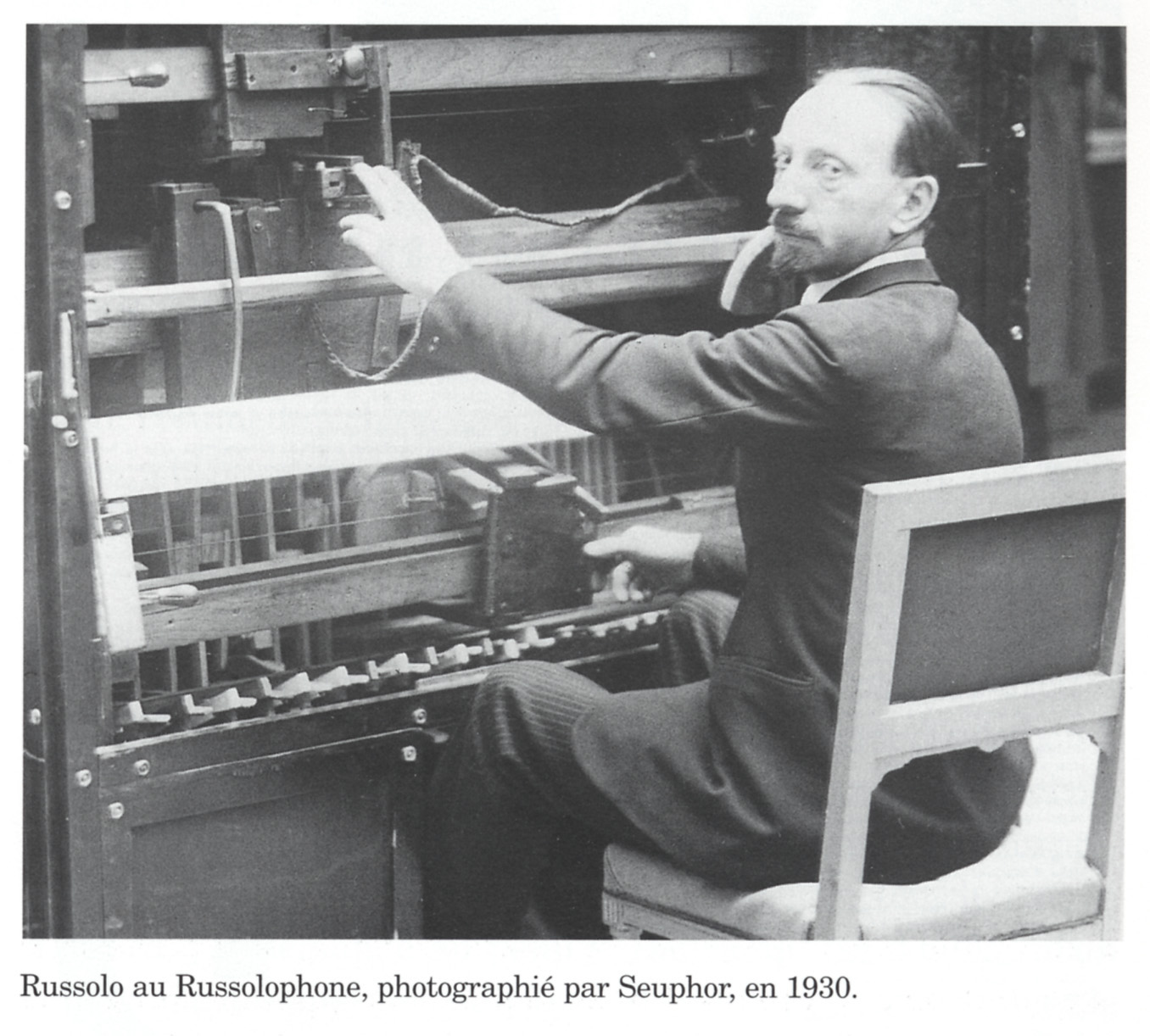
Nor should the newest noises of modern war be forgotten. Recently, the poet Marinetti, in a letter from the trenches of Adrianopolis, described to me with marvelous free words the orchestra of a great battle:

“every 5 seconds siege cannons gutting space with a chord ZANG-TUMB-TUUMB mutiny of 500 echos smashing scattering it to infinity. In the center of this hateful ZANG-TUMB-TUUMB area 50square kilometers leaping bursts lacerations fists rapid fire batteries. Violence ferocity regularity this deep bass scanning the strange shrill frantic crowds of the battle Fury breathless ears eyes nostrils open! load! fire! what a joy to hear to smell completely taratatata of the machine guns screaming a breathless under the stings slaps traak-traak whips pic-pac-pum-tumb weirdness leaps 200 meters range Far far in back of the orchestra pools muddying huffing goaded oxen wagons pluff-plaff horse action flic flac zing zing shaaack laughing whinnies the tiiinkling jiiingling tramping 3 Bulgarian battalions marching croooc-craaac ZANG-TUMB-TUUUMB toc-toc-toc-toc [fast] crooc-craac [slowly] crys of officers slamming about like brass plates pan here paak there BUUUM ching chaak [very fast] cha-cha-cha-cha-chaak down there up around high up look out your head beautiful! Flashing flashing flashing flashing flashing flashing footlights of the forts down there behind that smoke Shukri Pasha communicates by phone with 27 forts in Turkish in German Allo! Ibrahim! Rudolf! allo! allo! actors parts echos of prompters scenery of smoke forests applause odor of hay mud dung I no longer feel my frozen feet odor of gunsmoke odor of rot Tympani flutes clarinets everywhere low high birds chirping blessed shadows cheep-cheep-cheep green breezes flocks don-dan-don-din-baaah Orchestra madmen pommel the performers they terribly beaten playing Great din not erasing clearing up cutting off slighter noises very small scraps of echos in the theater area 300 square kilometers Rivers Maritza Tungia stretched out Rodolpi Mountains rearing heights loges boxes 2000 shrapnels waving arms exploding very white handkerchiefs full of gold srrrr-TUMB-TUMB 2000 raised grenades tearing out bursts of very black hair ZANG-srrrr-TUMB-ZANG-TUMB-TUUMB the orchestra of the noises of war swelling under a held note of silence in the high sky round golden balloon that observes the firing…”
We want to attune and regulate this tremendous variety of noises harmonically and rhythmically. To attune noises does not mean to detract from all their irregular movements and vibrations in time and intensity, but rather to give gradation and tone to the most strongly predominant of these vibrations. Noise in fact can be differentiated from sound only in so far as the vibrations which produce it are confused and irregular, both in time and intensity. Every noise has a tone, and sometimes also a harmony that predominates over the body of its irregular vibrations. Now, it is from this dominating characteristic tone that a practical possibility can be derived for attuning it, that is to give a certain noise not merely one tone, but a variety of tones, without losing its characteristic tone, by which I mean the one which distinguishes it. In this way any noise obtained by a rotating movement can offer an entire ascending or descending chromatic scale, if the speed of the movement is increased or decreased. Every manifestation of our life is accompanied by noise. The noise, therefore, is familiar to our ear, and has the power to conjure up life itself. Sound, alien to our life, always musical and a thing unto itself, an occasional but unnecessary element, has become to our ears what an overfamiliar face is to our eyes. Noise, however, reaching us in a confused and irregular way from the irregular confusion of our life, never entirely reveals itself to us, and keeps innumerable surprises in reserve. We are therefore certain that by selecting, coordinating and dominating all noises we will enrich men with a new and unexpected sensual pleasure. Although it is characteristic of noise to recall us brutally to real life, the art of noise must not limit itself to imitative reproduction. It will achieve its most emotive power in the acoustic enjoyment, in its own right, that the artist’s inspiration will extract from combined noises. Here are the 6 families of noises of the Futurist orchestra which we will soon set in motion mechanically:
1 2 3 4 5 6
Rumbles
Roars
Explosions
Crashes
Splashes
Booms
Whistles
Hisses
Snorts
Whispers
Murmurs
Mumbles
Grumbles
Gurgles
Screeches
Creaks
Rumbles
Buzzes
Crackles
Scrapes
Noises obtained by percussion on metal, wood, skin, stone, tarracotta, etc. Voices of animals and men:
Shouts
Screams
Groans
Shrieks
Howls
Laughs
Weezes
Sobs
In this inventory we have encapsulated the most characteristic of the fundamental noises; the others are merely the associations and combinations of these. The rhythmic movements of a noise are infinite: just as with tone there is always a predominant rhythm, but around this numerous other secondary rhythms can be felt.

Cover of the original Italian edition, publishe d 1916.


Conclusions

  1. Futurist musicians must continually enlarge and enrich the field of sounds. This corresponds to a need in our sensibility. We note, in fact, in the composers of genius, a tendency towards the most complicated dissonances. As these move further and further away from pure sound, they almost achieve noise-sound. This need and this tendency cannot be satisfied except by the adding and the substitution of noises for sounds.
  2. Futurist musicians must substitute for the limited variety of tones posessed by orchestral instruments today the infinite variety of tones of noises, reproduced with appropriate mechanisms.
  3. The musician’s sensibility, liberated from facile and traditional Rhythm, must find in noises the means of extension and renewal, given that every noise offers the union of the most diverse rhythms apart from the predominant one.
  4. Since every noise contains a predominant general tone in its irregular vibrations it will be easy to obtain in the construction of instruments which imitate them a sufficiently extended variety of tones, semitones, and quarter-tones. This variety of tones will not remove the characteristic tone from each noise, but will amplify only its texture or extension.
  5. The practical difficulties in constructing these instruments are not serious. Once the mechanical principle which produces the noise has been found, its tone can be changed by following the same general laws of acoustics. If the instrument is to have a rotating movement, for instance, we will increase or decrease the speed, whereas if it is to not have rotating movement the noise-producing parts will vary in size and tautness.
  6. The new orchestra will achieve the most complex and novel aural emotions not by incorporating a succession of life-imitating noises but by manipulating fantastic juxtapositions of these varied tones and rhythms. Therefore an instrument will have to offer the possibility of tone changes and varying degrees of amplification.
  7. The variety of noises is infinite. If today, when we have perhaps a thousand different machines, we can distinguish a thousand different noises, tomorrow, as new machines multiply, we will be able to distinguish ten, twenty, or thirty thousand different noises, not merely in a simply imitative way, but to combine them according to our imagination.
  8. We therefore invite young musicians of talent to conduct a sustained observation of all noises, in order to understand the various rhythms of which they are composed, their principal and secondary tones. By comparing the various tones of noises with those of sounds, they will be convinced of the extent to which the former exceed the latter. This will afford not only an understanding, but also a taste and passion for noises. After being conquered by Futurist eyes our multiplied sensibilities will at last hear with Futurist ears. In this way the motors and machines of our industrial cities will one day be consciously attuned, so that every factory will be transformed into an intoxicating orchestra of noises.

Dear Pratella, I submit these statements to your Futurist genius, inviting your discussion. I am not a musician, I have therefore no acoustical predilictions, nor any works to defend. I am a Futurist painter using a much loved art to project my determination to renew everything. And so, bolder than a professional musician could be, unconcerned by my apparent incompetence and convinced that all rights and possibilities open up to daring, I have been able to initiate the great renewal of music by means of the Art of Noises.

–Luigi Russolo

First published in Milan as a pamphlet, March 1913

COMMENTARY

Roman coin depicting Janus, the god of doors and beginnings.

TIME EXCHANGES: SHARE YOUR LIFE ENERGY

by Mira Luna

Time exchanges have been around for over a 100 years, presumably much longer in various forms, many undocumented. During the last two great depressions in the US, hundreds of thousands (possibly millions) of people organized to meet their basic needs when the mainstream economy and centralized monetary system failed them. Unemployed poor folks got together to create time dollar stores, cooperative mills, farms, healthcare systems, foundries, repair and recycling facilities, distribution warehouses, health care systems, and a myriad of other service exchanges. Many of these were based on the hour as a unit of account, and often everyone’s hour was equal and could either be exchanged for another hour of service or the equivalent in goods.  Now with unemployment topping 10 percent (likely twice that given recording problems), time exchanges are making a come-back, though modern forms branded as Timebanks and LETS (Local Employment Trading Systems) have been around since the 1980’s.

Timebanks USA, a system of over 120 timebanks in the US and a few other countries, was developed by activist lawyer Edgar Cahn as a way to help the underprivileged and underserved help each other through an organized system of reciprocity. Official Timebanks purchase software that provides a ready-made, standardized directory and accounting system of individuals, and sometimes nonprofits or government agencies, that are willing to provide services to their communities and receive help in return. Timebank coordinators help create matches between people who need things and others who can help meet those needs locally and enter completed transactions into the system.  No money is involved and everyone’s hour is equal in this system, which is one of the features that enabled Timebanks to receive an official IRS income tax exemption declaration so people on disability, social security, unemployment and other government benefits can participate without penalty. The egalitarian nature of the system ensures that people will be able to purchase the services that they need without toiling endlessly for high priced services like in the market economy. People can also trade goods with the stipulation that their price be based on the amount of time involved in producing the goods and not their market value. Timebanks’ most successful application has been to provide a means for at-risk youth who have gone to court to do service for their community.

LETS systems also operate without money (except for fixed costs like gas or paper copies), but the value of time or goods may be linked to its market value. Every community determines its own rules so every LETS is a little different. LETS are now mostly online accounting and directory systems just like Timebanks, but they have also taken the form of paper ledgers, checkbooks, paper currencies, and time-based stores. When one person provides service or goods to another, the giver receives credit in her account and the receiver gets a debit to his account so the system is always in balance. People manage their own accounts and make payment over the internet by logging into their personal account. Businesses, nonprofits and government may also have accounts if they are involved in reciprocal community exchange. Some systems have account balance limits, others don’t or merely flag high or low balances and then contact members to help them figure out how to spend or earn their credits.

Other similar time exchange projects exist, going by other names like Fourth Corner Exchange, Village Networks, Richmond Hours, and Austin Time Exchange. Probably the largest time exchange in the world is the Furai Kippu in Japan. Fureai kippu (meaning “Caring Relationship Tickets”) was created in 1995 to help families who had migrated to other parts of Japan care for their elder family members that they became separated from. Seniors can help each other and earn the hour credits, family members can earn credits and transfer them to their parents who live elsewhere, or users may keep credits for when they become sick or elderly themselves. Free open source software is now available for any community to tailor a time exchange to its own needs and to reflect the local culture. Many of these projects also have regular in person meetings, swaps, potlucks, etc. to help facilitate exchange, trust and community building.

While we may not have many dollars these days, most people do have some time. Instead of paying professionals who we may never see again to provide services, we can use time exchanges to find neighbors who might provide service in exchange for hour credits, thereby saving scarce US dollars for things like rent and medicine. In the process, people get to know and trust their neighbors, establishing caring relationships that can help reweave the fabric of our communities and replace our culture’s over-reliance on individual financial security.