Sunday Poetry Series Presents: Jason Gray


CIRCUS CIRCUS


This is the trapeze a dream might make—

Precarious height from which you swing to safety

Or fall into your life, the swollen sea

Of calliope music where no driftnet lays.

Blessed to land on solid ground for once

Instead of sinking deeper into the whirlpool

Where you are phase-shifted to some Middle Europe

With its klaxon angels that scream at you to wake.

Their dissonance overwhelms, like slides

Of all your human failures stacked together.

Try forgetting, and life will send its lions

To ravage the hole you make—so wide,

It is a flaming hoop. See how they leap

Through to the past, that sewer that does not drain?

Photograph what you see to freeze the moments

And watch the way the light betrays

Its very gift by fading. Even the light can’t bear

The repeating, a scratch against the silence, the record

Never getting to where you want it to go,

But always in motion. The Big Top’s shadow stretches

Across the grass and changes every second,

Like a sundial, but you refuse to see it,

Hiding beneath your never-unmade bed.


Jason Gray is the author of Photographing Eden (Ohio UP, 2008), winner of the Hollis Summers Prize, and two chapbooks, How to Paint the Savior Dead (Kent State UP, 2007) and Adam & Eve Go to the Zoo (Dream Horse, 2003). His poems and reviews have appeared in Poetry, The Kenyon Review, American Poetry Review, The Southern Review, Cincinnati Review, and elsewhere. He co-edits the online journal, Unsplendid.

Book Review: The End of the Circle, by Walter Cummins

BOOK REVIEW by DUFF BRENNA

Walter Cummins has published more than one hundred short stories in venues such as Kansas Quarterly, Virginia Quarterly Review, Confrontation and many, many other journals and magazines. His fourth collection of stories, The End of the Circle, takes place on the run, so to speak, in various places like America and London and Venice and Leiden, the Swiss Alps and Paris and other locations in Europe.

“Oxfords” dips into the lives of Stuart and Winnie and baby Tink; Elaine and Henry and baby Joy. Stuart and Winnie live in Oxford, a tiny farm town in America. They are prosperous and have a very comfortable home. Stuart has a large library that Henry envies. Both Stuart and Henry work at a nearby university, but Stuart is not a teacher. He’s a renowned scholar. A renowned scholar doesn’t need to teach; he does renowned scholar stuff. These contrasting personalities, especially Stuart and Henry, find very little in common. Their wives have babies, Tink and Joy, to help them connect, but Elaine and Winnie would never have formed a friendship otherwise. It’s what the story is about ultimately—connections, how vague and formless and happenstance they are, even those connections between parents and children.  This unlikely foursome never really coalesces. The men are awkward together, having only Stuart’s work to talk about (because he wants to talk, not listen), work which Henry finds only mildly interesting. What Henry notices more than anything other than the renowned scholar’s library is that Stuart can’t stand his son Tink, seems to hate him, actually. We find out the boy was an “accident.”

One day Henry and Stuart are talking and the thread of the conversation leads Henry to think that Stuart is going to explain his aversion to Tink. But instead of an explanation, Stuart wants to discuss Tristram Shandy, and Henry, trying to follow Stuart’s elaborate thesis, ends up “uncertain whether he was in the presence of genius or a bizarre form of madness.” The upshot of Stuart’s problem with his son? He’s a noisy kid, a distraction.  A magnificent mind needs quiet in order to work well. Stuart can’t have a screamer around the house. Too disturbing. Too bothersome. Ultimately, scholarship wins and Stuart leaves Winnie and Tink.

Later, after tragedy strikes Henry and Elaine, the story shifts 20 years into the future and a coincidental meeting in England. A grant has taken Henry to Oxford University. He runs into Stuart who is there doing research. But there’s a large problem for the renowned scholar who needs quiet. His son Tink is there too. Tink is searching for his daddy, who vehemently does not want to be found.

The second story in the collection, “Baggage,” might have been called “The Irritable Traveler.” Or maybe “The Rotten No Good Bastard.” His name is Howard. He’s on a train going from France to Italy. He’s packed into a compartment with five other people of various nationalities. They’re all kind to each other, affable, accommodating; all that is except Howard who decides (capriciously) that he doesn’t like any of his fellow passengers and will not speak for the entire trip no matter what language they use to communicate with him. An old woman in the compartment drops her passport accidently. Howard knows where it is, but he won’t tell her. Let her fret. To hell with her. The passport is found by one of the other passengers and given back to the fretful woman. But Howard’s baggage is on a rack over her head. He sees it is going to fall on her if he doesn’t do something. It is a moment wherein Howard can redeem himself and also spare the old lady from serious harm. Do it, Howard. Come on, man move. You could call this one a cliff-hanger to the last page.

“The Happy Frenchmen” is a story about funny doings. Man. Woman. Love affairs. Let’s get away from it all, darling, away from your wife, away from our colleagues who might rat us out. Let’s go to Italy and call the trip our honeymoon. Sex, good food, wine. And sex and sex, yes lots and lots. Grand idea. Except fate steps in and the couple suddenly have to deal with the man’s dislocated sacroiliac. Sex? What man can have sex when he can hardly get out of bed or dress himself or move other than in a crimped crab sort of way? He’ll find things he doesn’t want to know about his new lover. She’ll be enlightened as well. And there’s that pesky wife waiting back in the States. This story isn’t a belly laugh, but it’s full of irony and knowing chuckles and wise insights into the nature of “lovers” like these two. “Awful Advice,” “Poaching,” and “The End of the Circle” come at the same theme of illicit love in various ways.  All three narratives are little gems and perhaps the most haunting stories in the book.

Other treasures include “Stef,” “What Eamon Did,” “The Beauties of Paris,” and “Missing Venice.” Stef shows us a father visiting his estranged daughter in London. She has a new baby and she’s not married. Her flat is a rundown disgrace. The father has married a younger woman and he doesn’t want to tell her about Stef, but he also wants somehow to connect with his daughter. He is clumsy and awkward. He tells Stef that her baby looks well-behaved. Rapidly, caustically Stef says, “You’ve only seen her for ten seconds.” He asks if the baby gives her problems. With obvious annoyance Stef replies, “She’s a baby, isn’t she.” Then this telling exchange:

“I only meant that some are easier than others.”

“So are some parents.”

And therein hangs a tale of parents and children and everyone going their own way, cutting themselves off from their blood ties and finding how impossible it is to backtrack or start a relationship over. Too many mistakes, heartaches, failures, lapses in caring that turn things so sour nothing can sweeten even an hour when you haven’t been around for years, Daddy. But surprisingly this story concludes on an encouraging note, an ending suggestive of the hopeful possibilities it uncovers.

Carter in “What Eamon Did” is a loner. He saves just enough money at teaching each year to set out for the countryside, living in the woods sometimes, or renting a room when the weather turns bad and he has to. When he stops at a pub for a drink one day some musicians show up to entertain the patrons. One musician who plays a pipe aggressively taunts a man in the audience named Eamon. There is obviously bad blood between them. Carter wants to know what in the world the problem between the two men is. He tries in various ways to find out. By the end of the evening the piper has provoked a fight, not with Eamon, but with Eamon’s overwrought wife. A fight because of something Eamon did, “some crime or sin or stupid error.” Carter knows that the people in town won’t ever let the man forget, not for as long as he lives.

In “The Beauties of Paris” we have another father estranged from his daughter. Her name is Ariel. She has nursed her mother through to a painful death and it is obvious that she, Ariel, is still deeply grieving and angry and emotionally exhausted. The father wants to distract her from her grief by showing her the beauties of Paris. Like the father in “Stef,” he also wants to connect. In an odd way a tentative connection happens when he gets them both lost at night in the middle of a Parisian riot.

“Missing Venice” has David and his son Donny on a train to Venice. David is divorced from Donny’s mother. The fourteen-year-old brat has been making trouble for her. She has remarried and is having another baby and she wants Donny out of her hair, so she guilts David into taking his son on a trip that was originally planned for David and his new wife Virginia.

David and sullen, pissed off Donny meet Maria, a homely woman who doesn’t know when to shut up. She barrages the father and son with her knowledge about Italy and the places the train is passing through. When the three of them reach Venice they can’t find a place to stay, so they end up searching for lodging, wandering the city at night with their cumbersome luggage. It’s very late and very dark and Maria is in an alley crying, David trying to comfort her, Donny standing by angry and bitter at the whole stupid world. When two women and a man they had seen earlier show up and start beating David and Maria, “This is death,” David believes. The sensation of “an absolute emptiness” shudders through him. But finally Donny has somewhere to put his anger. And he does. The result creates one of the most satisfying endings in the entire book.

All of the stories in this latest Cummins’ collection tell us how difficult it is for human beings to really know one another—to really connect—and how unpredictable our futures are. With subtle symbols (trains, unknown streets, crumbling towers to nowhere, dark alleys, claustrophobic hotel rooms) and character insights that only the finest writers have at their command, Cummins reveals another fact over and over: nothing turns out the way you think it will, so don’t create scenarios for your tomorrows. Don’t make inflexible plans, dear traveler—unless you want to hear God laugh.


Duff Brenna is the author of the novels Too Cool (a New York Times Notable Book), The Altar of the Body, and The Book of Mamie (an AWP Best Novel selection).

Toward a Coherent Vision of the 20th Century—Or, Why Jorge Volpi Is My New Favorite Novelist


Season of Ash

by Jorge Volpi (translated by Alfred MacAdam)

Open Letter / University of Rochester Press

ISBN: 978-1-934824-10-8


Jorge Volpi’s Season of Ash is the kind of novel that reminds me why I read novels in the first place, but it’s also the kind that makes me wonder why I bother to write.  Before the end of this review, I am going to try to convince you that Volpi is a genius, that you have to buy this book, and that he’ll end up with the Nobel Prize in Literature if there is any justice in the world (which there might not be…)—but before I attempt all that, you should know who Jorge Volpi is, as he is not yet well-known to North American readers.

Jorge Volpi, born in the internationally tumultuous year of 1968 in Mexico City, has written nine novels, including one other, In Search of Klingsor, that has been translated into English and which has won prizes in Spain and France, as well as Volpi’s native Mexico.  He is one of the founders (along with Ignacio Padilla, Pedro Ángel Palou, et al) of the “Crack Movement” in Mexican literature, a movement attempting to free itself from what its members perceive as the chains of magical realism, hoping to return to the joys found in the work of, for example, Julio Cortázar and Jorge Luis Borges.  Volpi studied law at Universidad Nacional Autónoma de México and holds his PhD in Spanish philology from Universidad de Salamanca in Spain.  He has worked as a lawyer, a political aide, and as a scholar.  The evidence of this political/legal praxis and this scholarly knowledge certainly show up in his work, though never pedantically or gratuitously.  In the world of Spanish-language literature, he is known for his wide-ranging intelligence, the ambition of his work, his intricate plots, and a subtly dark humor.

Okay…that is an inadequate and rushed introduction to the man and his career, now on to an equally inadequate discussion of his marvelous novel.

Season of Ash opens with the infamous 1986 meltdown at Chernobyl.  (So, okay, here I have an admission: I rather disliked the first few paragraphs of the novel—so much so, in fact, I was disappointed I’d agreed to review the book, since I was worried the rest of it would be equally unpleasant.  I mention this for two reasons—to let you know I’m not such a fan of Volpi’s novel that I can’t admit its failings, and to make sure if you pick up a copy of the book, that you force past the first two pages, because after that, while there are occasional lapses of mastery, it borders on perfection.)  Here is Volpi, several pages in, at his lyric finest, personifying the radiation from the reactor’s meltdown as a monster the hopeless Soviet soldiers die trying to fight:

Wind and rain were carrying its humors toward Europe and the Pacific, its dregs were piling up in lakes, and its semen was filtering its way through the geological strata.  The monster was in no hurry.  It was patiently planning its revenge: Every baby born without legs, without a pancreas, every sterile sheep, dying cow, every rusty lung, every malignant tumor, every eaten-away brain would celebrate its revenge.

That wide narrative view—which takes in so much geography, time, and human suffering—is one of the joys throughout the novel.  The various plotlines, however, occasionally focus very closely on certain characters, the POV embedding so deeply into the consciousness of a particular character in the ensemble cast that we forget the novel spans four continents, eight decades, and over a dozen important characters (not to mention such historical figures as Joseph Stalin, Ronald Reagan, and Boris Yeltsin).  Though, now looking over the above excerpt, I see just how intricately Volpi weaves his narrative lines, how flawlessly he modulates his narrative registers; I say this because while I enjoy the excerpt by itself, it loses much (most?) of its power out of context, where we see Soviet soldiers sent to their deaths, ordered to bury the site of the incident with sand, ordered to axe to death all the animals in the region and incinerate them, all the while dying slowly or quickly of radiation poisoning.  We also are worried about the political wellbeing of the scientists involved as we read all this.  And on, and on.

Volpi’s scholarship and knowledge of international law and politics complements his novelistic powers wonderfully.  With only a few well-placed and concisely explained historico-political facts, Volpi creates unimpeachable narrative authority on such wide-ranging topics as Hungarian student movements, the Zairian French dialect, the corruption surrounding IMF funds in Africa, computer technology, mathematics, genetics, war strategy, investment banking, hippie communes in the US during the 60s, abortion procedures, depression, and more.  There seems to be nothing he doesn’t know and nothing he can’t find human tragedy and human comedy in.

This wide of a scope and this many movable parts would likely become a mess in a lesser novelist’s hands.  Volpi has, however, chosen a structure that organizes his materials without constricting them.  The novel is divided into a prelude and three acts, each act containing seven chapters.  The Prelude covers the Chernobyl incident and is set entirely in 1986.  Act I, which covers the years 1929-1985, is not chronologically ordered but rather swims around in time and plotlines, which seems unorganized but is not on closer inspection.  We learn the DNA, so to speak, of the novel in Act I, and the non-linear narrative lends itself to such a huge vision very well.  But had Volpi kept that non-linearity for the entire novel, readers would simply get lost in the wash of time and information.  And so, Act II, which covers the years 1985-1991, is ordered exactly chronologically, with each of its seven chapters covering a single year.  Act III covers 1991-2000 and returns to the non-linear structure, but by this point, we are oriented enough in the world of the novel for this not to be a problem.  And, as you can see, the overall structure of the novel takes us, in its roundabout way, from 1929 to 2000, thus giving the novel an overall sense of progression.

The two novels I was most reminded of while reading Season of Ash were Europe Central, by William T Vollmann, and 2666, by Roberto Bolaño.  Most novels would be reduced to, forgive the pun, ash by such a comparison, but Volpi’s novel not only stands up to these two masterpieces, I daresay it surpasses them.  It shows all the erudition, all the aesthetic sophistication, all the vision of a Europe Central or a 2666, yet it is considerably more readable.  In effect, it accomplishes all they do intellectually and emotionally while also being entertaining.  During the time I carried the book around with me, I was always digging it out my bag on a bus or train, just to get a few pages in; it kept me up past when I should have been asleep; it caused me to ignore invitations to parties (even ones I actually wanted to go to).

Okay…I’ll stop now with the praise.  For those who want a summary, kind of like the ones you get on the back of a book, here is the publisher’s summary from the back of the book:

Jorge Volpi’s Season of Ash puts a human face on earth-shaking events of the late twentieth century: the Chernobyl disaster, the fall of the Berlin Wall, the collapse of Soviet communism and the rise of the Russian oligarchs, the cascading collapsing of developing economies, and the near-miraculous scientific advances of the Human Genome Project. A scientific investigation, a journalistic exposé, a detective novel, and a dark love story, Season of Ash is a thrilling exploration of greed and disillusionment, and a clear-eyed examination of the passions that rule our lives and make history.

So, there you have it.

In the limited space I have, I can’t go into a complete analysis of the translation, but suffice to say that Alfred MacAdam, who has translated many of Latin America’s literary giants (Fuentes, Vargas Llosa, and Cortázar), has made a virtuoso performance here (though I do wonder how the Spanish title, No será la Tierra, became Season of Ash—but oddities of title changes happen all the time in translation, so we’ll just have to overlook this).  Translating genius requires itself a certain genius.  He is already well-lauded for his work as a translator, but someone needs to give this man a medal for his current effort.  I hope Volpi’s international reputation coupled with MacAdam’s academic credentials make this book a real contender for the Nobel, which would end the Eurocentrism many (Americans) complain about the prize having had in recent years.  But more importantly, it would celebrate a massive and original talent.

-Okla Elliott

[The above review was originally published, in somewhat different form, in Inside Higher Education.]

“How To” by Aaron Burch

How To

by Aaron Burch

Remember the myth of looking directly into the sun. The milk cartons cut into a makeshift periscope. Remember your brothers and sisters having to turn away, their eyes too weak. Forget their fall, the push, the fact that that was the last time you saw them. Look up to the sun and ask if your strength is a gift or a curse. Push up, out of your nest, and fly toward it, past the caladrius, feeling for a brief moment a kinship you’ve missed, you’ve thought was gone, you’ve thought wasn’t possible. Feel the heat burn away your outer layer, as if a film had built up over time and you hadn’t even noticed, then tuck and fall. Plummet. Past the caladrius again, past others trying to follow its ascent, and crash into the water. Feel new, cleansed, reborn.

***

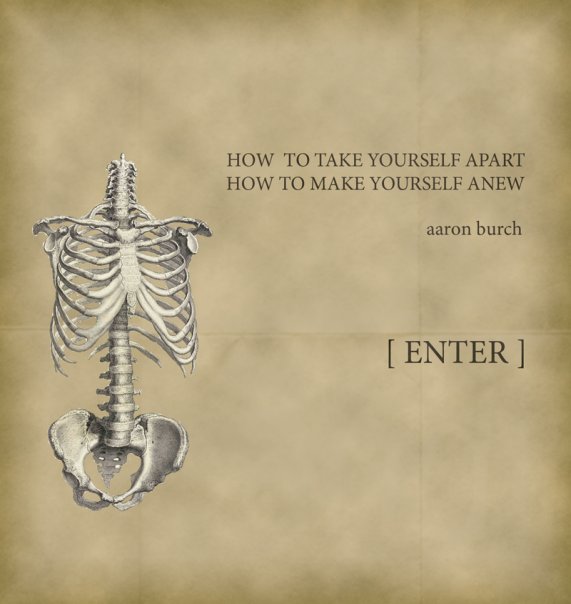
Aaron Burch‘s chapbook of short shorts and prose poems, HOW TO TAKE YOURSELF APART, HOW TO MAKE YOURSELF ANEW (from which the above work is taken), is due out in January from PANK. A novella, How to Predict the Weather, is due later in 2010 from Keyhole Books, and he edits HOBART. The work above was originally published in Sleeping Fish and is reprinted by permission of the author.

Sunday Poetry Series Presents: Heather Kirn

.

WRITER REPENTS

by Heather Kirn


Crown, I said, or kite, and that was that.

Like flames encased in glass, the nouns dissolved.

But levitate had weight around it. Rapt,

I wrote it down. Then menacing jabbed dark

with dark and triumph made me win. I grinned,

heard the strained trill of an oriole

and knew it too was mine. As was the phone.

It sang an octave lower than the bird,

rang all day. Go away, I wrote

and dialogue was born. I gave the words

a mouth, designed a face, a body, legs

for him to choose the wrong direction—there

he went and there he fell. I clasped my hands.

He multiplied. Then, Yes? I took the call.

The voice said, First you killed the oriole.

You killed the old man who found it too.

You say you’re sitting down?, it asked. You killed

entire villages, then carved initials

into anything that bled. A eulogy?

A prayer? How could we say a word? I bowed

my head, left the pens and rode the car

to padded walls. I ate soup. Soup, I said

and slapped my wrists. Pill, I swallowed. The walls

are blank as pages. In my dreams, I write

the kiddy-books that label every noun.

I write door, bed, salamander, slug,

erase a letter only when I start

to feel an adjective, a verb. Nothing does.

By morning, all the work evaporates.

No word remains but one. Intent. When split,

it names a sleeping spot. If stripped on the sides

it calculates the digits on my hands.

But whole, it settles me to self. I meant

no harm. I found a shape and made a world,

then crawled inside. Where else was I to live?


***

Heather Kirn’s essays have been noted in The Best American Essays Series and published in The Florida Review, Colorado Review, Prairie Schooner, and elsewhere.  Her poems appear most recently in Cincinnati Review and Shenandoah. She teaches writing at UC-Berkeley. The above poem originally appeared in Beloit Poetry Journal and is reprinted here by permission of the author.

SATURDAY POETRY SERIES PRESENTS: WILLIAM BUTLER YEATS

By William Butler Yeats:

NO SECOND TROY

Why should I blame her that she filled my days
With misery, or that she would of late
Have taught to ignorant men most violent ways,
Or hurled the little streets upon the great,
Had they but courage equal to desire?
What could have made her peaceful with a mind
That nobleness made simple as a fire,
With beauty like a tightened bow, a kind
That is not natural in an age like this,
Being high and solitary and most stern?
Why, what could she have done, being what she is?
Was there another Troy for her to burn?

“No Second Troy” is reprinted from The Green Helmet and Other Poems. W.B. Yeats. Dundrum: Cuala Press, 1910.

ON BEING ASKED FOR A WAR POEM

I think it better that in times like these
A poet’s mouth be silent, for in truth
We have no gift to set a statesman right;
He has had enough of meddling who can please
A young girl in the indolence of her youth,
Or an old man upon a winter’s night.

“On Being Asked for a War Poem” is reprinted from The Wild Swans at Coole. W.B. Yeats. New York: Macmillan, 1919.

William Butler Yeats (1865-1939) was an Irish poet, dramatist, and one of the foremost figures of 20th century literature. A pillar of both the Irish and British literary establishments, in his later years Yeats served as an Irish Senator for two terms. He was a driving force behind the Irish Literary Revival, and along with Lady Gregory and Edward Martyn founded the Abbey Theatre, serving as its chief during its early years. In 1923, he was awarded a Nobel Prize in Literature for what the Nobel Committee described as “inspired poetry, which in a highly artistic form gives expression to the spirit of a whole nation.” He was the first Irishman so honored. Yeats is generally considered one of the few writers whose greatest works were completed after being awarded the Nobel Prize; such works include The Tower (1928) and The Winding Stair and Other Poems (1929). (Annotated biography of William Butler Yeats courtesy of Wikipedia.org.)

Editor’s Note: I’ll be honest, I do not tend to be a fan of rhyming poetry. As a result, I tend to overlook many of the greats of yesteryear, such as Longfellow, Keats, and Yeats – to name a few. However, my mother informs me that William Butler Yeats was a relative of ours, being of the same Butlers from which my family comes. Having presented me with that information, my mother promptly informed me that I should feature Mr. Yeats on my Saturday Poetry Series. Well, what kind of a Jewish daughter would I be if I did not heed the subtly guilt-ridden instructions of my mother?

Of course I would not publish something that I do not stand behind, so I perused Mr. Yeats’ work and found two pieces that I am pleased to share here today. “No Second Troy” I adore for both its story and its end line. “On Being Asked For a War Poem” I find wholly appropriate for As It Ought To Be in that it explores the relationship between the poet and politics. I was doubly pleased as I learned more about Yeats to find that he himself was a politician in addition to a poet.

May the relationship between poetry and politics live long and prosper, and may poets have the power to make the change we want to see in the world, as it ought to be.

Want to read more by and about William Butler Yeats?

The National Library of Ireland Presents The Life and Works of William Butler Yeats
NobelPrize.org
Poets.org
The Literature Network
The Poetry Archive
Poetry Archive

DAVID DeGRAW

AF-PAK WAR RACKET: THE OBAMA ILLUSION COMES CRASHING DOWN

by David DeGraw


As Obama announced plans for escalating the war effort, it has become clear that the Obama Illusion has taken yet another horrifying turn. Before explaining how the Af-Pak surge is a direct attack on the US public, let’s peer through the illusion and look at the reality of the situation.

Now that the much despised George W. Bush is out of the way and a more popular figurehead is doing PR for Dick Cheney’s right-hand military leader Gen. Stanley McChrystal, who is leading his second AF-Pak surge now, and with long time Bush family confidant Robert Gates still running the Defense Department, the masters of war have never had it so good.

Barack Obama, the anti-war candidate, has proven to be a perfect decoy for the military industrial complex. Consider all the opposition and bad press Bush received when he announced the surge in Iraq. Then consider this:

1. Troop Deployments

The Bush surge in Iraq deployed an extra 28,000 US troops. Under Obama, back in March, a surge in Afghanistan, that also further escalated operations inside Pakistan, deployed an extra 21,000 troops. However, in an unannounced and underreported move, Obama added 13,000 more troops to that surge to bring the total to 34,000 troops. Obama actually outdid Bush’s surge by 6000 troops and brought the overall number of US troops in Afghanistan to 68,000, double the number there when Bush left office.

Where opposition was fierce to Bush’s surge, barely any opposition was expressed during Obama’s surge. Part of the reason for so little political and public backlash was the cleverly orchestrated psychological operation to announce the beginning of US troop withdrawal from Iraq. While the drawdown in Iraq has been greatly exaggerated in the US mainstream media, as of October, Obama still had 124,000 troops deployed in Iraq (not counting private military contractors).

When Obama casts the illusion of a 2011 withdrawal from Afghanistan, one just needs look at the reality of the situation with the over-hyped withdrawal in Iraq.

Now, with Obama’s latest surge announcement he will again be adding a minimum of another 30,000 US soldiers. This means that Obama has now led a bigger surge than Bush… on two separate occasions within the past nine months of his new administration.

Obama has now escalated deployments in the Af-Pak region to 98,000 US troops. So in Af-Pak and Iraq, he will now have a total of 222,000 US troops deployed, 36,000 more than Bush ever had – 186,000 was Bush’s highest total.

Private Miitary and NATO Deployments

The amount of private military contractors deployed in Iraq and Afghanistan is rarely reported on in the US mainstream press, but a Congressional Research Service investigation into this revealed that a record high 69% active duty soldiers are in fact private mercenaries.

Although the administration is yet to disclose how many private mercenaries will be deployed in the latest surge, it is believed that the 69% ratio will remain in tact.

The Pentagon released a report showing that Obama already had a total of 242,657 private contractors in action, as of June 30th. 119,706 of them in Iraq, 73,968 in Afghanistan, with 50,061 active in “other US CENTCOM locations.”

Back in June, Jeremy Scahill reported on these findings: “According to new statistics released by the Pentagon, with Barack Obama as commander in chief, there has been a 23% increase in the number of “Private Security Contractors’ working for the Department of Defense in Iraq in the second quarter of 2009 and a 29% increase in Afghanistan….”

Plus, we must mention, the immense dangers of having private military contractors as 69% of our fighting force. For those of you unaware, private military contractors are hired from all over the world. Any former soldier, from any country, is welcome to come and fight for a salary – a salary that is often significantly more than what we pay our own US soldiers.

These mercenaries have a vested interest in prolonging the war, for as long as there is a war, they have a well paying job. So it is easy to infer that a significant percentage of these contractors will not have the US soldiers, or US taxpayers, best interests at heart.

Obama continues to feed this out of control private army by pouring billions of taxpayer dollars into shady and scandalous companies like Blackwater, who recently changed their name to Xe Services, because they destroyed their reputation by committing numerous war crimes in Iraq. A recent investigation by Jeremy Scahill revealed the extent to which Blackwater is involved in covert operations inside Afghanistan and Pakistan. In some cases, Blackwater is not working for the US, but were hired by covert elements inside Pakistan. When it comes to private contractors, the fog of war grows ominous, exactly who is fighting for whom is unclear. The crucial factor is who paid them the most that particular day.

The US military can give them $1000 today, and an enemy can give them $1000 tomorrow, when you have people who fight for a payday and not for a country, you get chaos. This leads to a breakdown in the chain of command, effectively turning a military operation into a covert intelligence operation, where you’re never really sure if the person you are fighting with is on your side or not.

A federal investigation by the Commission on Wartime Contracting in Iraq and Afghanistan, revealed in June: “More than 240,000 contractor employees, about 80 percent of them foreign nationals, are working in Iraq and Afghanistan to support operations and projects of the U.S. military, the Department of State, and the U.S. Agency for International Development. Contractor employees outnumber U.S. troops in the region. While contractors provide vital services, the Commission believes their use has also entailed billions of dollars lost to waste, fraud, and abuse due to inadequate planning, poor contract drafting, limited competition, understaffed oversight functions, and other problems.”

Before this latest surge, there were over 123,000 US and NATO troops in the Af-Pak region, and 200,000 Afghan security forces, supporting the US effort. According to US intelligence sources the total number of Taliban and al-Qaida fighters in the region was estimated to only be about 25,000, giving the US led forces a minimum of a 12 to 1 troop advantage.

When you add in estimated private soldiers, you get an approximate minimum of a 17 to 1 advantage.

Although Obama opened his war speech by mentioning al-Qaida as the main justification for this war, consider this AP report: “national security adviser James Jones said last weekend that the al-Qaida presence has diminished, and he does not “foresee the return of the Taliban’ to power. He said that according to the maximum estimate, al-Qaida has fewer than 100 fighters operating in Afghanistan without any bases or ability to launch attacks on the West.”

Does it seriously take a surge of hundreds of thousands of troops to contain what amounts to “less than 100″ al-Qaida members?

Any serious war strategist will tell you that the most effective way to combat the remains of the al-Qaida network, is through an intelligence operation, and statistics prove that escalating more troops into the region will only fuel further acts of terrorism.

Drone Deployments

Speaking of fueling hatred toward the US, other than a huge troop increase, there has also been a sharp increase in the use of unmanned drones. The New Yorker reports: “According to a just completed study by the New America Foundation, the number of drone strikes has risen dramatically since Obama became President. During his first nine and a half months in office, he has authorized as many C.I.A. aerial attacks in Pakistan as George W. Bush did in his final three years in office.”

The unmanned drones have caused major controversy due to the high number of civilian causalities they cause. However, as the study stated, the Obama Administration continues to increasingly rely upon them.

So summing up these statistics, we have the most fierce and technologically advanced military force in history, vastly outnumbering what amounts to be a ragtag army of peasant farmers with guns, and our best option is supposed to be an increase in troop levels?

Obviously, something doesn’t add up.

After thinking about all of this, you begin to see through the smokescreen of what this war is said to be about and get a glimpse of some of the sinister forces at play here.

Over-Extended Troops

With the rise in deployments, the US military is stretched to a breaking point. Obama is “deploying practically every available US Army brigade to war, leaving few units in reserve.”

As this war enters its 9th year, many soldiers are forced into deploying on their 3rd or 4th combat tours, and morale is fading fast.

The past year has seen a dramatic increase in US soldier deaths, with the number of wounded drastically rising as well. 928 US soldiers have died in Afghanistan thus far, with last month being the deadliest month since the start.

AP reports that “nearly four times as many troops were injured in October as a year ago. Amputations, burns, brain injuries and shrapnel wounds proliferate in Afghanistan, due mostly to crude, increasingly potent improvised bombs targeting U.S. forces…. Since 2007, more than 70,000 service members have been diagnosed with traumatic brain injury — more than 20,000 of them this year…”

US soldier suicides are also on the rise. In 2008, 197 army soldiers committed suicide. Thus far in 2009, there have been 211 army suicides.

McClatchy recently reported: “An Army task force has found that a growing number of soldiers serving in Afghanistan are suffering from some kind of mental stress and is urging the military to double the number of mental health professionals deployed there. The study, conducted by the Army Mental Health Advisory Team, found that soldiers’ morale in Afghanistan is ’significantly lower’ than it was in 2005 and 2007 studies…”

As wounded soldiers return from Afghanistan and Iraq, they are finding a healthcare system that is increasingly more difficult and costly to get care from. In fact, 2,266 US veterans died in 2008 due to lack of healthcare, and “researchers also found that, in 2008, 1,461,615 veterans between the ages of 18 and 64 lacked insurance.”

Despite all of this, in another devastating example of how the economy is unraveling US society, military enlistment levels have reached a high. In a report by the Washington Post headlined: “A Historic Success In Military Recruiting” they reveal:

“For the first time in more than 35 years, the U.S. military has met all of its annual recruiting goals, as hundreds of thousands of young people have enlisted despite the near-certainty that they will go to war.

The Pentagon… said the economic downturn and rising joblessness, as well as bonuses and other factors, had led more qualified youths to enlist. The military has not seen such across-the-board successes since the all-volunteer force was established.…

“We delivered beyond anything the framers of the all-volunteer force would have anticipated,’ Bill Carr, deputy undersecretary of defense for military personnel policy, said at a Pentagon news conference.

Overall, the Defense Department brought in 168,900 active-duty troops, or 103 percent of the goal for the fiscal year….”

What we are witnessing here with such high enlistment levels during this economic crisis has many parallels to Germany in the 1930’s. Just like the United States now, the German economy in the 1930’s was devastated by an economic crisis brought on by Wall Street. With rising unemployment and poverty, German men turned to the military for income and health benefits that their family severely needed. With over 25 million US citizens unemployed and underemployed, over 50 million with no healthcare, and over 50 million living in poverty, military service is now a last resort for a growing number of desperate Americans as well. The record-breaking enlistment numbers are expected to continue to rise as the economy continues to decline.

2. The Militarized Economy

The amount of money necessary to keep the US military machine growing has reached astonishing levels. Considering the increasing amount of troops and contractors, the White House estimates that it spends one million dollars per soldier, per year in Afghanistan, “not including the added expense of training and maintaining a security force.”

According to these calculations, 30,000 troops for this latest surge will add an additional $30 billion to the annual budget, just in troop related costs. Also consider the price of moving fuel around, AFP reports: “Moving soldiers and supplies across the rugged Afghan landscape costs more than in Iraq, with the military consuming 83 liters or 22 gallons of fuel per soldier per day.” The Hill adds: “Pentagon officials have told the House Appropriations Defense Subcommittee a gallon of fuel costs the military about $400 by the time it arrives in the remote locations in Afghanistan where U.S. troops operate.”

Other than in Iraq and Afghanistan, you have an unprecedented number of military bases spread throughout the world. Officially there are “900 military facilities in 46 countries and territories (the unofficial figure is far greater). The US military owns or rents 795,000 acres of land, with 26,000 buildings and structures, valued at $146bn. The bases bristle with an inventory of weapons whose worth is measured in the trillions and whose killing power could wipe out all life on earth several times over. The official figures exclude the huge build-up of troops and structures in Iraq and Afghanistan over the past decade, as well as secret or unacknowledged facilities in Israel, Kuwait, the Philippines and many other places. In just three years of the Iraq and Afghanistan wars, £2bn was spent on military construction.”

There was public outcry when Bush drastically raised an already bloated military budget to record highs. But in comes the admired anti-war candidate Obama, in the middle of a severe economic crisis, and what happens? Obama drastically increased Bush’s record budget to $651 billion in 2009. Yes, during a severe economic crisis, Obama actually increased Bush’s budget. US military spending is higher than the rest of the world combined. The 2010 budget, which doesn’t account for war-related spending yet, is already set to grow to $680 billion.

However, these budget numbers are deceiving because the Obama Administration has been getting better at hiding extra spending in other budget items. The actual total 2009 budget was over $1 trillion.

And much like the staggering giveaway to the economic elite in the Wall Street banker bailout, no one is really sure where a significant percentage of this money is actually going. On September 10, 2001, Donald Rumsfeld announced that $2.3 trillion in military spending was unaccounted for. As CBS News reported: “$2.3 trillion – that’s $8,000 for every man, woman and child in America.”

At that time, Pentagon auditors admitted that they couldn’t account for a staggering 25% of all military spending. And the budget has exploded since then, with fewer people accounting for where this money is going.

Once again, just like the $23.7 trillion that went into propping up the Wall Street elite – which totals $80,000 for every American – you have trillions more in taxpayer money vanishing and very few regulating and accounting for it.

Other than this staggering loss of taxpayer money, any serious economist will tell you “that military spending increases unemployment and decreases economic growth.”

Economists Joseph E. Stiglitz and Linda J. Bilmes, in their book “The Three Trillion Dollar War,” report that military spending on the war in Iraq has created over a trillion dollars in loses to the US economy.

On top of all the looting of taxpayer money that is occurring, “several powerful House committee chairmen have proposed a surtax on Americans to pay the future military costs.”

With the country already operating at a record $12 trillion deficit, members of congress don’t know how we can afford increasing an already huge war expenditure.

Weapons Sales

In this struggling economy, weapon sales have become one of America’s most booming businesses. US weapon sales have hit a record level under the Obama administration. Foreign Policy In Focus reports:

“In fiscal year 2008, the foreign military sales program sold $36 billion in weapons and defense articles, an increase of more than 50% over 2007. Sales for the first half of 2009 reached $27 billion, and could top out at $40 billion by the end of the year. In contrast, through the early 2000s, arms sales averaged between $8-13 billion per year….

But last year, the United States sold arms or military services to well over 100 nations….

… the majority of U.S. arms sales to the developing world went to countries that our own State Department defined as undemocratic regimes and/or major human rights abusers. And over two-thirds of the world’s active conflicts involved weapons that had been supplied by the United States.”

Selling all these weapons, especially during the biggest global financial crisis, will lead to one thing… terrorism.

Given these statistics, it shouldn’t be a surprise to hear how US taxpayer dollars are still funding the Taliban. Prior to the 9/11 attacks, the Taliban government was funded by the US taxpayer. In fact, the Taliban still receives a significant portion of their funding courtesy of the US taxpayer. As The Nation recently reported: “It is an accepted fact of the military logistics operation in Afghanistan that the US government funds the very forces American troops are fighting. And it is a deadly irony, because these funds add up to a huge amount of money for the Taliban. “It’s a big part of their income,’ one of the top Afghan government security officials told The Nation in an interview. In fact, US military officials in Kabul estimate that a minimum of 10 percent of the Pentagon’s logistics contracts–hundreds of millions of dollars–consists of payments to insurgents.”

As former CIA Station Chief John Stockwell explained: “Enemies are necessary for the wheels of the US military machine to turn.”

With the war in Afghanistan now entering it’s 9th year, senior military commanders and a growing number of experts have come to the conclusion that this war is unwinnable and will fuel terrorism.

However, they all seem to be missing the point, before explaining this in more detail, let me start by referring you to a quote from a journalist who had firsthand experience operating inside a militaristic empire:

“The war is not supposed to be winnable, it is supposed to be continuous… all for the hierarchy of society… The essential act of war is destruction, not necessarily of human lives, but of the products of human labor. War is a way of shattering to pieces, or pouring into the stratosphere, or sinking in the depths of the sea, materials which might otherwise be used to make the masses too comfortable, and hence, in the long run, too intelligent… it helps to preserve the special mental atmosphere that a hierarchical society needs. War… is now a purely internal affair.” — George Orwell

3. Masters of War

Many of the weapons manufactures and private military contractors are seen as the primary war profiteers. For an example of grotesque war profiteering, let’s look at Dick Cheney’s former company Halliburton. In a report headlined: “U.S. War Privatization Results in Billions Lost in Fraud, Waste and Abuse,” Jeremy Scahill reports on KBR, a Halliburton subsidiary.

“KBR has been paid nearly $32 billion since 2001. In May, April Stephenson, director of the Defense Contract Audit Agency, testified that KBR was linked to “the vast majority’ of war-zone fraud cases and a majority of the $13 billion in “questioned’ or “unsupported’ costs. According to Agency, it sent the inspector general “a total of 32 cases of suspected overbilling, bribery and other violations since 2004.

According to the Associated Press, which obtained an early copy of the commission’s report, “billions of dollars’ of the total paid to KBR “ended up wasted due to poorly defined work orders, inadequate oversight and contractor inefficiencies.’

KBR is at the center of a lethal scandal involving the electrocution deaths of more than a dozen US soldiers, allegedly as a result of faulty electrical work done by the company. The DoD paid KBR more than $80 million in bonuses for the very work that resulted in the electrocution deaths.”

With numerous scandals over KBR operations, Halliburton ended it’s relationship with the company. However, “Halliburton reported $4 billion in operating profits in 2008, while KBR recently said its first quarter revenues in 2009 were up 27%, for a total of $3.2 billion. Its sales in 2008 were up 33%, and according to the Financial Times, the company had $1 billion in cash, no debt, and was looking for acquisitions.”

Beyond these blatant examples of war profiteering, there are more insidious forces at play that most people don’t see. These war profiteering companies are funded by the same banks that have destroyed the US economy.

Consider this example concerning Alliant Techsystems and Textron, two manufactures of cluster bombs, the controversial civilian killing WMDs. The Guardian reported:

“The deadly trade in cluster bombs is funded by the world’s biggest banks who have loaned or arranged finance worth $20bn to firms producing the controversial weapons, despite growing international efforts to ban them…

Goldman Sachs, the US bank which made £3.19bn profit in just three months, earned $588.82m for bank services and lent $250m to Alliant Techsystems and Textron…

Last December 90 countries, including the UK, committed themselves to banning cluster bombs by next year. But the US was not one of them. So far 23 countries have ratified the convention.”

Before going into further detail on how these banks make a lion’s share of war profits, let’s look back at the origins of these wars.

Geo-Strategic Oil Operations

With all due respect to people who have been force-fed Pentagon propaganda by the US mainstream media, any serious observer of the Iraq and Af-Pak wars knows that these are geo-strategic conflicts based on controlling the world’s oil supply. Anyone in the “news” media who tells you otherwise is either unaware of what is actually going on, or is a well-paid propagandist working for the very people who profit off of them.

Origins of the Iraq Occupation: Cheney Energy Task Force

As an AlterNet report put it: “In January 2000, 10 days into President George W. Bush’s first term, representatives of the largest oil and energy companies joined the new administration to form the Cheney Energy Task Force.”

Secret Task Force documents that were dated March 2001, which were obtained by Judical Watch in 2003 after a Freedom of Information Act lawsuit, contained “a map of Iraqi oilfields, pipelines, refineries and terminals, as well as two charts detailing Iraqi oil and gas projects…” They also had:

“… a series of lists titled “Foreign Suitors for Iraqi Oilfield Contracts” naming more than 60 companies from some 30 countries with contracts in various stages of negotiation.

None of contracts were with American nor major British companies, and none could take effect while the U.N. Security Council sanctions against Iraq remained in place. Three countries held the largest contracts: China, Russia and France — all members of the Security Council and all in a position to advocate for the end of sanctions.

Were Saddam to remain in power and the sanctions to be removed, these contracts would take effect, and the U.S. and its closest ally would be shut out of Iraq’s great oil bonanza.”

Project Censored highlighted a Judicial Watch report that stated: “Documented plans of occupation and exploitation predating September 11 confirm heightened suspicion that U.S. policy is driven by the dictates of the energy industry. According to Judicial Watch President, Tom Fitton, “These documents show the importance of the Energy Task Force and why its operations should be open to the public.’”

Origins of the Afghanistan Occupation: “Strategy of the Silk Route”

Up until 9/11, oil companies, with the help of the Bush administration, were desperately trying to work out a deal with the Taliban to build an oil pipeline through Afghanistan. One of the world’s richest oil fields is on the eastern shore of the Caspian sea just north of Afghanistan. The Caspian oil reserves are of top strategic importance in the quest to control the earth’s remaining oil supply. The US government developed a policy called “The Strategy of the Silk Route.”

The policy was designed to lock out Russia, China and Iran from the oil in this region. This called for U.S. corporations to construct an oil pipeline running through Afghanistan. Since the mid 1990s, a consortium of U.S. companies led by Unocal have been pursing this goal. A feasibility study of the Central Asian pipeline project was performed by Enron. Their study concluded that as long as the country was split among fighting warlords the pipeline could not be built. Stability was necessary for the $4.5 billion project and the U.S. believed that the Taliban would impose the necessary order. The U.S. State Department and Pakistan’s ISI, impressed by the Taliban movement to cut a pipeline deal, agreed to funnel arms and funding to the Taliban in their war for control of Afghanistan.

“Until 1999 U.S. taxpayers paid the entire annual salary of every single Taliban government official.”

The U.S., Saudi and Pakistan intelligence alliance that created the terrorist financing bank BCCI reunited to facilitate the rise of the Taliban. BCCI was a US intelligence bank, which served as the financing arm for the creation of the al-Qaida network. BCCI was involved in many covert operations throughout the 80’s and early 90’s. They played a pivotal role in arming Saddam in Iraq, the Iran-Contra scandal, the Iran hostage crisis, even selling drugs through Manuel Noriega and other top drug dealers. BCCI gave nuclear weapons to Pakistan, which led to North Korea and Iran obtaining pivotal nuclear secrets as well. BCCI was also a driving force behind the Savings and Loan scandals that were a precursor to our current economic crisis.

Focusing on the creation of the Taliban, let’s read an excerpt from a 2003 book, “Modern Jihad: Tracing the Dollars Behind the Terror Networks,” by Loretta Napoleoni:

“The alliance between American capitalism and Islamist fundamentalism is not limited to the creation of the Taliban; it also produced business ventures designed to extract favours from the new regime. To strengthen its bargaining power with the newly formed Islamist state, Unocal joined the Saudi Delta Oil Corporation to create a consortium called CentGas. Delta Oil is owned by the bin Mahfouz and al-Amoudi families [pivotal BCCI players], Saudi clans which have strong links with Osama bin Laden’s family…. Mahfouz has been sponsoring charitable institutions used as fronts for bin Laden’s associates through the National Commercial Bank, which his family controls….

Naturally, as soon as George W. Bush was elected president, Unocal and [UK’s] BP-Amoco… started once again to lobby the administration, among whom were several of their former employees. Unocal knew that Bush was ready to back them and resumed the consortium negotiations. In January 2001, it began discussions with the Taliban, backed by members of the Bush administration among whom was Under Secretary of State Richard Armitage, who had previously worked as a lobbyist for Unocal. The Taliban, for their part, employed as their PR officer in the US Laila Helms, niece of Richard Helms, former director of the CIA and former US ambassador to Iran. In March 2001, Helms succeeded in bringing Rahmatullah Hashami, Mullah Omar’s adviser, to Washington…. As late as August 2001, meetings were held in Pakistan to discuss the pipeline business….

While negotiations were underway, the US was secretly making plans to invade Afghanistan. The Bush administration and its oil sponsors were losing patience with the Taliban; they wanted to get the Central Asian gas pipeline going as soon as possible. The “strategy of the Silk Route’ had been resumed….

Paradoxically, 11 September provided Washington with a casus belli to invade Afghanistan and establish a pro American government in the country. When, a few weeks after the attack, the leaders of the two Pakistani Islamist parties negotiated with Mullah Omar and bin Laden for the latter’s extradition to Pakistan to stand trial for the 11 September attacks, the US refused the offer….

In November 2001… Hamid Karzai was elected [Afghanistan’s] prime minister… Yet very few people remember that during the 1990’s Karzai was involved in negotiations with the Taliban regime for the construction of a Central Asian gas pipeline from Turkmenistan through western Afghanistan to Pakistan. At that time he was a top adviser and lobbyist for Unocal… during the anti-Soviet jihad, Karzai was a member of the Mujahedin. In the early 1990’s, thanks to his excellent contacts with the ISI, he moved to the US where he cooperated with the CIA and the ISI in supporting the Taliban’s political adventure.”

So it is not all that surprising to see recent reports revealing that Hamid Karzai’s drug kingpin brother, Ahmed Wali Karzai, is also on the CIA payroll.

With this, a new Senate investigation just revealed evidence that Donald Rumsfeld made a conscious strategic decision to let Bin Laden escape. AFP reports:

“Osama bin Laden was within the grasp of US forces in late 2001 and could have been caught if then-defense secretary Donald Rumsfeld hadn’t rejected calls for reinforcements, a hard-hitting US Senate report says….

It points the finger directly at Rumsfeld for turning down requests for reinforcements as Bin Laden was trapped in caves and tunnels in a mountainous section of eastern Afghanistan known as Tora Bora.

“The vast array of American military power, from sniper teams to the most mobile divisions of the marine corps and the army, was kept on the sidelines,’ the report said.”

So now that we see how these wars are driven by oil, let’s look at how the oil industry is benefiting from them. Since the invasion, the industry has experienced record profits across the board, setting new profit records quarter after quarter, year after year, as these wars rage on.

Iraq Oil Deals

With Exxon and Shell just signing new oil contracts in Iraq, it’s obvious why there are still over 100,000 troops in Iraq. In a Daily Mirror report headlined, “Oil Billions and Weapons of Mass Deception In Iraq,” they report on the new oil deals:

“Exxon-Mobil and Royal Dutch Shell won the development rights of a massive oil field — West Qurna near Basra in Iraq’s south. The two oil giants hope to boost daily production from the current 300,000 barrels to 2.3 million barrels a day at West Qurna, which the ousted and hanged Iraqi President Saddam Hussein wanted to give to a Russian oil company.

Last month, British Petroleum (BP) and the China National Petroleum Corporation (CNPC) won a contract to develop another oil field. The invitation to China to join the plunder of Iraq is probably a payoff by the US so that this Asian economic powerhouse and rising military power would not rock the pirates’ boat.”

Let’s look back over the years since the start of the War on Terror, here’s a 2005 MSNBC report:

“By just about any measure, the past three years have produced one of the biggest cash gushers in the oil industry’s history. Since January of 2002, the price of crude has tripled, leaving oil producers awash in profits. During that period, the top 10 major public oil companies have sold some $1.5 trillion worth of crude, pocketing profits of more than $125 billion.

“This is the mother of all booms,” said Oppenheimer & Co. oil analyst Fadel Gheit. “They have so much profit, it’s almost an embarrassment of riches. They don’t know what to do with it.

So an oil field that was profitable with oil selling for $20 a barrel is much more profitable with oil trading around $60…. Since January 2002, stocks of major oil companies have gained 88 percent; during that period the Standard and Poor’s 500 index has gained less than half as much.

Oil producers have also given investors a raise by gradually increasing the dividends paid out to shareholders.”

Here’s a 2007 Public Citizen report summing up oil company wartime profits:

“Since George Bush became President in 2001, the top five oil companies in the United States have recorded profits of $464 billion through the first quarter of 2007:

ExxonMobil: $158.5 billion
Shell: $108.5 billion
BP: $89.2 billion
ChevronTexaco: $60.9 billion
ConocoPhillips: $46.9 billion”

In Febuary 2008, CNN reported:

“Exxon shatters profit records

Oil giant makes corporate history by booking $11.7 billion in quarterly profit; earns $1,300 a second in 2007.

Exxon Mobil made history on Friday by reporting the highest quarterly and annual profits ever for a U.S. company, boosted in large part by soaring crude prices.

Exxon, the world’s largest publicly traded oil company, said fourth-quarter net income rose 14% to $11.66 billion, or $2.13 per share. The company earned $10.25 billion, or $1.76 per share, in the year-ago period.

The profit topped Exxon’s previous quarterly record of $10.7 billion, set in the fourth quarter of 2005, which also was an all-time high for a U.S. corporation.”

In January 2009, during a severe economic crisis, the Washington Post reported:

“Exxon Mobil finished a roller-coaster year in the oil markets with an all-time record $45.2 billion in profits…

The world’s most far-flung oil giant broke its own record for corporate profits in a year that saw oil prices climb to $147 a barrel in July… Exxon Mobil still beat analysts’ expectations by registering $7.82 billion in profits, or $1.55 a share, for the final quarter of the year. Exxon Mobil and Chevron’s revenue combined for 2008 exceeded the gross domestic product of all but 16 of the world’s nations, according to Bloomberg.

Royal Dutch Shell, Europe’s largest oil firm… posted a $26.3 billion profit for the year.”

Once again, beyond these blatant examples of war profiteering, there are more insidious forces at play that most people don’t see. When you take a closer look at the oil profits, you see the true driver and ultimate beneficiary of these profits are none other than the same people who benefited the most from the stock market collapse and the ensuing $23.7 trillion taxpayer “bailout.”

As the Washington Post reported, the huge oil profit margins were the result of the soaring price of a barrel of oil, reaching “$147 a barrel in July.”

The intercontinental Exchange (ICE)

In 2000, Goldman Sachs, Morgan Stanley and several oil companies “founded the InterContinental Exchange (ICE)…. ICE is an online commodities and futures marketplace. It is outside the US and operates free from the constraints of US laws. The exchange was set up to facilitate “dark pool’ trading in the commodities markets.”

A Congressional investigation into this exchange found that these companies were fraudulently inflating the price of oil by executing “round-trip” trades where one company would sell shares in oil to another company who would then sell the shares right back. This would drive the price of oil to however high they wanted it to go to. “No commodity ever changes hands. But when done on an exchange, these transactions send a price signal to the market and they artificially boost revenue for the company. This is nothing more than a massive fraud, pure and simple.”

So when oil was selling at $147 a barrel, the actual worth was most likely closer to half that price. Phil’s Stock World summed up the situation:

“How widespread are ’round-trip’ trades? The Congressional Research Service looked at trading patterns in the energy sector and this is what they reported: This pattern of trading suggests a market environment in which a significant volume of fictitious trading could have taken place. Yet since most of the trading is unregulated by the Government, we have only a slim idea of the illusion being perpetrated in the energy sector.

DMS Energy, when investigated by Congress, admitted that 80 percent of its trades in 2001 were ’round-trip’ trades. That means 80 percent of all of their trades that year were bogus trades where no commodity changed hands, and yet the balance sheets reflect added revenue…

…the InterContinental Exchange; that is, the online, nonregulated, nonaudited, nonoversight for manipulation and fraud entity run by banks in this country….

Under investigation, a lawyer for J.P. Morgan Chase admitted the bank engineered a series of ’round-trip’ trades with Enron….

ICE… turned commodity trading into a speculative casino game where pricing was notional and contracts could be sold by people who never produced a thing, to people who didn’t need the things that were not produced. And in just 5 years after commencing operations, Goldman Sachs and their partners managed to TRIPLE the price of commodities.

Goldman Sachs Commodity Index funds accounted for $60Bn out of $100Bn of all formula-managed funds in 2007 and investors in the GSCI lost 15% in 2006 while Goldman had a record year. John Dizard, of the Financial Times calls this process “date rape’ by Goldman Sachs…

It is not surprising that a commodity scam would be the cornerstone of Goldman Sach’s strategy. CEO Lloyd Blankfein, rose to the top through Goldman’s commodity trading arm J Aron, starting his career at J Aron before Goldman Sachs bought them over 25 years ago. With his colleague Gary Cohn, Blankfein oversaw the key energy trading portfolio. According to Chris Cook: “It appears clear that BP and Goldman Sachs have been working collaboratively – at least at a strategic level – for maybe 15 years now. Their trading strategy has evolved over time as the global market has developed and become ever more financialised. Moreover, they have been well placed to steer the development of the key global energy market trading platform, and the legal and regulatory framework within which it operates….

Before ICE, the average American family spent 7% of their income on food and fuel. Last year, that number topped 20%. That’s 13% of the incomes of every man, woman and child in the United States of America, over $1Tn EVERY SINGLE YEAR, stolen through market manipulation. On a global scale, that number is over $4Tn per year – 80 Madoffs! Why is there no outrage, why are there no investigations. Well the answer is the same – $4Tn per year buys you a lot of political clout, it pays to have politicians all over the world look the other way while GS and their merry men rob from the poor and give to the rich on such a vast scale that it’s hard to grasp the damage they have done and continue to do to the global economy.”

The congressional investigation into ICE concluded that they couldn’t do anything about it because the exchange was set up offshore.

How convenient!

So here we can see, that behind almost all of our societal problems and suffering, you have this small elite group profiting on destruction and misery at record highs.

When Gold Sachs CEO Llyod Blankfien says that he is doing “God’s work,” one has to wonder, who is the God he is praying to?

Famed two-time Congressional Medal of Honor recipient US Brigadier General Smedley D. Butler accurately summed up the situation when he said: “I spent 33 years in the Marines, most of my time being a high-class muscle man for big business, for Wall Street and the bankers. In short, I was a racketeer for Capitalism…. The general public shoulders the bill. This bill renders a horrible accounting. Newly placed gravestones, Mangled bodies. Shattered minds. Broken hearts and homes. Economic instability. Back-breaking taxation for generations and generations.”

What It All Comes Down To…

In the global economy, the economic elite don’t need the US public anymore. When you see Obama taking trips to meet with the leader of China, and having his first official White House State Dinner in honor of the Prime Minster of India, you should know that the elite have moved on. There are billions of people in just these two countries that they believe can do all the work we do for much less pay. It is a race to the bottom, and we are considered obsolete to technocratic leaders who think it is better to hire cheaper workers in foreign lands.

As the US continues to collapse, the technocrats have already moved on to the next country to rape and pillage. The economic elite don’t have a home country, to them the entire globe is theirs, and the majority of the US can collapse into poverty for all they care, and that’s exactly what they want to happen.

The US working class is the biggest threat to them and they want us eliminated.

As the IMF would say, there has been a structural adjustment program in place, and the US working class is obsolete.

When you understand this, you can understand how the wars in Iraq, Afghanistan and Pakistan are wars against the US public. Wars that weaken and drain the US working class of vital resources and social safety nets.

In the overall picture, the technocratic elite see everyone as a number on a spreadsheet. To them you are what your economic net worth says you are. Considering this perspective, most in the US public have much more in common with an Afghanistan farmer than the billionaires on Wall Street. And the billionaires have put us in the same category as those in Afghanistan. To them it really doesn’t matter if it’s an American life ended or an Afghani life ended in the war, as long as the profits keep coming in… they can care less.

Common sense and statistics demonstrate that the more troops you send into war, the higher the causality count will be, and the more costs will rise, leading, of course, to higher profits.

So as the Obama illusion and the motives behind this war become exposed, and the massive theft by the economic elite becomes known to a critical mass, the elite are ramping up their psychological operations on the US public by turning up their mainstream media distraction machine.

4. Psyops: Wag the Dog and Shake the Mohammed

With the healthcare debate losing steam, and the people starting to understand that the final bill will do little to create much needed change, and as “health care reform” is exposed as another gift to insurance company executives, and as unemployment rates remain high, the Economic Death Squad vitally needs some new distractions.

Never mind the criminals on Wall Street: It’s time to… Wag the Dog and Shake the Mohammed

By Wag the Dog, I am of course referring to the old political trick of distracting public consciousness away from a crisis by starting, or in this case drastically escalating, a war.

Don’t worry about the $23.7 trillion of public wealth that was given to Wall Street as a reward for destroying the economy, we are at war and it’s time for you to support our troops.

Ah, yes, another racket to pile up more of the economic poor.

Barack W. Obama, once again, bows to… the elite… and serves up yet another gift by sending more US citizens to the Af-Pak region.

50 million US citizens are already living in dire straights, so what’s the big deal if you just throw another 220,000 US lives onto the fire, not to mention the millions of Afghani, Pakistani and Iraqi lives.

But a war in a distant land just isn’t enough, is it?

American public opinion has long been saturated in the distraction of war, and given the severity of the economic crisis, the elite policy makers figured another surge in Eurasia just wouldn’t be enough of a distraction.

So the psychological operations PR department has decided to also Shake the Muhammad. Yes, bring the 9/11 “mastermind,” Khalid Sheikh Mohammed, back to the scene of the crime and create a New York media frenzy. Now that’s a distraction!

Not only will it cause a media frenzy, it will also reaffirm public opinion in the war effort… win, win!

I don’t know about you, but as someone who grew up a New Yorker and spent the last five years of my life living three blocks from Ground Zero, I have to say, take your psychological operations to a different location.

You are going to have the “9/11 mastermind” in a courtroom right around the corner from the biggest terrorists of all… Wall Street.

Khalid Sheikh Mohammed, Llyod Blankfien, Jamie Dimon and John Mack are all going to be in one place, at the same time! We will have the “9/11 mastermind,” Goldman Sachs, JP Morgan and Morgan Stanley all in the same zip code… HELLO!

Can you say here comes the next Timothy McVeigh?

Yes, the USA… is an insane asylum! So just Wag the Dog and Shake the Mohammed.

5. U.S. Insurgency: Violent, Strategic Dislocation Within the U.S.

Will there be a violent insurgency within the US?

As a growing number of American lives are directly negatively impacted, media propaganda operations will lose their ability to confuse and distract. Studies of societal breakdowns prove that having such a large population experiencing severe and prolonged economic decline will result in violent outbrakes.

Other than the 50 million US civilians living in dire straights, what will happen as thousands of bitter soldiers and US intelligence agents — who have given their lives to these wars, only to return home to find an economy in ruins and a healthcare system that has thrown them overboard — begin to make these connections and understand that a small group of men on Wall Street are at the root of their suffering?

Well, some former military and intelligence agents, including a growing number of current serving members, have already made this connection, and they are organizing, training and strategizing tactical operations. They are factions inside a quickly growing – heavily armed – militia movement that now numbers over 200 active cells, within the US.

The mainstream press gives some passing attention to the fringe factions that make threats against Obama, but the more experienced soldiers understand that he is just a figurehead and they have connected all these dots and have come to the conclusion that this war is actually a war to create profits for the economic elite at the expense of the US public.

Llyod Blankfein, Jamie Dimon and John Mack can arm themselves and hire all the security they can get, but will it actually keep them safe when you have a population of millions living in dire straights as a direct result of their actions? At this point, even their own security members may be conspiring against them.

The Obama illusion is fading fast. Every time you see through it, you get a glimpse of them. The Economic Death Squad is exposed under the bright light of inspection and investigation.

Take a look at many of the major problems facing us today, as a country and as a species, and then you will understand that these problems exist because the economic elite are profiting off of them.

Obama is just their mask, an illusion to pacify the masses. The economic crisis and the wars have now shattered this illusion – it has come crashing down… upon us.

It has become clear that an opinion has emerged among a growing segment of the United States population: If the government will keep pouring money into banks and war, and won’t stop the theft of US taxpayer money by holding accountable those responsible for it, WE MUST.

And the question that arises after that: Can it be done non-violently?

I certainly hope it can.

However, this growing segment of the population uses strong rhetoric and is prepared to take up arms.

With over 200 active militia cells, who are equipped with weapons, training and strategizing, the government must take swift action to rein in the economic elite. Otherwise, we are heading to war, not in a distant foreign land, within the US.

The economic elite are well aware of the threat of a violent uprising within US borders. US Army documents have revealed that strategic plans are already formed for this situation. Chris Hedges explains:

“The military must be prepared, the document warned, for a “violent, strategic dislocation inside the United States,’ which could be provoked by “unforeseen economic collapse,’ “purposeful domestic resistance,’ “pervasive public health emergencies’ or “loss of functioning political and legal order.’ The “widespread civil violence,’ the document said, “would force the defense establishment to reorient priorities in extremis to defend basic domestic order and human security.’

“An American government and defense establishment lulled into complacency by a long-secure domestic order would be forced to rapidly divest some or most external security commitments in order to address rapidly expanding human insecurity at home,’ it went on.

“… this might include use of military force against hostile groups inside the United States. Further, DoD [the Department of Defense] would be, by necessity, an essential enabling hub for the continuity of political authority in a multi-state or nationwide civil conflict or disturbance,’ the document read.

In plain English… this translates into the imposition of martial law and a de facto government being run out of the Department of Defense. They are considering it. So should you.”

We could have a situation where the government deploys private soldiers, mostly foreign nationals, on US soil to fight against US citizens. Blackwater and DynCorp already had active duty soldiers deployed within the US when Hurricane Katrina hit.

In New Orleans, they were essentially a foreign occupying force.

Loss of Faith in Political Process

In response to the report, “The Critical Unraveling of US Society,” readers primarily critiqued the part in which we call on readers to engage their representatives.

An irate majority of the responses have consistently stated that they have repeatedly contacted their representative through multiple forms of communication, and no action was taken. A growing segment of the US population has now lost all faith in our government and they are on the verge of taking violent action.

Personally, I believe that non-violent action is a much more strategic and effective move. We are 99% of the population, and the enemy is less than 1%. We are a sleeping giant; they are a small group of clueless greed-addicted people who desperately cling to the Administration, Treasury, Fed and a few other firms like Goldman Sachs and JP Morgan.

If we can take action on a mass non-violent scale, the rule of law and economic justice can be obtained. In our nation’s history, the stakes have never been higher. If we cannot organize a mass movement to non-violently oppose outright theft, then violence will ultimately tear our nation apart.

The question on my mind: Can we swiftly mobilize such a heavily propagandized population to take mass non-violent action? A growing population does not believe we can do so, and is on the verge of launching a heavily armed insurgency. So in the months ahead, while they are Wagging the Dog and Shaking the Mohammed, the US public vitally needs to understand that the stakes have never been higher.

And the clock is ticking …

–David DeGraw

The piece was first published 12/2/09 on Amped Status.

See the full Amped Status Report here:

Download Full Report in PDF format.

DADA

Walter Serner by Christian Schad, 1916.

THE SWIG ABOUT THE AXIS MANIFESTO (1919)

by Walter Serner

1 It’s a long way to Tipperary. For sure. Because properly considered: psychology is a handicap. Every rule has its exception, without a doubt. In fact as a rule. Therefore take extra care: every rule is to be applied as an exception, for the rule is the exception. (An important rule, that!)

… You can only relatively establish relative interrelations. And not even that. Psychiatrists and examining magistrates are, at bottom, ticketsellers manqué (wandering circuses), as every (oh well!) – psychological judgment is an exercise directed by the one who is judged, the results of which so seldom please merely for the reason that the exercise is inaccurately commissioned owing to the deficient self-knowledge of the one who is judged. As has been proven, the best judgments are posed in the worst way, the worst ones in the best way. (The seedless fruits are the sweetest. oh the dear idle physogs!) As has been proven: the quite terrific variety of judgments about (ha!) – bad people. (The ones about good people are always right.) Sub-proof: judgments only interest the lads, when they hear them; but the toffs already care even before anything’s been – (down boy!) given in … Every piece of advice is a downright lethal affair; but just in passing: administering bad judgments about yourself is nonetheless the most honest way of avoiding good judgments that are also false. Tant de bruit pour une – occasion perdue? … But sometimes nothing helps: neither grinning for nor grinning against. They trust you anyway. Oh, where is the audience for really heavy fellows? I have become so narrow and sprattish…

2 The ultimate disappointment? When the illusion that one is free of illusion reveals itself as such. (The most oppressive manoeuver of vanity: making oneself out to be more stupid and bad than one would like to be in order to indulge the vanity of not being vain. Fails miserably.) … The height of naivete? When someone wants all at once to find out the (ogodogodo) – truth. (A clout on the ear is after all only a desperate approximation. Also, false tears often seem more genuine than – false ones.) … Two joke questions? Not at all. Two bracelets.

9 In the final track … one becomes malicious out of boredom. Then it becomes boring to be malicious. And finally one begins collecting little pictures made of chocolate. Idealism still is criminal realism. A braggart who has remained gentle is a little less gruesome (as he is an Idealist) than an Imagist gone wild (as he is a Realist). Whoever invented the ampulla ‘soul’! Perhaps the somewhat disappointing sight of the naked man … But this disappointment: one should take oneself by the ear, build up one’s courage and admit to oneself, that one has, as opportunities no longer earn, what others used to get off danger – a secret admiration for one’s own legs … Yes, one goes so far as ALMOST to feign one’s tabula rasta to the totality, in order to deliver one’s most devastating blow with the apparently unapparent remains of the ‘almost’. A blow which admittedly strikes one’s own flesh: … last little pleasure … last little rage…

11 There are days when everyone makes a stupid face. And nights when the most stupid still looks too significant. And there are weeks and months and years and … The most blown-through vocabulary, the slackest pauses, the tongue stuck out, the long nose, etc. are therefore communicative gestures that afford great relief; the more so, the more every situation is actually intolerable in every respect. One should let these dear gestures become tenderly tinged with madness (THIS the high idiom!), and one will be amazed how excellently everything turns out … And as one can, by merely passionately (so to speak) talking away, demolish ALL relations between people (they are ALWAYS constructions!), it offers moreover a healthy palliative. Speaking of which: one lives together, as is known (as long as one doesn’t) … always in a mostly self-spun and often very finely spun net (conjugal paranoia: Juan Suvarin and his Marva); only in a yet far more finely (as long as one doesn’t) … One should begin at long last to speak out against oneself! One should begin!! One!! (For a long time now I have, in quiet hours, been spitting on myh own head … Oh, I don’t give a damn about … Yes, about what? …)

12 The swig about the axis: not giving a damn about anything.


Der Zeltweg (Zurich), November 1919


translated by Caitriona Ni Dhubhgaill

CINDY SHEEHAN


I AM A CHARITY!

by Cindy Sheehan

Dear Mr. Obama,

I hear that you were awarded the Nobel Peace Prize recently in Oslo, Norway and that, in addition to that spiffy medal, it comes with 1.4 million tax-free dollars that you are going to “donate to charity.”

I just want to let you know that there are still some of us in the US who oppose the wars, even though you are president, and its nothing personal, but I vehemently oppose your wars and especially oppose the escalation of troops to Afghanistan and the fact that there has been no de-escalation from Iraq.

It has been super-tough being a peace activist since you took office, because a lot of my colleagues supported your candidacy and gave you a “wait and see”and “give him a chance,” while I have been working against these policies since Bush was president and have never stopped.

Well, I don´t know if you have heard, but I am planning on setting up a Camp right across the street from you house on the lawn of the Washington Monument called–Camp OUT NOW–and, not only will it be an anti-war Camp, but it will also be a community for people who have lost their jobs and homes during the past years of the Goldman Sachs depression. Also, while the need is rising, the city of Washington, DC is cutting back on services for the poor.

Mr. Obama, Camp OUT NOW will provide services to these people AND be the launching pad for what we hope will end the mad wars for profit and imperial power in Iraq-Afghanistan-Pakistan.

You proposed a “Just War” theory during your Nobel acceptance speech and I just want to also let you know that we don´t think, and never have thought, these wars are “Just,” but we think what we are doing, beginning March 13th is extremely, “Just.” I think if you thought about it really hard, you would agree. We are saving the lives of Americans and our brothers and sisters in the Middle East.

Well, Mr. Obama, the reason that I am writing to you is to apply for part of that money that you will be donating to charity. We don´t need all of it, but my coalition–Peace of the Action–could use a couple of hundred thousand of it!

Please go to www.PeaceoftheAction.org for more info about our efforts, which we are hoping will, “Make you do it.”

You can go to www.Paypal.com and put in my email address: Cindy@CindySheehansSoapbox.com to make a donation online, or mail a check to:

PO BOX 6264
Vacaville, Ca 95696

You did say, time and again, during your campaign that we the people had to “make you,” and Peace of the Action will do just that! We just want to be of service to show you the way to Peace.

Thanks for your consideration,

Cindy Sheehan
Director of the Peace of the Action Coalition

HITCHHIKING & TRAINHOPPING–Part X

THE CONFESSIONS OF FOFI LITTLEPANTS

PART X

by Fofi Littlepants

X. CONCLUSION

A dear activist friend upon whose doorstep I ended up, filthy and exhausted, near the end of my journeys patiently took me in and gave me all the warm, fuzzy things that one dreams about of home (like high speed wi-fi.)

I hung out with her for a while at her big, old, creaky house, which I found quite charming despite suspicions that it was haunted (the family would hear humongous crashing noises periodically upstairs when no known human was there), and we talked a lot. She eventually confessed to me that she had been worried about me on this trip, not about whether I would get killed by some psycho, but a concern reflecting a much deeper, more primal activist fear. She thought it was great I was traveling, but she couldn’t help but wonder ~ whether perhaps I wasn’t frittering away my time and talents on frivolous pastimes like trainhopping and hitchhiking, when I could have been doing more to help the world?

I could have said that I was working during this whole journey on a giant human rights project, but actually, I don’t think that would have addressed the quintessentially activist angst of  “Couldn’t you have done more if [fill in the blank: for example, ‘you didn’t sleep’ / ‘you had no life’ / ‘you weren’t bouncing around on trucks and trains’]?” It was a legitimate question, one that I have been mulling over, and that I still don’t have an answer to. In sharing these reflections, it is certainly not with the purpose of issuing a clarion call to all progressives to quit their day jobs and go trainhopping and hitchhiking. I don’t know if that would be the best of use of their time; I’m not even sure if it was the best use of mine. Sometimes, I envy the way soldiers on the train look at their military watches, they know exactly where and when their time goes.

Though I have to say that I’m not entirely sure that it wasn’t, either. The following are some thoughts about why this trip might potentially have been useful, at least for myself.

***

I could say that I learned a lot about the United States on this journey, though admittedly, this was inevitable because I was so woefully ignorant in the first place. Until an unspeakably late age, I thought Alaska was an island because it appeared together with Hawaii in a little box at the bottom of U.S. maps. I probably could have learned much of the same information, and more, if I had read a good book.

But I’ve heard it said that travel, like education, is something that adheres to your core ~ it enriches at the foundations and cannot be taken away. In middle school, I remember hearing about a woman that was imprisoned during the Nazi era in a cell only a few feet wide. But being well-traveled, she was able to maintain sanity by walking the streets of Paris in her mind while she paced that little cell.

As did Goldmund, we had much rain and snow fall upon us in our journeys. But could I have stood at the edge of nothingness in the mists of Maine, presenced the moment of spiritual release at a wi wanyang wacipi, or felt the vibration of Texas bugs in my chest otherwise? A Buddhist saying goes, “At the end of snow is Nirvana.” Did these experiences have any value or significance? For increasing my knowledge? My insight?

All knowledge gained must make you a better activist. How can we seek to build a better world without understanding it to the best we can? For myself there are still so many mysteries that I know I’m far from comprehending. But I feel like a bit more of the blinders that hemmed in my understanding have been chipped away by this journey, so that I have a wider field of vision. And this broadening can better embrace more people ~ if ever I meet someone from Idaho or Iowa, and the many other places I passed through that are dismissed as “fly-over states” by some Californians, I can tell them honestly that I’d been there and shared in its feeling for a moment, and ask with genuine interest to hear more about it. And if I meet another trucker, biker, and even white supremacist, I hope I can better see the person less as a cardboard cut-out, to be able to perceive his or her unique complexity with an open heart.

Could those things also open my doors wider to insight?

***

In the realm of experimenting with social alternatives, I could say that it was useful for me to find out that I could get across the country without a car. Trainhopping and hitchhiking are clearly more environmentally friendly than cars ~ minimal additional fossil fuels were used by us scabbing rides; they might be considered a low-income variation on carpooling.

And resisting car dependency might reveal other alternative benefits. I have long had a sense that car culture contributes to the private bubble phenomenon, which feeds societal fracturing. Most American cities or even towns don’t have central common spaces like the Latin American plaza, thus people from different walks of life really don’t run into each other that much; this is exasperated when people just drive to where they’re going. Cars are in essence a personal gated community that allows you to wall yourself off from the world you don’t want to see. When I lived in New York, I assumed that everyone took the subway cause it’s so convenient, but I eventually learned that many executives (and even peons that work in big corporations) get driven around because their company pays for a car service for them. I’ve often wondered if people might have greater goodwill for each other (or at the very least, an awareness of the consequences of societal exclusion and burgeoning inequality) if everyone had to rub elbows in public transportation on a regular basis. They say that when black people started moving into cities, there was “white flight” to the suburbs. I wonder if there has ever been a study done about whether there was white flight to cars when black people started getting to sit on the bus without having to go to back.

Like public transport, trainhopping and hitchhiking, by departing from private car culture, were windows to different socioeconomic and cultural communities. As a hitchhiker, I ran into incalculably different people and things than I would have as a driver. (This was very clear to me during the few days that I rented cars.) And while I never became a “trainhopper” in its full sense and don’t pretend to have a lot of knowledge about that culture, I did gain some small awareness that I didn’t have before.

***

As a practical matter, this trip could be said to have been good for me because it forced me to confront the question: how much weight do I want to carry around? I had to apply this examination to the trip as well as to my life as a whole. In packing my penis backpack and moving out of my apartment, I had to go through the exercise of clarifying my values and purging the superfluous.

Trainhopping and hitchhiking may be the most ascetic forms of travel ~ we had to live just with what we could carry on our backs. And since we also weren’t loaded with lots of cash or plastic, we were trying to live as simply as we could. I found this a valuable exercise ~ I’d like to live that way in my “regular” life anyway.

In the U.S., many people seem to think that survival requires a spectacular array of material possessions, from a house in which everyone has a private room, microwaves, dishwashers, washer-dryers, flat-screen television, DVD players, stereos and iPods, multiple cars, clothes for every occasion, with matching shoes and accessories to be changed every season, and the like. It is telling that the federal government offered a subsidy for people to transition from analog to digital television ~ never mind funding for education ~ television is a basic need.

I wonder if people who have a lot of material things might also tend to be unable to let go of emotional weight as well ~ I’ve known some people that seem to cling to their ideas of the things they should have, which appear to correlate with their identities, how they think their lives should be, the place they should have in society and how people should treat them; this seemed to contribute to them being unable to let go of the past, and consequently their loves and their hates, their failed dreams, disappointments, resentments, addictions, and obsessions.

I’m certainly far away from letting go of all unnecessary material or emotional baggage ~ I didn’t do particularly well with it in this trip: I was lugging around my laptop and cornucopia of other electronics, which is why I couldn’t catch more trains, plus I was addicted to my Crackberry and high speed internet.

But Joey and I did eventually shed enough to be able to see that life didn’t need too many specialized accessories. If we subtracted our clunky work implements (laptops and such), in the end we really didn’t have that much: our packs contained not much more than a handful of clothes (for hot, medium, and cold weather, and a swimsuit), just a bit of toiletries, plus a tent, one sleeping bag each, and a miniscule camping stove; our entertainment was the world on stage before us, a few books, a little camera, and ourselves. All together this gear probably weighed less than 10 pounds for each of us.

I found myself, upon arriving in Washington D.C., where I had shipped some business clothes in order to have meetings, longing for the simpler life ~ I was completely confounded by having so many choices of things to wear. I felt it as but a small taste of the magnitude of the crushing burden that fell upon Tarzan, and all humanity, by being hoisted upon with clothing (and civilization.)

***

Most people that we encountered didn’t have x-ray vision so couldn’t see that our backpacks were stuffed full of electronics, so they just assumed we were poor, and as I described before, some felt sorry for us and wanted to give us money.

We never accepted, except for once. In retrospect I could say it was good I took that one dollar from that recovering co-dependent mom, because now I can’t keep a prideful self-concept that I’m above taking handouts. Cesar Chavez said, “You are never strong enough that you don’t need help.” But American meritocracy attaches strong stigma to handouts and social assistance, and in some people’s minds, there is a divide between the industrious who have worked hard to deserve the fruits that they are enjoying, and those poor people that ask for help, who must of course be lazy bums. If you sit on the subway and watch what happens when someone comes through asking for money, it seems to me that it is often people that look poor that give money ~ maybe it’s because they understand there are myriad reasons why some might have to ask for help. In contrast, the more affluent seem to have no problem saying no, sometimes in a very superior way, but more often by absolutely avoiding eye contact or acknowledgement altogether.

Refusing offers of assistance can also deny other people the opportunity to help. The girl that thought we were runaways was herself probably 17 years old. She seemed to have a lot of cares; we learned that her father was in the hospital. She seemed excited to offer us money, and disappointed when we declined. Now I think we should have accepted something from her, just a bit, within what she could afford. Maybe she would have felt happy that day having helped someone out. Later, someone told me that in some religious beliefs, if you are down and out, the best thing you can do is to give to someone else, and this will bring you heaven’s rewards. I’m sorry I denied her that opportunity.

Also, accepting help from someone binds you inextricably to that person. You carry that debt forever. So for me, to get help from racists, sexists and homophobes and other people that I didn’t normally choose to cavort with, forced my world to open wider because it made me think about and appreciate them as people, recognize that I owed them something, and despite all the things I didn’t like about them, accept that my life was interrelated with theirs.

***

To some people, especially in middle class American society, the simple fact of not having a car or a television is a radical form of deviance. And trainhopping, hitchhiking, squatting and getting handouts are even worse.

I personally didn’t choose to trainhop and hitchhike and squat because they were considered deviant or marginal things to do, but I didn’t particularly mind that they were either. In addition to giving me insight into foreign worlds, I was aware that dabbling in deviant behavior could serve as good exercise for personal integrity.

I’m surely not on the vanguard of deviance at all ~ I try not to engage in anti-social behavior that will cause harm to someone else, and I’m probably far too polite and concerned about other people’s feelings, all of which mires me in the muck of too many social rules. But I do think that deviance, or more accurately, the capacity to deviate, is important, because it liberates you to make an independent assessment rather than blindly accepting the prevailing paradigm. And while it’s not necessary to engage in strange deviant behavior all the time in order to be able to deviate when it’s called for, sometimes having experience with deviant action that doesn’t harm others is beneficial for building emotional preparedness for the requisite moment. An immeasurable range of rules permeate every dimension of our lives ~ laws, mores, customs, cultural expectations, language, ways of seeing and knowing. I think none of us understand the depths to which we have internalized social rules, and how it circumscribes our lives, and even the reality and possibilities we perceive.

There is a long line of sociological exploration examining the aspects of human psychology that allow social control. For instance, subsequent to World War II, there was heightened interest in exploring the nature of obedience to authority, in order to understand how atrocities like Nazism could occur without more people protesting. A sociological classic is the Milgram experiment, which tested the extent to which people would follow orders given by an authority figure (in a white lab coat), even when they believed they were causing extreme harm to another human being.1 Milgram wrote in his 1974 article “The Perils of Obedience”, that in the studies, even though the participants’ “ears were ringing with the screams of victims, authority won more often than not”, and that “relatively few people have the resources needed to resist authority”.2

Another bleak but fascinating study that I remember hearing about is one in which an individual is tested on whether he or she would report the length of a line held up to a ruler inaccurately, when all others in the room did so. The study found that many did:  though the line clearly measured a certain length for all to see (I think it was four inches), many individuals would report it to be a different length, mimicking the others in the room (who were actors) who said it was three inches. (!) Einstein said that the world is dangerous not because of the people who do evil but because of the people who sit and let it happen. What hope do we have as a society if more of us are not more comfortable with being deviants, even to assert a scientifically provable fact?

One sociology professor I heard about used to require his students to do a project in which they went out into the world and committed a very public, deviant act. This could be almost anything, and didn’t even have to be particularly dramatic – it could be things as simple as reading aloud to oneself on the bus, cutting in front of a long line at the supermarket, or sitting down to have a picnic in the middle of a busy sidewalk. The theory was that this would make the students more fully aware of what engaging in deviance feels like, and to understand that much social control is internalized ~ it is usually our feelings of consternation that keep us in check.

Even Joey and I, who weren’t particularly conformist to begin with (I think), found it an emotional learning experience to engage in deviance. We realized that one of our barriers in trainhopping was that we weren’t aggressive enough in scoping out the trainyards because we were afraid of getting caught by the bulls, not so much for fear of getting arrested or beaten up, but because we would be embarrassed. And as we stood on street corners with our hitchhiking sign or walked around looking like rags with large backpacks, we had to learn to withstand the reactions that are aimed at “deviants” from some people: one being The Scowl (murderous dirty looks), and another being Invisibility (people magically seeing right through you). I remember hearing an account on the radio by a journalist (I think he was Israeli) who traveled through Israel pretending to be a Palestinian. What he said was the most deeply impacting was not threats of violence or overt discrimination, but that he had suddenly become invisible to many Israelis. This he found most hurtful and dehumanizing of all.

One hopeful thing is that there seems to be some evidence that becoming aware of the pressure exerted toward conformity and obedience may increase fortitude of conscience. The Milgram experiment triggered a maelstrom of discussion and controversy, on interpretations of the results as well as the ethics of testing unknowing subjects ~ many of the individuals reported undergoing extreme stress in the experiment. But additionally, some reported having been transformed. One individual is said to have written Milgram years later to thank him, because the self-awareness that he gained as a result of the study gave him the strength to conscientiously object to the Vietnam War.

And in variations of the 3-inch/4-inch line study, the percentage of people that did speak the truth increased exponentially when one other person in the room (who was also an actor) did so: one voice of courage can unleash a tide.

But I’m not saying at all that Joey and I made any grand contributions to societal liberation because of our little dabblings with deviance. We surely could have found more noble and socially useful (as well as more dignified) acts of deviance to engage in, like a tax boycott against the war. But perhaps this journey was a baby step that will help prepare us for future deviant acts required by our conscience (which may include further baby steps like defending why we were hanging out with racists, sexists and homophobes and why I’m writing sympathetically about them.)

***

On a related note, I could say that this trip was useful because by engaging in it, I confirmed that, contrary to what sometimes appears to be popular American belief, that a human being does not spontaneously combust if he or she breaks the law.

Yes, I admit it. I trespassed on private property and hopped on a train. I also hitchhiked and squatted, which are illegal in some states. Do I think those are great things? No, but I don’t think they are so incredibly bad either.

It seems to me that the topic of legality and illegality is an important one for progressive discussion, because there is a particular type of objection that I have heard from many lawyers (and non-lawyers) that tends to severely limit intellectual exploration. Sometimes whispered in reverence, the phrase ~ “Well, it’s The Law!” ~ is meant to put an end to all further discussion.

In the Milgram experiment, one of the symbols of authority that stood out to obedient subjects was the white lab coat. In the U.S., the national equivalent of the white lab coat is “The Law”. Americans, in conjunction with their love of order and fear of chaos, place a high authority on law. This can be a good in some ways, but can also be bad when it breeds excessive deference to law that stunts independent moral examination.

Even if something appears to be “The Law”, the analysis shouldn’t stop there. To begin with, there usually isn’t as much clarity as some people say about what the law actually is ~ all laws can be interpreted in many different ways, and there are also many laws that conflict with each other. And even if the meaning of a law is clear, individuals must scrutinize it under the light of his or her conscience. Do any of us think that the current law-making system is perfect? So how can the laws be? Laws comes from other people ~ currently, they are thought to have value if they emanate from the individuals authorized as lawmakers within the nation-state. But the nation-state is a political construct that emerged in the 19th century and is quickly going out of style; further, even if we accept that paradigm, currently the persons issuing laws are not always properly authorized ~ for instance, because election systems are flawed, discriminatory, or manipulated.

Of course, I’m not saying anything that hasn’t been said before by others more eloquent than I, including St. Augustine, Gandhi, Emerson, Thoreau, and Martin Luther King Jr. [FN1] And I’m not claiming that my trainhopping and hitchhiking adventure was motivated by a desire to make any intelligent political statements. [FN 2] I’m also not saying that there shouldn’t be any laws at all or that people shouldn’t be punished for violating laws. But it is fundamental in the concept of rule of law (effective operation of a legitimate framework of laws) that laws have to be just, including that they are democratically agreed, respect fundamental human rights, and establish only punishments that fit the crime.

Current American lawmakers (and the populace) don’t appear to care about this, as they barrel along the road of criminalizing more and more people (which tends to disproportionately affect and then further exclude poor and marginalized people), and instituting increasingly outlandish penalties for minor infractions (such as in the “War on Drugs” and “War on Terror”). It’s astounding to me that people designated as “felons” are stripped of the right to vote in many states ~ they are forever banished from the polity. And if they are immigrants, they often get deported, even if they already served their time, and/or if they grew up in the U.S., or have U.S. citizen spouses or dependent children. (And immigants don’t even have to commit felonies to be declared “An Illegal” and stripped of many rights ~ any little infraction will do, including things like overstaying a visa or being late to renew their work permit (often because of errors or delays by the immigration service. I am in love with the Vietnam visa online process they have at the moment, I feel much less error will come from it). And there are paradoxes in other dimensions, such as that even procedures to determine whether or not someone should have the permission to stay in the U.S., such as asylum or green card proceedings (which will determine if someone is designated “legal” or not) are continuously having their due process safeguards eroded ~ I guess immigrants are thought to not even deserve a fair trial before condemnation, because they are inherently “illegal” by nature.)

No human law, or punishment, can legitimately strip a person of the human dignity, equality and fundamental rights they hold as human beings.

So if I get arrested hopefully I won’t get tortured or condemned to death. I would be happy to provide restitution to the train company for the 12 cents I probably owe them for the proportion of fuel I used up by sitting on their property, and to compensate any interested states for the damages that they think I caused by hitching a ride with a consenting driver, and reimburse the rent for squatting under that bridge.

***

Another form of deviance that we engaged in that might have been useful was the clash we had with that most omnipresent of structures ~ gender paradigms.

I’ve already talked about the fact that a lot of people thought that it was completely mindblowing that Joey and I, two women, were hitchhiking and trainhopping at all. We still find this surprising, but I guess it’s still more a man’s world than we thought.

While the trainhopping and hitchhiking seemed to earn us some respect among some men, a different form of gender deviance probably did not: against all demands of male expectation, socialization, and browbeating by our mothers, during this journey Joey and I ended up letting ourselves look like total, absolute, unadulterated, crap. This was especially the case when we weren’t under pressure to look presentable for the purposes of hitchhiking.

That women are brainwashed to value beauty more than life itself is evidenced by those females that can be seen speeding down the freeway at rush hour putting their eyeliner on in the rear view mirror. This journey may have been useful because Joey and I became living evidence that women do not dissipate into nothingness if they do not look cute. I went through this trip looking for the most part like a dirty dishrag. I didn’t shave my legs or use deodorant, and sometimes slept for days in the same clothes and sweat.  In New York City, in which even the people in the worst ghettos are hip and fashionable, I ended up walking around in hand-me-down checkered pajama pants, painfully combined with a baggy brown/beige flower print shirt and clunky hiking boots; my hair, after months without conditioner, was making right angles off the side of my head. The overall effect was that of a depressed, sleepwalking clown ~ but I did not shrivel up and die: I survived this fashion disaster to tell the tale. And as the Power Puff superhero Buttercup said, “Baths are for big fat wussies!”

But I’m not making any grand revelations about the oppression of women that other feminists haven’t already talked about in the past. And it’s not that I was a fashion victim before either ~ for a long time, I’ve been trying to buy recycled clothing as much as I could, so wasn’t that unaccustomed to looking like a dishrag to begin with. But this journey pushed me to a new dimension of dishrag liberation.

But, it would be dishonest if I didn’t admit that I failed to free myself entirely. While wandering around alone for a few days in Texas, I was referred to a friend of a friend, who turned out to be a lovely man with a lovely family with a lovely home with lovely art. I have to confess that I was late to our scheduled meeting because I was washing my face at the Jack-In-the-Box and trying to scrape the sand off my scalp from having slept at the seashore the night before. (But in case he reads this ~ I promise I scrubbed myself really well in the shower before I slept in your daughter’s bed!!!!)

***

The last potentially useful experiment from this trip that I’ll mention are related to deliberateness and faith.

Thoreau spoke of choosing to live deliberately, in order to not find at the end of life that he had not lived. I’ve wondered though, if sometimes living too deliberately can restrict learning and life. Sometimes there are things to be gained by existing non-deliberately.

It seems to me that a lot of people, especially “middle class” Americans, have gone off the deep-end with deliberateness and future planning. American society is conservative by nature. Watches, calendars, airconditioning, indoor pools, SWOTs, genetic screening, GMOs, life insurance …are all indications of the American desire to control nature, and eliminate disorder and chaos; Americans want to obliterate every known and unknown risk and uncertainty from their lives. This desire to control often goes along with very rigid conceptions of what life should be, and can be a recipe for unhappiness (and oppression of others).

This is of course probably a different “deliberateness” than the self-knowledge and conscience that Thoreau had in mind. So perhaps he wouldn’t completely disagree with the idea that I’m toying with, that maybe living “semi-deliberately” in certain respects would be the ideal. If I could, I think I would want to make deliberate, conscious choices about ethics, values and general direction in life, but try to give myself some freedom to follow the unexpected and end up where the path takes me. (I’m far from reaching such an enlightened balance.)

Trainhopping and hitchhiking are the least deliberate forms of travel ~ you go blown by the whims of the winds. As such it was a good exercise in being comfortable with the unknown, and being open to what comes.

Goëthe said, “Character is formed in the stormy billows of the world.” Joey and I discovered that learning to tolerate uncertainty goes along with strengthening optimism and faith. No matter how dark or strange the road seemed, or how boring or uneventful, and no matter how much rain and snow and rats fell upon us on the way, we were always willing to go on, because we had built an unshakeable belief in discovery ~ the possibility that the next corner and the next day could reveal a sublime treasure. Saint-Exúpery wrote, “What makes the desert beautiful is that somewhere it hides a well.” Sometime after the end of our journey I wondered ~ how luminous might all of life be if we carried the same kind of joy and excitement we had had, into every seemingly ordinary day and into every encounter with the scary and unknown?

Perhaps this was a good exercise for us as activists too ~ how can we imagine and experiment with alternatives social structures, new paradigms, and different ways of being and relating with other, if we aren’t willing to walk what appear to be dimly lit paths? Growth and change always involve uncertainty and some discomfort on the road. Part of the problem with many centrists and Democrats, it seems to me, is that they don’t really want genuine change ~ they’re too afraid (or complacent or vested) to depart very far from what they know.

***

All that being said, it may be that our trainhopping/hitchhiking adventure in actuality was devoid of any social value whatsoever, and in truth merely an idiotic indulgence in absurdity.

***

But Václav Havel mused: “Modern [humans] must descend the spiral of [their] own absurdity to the lowest point; only then can [they] look beyond it.” And, “Without the constantly living and articulated experience of absurdity, there would be no reason to attempt to do something meaningful. And on the contrary, how can one experience one’s own absurdity if one is not constantly seeking meaning?”

Might there be, then, some hope for us? That perhaps someday we may somewhere surface on the other side of our vortex of stupidity, which certainly revealed itself during this voyage to dive to unimagined depths, and find some meaning in our ridiculous lives?

***

Here are two final pieces of wisdom that I pondered on this journey:

The first is a text message I received from one of the friends we met on the road, which read,

“I cried today because I got a message that in 2010, they are going to ship off all the retards. Wear your helmet and don’t forget your crayons.”

~ Anonymous

It sounds un-PC, but I think of it with the word “retard” referring not to individuals with learning disabilities, but to all of humanity ~ this may be the human condition after all.

And here is a last, little jewel of insightful profundity emitted so eloquently by that wise, Asian soul sister and icon revered ubiquitously all over the world:

“……….”

~ Hello Kitty

THE END

–Fofi Littlepants


Footnotes

FN1. See for instance, King’s Letter from Birmingham Jail, which cites St. Augustine to distinguish just and unjust law ~ the first as law that squares with moral law and uplifts the human personality, and the second as a human law that degrades human personality and is consequently out of harmony with moral law. This principle is reflected in international human rights law ~ local and national laws which are contrary to human dignity and international human rights law and principles are considered to be invalid and should be repealed.

FN2. It is possible that anti-trainhopping, anti-hitching, and anti-squatting laws probably target or affect the poor disproportionately and thus may be unjust on that basis, but I have to admit that I didn’t actually do a thorough examination of all those laws to be able to make any grand claims.

_________________________________________

Read the complete:

CONFESSIONS OF FOFI LITTLEPANTS

I  Trainhopping

II  Hitchhiking

III  Other Particulars

IV  The Journey

V  Society I ~ Native America

VI  Society II ~ Identity

VII  People

VIII  Penises

IX  Of Dreams And Spirits

X  Conclusion