ANDREAS ECONOMAKIS

Flickr photograph by super-structure.

THE DAY I WENT CRAZY

by Andreas Economakis

I’ve always been a little superstitious.  Okay, I don’t wig out if a black cat crosses my path (maybe because I once read that the Portuguese consider the black cat a sign of good luck), but I do make a point of putting on my left sock first every morning.  I don’t know why I do this, it’s just that I’ve been doing it for as long as I can remember.  Call it a part of my routine, call it some kind of DNA signature, this left sock thing has never done me wrong.  I’m alive and kicking to prove it.

I guess you could say I believe in signs.  So you can imagine what was running through my head when my girlfriend Justina mentioned that our 8-year relationship was in trouble on the exact same day that our cat Buddy was run over in the driveway by our idiot neighbor Quentin.  Yup, the meaning of this wasn’t lost on me.  After all, Buddy had been our very first kitten and he was probably the sweetest of our cats.  People need symbols and Buddy became a symbol of our relationship, a symbol of our budding love.  At least for me.  And as anyone who’s ever believed in something will tell you, when a symbol dies, well then the thing that it represents dies as well.

Justina moved out shortly after Buddy’s death, the very day after I celebrated my thirtieth birthday.  It was nice of her not dumping me on my birthday, all in all.  Okay, it sucked that I had to spend the day all alone (Justina had once again feigned a heavy work load at school, leaving me a cupcake and a pink Hallmark card by the key dish), and it also sucked that my free birthday eggs at Denny’s were watery, cold and tasteless, but at least I was still in a relationship.  Or so I believed.  When my girlfriend showed up with a moving van the next day, I worried that this cataclysmic event would influence all of my thirties.  I shivered in dread.

How would the relationship ads read? “30 year old male, shy, not too bald, with nice smile, totally dependent and mono-focused on his ex-girlfriend, is now totally and utterly alone and looking for companionship.  A pretty decent cook, likes animals and enjoys romantic Sunday afternoon hikes up Runyan Canyon.”  “Ugh, just shoot me here and now and get it over with,” I thought to myself.  Ads aside, a bigger dilemma was now at hand: what does one do with oneself when not in a relationship?

Suddenly the accidental bachelor, I hit the streets looking for answers.  All I saw were happy couples and groups of friends, everyone smiling and jocular and together.  The only solitary people I came across were either crazy or passed out from drugs or alcohol or poverty.  That’s when it occurred to me.  Insanity is the quickest way out of a broken heart.  Everyone feels pity for a young man who loses his marbles, even if those marbles were all there but a week before.  And what’s even better is that when one does actually go crazy, nothing is expected of him.  It’s like total freedom.  How cool is that?  I decided to go insane without further ado.  I rushed home all excited, eager to set my new plan in motion.

First off, I would have to get rid of my cats, for a crazy man cannot follow a routine of feeding pets and cleaning up after them.  I loved them dearly and so deliberated a long time before leaving them and the remaining supply of cat food on my girlfriend’s doorstep (I was still having a hard time annunciating the prefix “ex”).  Justina may not love me anymore, but she must surely have a soft spot in her heart for the cats.  Right?  I mean, they’d been with us for so many years and they slept with us every night, albeit on my side of the bed (Justina always insisted that they preferred my side, though I knew she swished and swooshed her feet under the covers to chase them away).  I decided to not leave a note as that would give her an opportunity to return the cats with a reply.

The next step was to clear out of the apartment.  I meticulously gathered all the shreds of my life and bagged them in Smart & Final jumbo garbage bags (“curiously spot on this company name,” I thought as I stuffed my outdated cd collection and utilitarian Ikea cd racks in one of the bags).  I hauled the bags a few blocks away, tossing them in a restaurant dumpster.  Almost like an omen, Fabio, the faux-Italian longhaired model/actor smiled and waved at me as I walked in front of his shiny peach-colored sports car just off of Melrose.  “I’m friends with Fabio?” I wondered as he drove away.  I was now more than ever convinced that my plan must be working, that surely I must be going insane.

I drank my last celebratory beer on the dusty floor of my apartment, staring at the clumps of cat hair that floated about the now empty living room.  As a token to my new found life, I bit down on the can until my mouth started to bleed.  I smeared the sticky blood all over my face, screamed at the top of my lungs and rushed out of the apartment all bleary-eyed but determined, leaving the door wide open.  That was the last time I ever went through that door.  My new life snatched me up and propelled me forward.

I found a safe place to sleep next to a burnt out building on Spaulding.  I dreamt that my girlfriend was trying to wake me up by tickling my eyelashes with her hair.  I kept brushing her hair away, trying to prolong the dream of her tickling my eyelashes.  I woke up shivering after swatting my nose.  A huge cockroach fell off my face and scurried under my jacket.  I jumped up and started ripping my clothes off, trying to find the roach.  I couldn’t find it and so I decided to shuffle off, cursing and trying to rearrange my torn clothes.  I quickly realized that I was barefoot.  Someone had stolen my shoes and my socks while I slept.   The significance of my new predicament didn’t escape me.  Without a left sock to put on first, what did fate have in store for me?

I walked on, vowing to take a straight line down Spaulding, vowing to go straight until I could go straight no longer.  I could not for the life of me fathom making a right or a left.  That would be calamitous.  Two nervous women walked by, stepping on the grass next to the sidewalk so as not to come too close to me (oh, you think I didn’t notice, but I did…).  I decided to mimic them and stepped on the grass as well.  Shit, I inadvertently made a right!   I cringed and quickly shielded my head, expecting a lightning bolt to scream out of the sky and strike me between the eyes.  That’s when I stubbed my toe on a sawed-off tree trunk.  I fell without grace, clutching my injured toe and tipping backwards.  I smacked my head on the edge of the sidewalk, snapping my neck in the process.  I died a couple of minutes later, amused by all the confused voices and sirens competing for space in my increasingly tranquil brain.

–Andreas Economakis

This piece is part of a collection of stories on blindness entitled: The Blindness of Life.

Copyright © 2010, Andreas Economakis. All rights reserved.

For more stories by Andreas Economakis click on the author’s name below.

SATURDAY POETRY SERIES PRESENTS: OCTAVIO PAZ


BETWEEN GOING AND STAYING

by Octavio Paz


Between going and staying the day wavers,
in love with its own transparency.
The circular afternoon is now a bay
where the world in stillness rocks.

All is visible and all elusive,
all is near and can’t be touched.

Paper, book, pencil, glass,
rest in the shade of their names.

Time throbbing in my temples repeats
the same unchanging syllable of blood.

The light turns the indifferent wall
into a ghostly theater of reflections.

I find myself in the middle of an eye,
watching myself in its blank stare.

The moment scatters. Motionless,
I stay and go: I am a pause.


Octavio Paz (1914-1998) was a Mexican writer, poet, and diplomat. Under the encouragement of Pablo Neruda, Paz began his poetic career in his teens by founding an avant-garde literary magazine, Barandal, and publishing his first book of poems, Luna Silvestre (1933). In 1962, Paz became Mexico’s ambassador to India and resigned six years later in protest when government forces massacred student demonstrators in Mexico City. Paz was awarded the Cervantes Award in 1981, the Neustadt Prize in 1982, and the Nobel Prize for Literature in 1990.

Editor’s Note: This post is both in line with my love for great Spanish poets and with an ongoing discussion here on As It Ought To Be of the role of artists in politics. In a time of great turmoil – the new racist police state law in Arizona, the BP oil catastrophe, and Israel’s attack on those trying to aid occupied Palestine, to name a few – we as artists have a responsibility to use our voices for the greater good. May Octavio Paz serve as an inspiration to do so.


Want to read more by and about Octavio Paz?
Poets.org
NobelPrize.org
Britannica Online

FRIDAY POETRY SERIES PRESENTS: Kenneth Fearing

X Minus X

by Kenneth Fearing


Even when your friend, the radio, is still; even when her dream, the magazine, is finished; even when his life, the ticker, is silent; even when their destiny, the boulevard, is bare;
And after that paradise, the dance-hall, is closed; after that theater, the clinic, is dark,

Still there will be your desire, and hers, and his hopes and theirs,
Your laughter, their laughter,
Your curse and his curse, her reward and their reward, their dismay and his dismay and her dismay and yours—

Even when your enemy, the collector, is dead; even when your counsellor, the salesman, is sleeping; even when your sweetheart, the movie queen, has spoken; even when your friend, the magnate, is gone.


Kenneth Fearing(1902-1961) was an American poet, novelist, speechwriter, editor, and journalist. One literary critic named him “the chief poet of the American Depression.” He helped found the Partisan Review and took an active interest in leftist politics while also churning out pulp fiction that sometimes bordered on the pornographic under the pseudonym Kirk Wolff. His poetry uses contemporary vernacular to probe the grotesque in the urban landscape.

GEORGE ORWELL

SPILLING THE SPANISH BEANS (1937)

by George Orwell

The Spanish war has probably produced a richer crop of lies than any event since the Great War of 1914-18, but I honestly doubt, in spite of all those hecatombs of nuns who have been raped and crucified before the eyes of DAILY MAIL reporters, whether it is the pro-Fascist newspapers that have done the most harm. It is the left-wing papers, the NEWS CHRONICLE and the DAILY WORKER, with their far subtler methods of distortion, that have prevented the British public from grasping the real nature of the struggle.

The fact which these papers have so carefully obscured is that the Spanish Government (including the semi-autonomous Catalan Government) is far more afraid of the revolution than of the Fascists. It is now almost certain that the war will end with some kind of compromise, and there is even reason to doubt whether the Government, which let Bilbao fail without raising a finger, wishes to be too victorious; but there is no doubt whatever about the thoroughness with which it is crushing its own revolutionaries. For some time past a reign of terror–forcible suppression of political parties, a stifling censorship of the press, ceaseless espionage and mass imprisonment without trial–has been in progress. When I left Barcelona in late June the jails were bulging; indeed, the regular jails had long since overflowed and the prisoners were being huddled into empty shops and any other temporary dump that could be found for them. But the point to notice is that the people who are in prison now are not Fascists but revolutionaries; they are there not because their opinions are too much to the Right, but because they are too much to the Left. And the people responsible for putting them there are those dreadful revolutionaries at whose very name Garvin quakes in his galoshes–the Communists.

Meanwhile the war against Franco continues, but, except for the poor devils in the front-line trenches, nobody in Government Spain thinks of it as the real war. The real struggle is between revolution and counter-revolution; between the workers who are vainly trying to hold on to a little of what they won in 1936, and the Liberal-Communist bloc who are so successfully taking it away from them. It is unfortunate that so few people in England have yet caught up with the fact that Communism is now a counter-revolutionary force; that Communists everywhere are in alliance with bourgeois reformism and using the whole of their powerful machinery to crush or discredit any party that shows signs of revolutionary tendencies. Hence the grotesque spectacle of Communists assailed as wicked ‘Reds’ by right-wing intellectuals who are in essential agreement with them. Mr Wyndham Lewis, for instance, ought to love the Communists, at least temporarily. In Spain the Communist-Liberal alliance has been almost completely victorious. Of all that the Spanish workers won for themselves in 1936 nothing solid remains, except for a few collective farms and a certain amount of land seized by the peasants last year; and presumably even the peasants will be sacrificed later, when there is no longer any need to placate them. To see how the present situation arose, one has got to look back to the origins of the civil war.

Franco’s bid for power differed from those of Hitler and Mussolini in that it was a military insurrection, comparable to a foreign invasion, and therefore had not much mass backing, though Franco has since been trying to acquire one. Its chief supporters, apart from certain sections of Big Business, were the land-owning aristocracy and the huge, parasitic Church. Obviously a rising of this kind will array against it various forces which are not in agreement on any other point. The peasant and the worker hate feudalism and clericalism; but so does the ‘liberal’ bourgeois, who is not in the least opposed to a more modern version of Fascism, at least so long as it isn’t called Fascism. The ‘liberal’ bourgeois is genuinely liberal up to the point where his own interests stop. He stands for the degree of progress implied in the phrase ‘la carrière ouverte aux talents’. For clearly he has no chance to develop in a feudal society where the worker and the peasant are too poor to buy goods, where industry is burdened with huge taxes to pay for bishops’ vestments, and where every lucrative job is given as a matter of course to the friend of the catamite of the duke’s illegitimate son. Hence, in the face of such a blatant reactionary as Franco, you get for a while a situation in which the worker and the bourgeois, in reality deadly enemies, are fighting side by side. This uneasy alliance is known as the Popular Front (or, in the Communist press, to give it a spuriously democratic appeal, People’s Front). It is a combination with about as much vitality, and about as much right to exist, as a pig with two heads or some other Barnum and Bailey monstrosity.

In any serious emergency the contradiction implied in the Popular Front is bound to make itself felt. For even when the worker and the bourgeois are both fighting against Fascism, they are not fighting for the same things; the bourgeois is fighting for bourgeois democracy, i.e. capitalism, the worker, in so far as he understands the issue, for Socialism. And in the early days of the revolution the Spanish workers understood the issue very well. In the areas where Fascism was defeated they did not content themselves with driving the rebellious troops out of the towns; they also took the opportunity of seizing land and factories and setting up the rough beginnings of a workers’ government by means of local committees, workers’ militias, police forces, and so forth. They made the mistake, however (possibly because most of the active revolutionaries were Anarchists with a mistrust of all parliaments), of leaving the Republican Government in nominal control. And, in spite of various changes in personnel, every subsequent Government had been of approximately the same bourgeois-reformist character. At the beginning this seemed not to matter, because the Government, especially in Catalonia, was almost powerless and the bourgeoisie had to lie low or even (this was still happening when I reached Spain in December) to disguise themselves as workers. Later, as power slipped from the hands of the Anarchists into the hands of the Communists and right-wing Socialists, the Government was able to reassert itself, the bourgeoisie came out of hiding and the old division of society into rich and poor reappeared, not much modified. Henceforward every move, except a few dictated by military emergency, was directed towards undoing the work of the first few months of revolution. Out of the many illustrations I could choose, I will cite only one, the breaking-up of the old workers’ militias, which were organized on a genuinely democratic system, with officers and men receiving the same pay and mingling on terms of complete equality, and the substitution of the Popular Army (once again, in Communist jargon, ‘People’s Army’), modelled as far as possible on an ordinary bourgeois army, with a privileged officer-caste, immense differences of pay, etc. etc. Needless to say, this is given out as a military necessity, and almost certainly it does make for military efficiency, at least for a short period. But the undoubted purpose of the change was to strike a blow at equalitarianism. In every department the same policy has been followed, with the result that only a year after the outbreak of war and revolution you get what is in effect an ordinary bourgeois State, with, in addition, a reign of terror to preserve the status quo.

This process would probably have gone less far if the struggle could have taken place without foreign interference. But the military weakness of the Government made this impossible. In the face of France’s foreign mercenaries they were obliged to turn to Russia for help, and though the quantity of arms sup–plied by Russia has been greatly exaggerated (in my first three months in Spain I saw only one Russian weapon, a solitary machine-gun), the mere fact of their arrival brought the Communists into power. To begin with, the Russian aeroplanes and guns, and the good military qualities of the international Brigades (not necessarily Communist but under Communist control), immensely raised the Communist prestige. But, more important, since Russia and Mexico were the only countries openly supplying arms, the Russians were able not only to get money for their weapons, but to extort terms as well. Put in their crudest form, the terms were: ‘Crush the revolution or you get no more arms.’ The reason usually given for the Russian attitude is that if Russia appeared to be abetting the revolution, the Franco-Soviet pact (and the hoped-for alliance with Great Britain) would be imperilled; it may be, also, that the spectacle of a genuine revolution in Spain would rouse unwanted echoes in Russia. The Communists, of course, deny that any direct pressure has been exerted by the Russian Government. But this, even if true, is hardly relevant, for the Communist Parties of all countries can be taken as carrying out Russian policy; and it is certain that the Spanish Communist Party, plus the right-wing Socialists whom they control, plus the Communist press of the whole world, have used all their immense and ever-increasing influence upon the side of counter-revolution.

In the first half of this article I suggested that the real struggle in Spain, on the Government side, has been between revolution and counter-revolution; that the Government, though anxious enough to avoid being beaten by Franco, has been even more anxious to undo the revolutionary changes with which the outbreak of war was accompanied.

Any Communist would reject this suggestion as mistaken or wilfully dishonest. He would tell you that it is nonsense to talk of the Spanish Government crushing the revolution, because the revolution never happened; and that our job at present is to defeat Fascism and defend democracy. And in this connexion it is most important to see just how the Communist anti-revolutionary propaganda works. It is a mistake to think that this has no relevance in England, where the Communist Party is small and comparatively weak. We shall see its relevance quickly enough if England enters into an alliance with the U.S.S.R.; or perhaps even earlier, for the influence of the Communist Party is bound to increase–visibly is increasing–as more and more of the capitalist class realize that latter-day Communism is playing their game.

Broadly speaking, Communist propaganda depends upon terrifying people with the (quite real) horrors of Fascism. It also involves pretending–not in so many words, but by implication–that Fascism has nothing to do with capitalism. Fascism is just a kind of meaningless wickedness, an aberration, ‘mass sadism’, the sort of thing that would happen if you suddenly let loose an asylumful of homicidal maniacs. Present Fascism in this form, and you can mobilize public opinion against it, at any rate for a while, without provoking any revolutionary movement. You can oppose Fascism by bourgeois ‘democracy, meaning capitalism. But meanwhile you have got to get rid of the troublesome person who points out that Fascism and bourgeois ‘democracy’ are Tweedledum and Tweedledee. You do it at the beginning by calling him an impracticable visionary. You tell him that he is confusing the issue, that he is splitting the anti-Fascist forces, that this is not the moment for revolutionary phrase-mongering, that for the moment we have got to fight against Fascism without inquiring too closely what we are fighting for. Later, if he still refuses to shut up, you change your tune and call him a traitor. More exactly, you call him a Trotskyist.

And what is a Trotskyist? This terrible word–in Spain at this moment you can be thrown into jail and kept there indefinitely, without trial, on the mere rumour that you are a Trotskyist–is only beginning to be bandied to and fro in England. We shall be hearing more of it later. The word ‘Trotskyist’ (or ‘Trotsky-Fascist’) is generally used to mean a disguised Fascist who poses as an ultra-revolutionary in order to split the left-wing forces. But it derives its peculiar power from the fact that it means three separate things. It can mean one who, like Trotsky, wished for world revolution; or a member of the actual organization of which Trotsky is head (the only legitimate use of the word); or the disguised Fascist already mentioned. The three meanings can be telescoped one into the other at will. Meaning No. I may or may not carry with it meaning No. 2, and meaning No. 2 almost invariably carries with it meaning No. 3. Thus: ‘XY has been heard to speak favourably of world revolution; therefore he is a Trotskyist; therefore he is a Fascist.’ In Spain, to some extent even in England, ANYONE professing revolutionary Socialism (i.e. professing the things the Communist Party professed until a few years ago) is under suspicion of being a Trotskyist in the pay of Franco or Hitler.

The accusation is a very subtle one, because in any given case, unless one happened to know the contrary, it might be true. A Fascist spy probably WOULD disguise himself as a revolutionary. In Spain, everyone whose opinions are to the Left of those of the Communist Party is sooner or later discovered to be a Trotskyist or, at least, a traitor. At the beginning of the war the POUM, an opposition Communist party roughly corresponding to the English ILP., was an accepted party and supplied a minister to the Catalan Government, later it was expelled from the Government; then it was denounced as Trotskyist; then it was suppressed, every member that the police could lay their hands on being flung into jail.

Until a few months ago the Anarcho-Syndicalists were described as ‘working loyally’ beside the Communists. Then the Anarcho-Syndicalists were levered out of the Government; then it appeared that they were not working so loyally; now they are in the process of becoming traitors. After that will come the turn of the left-wing Socialists. Caballero, the left-wing Socialist ex-premier, until May 1937 the idol of the Communist press, is already in outer darkness, a Trotskyist and ‘enemy of the people’. And so the game continues. The logical end is a régime in which every opposition party and newspaper is suppressed and every dissentient of any importance is in jail. Of course, such a régime will be Fascism. It will not be the same as the fascism Franco would impose, it will even be better than Franco’s fascism to the extent of being worth fighting for, but it will be Fascism. Only, being operated by Communists and Liberals, it will be called something different.

Meanwhile, can the war be won? The Communist influence has been against revolutionary chaos and has therefore, apart from the Russian aid, tended to produce greater military efficiency. If the Anarchists saved the Government from August to October 1936, the Communists have saved it from October onwards. But in organizing the defence they have succeeded in killing enthusiasm (inside Spain, not outside). They made a militarized conscript army possible, but they also made it necessary. It is significant that as early as January of this year voluntary recruiting had practically ceased. A revolutionary army can sometimes win by enthusiasm, but a conscript army has got to win with weapons, and it is unlikely that the Government will ever have a large preponderance of arms unless France intervenes or unless Germany and Italy decide to make off with the Spanish colonies and leave Franco in the lurch. On the whole, a deadlock seems the likeliest thing.

And does the Government seriously intend to win? It does not intend to lose, that is certain. On the other hand, an outright victory, with Franco in flight and the Germans and Italians driven into the sea, would raise difficult problems, some of them too obvious to need mentioning. There is no real evidence and one can only judge by the event, but I suspect that what the Government is playing for is a compromise that would leave the war situation essentially in being. All prophecies are wrong, therefore this one will be wrong, but I will take a chance and say that though the war may end quite soon or may drag on for years, it will end with Spain divided up, either by actual frontiers or into economic zones. Of course, such a compromise might be claimed as a victory by either side, or by both.

All that I have said in this article would seem entirely commonplace in Spain, or even in France. Yet in England, in spite of the intense interest the Spanish war has aroused, there are very few people who have even heard of the enormous struggle that is going on behind the Government lines. Of course, this is no accident. There has been a quite deliberate conspiracy (I could give detailed instances) to prevent the Spanish situation from being understood. People who ought to know better have lent themselves to the deception on the ground that if you tell the truth about Spain it will be used as Fascist propaganda.

It is easy to see where such cowardice leads. If the British public had been given a truthful account of the Spanish war they would have had an opportunity of learning what Fascism is and how it can be combated. As it is, the News Chronicle version of Fascism as a kind of homicidal mania peculiar to Colonel Blimps bombinating in the economic void has been established more firmly than ever. And thus we are one step nearer to the great war ‘against Fascism’ (cf. 1914, ‘against militarism’) which will allow Fascism, British variety, to be slipped over our necks during the first week.

–George Orwell

ANDREAS ECONOMAKIS

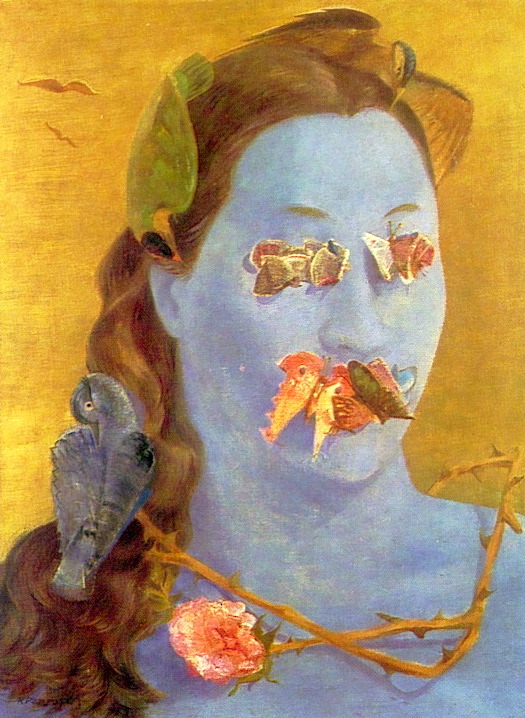
“Winged Domino: Portrait of Valentine” by Roland Penrose, 1938.

INSPIRATION

by Andreas Economakis

Inspiration. How does one get it? Inspiration is such an elusive thing. There are days when you just can’t shut up, shut your mind off. Hyper aware. Hyper expressive. Everything inspires you then. A leaf, the way dust settles on the leaf, your cat’s quivering white whiskers, the way a hunk of cheese falls on the floor, how your cats react to it, how you react to them reacting to the cheese, the fact that you run to the computer to write it down, only to stare at the screen vacantly, your fingers frozen over the keyboard, mind drifting, wondering whether you should check your e-mail first and what should I have for dinner (?) and man, better wash that thought down with a beer, yeah, comfortable again in front of the screen, going online, nope, no messages, sign off, open Microsoft Word and stare at the vacant screen, nothing written yet, boldly typing the title, swig of beer, highlight, hit the bold-underline keys and lean back, INSPIRATION, feet on desk and another swig of beer, better go check on the plants, see if they’ve grown another millimeter, and what are the cats doing now and why is Billy always hungry (?), is it because he has a cancerous lump in his stomach, poor little guy and I can’t really do anything about the lump because he’s almost 15 and one just can’t cut into a cat at that age, but wait, they cut into my old man when he was 69, and, my oh my, my phone number starts with 69 and, oh wait, that’s the sign of the crab and, frankly, a position that’s pretty fun in bed except I don’t really do it all that often, I don’t know why, I should talk to my girlfriend about this and, shit, I should get back to writing about the cats and the cheese and, swig of beer, I’m just not really inspired to write anything today, just inspired in general and you stare at the title on the screen and, hands frozen above the keyboard you write “How does one get it?” Shit if I know, you think, it’s like your cat looking at his plate when he isn’t hungry, or a butterfly landing on your cheek, which is a good metaphor for how love strikes and how beautiful it is, and the moment you try and possess the butterfly it flies off, leaving your cheeks tingling and slightly dusted with butterfly dust, and you sit and stretch your face out into the air, waiting for the next butterfly to land, but it won’t ever land while you’re waiting, no, it will only land when you’ve given up completely and aren’t thinking about it, kind of like when you’re doing something you really like, say like snorkeling, and you aren’t thinking about sex, or the last meal you ate, or how it felt when you got that good luck phone call, or when you fell in love that time, or when that butterfly landed on your cheek earlier, no, it will come while you’re looking at a plate of fried fish, or severed cow heads bobbing slowly up and down in the sea, barely touching the billowing, drifting sand, or when you kick the pebble out of your flip-flop and then voila, the butterfly of inspiration, like the butterfly of love, will land on your cheek and send your heart into palpitations, your mind into alertness, aware, aware that your are staring at your computer screen and your fingers have just finished this story.

–Andreas Economakis

This piece is part of a collection of stories on blindness entitled: The Blindness of Life.

Copyright © 2010, Andreas Economakis. All rights reserved.

For more stories by Andreas Economakis click on the author’s name below.

SATURDAY POETRY SERIES PRESENTS: JIMMY SANTIAGO BACA


THEY ONLY CAME TO SEE THE ZOO

by Jimmy Santiago Baca


Our muscles warped and scarr’d
Wrap around our skeletons
Like hot winds
That sweep the desert floor
In search of shade,
Sleeping each night
In the hollow of petrified
Skulls.
And from our mouths
Words of love would come
If we let them,
Like molten stones shrieking
From the belly of a volcano
But standing at these bars
We watched you leave
And only wondered…
You looked up at us with passion
As we stood at the bars.
A vacuum swelled at our hands
Went pale, our fingers cold
The gray pity of our lot
Made you turn away
But our spirits met that moment
Faraway in the land of Justice
And we whispered with our eyes,
”Come closer”
But you did not.
It’s been so long now
Since you left.
Did you tell them?
Hell is not a dream
And that you’ve been there?
Did you tell them


Jimmy Santiago Baca was born in Santa Fe, New Mexico in 1952 where he lived in a two-room shack with his alcoholic father, his mother, and his brother and sister. When he was two years old, Baca’s parents abandoned him and he and his siblings moved into their grandparent’s shack. Baca eventually moved into an orphanage and later, a detention center. Finally—when Baca was only 15 years old—he graduated to living on the streets. When Baca was 21, he was sentenced to five to ten years in a maximum-security prison in Arizona for dealing drugs. In prison, Baca taught himself how to read and write and developed a passion for writing poetry. Baca, who corresponded with several established poets while he was in prison, first published his poetry while he was still incarcerated. After he was released, he publishing his first major collection of poetry, Immigrants in Our Own Land, which is based on his prison experience. Since then Baca has released several other books of poetry, a collection of essays and stories, screenplays, and a memoir. Additionally, Baca conducts writing workshops at numerous schools and correctional facilities across the county. In 2003, Baca received his PhD in Literature from New Mexico University. (Annotated biography of Jimmy Santiago Baca courtesy of Youngstown State University.)

Editor’s Note: This post was by request, and it was requested that this poem be dedicated to all prisoners everywhere. If you have a request of your own please feel free to post it as a comment.

I love the idea of poetry as a means of redemption and as a means of finding your voice. I hope this post inspires people to find their own voices and their own freedom through poetry and art. “And from our mouths words of love would come, if we let them.”

Want to read more by and about Jimmy Santiago Baca?
Official Website
Poets.org
Youngstown State University

FRIDAY POETRY SERIES PRESENTS: Lawrence Raab

Marriage

by Lawrence Raab


Years later they find themselves talking
about chances, moments when their lives
might have swerved off
for the smallest reason.
What if
I hadn’t phoned, he says, that morning?
What if you’d been out,
as you were when I tried three times
the night before?
Then she tells him a secret.
She’d been there all evening, and she knew
he was the one calling, which was why
she hadn’t answered.
Because she felt—
because she was certain—her life would change
if she picked up the phone, said hello,
said, I was just thinking
of you.
I was afraid,
she tells him. And in the morning
I also knew it was you, but I just
answered the phone
the way anyone
answers a phone when it starts to ring,
not thinking you have a choice.


Lawrence Raab employs refreshingly simple language to explore memory, love, and a mysterious inevitability.   “Marriage” appeared in his collection of poems titled, What We Don’t Know About Each Other. The book won the National Poetry Series and was a finalist for the 1993 National Book Award. His latest work, A History of Forgetting, may not be as flashy as some of his earlier poetry, but finds the poet settled into a moody pathos that has some critics drawing comparisons to Thomas Hardy.

Ann Wright

Thousands send off the 600 passenger ferry Mavi Marmara from Istanbul with pro-Palestinian activists and humanitarian aid for Gaza. Photograph by Emrah Dalkaya

BREAK THE ISRAELI SIEGE OF GAZA OR ATTACK AT SEA, DETENTION CAMPS

AND DEPORTATION

By Ann Wright

Flotilla of eight ships is on en route to break the Israeli siege of Gaza. Will they make it to port in Gaza?

By the time you read this, we will be on the high seas of the Mediterranean (we hope the seas will not be too high).

Our two U.S. flagged Free Gaza boats, will join two other passenger ships, a 600 passenger ship from Turkey sponsored by the Turkish humanitarian organization, Insani Yardim Vakfi (IHH) and a 50 passenger ship from Athens sponsored by the European Campaign Against the Siege and the Greek/Swedish Ships to Gaza campaign, to sail to the shores of Gaza to break the Israeli naval blockade of the 1.5 million citizens in Gaza.

Four cargo ships from Ireland, Greece, Algeria and Turkey, will carry a total of 10,000 tons or 2 million pounds of construction materials for the housing of 50,000 made homeless during the 22 day Israeli attack on Gaza that killed 1440 Palestinians and wounded 5,000.

Many of us would like to see our boat renamed “The Audacity of Hope” as that is what we want to see from the Obama administration– courage to challenge the Israeli government on the siege of Gaza. It would be a really brave, bold move as every U.S. presidential administration since the formation of the State of Israeli in 1948 has blindly given free-rein to Israel in whatever actions it wishes to undertake no matter if the actions are a violation of international law. The carte blanche given to Israel by the United States has been dangerous for Israel’s national security as well as for the national security of the United States.

Probable reaction of Israeli Navy Ships-Bow shots, ramming or boarding

In less than 48 hours, the Israeli Navy will probably fire U.S. made ammunition and rockets in international waters over the bows of two U.S. flagged boats and one Greek boat with U.S. citizens aboard as well as citizens from 13 other countries and over the bows of the Turkish 600 passenger ship.

Ironically, on one passenger ship will be Joe Meaders, a U.S. citizen who is a survivor of the Israeli air and naval attack on a United States Navy ship, the USS Liberty, in 1967 killed 34 U.S. sailors and wounded 173. The Israeli government has never acknowledged, much less apologized for, the deaths of these sailors, nor the destruction of the USS Liberty.

According to Israeli media (http://www.jpost.com/Israel/Article.aspx?id=176491), the Israeli military is preparing for our arrival off the shores of Gaza. The Israeli navy has been practicing its plan for preventing us from docking in Gaza, a plan that probably includes demanding by radio that the ships change course away from Gaza, firing weapons in front of the ships, ramming the ships and sending well-armed boarding parties onto the ships.

Israelis prepare a detention camp

As our 8 ship flotilla prepares to depart Greece and Turkey to break the Israeli naval blockade of Gaza, the Israeli military is preparing a detention camp for the flotilla’s 700 delegates from 20 countries who are passengers on four of the ships.

Those passengers include Hedy Epstein, an 85 year old holocaust survivor, Parliamentarians from Germany and Ireland, two former diplomats from the United States, a retired U.S. Army Colonel, authors, journalists, activists, businesspersons and clergy.

Additionally, the military has identified a warehouse in the Ashelod area, just over Gaza’s northern border that will be used to detain the 700 passengers on the 8 ships.

Taking a page from the New York City police who put over 1500 persons into a filthy, unclean warehouse on a pier in New York City during the 2004 Republican convention, the Israeli government no doubt will make the surroundings as difficult as possible for us.

The Israeli government has extensive experience in warehousing dissent, as over 10,000 Palestinians are in Israeli jails and prisons, including juveniles who are arrested regularly in nighttime raids in villages of the West Bank.

20 passengers on the May, 2009 Free Gaza boat trying to break the siege were imprisoned for 10 days before they were deported from Israel. They included Nobel Peace Laureate Mairead Maguire and former U.S. Congresswoman Cynthia McKinney.

Wish us luck as we challenge the Israeli, Egyptian, European Union and United State’s unlawful siege and collective punishment of 1.5 million Palestinians in Gaza!

What will you do to help break the siege of Gaza?
 

–Ann Wright

Ann Wright is a 29 year US Army/Army Reserves veteran who retired as a Colonel and a former US diplomat who resigned in March, 2003 in opposition to the war on Iraq. She served in Nicaragua, Grenada, Somalia, Uzbekistan, Kyrgyzstan, Sierra Leone, Micronesia and Mongolia. Wright made three trips to Gaza in 2009 and helped organize the Gaza Freedom March that in December, 2009 brought 1350 persons from 44 countries to Cairo, Egypt in an attempt to break the siege of Gaza. She is the co-author of the book “Dissent: Voices of Conscience.”

This piece was originally published at Rabble.ca on May 26, 2010.

ANDREAS ECONOMAKIS

MOUSEHEART

by Andreas Economakis

4:30pm.  I’m standing outside of TK Films, on Cory Avenue.  The day is hot and humid.  The brown litter of a million exhausts sticks to my skin like an itchy Teflon coat.  July in Beverly Hills.  Overhead, a noisy police helicopter competes with the constant drone of Porsches and Land Rovers and other large combustion engines whizzing down Sunset Blvd., a few meters to my left.  Chris’ cigarette smoke wafts over my shoulders, around my sunglasses.  I don’t mind.  My eyes are glued to the spectacle across the street.

Two young women, actress-types, are on their knees, shrieking.  Their long, tanned legs are stretched out on the pavement, their arms swishing underneath a gold-colored Buick with ugly rims that’s parked next to a dumpster.  A squad of frantic green parrots buzzes overhead, raising all kinds of hell.

“Check THAT out!” gurgles Chris, his eyes pinned on the two women.  For a distracted moment, I think he’s talking about the parrots.  I squint directly at sun, following the squawking.  I look at Chris.  Through the dancing sunspots that momentarily cloud my vision, he looks distorted.

“What do you think they’re looking for?” I ask, not really wanting the two women to get up and straighten out their hiked up miniskirts.

“Beats me,” my friend says, patting his beer-belly and letting his mirror Rayban sunglasses slide down his nose, “…but I sure hope they don’t find it!”  He shines a wide tobacco yellow grin my way.

Brian, the discontented receptionist, waddles up next to us.  He lights a cigarette, his eyes locked on the gold-colored Buick.  Those two women must know they are attracting a lot of attention.  In the reflection of a passing van’s windows we look like a bunch of horny frat-boys.  I shudder at the thought but don’t budge.  We’re talking backlit thigh hairs here.

“Damn!” is all Brian says, inhaling deeply from his American Spirit Light.  Chris and I nod together.  Something beeps and I look down at my cell phone.

“The client will be here any moment boys,” I mutter.  I’m hoping Chris will get the drift and get back to work.  I don’t want it to look like we’re all fucking off, which, of course, we are.   Though I’ve personally made sure that all is ready for the pre-production meeting that’s about to take place, I need to warn Chris anyway.  That’s my job.  That’s why they call me a Production Coordinator.  I coordinate people and things.  Well anyway, I act like you do.

The words bounce off of Chris, who’s no less interested in the meeting than if chipmunks mate in springtime or summer.  He pushes his mirror Raybans up his nose, tucks his shirt in and turns his twin mirrors towards me.  For a moment, he reminds me of Jon from CHIPS, only after an all-night bender and with a few years and beers strapped to his frame.  In the mirrors, I kind of look like a freaky Ponch, only with a touch of William Burroughs.  “What keeps mankind alive?” I ponder, staring at this sepia-tinted, receding-hairline hybrid that’s me.  “Bestial acts!”  I clear my throat and look towards the two women.

“I’m going to check it out!” Chris gurgles, snapping me out of my reverie.

“Insolent, this assistant,” I think to myself.

Affecting the other John, John Wayne, Chris swaggers across Cory Ave.

Well, it takes all of 30 seconds before Chris is on all fours as well, swishing his hand under the gold-colored Buick. The girls don’t even pay attention to him, all focused as they are at whoever or whatever is under that ugly hunk of Detroit’s finest.  For a brief moment, Chris is totally stretched out on his stomach, skinny legs poking dangerously into the street.  In a maddeningly quick psychedelic flash, I picture a car rolling over Chris’s legs, his beer belly exploding, me running, people screaming, blood and guts and beer everywhere, mirror Raybans cracked on the street, seven years bad luck.  Fuck!  Are these psychedelic flashes weird tracers from my past?  A friend once told me that eating psychedelic mushrooms more than 7 times makes people legally insane.

Curiosity finally gets the better of me.  Feigning indifference, I stroll over to the circus act, throwing one last glance at my cell phone and an apprehensive look at the window upstairs.  I want to be sure that Eva, my Swedish producer, isn’t looking out of the window at us, wondering why the hell we’re all fucking off.

I approach the spectacle. “What are we looking for?” I ask, knowing exactly what I’m looking for.  My question goes unanswered.  The beautiful legs continue to move and I hear some muffled exclamations.  I have a clear view of both women.  My heart skips a beat.  Deep down, I know that if I too drop on all fours, I will forever be a slave to backlit thighs and peach-colored lace underwear. “Ah, hell!” I drop down to my primitive state and peek under the gold-colored Buick.

I don’t see anything.  The women are swishing their arms wildly and Chris is groaning in an extended reach.

“WHAT ARE WE LOOKING FOR?”  I half-yell.

“Rat!” Chris replies, matter-of-factly.  “They’re trying to catch their rat.”

A moment’s pause.  The reader will notice the diction, the grammar involved here.  “Their rat.”  There’s a rat under the gold car and this rat belongs to the beautiful backlit models.  I flatten out some more and strain to see the elusive quadruped.

“Rat?” I say aloud.

“He’s not going to answer you!  He’s a fucking rat!” Chris chuckles.

“I’m not talking to the beast you idiot,” I reply.

I picture myself catching the rat.  I have a clear shot at becoming a hero if I catch the large mouse.  The headlines will blare:  “Hero-Coordinator saves young woman’s pet mouse!  Couple to wed in April.”

But where is he?  I flatten myself onto the street for a better look, a few feet away from the future mother of my children.   My eyes drift up her back and settle on the base of her neck.  My heart skips another beat.  Something is looking back at me.  “Oh my God!  The rat is on her neck.  Wait!  No!  That’s not a rat,” I think to myself.  I look closer.  “That’s a tattoo.  A tattoo!”  A green snake is coiled around the young woman’s neck, its beady eyes looking directly at me.  The snake’s fangs are biting into a shiny red apple.  Milky white juice rolls down the apple seductively, onto the snake’s scaly green skin.  I’m transfixed, like Adam in the Garden of Eden.

“He’s running out of steam,” the other woman says.  “He’s over-exerted himself.”

“Amateur,” I think to myself.

A brown blur moves in the periphery of my vision.  The rat!  I have a bead on him.  Chris swipes his hand at the blur.  Suddenly, the brown fuzzy one scurries right up to my nose.  “Aaaagh!” I yell and jerk upward.  The metal clunking sound that follows is my cranium smacking the gold-colored Buick’s undercarriage.  Ouch!  This rat is huge.  Well, he looks huge, three inches from my nose.  Did the rodent just laugh at me?  I jump to my feet and back off onto the street cursing, rubbing the almost perverse little bump that’s rising out of my little bald spot.  A convertible Mercedes the color of a metallic prune honks aggressively and nearly runs me over.  The idiot actor/driver glares at me.  I flip him the bird.  He flips me back and mouths the word “jackass” from inside his ugly car.  The small crowd of TK employees gathered across the street laugh and hoot in unison.  I take a deep breath and plunge forward.

I crouch down and once again look under the gold-colored Buick.  My rodent friend looks back at me, beady black eyes trembling in their sockets, nose twitching.  He seems both energized and lethargic at the same time.  Chris’ hand swipes again and the rat dashes off toward one of the girls.  She makes a grab for him but he fakes to the right, bolting by one of her smudged kneecaps.  He banks to the curb and heads for the next parked car, a silver Beetle.

We all take our battle stations around the Beetle.  Outside of the office, more faces and murmurs gather.  A circus-like atmosphere is starting to develop.

Chris makes another swipe at the rat and he moves toward the curb.  I jump up and make for that spot.  I’m not exactly sure what I will do if I corner him.  One doesn’t think about these things when rat hunting.

As soon as I get there, the rodent makes a break for it and zooms past me, ducking around Chris’s blonde palm.  “Los Ratos!”  Chris yells, scrambling underneath the gold Buick again.

Like four seasoned animal wranglers from Mutual of Omaha’s “Wild Kingdom,” we take our places once again around the Buick.  That’s when things take a surprising turn.

Before I even crouch down, the little brown beast runs up to my like-colored hiking boots and pauses, nose twitching, body shaking like a leaf.  I look at the two women, then down at the rat.  Vortex vision.  The world becomes a slow-motion pinhole, the circle dominated by the rodent.  A rat in the pinhole.  Rattus Norvegicus is all that exists in the world at this moment.  No girls, no backlit thighs, no smoke or squished caterpillars or alarm clocks that don’t go off, no white crust around corroded car-battery terminals.  Just the rat and me.  Primitive hunting instinct.  Focus so pure it’s like sex.  Better.  It’s very primal…

So there I am, floating in this absolute, profound, vortex-induced silence.  I kneel down in slow motion, my right hand poised to grab my prey by the scruff of his neck.  I am two inches away from nirvana.  A predator, coiled, ready to strike.  Our eyes meet for second and for the first time in my life I look into the face of eternity, into creation itself.  I pause.  The rat twitches and springs forward with his muscular rodent legs.  My hand shoots out, faster than lightning but slow as a snail, a bullet against a gray background filmed at a 2000 frames per second, like those government films of a milk drop exploding on a lake of milk.

The bullet isn’t fast enough for a clean hit, but it lands on its mark nonetheless.  I miss the speedy rodent’s neck but my fist closes in on his haunches.  I have the rat by his ass!

I hoist the rat up above my head, half of my fist grasping his rump, the other half wrapped around his long, bony tail.  In a testosterone-filled moment of pure triumph, I bellow: “I’ve got him,” my voice booming, the world suddenly stopping to take note of my fearlessness, of my manliness, of my sheer Scottish-styled bravery.  Mouseheart!  I look over at the two women with a swagger and a sly smile, dripping some sort of manly 007 Venus flytrap aphrodisiac charm like Sean Connery or Timothy Dalton or Daniel Craig.  Definitely one of these Bonds.  Not the other ones.  They were poofters.

Both long-legged beauties are staring at me, mouths agape.  I bet they’ve never seen a man quite like me.  “This is how they make ‘em in Greece, girls” I want to say.  None of this half-caf double latte & a panini, manicure pedicure metro-sexual sensitive “I’m looking for the inner boy in me” bullshit.  Real men don’t flinch!  Real men don’t floss!  Real men don’t feel pain!  We roll up our sleeves and catch fierce jungle animals with our bare hands!

Just then, right then, my world is turned upside down.  My prey suddenly decides to turn Kujo on me.  Like a freaky Chinese contortionist, he does a 180, his toned athletic body folding in half.  I catch a tiny glint of the beast’s white fangs.  Then, the unthinkable happens.  Kujo bites down deep into my right index finger.  I bellow again.  Or is it a shriek?

Almost in response to my shriek, a black Lincoln Towncar pulls up in front of TK Films.  I look over towards the black Lincoln, the very car that houses TK’s big client, Mr. Miller Genuine Draught himself.  Mr. Draught steps out of his car, his mouth wide open, his eyes locked on the squirming rodent in my hands.

In a primitive moment of instinctive survival, I hurl the great beast across the street, yelling: “Aaaagh, get the fuck off of me!”

Kujo flies across the street in cartwheel fashion, a trapeze artist hell-bent on impressing my client.  He lands right by the client’s feet, dazed.  Dear god!  As if on cue, the rodent flops his bony tail across the client’s expensive Italian shoe.  The client shrieks and jumps back into his Lincoln, clunking his head on the car door.

“Why did you throw him?” I hear one of the women scream.  She’s barely audible over the guffawing of the office personnel, over the sheer horror of my breath as I look at my bleeding hand.  Across the street, the stricken rat hesitates and then high-tails it under another dumpster.

“He BIT me!” I snarl at the girl, watching my dreams of Coronas on the beach and sand on the sheets and that sweet, sweet smell on the pillows swirl down the toilet. “Aw hell, your rat bit me…”

“He’s not our rat!  Why did you throw him like that?”

Ten thoughts flash through my mind simultaneously.  One thought involves a violent act; all nine other involve a syringe the size of Baja with a rabies antidote being jammed with force into my tense stomach muscles.  I feel faint.

“Oh shit,” I mutter to myself, clutching my throbbing, bloody hand.  Ironically, it’s my belly that hurts more.

“He’s not your rat?” Chris barely whispers.  The two women shake their heads and look at me, irritably.

“We were just trying to catch him,” one of the women says.  I laugh at myself, trying to laugh at them.

I don’t wait around for the two mini-skirted freaks to justify their outrageous action.  Clutching my bleeding hand like a pistol, I yell “OUT OF MY WAY!” and barrel across the street.  The client steps in front of me and I barrel past him too.  I’m an injured man.  This is an emergency.  I hustle through the office door, screaming past Michael, the Executive Producer.  He’s busy screaming past me to go see what all the commotion is about now that his client has arrived.

“What’s going on here?” I hear Michael yell as I rush to the office bathroom.  Thinking he’s talking to me, I yell back “A fucking rat bit me!”  I kick open the bathroom door and plunge my stricken mitt under tepid water.  I try to catch my breath.  Rabid red water swirls down the drain.  Spots not unlike the earlier sunspots cloud my vision.  I feel dizzy.  Surely this is all a dream.  Rats don’t bite people in Beverly Hills.

Before I know it, Michael is crowding the bathroom door in a visibly perturbed and ominous manner.  Stale cigar smoke wafts directly to my nostrils.   “What the fuck just happened?” he asks.  Then, with a distinctly NY Italian accent, obviously exhumed in a state of crisis, he says: “Why’d you fucking throw a fucking rodent at the client?” He obviously doesn’t give a rat’s ass about his diction or the fact that I’m rabid, slowly dying and a prime candidate for workman’s compensation.

“I thought he was a show rat!” I reply, staring at my finger.  It’s beginning to throb.  The puncture wound is gushing blood in spurts, timed perfectly to my beating heart and brain, my dying heart and brain.  Suddenly, the bathroom feels tiny.

“What?!” Michael yells.  Chris appears behind Michael’s fat shoulders, dancing from foot to foot for a peak at the freak.

“I thought the rat belonged to those two actresses. I was trying to help them catch it,” I breathe.

“I don’t fucking believe this,” Michael belts out, sounding more and more Bensonhurst by the minute.  Any moment now he’s going to cut my head off and hold it over his head like a watermelon.  The bathroom gets even smaller.  I shut the water off and turn to Little Italy’s finest with determination.  He’s a big man, twice as wide as me.

“I think I’d better be getting to a hospital,” I manage to choke out, holding my injured finger out front as proof.  Michael glares at me like Tony Soprano.  He doesn’t budge.  His glistening eyes move slowly from my hair to my feet and back up to my face.   Fat Italians are a scary fucking people.  Sure, they lull you in with that mama pizza, let’s all sit at the same table and break bread with the kids crap, but deep down they just want to slit your throat, wrap you up in plastic garbage bags and stuff you into the trunk of a Cadillac, pumping a few 357 slugs into you for good measure.  Hell, I saw “Goodfellas”!

I wrap my hand in toilet paper and make for the door, eyes diverted so that a battle of the wills won’t ensue.  Little Italy rumbles, then moves.  As I glide past Michael, I hear Chris address him in a meek manner:  “This is all my fault.  I feel responsible here.  If I hadn’t gone over to help those two whacked out chicks, this wouldn’t be happening….  I’ll take him to Cedars-Sinai Hospital….”

I make my way back onto the street.  A small crowd has formed. I see someone mimic my rat toss across the street.  Everyone bursts out laughing.

“Chris!” I yell.  “Get your car.  Let’s go!”  Chris hurls his ample frame up Cory Ave.  Before I can spit, a baby blue ‘68 Camaro pulls up and Chris swings the door open.  I pile in and slam the door shut, eyes glued straight ahead.  What the hell, I turn and wave my bloody toilet paper finger to the small, merry crowd.  Chris chirps the tires and leaves the crowd in a cloud of blue-grey smoke.  At long last, we’re on our way.

“It’s all my fault, dude,” Chris says as he speeds down Doheny Ave., on the way to the hospital.  The afternoon lighting is incredible.  Is this all a dream, a bad remake of “Thelma & Louise”?

“No it’s not.” I reply, looking dreamily at the rose colored clouds.  I’m sinking into a dream.  Or is it death?  My hand sits on my lap like some bloody object I picked up accidentally from the street.

I look at Chris.  He’s sweating like a pro-wrestler.  Strange, considering a cool breeze is blowing in through the windows.

“I went across the street willingly, Chris,” I say.

“Still…” he replies, shooting past Beverly Blvd., forgetting to turn towards the hospital.

“You missed the turn, Chris!” I mutter.  I’m slowly coming to.  The urgency of my predicament seems very real all of a sudden.  I can feel the rabies and the plague crawling up my bloodstream, slowly making their way to my heart, to my brain.  If Chris doesn’t hurry, I will start foaming at the mouth.  I become nauseous.

“Shit!  See, you can tell I’m nervous, dude.”  He shoots me a worried glance.  I feel like I’m about to be sick.  “Whoa, dude!  You okay?  You’re not going to hurl, are you?”  He looks at me and then around the interior of his beloved car.

“I’m okay, but hurry up”.

Chris runs through a red light and snaps a Dukes of Hazard u-turn.  My stomach heaves to the right and then settles on the left.  I burp some sulfur and breathe deeply.

“It’s okay to break the law, isn’t it?  I mean, this is an emergency, right?  You’ve been mauled and we’re going to the hospital, right?”  He nervously peers into the rear view mirror for the imaginary cop.  He fumbles for a cigarette.

“Yeah,” I reply.  How far is this fucking hospital?  Seems like I’ve been in the car for weeks.

We pull into the emergency ward of the hospital.  A rather frantic Chris beelines for the ambulance parking space, nearly running over a security guard.  Ignoring the gesticulating guard, he runs around to my side and helps me out.

“Christ, Chris, I’m not a fucking cripple.  I got it!”

Instinctively, I limp into the ward.  An old friend in New York taught me the limping trick.  It was his contention that the more messed up you are, the faster the treatment in these big city hospitals. Actually, upon entering the squeaky clean lobby of Cedars, I notice that not a soul is waiting.  Rich people’s hospitals are such a trip!  The last time I was in a hospital was in NY.  I had to wait for four hours in a carnival-like atmosphere for treatment.  I saw some amazing things in those four hours.  The image of a hobo on a stretcher with the crucifix carved onto his face will be with me forever.

No crucifixes at Cedars-Sinai.  In an absolutely antiseptic and politically correct LA way, the hospital is rabidly non-denominational.

I drag my battered countenance to the front desk.  A young male nurse in clean civvies and a nametag looks up at me. “May I help you?” he asks politely, his fingers not leaving the keyboard of the computer.

“I need to see a doctor,” I reply.

“What’s wrong?” asks the calm nurse at the computer.

“A rat bit me on the finger about a half hour ago.”  I wait for his surprised expression.  There is none.

“Let’s take a look.”

I lift my hand, unwrap the toilet paper and hold my finger before him, like a kid presenting a broken toy to his daddy.  Not in the least bit impressed, the nurse pulls out a clipboard, attaches a form to it and points me to the waiting area.  “Fill this out and we’ll call you as soon as a doctor is available.”

“Do we need to catch the rat?  You know, what if it was rabid?”  Chris blurts from behind me.

“Oh dear me, no!  That won’t be necessary,” the nurse replies.

“I could hit him over the head with a shovel and bring him in, if you want,” Chris interjects.  I can’t figure this guy out.  What courses through Chris’ brain would probably mystify a few shrinks.

“That really won’t be necessary,” says the nurse, knitting his eyebrows in disgust.

“What about rabies, or the plague?  We’re talking a dumpster rat here.  Not the cleanest fella I’ve ever seen.”

The nurse is getting a little uneasy.  Obviously, not too many people like Chris walk into Beverly Hills hospitals.  Chris needs some southern logic to stop him from running back to Cory Avenue and assaulting that poor rat with a shovel or a shotgun.

“Don’t you worry.  Here…” the nurse says, handing me a pen and pointing once again to the waiting area.  A couple of other patients walk in and head for the desk.  I limp over to the couch.

“What’s wrong with your leg, dude?” Chris practically shouts.  He’s definitely in spontaneous combust mode.  The bigger the panic, the louder the Chris.

I sit down and look at the form.  For some unknown reason, Chris’ agitation rubs off and the paper goes out of focus.  The rabies and plague are obviously affecting my vision.  A bead of sweat trickles down my nose, making it twitch.  My eyes feel beady, like they’re going to roll out of their sockets.  I can feel myself trembling.  Dear God, I’m turning into a rat!

A young woman wearing way too many clothes walks up to the couch right next to mine and sits down with her clipboard.  I look over at her.  She clutches her head slowly and freezes, kind of like that “silent scream” painting.

I slowly peel back the tissue and look at the rat bite.  Two deep puncture wounds. The skin around the incisions is turning white.  My whole hand looks ghostly white.  Rabies!  I’m a dying man.

Suddenly, a large explosion issues from the silent-scream woman next to me, shocking the pen out of my fingers.  A deep, guttural, wheezing, wall-shattering cough bursts forth from her quivering lips, sending her into a tense fetal position on the couch.  Chris springs forth from his position like a rocket.  When the momentum catches up with him, he’s on the other side of the waiting room, examining the pastel paintings on the walls.

“Dude!  Check this out,” he half-yells across the fluorescent room, beckoning me over.  The king of subtlety, Chris is not.

“What?” I reply, not budging.  I gather my pen from the floor.

“Dude, seriously, come check this out!”  He’s pointing at a pastel painting not unlike the others.  Done with my test, I hobble over to the painting.  It’s either a flower, a building or a sailboat.  Or maybe it’s a mountain.

Chris whispers in my ear: “You know why I called you over here, right?”

I gaze at the woman and look Chris squarely in the face.  “Why’s that, Chris?” I ask loudly.

“Shhhhh!  Did you hear that woman?  Woah, dude!!  A cough like that has got to be contagious.  I mean, she’s in a hospital emergency room, dude!”

“So are you, Johnson!”  I reply and walk over to the nurse.  He takes the clipboard from me and I sit down by the woman again.  Chris continues to bounce from foot to foot by the surrealist pastel painting.

A few moments later, the nurse points at me and calls me over.  Another nurse is standing beside him.

“Are you our rat bite?” she asks, face wide with hilarity.

“Uh, huh!”

“Follow me.”

We travel down a long corridor, past several rooms with paper-covered beds.  A long, hysterical shriek issues from the depths of the building.  The nurse chuckles and looks at me.  I don’t think it’s funny.  There’s a certain feeling of powerlessness one gets in hospitals.

I’m ushered into a room with a partition in the middle.  A young woman is sitting on the bed on the other side.  A clean-cut fellow with an otherwise enormous Taliban beard is hovering around her.  They talk in whispers.

The nurse asks me to sit down on the bed.  She swivels a TV on an arm right up to my nose and turns it on.  The Food Channel blinks to life an inch away from me.  The nurse switches channels.  The Simpsons come on.  Homer has Bart’s neck in his hands and Bart is choking, his beady eyes almost popping out of their sockets.

“We’ve got cable here,” the nurse says with pride.  “Make yourself comfortable and the doctor will be with you shortly.”

I switch channels.  I once saw a documentary about this tribe in India that considers rats a delicacy.  The children fan out across fields and scare the rats out of holes, chasing them down and grabbing them with their bare hands.  How come the rats don’t bite them?  In the evenings, the tribe cooks the rats by throwing them as they are on a fire.  When the fur is singed off and the skin is nice and roasted, they pick the meat off, like we eat chicken at KFC.  Meanwhile, in New Delhi, one out of every god knows how many rats is rabid.  In the film, this guy pokes a stick at a rabid rat and it leaps four feet into the air, growling and gnashing at the stick.  I wonder if anyone in LA eats rats.  Didn’t someone once find a rabid rat in Griffith Park?  I switch the TV off.

The couple next to me are murmuring.  I think I hear the woman say that she has a brain tumor and is going to die.  The bearded man acts incredulous.  I’m obviously in the terminal ward.

“Are you the one who got bit by Mickey Mouse?” a young Latino man in green scrubs asks me from the door.

“Uh, huh…” I reply.

“Hi, I’m Tomas.  I’m going to irrigate your wound and the doctor will be right with you.”  Where is the doctor anyway?  He’s been “right with me” for hours.  The fucker is probably in the broom closet smoking a joint and getting it on with the nurses.

“How’d this happen?  Why’d Mickey bite you?”  He pulls out a massive syringe from a drawer.  Oh, Jesus, it’s true!  I gulp.  My stomach tenses into a knot.  Is it 30 or 40 shots that they have to pump into your stomach for rabies?  The nurse eyeballs me and chuckles.

“Don’t worry.  I’m only going to use this to irrigate the wound.”

I recount the tale of how I was attacked by the big mouse.  The medic doesn’t look up from the wound but keeps nodding and chuckling.  He sprays the fang bites with a saline solution.  My hand stings and throbs but I can take it.

“Am I your first rat case?” I ask.

“Oh, heavens no.  We see it all here.  Worst case I’ve seen was a dog bite.  A police dog chewed this homeless guy to bits.  He barely made it.  Really horrible.”

My rat bite seems kind of trivial all of a sudden.

“Am I going to get those rabies shots?  How many do I have to take?”

Tomas chuckles.

“What, for this little mouse bite?  There’s no rabies in LA.  You have nothing to worry about.  A couple of stitches and some antibiotics and you’ll be up and running.”  He finishes prepping my wound and waves goodbye.

“Hello Andreas, I’m Doctor Larson.  Are you our rat bite du jour?” a middle age man with a clipboard asks, approaching my bed.  He has squeaky-clean hands and has a touch of pomade in his hair.  I can tell he plays tennis and golf at some posh country club in Beverly Hills.  He probably has an Olympic-size swimming pool at home.  They all do.

“Hi Doc,” I say, feebly.

“How’d this happen?” he asks.  I repeat the story.  He looks at my finger, carefully inspecting the wound.  Doctors have such soft touches.

“Yup, looks like you’ll need a couple of stitches.”  He starts to prep for the operation.

“You get many cases like this, doc?”

“I wouldn’t say many, and none quite like yours.  Most people are trying to run away from or scare away the rat, not grab it.”

“I see…”

“And you have your weird cases too, of course…” he adds.

“Like what?”

“Oh, I don’t know, rats and other little furry things used in play, in bed, you know during sex.”

“What?!”

“They tend to freak out at the most inopportune times and bite down where they will.”

“Oh,” I say, wondering if Richard Gere lives nearby.

The smiling doctor finishes up.  He binds my finger in an enormous white bandage, scribbles a prescription on some paper and bids me farewell.  My white finger looks like a lighthouse.  An administrator comes by with a wheelchair and asks me to take a seat.  I’m wheeled out to the reception area.  After filling out a form, I am released into Chris’ custody.  He laughs at the size of my bandage.  We ride back to TK Films in perfect silence.  It’s dark outside.

We pull up to the office.  The rat and the two women are long gone.  I look up to the conference room and can see several heads bobbing up and down.  The meeting is in full swing.  They’re probably all laughing.  I bound up the stairs, my white finger a beacon of embarrassment.

Michael is at the top of the stairs, on his way down.  He shakes his head and stops.

“You okay?  You gonna live?” he asks.

“Yeah, except my ego has been mortally wounded.”

“What the hell were you tossing rats for?” he asks, half-seriously, half-laughing.

“Vortex vision, Michael.  It was me and the rat.”

“It was more than that.  Classic case of thinking with your little head, not your big head.”

“I guess so,” I reply, though I know he’s wrong.  I wouldn’t trade the rat in the pinhole for all the money in the world.  Michael will never know the vortex, the pure focus of creation, of life itself.  Michael will never feel temptation the way I did, the way Adam must have felt it in the Garden of Eden.  Michael will never be Mouseheart.

“Well anyway, the client’s okay,” he says on his way down the stairs, popping a glance at my finger.

“Cool!” I reply.

“Rat-boy!” he yells out and laughs before the door slams shut.

–Andreas Economakis

This piece is part of a collection of stories on blindness entitled: The Blindness of Life.

Copyright © 2010, Andreas Economakis. All rights reserved.

For more stories by Andreas Economakis click on the author’s name below.