Everything in the college cafeteria
is the fleshy color of canned pears
and so am I because it is winter.
*
Because it is winter and fresh fruit is impossible,
or at least too expensive,
I spoon canned pears into a blue plastic bowl
and guzzle the syrup straight from the can
like nobody raised me with any manners,
that’s what my mother would say,
and she’d be mostly right.
*
My mother would say, and she’d be mostly right,
that I am a beast. Sometimes I see Hannah with her shirt off
because we are roommates and sometimes it happens
and she has a pear tattooed on her side and sometimes
it happens that I am hungry and I’m not supposed to
put my mouth there because we are roommates.
*
Because we are roommates
in a time of fresh fruit
we share bites
from the same soft pear
and let the juice stick
to our bald chins
and say it is good.
*
Say it is good. Say it slides
good on you tongue.
Say soft. Say bites. Say
the juice sticks good
to your chin. Say it’s a pear.
MY FIRST STAB AT LIVING A DOUBLE LIFE
Because we were too proud a family
for the free lunch program
and cheese and deli meat were too expensive
for daily sandwiches, each school night for a decade
I smeared PB&J over cheap wheat bread
and shoved it into a flimsy sandwich bag.
Because I knew real hunger
was when the loaves ran out
and there was almost always a loaf
of frozen bread in the deep freeze to unthaw,
I told the soon-to-be cheerleaders
who lived in subdivisions
with names like storybooks,
who mocked the constant sameness
and smallness of my lunch offerings,
that this blandness gumming
the roof of my mouth was my favorite,
that I could have their stupid meat
and crackers, their juice boxes
and pudding cups and fullness
if I willed it. For a month each girl
came to school carrying carefully cut
triangles of PB&J and bragged
hers was the best, and I knew
I could turn any nothing into want.
WE WERE TRYING TO WRITE A LOVE STORY
but were we flailing on the bare, rough
mattress or failing? If to fail is to want
wilderness and achieve only small puddles
of salt—if to salt is what we do to wounds
to make them feel more wound-like,
then we must’ve been filling
our anatomies with stinging,
which was a failure at mercy,
which is a component of loving.
Did I hear him singing a blues
that bent August into a woman’s room
with no windows to cool the viscous night?
It must be possible to bend a woman
into a window. He must have tried
to jump out of me. He must have
tired his jumping muscles.
Could I have ever born him up
into the glad light of spring?
Do I mean born or raised and can you
raise a sad-boned man into anything
like light? If to find blood inside
a store-bought egg is to bear
sadness, if we were scared to eat it,
then aren’t we human, soaked
and salted and saved?
FORGIVE IT ALL
At Macy’s on State Street, in the year
of the good paying office job, I selected
an armload of spring dresses to try on,
a present to myself for my birthday.
Forgive the salesclerk who told me
not to play dress-up with the merchandise
when I wasn’t going to buy any.
She couldn’t have been speaking to
my well-starched shirt collar and woolen
trousers. There must have been some
darting hustle left in my eyes. Forgive
me. I dropped the half-dozen dresses
on the floor in front of the fitting rooms
and stomped off muttering, I’ll take
my damn money somewhere with
manners
. Forgive me for wanting
them so bad I went to the Macy’s
three Subway stops away where
the salesclerk didn’t mind the trash
in my bloodshot eyes and I wept
in the fitting room and bought
the most expensive frock. Forgive
the looming credit card balance
I should’ve paid down from years
with no dresses and tattered shoes.
There was a glad whimsy music
to that dress— the tiered
gingham skirt and crisscross
back—worth the stomping off,
the weeping, the reckless want.
(Today’s poems originally appeared inThrush Poetry Journaland appear here today with permission from the poet.)
Stevie Edwards is an MFA-poetry candidate at Cornell University. Her first full-length book of poetry, Good Grief, was released by Write Bloody Publishing in April 2012. She is the Editor-in-Chief of Muzzle Magazine, Head Honcho of Brusque Magazine, and an Editor of 4th & Verse Books. Her poetry has previously appeared in Southern Indiana Review, Rattle, Verse Daily, PANK, Thrush, and several other literary periodicals.
Editor’s Note: It is no wonder Thrush Poetry Journal featured six of Stevie Edwards’ poems when they typically feature no more than three pieces per poet. These poems are addictive. One unfolds into the next, riveting in their confessional nature, a feeling of kinship arising as poems read like shared experience. These pieces are successful as narrative poems, as short stories or flash fiction, and as poems bearing the torch of the lyric tradition, when they shine brightest with lines like, “Did I hear him singing a blues that bent August into a woman’s room…” In reading these poems I find that it can be difficult to discern whether my heart is broken for the poet, the narrator, or myself.
My first time alone
with the women in Saudi Arabia,
abayas, head covers off and I see
their faces, their hair free. Hands touch
me, lead me down
a line of greetings, kisses, whispers
in Arabic that I try
to return, trilled rs, long ms,
they laugh, because my words are
Egyptian, not Saudi, not
ours, they say. I watch, follow
what they do, sit on the ground, drink gawa
from tiny gold cups, nibble whole fried fish
with my right hand. We break bread, strangers,
now friends, uncovered, naked
in a way, because they speak to me of love.
They motion with their hands, point
to themselves, each other, then
at me, pause to see
if I understand, stop between streams
of Arabic to say daughter, sister, lover.
(Today’s poem originally appeared in Thrush Poetry Journal and appears here today with permission from the poet.)
Tawnysha Greene is currently a Ph.D. candidate in fiction writing at the University of Tennessee. Her work has appeared in various literary journals including Bellingham Review and Raleigh Review and is forthcoming in PANK Magazine.
Editor’s Note: When I first read today’s poem I was reminded of Reading Lolita in Tehran, a fantastic book I read recently about women in Iran and their relationship to their country, their government, their gender, and the veil. I was also reminded of Naomi Shihab Nye, a Palestinian-American poet whose soft-spoken reflections on the Middle East are often humbling, and, in particular, of Shihab Nye’s poem “Red Brocade,” one of my favorite poems of all time. Today’s poem is rich with sisterhood, with women bonding in their own sacred space—a tradition that dates back to a time before the patriarchy and remains a critical aspect of the feminine to this day. While I was drawn to all of these aspects of the poem, it was one stunning moment of emotional lyric that made me fall in love: “naked / in a way, because they speak to me of love.”
The Hetch Hetchy Valley as it looked in 1913. Photo from the archives of the San Francisco Public Utilities Commission.
RESTORE HETCH HETCHY VALLEY, VOTE YES! ON PROPOSITION F
by Matt Gonzalez
A fascinating challenge facing today’s environmental movement is how to best approach the reversal of past decisions that altered once-pristine environmental spaces for the sake of urgent man-made needs.
There is one school of thought that says, leave it be, let’s move on to the next battle to save this space or that resource. But there is another very compelling view that urges fighting to win back the right to restore once unique and diverse ecosystems.
Some types of environmental restoration projects are well-known; restored wetlands, for instance, or coal mine reclamation projects. Recently though, larger dam removal projects have started, a number of them in Washington state. These include the breaching of the 120 foot Condit Dam on the White Salmon River to finally allow access for Pacific salmon and steelhead runs. Also, Washington boasts the largest dam removal project in history which includes both the over 100 foot Elwha Dam and the 210 foot Glines Canyon Dam which will allow passage by migratory salmon and trout species for the first time since the dams were built about 100 years ago.
San Francisco voters will get a chance on November 6th to take a similar step toward studying the viability of restoring the Hetch Hetchy Valley in Yosemite National Park when they vote on Prop F, the Water Conservation & Yosemite Restoration Initiative.
First authorized by a Congressional Act of 1913 to primarily provide drinking water to the San Francisco Bay Area, the O’Shaughnessy Dam was built on the Tuolomne River in 1923 which flooded the Hetch Hetchy Valley under 300 feet of water. While it destroyed the valley’s ecosystem it created the Hetch Hetchy Reservoir, located 65 miles northeast from the city of Merced, which since 1934 has provided water to the San Francisco Bay Area, recently estimated to serve 2.4 million people yearly.
The Hetch Hetchy Reservoir also serves to provide energy in the form of hydroelectricity, with a capacity of over 200 megawatts a year. The water is transported from the reservoir by the Hetch Hetchy Aqueduct which is made up of 170 miles of gravity-driven pipelines, dams, and other reservoirs. Hydroelectricity is produced by the Kirkwood and Moccasin powerhouses, which have capacities of 118 and 100 megawatts, respectively.
Can it be restored?
At first glance the very idea of trying to restore what John Muir once called “one of nature’s rarest and most precious mountain temples” seems impossible, maybe just downright wishful thinking.
But many experts are starting to see renewable energy as the game-changer. If the city could harness solar and wind alternatives to make up for hydroelectricity losses and address water needs by simply collecting and storing the same water at a location downslope from Yosemite, perhaps the equation becomes more balanced and achievable. Also pursuing water recycling and utilizing the advancing science of desalination are just starting to be explored. But a serious, and well-funded, study is needed to truly begin exploring all of our options.
21st Century engineering advancements provide the opportunity to start discussing and evaluating whether restoration of this natural treasure is possible. Of course, it will be a large undertaking with a variety of concerns that must be considered. But there is no doubt that the project will attract the most creative and ambitious minds in areas encompassing many disciplines.
There is a preliminary belief that Tuolumne River water could be captured by other reservoirs that are downstream from Hetch Hetchy, the Cherry and Don Pedro reservoirs for instance. Furthermore, any shortfalls could be supplied via greater conservation efforts, newly discovered groundwater supplies, and water purchases when necessary. Voters should keep in mind that it’s the Tuolumne River that provides San Francisco’s water, the Hetch Hetchy Reservoir is simply one of nine reservoirs used for water storage within the greater Hetch Hetchy Acqueduct.
There’s also the issue of better conservation. San Francisco is notorious for not recycling any of its water. We treat rainwater as sewage and wash our streets and flush our toilets with drinking water. By contrast Orange County, not known for progressivism, recycles 92 million gallons of water a day.
Any loss in hydroelectricy could be made up by increasing our investment in renewable power such as wind and solar, which we should be doing anyway. Already renewable energy advocates are noting that the 42 miles of above-ground right-of-way between Yosemite and the city could be fitted with enough solar panels to generate at least 40 megawatts per year—a proposal the San Francisco Public Utilities Commission has never seriously considered because they currently aren’t required to do so. Who knows what other ideas will emerge by studying the issue?
Opponents say that such a study will cost too much. But Prop F supporters have proposed that a restoration study be paid for by committing 0.5% of bond monies voters approved in 2002. $8 million of the $1.6 billion dollar bond would be sufficient to get a reliable plan together voters could consider.
Former Secretary of the Interior Donald Hodel has proposed restoring the Hetch Hetchy Valley, as has the national Sierra Club and three former superintendents of the Yosemite National Park. A 1988 report prepared by the Bureau of Reclamation for the National Park Service states: “[The Hetch Hetch Valley] restoration would renew the national commitment to maintaining the integrity of the national park system and keep in perpetual conservation an irreplaceable and unique natural area.”
When the O’Shaughnessy Dam was first constructed, water management technologies were in their infancy. Now that these technologies have evolved, studying alternatives is highly attractive to environmentalists who see these major restoration projects as finally possible in the 21st century.
Despite the optimism, many are skeptical. After many ongoing legal controversies and broken promises, they should be. But this measure simply asks that the issue be on the table, and studying its viability will at least result in enhanced dam removal understanding that will benefit better ecology everywhere.
Voting yes on Proposition F will compel government to explore the alternatives. Nothing can be implemented without a further vote of the public in 2016, after a plan for action has been made available for public review, discussion, and debate.
Help give John Muir the victory that eluded him 100 years ago, vote yes on Proposition F, and take one step toward restoring the once pristine Hetch Hetchy Valley.
Matt Gonzalez is a former president of the San Francisco Board of Supervisors.
We loved wind so much that we
talked about buying kites. When we
finally bought kites, we continued to
talk about flying them on windy
days.
We talked about disasters, where the
kites would tangle into wind, how far
into things we loved, upward and
away from the sticky beach.
When we reviewed all possible
outcomes for disasters, we went
there, to the sticky beach, with our
kites, to the boardwalk where a sign
alerted us that all wind was cancelled
until we were ready to lose one
another.
(“Fantasy” will appear in Heartwrecks (Sibling Rivalry Press, 2013) and is printed here today with permission from the poet.)
Nicolas Destino’s work has appeared in The American Poetry Journal, The Bellevue Literary Review, Barge Journal, 580split, 322 Review, and others. He is a graduate of the MFA program at Goddard College, and his first full-length collection of poems, Heartwrecks, was released by Sibling Rivalry Press in 2013.
Editor’s Note: The Eastern Seaboard is struggling through the aftermath of disaster. ‘Superstorm Sandy,’ as the powers that be have dubbed her, has devastated New England and neighboring areas, hitting hardest in New Jersey and New York City. Your faithful editor of this Saturday Poetry Series has been without power, internet, and cell phone reception for days. But in times of crisis people come together and rise to the challenge. On the micro level, this poet and editor has been taken in by her neighbors, poets and artists with electricity and mean Italian cooking skills. Nicolas Destino and his husband Seth Ruggles-Hiler have opened their home to me and mine, and in the process of this disaster-togetherness I have had the opportunity to read Nicolas Destino’s Heartwrecks from cover to cover. I am humbled in the presence of greatness.
Today’s poem, from Destino’s forthcoming debut collection, was chosen for the ways in which it resonates with the disaster at hand. The power of the wind, the survival and destruction of the beach and boardwalk, the contemplation of possible outcomes of disaster, and the fact that, in the end, it is our human bonds that matter most. A deeply personal poem in nature, “Fantasy” speaks not only to love and loss between two souls, but to that which is far more powerful than us, from the heart through the forces of nature.
HOW SILENT THE TREES By Wyn Cooper for Liam Rector, 1949–2007
How the hell are you, I want
to ask but can’t—you’re dead.
How hard the snow fell,
how slowly it melts.
How to tie a knot big enough
to choke the wild pain.
How to listen carelessly
to words used carefully.
How philosophy handles death:
with great reluctance.
How answers to questions
often contain no answer.
How to wind a watch
so tight time stops.
How silent the trees, how
loud the shots of hunters.
Today’s poem previously appeared in AGNI Online and appears here today with permission from the poet.
Wyn Cooper’s fourth book of poems, Chaos is the New Calm, was published by BOA Editions in 2010. His poems appear in 25 anthologies of contemporary poetry. He has taught at Bennington and Marlboro Colleges, the University of Massachusetts/Amherst, the Frost Place, and at the University of Utah. He has written songs with Sheryl Crow, David Broza, Jody Redhage, and David Baerwald. Songs from his two CDs with Madison Smartt Bell can be heard on six television shows. He lives in Vermont and recently worked for the Harriet Monroe Poetry Institute, a think tank run by the Poetry Foundation in Chicago. He currently works as a freelance editor of poetry, fiction, and non-ficition. www.wyncooper.com
Editor’s Note: Whether it is because I lost my father earlier this year, because a dear friend is right now at her grandfather’s deathbed, or because Dia de los Muertos is around the corner, I am interested in poems that honestly share the experience of loss. Today’s piece captures a range of emotions and occurrences that losing someone encompasses. The instinctual desire to call them coupled with remembering you can’t, the questions you ask to which there is no answer, and the way their absence comes upon you like a panic, leaving you wondering how to “tie a knot big enough to choke the wild pain.”
One of 95 million high-tech imaging studies performed each year at a cost of over $100 billion, in a still from Money and Medicine. Photo credit: Public Policy Productions, Inc.
An Epidemic of Overtreatment
By John Unger Zussman
Last month, I previewed Roger Weisberg’s new documentary about medical overtreatment, Money and Medicine, which premiered on PBS on September 25. You can view the film in full on its PBS website. In this post, I’d like to continue the discussion of the issues raised by the film and by readers’ thoughtful comments on my earlier post, with special emphasis on the politics of overtreatment.
In a particularly poignant scene in Money and Medicine, Dywane Stonum shows his elderly mother, Willie Stonum, black-and-white photos of her younger self on an electronic viewer. In one, she holds her first baby while her husband holds her. In another, she smiles proudly, decked out in an elegant jacket, a scarf tied in a bow, and a filigreed hat. “Here’s your favorite picture,” he tells her.
Willie Stonum doesn’t stir, or blink, or even acknowledge his presence.
Ten months earlier, she suffered a massive stroke. Now she languishes in her bed at UCLA Medical Center, occasionally opening her eyes. She is on a ventilator, uses a feeding tube, relies on dialysis, and needs constant medical support to maintain her blood pressure and fight pneumonia and other infections. Her Medicare bills exceed $5 million.
Dywane Stonum is his mother’s proxy for medical decisions. “I feel like my mom is my baby,” he says. “If there’s something that can sustain her medically, she would want that. Miracles happen if you believe in miracles. You do everything you can to preserve life. That’s what my mother would want.”
After ten months, UCLA’s Ethics Committee has decided that, should Willie Stonum experience another crisis, no heroic efforts should be undertaken to save her life. Dywane Stonum is incensed. “They’re pulling the plug,” he protests. “I call it a medical execution. It is euthanasia.”
“We do not practice euthanasia under any circumstances,” says Dr. Neil Wenger, chair of the Ethics Committee. But “it’s possible to use these advanced tools not to help patients, but to prolong a death, or to produce more suffering or less comfort. And under those circumstances, physicians may well say no.”
Nine years ago, my wife and I stood by my brother-in-law’s ICU bedside with his wife, daughter, and son-in-law. At age 59, after living with kidney disease for years, he had passed out and fallen in his bedroom. Although his wife quickly called 911, he had lost brain function by the time the paramedics arrived. Now we held hands and cried softly as the nurse removed his breathing tube. Minutes later, he died peacefully.
Long before his ultimately fatal illness, my brother-in-law had made this decision easy on his wife. “No way I want to live like a vegetable,” he told her, and us, and anyone who would listen. “Pull the plug. Put me out of my misery.” When he died, we felt relieved, not guilty. We were absolutely certain that’s what he would have wanted.
Leaving aside the question of why Willie Stonum is occupying a bed at UCLA—at a cost of over $16,000 a day—rather than at a nursing home, it is impossible not to wonder if she would want this kind of prolonged death—and if she ever had that conversation with her doctor or her son.
Of course, a proposal to compensate physicians to counsel their Medicare patients about end-of-life care options was originally included in the Affordable Care Act, often known as Obamacare. But when Sarah Palin falsely branded it a “death panel”—a claim that merited PolitiFact’s Lie of the Year award in 2009—it was removed from the bill.
Money and Medicine shows us two patients having just this conversation with their doctors at Intermountain Health Care in Salt Lake City. One, Davis Sargent, is suffering from end-stage congestive heart and kidney failure. “When it’s time, it’s time,” he says. “Of course I don’t want to die, but going out kicking and screaming doesn’t change the going out.” Sargent makes it clear that, instead of rescue care in an ICU, he wants hospice care at home. “I’m only 6 feet from a nice place to sit in the sun in the front yard, and I love that more than anything else.”
After his discharge, Sargent received comfort care at home for ten days before he died—as he wished—surrounded by his loved ones.
The film argues that reducing overtreatment at the end of life is not simply a question of reducing costs—it’s also what patients want when given the choice. “To deny people an opportunity to talk about death, to discuss how they want to die, to be given choices about dying, I think is a really cruel thing,” says Shannon Brownlee, acting director of the Health Policy Program at the New America Foundation, and the author of Overtreated: Why too much medicine is making us sicker and poorer. “And we have to start being able to talk about it. And not just because we’re spending a huge amount of money on it, but because a medicalized death is not what most people want.”
That sentiment is echoed by Sir Thomas Hughes-Hallett, former CEO of Marie Curie Cancer Care in the UK. “It’s not about hastening death,” Hughes-Hallett said in a recent New York Times Op-Ed. “It’s about recognizing that someone is dying, and giving them choices. Do you want an oxygen mask over your face? Or would you like to kiss your wife?”
Money and Medicine shows us overtreatment in a variety of settings and contexts. Filmmaker Weisberg argues that overtesting, overtreatment, and waste are inherent in the way we provide health care in the U.S. Our whole system is geared toward doing something rather than nothing, even when it doesn’t help or causes harm.
But there are alternatives, even within the current health-care system. Money and Medicine profiles Intermountain Medical Center, where Sargent received end-of-life counseling, as a case study in designing the best available science into care. IMC takes time to educate patients in the real risks and probabilities of both disease and treatment. And it regularly reviews practices and metrics in light of medical evidence.
For example, “elective induction of birth” by cesarean section has proliferated in much of the U.S., not for any medical reason, but for the convenience of patient and/or doctor. When IMC realized that more than a quarter of obstetrician referrals for elective C-sections were poor candidates for the procedure, they instituted team reviews of the cases. “Maybe I need my counselor who advises the surgery to not be the surgeon,” reasons Brent James, IMC’s chief quality officer. This resulted in a dramatic drop in C-sections, fewer babies in need of neonatal intensive care, and a savings of $50 million. Ironically, IMC suffered financially by receiving lower reimbursements because it performed fewer expensive procedures.
And this upside-down system of reimbursements—fee-for-service medicine—is at the core of the problem. Money and Medicine demonstrates that overtesting and overtreatment are not isolated or accidental, but integral parts of the American medical system. Every decision, every incentive—for patient, doctor, hospital, pharmaceutical and device manufacturer, insurer, and politician—is weighted toward doing more rather than less, even if it causes harm.
Of course, it’s wasteful—it consumes, by one estimate, 30% of U.S. health care spending, or $800 billion a year. But, as IMC’s James puts it, “one person’s waste is nearly always another person’s income.” In fee-for-service medicine, no one gets paid unless the test is ordered, the medication is prescribed, or the procedure is performed.
It would be one thing if overspending and overtreatment resulted in positive patient outcomes. But the U.S. achieves, at best, middling results when compared to other Western countries, while outspending them significantly. The system’s defenders like to point to foreign “medical tourists” who come to the U.S. for treatment, and the Deloitte Center for Health Solutions estimated there were more than 400,000 of them in 2008. But that number is dwarfed by the 1.5 million Americans who sought health care abroad in the same year.
Stanford geriatrician Dr. Walter Bortz blames overtesting and overtreatment on the collision of biology and capitalism in fee-for-service medicine:
I’m a capitalist, I believe in capitalism; it’s the best social contract we have to make the gears of society work. But it’s selling the wrong product. Our capitalism sells disease. We want you to bleed. Or we want you to have a spot that we don’t know, and that will generate X-ray after X-ray after X-ray … Stanford, where I love my life, is a repair shop. You go there to get fixed. Why? Because we can send you a bill for that.
The emphasis on profit means that we haven’t even done enough research to know which of our current treatments are actually working. Pharmaceutical and device manufacturers, who underwrite clinical trials, have no incentive to finance research on drugs and devices that are already making them money. “Medical research is dominated by research on the new: new tests, new treatments, new disorders, new fads, and new markets,” says Dartmouth professor Dr. H. Gilbert Welch. “We have to start directing more money toward evaluating standard practices—all the tests and treatments that doctors are already providing.”
I wish Money and Medicine had the time to show in detail the harm that can be caused by excessive screening tests and treatments, since many patients (and even doctors) discount it. What’s the downside, they reason, in getting an annual PSA or mammogram, or in receiving chemotherapy that reduces your chance of recurrence by a couple more percent? But as James says, “treatments that are powerful enough to heal can also harm.” This was illustrated last June, when Good Morning, America co-anchor Robin Roberts, who had gone public with her successful battle with breast cancer in 2007, announced that she was diagnosed with myelodysplastic syndrome (MDS). MDS is a bone marrow disease often caused by chemotherapy and radiation received in an earlier cancer treatment. “We always think of the drug as a double-edged sword,” says Otis Brawley, chief medical officer of the American Cancer Society. “It’s one of the reasons why I’m outspoken about only using chemotherapy when we absolutely need chemotherapy.” Roberts received a bone marrow transplant earlier this month.
With health care a central issue in the current presidential election, I asked Weisberg how the Obama and Romney campaigns would address the overtreatment and waste issues raised in his film. He began with Obamacare:
The Affordable Care Act that the Supreme Court recently upheld extends health care coverage to over 30 million uninsured Americans but actually does very little to make health care more affordable. The main thrust of the legislation was to expand access, not to contain costs. However, there are a number of provisions that fund demonstration projects that attempt to alter the reimbursement system in order to reward value instead of volume—to reward the quality instead of the quantity of medical services. One of the best-known initiatives involves the creation of Accountable Care Organizations or ACOs.
If the Affordable Care Act doesn’t actually do enough to make health care affordable, it’s tempting to blame Republicans and their lies about death panels. But let’s remember that the Obama administration gave away much of the store before the debate actually began, in its attempt to win support from industry and Congress. For example, in exchange for support and cost concessions from the Pharmaceutical Researchers and Manufacturers Association (PhRMA), the White House agreed not to use government leverage to bargain for lower drug prices or to import drugs from Canada.
But at least the ACOs encouraged by Obamacare take a shot at overturning the overtreatment incentives of fee-for-service medicine. Romney’s plan—to the extent he has revealed it—aims to reduce government expenditures for health care, but not the costs or structure of health care itself. Weisberg’s take:
The Romney plan, like many of his policies, is not terribly fleshed out. His mantra is “repeal and replace.” What we do know is that he would make Medicaid a block grant program, leaving states to struggle with declining budgets and decide who gets what kind of care. He would also turn Medicare into a voucher program, with the result that over time the voucher would cover a smaller and smaller portion of the medical bills of seniors.
As I write this, shortly after the final presidential debate, the campaigns have not seriously discussed medical overtreatment or cost control. In fact, so far they have not progressed beyond a fight between siblings. “You want to destroy Medicare!” “No, you do!”
Faced with governmental inaction, hospitals and professional medical organizations have begun to take responsibility for reducing overtreatment and waste in their own domains. Memorial Sloan-Kettering Cancer Center and the Mutual Of Omaha Medicarerecently decided to drop an expensive new colorectal cancer drug (Zaltrap) from its formulary, despite the fact that Medicare would reimburse them for it. The reason: it works no better than a similar drug (Avastin), but costs more than twice as much.
Another ray of hope comes from the Choosing Wisely initiative, sponsored by the American Board of Internal Medicine Foundation. The initiative has recruited professional associations for major medical specialties, like the American Association of Cardiology and the American Society of Clinical Oncology. Each association has identified “Five Things Physicians and Patients Should Question”—common tests or treatments that are expensive, overused, and unsupported by medical evidence. Working with these professional societies, Consumer Reports has compiled clear and objective guidelines for patients on such topics as heartburn, Pap tests, and lower back pain. As the film suggests, when patients are informed about the choices available to them and their risks and benefits, they are less likely to choose overtreatment. (My thanks to Cameron Ward for alerting me to this site in a comment to my earlier post.)
Some commentators maintain that, to truly control health care spending in the U.S., we need to ration health care. “In the famous ‘third rails’ of American politics,” argues Steven Rattner, former counselor to President Obama’s treasury secretary, invoking the spectre of death panels, “none stands taller than overtly acknowledging that elderly Americans are not entitled to every conceivable medical procedure or pharmaceutical.”
In the long run, that’s probably true. But we’re not there yet—not even close. There’s plenty of low-hanging fruit to pick first. “It’s not rationing to get rid of stuff that’s bad for you,” says Brownlee, author of Overtreated. “It’s not rationing to get rid of care that won’t benefit you.” In the film, she cites a recent study of late-stage cancer patients that compared palliative care—making the patient comfortable without actively trying to combat the disease—to standard, aggressive treatment. The patients who received only palliative care actually lived longer than those who received the standard treatment.
“This isn’t withholding necessary care,” echoes IMC’s James. “It’s withholding unnecessary injuries.” Eliminating overtesting and overtreatment have little downside and great upside. But to do that, we need to rely on science to sort out which tests and treatments are medically warranted. And we need to eliminate the incentives of fee-for-service medicine and embrace an ACO model in which healthy outcomes, not tests and treatments, are rewarded.
It’s time to have that “adult conversation” our leaders keep promising—whether they choose to participate or not.
Fierce This Falling: “Belief” and “disbelief” are the easy answers to spiritual quests. In her latest collection, Fierce This Falling, Betsy Johnson-Miller explores the much tougher road that is “faith”–the dangerous openness to possibility (“Living lately on my knees, it feels perverse / this waiting for crumbs from the universe”). As readers, we bear witness to her wanting, her watching, her waiting; to those precious, small epiphanies of a woman who is “lost on a good road.” Johnson-Miller’s words are at once measured… and fiercely beautiful. -Robert Gray, Contributing Editor, Shelf Awareness
Betsy Johnson-Miller writes and lives in Minnesota. She teaches at the College of St. Benedict/St. John’s University, and her work has appeared in Agni (online), Cortland Review, Gray’s Sporting Journal, Portland magazine, 5 A.M., Mid-American Review, and Salamander.
Editor’s Note:Fierce This Falling is a mediation on faith, marriage, and loss. On what makes us human and what it is to struggle with our most intimate and trying relationships. Within a lyrical realm of her own design, Betsy Johnson-Miller turns inward with a keen and often painfully honest insight. The roots of her quest reach as far back as the creation of mankind and blossom in the beauty and suffering of the moment at hand.
My temple sweeps are nightly but will go largely unremembered
when the salute comes down from in front of you and covers
your heart
save and continue save and continue save
Today’s poem previously appeared in ILK journal and appears here today with permission from the poet.
Lesley Wheeler is a writer living in Kansas City. She is a co-editor of Strange Cage and graduate of the Iowa Writers’ Workshop. Her poetry has appeared in ILK, and Sawbuck Poetry, and translation work in the Washington Square Review. Poet CA Conrad says of her, “She is not small sticks, but flares up from them, beautifully!”
Editor’s Note: In a few words Lesely Wheeler is able to traverse time, reaching from antiquity to modernity. Today’s poem prepares us to enter the world of archaeologists—those students of human activity of the past—then takes us within the walls of temples and into the realm of the heart. But the methodology the poet proposes for commemorating her experience evokes not the past, but this very moment in history when she instructs, incants, or pleads, “save and continue save and continue save.”
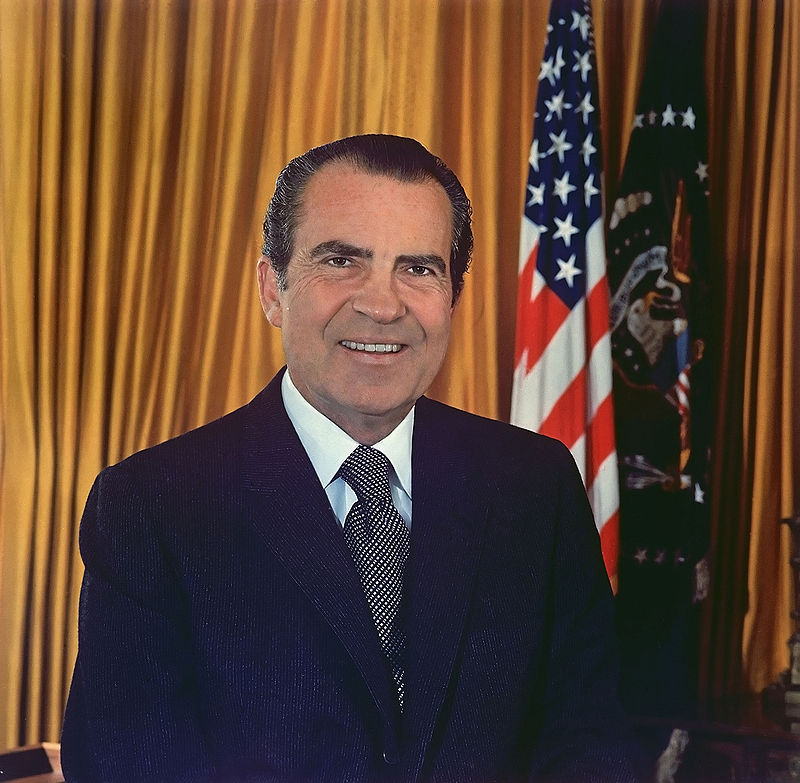
Official White House photo of President Richard Nixon NARA National Archives and Records Administration (public domain)
The most remarkable thing about Rick Perlstein’s Nixonland is that it was published four and a half years ago, before Barack Obama was elected president, before the Tea Party, before Occupy. Otherwise you might be forgiven for thinking that Perlstein was drawing meaningful parallels between our era and the 1960s and early 1970s of Richard Nixon’s heyday. There’s no way he could have been, of course. But it sure feels that way.
It is easy to forget that our current toxic “red state/blue state” opposition is nothing especially new, even if it has taken on a novel geographical aspect—a “big sort,” as Bill Bishop has it. We neglect to trace our current divide back through the Reagan era, through the Nixon era, to 1965, which is Perlstein’s starting point. The United States has been two oppositional yet intermingled nations for nearly fifty years, and Perlstein sets out to find out where it started and who stood to profit from exploiting that tension.
Nixonland is about Kulturkampf, American-style, and about Richard Nixon’s manipulation of it for political gain. Perlstein’s thesis is that the future president’s worldview was formed at Whittier College, where young Nixon was shut out of the world of the Establishment swells, known there as “Franklins”; Nixon formed his own social club for the lower-class strivers, which he called the Orthogonians. For the rest of his life, Perlstein claims, Nixon saw the world as divided between the Franklins and the Orthogonians. (This is an interesting tack for Perlstein to take, given that he prefaces every psychological insight he borrows from other sources—that is, virtually all of them—with “The psychobiographers might say that…” or something similar; more on that below.) What’s more, he had a gift for sniffing out these socioeconomic oppositions and using them to further his political career. Paradoxically, Nixon positioned himself as the champion of the traditional values of the working class in spite of his membership in the party of business and wealth, and he was the first to bring many blue-collar voters into that party, which so disdained their economic interests. Before there was What’s the Matter with Kansas? there were the Reagan Democrats, and before the Reagan Democrats, there was Nixon’s “Silent Majority.”
How did he do it? The answer is obvious to us, because it’s the political air we now breathe: cultural wedge issues. It wasn’t so obvious at the time. Nixon pioneered the alchemical transmutation of fear of change and class resentment (where class is a cultural category, rather than strictly an economic one) into virtues, a subtle manipulation that Perlstein calls “political jujitsu.” How dare those artists and movie stars, those pinko professors and Establishment liberals, that liberal-biased media sympathize with the Communists we’re fighting in Korea and Cuba and Vietnam, the druggie degenerates who are tearing apart the moral fabric of our great nation and perverting our children, the civil rights activists and Yippie political agitators who want to change our venerable Constitution and overthrow our government? How dare they throw their “tolerance” and “experimentation” in our faces? We just want economic stability and peace and quiet in the streets and the kind of life our parents had, only more prosperous.
And so, after a quick summary of Nixon’s boyhood, education, and early political career—including the all-important “Checkers” broadcast, in which Nixon gave an early virtuoso performance of his uniquely passive-aggressive brand of moral suasion—Perlstein throws us into the Watts riots of 1965, where the era of Great Society peace and prosperity promised by Lyndon Johnson’s 1964 landslide victory (the 1960s equivalent of Francis Fukuyama’s 1992 premature prediction of the “End of History”) immolated itself before a shocked television audience. Nixon took in the violent cultural fault lines created by desegregation and protest against an already unpopular war. He understood that once equal rights became a statutory reality, oppressed blacks would not tolerate anything but the full and immediate fulfillment of that legal promise, which most whites, especially Southern and working-class whites, would not abide. He saw that the traditionally Democratic South was appalled by LBJ’s liberal turn on civil rights and desegregation, and that in the North, traditional Democratic stalwarts such as labor unions and big-city machines felt as though their interests were being ignored in favor of rights and privileges for blacks and the non-working poor. And in all this he saw opportunity—opportunity for a traditional-values based Republican party, led by Richard M. Nixon, to make inroads into perennial Democratic strongholds. Nixon was always a hard worker, and he put all his energy, stamina, cunning, and political influence to work.
Perlstein goes into great detail as he traces the disintegration of the Democratic party—first at the notorious 1968 nominating convention in Chicago and then at the less-infamous, but perhaps even more damaging, 1972 convention in Miami Beach—and the implosion of George McGovern’s presidential run. Perlstein rightly sees McGovern’s campaign as doomed from the start: though his ill-advised choice of Thomas Eagleton as his running mate was the coup de grace, it was the Committee to Re-Elect the President’s sabotage, the internecine skirmishes and philosophical contradictions between rival candidates and factions, and the neutering of the once-powerful bosses, capped off by a three-ring circus of a convention that showcased the party’s divisions and apparent frivolities, that preordained the Democrats’ failure. Simultaneously, he follows the rise, and the beginning of the political demise, of Richard M. Nixon.
Perlstein’s talent (at least here) is not with original research (Nixonland contains little, if any), but with sifting through secondary sources and collocating and analyzing his finds. He arranges his facts to speak for themselves, and his style of analysis is subtle and unobtrusive, interwoven into the narrative so well that the reader sometimes fails to notice that the story has taken a didactic turn. He is also an astute student of politics and a political realist, with a deep respect for the compromise, the coalition, the power play, and even machine politics to a degree (for an excellent short-form example of Perlstein at work, see this recent piece on Barack Obama’s roots in Chicago machine politics). It is here that the lessons he takes from the history of Nixon’s era differ from the usual partisan fare—even when he’s using source material written by partisan observers—and where his analysis of the politics of that time provides unsettling insights into our current situation. He stresses how radicals’ chronic aversion to compromise and coalition-building, and their incorrigible overestimation of the majority’s tolerance for rapid change and novelty, nearly always dooms their efforts to effect reform, and how the top-down reforms they are able to institute so often meet with resistance from the rank-and-file. The radicals’ fetish for open discussion and equal and democratic representation in all decisions, especially in combination with the aversion to compromise and coalition, creates deadlock and endless delay and forecloses any possibility of quick executive decision-making and nimble response—a lesson that the Occupy movement has yet to take to heart. And all too often, there is a Richard Nixon figure, an adept of Realpolitik, to capitalize on the chaos that ensues.
And about Realpolitik: an argument that Perlstein seems implicitly to make is that Nixon’s downfall was at least partly a function of his transformation from a sort of Manichaean figure, the scourge of State Department crypto-Communists and hippies and champion of the “Silent Majority,” to a disciple of Henry Kissinger’s amoral power-worship. His manipulations vis-à-vis the Vietnam war—of facts, of the lives of POWs—and his brute, naked lust to gain a second term as president, his increasing paranoia, his stonewalling of the press, his abandonment of principle in the economic realm as stagflation and competition from Japan and the Common Market created trade imbalances and degraded the value of the dollar, his need to surround himself with venal yes-men who would do literally anything to get a leg up on the president’s “enemies”: these were distortions and exaggerations of Nixon’s character flaws that only grew the more power he amassed. It is an interesting theory, if it can even be called a full-fledged theory, but it smacks of the kind of armchair psychoanalysis that Perlstein claims to disdain.
Nixonland is a big book, a sprawling history, given its seemingly narrow focus of a seven-year period, and its epic scope and accumulative nature have the virtue of presenting the reader with a wealth of trivial information and glimpses—foreshadowings—of things and people that will become important only later. We meet a young Karl Rove, a campus Young Republican who ingratiated himself into the Committee to Re-Elect the President by bringing to the ’72 campaign a bag of political tricks garnered in college elections. We meet a newly-divorced Senator Bob Dole on the prowl, sporting bell-bottoms and a fake tan. We see early abuses of the Political Action Committee in John Connally’s Democrats for Nixon, which produced one of those tasty if vapid statistical coincidences that really make reading history fun: the specious claim, in a TV ad, that George McGovern would make 47% of the population eligible for welfare. But the agglomerative method also has its drawbacks: one finds repetitions of unfortunate words and phrases—near-comical overuses of the phrases “slow, soiling humiliations” and “man bites dog,” and of the words “solons” for legislators and “exuberants” for conservative die-hards come immediately to mind—as well as the sort of minor factual errors that have the effect of calling into question the veracity of more important claims: the film Straw Dogs is not a western; Richard Nixon’s father was born in Ohio, not Indiana; and the chief official of a Nazi political district was a Gauleiter, a German word, not gauletier, a real-sounding but imaginary French one.
On a more macro level, while one shudders at the possibility of seeing scores more instances of “slow, soiling humiliations,” it might have been interesting had Perlstein lent his skills to taking the book all the way through Watergate to Nixon’s actual resignation, rather than leaving off shortly after the 1972 election. But that could well be an entire 900-page book in itself, and Perlstein succeeds admirably in proving his point in the period he allotted himself. What remains to be seen is whether American politics continue to exhibit—as in Nixon, in his pupil Ronald Reagan, and in Reagan’s student George W. Bush—the pattern of ruthless power-seeking by the Right, and rudderless floundering and fissile factionalism within the Left. The human cost of such recurrent dysfunction is higher than ever.
I must have been lazy like tepid water.
I have become a chaise lounge in the hallway
asking what will happen if the big one comes,
if it will destroy my relationship with the past. Will it?
Four beautiful women play ping-pong in my ears
and someday I will turn to watch them suffocate
into their boyfriends’ arms like leer jets,
the way they get caught between two peaks
because the pilots forgot, were lost in the snow already
before their feet even hit the ground.
My mother was my cellmate in my first life.
In this one, my mother is my mother in a cell,
her hands divided into quadrants,
an example of what melodramatic could never mean.
Her and I have become friends at the gym
where we use our eyes to signal that we are the same.
Four women talk about boyfriends like they were diets,
like we haven’t been to the same dream a hundred times.
My mother wishes they would exchange hairstyles with her,
that they would hand her gold flecks under the covers.
Today’s poem previously appeared in ILK journal and appears here today with permission from the poet.
Eszter Takacs is a Hungarian-born poet who has spent most of her life living in Los Angeles and a little bit of it living in Maryland, Hungary, and France. She is currently a first-year MFA candidate and Graduate Teaching Assistant at the University of Arkansas in Fayetteville. She paints, plays the flute, tinkers with digital cameras and knows more than you expect a poet to know about cars after spending the past six years working in the automotive industry. One day she hopes to live in a city like Paris. Or just Paris. She has a photo blog that really needs to be updated more often. Her poems have appeared in elimae, ILK Poetry, The Dirty Napkin, Mixed Fruit, Birdfeast, Utter, and elsewhere.
Editor’s Note: If words are glistening malleable threads then Eszter Takacs is a spider. At home within them, manipulating them, and anchoring her creation to the world which surrounds it. In today’s poem Takacs draws on popular culture, mother-daughter relations, and a kind of existentialism that straddles the spheres of the feminine and the personal. I mean it as a compliment to the poet’s talent and unique vision when I say: What a tangled web she weaves.



 As It Ought To Be