.
Chase Dimock reviews
100 Mornings
By John Dorsey
As It Ought To Be has had the privilege of featuring over a dozen of John Dorsey’s poems in the past decade, and every time I see a submission from him, it’s like receiving a postcard in the mail from a friend. His trademark style relies on an economy of words, short stanzas, and minimal punctuation that deepen the effects of his imagery and description without superfluous flourishes or navel gazing meanderings. Instead, you feel like you’re receiving the very core of what matters in his poem, just as the few lines afforded by a postcard concentrates a correspondence with a friend down to only the most meaningful details.
His poems are a shot of moonshine or a single ice cube dropped down your shirt on a hot day: immediately impactful and efficiently potent.
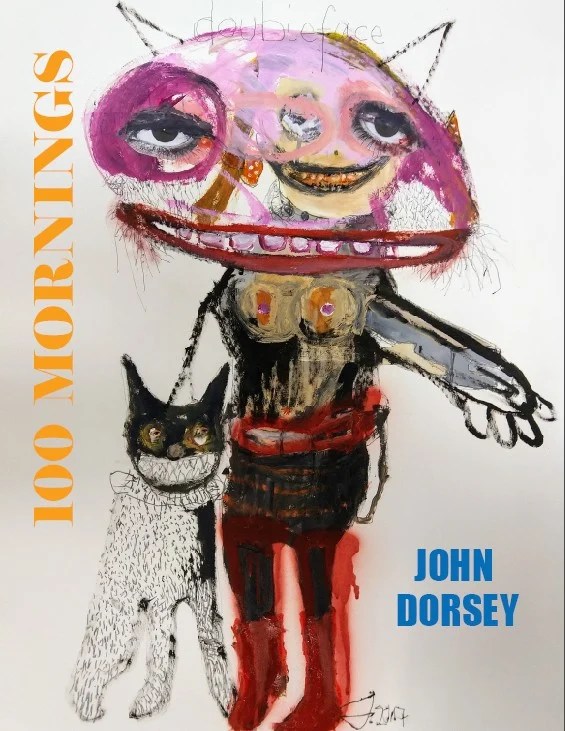
Dorsey’s new book 100 Mornings (published by Sacred Parasite) is very much like a collection of postcards. The pages are about the size of a postcard and the short poems are accompanied by a series of paintings by Juliane Hundertmark whose images of fantastical creatures bring to mind what it would look like if Jean-Michel Basquiat was hired to design the muppets for Fraggle Rock. While I don’t endorse defacing a book of poetry, one could conceivably send pages from 100 Mornings as postcards themselves.
Just like a message written on a postcard, many of the poems in 100 Mornings read like a brief update on Dorsey’s life in the present, combining reflections on his health and mortality with his ever present empathy for the struggles of his friends and family. These themes tie together with the final poem of the collection, “Midlife Crisis Sutra.”
i wake up on a borrowed couch at 48
with pain in my right shoulder
that could be a pinched nerve
or signs of a stroke
the air tastes like old books
i think about
all the kids
i started out with
some dead
most with better lives
none of them
bothering with poems
Dorsey’s physical health is a constant presence in his work as he’s endured coping with disability, cancer treatments, and most recently, the loss of an eye. And yet, Dorsey uses his pain not to wallow or milk sympathy, but to understand the pain of others through the connective tissue of poetry. The symptoms of a stroke transition to the smell of books and the memories of friends he made through poetry by instinct. Dorsey performs a similar maneuver addressing the loss of his eye in “On Being Compared to Jim Harrison”
you could do far worse
but there are a lot of men
with one eye
& a fondness for rivers
who have trouble
sleeping through the night
men who gave up shaving ages ago
to write love poems
whispered sweetly into the ears of barn owls
& the faded girls of memory on dirt roads
Receiving the compliment of a comparison to the legendary Jim Harrison would inflate most egos, but for Dorsey, the similarity inspires him to weave connections with others who share the experience of disability and bittersweet memories of long lost acquaintances preserved in poetry.
Last year, As It Ought To Be published “Poem for Wookie,” the first piece I read of Dorsey’s in which he directly engages with the loss of his eye and how it influences his relationships with others.
you chase leaves
in the warm morning air
before coming over
to place one in my hand
& ask about my eye
who took it
where did it go
will it grow back
like a freshly planted tree
What initially struck me about this poem was how he directly, yet lightly presented the loss of his eye through Wookie’s innocent inquisitiveness. Such questions could feel invasive, but Dorsey understands they come naturally without the intention of a burdensome weight like the falling of leaves. Dorsey further narrates:
for every question
another leaf
seemingly out of nowhere
like a piece of your soul
all sound gone in this moment
my mouth dry
beyond explanation
i dance around the question
just another leaf.
Dorsey doesn’t hide his discomfort, and his dry mouth beyond explanation presents the rare possibility of lacking the words to express both his feelings and the biological facts of his condition. And yet, in just three words at the end, the explanation comes: “just another leaf.” Afterall, it is Wookie who connects the fallen leaf with the lost eye, and with his ability to see the best of intentions in others, embraces Wookie’s leaf as the answer itself.
100 Mornings is another unique leaf in Dorsey’s bibliography of well over a hundred books spanning more than three decades of writing. He has measured his life in zines, chapbooks, broadsides, anthologies, full-length books, collected works, and many other genres–thousands of leaves of poetry too voluminous for any single person to rake into a neat pile. And still with my ever growing shelf of John Dorsey books, I always look forward to his next poetry postcard in the mail.
About the Author: Chase Dimock is the Editor in Chief of As It Ought To Be. He holds a PhD in Comparative Literature from The University of Illinois and teaches literature and writing in Los Angeles. His poetry has appeared in dozens of magazines and his debut book Sentinel Species was published in 2020. Chasedimock.com
 As It Ought To Be