..
Nights of Ecstasy:
A review of john compton’s house as a cemetery
by Peter Mladinic
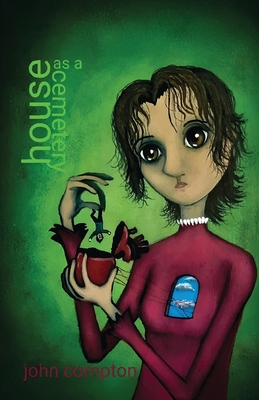
house as a cemetery is a poetic journey. Part iii begins with the lines: “reader, both of us are learning / through the connection of words.” The poet’s connection with self is followed by a connection with family, friends, strangers, lovers, a spouse, and poetic predecessors: Allen Ginsberg, John Ashbery, Anne Sexton, and Emily Dickinson. His homage to Dickinson begins “on my face— / etched—my name / & two dates.” In this startling metaphor, face as headstone, Compton’s reader sees their face reflected in the eye of the poet. Throughout the journey, the poet’s grandmother appears in the middle, in part iii as a nurturer offering her grandson a bowl of chili, and in iv with her spouse: “they fuck & call it a manifestation of church.” Although her second presence is in stark contrast with the first, the poet’s strongest bond is with his grandmother.
The poet’s mental/emotional landscape was formed between the ages of five and seven, and his grandmother is at the center of it. In the first poem in the book he says that words have “forced me to realize/ lineage/ between embalming fluid/ & origin.” In part i, a chrysalis of dreams and memories, birth and death are linked. People, things, and places appear bigger to a child than to an adult. “the enormous room” begins, “i was a cancer that his side of the family / could never cure. i was the blame / for his death.” Farther along, “how could their son ever love a man?” Then, “i was elated to see his mother.” Then the poem goes into her life, and she could be the grandmother, though that is not explicitly stated. A lonely widow, an introvert, “no visitors, she/ made that very clear,” she is like one of the “corner pieces” in the room. “i would have tried to mend her tears / but instead i let her dry skin / soak them.” The poet’s elation turns to disappointment and regret, but his bond to this person is very clear in how he talks about her. “the father who understood” involves a father holding his infant son, a union devoid of tenderness. The father “swaddled this broken boy…/ each / piece of him/ unable to be collected.” The poem concludes “urine warms his arms, dripping.” “funeral arrangements in a crawlspace” is the last poem in part iii. The son is a house, and he sees “a mother / on hands & knees / clawing the boards…/ trying to dig open / her son.” Childhood, the formative years, is emphasized in “i’ve only been here all my life.” In it, there’s a barn in the middle of a cornfield, an empty bible, and the poet wondering “why am I, to them, not able to make sense?”
i close my eyes hard,
tight enough that tears come between the lids.
when i open them, will i be saved?
will you hold my hand
& kiss me like i’m god?

so many prayers have come back soundless.
no proof of life beyond these walls.
somewhere i will find you;
but right now i continue to write you
into existence.
“You” is none other than the poet himself, in a place, and his grandmother is at the center of it. To get the full picture, a reader must consider “winter coat & a half glimpse of the world:”
fingers crackle like a frigid bough.
an ice blossom sprouts.
summer is my grandmother’s voice
asking if i’d like a bowl of chili.
The poet’s grandmother is part of his growth from childhood to adolescence, his awakening and becoming an individual. A harsh awakening. Consider the beginning of “transphobia;” “you were raped / yet too young to cum—they stuck objects / inside you to remind you you were a girl / & not a boy like them. The horrific waking nightmare of that experience is followed by condemnation from the religious in “after realizing my name means gift from god:” “you belong in hell. In the poet’s emergence of identity there is affirmation. “i am gay for the dead I was blamed for.” Lineage is sustained in one poem with the mention of the birth of the poet’s great nephew, and identity is developed in his encounter with strangers in a Greyhound bus depot. Water is symbolic of life and death in this book, and in “my mental breakdown at a greyhound station” he and the strangers are depicted as fish, and the depot itself is “a polluted aquarium.” Encounters with lovers are encapsulated in a poem with a title reminiscent of Walt Whitman: “i find your midnight in my pocket.” In the middle the poet says “now / all I have / is your darkness. And perhaps the love he felt as a child from his nurturing grandmother is manifested in “love poem for my husband:”
if you ever die,
i shall never wake:

the world, a blur
& boring—
Lastly, the early bond the poet formed with his grandmother is integral to his identity as a gay poet. She was nurturing (a plus) and religious (a minus). Consider this passage from part iv. blacked out borderland from an exponential crisis:
with no remorse using homophobia as their anchor they said: all your poems are queers i replied: no all my poems are gay they love you even though you’re homophobic they are yet to understand hate they haven’t grown in his world they are still innocent give them time they’ll cut your throat
In “my love letter to pride” he says “i will seize your city,/ plant words / in every inhabited region/ & let a forest / with my gay poems / breed into a colossal library.” It would be “off the mark” to say the poet is first and foremost his grandmother’s grandson, though that is undeniable. More apropos, John Compton is, and is a gay poet.
And his book house as a cemetery is unsettling and invigorating. In it, there are poems about the loneliness and happiness of marriage (to David), poems about their pets, and poems that pay homage to writers aforementioned, and to W.C. Williams and Virginia Woolf. As a gay poet, Compton is—this is fair to say—combative against forces trying to eradicate gay people, erode individuality, and undermine freedom; in short, forces that are trying to conquer, enslave, and destroy …in the name of god. So there are numerous war images. One poem ‘the turbulence of living” comes shortly after Compton’s homage to Emily Dickinson; its battle imagery gives an impression of civil war between north and south. It begins: “they took to the sun / like mushrooms: / corpses lay swollen.” The reader conjures a clearing in a wood and smoke from cannon fire. It’s just one of many flourishes in a book filled with poems that had to be written and deserve to be read, and read again. Bravo, John Compton. We need you!
house as a cemetery
by john compton.
QUEERMOJO a Rebel Satori Imprint
New Orleans, LA.
2026.
$16.95 paper.
About the Author: Peter Mladinic’s most recent book of poems, The Whitestone Bridge, is available from Anxiety Press. An animal rights advocate, he lives in Hobbs, New Mexico.

