SATURDAY POETRY SERIES PRESENTS: ANNE SEXTON


THE TRUTH THE DEAD KNOW
by Anne Sexton

For my Mother, born March 1902, died March 1959
and my Father, born February 1900, died June 1959

Gone, I say and walk from church,
refusing the stiff procession to the grave,
letting the dead ride alone in the hearse.
It is June. I am tired of being brave.

We drive to the Cape. I cultivate
myself where the sun gutters from the sky,
where the sea swings in like an iron gate
and we touch. In another country people die.

My darling, the wind falls in like stones
from the whitehearted water and when we touch
we enter touch entirely. No one’s alone.
Men kill for this, or for as much.

And what of the dead? They lie without shoes
in the stone boats. They are more like stone
than the sea would be if it stopped. They refuse
to be blessed, throat, eye and knucklebone.

Anne Sexton (1928 – 1974) was an influential American poet, known for her highly personal, confessional verse. She won the Pulitzer Prize for poetry in 1967. Themes of her poetry include her suicidal tendencies, long battle against depression, and various intimate details from her own private life, including her relationship with her husband and children. (Annotated biography of Anne Sexton courtesy of Wikipedia.org.)

Editor’s Note: Today’s post is dedicated to the poet Norma Liliana Valdez, who recently shared an audio recording of Sexton reading today’s selection. Keep an eye out for the work of Ms. Valdez who, like Sexton, has the ability to transform emotional turmoil into a poetic experience that transforms her readers.

For me, this piece slices as close to the bone as a poem can. That inevitable human experience of losing my parents is my greatest fear.

Despite the inherently personal nature of the poem and of Sexton’s experience, a distance can be felt in her choice of words and images. In another country people die, not in this, her own country. The dead lie in boats, not here with her. And Sexton’s discussion within the poem is directed to her darling, to someone among the living with whom she is sharing an experience of touch, of connection, of living and of not being alone. It feels as though in order to even comprehend the overwhelming experience of losing her parents Sexton has to distance herself from that experience and throw herself into connection with another living being, with the notion that “no one’s alone.”

Want to read more by and about Anne Sexton?
Audio recording of Sexton reading “The Truth the Dead Know”
Modern American Poetry
Poets.org

Andreas Economakis

Shotgun

by Andreas Economakis

11:53 pm.

He’s sitting alone in the living room, alone with his two dogs. His mother is at a cocktail party down the road. Connecticut, the edge of suburbia, where manicured lawns meet the forest, the unknown, the bogeyman. The TV is chattering in the corner of the room but he’s not paying any attention to it.

He looks out the large sliding patio window in front of him, into the deep, dark forest. He can barely make out the abandoned old house that’s rotting by the fork in the little stream that cuts through the woods. That house gives him the creeps. He can feel bad energy coming from it, kind of like the energy of a motel room after a murder. He buried his cat under a tree in the woods the week before, fashioning a crude cross from birch branches. His mother had accidentally crushed her under the garage door. He kept a weary eye on the abandoned house while he dug, running away quickly once the cat was in the ground.

He switches channels on the TV and a movie with dolphins comes on. In one of the scenes, a dead man hangs upside down in a large aquarium, his frozen eyes looking directly at him. He runs upstairs and gets his mom’s shotgun. It’s a single-barrel 20-gauge Harrington and Richardson. He loads it and goes back downstairs. He sits on the couch again, his dogs at his feet, listening to the woods.

At 3 in the morning, 2 cars rumble up the driveway. He tenses, his finger on the trigger, the hammer cocked. A fist pounds on the kitchen door. A large man is holding his mother in his arms. She’s unconscious. He puts the shotgun down and holding the dogs by their chokers, he opens the door.

“Hey kid, is this your mom? She’s drunk,” the man says. After a pause, he adds: “This is the address on her license.”

“Thanks,” he says.

The man lays his mom on the kitchen floor and hands him his mom’s car keys and her purse. He smells of whiskey and cigarettes. He looks around silently, a glint in his eye. He then nods with a slight smile and exits slowly.

He locks the door behind him. He struggles to get his mother into her room. He goes back downstairs and takes the shell out of the shotgun. His mommy is home and he is safe again.

–Andreas Economakis

This piece is part of a collection of stories on blindness entitled: The Blindness of Life.

Copyright © 2010, Andreas Economakis. All rights reserved.

For more stories by Andreas Economakis click on the author’s name below.

USELESS BUT VALUABLE

USELESS BUT VALUABLE

by John Dunn

It began with an email from an old friend, now living in Sweden. He is in his later 60’s and reported that one of his kidneys had quit working and the other was down for the count and maybe longer. Weekly dialysis is what he has to look forward to.

A day later another old friend, a musicologist and pianist, about the same age as my friend in Sweden, told me over breakfast that just two weeks before he had suddenly lost the use of his left arm. A debilitating and despair-inducing moment for anyone, but especially for a pianist. The function is slowly returning, but the discouraging thing is that they still don’t know what caused it.

Yet another friend of about the same age reports that back trouble has led to a loss of feeling in parts of his legs, which affects his ability to walk and stand. X-rays and MRI’s suggest all manner of disc problems. Neither the prognosis nor the path to recovery is yet clear.

These incidents and a number like them over the last few years put me in mind of a story  about R.H. Tawney, the great English economic historian and socialist. Tawney was well acquainted with mortality. An English non-com in World War I, he survived one German bullet only because it struck the Book of Common Prayer he kept in the breast pocket of his jacket. Later wounded during the Battle of the Somme, he was left in no-man’s land for some 30 hours before being evacuated to a field hospital and later back to England. (http://en.wikipedia.org/wiki/R._H._Tawney).

After the war, Tawney returned to civilian life and lectured for a number of years at the London School of Economics (LSE). Like many Englishmen of his time, Tawney smoked a pipe and wore tweeds. Walking into the lecture room at LSE one day, he stuffed his still-lighted pipe into his jacket pocket. A few minutes into the lecture a student noticed smoke curling up from that pocket. He alerted Tawney who, without missing a beat, pulled the pipe from his pocket, patted the smoldering tweed jacket to be sure the fire would not spread, smiled and remarked to his students (echoing Wordsworth) “intimations of mortality.”

Intimations indeed. However we humans have come to be what we are – Dawkin’s “blind watchmaker”, directed evolution, dumb cosmic luck, divine intervention – we are biological machines and we are wearing out. We are mortal.

When someone young confronts her mortality, it’s one thing: facing a possibly fatal illness or recovering uncertainly from an accident, she thinks about what she will miss if she does not survive.

For those of us in our 60’s, it’s different. We have largely lived our lives. As I see it we have three choices.

One is urged on us by advertisements, medical inducements and a variety of feel-good books: struggle to remain young, in appearance and in our activities. Try to look 20 or 30 years younger than we are and try to continue in activities at levels that our bodies simply cannot endure any more.

The second choice is to resign ourselves to old age, in effect to see the glass as half empty and say to hell with it. Why bother? It’s no use. We are going to die, so what’s the point?

The point is the third choice, what I might call the path of wisdom. It was my friend Alex, a priest in the Orthodox Church of America and a very wise man who urged this on me when I was telling him about this article.  (He’s not much older than I am, making me wonder how he got to be so wise!) I was lamenting the fact that our generation is being discarded, that we are being made useless by the way society treats us, ignoring our hard-won experience in its pursuit of whatever is new.

In effect he said that he has no desire to retire into the kind of busyness that our society thinks of when it thinks of someone being useful. “I want to be useless”, he said, “I want to be free to relax and write and think.” He went on to talk about how he wants to make his life-experience available to others. At which point my wife said to him “you want to be useless but valuable.”

“Exactly”, he replied.

Useless but valuable. We slip over into the local lanes, where we can pull off easily. We can stand by the roadside, waving to those driving by, causing them to wonder what we might be doing, whether we have something to offer.

Alex went on to tell me about an entry in the published journals of Alexander Schmemann, an Orthodox priest who was Alex’s mentor. (As well he was the father of Serge Schmemann, who used to write for the NY TIMES and who now writes for the INTERNATIONAL HERALD TRIBUNE). Schmemann senior says that we can”cling to life (“I can still be useful”) and to live as if death had no relation to me.” Or we can transform “the knowledge of death”, i.e., our honest acknowledgment of our mortality, “into the knowledge of life…” He goes on to say that we “really are needed, but not for all the concerns that fragment our lives. Their [our] freedom is needed, the beauty of old age, the reflection of the ray of light from it, the dying of the heart and the rising of the spirit.” (These quotes are from THE JOURNALS OF FATHER ALEXANDER SCHMEMANN, 1973-1983, p. 84.)

Alex’s comments, my wife’s response and the journal entry reminded me of the way I have tried to lead my own life, practicing what I call teacher’s mind. I can never know how what I say or do will effect others. All I can do is share with them what I’ve come to know and what I now realize I cannot know. I offer it to them with no expectation that it will make a difference. I can only hope that at some point it will come back to them at a time when they need it. I may find that out; more likely I will never know. Which is alright.

Recently, expecting that we will be moving at some point, I have been giving away books, lots and lots of books. I love books, I cherish books, I have a touch of bibliomania. But, with my wife’s help, I realized that I didn’t want to pack up all these books and move them two thousand miles. And I wanted others to have use of them. I wanted them to find good homes where others would read and enjoy them as I have read and enjoyed them.  I’ve given them to local libraries, to cull for volumes they’d like to add to their collections and to sell the rest to raise money. A few I’ve given to particular people.

I would like to do the same with my life and I hope my contemporaries will consider doing the same.

I cannot give my experience away – the memory of it will be mine until I die – but I can share it with others. I can share with them all that I have read and thought and experienced, the good and the bad. I am sometimes surprised to discover that nothing more than an account of my time in the anti-war movement in the 60’s or of the year I lived in Israel, on a kibbutz, in the early 70’s, can hold people’s attention. Young enough to have only read about these things, they can hear about them firsthand and ask questions. Or they can share a moral dilemma with someone older, wondering what you – the older of the two – might do under the same circumstances.

Growing older can be economically difficult, especially now that we are all living longer and given the fact that many of us have seen retirement savings badly eroded or even destroyed. Growing older is physically difficult: no matter how we try, these bodies of ours will slow down and wear.

But it need not be spiritually debilitating. Some of us can take comfort in the promise of an afterlife. (I have my doubts on that score.) Even with that, though, we can, if you will, set ourselves spiritually alight, as numerous small beacons to those coming after us. Beacons to remind them that we are still here for them, places where they can sit and warm themselves in the glow.

As Alexander Schmemann says in that same entry, we should not “focus on death, but, on the contrary” we should “purify one’s reason, thought, heart, contemplation and…concentrate on the essence of life, the mysterious joy. Aside from that joy, one needs nothing else because “bright rays are rushing from that joy”.”

SATURDAY POETRY SERIES PRESENTS: EMILY DICKINSON


THE DANDELION’S PALLID TUBE
by Emily Dickinson

The Dandelion’s pallid tube
Astonishes the Grass,
And Winter instantly becomes
An infinite Alas —

The tube uplifts a signal Bud
And then a shouting Flower, —
The Proclamation of the Suns
That sepulture is o’er.

Emily Dickinson (1830-1886) is one of America’s most beloved poets. Most of her work was published after her death, and since then she has become an icon for American poetry.

Editor’s Note: Today’s post is dedicated to Deborah D., a dear friend, faithful reader, and lover of poetry. Deborah was thoughtful enough to let me know (since I am currently living in New York) that the New York Botanical Garden is hosting an exhibit titled “Emily Dickinson’s Garden: The Poetry of Flowers.” The exhibit was inspired by Dickinson’s life as an avid gardener. Known to be a recluse in her Amherst, Mass home, she was known in her lifetime as more of a gardener than a poet, though she always carried the latest poem she was working on in the pocket of her gardening dress and incorporated flowers and nature into her poems. Dickinson referred to herself as a dandelion. Read about the NYBG Emily Dickinson exhibit here.

Want to read more by and about Emily Dickinson?
Poets.org
The Literature Network
NPR on the NYBG Exhibit

The Coming Crisis of Western Food: Critical Theory, Social Problems, and Food

By Liam Hysjulien

Credit: Bill Sanders http://www.wku.edu/library/onlinexh/sanders/pages/imagery/hunger_us.html

The sociologist Pierre Bourdieu once wrote, “[a]‘social problem’ (juvenile delinquency, drugs, AIDS)…constituted as such by the fact that it is hotly disputed and fought over, passes lock, stock and barrel into science” (Bourdieu 1992: 42).  For Bourdieu, the hasty “constitution of social problems¹” places these problems in the same arena as “sociological problems”—something that Bourdieu feels limits our ability to understand the complexity and historical development of these problems.  Bourdieu finishes this passage by stating, “social problems draw attention to critical sociological questions, but they must be approached with a redoubled epistemological vigilance, with a sharp realization that they must be demolished in order to be reconstructed” (Bourdieu 1992: 42).

While I agree with Bourdieu’s position, I put forth this question in response:  what happens if a problem isn’t really seen as a sociological problem to begin with? How do we reconstruct something that rests in a political, theoretical, and scientific nexus of “not really, but kind of a problem, or maybe more of a serious concern.” As a sociologist interested in food, I have a memory of discussing with a friend my interest in community gardens as a means of providing access to local fresh fruits and vegetables.  Halfway through our conversation, my friend—a compassionate and intelligent liberal if there ever was one—interjected with the statement, “well, access to food isn’t really a problem. I mean everyone can get enough food to eat these days. So what do you really see is the point of these community gardens?” At that time, my acquired knowledge had not equaled my passion for food systems and food securities, so I shrugged my shoulders and went on about the aesthetic contribution of bringing food and gardens into low-income neighborhoods—a position I hold to this day.  If I had, as the saying goes, known then what I know now, I would have rattled off statistics about how in 2008 over 50 million Americans, or nearly one in six, struggled to feed themselves and their children (Debusmann 2009).  And that a recent report by the Food Research and Action Center (FRAC), one of the oldest anti-hunger social movements in the country, cited that over 17.3 million people in the United States currently live in very low food security households (FRAC 2010).

Credit: UNEP http://maps.grida.no/go/graphic/trends-in-food-commodity-prices-compared-to-trends-in-crude-oil-prices-indeces

But again how do we begin to understand food as a social problem?  Is it in the fact that we are destroying valuable topsoil to increase larger  crop yields—and not only that, but we are completely dependent upon a finite petroleum-based resource to keep the system humming along (Hellwinckel and De La Torre Ugarte 2009; Roberts 2008)?  Probably.   Or how about the reality that over 200 million people in the world starved in 2006 because investors, seeing food securities as less financially risky than the housing market, drove up the cost of grains by 80% (Hari 2010)?  Yeah, that’s actually pretty depressing. Or is it simply the reality that rates of obesity have increased to the point where nearly one-third of adults are currently obese in this country (Flegal et al. 2010)?   While this list is far from exhaustive, I’m sure you’re getting the point—it doesn’t take much unpeeling to see problems embedded in all aspects of our current food system. Understanding how something becomes a social problem, at least from a critical theory perspective, is an attempt to recognize the contradictions inherent in the totally administrated world—to use Adornian language—of modern society.  Similar to Bourdieu’s charge that we must demolish in order to reconstruct, and in doing so, understand the complexity of a problem, a critical understanding of food as a social problem requires that we push beyond the noise of ideological divisions and polemics, and see the seams of contradictions splitting the edges of our society.

Let us take hunger, for example.As Paul Roberts writes in his incredibly well-researched and thought-provoking book The End of Food, hunger, being an almost daily reality through much of Western civilization’s history, tended to ebb and flow, like the cycles of economic recessions, during periods of plague, war, mass famine, or invasions. If we use the decline of the Roman Empire as an example, we see how the collapse of the Roman’s extensive outsourced food system resulted in the fact that “in fourth A.D., the Western food economy collapsed so completely that for the next six centuries, global population rose from 300 million to just 310 million”(Roberts 2008: 12).

Even today, American public policy discourse often falls short in its framing of hunger as a problem.   Looking at the lack of attention among policy officials toward food securities in urban areas—where the problem of food deserts are reality in many communities— Pothukuchi and Kaufman argue that, “food is not perceived as an urban issue in the same magnitude as…housing, crime, or transportation”(Pothukuchi and Kaufman 1998: 214). Nowhere is this point better articulated than in Patricia Allen’s article, “The Disappearance of Hunger in America.”  Allen, one of the most significant voices in food policy and food securities research, describes the effect of the United States Department of Agriculture (USDA) decision to change their terminology from hunger to food insecurities.  Unless you study the linguistic decisions of the USDA, this change probably went unnoticed by you, but it has the potential to have a resounding impact on how hunger is understood in this country.  As Allen writes, “If hunger is no longer an analytical category, how does one talk about it or advocate for its elimination…the discursive shift from hunger to very low food security…takes away the sharp edge of the word hunger” (Allen 2007: 22).    While the word food security—a word that has its own complex history within anti-hunger movements— may offer a more nuanced way of conceptualizing a person’s inability to access nutritional food, it doesn’t pack any sort of political punch.   The word hunger evokes images of people physically emaciated and ravaged by a lack of access to food. There is a dimension of humanness in a word like hunger, and as the late philosopher Richard Rorty would have said, it helps in manipulating our sentimentality toward other fellow featherless bipeds (Rorty 1999).

Through social movements, policy reforms, and food-based theories, we must challenge these issues surrounding food as a social problem.  When I consider the attention, or lack thereof, placed on hunger in American politics, I immediately think of the statement made by South Carolina Lt. Governor Andre Bauer comparing providing people with food stamps to feeding “stray animals”(Barr 2010).    It is these Sorelian myths that epistemological vigilance can help to negate.   The longer this crisis of food is marginalized, the more we will face ideological narratives that fit comfortably within a neo-liberal framework—a linkage that food experts are only now beginning to connect: new technologies will solve our food problems; obesity is the fault of the individual; everything is fine; healthy food is elitist propaganda.  We’ll continue to do nothing with the knowledge that we have gained, and the system that we’ve created— the totally administrated world of food—will go on unraveling.

Notes
¹ The critical theorist, Harry Dahms, delineates the difference between social and sociological theory as being the way in which “social theorists endeavor to understand the logic of social and/or political historical transformations” while “sociological theorists strive to set up a suprahistorical frame of reference for theoretical and empirical research” (Dahms 1995:2).

References

Allen, Patricia. 2007. “The Disappearance of Hunger in America.” Gastronomica: The Journal of Food and Culture 7(2):19-23.

Barr, Andy. 2010. “S.C Lt. Gov.: Poor Like ‘Stray Animals.‘” Politico.  January 25.

Bourdieu, Pierre. 1992. “Thinking About Limits” Theory Culture and Society 9:37-49.

Dahms, Harry. 1995. “From Creative Action to the Social Rationalization of the Economy: Joesph A. Schumpter’s Social Theory.” Sociological Theory 13(1):1.13.

Debusmann, Bernd. 2009. “A Paradox of Plenty-hunger in America.” Reuters. Nov 24.

Flegel, Katherine, Margaret Carroll, Cynthia Ogden, and Lester Curtin. “Prevalence and Trends in Obesity Among US Adults, 1999-2008.” The Journal of the American Medical Association 303(3):235-241.

Food Research Action Center. 2010. “Nutrition Programs and Refundable Tax Credits in President Obama’s FY 2011 Budget.” Retrieved April 24, 2010 (http://www.frac.org /Legislative/budget_FY2011.htm).

Hari, Johann. 2010. “How Goldman Sachs Gambled on Starving the Poor – And Won“.Huffington Post. July 2.

Hellwinckel, Chard and Daniel De La Torre Ugarte. 2009. “Peak Oil and the Necessity of Transitioning to Regenerative Agriculture.” Farm Foundation.  October 6.

Pothukuch, Kameshwari and Jerome L. Kaufman. 1999. Placing the Food System on the Urban Agenda: The Role of Municipal Institutions in Food Systems Planning. Agriculture and Human Values 16:213-224.

Roberts,  Paul. 2008. The End of Food. Boston MA: Houghton Mifflin Company.

Rorty, Richard. 1999. “Human Rights, Rationality and Sentimentality.” Pp. 67-83 in The Politics of Human Rights, edited by the Belgrade Circle London UK: Verso.

OPEN LETTER TO BILL GATES ABOUT EDUCATION

(from a public schools parent)

by Sue Peters

Dear Bill,

I am a public schools parent in your own general neighborhood (Seattle). I realize you have an interest in public education, and are a major participant and funder in the current “education reform” efforts being attempted nationally.

Unfortunately, I don’t agree with a number of the choices and “investments” you are making in our schools. I believe they have not been that effective, and some of them are even damaging.

Your all-tech $63 million “School of the Future” in Philadelphia, for example, apparently hasn’t worked out so well. Your $2 billion “Small Schools Initiative” was ultimately canceled (though the concept of smaller schools seems sound to me). And now you are promoting charter schools and “merit pay” for teachers as a measure of “teacher effectiveness,” even though recent reputable studies from Stanford and Vanderbilt universities cast serious doubts on both of these concepts, showing that most charters are not better than public schools and merit pay doesn’t work. (Also see The Pillars of Education Reform Are Toppling.”)

In other words, you seem to be spending a lot of money and not getting good results.

Does “merit pay” actually improve “teacher effectiveness”?

As a keynote speaker at the national American Federation of Teachers (AFT) conference that was held here in Seattle last week, you said: “The truly impressive reforms share the same strategic core – they all include fair and reliable measures of teacher effectiveness that are tied to gains in student achievement. Public schools have never had this before. It’s a huge change – the kind of change that could match the scale of the problem.”

By this you mean teachers being measured by and paid according to student test scores.

But lashing teachers to test scores is the kind of “change” that will quash innovation and passion, and turn teachers into test-prep robots and schools into test-prep factories. It leads to teaching to the test. That’s already happening in some schools as a result of No Child Left Behind “Annual Yearly Progress” pressures. Not all students test well, by the way – didn’t Einstein famously get Fs in school? And not all learning shows up on tests. I have said before, how do you measure that “Aha!” moment when a child understands something for the first time? It will never show up on a standardized test, but those moments are the real measure of successful teaching.

Above all, research shows that “merit pay” for teachers doesn’t work – it does not lead to true and lasting improvements in genuine student academic achievement.

Meanwhile, perfectly good teachers and principals are being sacrificed and fired under such draconian rules, as this article in the July 19 New York Times attests, “A Popular Principal, Wounded by Government’s Good Intentions.”

One of the main problems with merit pay is that it’s based on the flawed presumption that teachers are motivated by greed and competition, and not by collaboration and helping students learn. But teaching is a cooperative profession; the best teachers are not motivated by making more money than their colleagues.

You yourself have said you want teachers to share their expertise with each other, so they can all become stronger teachers. They already do that, for starters. But how likely is it that they will continue to help each other if you set up a scheme in which they are pressured to compete with each other to get bonuses?

If you want teachers to improve, help give them the respect and salaries they deserve, the resources they need, and the autonomy to be creative and innovative and cooperative with each other, and small classes so they can give each student the attention s/he needs.

Why charter schools?

At the National Charter Schools Conference on June 29 in Chicago where you also spoke, you promoted charters – privately run schools that use public money but have little to no public oversight.  Why do you keep promoting this concept when growing evidence shows that most charters are no better than public schools? In fact, according to Stanford’s CREDO study, as many as 83 percent of charter schools perform no better or do worse than public schools.

Even the Secretary of Education Arne Duncan recently admitted at the same convention of charter operators that charters have serious problems: “…unfortunately, we have far too many mediocre charters and we have far too many charter schools that are absolutely low performing.” (Duncan’s address to the National Charter Schools Conference, July 1, 2010.)

(Also see: “Study Finds No Clear Edge for Charter Schools,” Education Week, June 29, 2010.)

Education reformers repeatedly claim to be “data-driven.” The data do not support charters.

If you support innovation, take a look around inside public school districts. Secretary Duncan recently toured Aviation High School, an innovative public school here in the Puget Sound area. Check out the Nova Project, an innovative alternative high school in Seattle that has some of the most independent thinking and civically aware kids I’ve ever met and some of the highest SAT scores in the district. In Seattle, we also have successful and award- winning schools for highly gifted kids that challenge these kids with an accelerated and deeper curriculum while keeping them in with their age group peers (Accelerated Progress Program), and a number of alternative schools that all have waitlists because they are so popular – Salmon Bay K-8, Thornton Creek. And yet your education reform colleagues and your own foundation are pushing curriculum alignment and standardization on all our schools, quashing any chance for individuality or innovation. That’s a mixed message you are sending.

While it is certainly good of you to be generous with your wealth, it would seem that you are funneling good money after bad, as the saying goes.

So I have some suggestions for you. As a parent with children in public schools, as someone who is the product of both private and public schools and an international education, I hope you will consider my thoughts on how you can direct your public education involvement in a manner that will get genuine and positive results for children. These would be investments in education that parents like me could get behind.

Here are three ideas. They are not flashy. They are not tech-oriented. But they will get positive results.

Invest in Smaller Class Sizes

If you want to fund education and make a difference, fund smaller class sizes. Help school districts hire more (and genuinely qualified – not short-term, inexperienced Teach for America type) teachers and reduce class sizes. Every child would benefit from more one-on-one interaction with a teacher. I don’t think it takes a multi-million dollar “study” to prove that. Here in Seattle our superintendent has laid off teachers two years in a row and closed schools. So class sizes are large and getting bigger.

One of the main reasons people who can afford it choose private schools is because they tend to offer smaller teacher-student ratios.

I’ve read you’d like to see kids taught en masse by one teacher on camera beaming a lecture via the Internet to thousands of students at once. While technology may have its place in our world and in schools, don’t you agree that the most valuable connection a child can have is not to the Internet, but with a teacher, a parent, a nurturing human who will give this child the individualized, personalized attention s/he needs?

Here’s a study that shows that class sizes matter:  “Smaller is Better: First-hand Reports of Early Class Size Reduction in New York City Public Schools,” as does this blog: Class Size Matters.

At the AFT conference, you said something that implied that funding for public schools has gone up in my lifetime and class sizes have gone down: “The United States has been struggling for decades to improve our public schools. We have tried reform after reform. We’ve poured in new investments. Since 1973, we have doubled per-pupil spending. We’ve moved from one adult for every 14 students to one adult for every eight students.”

I am confused by this claim because all my life (which began before 1973) public schools have been scrambling for money, school districts are constantly telling us parents, our kids and their teachers that cuts and layoffs and school closures have to happen. Our own state of Washington, Bill, ranks 46th in the nation for per-pupil funding! Washington State recently passed a law mandating full state funding of K-12 education, yet that is not happening. Meanwhile in California, the public education system has been drained of property tax revenue ever since the passage of Proposition 13 in 1978.

Are you referring to student-teacher ratios? Or do these “adults” you speak of include all adults in the school district,  from counselors to custodians to central district office staff? (If the latter, that would be true for Seattle, which has a disproportionately high and growing number of administrators in its overstaffed central office. (See “Central Administration Efficiency in Seattle Public Schools,” a very troubling report by parent/analyst Meg Diaz.)

Class sizes have not gotten smaller in my lifetime. Neither I nor any of my children have ever been in a public school class of eight – or 14, for that matter. Here in Washington, teacher to student ratio has not gone down, even though we voted for it on Initiative 728 which passed with 72 percent of the vote in 2000.

What is your source for this data? Is it that McKinsey & Corp study that Vicki Phillips, your foundation’s education director, has referred to in the past? The same discredited consulting firm that was “a key architect of the strategic thinking that made Enron a Wall Street darling,” according to Businessweek? If so, I think you can understand how one might question their research.

Lastly here’s a personal story: One day earlier this year, I sat at my kindergarten son’s lunchroom where some of the kids were goofing around. When I told them as group to settle down, I got a limited response. But then I knelt down and looked one of the boys in the eyes and asked him about one of his hobbies, he calmed down immediately and engaged with me. That personal engagement is priceless and essential to good and inspired teaching. It’s not possible when classes are too big and teachers are overwhelmed.

Consider Grants for Books

I sense you have mixed feeling about the value of books. I understand your “School of the Future” in Philadelphia is bookless, paperless and pencil-less, but offers a laptop and Microsoft portal for every child.

I personally want my children to know the pleasure of reading an actual book, the smell of the paper, perhaps the feel of the embossed letters of the title or the details of the illustrations, the joy of summer reading while lying on the grass or idly spinning from a tire swing with a book in hand, unplugged from the wired world.

If you and Melinda were to simply create an endowment that would provide every school in the district, for example, a grant to stock their libraries, buy complete textbooks for classes, that would be an amazing gift and would go a long way toward endearing you to the community for such an obvious, tangible contribution. Because, as you may or may not know, schools like Rainier Beach High School in Seattle don’t have complete or updated sets of history books. Hard to believe, but true. Teachers across the nation still scramble and scrounge to buy class sets of books. My own brother, a public school teacher in California, is trying to gather enough copies of Shakespeare plays for his class. I’m helping him out by scouring local used bookstores up here and mailing them to him. Is this the way it should be? Don’t you agree that every child in every class should be able to take home and spend time with a book, read it on the school bus, even if they are not fortunate enough to own a laptop, and that the cost should not come out of the teacher’s own pocket?

I can imagine a bookplate with your and Melinda’s name on it. (I believe Paul Allen does something similar.) If my children were to grow up believing that you are the providers of books to Seattle school children, believe me, you would rank high in their pantheon of heroes. They love books. (The thrice-yearly Measures of Academic Progress™ computerized test your foundation may be funding, not so much.)

How about Nutrition & Health here in the U.S.?

There are kids who come to school hungry, as I’m sure you know. School districts serve packaged food of questionable nutritional value. Good nutrition would manifest itself in positive and tangible ways. I know you are concerned about health in other parts of the world — how about in your own backyard?

Imagine a Gates Foundation program that supported the creation of freshly cooked meals made of locally and sustainably grown organic produce for all of Seattle’s public schools. (I don’t mean Monsanto-style GM foods, by the way.) I promise you that a well-fed child will do better in school than one who is hungry or on a nutritionally empty diet. This would also create business opportunities for local farmers.

In sum, these ideas, simple as they might seem, will work. They will help kids do better in school. Charters, merit pay have a very mixed and inconsistent record.

I know you and Eli Broad and others have some notions about how you would like schools to be. But as you have acknowledged yourself, you are not an education expert, and I understand that neither you nor your children have attended public schools. So I am asking you to listen to parents and teachers and kids who are in the public schools, who are on the receiving end of all that is good and not so good about our current system, and on the receiving end of all your “reforms,” and learn what we really need and want for our kids.

I suggest you take a look closer to home at the town of Everett, Washington, where the school district has managed to decrease high school drop-out rates significantly in the last few years. (See: “Simple, steady is way to win,” by Danny Westneat, Seattle Times  and “Once shamefully low, Everett’s graduation rate soars,” by Linda Shaw, Seattle Times.) How? With computers and Smart Boards? No, with old-fashioned follow-up, teachers and counselors getting to know kids and keeping them in their sights, engaging and challenging the students with interesting classes. What this requires is the time and care of sufficient staff. Meanwhile, here in Seattle, the school district (SPS) continues to lay off needed teachers and counselors. If you could offer a grant to SPS to rehire these crucial people, you would see results, I guarantee it.

I would value the opportunity to meet with you to discuss these and other thoughts about education. Your new foundation headquarters are not too far from where I live. You can reach me care of Seattle Education 2010, a blog some parents and I started up last year in response to the school closures and “reforms” our children and their schools have been subjected to.

Sincerely,

Sue Peters

Seattle public schools parent

July 2010

Sue Peters is a Seattle-based writer and public schools activist. She co-edits the Seattle Education 2010 blog which can be found here
and here.

Bill Gates, co-chair and trustee of the Bill & Melinda Gates Foundation, was a speaker at the AFT convention held in the Seattle last week. His speech can be found here.

Andreas Economakis

That Whirring Noise

by Andreas Economakis

“I’m trying to figure out where that high-pitched noise is coming from,” I say in Greek, tired eyes scanning over her shoulders.

“What noise?” she asks, innocently. Her eyes circle over my head, like two crows coming in for a landing.

“That noise,” I say, pointing to where I think it’s coming from.

“I don’t hear anything,” she replies, calmly.

“You don’t hear that whirring noise? It sounds like a high pitched engine that’s out of tune.”

“No, I don’t hear anything.” She adopts the classic Greek island facial shrug, the one with that tiny, crooked smile. I can’t tell if she’s pulling my leg. “Maybe you’re thinking of the noise from the desalinization plant?” she adds.

“Ah! That must be it!” I say, triumphantly. “It kept me up all night!”

She shakes her head slowly, faintest smile still in place. “It can’t be. The plant is closed at night.”

“Then they must have kept it open last night. My nerves are wrecked,” I say.

“No, no, it doesn’t work at night. Who knows what you heard… Are you sure you heard something?”

I smile and lower my head, shrugging. Defeated. Without knowing it, I adopt the same quizzical island smile and pad away from the Loutra Spa Hotel, toward my parked motorcycle. I’m looking forward to a quiet coffee in the village square. Then, maybe, I’ll ride out to the beach for a nap. There I’ll be able to get some sleep.

Silence is rare in Greece. Greeks are by far the loudest people I have ever met. And I’ve been around. I’ve slept in fleabite hotels in downtown Cairo, stained-sheet pensions in the middle of Rome, even in small dorm rooms two meters over a rumbling and rambling Broadway in the heart of New York City. Greece is, hands down, the loudest country on planet earth. The little remote island I’m visiting is not an exception to this rule.

The whirring noise at the Loutra is just the tip of the iceberg when it comes to noise at the old spa hotel. First off, there’s my bed. Any small movement and the ancient wood frame squeals like a giant redwood coming down in a windstorm. Then there’s the floorboards. They’re so old and noisy that I fear crashing through them and into the old timer’s bed in the room below. When I walk around in my room, the Pope in Rome can hear me. And as for the old geezer below, every time he gets out of bed the entire hotel squeaks like a thousand mice being stepped on at the exact same moment.

My first night at the hotel I jumped out of a deep sleep in a sheer panic, convinced that bloodthirsty Turks were fornicating in my room. Later in the same night, I thought I heard a camper-van emptying its toilets on corrugated metal. It was the old timer again, clearing his throat. The following night I was awakened once again in terror, this time dead sure that a rat the size of Lassie was nibbling on my flip-flops in the corner of the room. It was the same old timer, taking a pee in a cup or something down below. That noise has repeated itself constantly since I moved in. At the exact same hour of the night. I guess the incontinent old fellow down below is too lazy or tired to walk to the communal bathrooms. Or maybe he’s afraid he’ll make too much noise walking down the creaky hallway.

The old timer and the other nighttime apocalyptic sounds in my hotel are merely the frosting on the cake. They are nothing compared to the racket that the obviously deaf octogenarians make every morning right below my window, hollering at top volume through their missing front teeth. This starts before the crack of dawn. Every day. No exception. My window has the wonderful advantage of being directly above the entrance to the Loutra, the very spot that has shade throughout most of the day. All the ancient geezers of this famous little island spa congregate in this spot from before sunrise until after sundown.

My first morning at the hotel, I was startled out of a restless sleep by two old men plumb screaming at each other. It sounded like they were going to come to blows at any moment. I cringed, waiting for that sudden gunshot crack of rusty World war Two guns going off, or that telltale soft thump of a body landing on concrete. I tried to figure out what the fuss was all about. It seemed like the old men were screaming about the quality of water on the island. That couldn’t be right.

I sat up in my squealing bed, wondering what national water crisis had just unfolded. As I listened, drops of salty sweat rolling down my overheated neck (there was no ventilation in my ancient room), I realized that they were simply weighing the pros and cons of drinking tap water on the island. At full volume. The old geezers were soon joined by two women, who, god bless them, were even louder and shriller that their toothless male companions. Their high-pitched yells sounded like donkeys braying in a room filled with cheering, drunk frat boys. They damn near shattered my windows. Dear god, I’ve just realized that I am in a hotel for the hearing impaired! No, I am on the island of the deaf!

–Andreas Economakis

This piece is part of a collection of stories on Greece entitled: The Greek Paradox.

Copyright © 2010, Andreas Economakis. All rights reserved.

For more stories by Andreas Economakis click on the author’s name below.

Duopoly Must Go: An Appeal for Score Voting

24529v


Duopoly Must Go: An Appeal for Score Voting

by Andrew Jennings, Clay Shentrup, and Warren D. Smith


Progressive thinkers on all sides of the political spectrum often wonder why the United States seems incapable of escaping a two-party political system. Is it a result of an extreme demographic situation, an urban and a rural America so large and obstinate that they are incapable of cooperation? Does it somehow come from the unique American spirit, a tradition steeped in individualism and adventure? Are the third parties being silently stifled because of their opposition to our incessant march toward rule by large corporations? The answer, in fact, may be so simple that it is right at our fingertips at least once a year. Every time we vote, in fact.

Fifty years ago, French sociologist Maurice Duverger observed that the plurality voting method tends to favor a two-party system, whereas “the double ballot majority system [a.k.a. ‘top-two runoff’] and proportional representation tend to multipartism.” Observations in the social sciences are never absolute, but this tendency for plurality voting to maintain two-party domination is so reliable that it has become known as Duverger’s Law.

Plurality voting (a.k.a. “first past the post”), by far the most common system in the United States, is where each voter votes for one candidate and the candidate with the most votes wins, even if he receives fewer than 50% of the votes. Top-two runoff (a.k.a. “TTR” or “delayed runoff”) is just like plurality voting, except that if no candidate receives a majority of the votes, then a subsequent election is held between the top two finishers.

Few would expect the way we count our votes to be the primary factor determining the layout of our political landscape, but the evidence is overwhelming. Beyond the empirical trends to which Duverger referred, mathematical analysis of these voting methods suggests a causal relationship. For instance, a plurality voter who prefers a Green Party candidate will often take the tactical route, casting an insincere vote for the Democrat in order to prevent the Republican from winning. This costs the voter very little, since a minor party candidate is by definition unlikely to win anyway. It seems clear that such tactics keep us locked in a two-party system.

A top-two runoff system differs considerably. To echo Duverger, most of the approximately 30 countries which use this system have escaped two-party domination, even in single-seat non-proportional elections. And as with plurality voting, analysis of the runoff system strongly suggests that this is not a coincidence, but in fact a result of voter psychology and the different tactical incentives at play. For instance, voters in the runoff have no incentive to cast an insincere vote, as there are only two choices. And once the options are narrowed down to two candidates, voters often have a better chance to get to know an otherwise unknown challenger. These factors may largely explain how Green Party candidate Matt Gonzalez was able to come within striking distance of Democrat Gavin Newsom for mayor of San Francisco in 2003 (the margin was less than 6%) despite being outspent five to one, and despite Newsom’s being endorsed by a host of powerful beltway politicians.

Opinions vary as to the relative merits of TTR versus other systems, and the above is not meant as an endorsement of TTR per se. Rather, it is a testament to the extent to which the voting method determines the party composition of a government. It seems clear that if we want to escape the two-party stranglehold, we must adopt a different voting method; specifically one which is not known to also maintain two-party domination.

Many of the modern efforts for voting reform promote an alternative form of runoff, called instant runoff voting (“IRV”), which allows voters to rank the candidates and appears to offer us a way out of our electoral difficulties. Unfortunately, communities and scholars are discovering that the hope IRV offers us for escaping our two-party system is only illusory.

Like TTR, IRV doesn’t fix the spoiler problem: a bloc of voters may get a worse result by supporting their sincere favorite candidate. For instance, in the 2009 mayoral election in Burlington, Vermont, a group of voters who preferred Republican over Democrat over Progressive could have gotten the Democrat instead of the Progressive by insincerely top-ranking the Democrat instead of the Republican. It may seem strange to think of the GOP candidate as the spoiler, but the ballot data shows that a majority of voters in left-leaning Burlington would have taken the Progressive or the Democrat over the Republican in a runoff election, making the GOP more akin to a third party in this particular circumstance — albeit a strong third party.

And therein lies the rub. See, most voters picture runoffs in the context of weak third parties. The thinking goes that if you prefer, say, Green over Democrat over Republican, then you can safely support the Green. If the Green doesn’t make it to the runoff, then your support will simply go to the Democrat. But that is only the first phase of a third party’s growth. Next imagine that the Green Party, freed from the fear of “wasted votes,” grows to encompass more and more of the electorate until it can outlast the Democrats and make it to the runoff. Finally, imagine a third phase in which the Greens have grown enough to not only defeat the Democrats, but to win against the Republicans in the runoff. This third phase represents the greatest hopes for those who see IRV as a way to end the stifling two-party stranglehold on government.

But this rosy picture starts to darken the moment we take account of two crucial factors. First, it must be noted that each of these three phases is generally a prerequisite for the next. This is explained concisely as follows: as a third party grows, it will become powerful enough to defeat its most similar major party before it will become powerful enough to defeat both major parties. Second, the middle phase is effectively a barrier to the third. It is precisely the scenario experienced in Burlington. In this phase, the Greens defeat their most similar opponent, only to lose in the runoff. For Greens who prefer the Democrat to the Republican, the announced ballot totals will make clear to them that their honesty caused them to get the Republican instead of the Democrat. If even a mere 10% of them decide to cast a tactical vote for the Democrat in the next election, then even a prodigious 10% increase in their popularity by that time will be completely nullified. More realistically, their popularity would increase by less than 10%, in which case the tactical behavior would bring them down faster than they could increase their membership.

Many IRV proponents have argued that such strategy is infeasible and/or inadvisable, since it is likely to “backfire.” We address this theoretical argument in detail elsewhere, but for now let’s put aside contentious theorizing, and turn our attention to empirical reality. Australia uses instant runoff voting to fill each of the 150 seats in its House (has used IRV since 1918). It also uses other methods for other elections, e.g. its Senate is elected with a multiwinner method called PR-STV (proportional single-transferable vote). Australia’s House is two-party dominated; in the elections of 2001, 2004, and 2007 combined, not a single house seat was won by a third-party member. In contrast, quite a few seats in their Senate (e.g. 9 out of 76 in their 2005-2008 Senate and 6 in the 2008-2011 Senate) were/are occupied by third parties, mainly the Greens.

The same trend has been observed with IRV elsewhere, such as the Irish presidency (a near monopoly despite being mostly ceremonial), and in Malta and Fiji (before it was a dictatorship). And it is interesting that San Francisco supervisor Ross Mirkarimi (who helped found the California Green Party) switched from Green to Democrat in early 2010, despite the fact San Francisco now uses IRV, instead of the delayed runoff system it used when Matt Gonzalez made his impressive mayoral bid.

Of all these examples, Australia may be the most pertinent. We noted that their Senate uses STV, while their House uses IRV. STV is a multiwinner proportional system, and it so happens that IRV is actually the single-winner form of STV, so both systems use the same ranked ballot. Thus it is not too surprising that many American election activists see the adoption of IRV as a crucial “stepping stone” to proportional representation via the adoption of STV. IRV gets voters accustomed to ranking the candidates, and puts the basic machinery in place to tabulate those ranked ballots in the specific manner that STV entails. Even IRV proponents who are aware of its tendency for duopoly often support it for this very reason; they want proportional representation. In fact FairVote, the organization most often associated with the push for IRV, was founded in 1992 as “Citizens for Proportional Representation” (and later the “Center for Voting and Democracy”), and it seems that behind the scenes, their pursuit of IRV is a long-term play for proportional representation in America.

The stepping stone strategy might actually make sense were it not for the USA’s rigid impediments to proportional representation, which was made illegal at the federal level via a 1967 law which outlawed multi-member districts. In 1996, congresswoman Cynthia McKinney (who later ran as the Green Party candidate for US President) wrote, but failed to pass, bill HR 2545, which would have overridden that previous 1967 law. She re-introduced a similar bill, HR 1189, in 2001. It failed again. Then she tried again with HR 2690 in 2005. It failed yet again.

This leads us to believe that PR will be federally unobtainable in the USA as long as we are two-party dominated (a Congress dominated by two parties will continue to block anti-duopoly legislation such as McKinney’s). We therefore believe that proponents of PR must find a single-winner voting method which doesn’t maintain duopoly, as a prerequisite to PR. As has been noted, ordinary top-two runoffs fit that description, but they have their own problems, both in terms of voter turnout and the cost and fatigue associated with extra elections. And they can still leave voters justifiably fearful of supporting candidates they sincerely prefer to the apparent frontrunners, in the first round. (As a reminder, voters have no incentive to be insincere in the runoff.)

There are other voting systems that work with a ranked ballot and have several advantages over instant runoff voting (e.g. Condorcet methods), but even more exciting is a simpler class of voting systems discovered in the past few decades, based on an entirely different paradigm: ratings rather than rankings. These systems let each voter consider each candidate separately and assign to each a score or grade.

In his 2008 book Gaming the Vote, author William Poundstone (an MIT physics grad) suggests a voting method called range voting (a.k.a. score voting), in which voters rate the candidates on a scale such as 0-10 or 1-5. When the scale is reduced to 0-1, we effectively have approval voting, which is identical to plurality voting except that there is no limit on the number of candidates a voter may support. A third method, the Majority Judgement, asks the voters to use a few natural-language terms (Excellent/Good/Acceptable/Unacceptable, for example) to grade the candidates and chooses the winner by finding the candidate who was given the highest grade by a majority of voters (the median grade).

Score voting has historically been overlooked, based on the assumption that it would succumb to pervasive tactical exaggeration. But that view was debunked back in 2000, when a Princeton math Ph.D. named Warren D. Smith performed an extensive set of computer calculations which showed the system working extremely well, even with high rates of tactical voting. This is based on an objective “economic” indicator of voter satisfaction with (or “representativeness of”) election outcomes, called Bayesian regret.

This can be understood if we think for a moment about a voter whose preferences are Nader=10, Gore=6, Bush=0. If this voter is sincere, he casts those very scores. But if he is a tactical voter, like those who voted for Gore instead of Nader under plurality voting, how should he vote under score voting? For starters he wants to give Gore a 10, and Bush a 0, to maintain the tactical advantage he sought under plurality voting. But he can additionally give a 10 to Nader, and any other candidates he prefers to both frontrunners, with no fear of negative consequences. (In election theory parlance, we say that score voting passes the Favorite Betrayal Criterion.) Whereas you will recall that with IRV, tactically placing the Democrat in first place absolutely requires a Green voter to place the Green lower than first place. But with score voting, giving Gore a maximum score in no way prevents a voter from still giving Nader a maximum score too. So third parties face no artificial barrier to growth, as they do with IRV.

A simple way to think of it is that a tactical score voter should support the same candidate as he would with a plurality ballot, and then also support all the candidates he likes better. This means that the appearance of being “unelectable” need not become a self-fulfilling prophecy, like with plurality, IRV, and so many other methods. If it turns out that enough voters prefer a minor party or independent candidate to the presumed frontrunners, then he can actually win, even if the voters are highly tactical! Empirical evidence strongly suggests election outcomes will then be vastly more representative of the actual relative support for the candidates.

We believe this has enormous consequences, beyond the obvious opportunity to escape from two-party domination. For instance, the inordinate importance of cash in elections is largely a product of the need to prove electability. Consider exit polling from 2000 in which 90% of Nader supporters claimed to have voted for someone other than Nader. This shows that the number of votes Nader could have received by convincing voters he could be elected (e.g. by having an enormous campaign “warchest” and/or getting the nomination of a major party) was nine times as large as the number of votes he won by trying his best to convince voters he should be elected. Also consider that in the 2008 US presidential election, Mitt Romney spent large amounts of cash from his personal fortune to bus in voters to straw polls with no legal consequence whatsoever, apparently in order to be seen early on as a frontrunner, so as not to be abandoned by tactical voters, who fear wasting their vote on candidates who can’t win.

These may seem like anecdotes, but their prevalence amounts to something greater. Money matters far too much in today’s political process. And efforts to curb that with typical campaign finance reform are inherently unstable, as cheaters will be more likely to win elections, and then just make their cheating retroactively legal, and/or intimidate government officials who dare to try to prosecute them. We believe it may be more effective to try to reduce the inherent importance of cash, than to wage a potentially futile battle to level the playing field. With score and approval voting, a candidate need not prove his electability in order to earn your vote.

In summary, we would be wise to realize that the lack of alternative choices in American politics is unlikely to be repaired without changing to a better voting system, and that instant runoff voting is probably not the answer. We should give serious consideration to voting systems based on ratings, where voters can evaluate each candidate independently, and never fear giving their full support to the candidates they prefer to the frontrunners. While it’s impossible to predict exactly how these systems will play out in practice, the theory and a great deal of empirical evidence make them seem promising, and it’s clear that the systems we have now are not working and it’s time to look outside the box for a voting system that will truly support smaller parties and encourage alternative ideas in our political discourse.


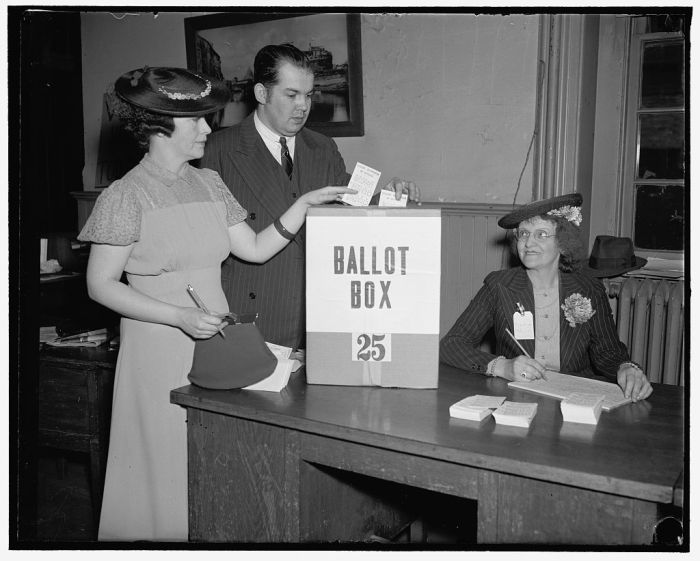
Image Credit: Creator(s): Harris & Ewing, photographer

“Washington Votes; first time since 1874. Washington, D.C., April 30. It was a long time between votes, 1874 to 1938, but the Capitol bridged a gap today when its residents cast a city-wide ballot on the question of whether suffrage shall be voted to the voteless community. Mr and Mrs Paul R. Henry are shown depositing their ballots while Miss Magdalena Gale registers them, 4/30/38”

From The Library of Congress

Ray DeCapite (1924-2009)

RAY DECAPITE (1924-2009)

by Thomas Baughman

One of my favorite authors is Cleveland novelist Ray DeCapite, a writer who devoted his entire life to writing fiction that took place on the very streets where he was born and raised. More specifically, his work chronicled life among Cleveland’s ethnic working class.

In 1960, DeCapite published his first novel, The Coming of Fabrizze, a celebration of ethnic working class community set in the 1920s. Fabrizze is an almost mythical tale of an immigrant who succeeds by hard work, marries a beautiful girl, wins the admiration of the immigrant community, then fails on a large scale. Even so , it ends well with the hero retaining the love of his neighbors.

The next year, the author would publish his second novel, A Lost King, which is a small masterpiece. As writer Thomas DiPietro has written ,“this elegant little novel beautifully captures the double consciousness of American ethnicity in its tale of an emotional struggle between a son and his father.”

Carl, an immigrant crane operator who has recently retired, cannot comprehend his carefree son. Paul, the slacker son, is content to play his harmonica and sell watermelons from a cart rather than pursue success or gainful employment. The ensuing conflict in the novel is both heartbreaking and uproariously funny.

Even though both books were greeted critical acclaim, they also met with public indifference and soon went out of print. Further complications ensued when DeCapite’s editor died and his publisher went out of business. Then to top it all off, several publishers passed on the authors next novel because the hero was a garbage man.

It would be 35 years before DeCapite would publish another book. In 1996, Pat The Lion on the Head was published by University Editions. This book, a novella really, tells the story of a trash sweeper at Cleveland’s West Side Market in the in the 1950s. Christy, an aging, lonely, hard-drinking veteran, meets and finds love with a lonely widow named Jenny. Ultimately he loses Jenny and ends up alone. While the story sounds simple the book is a small miracle of precise writing and nuanced detail. Four years later, the author would publish his last book, Go Very Highly Trippingly To and Fro/ The Stretch Run, which would again delineate life at the bottom.

Ray DeCapite died last year at the age of 84. He left behind an unpublished manuscript entitled All Our Former Frolics.

Lest the reader find the above story depressing, there is good news. Kent State University Press has republished both The Coming of Fabrizze and A Lost King. I can only hope that a new generation of readers will read and revere these two wonderful books.

SATURDAY POETRY SERIES PRESENTS: CHARLES BERNSTEIN


ALL THE WHISKEY IN HEAVEN
by Charles Bernstein

Not for all the whiskey in heaven
Not for all the flies in Vermont
Not for all the tears in the basement
Not for a million trips to Mars

Not if you paid me in diamonds
Not if you paid me in pearls
Not if you gave me your pinky ring
Not if you gave me your curls

Not for all the fire in hell
Not for all the blue in the sky
Not for an empire of my own
Not even for peace of mind

No, never, I’ll never stop loving you
Not till my heart beats its last
And even then in my words and my songs
I will love you all over again

From All the Whiskey in Heaven by Charles Bernstein. Copyright © 2010 by Charles Bernstein.

Charles Bernstein is an American poet, essayist, writer, and editor who has authored over 40 books. His works, accomplishments, and accolades are too numerous to note here. For a thorough look at Charles Bernstein check out the Electronic Poetry Center.

Editor’s Note: Today’s post is dedicated to Nathan W.

Recently a dear friend and faithful reader of this series took me for my inaugural visit to Green Apple Books in the Richmond District of San Francisco. Holed up in the poetry section I came across a copy of All the Whiskey in Heaven, a book named for a poem of the same name. Nathan W. had chosen this poem for me about two years ago when it appeared in The Nation, and it has been a part of the map of my heart ever since.

Today’s poem will always remind me that no matter how fleeting, no matter how much lost or gained, it is a blessing to be loved.

Want to read more by and about Charles Bernstein?
Poets.org
The Poetry Foundation
Electronic Poetry Center