Sunday Literary Series Presents: Sofia Starnes

.

ONE BODY

by Sofia Starnes


The earth is our great mother and the stones

Within earth’s body surely are the bones

The oracle intends.

(Metamorphoses: Ovid. Trans. A. D. Melville)


Let us suppose for once,

in our intimate illusion, the metaphor

is true.  The ant, nervate, exhausting, vexes


through flesh-fields, into earth’s

fragrant udders for its milk; the spigot

pours an ocean into pail, the evening


falls on metal ears, light treading

lifelike in this shell.  All flutter, wink

of wings, must snap out of the strong,


peculiar outbreak of a leaf,

a single spit of wind; the odd kiss mating

March to April year to year.


The worm partakes of this;

the gopher frets and burrows under skin

we must call ours: brown, humid, slug-


filled—quelling throbs as crust

of a secluded heart we recognize.

Thus would we soak in one soft tissue


the day’s outpouring of pain,

downfall of pears and peaches at the edge

of half-crazed beds. Thus would we


explain the squeezing, tightening

lungs in chase of air, long-taken, gulped

by others with our breath.


There may have been no other foot-

prints in our trek from quietness to quake,

from nothingness to whimper, bang


or bubble, whisper swelling into roar.

One naked, mute amoeba prior to clear

voice; yeast plugged into a moist


desire and gestured….

Be food, risen as auburn challah to consume—

Be that consuming body tumbling down to seed.


Sofia Starnes is the author of The Soul’s Landscape, selected by Billy Collins as a winner of the Aldrich Poetry Series Prize (Aldrich Museum Press, 2002); A Commerce of Moments (Pavement Saw Press, 2003), Editor’s Prize in the Transcontinental Poetry Award competition and subsequently named Honor Book in the 2004 Virginia Literary Awards; and Corpus Homini: A Poem for Single Flesh (Wings Press, 2008), winner of the Whitebird Chapbook Series Prize. Her next full-length book, Fully Into Ashes, is forthcoming, also by Wings Press.

The earth is our great mother and the stones

Within earth’s body surely are the bones

The oracle intends.

(Metamorphoses: Ovid. Trans. A. D. Melville)

MARK VAN PROYEN

Jack Stuppin, Mt. Tamalpais, oil on canvas, 2009.

EBULLIENT INHABITIONS: JACK STUPPIN’S EXHILARATING LANDSCAPES

by Mark Van Proyen

“In landskip, inanimates are principal:
’tis the earth, the water, the stones,
and rocks which live. All other life
becomes subordinate.”
An Essay on Painting, Shaftsbury (1713)

During the final decade of the 20th century, it was fashionable to view the entire idiom of landscape painting in terms of its representation of civilization’s “imperial” power over the land, casting it as the means of conveying a kind of pseudo-historical myth and idealized proof of the rightness of civilization’s dominion over nature. Witness W.J.T. Mitchell’s claim that “landscape might be seen more profitably as something like the dreamwork of imperialism,” … if Kenneth Clark is right to say that “landscape painting was the chief artistic creation of the nineteenth century,” we need at least explore the relation of this cultural fact to the other chief creation of the nineteenth century — the system of global domination known as European imperialism.(1) Of course, statements like this can also be taken as the artifacts of a another kind of dreamwork; that being the casting of academia’s relationship to late 20th century history as a wishful attempt to re-determine the corporately controlled present via an exegetical framing of the not-so-mythical past. As such, it can be said to evade the important — indeed, the crucial issue of our time, that being the one which asks how we might most fully inhabit our own moment in our own time, disengaged from the pull of superordinating presuppositions and in un ambivalent possession of a psychically self-sufficient moment of temporary isolation from an insane world overdetermined by policy mandates and the rote groupthinks which are bred from an endless and irresolvable contest of cultural politics.

Jack Stuppin’s landscape paintings are remarkable for the directness and clarity with which they address themselves to this issue of spontaneous psychic inhabitation, and because of this, they take us to places where the angels of anxious sanctimony fear to tread. Not that they do anything wrong; on the contrary, theirs is the most innocent and uncontroversial of artistic tasks, that being the capture and alignment of the momentous confluence of time, place and atmosphere which memorably comprises the irrepressible psychic scenery which cultural politics always seeks to deny and drown out. And yet, it cannot and will not be denied, because all of the abstract information in the world cannot even begin to compete with the tangibility of actual experience in terms of real impact on human memory, however precise, coherent and well-ordered such information might pretend to be. In the end, memory will of necessity trust experience over hearsay, and observable pattern over even the most logically consistent of speculative possibilities. To state the same thing in plainer words, we can say that the meanings that memory makes always places experiential moments in its forefront, emphasizing them as vivid markers for expedient recovery as well sustaining them as keynotes and catalysts for further investigations. This stems from the fact that we are all fated to be haunted by images even as the will to self-protection makes us skeptically suspicious of sermons and diatribes, and images are of necessity always located in some kind of place.

Stuppin’s landscapes address themselves to exactly this notion of perpetually-present memory in that they always seek to collapse and cement the difference between time-present and time-past, re-making them as one-and-the-same as an all-at-onceness which reminds us of the popular truism stating that time is God’s way of keeping everything from happening all at once. Open-minded yet decisively assured, Stuppin’s paintings lift us to the Olympian vantage of geological time where everything pretty much does happen all at once, again-and-again, and they are remarkable for the different paths that they take to carry us to the threshold of that vantage, giving us both its complex topographic texture and well as its eternal panoply of elements — the difference-within-wholeness that is the very essence of the long tradition of landscape painting as it continues to exist in Europe, Asia and North America. If we ascertain within these works a once-upon-a-time magic, then we are also reminded of the delightfully inescapable fact that said time and place is our own here-and-now. Stuppin’s paintings remind us that it is the land itself that is the place which contains all possible places (as both Ur-source and final teleological destination), so they make a perfect, almost heroic sense in that they portray, and thus contain the thing that is destiny tells us will finally contain everything else.

Laboring within the long shadow of both Kantian and Hegelian Idealism, the German art historian Max J. Friedlander stated what has since become a truism for the modern reception and practice of landscape painting: land is the thing-in-itself, landscape the phenomenon.(2) Even though Stuppin’s paintings always take a specific geographical location as their point of departure, their “landscape-ness” should primarily be understood as a model of the mind in so far as they reveal themselves to be idealized imaginings of an a temporal perpetuity. In this, they are demonstrations of the rigors and vigors of an everymind which seeks to wrap itself around the complexities of any given situation that strikes its fancy. To be a bit more precise, we should probably say that Stuppin’s ebullient landscapes are models of being which the mind has chosen to inhabit with a set of specific temperamental priorities and consistent attitudes: obstreperous, playful and perhaps a little impatient to reach a pictorial conclusion about a subject that can never be concluded. Perhaps this recognition casts the repeated effort to reach such a conclusion as a kind of repetition-compulsion giving way to momentary Phyric victories which provide a quick and essential glimpse of that larger-than-lifeness which can only regard the so-called drama of our own existence as a short and rather brutish epiphenomena. But it also gets us closer to how the land can become a site for the projection of a wealth of subliminal meanings which reflect the whole array of styles-of-experiencing which we call life.

Other writers have alluded to some of these meaning in vivid and provocative terms: for John Fitz Gibbon,(3) Stuppin’s “primitive” landscapes are condensed cornucopias of nature’s delectable abundance … paeans to the benevolent vision of plenitude symbolized by the many-breasted goddess Diana of Ephasus. Sounding an almost diametrically opposed note, Donald Kuspit has pointed to how they reveal the fact that “the American landscape is no longer a demonstration of Emerson’s spirit in the fact of nature, but rather of the harsh facts themselves, in all their pristine indifference to human existence. Where spirit once spread over the vast panorama of America’s unspoiled nature like a benign morning mist, making every detail of plant and mineral and sky and cloud glow with sublime intensity, in Stuppin’s pictures the mist has been burned away by a ruthlessly bright sun, leaving behind the raw facts of nature uncontaminated by either divine or human presence.”(4) Even though we might think that these statements are at odds with each other, we should take pause to consider the fact that they take different individual works, or at least different clusters of Stuppin’s typical subject matter as their respective points of literary departure. Clearly, Fitz Gibbon is thinking of the perfervid spring and summer moods of pastoral works such as Mesa on Ghost Ranch (1999), or Hill at Wharton Hollow (1998), where rude bursts of sumptuous foliage impinge upon successive ranges of undulate hills and pillowy valleys which are typically regarded from an elevated panoramic vista. Kuspit’s assertion of the immutable remorselessness of nature is revealed in the upsurging rocks and barren crags pictured in paintings such as Main Top from Lighthouse Hill, Farallon Islands (1995), or perhaps in the sun-scorched hills pictured in Fog and Coastal Mountains, Sonoma County (1996), Both of these paintings take the dramatic confrontation of sun, sea, and land all pounding hard against one another as their subjects, and they remind us of the fact that Herman Mellville’s grim vision of nature as a place where all creation “be tooth’n and fang’n one another” is just as characteristic of the American spirit as are the meditative idylls of transcendental nature mystics such as Thoreau and Emerson.

Other epiphanies are revealed for our viewing pleasure in Stuppin’s paintings. Blossoming fruit trees of the type pictured in Three Plums (1997) and Almond Trees, University Farm (1997), are painted in a way that typically emphasizes their brilliantly efflorescent chromatics, all-the-while laboring to suppress excessive detail in a way that makes them seem more like the idealized remembrances of a particular moment rather than the specific pictorial recollection of a given location. These works literally pop into our visual word, seeming almost improbable in their convulsive bushiness. At first glance, their picture-spaces appear to be flattened in the distilled, economic manner of those painters which we associate with Modernist movements such as Fauvism, Die Brucke Expressionism or the Nabis. This flatness, combined with these work’s electric colors (which never become sour or overripe) quickens our eye, making us remember what it was like to be particularly alive to a particular moment in a particular place that is in itself particularly alive. This is accomplished by the way that the paintings prompt us to achieve high speed in our apprehension of the interrelation of complex pictorial incidents as they coalesce into the general view. It also beseeches us to savor the exhilarating chromatics of that view, forcibly re-acquainting us with the omnipresent epiphanies that are always lurking amid moments of everyday perception.

It is at this point that we realize that there are specific particulars inhabiting these scenes, uniquely memorable ones at that. These are revealed in the form of seemingly improbable details that seem somewhat insignificant in themselves, but in fact are the telltale giveaways to the actuality of the scenes portrayed by these works. To those who are familiar with the Napa, Sonoma and Marin County backroads that Stuppin most often uses as his en plein air studio, the shock of recognizing these details creates a kind of credibility of remembrance in that we can compare our memory of these locations with Stuppin’s fanciful rendition of it — thereby allowing entry into *seeing* that location in the specific frame of mind and perhaps even the specific imaginary moment in which the artist initially viewed it. For those who are not blessed with such geographic familiarity, those details offer themselves up as contributing textures which again remind us that landscape is always more than a mere geological parable. Rather, it is the disclosure of a cyclic narrative of becomings and diminishments which locate both as the polar points of some perpetual cosmic respiration, to which we are all connected regardless of whether we recognize it or not. But the momentousness of this recognition is enhanced if we are also able to recognize the precise moment from which it stems

It is in this use of specific incident to anchor and apply texture to the general scene that we see the true character of Stuppin’s art. His paintings neither seize the topical nor insist on the authority of the general view as an exclusive procrustean province, opting instead to unite these disparate polarities into a flexible, almost paradoxical continuum. They are “down to earth” even as they are never mired in it, always choosing to be unabashed in partaking of whatever pleasure are offered by time and place without making any kind of a moral issue over the powers which shape those moments, which at their essence are always indifferent to the anxieties and conceits of such powers. Once that indifference is noted, the land comes out from behind its passively picturesque shadow and shows itself to be a frisky Poseidon frolicking with the shy creatures of his endlessly fascinating dominion, revealing its supple musculature while remaining confidant and relaxed, unpossessed by any crippling tension bred of an apraxic self-consciousness.

Throughout the past two centuries, many painters have returned to working in and with the landscape to partake of the rejuvenation and spontaneity that goes hand-in-hand with a momentary liberation from the enforced miserablism that is bred from seemingly endless and ever-more arduous quotidian routine. Some, like Gaugain, have never looked back, and in fact they made it their business to stay as close to the land for as long as possible, knowing that it would take much longer than an ordinary lifetime to unlock its knot of secrets and exhaust its many pictorial possibilities. I suspect that Stuppin can rightfully count himself among those artists who have taken the land’s temptation to the point of almost going native with it. He certainly continues to find new vistas to inhabit and respond to, and the work seems to grow ever-closer to revealing what the Taoists call “the living breath of land and rock.” In this, Stuppin’s work can be said to respond to same vitalist impulse that motivated and inspired the scholar-painters of the Sung dynasty almost a millennium ago:

“Landscapes are large things. He who contemplates them should be at some distance; only so is it possible for him to behold in one view all shapes and atmospheric effects of mountains and streams.

“It has been truly said, that among the landscapes, there are those fit to walk through, those fit to contemplate, those fit to ramble in or to live in. All pictures may reach these standards and enter the category of the wonderful; but those fit to walk through or to contemplate are not equal to those fit to ramble in or live in … the wise man’s yearnings for woods and streams is aroused by the existence of such beautiful places …This may be called not losing the fundamental idea.”(5)

It is in the way that Stuppin’s paintings embrace “the fundamental idea” of psychic inhabitation that we see their importance and value. These are works that prompt us to that inhabitation, and in so doing, “do something for us,” that is, they facilitate our understanding of connectedness to the living onement that is both time and place. They prompt us to stop pretending to believe in the reality of the speculative and the intangible by reminding us of the tangible albeit unfathomable mysteries which lurk in that which is immediately at hand.

–Mark Van Proyen


NOTES

(1) W.J.T Mitchell, Imperial Landscape, in W.J.T. Mitchell (ed.) Landscape and Power, University of Chicago Press, 1994. p. 10.

(2) Quoted in Jed Perl, Earth, (1997) in Eyewitness: Report from an Artworld in Crisis, New York, Basic Books, 2000. p. 171.

(3) John Fitz Gibbon, A Barmecide Feast, Barmecide Feast: Landscapes and Figures by Jack Stuppin (exhibition catalog) Fairfax, CA. Bradford Gallery/Pegasus Press, 1996; pp.2-3.

(4) Donald Kuspit, At the Edge of the World, (exhibition catalog), New York, Nieman Gallery, Columbia University, 1998. pp. 4-5

(5) Kuo Ssu, The Great Message of Forests and Streams, (c. 1050 C.E.), in The Chinese on the Art of Painting, edited with an introduction by Osvald Siren, New York, Schocken Books, 1963. pp. 43-44.

A Movie That’s “About Something,” or Why “Creation” Isn’t a Great Movie, But You Should See It Anyway

Creation still photo

A Movie That’s “About Something,”
or Why “Creation” Isn’t a Great Movie,
But You Should See It Anyway
By John Unger Zussman

I was ambivalent about “Creation” even before I saw it. On the one hand, we desperately needed a movie about Charles Darwin in his bicentennial year. Evolution has become a religious and cultural flashpoint, and Darwin himself has been demonized. Only about 40% of American adults say they accept the truth of evolution. Our schools shy away from teaching it, and a raft of BBC and Nova documentaries haven’t been able to pick up the slack. We needed a movie that would humanize Darwin and explain evolution in a way that ordinary people would say, “Hey, wait a minute. That’s all it is? That’s not so bad.”

On the other hand, my wife Patti and I are screenwriters, and we had written our own Darwin screenplay which we hoped would do just that. We conceived it in 2006 and finished a reviewable draft (no screenplay is ever “final” until the movie is made) in 2007, in time (we hoped) for production and release in 2009. We called it “Origin” and it placed highly in several screenwriting contests. It won us a manager—representation in Hollywood is a big deal for screenwriters—and he submitted it to production companies both in the U.S. and Europe. Although it got some “good reads,” no one was willing to spend two years of their life raising money, attracting talent, making the movie, and getting it distributed. Then we learned that British producer Jeremy Thomas had bought the rights to Annie’s Box—a book about Darwin by Darwin’s own great-great-grandson, Randall Keynes—and watched as he recruited a screenwriter (John Collee) and director (Jon Amiel). When we heard that “Creation” had been financed and green-lit, we knew “Origin” was dead, at least in its current iteration. And I was jealous.

We knew it had been a long shot. Period dramas are notoriously difficult to get made, at least in Hollywood, and biopics (biographical movies) are especially problematic to write. People’s real lives do not often reflect the drama and story arc necessary for a good movie. That’s why successful biopics are usually heavily fictionalized or restricted to a brief but critical period in the subject’s life. We ourselves had used that tactic in a previous (and also, so far, unproduced) screenplay, “Trio,” about the love triangle between young Johannes Brahms, his mentor Robert Schumann, and Schumann’s wife Clara, a famous pianist. “Creation” used it as well, focusing on Darwin’s struggle to come to terms with the death of his beloved daughter, Annie, at age 10.

But for “Origin,” we decided we needed to portray the bulk of Darwin’s life, from his voyage on the Beagle, when he was a callow 22, until at least the great debate at the Oxford Museum when he was 51, after On the Origin of Species was published. Only a tale with such broad scope would trace Darwin’s own evolution, from his beginnings as an unpromising, upper-class youth, who studied for the ministry and believed the bible was literally true, yet was blessed with an overpowering fascination with nature—to the proponent of the best (and most subversive) idea in the history of science. Charles would be our proxy, a young creationist who nevertheless kept his eyes open and did not shy away from what they showed him. And so would his devout wife Emma, who abhorred the thought that Charles’s theory would prevent them from being together in heaven, yet who loved him too much to deny him his life’s work. It would be about a scientist and his theory, but really it would be a love story. We wanted it to be the “Brokeback Mountain” of evolution.

When we finally attended the San Francisco premiere of “Creation,” it fulfilled both our hopes and our fears. It succeeded in humanizing Darwin, and Paul Bettany was quite wonderful in the role. It found drama in Charles’s struggle to publish the work that he knew would polarize Victorian society and “break Emma’s heart.” And I had to admit that some of the scenes milked more conflict out of that struggle than ours had.

“Creation” was rather light on the science of evolution. This is understandable, since people go to movies (as our screenwriting coach keeps reminding us) to experience vicarious emotion, not for academic learning. It is even forgivable, especially from a British point of view, since I’d bet that British schools (and the BBC) do a better job educating the populace about evolution than our American counterparts.

But “Creation” was also light on what Darwin called the “grandeur” of nature, and that is more of a problem, for that is what made him tick. And in bringing out the drama, portraying Charles as an angst-ridden neurotic and Emma as his stern, disapproving wife, it made them unsympathetic. Charles and Emma came across as human beings, but not necessarily ones you’d want to spend two hours with, when by all reports they were both interesting, likeable, and generous people. “Creation” ended up as a domestic drama, at times dreary, that happens to be about a scientist. It was far from what we’d tried to write—a heroic drama about a scientist who stumbles on a revolutionary theory and struggles to publish it despite the condemnation of his wife and his society. We wanted a movie that would engage both heart and brain.

Jon Amiel, the director, conducted an hour-long Q&A after the screening. Despite our issues with the film, we were impressed with his intelligence and craft. When I asked whether he thought “Creation” would change any minds, he said he hoped it would at least open them.

To do that, of course, people who don’t accept evolution will have to see it. There’s the rub. Big studio movies open across the country (and world) on thousands of screens—it’s called “opening wide.” “Creation” opened in January on seven screens in five of the most progressive cities in the country. It is gradually rolling out more broadly—it’s on 14 screens as I write this in early February, and will play 15 more in the next month, again mostly in cities. This is the narrowest of openings for an important movie.

In fact, “Creation” was almost not distributed in the U.S. at all. After its premiere at the Toronto Film Festival, the producers expected it would be picked up for major distribution and released during “award season.” But no one bit. Finally, a smaller distributor, Newmarket Films, courageously rescued it and chose its distribution schedule.

Amiel called movies like “Creation” “an endangered species” and cited two strikes against it from the beginning. One reason is that it’s a period drama, a difficult genre to sell in Hollywood (as mentioned above), despite the success (and awards) of movies like “Amadeus” and “Shakespeare in Love.”

But more importantly, Amiel said, “it’s about something,” and that sets it apart from studio fare, which seems primarily to be based on comic books or video games or toys. Studios these days are all about making “tentpoles”—movies that will hold up the heavy tent of their businesses—and building “franchises” (like Spiderman, Transformers, Shrek, Harry Potter, Twilight, Batman, and Saw) that will not only attract viewers to movie after movie, but also sell plenty of cross-licensed merchandise.

Of course, movie-making is a business as well as (one hopes) an art. We can’t begrudge the studios a profit on their work, or ask them to make or distribute movies they expect to lose money on. Moviegoers these days tend to be young, in their teens or twenties, and at the end of a long school or work week, they don’t seek out heavy dramas or movies that make them think. They want to be entertained, they want to laugh or be aroused or frightened. They want to have fun.

You’d think there would be plenty of older moviegoers, too—boomers like me, and other ages too—who grew up on great movies and might prefer period dramas. But our viewing habits are different (despite the efforts of my early-retired friend Dan, who singlehandedly raised the curve by seeing 139 movies in theaters last year). We tend to wait for movies to be released on DVD or television, which is not nearly so profitable for filmmakers or distributors. That’s why they cater to younger audiences.

A year ago, the buzz in Hollywood was that intelligent movies, movies aimed at adults— “adult movies” has another meaning, so the term I prefer is “movies for grownups”—were dead. Serious films with major stars like “State of Play” and “The Soloist” disappointed at the box office. Even 2008 Oscar nominees like “Doubt” and “Frost/Nixon” struggled. The studios were shuttering their specialty divisions like Warner Independent and Paramount Vantage.

Of course, Hollywood is fickle, and trends may be reversed in weeks. These days, the mood is slightly more upbeat, with grownup movies like “Up in the Air” and “The Blind Side” racking up decent box office and surprising many with their staying power. But audiences are fickle, too. Even “The Hurt Locker,” which some critics consider the best movie of the year, barely made back its modest $13 million cost in theaters—the latest in a line of Iraq war movies to disappoint. And the bodies are still falling; just last month, Disney closed its Miramax division. Amiel said that he doubted “Creation” could even get financing today.

Which is why I’m urging you to go see “Creation,” despite its flaws, if it’s playing in a theater near you. If we want to see quality movies, we have to vote with our feet.

In fact, if you can, see these grownup movies the weekend they open. (At posting time, “Creation” has now opened in most U.S. cities, but debuts in Phoenix and Tuscon are scheduled for March 5.) By some arcane calculus, Hollywood counts opening weekend box office results disproportionately. As I understand it, the distributor takes a greater cut of the gross on opening weekend than on subsequent showings. Or maybe Hollywood just wants its marketing budget to play a larger role in a movie’s success, before word gets around that it sucks. (A vain hope, in the age of Twitter and texting.)

This may seem like too much “inside baseball,” and you may not care how the movie business works. I can relate. But one thing we’ve learned from politics is that making changes to a system depends on understanding how the system works and how to get a message through. And the way to encourage more movies for grownups to be made is for grownups to go to the ones that are—however imperfect.

So I’ll see you at the cineplex. Orsince Patti and I are currently adapting “Origin” into a stage playmaybe at the theater.

Copyright © 2010, John Unger Zussman. All rights reserved.

BOOK REVIEW

I-5, GOLDEN STATE GULAG

by Matthew Hirsch

In 1962, a literary magazine in the Soviet Union printed One Day in the Life of Ivan Denisovich, Aleksandr Solzhenitsyn’s debut novel about an ordinary man who’d been swept to the margins of society. Little to that point had been published about Soviet prison camps and the routine injustices suffered there by innocent people like Ivan Denisovich Shukhov. Halfway around the world and almost a half-century later comes a new novel that explores similar themes, aiming to expose an ongoing form of concealed oppression. The new book tells the story of a young woman who’s held captive not in a labor camp but a sex trafficking operation. The book is called I-5: A Novel of Crime, Transport, and Sex.

The title I-5 comes from the interstate highway that cuts 800 miles through California, from the U.S.-Mexico border crossing at San Ysidro to the start of the Cascade mountain range near southern Oregon. The terrain might be familiar, but the scenes in the book are virtually unrecognizable, even for those who’ve made the journey along I-5 many times. Like the highway itself, these are places we’ve all visited, like roadside apartment buildings and Denny’s restaurants, but know little or nothing about.

The main character in I-5 is a Russian immigrant named Anya, whose family has been ravaged by state violence and war. A military plane crash destroyed her grandparents’ farm and ultimately claimed her grandmother’s life. An arrest by the secret police took away Anya’s brother Dimitri; then Anya resolved to flee from home. It was this impulse to escape that drove Anya into the hands of her captor, a Russian-American businessman named Kupkin, and into the dark underworld of sex trafficking.

Summer Brenner, the Berkeley, California, author who wrote I-5, says Anya came into being in her imagination almost seven years ago when the U.S. military launched its war in Iraq. The context of Anya’s captivity was influenced by personal frustrations in Brenner’s own life, such as her failure as part of a mass movement to stop the Iraq War. Another source of frustration: the familiar sense of confinement that comes with reporting to a job you don’t want to do.

In I-5, Anya’s captors might call to mind an aggressor who’s presenting a justification for war or one who’s extracting labor from an unwilling workforce. “They like to say persuasive things. They like to make themselves sound philosophical. They also fancy the phrase, in principle. … They say, ‘You should get on your fucking knees and crawl across the room.’ And when they add in principle to their propositions, it lends them an air of dignity: as if in principle all mankind has been waiting to do their bidding.”

Brenner did not set out to update Ivan Denisovich, but the similarities are unmistakable. In both novels, the main characters are snatched from their families and delivered to remote places that function by a harsh new set of rules. Solzhenitsyn’s character Shukhov must learn to survive the Siberian winter. Anya’s existence depends on lap-dance performances and her high threshold for pain during sex with clients. In Ivan Denisovich and I-5, both characters also exhibit a sense of agency that helps them retain their humanity in brutish surroundings.

Most of all, it is Anya’s sobering perspective on suffering that makes her a literary heir to Shukhov, who issued the memorable line: “How can you expect a man who’s warm to understand a man who’s cold?” Anya’s captor Kupkin believes his fate is to rescue young, beautiful women. Though he traps them with deception, Kupkin concludes that these women are better off at his mercy in the U.S. than back home in an impoverished war zone. Anya agrees. As she tries to initiate another of Kupkin’s prisoners to her way of thinking, Anya offers this rationale: “Would she rather be fucking a dog in Atlanta? Or living like a dog in Romania? For Anya, this was not a theoretical question but a real choice. The relative improvement … could not be more clear.”

This is the voice of a survivor. Understanding this perspective is necessary. Accepting it, however, would mean admitting something awful about oneself. And herein lies Anya’s true power. She forces us to confront a taboo in the U.S. marketplace, that section where people trade on human flesh. It happens all around us, whether or not we can see into the shadows. Now that I-5 has made sex trafficking a little more visible, the question is: what are we going to do about it?

(For somewhat recent information about human trafficking, which includes trafficking for commercial sex, see “The Countertraffickers,” an article by William Finnegan published in the New Yorker in May 2008. The U.S. government has estimated that 14,500 to 17,500 people are trafficked into the country each year, according to Finnegan’s report. Worldwide estimates are much less precise, with half a million people at the low end of the range. Citing the International Labor Organization, Finnegan said almost half of all trafficked labor is sex trafficking.)

Amidst all the difficult questions, the lively depiction of villains and antiheros in I-5 make Brenner’s novel a thrill to read. A brief detour to a California state prison introduces us to Gervasio, perhaps the most compelling character after Anya. The prison scene also suggests a whole other story about captivity in the land of the free. In fact, Brenner says she hopes to extend I-5 into a trilogy about women in confinement. The second installment would focus on domestic servitude. The third would take aim at (you guessed it!) prisons.

I-5 marks an auspicious start for the new noir fiction imprint at PM Press, called Switchblade. PM Press bills the lineup as “a different slice of hardboiled fiction, where the dreamers and the schemers, the dispossessed and the damned, and the hobos and the rebels tango at the edge of society.” Catch PM on March 13 and 14 at the Anarchist Book Fair in San Francisco or online at www.pmpress.org.

–Matthew Hirsch

This essay was first published in ZNet on 2/21/10.

FILM CRITICISM

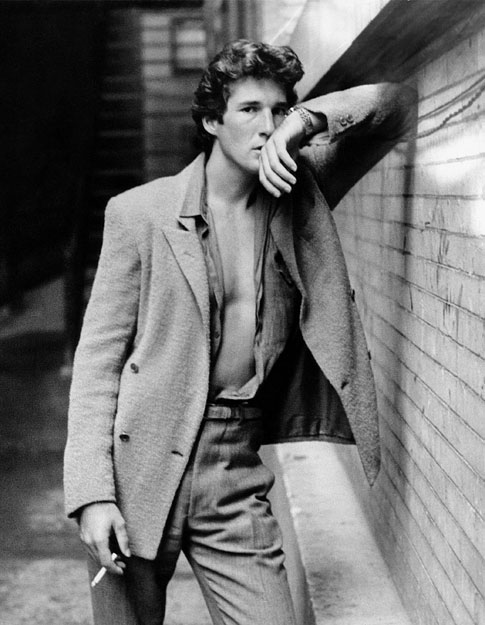
Richard Gere in American Gigolo, 1980

DON’T ASK, DON’T TELL: PHALLOCENTRIC ECONOMICS, TRIANGULAR TRADE & OTHER SHADY BUSINESS

by Mishana Hosseinioun

“All economic organization is homosexual.” — Luce Irigaray

Paul Schrader’s erotic thriller, American Gigolo (1980) does much more than simply explore the roving life of male prostitute, Julian Kaye, played by quintessential Hollywood sex-symbol Richard Gere (idolized by men and women alike); it supplies viewers with first-hand evidence supporting Belgian feminist Luce Irigaray’s phallo-critical theory that “all economic organization is homosexual”1, or “hom(m)osexual” (between males), as she would specify. What is more, the film adds layers of complexity of its own to Irigaray’s argument. While, in her essay on ‘Commidities among Themselves,’ Irigaray writes of male-to-male relations lubricating all capital flow, many elements in American Gigolo point to the ever-present nature of homosexuality in the economic realm and beyond. As the latter would suggest, the homosexuality that Irigaray regards as the basis for all economic transactions is perhaps just one of the many outward manifestations of repressed homosexuality in society. As such, a scene that depicts a transaction between Julian (or the effeminate, “Julie,” as he is called) and a married couple—exemplary of the homosexual economic organization to which Irigaray refers in her central thesis—can be read as one of the more pronounced expressions of subdued homosexuality of male characters in the film. Given its rich symbolism and rhetoric charged with an unmistakable hom(m)osexual undertone, this particular sequence calls for deep analysis through the lens of Irigaray’s critique of Lévi-Straussian kinship structures.

This sequence is just one instance in which American gigolo, Julian—in exchanging his sexual services with a woman in return for money—actually inserts himself into a transaction with another male. Upon entering the Palm Beach home of a client, Julie addresses the man of the household: Look mister, someone’s made a mistake here. I don’t do fags. When the husband tries to explain that it is not what he meant, Julie promptly stresses that he does not do couples either, to which the husband takes offense and retorts, no, no, no, you don’t understand, it’s just my wife Judy. Not me! Just her. The camera, turning back on Julie to capture his response to the husband’s emphatic disavowal, does not miss the telling shift in Julie’s eyes which graze a nearby male statue just milliseconds before he blurts out, OK. Such body language implies a nonverbal show of understanding on Julie’s part, of the husband’s true homosexual intentions; while the movements of Julie’s lips—a part of the body that is spoken through by culture—cannot similarly engage in the taboo as his eyes do, and are thus obliged to acquiesce to societal convention by forming the word, OK.

Only moments later, the husband continues, but I can watch, greedily asserting his only right that would bring him close to another man without appearing overtly homosexual. He states this less as a question than as a reiteration of a contract already established non-verbally between the two men. ‘Course, Julie says, reassuring the husband, as though merely confirming their pre-signed agreement. Would you—would you like a drink? the husband offers, to which Julie mumbles, No, yet simultaneously pairs with body language that would suggest otherwise. Mid-No, Julie, loosening his tie and making deep eye contact, begins to walk in the husband’s direction. With fear in his eyes, the husband scolds, Not yet!, which represents his being made uncomfortable by what he obviously felt (and possibly enjoyed with guilty pleasure) as Julie’s sexual advance towards him. As the camera zooms in swiftly onto the husband’s panic-stricken face in this scene, a slender, crystal statuette is made apparent just behind, to the side, and in line with the husband’s head, perhaps serving to mirror his psyche at that very moment and, more specifically, showing that he is reminded of how his relation with another man will always be mediated by a third party. The arms of this handless figure stick up in the air and the head drops lifeless to one side, in an almost feminine rendition of the crucified Christ2, foreshadowing his wife who will later be seen lying in a similarly passive position in a bed in the next room.

Immediately afterwards, Julie changes the topic, exclaiming, I think I’d like my money now, to which the husband, with similar aloofness, responds oh sure—sure, the second sure, fully aware of itself as a line spoken straight out of a socially-approved skit for two men seemingly conducting “business as usual”. Despite never having met one another before this particular interchange, Julie and the husband’s dialogue here strangely appears rehearsed, which can only mean that they play a similar role with other men, day-in and day-out. Both seem to recognize that their proper sounding dialogue, tailored to cultural standards, is simply a way of escaping the unease prompted by direct hom(m)osexual confrontation and the patent shadiness of their business. “Hom(m)osexuality is played out through the bodies of women, matter, or sign and heterosexuality has been up to now just an alibi for the smooth workings of man’s relations with himself of relations among men,”3 writes Irigaray, summing up the sexual struggle that takes place in this film sequence. In this situation, the homosexuality plays itself out through superficial dialogue, and in the following scene, through the ‘superficial’ wife.

Julie follows the husband into the bedroom, on the way, passing a phallic shaped cactus, perhaps symbolizing the husband’s “prick” (i.e. cactus needles) which is in a state of chronic unpleasure,4 given that it presumably cannot relieve itself of the tension of pent-up homosexual desire. As the two men enter the room, lying on the bed, in white sheets, is the almost naked, crucified, silent, doll-like, wife whose blonde hair and pale skin make her the closest thing to invisible (not unlike the crystal statuette from the previous scene) so as to maximally erase her from the subsequent sexual exchange in the bedroom; by her bedside lies an abstract piece of art, yet-again, phallic in shape. Its position on the nightstand is significant in that it both represents an unconsciously fetishized object that might be used to arouse the husband sexually and to make sexual contact with his wife bearable. While the hard, twisted, cold metal seems to highlight the frigidity and frustration surrounding his relationship with her and signals the violence that lies ahead, it is possibly evocative of the husband’s infantile fixation and fear of “sterility”, otherwise know as castration.

Julie is asked to engage in sexual relations with the wife as the husband, standing watch at a safe distance from the bed, yells a series of command. “Woman exists only as an occasion for mediation, transaction, transition, transference, between man and his fellow man, indeed between man and himself,”5 reaffirms Irigaray, clearly describing the way in which the wife here is merely an object to be filled, a vehicle through which the two men can carry out their homosexual exchange, and nothing more. When Julie attempts to contest this tripartite system by whispering to the wife to forget that her husband is also in the room, the husband reasserts himself and barks from the back of the room, Oh, no, no, from behind—it has to be from behind! in blatant reference to anal sex. Further evidence that there is no escape from this “triangular trade,” in which the female body is merely utilized a means to an end within an otherwise homosexual exchange, comes from the way in which the camera refuses to ever really capture Julie and the wife alone in a single frame. As soon as the husband no longer becomes visible in the background, the phallic artwork on the nightstand enters the frame and stands in for the second phallus that is required in the transaction, emphasizing Irigaray’s argument of how an exchange cannot take place in society in the absence of hom(m)osexual parties.

Later, the husband orders Julie to slap her—slap that cunt which demonstrates the husband’s frustration at having a woman stand in the way of his homosexual encounter with Julie, just as it shows how the repression of his homosexuality manifests itself into physical symptoms, namely as sadistic outbursts. The expression, cunt, reduces the wife to her mere genitalia, which is tragically the source of the husband’s pleasure as well as pain given that the cunt is both a window and a wall leading to and separating him from a homosexual encounter. In other words, his homosexual desires can only be achieved by means of a female body, yet are eternally doomed to suppression given the lack of direct access to another male; he vocalizes, and thus externalizes this repressed tension, by literally projecting his anger onto her body which is a constant reminder of his infantile fear of castration, as well as a reminder that his encounter with another male is forever sentenced to mediation, filtration, and thus, to dilution, by that cunt.

Not only does this film sequence provide backing for Irigary’s argument that all exchanges are ultimately homosexual6, it draws attention to the repressed hom(m)osexual desires that stir within males on a more regular basis and that desperately seek outlets for articulation. Given that forms of socially acceptable expression of such desires are limited and are, thus, never fully satisfied—as this particular instance in the film suggests—a patriarchal society is left but with one thing as its last avenue of expression: violence; hence, the murder of the wife on the night of the sexual exchange with the gigolo. Although this attempt to exterminate the female from the triangle-trade altogether is successful in one respect, the film shows how the entire monopoly falls apart as a result.7

In painting hom(m)osexuality as central to all socio-economic intercourse, Luce Irigaray once and for all complicates the kinship structures near and dear to the late “father of modern anthropology,” Claude Lévi-Strauss; yet even Lévi-Strauss, who writes that prohibition gives rise to a counter-claim, may not realize that his argument extends beyond the sphere of the incest taboo and already treads into the domain of homosexuality. Lévi-Strauss’ theory is even at work in American Gigolo, where Julie’s sexual transactions almost invariably contain male involvement and can be taken to represent the residue left behind by repressed homosexuality in society. In the same way that incest prohibition creates a need to make up for a subdued desire, the prohibition of homosexuality evidently calls for some sort of compensation, as well. “[…] every negative stipulation of the prohibition has its positive counterpart. The prohibition is tantamount to an obligation, and renunciation gives rise to a counter claim.”8 Just as a man’s renunciation of his sister calls for an obligation to give his sister to another, and claim the other’s sister for himself, figuratively speaking, certain men’s renunciation of their homosexuality makes it inevitable for other sexual forms of male interaction to spring up. All of this makes for the fact that Julie and the husband display a sort of censored homosexuality.

Whether it is Julie’s obsessive behavior towards picking and choosing clothing and scrutinizing himself in the mirror in the privacy of his own home, as the ultimate expression of his being stuck “in the closet,” or the way in which the convertible Mercedes he drives also speaks to the tension that lies between the need to keep a lid on his true sexual orientation as well as the inability to fully repress his identity—hom(m)osexuality,  as American Gigolo and Luce Irigaray’s Neo-Marxist theory of “Phallocentric Ecnomics” have shown, lurks around every corner, and “bums a ride” (rides a bum) only when safe.

Mishana Hosseinioun is a Drafter with the 2048 Project: Humanity’s Agreement to Live Together at the UC Berkeley Law School and a doctoral candidate in International Relations at the University of Oxford, England.

More writings by Mishana Hosseinioun:

Sex Pistols & the Polis: The Weapon of the Feminine in Aristophanes’ Lysistrata (411 BC)

Photography and Other Modes of Crying at Your Own Funeral

Black on White: Reading Fanon Against Mapplethorpe

Notes:

[i] Luce Irigaray, “Commodities among Themselves” in This Sex Which Is Not One (Ce Sexe qui n’en est pas un) (Ithaca, New York: Cornell University Press, 1985), ch. 9, p. 193.

[ii] Paying for the homosexual “sins” of the men.

[iii] Ibid., p. 172.

[iv] Derives from Freudian Pleasure/Unpleasure principle.

[v] Ibid., p. 193.

[vi] Ibid., p.192.

[vii]Julie, who goes to jail after killing the pimp in an unconscious attempt to remove a second bothersome male figure from his transactions with females, demonstrates that he cannot manipulate the system without effectively removing himself from the monopoly.

[viii] Claude Lévi-Strauss, The Elementary Structures of Kinship (Les Structures élémentaires de la parenté) (Boston: Beacon Press, rev. ed. 1969), p. 51.


DORIANNE LAUX

Photograph of Dorianne Laux by Ron Salisbury, from the back cover of her first book “Awakepublished by BOA Editions, Ltd, 1990.

QUARTER TO SIX

and the house swept with the colors of dusk,
I set the table with plates and lace. In these minutes
left to myself, before the man and child scuff at the doorstep
and come in, I think of you and wonder what I would say
if I could write. Would I tell you how I avoid his eyes,
this man I’ve learned to live with, afraid
of what he doesn’t know about me. That I’ve finished
a pack of cigarettes in one sitting, to ready myself
for dinner, when my hands will waver over a plate of fish
as my daughter grows up normal in the chair beside me. Missy,

this is what’s become of the wedding you swore you’d come to
wearing black. That was back in 1970 as we sat on the bleached
floor of the sanitarium sharing a cigarette you’d won
in a game of pool. You said even school was better
than this ward, where they placed the old men
in their draped pants, the housewives screaming in loud
flowered shifts as they clung to the doors that lined the halls.
When we ate our dinner of fish and boiled potatoes,
it was you who nudged me under the table
as the thin man in striped pajamas climbed
the chair beside me in his bare feet, his pink-tinged urine
making soup of my leftovers. With my eyes locked on yours,
I watched you keep eating. So I lifted my fork
to my open mouth, jello quivering green
against the tines, and while I trusted you and chewed
on nothing, he leapt into the arms of the night nurse
and bit open the side of her face. You had been there

longer, knew the ropes, how to take the sugar-coated pill
and slip it into the side pocket in your mouth, pretend
to swallow it down in drowsy gulps while
the white-frocked nurse eyed the clockface above our heads.
You tapped messages into the wall while I wept, struggling
to remember the code, snuck in after bedcount,
with cigarettes, blew the blue smoke through the barred windows.
We traded stories, our military fathers:
yours locking you in a closet for the days it took
to chew ribbons of flesh from your fingers, a coat
pulled over your head; mine, who worked
his ringed fingers inside me while the house
slept, my face pressed into the pillow, my fists
knotted into the sheets. Some nights

I can’t eat. The dining room fills
with their chatter, my hand stuffed with the glint
of a fork and the safety of butter knives
quiet at the sides of our plates. If I could write you now,
I’d tell you I wonder how long I can go on with this careful
pouring of the wine from the bottle, straining to catch it
in the fragile glass. Tearing open my bread, I see

the scar, stitches laced up to the root of your arm, the flesh messy
where you grabbed at it with the broken glass of an ashtray.
That was the third time. And later you laughed
when they twisted you into the white strapped jacket
demanding you vomit the pills. I imagined you
in the harsh light of a bare bulb where you took
the needle without flinching, retched
when the ipecac hit you, your body shelved over
the toilet and no one to hold your hair
from your face. I don’t know

where your hands are now, the fingers that filled my mouth
those nights you tongued me open in the broken light
that fell through chicken-wired windows. The intern
found us and wretched us apart, the half-moon of your breast
exposed as you spit on him. “Now you’re going to get it,”
he hissed through his teeth and you screamed “Get what?”
As if there was anything anyone could give you.
If I could write you now, I’d tell you

I still see your face, bone-white as my china
above the black velvet cape you wore to my wedding
twelve years ago, the hem of your black crepe skirt
brushing up the dirty rice swirls
as you swept down the reception line to kiss me.
“Now you’re going to get it,” you whispered,
cupping my cheek in your hand.

—Dorianne Laux

Dorianne Laux was born in Augusta, Maine. She teaches at North Carolina State University. Her most recent books are Facts about the Moon (W.W. Norton & Company, 2005) and Superman: The Chapbook (Red Dragonfly Press, 2008). Visit her website at www.doriannelaux.com.

Sunday Literary Series: Raul Clement


Overpass photograph by David Friedman.

Exit Ramp Cowboys and Overpass Indians

by Raul Clement

When I went to Billy’s trailer, his Dad was in the living room watching some game show on TV. It wasn’t really a living room, just a couch separated from the bedroom by a curtain. Billy lifted this curtain and told me he’d be out. On the TV, a fat woman in a Hawaiian skirt was dancing and singing screechy-like.

In a minute, Billy came out with a backpack.

“Me and Dave are going,” he said.

Billy’s dad leaned forward and yelled at the TV. His gut jiggled a little. “Give that bitch the gong!”

We left him still yelling and walked across the trailer park. At the edge of the weedy lot, we squeezed through a hole in the fence and crawled down a concrete embankment covered with graffiti. The highway had been under construction for the last year or so and there was no traffic.  Billy unzipped his backpack and took out the arrows. They were real shiny and looked expensive.

“Won’t your dad be pissed?” I asked.

“Screw him,” Billy said, wiping his mouth. “You bring what I told you?”

I gave him the rifle. We took our stations behind all kinds of equipment—machines for painting lines, spotlights, and big orange traffic barrels. Mine was at the curved mouth of an exit ramp. I slipped on my headdress and streaked the black across my cheeks. I could see Billy on the overpass shouldering the rifle. Exit Ramp Indians and Overpass Cowboys—we’d been playing it all this summer. For some reason, I was always the Indian. My knees hurt in my crouched position, but I told myself, Wait. You’ll be a Cowboy real soon.

Billy lifted his gun. The sky went dark and cold and electric behind him and a funnel came down like a black knotty rope trying to choke him. I stood up, not caring if I blew my cover. I pointed and said real quiet, or maybe it was my imagination, “Look.”

ART REVIEW

Theophilus Brown, untitled work on paper, 1998. Currently on exhibit at the Thomas Reynolds Gallery and previously shown at the Charles Campbell Gallery and the McAllen Art House.

LOOKING AT THEOPHILUS BROWN: WHAT THE OTHER IS NOT

by Esteban Ortega Brown

I most recently had the opportunity of exhibiting Theophilus Brown’s work Five Decades of Rendering the Male Nude in McAllen, Texas and also of attending one his openings in San Francisco, Recent Abstract Collages at the Elins Eagles-Smith Gallery. The works were viewed on two separate weekends, May 8 and June 8, 2009. However, prior to that all his work was viewed at his studio, flipping through the nude figures and alternating abstract collages all in about two one-hour visits, in July and October of the previous year. Rather short visits considering the volume of his work.

The Male Nudes featured at the Art House Gallery on May 8, 2009, consisted of 65 male nude figures captured with ink, acrylic, or charcoal on paper. I felt that the general public in South Texas would find them interesting and challenging. A large exhibit of the nude figure in McAllen has never been done, much less that of the male nude. The artist represented the body language of the male being, body gestures, a glance, or mannerisms. The figurative work itself formed an idealized aesthete presentation of the male figure. The pieces themselves lacked in passionate intimacy and are divested of any sexual content.

The actual Art House gallery is a rather small cottage in a conservative residential neighborhood that has been converted to a gallery out of the owners interest in art. Simple, and nonsensical. The venue was felt appropriate, consistent with the actual nude figures on paper that are placed in a utopian setting, pastel colors, interacting with an austere landscape of light and shadows.

The exhibit itself was curated over a coarse of five decades by the Bay Area public The male nude renderings were in the artist’s possession because those of the female nude had been found more desirable, been purchased, and on display elsewhere. The 65 male renderings had been saved and available for South Texas. As described by Anthony Torres….. as a cultural intervention. Accidental? An accidental encounter in South Texas between conservative males, both straight and gay, and a nude gaze on the wall that was neither. A matrixial of partial subjectivity, the male psychic dissolving, linking with those of others and experiencing the potentiality of maleness.

The viewers at the University of Texas Pan American panel discussion commented on Brown’s sensitivity, and sensibility in how the figures are balance. All attending were artist or art professors and enjoyed the work nicely displayed under the auditorium stage lights. With Theophilus Brown commenting, “ I am still learning how to draw the male nude.” All consistent with the male body language interacting with abstract geometric colors and light in a quest for the aesthetic male.


On June 8 through his Recent Abstract Collages at the Elins Eagles-Smith Gallery in San Francisco he extended and devolved the abstractness of the figurative work into a sensuality of the abstract collages. This work revealed a sensuality that is commonly more figurative. The work is sensual, rich in tactile forms and textures where the nude figurative work is not. One is reminded of childhood figure painting. His abstract collages captures past memories, recognized in accidental placement of skin–like peels of acrylic paint; cut, trim, and circumstance. His abstract shows a sensual tactile sameness, and again embodied through different viewers. The abstract work on the wall offer us a grid free of borders, space, and time; resting and linking their sensuality.

Neither the figurative work nor the abstract work however exists without the other. Each work is what the other is not. The collage work is sensual where the figurative work is not. Both works complement each other and create a different plane of intimacy, removed from either canvas. In doing so, what is left is eternal in the form of a separate intimacy and outside the canvas or figure, an impersonal intimacy for all to share.

His older figurative work reminds us of the present collages, and the new collages reminding of the past figurative work. It is a whole. Theophilus Brown’s work presents a whole, a body of work that continues to challenge us. He continues to passionately paint, freely, and provocative. He has the power to make us look. With graciousness and generosity. Thank you.

–Esteban Ortega Brown

EDITOR’S NOTE: Many of the works that were exhibited in Texas are currently being shown through February 27 in Theophilus Brown: Nudes at the Thomas Reynolds Gallery, 2291 Pine Street, San Francisco.


MEMOIR

ÉXPO-SEE: A MEMOIR

by Mark Van Proyen

In the early months of 1983, artist and curator Rolando Castéllon started Éxpo-See magazine: a small, photocopied, eight-page pamphlet that initially functioned as an advertising instrument for Bannam Place Exhibition Space, the underground gallery he started in 1983. The gallery was literally underground, located in the basement of the building where Don Soker had his above-ground gallery in North Beach.

Rolando had been an associate curator at the San Francisco Museum of Modern Art, but in 1981 he was “let go” because the museum was becoming part-and-parcel of what was then called “The Manhattanization of San Francisco.” After that point in time, few big shows of local artists were organized, and the situation seemed ripe for some DIY hijinks.

As a project of Bannam Place Exhibition Space, in the summer of 1983 Rolando and I organized a big exhibition of new figurative painting titled “The Impolite Figure,” which showed the work of twenty-eight artists at the Space and the Southern Exposure Gallery. During that year, Éxpo-See reprinted two essays by Michael Peppe (originally published in the LA-based High Performance magazine); the first was titled “Why Performance Art is So Bad” and it was soon followed by “Why Our Art is So Bad.” These essays were and still are nothing less than unalloyed masterpieces of art criticism, the kind of things that nobody writes anymore for fear of what it might mean to tell the truth about the art world of expectations diminished by programmatic sensitivity and nurturant-personhood. Now, what passes for criticism is all “educational explanation,” which is sycophantic cheerleading called by another name. Tedious, very tedious. In a saner world, Michael would be widely recognized as a living cultural treasure, at the very least, a treasure-trove of inspirational quotability: For example, from the former essay we read: “…what can be done about the rest of this halitotic idiom, this Thalidomide Muse with neither eyes nor ears but only a gigantic sucking mouth? Easy. Ignore it. Go to a movie, read a book, attend a concert, dance. Without witless, automatically-clapping audiences like ourselves to feed on, performance art faces the same choice we do: mutate or die.”

Those essays set the tone for the moment when I inherited the pro-bono editorship of Éxpo-See in the Fall of 1983. Rolando was hired as the Director of the Mary Porter Sesnon Gallery at U.C. Santa Cruz, so he had to liquidate some aspects of his underground publishing empire. At that point, we separated from Bannam Place and became a project of the Friends of the Support Services for the Arts, which was an organization affiliated with the South of Market Cultural Center. The new production team consisted of Christa Malone, associate editor, Bill Roarty, production manager, and Armagh Castle, the designer. None of us made any money, but we did pay our writers, which is something of which I am still very proud. Cecile McCann, founding editor and publisher of Artweek, was very supportive with advice, practical information and encouragement. Soon we were publishing three issues a year, and our little pamphlet grew into a small magazine of 48 pages, half of which were devoted to editorial content.

By the spring of 1984, we actually sold enough advertising to cover a press run of 1000 issues. This was funny, because we were publishing commentaries that often attacked the people who bought the ads. One of my own was titled “A Few of My Least Favorite Things,” which emptied both barrels on an art scene that had grown feeble on a diet of self-congratulation, petty cronyism and minimal financial support. This was published in the summer of 1984, at the time when San Francisco hosted the Democratic National Convention at the Moscone Center, an event that was memorable because it occasioned the naming of Geraldine Ferraro as the first woman to be nominated Vice-President of the United States. Those were the years when Punk was just starting to run out of gas, but Mark Pauline’s Survival Research Laboratories events were gaining momentum and recognition, and I still regret that Éxpo-See didn’t do an issue devoted to the work of that group. We had the opportunity.

Looking back, it now seems clear to me that our graphical and editorial tone was influenced by Vail’s punk fanzine, Search and Destroy, which ran from 1977 to 1980 and was very popular with the neo-bohemian gang who were students at the San Francisco Art Institute during those reckless years of wild shows at the Mabuhay Gardens. The first issues of his more widely circulated “Re-Search” books were contemporaneous with Éxpo-See, and they, too, shared the spirit of those times, those being the times of Ronald Reagan, which were times of fear.

The best thing that Éxpo-See did was run long interviews with established artists such as Squeak Carnwath, Joan Brown, Fred Martin, Anna Halprin, Tom Marioni, Wally Hedrick and Bruce Conner. Those interviews had a tell-it-like-it-is candor to them, which is something else that you don’t see in today’s brave-new-world of blind faith in our own self-impersonations. In 1984 and 85, we also launched a collector’s frenzy for the work of an artist named Harry Fritzius, who Christopher French and I mischievously dubbed the “last real beatnik artist.” That was not true, since the Beat movement in San Francisco ended in about 1964, a full decade before Harry came out from New York City. But Harry’s winning personality had a way of hypnotizing people, and for a few years he became the toast of the town. Harry was a an old friend of San Francisco Chronicle art critic Thomas Albright (who died in 1984), and he lived and worked in an apartment on 19th avenue making paintings and collage objects that evoked a mythopoetic shadow world. Harry died in 1988, a self-destructive victim of his own sudden success.

During those early years, Tony Reveaux was writing some very searching essays on technological innovation in the visual arts, so we invited him to guest edit an issue on art and technology in the Fall of 1985. That issue featured interviews with Antenna Theatre founder Chris Hardman and sound sculptor Bill Fontana, and their remarks proved to be prophetic of the wave of technologically-oriented art that would emerge in northern California a decade later. But that prophesy also signaled our demise, because we couldn’t interface with computer-driven changes in printing procedure, simply because none of us could afford a computer. After finishing our fourteenth issue, we bagged the whole thing in 1987, in large part because we were tired of working for free.

###

The age of art is over. Due to the democratization of education, the cheapness and availability of art technology, the increase in leisure time, the spread of literacy, the expansion of mass communication, the growth of population and the decentralization of art culture away from strictly urban areas, it is now possible for everyone to be an artist.
— Michael Peppe

Mark Van Proyen was editor of Éxpo-See magazine from 1983 to 1987. He is now Associate Professor of Art History, Painting and Digital Media at the San Francisco Art Institute, Contributing Editor and Columnist for Artweek and Northern California Corresponding Editor for Art in America.

This piece was originally published in Stretcher.

Beyond Quirky Chic: A Review of Chris Adrian’s A Better Angel

Beyond Quirky Chic: A Review of Chris Adrian’s A Better Angel

by Raul Clement


Let’s start with the obvious. Chris Adrian writes autobiographically. Or maybe that’s not so obvious—not obvious at all if you aren’t familiar with his biography.  The stories in A Better Angel, his first fiction collection and third book overall, feature murderous children and out-of-body experiences, drug-addicted doctors and, yes, angels. Not seemingly the stuff of autobiography.

But read some press on Adrian and it’s clear where his material comes from. A pediatrician and former seminary student, his second novel and best book to date, The Children’s Hospital, is about a biblical flood that consumes the earth, leaving only a children’s hospital to float, ark-like, on the seven-mile-deep waters.  Another big theme is loss and grief, and so it’s unsurprising to learn that his brother was killed in an automobile accident. In fact, several of the stories in the collection feature dead or dying relatives.

Adrian writes in a style I would call magical realism, though I can imagine the stories in this collection being described as fabulist, allegorical, and occasionally even sci-fi. Whatever you want to call it, the way a standard Adrian story works is this: the magical, supernatural, divine or surreal sit squarely on top of the real, buoying it and giving it a kind of mythical importance. The effect is pretty darn cool, honestly. Seductive.

But is that always a good thing? Sometimes this technique can feel like a crutch, something to truss up an otherwise psychologically unconvincing story. “The Vision of Peter Damien” describes a plague in 19th-century village. The character Peter Damien contracts a sickness that makes him hallucinate falling people, a pair of silver towers, birds racing through the sky. The other children in the village begin to have similar hallucinations. Gradually, it emerges that the towers are the Twin Towers, and the birds the two planes that crashed into them. There is a further 9/11 allusion in the fact that Peter’s brother, Tercin, ends up hiding in a cave.  It’s pretty clear what Adrian wants us to get out of this: 9/11 was a sickness, but one that may prove uniting and redemptive. Adrian is big on the redemptiveness of suffering.

This is not and of itself an uninteresting suggestion—though I do think it forces a positive meaning on an event that, regardless of your interpretation of world politics, has none. But the main problem is that the characters are mere vehicles for the theme. Why is the story set in a 19th-century village?  Why is it Peter who is first blessed or cursed with the vision? If there was something unique about him—some special sensitivity—it might make sense. But he seems like an ordinary little boy. And why does Tercin, though admittedly a tormenter  of his brother, play the role of Bin Laden? There is no suggestion that he precipitated the sickness. Due to these unanswered questions, this story doesn’t work as allegory, and yet it doesn’t present enough depth of character for us to want to read it otherwise.

At other times, Adrian falls in love with his own quirky conceits, language, and images, becoming just another contemporary writer of a style you might call quirky chic. If you’ve read journals like McSweeney’s or seen any recent “indie” romantic comedies—Juno, Little Miss Sunshine, Away We Go (the latter written by McSweeney’s founder Dave Eggers)—you’ll know what I mean. These works make a fetish of the odd detail—the hamburger phone Juno uses, the bizarrely-themed restaurants in the works of George Saunders—sometimes at the expense of real character work. Again, “The Vision of Peter Damien” is a perfect example of this—perhaps all the more egregious an offender because the 19th-century setting allows Adrian more wiggle room. And so within the first paragraph we have “the pearly botch,” “the oak gall,” and “the yellow flux.” Now, no doubt there were diseases with these names (it’s not hard to guess that “oak gall” is poison oak), but one example would have sufficed.

These details are supposed to make the story more believable—because as every good liar knows, it’s the unexpected that convinces—but in reality they do the opposite. They are either too outlandish to be believable or draw too much attention to themselves, and once having done so, don’t bear up to our scrutiny.  Or they just feel arbitrary. Should I care that a character always wears a particular quirky article of clothing or would my time be better spent learning how she feels about her father’s death? In the case of “The Vision of Peter Damien” Adrian is trying so hard to prove that he knows what he’s talking about that, paradoxically, we end up less convinced. And other stories, like “Stab”—about a Siamese twin grieving for his other half by murdering neighborhood animals—go so far over the top that we lack an empathetic reference point.

Here’s a typical Adrian story, and given the fact that it’s the title story, one might think that Adrian or his publishers thought it was one of the better one’s in the collection: a drug-addicted pediatrician reluctantly returns home to take care of his father.  Since childhood, he has been visited by a harpy-like angel, who has tells him he “will be great and do great things.” So far, he has not done so: he is incompetent as a doctor, having cheated his way through medical school, and has since coasted by in the relatively undemanding world of family care.  Now that his father is dying, the angel’s injunctions take on a more specific theme: he must cure his father and all his sins will be absolved.  “Just put out your hand,” the angel tells him.  “Touch him and make him well.”   The laying-on-of-hands symbolism should be obvious. Nor is it the first time he’s used it. In The Children’s Hospital, the female protagonist, a semi-incompetent intern, is given the ability to cure all the children in the ward simply by touching them.

But Adrian’s miracles are complicated, ambiguous. In The Children’s Hospital, the cure is only temporary, a postponement of Judgment Day. And in “A Better Angel” there is no miracle at all. The father dies; the son does not save him. Or maybe this a miracle, after all. The father has been released from his misery, with his estranged son there to comfort him in his last minutes. That the son falls asleep with his hand on his father’s shoulder and his head on his chest—and that it is after this that he wakes up and finds his father dead—suggests that death was the cure.  And maybe this small redemption is miracle enough.

Back to the angel, though. What does she—for it is female, though it can take on any form—represent? Is she the hallucination of a drug addict in withdrawal (she grows calmer and less demanding when he self-medicates)? But if so, why has he seen her since childhood? Is this merely a case study of a lifelong schizophrenic?  Is she his conscience made visible? Or is she a literal agent of God come to command him? Or is she just a convenient literary symbol for things like duty, kindness, charity, and redemption?

To Adrian’s credit, he never answers these questions. But at the same time, I have a hard time deciding whether all this scaffolding is richly ambiguous, in the way good literature should be, or just distracting. Because the thing is, the character in “A Better Angel” never really emerges, for all the originality of his conception.  Does he want atonement? Does he even care? Or does he refuse it because he’s too afraid? The latter is closest, I think…but why? What is the root of this fear? Instead of delving into the narrator’s head, all his problems are externalized in the form of this angel—who, even if she is a product of his subconscious, still seems a little too forceful a way of presenting the same.  As a reader there’s a joy in discovering— through subtext, through telling contradiction, and through concrete action—the secret part of a character, the part that he doesn’t even fully admit to himself. Like dream sequences, the angel in this story deprives the reader of a lot of that joy.

And I think this goes to the heart of my problems with this collection—inventive, seductive, thrilling and just downright bad-ass as it sometimes is. It’s rhetorical technique—this mashing together of the everyday and the divine, most notably the worlds of medicine and childhood and loss against the worlds of angels and prophecy—distances us when it should draw us closer. I don’t think this is necessarily a mistake on Adrian’s part—in fact, it feels pretty intentional—but it does seem like Adrian doesn’t trust his base material enough to let it be.  If he adds angels—and when I say angels, I mean any of the supernatural or surreal elements of this collection—then it will be important. Never mind the fact that a story about a doctor helpless to save his father, and written by someone with intimate medical knowledge, carries its own interest. In the world of quirky chic this is not enough.

I am probably being a bit unfair lumping Adrian’s writing in with the rest of the quirky chic. The best Adrian stories use their techniques to explore things they could not otherwise. My personal favorite in this collection is “The Sum of Our Parts.” In it, a suicide victim is maintained on life support in a hospital. Her spirit hovers in a kind of limbo, unable to leave the hospital until her body dies. She floats from room to room and in this out-of-body state discovers a new capacity to read minds. She is privy to the secret lives of doctors—their thoughts about each other, their lusts and petty grudges—as they go about their rounds. The inner workings of a hospital are described in fascinating, authoritative detail while the story is moved forward by Beatrice’s ghostly wanderings. The title, at first just a reference to  Beatrice’s multiple organ transplants, takes on a richly layered meaning as we come to understand how humans as a whole are more than the sum of our parts—all of our actions spread out in a web of consequence not unlike the invisible net that pulls Beatrice back whenever she tries to leave the hospital.  Each person is an organ, humanity a body. Adrian might have arrived at this idea through a simpler omniscient story about the people in a hospital ward, but in the creation of Beatrice—a literalization of the omniscient narrator, disembodied, outside the action, able to go anywhere—he has given himself justification for the technique and added levels of metaphor that wouldn’t exist otherwise. The story was written this way because it had to be; it was the only way of saying what Adrian wanted to say. That is not true of all the stories in this collection.

For better or worse, Chris Adrian is a writer of high moral seriousness: even when the conceit overwhelms a story’s effect, his aims are large. He is concerned with no less weighty subjects than grief, loss, redemption, and the apparition of the divine.  Maybe to tackle those subjects, a bold, elevating technique is what’s required. At their very best, Adrian’s stories allow us to hover, angel-like, above the action, observing it all with the cruel, tender detachment of God.

And that in itself is pretty divine.


Raul Clement is a fiction writer, musician, and poet living in Greensboro, NC. His work has appeared in various literary journals.