Wendy McVicker Reviews
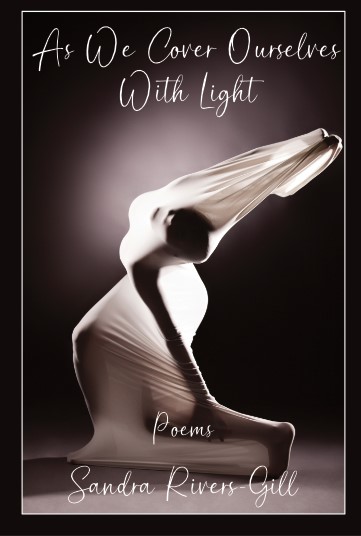
As We Cover Ourselves With Light
By Sandra Rivers-Gill
…
With deft and musical language, and a great deal of heart, Sandra Rivers-Gill gives us a collection that honors family, food, community: love, and its complications. The very first poem, “Ain’t Nothing Like Family,” sets the table for the rest of the book. She tells us:
Family is like leftover stew
and:
We are a culture of ripened fruit
consuming what is not always easy.
and:
We are marinated in love,
seasoned with salt for our journey.
From the start we know that we are in the capable hands of a woman with the courage (from the Latin cor: heart) to look into the shadows cast by the light. She asserts her own vision, her own right to name that vision, and she passes this message on to her children — and us. In “Colored Imagination,” she writes about her daughter and, I suspect, herself, brown girls asserting their visions in a too often uncaring, if not downright hostile, world. She writes,
If a girl teaches her teacher about her sun
colored from the world of her brown hands,
beyond the margin of a grammar school desk,
the girl will weave her own narrative.
You would be forgiven for thinking about hair, and how hair itself is politicized in our world. In another poem, “Snip,” she writes
It is how the barber begins
to censor a man.
And yet these poems are crafted and delivered with a light touch and a great deal of warmth. In the poem that gives us the title of this collection, “The Quilt Maker,” she writes,
Home is where the edges are salvaged—
and we are made aware of the edges, sometimes still raw, where the family pieces, parents, children, grandparents and great-great grandparents, have been stitched together, and sometimes ripped apart, to form a family, a life, many lives, all of them precious.
Rivers-Gill has chosen lines from Gwendolyn Brooks as the epigraph of this book: “Reading is important—read between the lines. Don’t swallow everything.” Rivers-Gill clearly “reads between the lines,” and, while she may swallow some of the home-cooked meals offered to her, she also looks carefully at what is set before her. In the poem that whispers back to Gwendolyn Brooks’ lines, fittingly titled “Between the Lines,” she examines the largely unspoken, often uneasy, understandings that tie mothers and daughters, when her mother suggests, between the lines, that she take on a task the mother can no longer manage. Rivers-Gill tells us,
She does not invite my help
but teaches me time and timbre—
the fine art of reading.
Between unspoken lines
mothers and daughters dwell.
I would venture to say, between unspoken lines, poets dwell — and they report back on what they read there.
There are many tender moments in this book; one comes away with a clear sense of the people the poet has been shaped by, the people she loves, in all their complexity. Reading this collection can be like sitting at that table and listening in on conversations that fly back and forth over the rapidly devoured food. We are well-nourished by Rivers-Gill’s clean lines. Even when she brings us poems about difficult subjects (as in the one called “Fat Meat is Greasy,” which begins
“The air in our home spat like fat meat in a cast iron skillet.”) her light touch makes us eager to swallow what she puts before us.
I would be remiss if I did not mention the brilliant way Rivers-Gill addresses one of the more devastating events in our recent history. Toward the end of this collection, we have the poem, “D’Anjou.” You would be forgiven for thinking that this is another ode to a favorite food, but then you read, beneath the title, that she writes, “for George Floyd.” Clearly there is another dimension at work here. The poem begins as an ode to the pear, segues into the memory of “the white woman next door” who grew pear trees, and shared the fruits with her neighbor children, instructing Rivers-Gill and her brother on how to be patient and wait for the right moment to enjoy their sweetness. She brings us into the present moment, where she is paring a pear in her own kitchen, and then ends the poem with these lines:
I remember the instructions
that guarantee a pear’s ripeness:
simply press its neck.
This may be the most devastating and delicate political poem I’ve ever read. We need to know who George Floyd was, and what happened to him, but we should know: it is our collective responsibility to carry and reckon with this knowledge. Showing us how to hold the sweetness of a pear in one hand and the horror of George Floyd’s death in the other is Sandra Rivers-Gill’s gift, one that is reflected throughout this rich and beautiful collection.
About the Author: Wendy McVicker is poet laureate emerita of Athens, OH, and a longtime Ohio Arts Council teaching artist. She is the author of several books of poetry, most recently a dialogic collection with Cathy Cultice Lentes, called Stronger When We Touch (The Orchard Street Press, 2023) and, forthcoming from Sheila-Na-Gig Editions, Alone in the Burning. Her poems have appeared in a number of anthologies and journals, online and in print, including Pine Mountain Sand & Gravel, Women Speak, Gyroscope Review, and Sheila-Na-Gig online. She performs whenever she can with musician Emily Prince, under the name another language altogether.

 As It Ought To Be