Jason Ryberg: “Scarecrow Standing at a Crossroads”

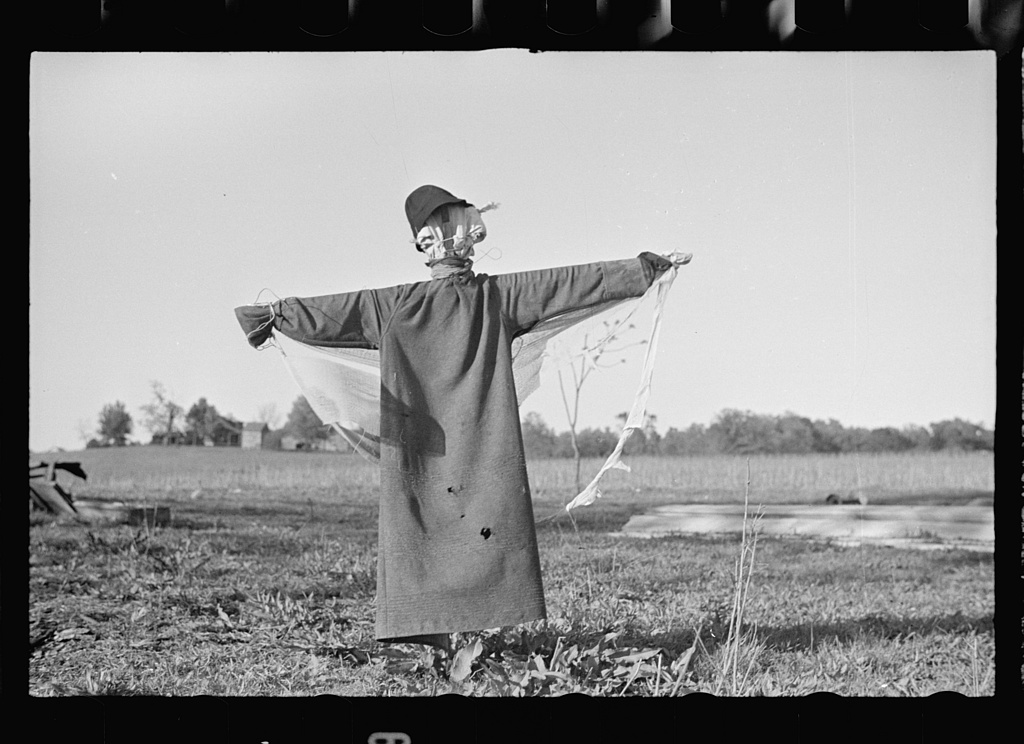
Scarecrow Standing at a Crossroads

There’s a blackbird between the shadows
of two white houses,

the midnight train is a silver river
of moonlight,

the cornfield is now a haunted forest
of skeletal husks,

and it would appear that the old, madcap,
vaudeville, soft-shoe dancer of a scarecrow,
who, one day who knows how many years ago,
just seemed to have showed-up, out there,
outta nowhere,

has moved on, now

(his past finally
catching up with him, I guess).

About the Author: Jason Ryberg is the author of eighteen books of poetry, six screenplays, a few short stories, a box full of folders, notebooks and scraps of paper that could one day be (loosely) construed as a novel, and, a couple of angry letters to various magazine and newspaper editors. He is currently an artist-in-residence at both The Prospero Institute of Disquieted P/o/e/t/i/c/s and the Osage Arts Community, and is an editor and designer at Spartan Books. His latest collection of poems is The Great American Pyramid Scheme (co-authored with W.E. Leathem, Tim Tarkelly and Mack Thorn, OAC Books, 2022). He lives part-time in Kansas City, MO with a rooster named Little Red and a billygoat named Giuseppe and part-time somewhere in the Ozarks, near the Gasconade River, where there are also many strange and wonderful woodland critters.

Image Credit: John Vachon “Scarecrow, North Carolina” (1938) Public domain image courtesy of the Library of Congress
Jean Biegun: “Olives”

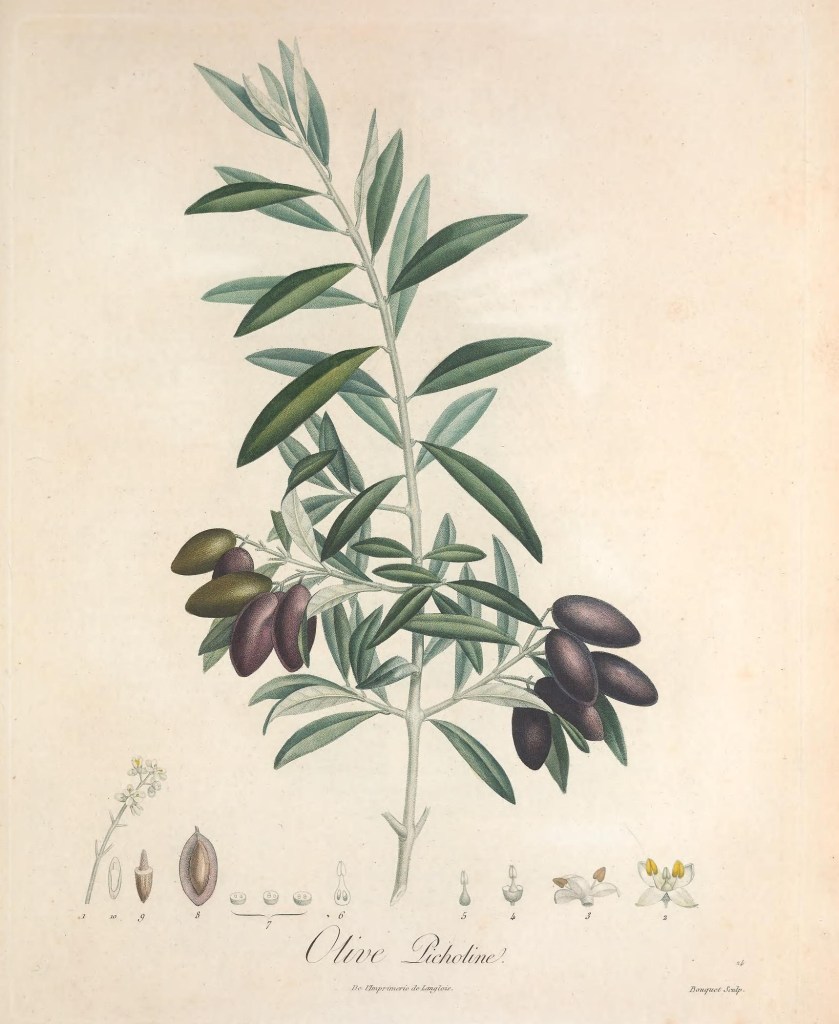
Olives

I have a grocery list with olives
on it. Meanwhile you have

an issuance of pain aching
somewhere in your left hip

and the x-ray showed nothing but it
makes you think of Esther.

How tentatively I would step around
her and she, mean in her broadcast,

wide-shouldered through each game
we played. Yes, I recall she needed

to win every time.
I’m going to make a big salad with your

favorite marinated artichoke hearts
and fresh dill dressing. Want to come over?

We’ll walk to the pond—good exercise
for you. Remember that old photo

where she caught the biggest fish? It was
the only instance you did not smile

even though Pa told us to. He always said
we should smile whatever storm

blows at the door. I’ll mix up corn muffins
from scratch. We’ll have a healthy meal.

About the Author: Jean Biegun’s poetry has appeared in numerous journals and anthologies. In 2022, her chapbook HITCHHIKERS TO EDEN was published, she received a Pushcart Prize nomination and the Christine Award for Best Prose Poem of 2021(EASTERN IOWA REVIEW). Poems have been in AS IT OUGHT TO BE MAGAZINE, GYROSCOPE REVIEW, MUDDY RIVER POETRY REVIEW, AS ABOVE SO BELOW, UNBROKEN, and other places.

Image Credit: Image originally published in Pomologie française: Paris: Langlois et Leclercq, 1846. Public domain image courtesy of the Biodiversity Heritage Library

Erika Seshadri: “Flooded”

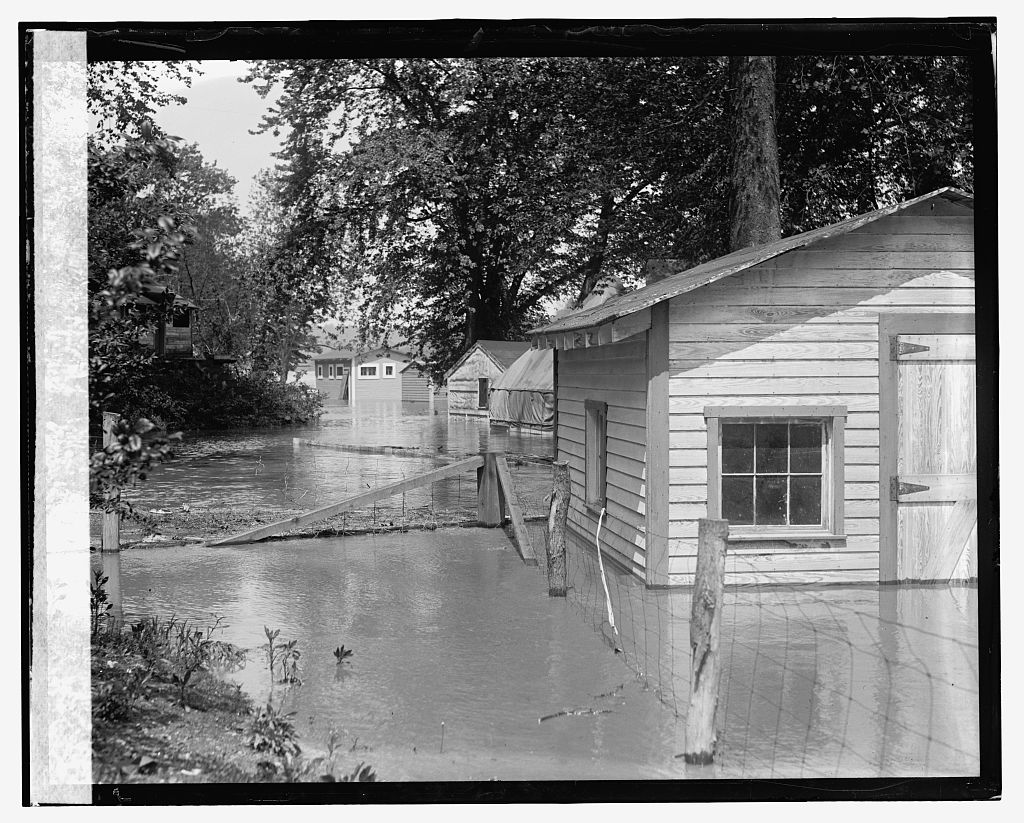
Flooded

After ten days,
    the water receded
leaving mud beneath
our feet—
caking our shoes,
    pulling us
slick and sinking into
memories of what was:
before.

The weight was too much.

I wallowed up to my ankles
    in muck
drowning frustration and
standing as a
    deadweight,
imagining tree roots
and fewer
    responsibilities.

With a slurp of suction
I stepped free,
    leaving
my shoes
to fend for themselves,
    as mud
seeped through my socks
and between my toes.

About the Author: Erika Seshadri lives on an animal rescue ranch in Florida with her family. When not caring for tame critters or feral children, she can be found writing. Her work has appeared with Stonecrop Magazine, Funicular, Nine Cloud Journal, Quibble Lit, Hare’s Paw Literary Journal, Dreamer’s Magazine, and many others.

Image Credit: “Flood” (1924) Public domain image courtesy of the Library of Congress
Cord Moreski: “Night Swimming”

Night Swimming 

After working another shift 
in the oppressive Jersey heat 
taking food orders from the privileged 
and counting tips so I can make
my rent that just went up again

any ghost from Roman literature 
would definitely point out that 
I haven’t been very carpe diem
as of lately

so I make my way 
to North End beach 
surrounded by teenagers making out 
past their curfews in the sand
and stoners hot-boxing 
beneath overturned lifeguard boats 

I take off my work clothes 
while this drunken couple 
on the shoreline beside me
continue their post-bar conversation 

about the fate of the world
the fate of us all, fire and ice,
as if they were knocking back 
a few earlier with Robert Frost

they try to ask me what I think
but I’m already diving into the surf 
and by the time I resurface they leave
and all I’m left with is just this darkness 
as I float on the calmness of the water

I don't know what’ll happen I think to myself
but the stars sure do look pretty tonight.

About the Author: Cord Moreski is a poet from the Jersey Shore. Moreski is the author of Confined Spaces (Two Key Customs, 2022), The News Around Town (Maverick Duck Press, 2020), and Shaking Hands with Time (Indigent Press, 2018). When he is not writing, Cord waits tables for a living and teaches middle school children that poetry is awesome. His next chapbook Apartment Poems will be released by Between Shadows Press in late 2022. You can follow Cord here: www.cordmoreski.com

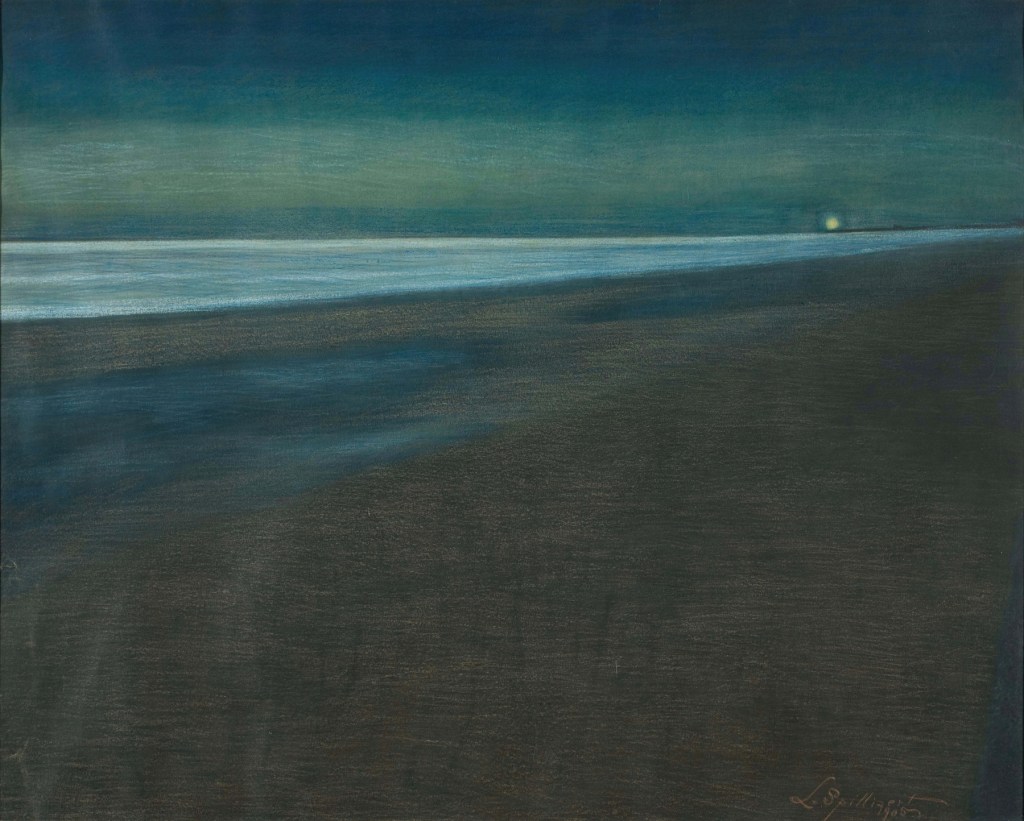
Image Credit: Léon Spilliaert “Beachview at Night” (1905) Public domain image courtesy of Artvee

Rocío Iglesias: “How to Own Nothing”

How to Own Nothing

When you gave me a drawer at your place to keep my things
I told you I don’t keep anything except my promises,
I told you the only thing I’ve ever truly owned is my heavy heart
But still you gave me this one drawer to come home to

I searched the ghost town of my personal possessions
And exhumed the things I was too afraid to admit I loved
The only photo of my mother pregnant with me
An old dictionary annotated with English to Spanish translations
My Saint Lazarus pendant
The first letter you ever wrote me

I placed them in the drawer and I was home

About the Author: Rocío Iglesias is a queer Cuban-American poet. Her work has appeared in various print and electronic publications and can most recently be found in Cuento Magazine and the Piker Press. She lives, breathes, and works in Minneapolis, MN.

Image Credit: Russell Lee “Dresser in farmhouse. Williams County, North Dakota” (1937) Public domain image courtesy of the Library of Congress

Ken Gierke: “Riding With Monk”

Riding with Monk

Epistrophy, apostrophe,
brush these blues off of me.
Lift me off this loneliest of roads,
beyond these bare trees.

Even in their beauty,
these bones of winter
hold no answers,
only questions.

On this road of introspection,
you tease me with those keys.
I don’t blame you, but
I’ve had all the blues I can abide.

I’m not in the mood.
Give it to me straight.
I’m tired of chasing dreams.
Lend me yours.

It doesn’t have to be easy,
but these streets would look
a whole lot better with
blue skies and just a little green.

About the Author: Ken Gierke is retired and has lived in Missouri since 2012, when he moved from Western New York, where the Niagara River fostered a love for nature. He writes primarily in free verse and haiku, often inspired by hiking and kayaking. His poetry has been published or is forthcoming both in print and online in such places as Ekphrastic Review, Amethyst Review, Silver Birch Press, Trailer Park Quarterly, The Gasconade Review, and River Dog Zine. Glass Awash, published by Spartan Press, is his first collection of poetry. His website: https://rivrvlogr.com/

Image Credit: “Nachtconcert van Thelonious Monk in het Concertgebouw Datum” (1961) Public domain image courtesy of Wikimedia, CC0

Tina Williams: “Two Kinds”

Two Kinds

It was dusk
on a two-lane road
in deep East Texas
and we had not passed
a word for miles
when she said
there are two kinds
of people in the world.
Years later, the turtles 
in my neighborhood 
know nothing of
my friend’s philosophy.
Or how simply 
some things boil down.
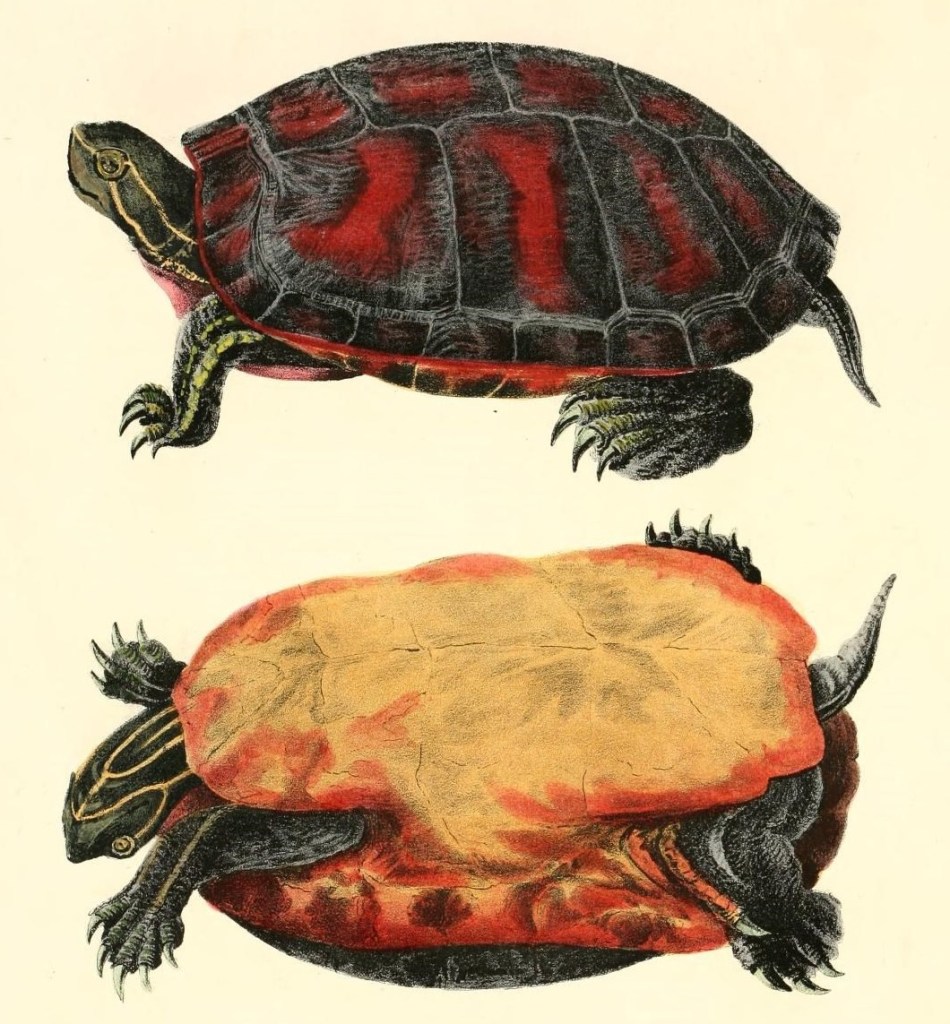
The red-eared slider at my feet,
flipped over and still but still here,
knew seasons.
She knew navigation
and the grass best for nesting. 
Tenacity.
Now, spun senseless
to where the street met the curb,
she lay bloody, mud-baked legs
splayed flat and a gut-deep wound
cracked clean down her belly.

Turtles have inched their way
across hundreds of millions of years,
ducking one mass extinction
after another protected by nothing more
than the home on their back.
Today, the turkey vultures
working a squirrel
three blocks away
will catch wind
of this one at my feet,
an ancient traveler
felled handily enough
by steel on rubber
and the kind who
do not stop.

About the Author: Tina Williams is a former journalism instructor and advertising copywriter living in Austin, TX. Her poems have appeared in or are forthcoming in the New Verse News, Amethyst, Borderlands: Texas Poetry Review, and the Concho River Review.

Image Credit: Public domain image originally published in North American herpetology : Philadelphia, J. Dobson;1842. Courtesy of the Biodiversity Heritage Library

Paul Koniecki: “you are my”

you are my

cathedral of air
and hopefulness
in opening things

shades curtains
harnesses reins

buttons zippers morning
sky evening rain
flowers sun

a tube
of paint stiff lashes

bottomless eyes

blank

paper
packs of pens

errant as road trips
unruly as we are

reindeer ready to fly
the other 364 days a year

-for Reverie

About the Author: Paul Koniecki lives in Dallas, Texas. He was once chosen for the John Ashbery Home School Residency. His poems feature in Richard Bailey’s movie “One of the Rough” distributed by AVIFF Cannes. Paul proudly sits on the editorial board of Thimble Literary Magazine. His poems have appeared in Henniker Review, Chiron Review, Gasconade Review, As It Ought To Be Magazine, Trailer Park Review, Poetry Bay, and many more. Paul is currently finishing his MFA at VCFA.

Image Credit: Chase Dimock “Water Lily” (2023)

Jim Murdoch: “Mucus Fishing”

Mucus Fishing


On hot summer days my granddad
would poke at his eyes with
an uncharacteristically garish
green silk hankie.

Asked what he was up to he’d smile
           (his mouth at least, never his eyes),
and say,
           “Gathering stale tears, my dear.
           Too often we forget or neglect to cry
           or hold onto our tears and years on,
           well, they congeal and you need to
           tease them out,”
or something of that ilk.

Like most old folk my grandfather
talked a lot of rot but he was sweet,
had the soul of a poet and the heart,
we learned (too late),
            although it came as no surprise,
of a terminally-sad man.

My mother washed the handkerchief.
I was so mad at her.

About the Author: Jim grew up in the heart of Burns Country in Scotland. In fact his first poem was in butchered Scots. Poetry, for him, was about irrelevances—daffodils, vagabonds and babbling brooks—until one day in secondary school the teacher read Larkin’s ‘Mr Bleaney’ and he felt as if the proverbial scales had fallen from his eyes. How could something so… so unpoetic as far as he could tell be poetry? He’s been trying to answer that question for the past fifty years.

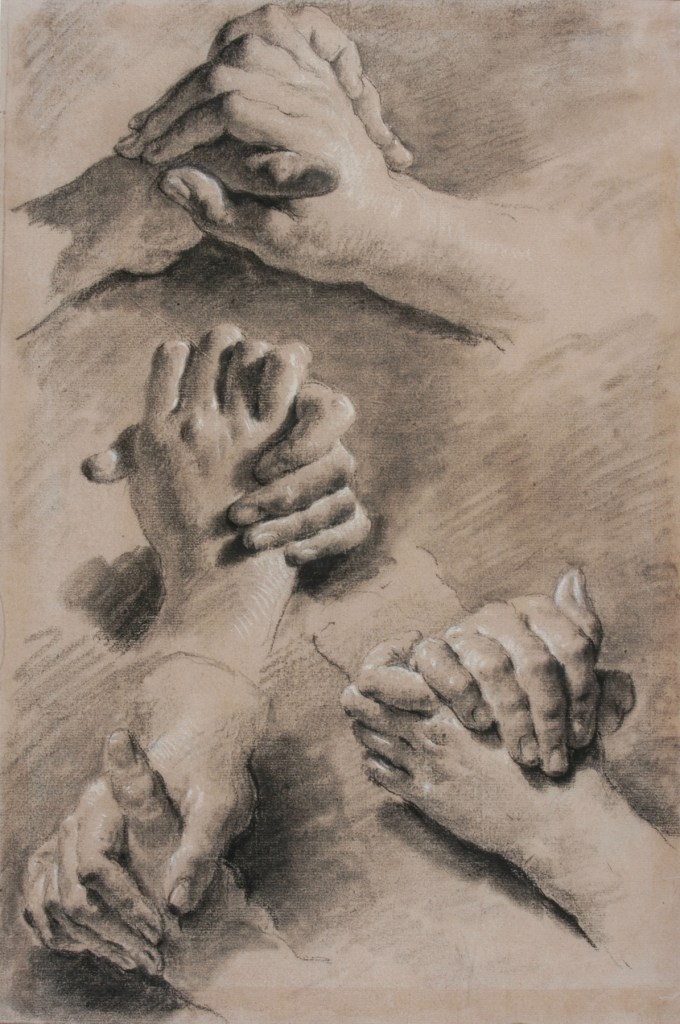
Image Credit: Jacopo GuaranaFour Studies of Clasped Hands” Public domain image courtesy of Artvee

Robin Wright: “From This Height, Six Days before 9/11”

From This Height, Six Days before 9/11

The plane inches toward take-off.
I glance at family members,
waving us on to our destination,
Lawton, Oklahoma, 
our son’s graduation 
from basic training.

From the air, the ground 
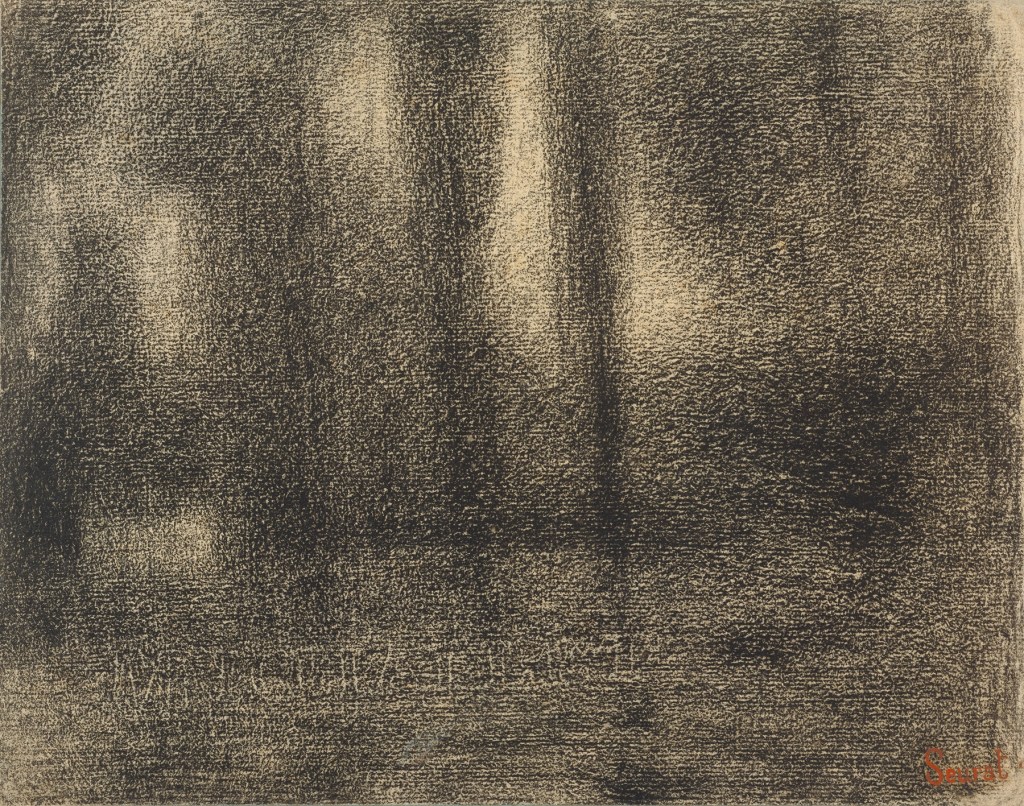
looks like Seurat painted it,
blue swimming pools,
green and brown fields,
more like quilt squares 
than dots, nature’s ballroom, 
enjoyment for the locals.

Seurat used conte crayons
on rough paper for sketches.
Our son’s diploma 
will be on smooth paper, 
cream with dark type, 
his name large in the middle, 
no conte crayons, 
the worst roughness 
lies ahead.

About the Author: Robin Wright lives in Southern Indiana. Her work has appeared in or is forthcoming in As it Ought to Be, Loch Raven Review, Spank the Carp, The New Verse News, Rat’s Ass Review, Bulb Culture Collective, Bindweed, One Art, Young Ravens Literary Review, Sanctuary, and others. She is a Pushcart Prize nominee, and her first chapbook, Ready or Not, was published by Finishing Line Press in October of 2020.

Image Credit: Georges Seurat “Poplars” (1883-1884) Public domain image courtesy of Artvee