SATURDAY POETRY SERIES PRESENTS: BONNIE NADZAM

By Bonnie Nadzam:

TATTOO

When she told the tattoo artist where she wanted it, he sat her down, pulled up a chair, and leaned in close. The alphabet was written across his chest like a talisman. She could read it through the open collar of his shirt.

“Listen,” he said. “Are you sure? That would really be permanent. And it’d hurt. A lot.”

“You listen,” she took him by the front of his shirt. “If I don’t have his name printed on my body, I’m going to die.”

“What about your arm? Your hip bone?”

“I’ve made up my mind.”

“What about the bottom of your foot?”

She sat down and unbuttoned her shirt. “Do it,” she said.

So he tied her ankles and wrists to the chair, opened up his pocketknife, and sliced a wet red line from the hollow of her throat to the smooth white plate of her sternum. Her body arched and she inhaled sharply.

“You’re open,” he said. “I’m going to use my tattoo gun to separate your ribs, okay? Just a little pressure,” he said. She felt her bones crack apart from the middle, then a long pause.

“What?” she asked. “What is it.”

“His name is already there.”

“I knew it,” she said. “Put it on again. Make sure you capitalize his first and last names.”

“You want it on there twice?”

“Yes. And don’t rush. I want to be able to picture it there very clearly. Be really careful with the vowels.”

So he bent over her and went to work with his needle and ink, carefully tracing each letter in fine and even print until it was stamped across her heart, twice. Like a question posed and confirmed. Like two quick punches to the chest. Like a stutter—a name she could scarcely utter out loud if she dared. So perfect a name that—as with all the beautiful things she’d seen in her short life: soft brown birds flying in cursive loops against a paper blue sky, a hundred thousand black ants crossing the blank sidewalk in a spill of broken words—it was compelled to repeat itself, to write itself in typescript again and again across the wet muscle of her heart, the word thoroughly inextricable from the flesh.


YOU TELL YOURSELF A STORY

Wet night,
One cold beer.
Ok—
Whiskey.
And ok.
One kiss.
Arches of my socked feet pushed
Against your hip bones.
Ok
ok


Bonnie Nadzam has published fiction in The Kenyon Review, Story Quarterly, The Alaska Quarterly Review, Callaloo, The Mississippi Review, and several others. Her first novel, “Lamb,” is forthcoming from The Other Press. Bonnie lives in a stone house on Melville Island with her beloved and their three horses, four pigs, one mule, six goats, twelve hens, and two German Shepherds. They farm primarily turnips and alfalfa in the short growing season.

Editor’s Note: I am a sucker for poetry that hits you “Like two quick punches to the chest.” Especially when that poetry is about love, and within that qualifier, particularly when that love poetry is about sex. Is there anything older, any instance where, to paraphrase Ms. Nadzam, the word is more thoroughly inextricable from the flesh?

Whether exploring this human connection through prose or through a poem quick and sharp as an incision, Ms. Nadzam is a spot on artist of the heart. A poet unafraid to paint us a picture of the inner workings of the female mind. Reading her poetry is a bit of a guilty pleasure, as if it were a forbidden magazine read behind my parents’ backs.

(“Tattoo” and “You Tell Yourself a Story” were originally published in The Loudest Voice Anthology, vol. 1 and in The Offending Adam. These poems are reprinted here today with permission from the poet.)

Want to read more by and about Bonnie Nadzam?
The Big Something
Storyglossia
The Offending Adam

SATURDAY POETRY SERIES PRESENTS: CARL ADAMSHICK

By Carl Adamshick:

HOME

You had been gone a few days.
The place went looking for you,

unaware you were returning.

I remained lonely in the evening
when the moon broadcasted

silence through the dust.

My love was once
a faint blue tear
of thin glass glowing
in my chest.

Now my love is you.

It must be three in the afternoon
and I am trying to sleep
on your side of the bed.

THE CONSECRATION OF AN APRICOT

It has become what was irrepressible
in its nature. It is the color of fire
suspended in a passion of green.
It is ordained the egg of the sun
and when the hull of the moon
rides through a whisper of stars
it is a fever, desirable for its sweet
ache on the tongue. It is the swell
and flesh of a flower, the lost
antecedent of an almond-stone
heart. One after another after another
fills its office and falls into death’s
inception, where it is observed
on the slope of a knoll, lucid,
laid open, and rotting in utter beauty.

“Home” first appeared in The Oregonian. “The Consecration of an Apricot” first appeared in the Mid-American Review. These poems are published here today with permission from the poet.

Carl Adamshick won the 2010 Walt Whitman Award. His book Curses and Wishes is to be published in March of 2011.

Editor’s Note: I came across Carl Adamshick’s work in the recent issue of Narrative Magazine and I just about died and went to poetry heaven. Letter, which appears in that issue, is a must-read for any lover of that genre of poetry that intersects with the sexual and the heart, of which I most definitely am one. With the help of Lezlie Mayers, editor of the Friday Poetry Series here on As It Ought To Be, I was able to track down this poet-on-the-forefront and obtain his permission to print the two poems featured today.

According to the poet Dorianne Laux, Adamshick “has not joined the ranks of the M.F.A./Ph.D.’s and has never attended a writer’s conference or residency.” His work speaks for itself, I believe, in showing where nature outshines nurture, and how one can maintain genius simplicity in poetry by remaining outside of the world of literary higher ed. With moments like “It is the swell and flesh of a flower, “My love was once a faint blue tear of thin glass glowing in my chest. Now my love is you,” and “desirable for its sweet ache on the tongue,” Adamshick’s choice of language is a delight to the senses and the heart, a combination that is pure delight to those who love great poetry.

Want to read more by and about Carl Adamshick?
Poets.org
Carl Adamshick Receives the 2010 Walt Whitman Award
The Olives of Oblivion

SATURDAY POETRY SERIES PRESENTS: NATALIE LYALIN

By Natalie Lyalin:

ELECTROCARDIOGRAM

I protect my heart when I perform, but the night is another thing.
It does not appear to care much, and I am weak.
Nightmare: my father is a bride. I lift the veil over his eager face.
His wife’s eyes are very dark suckling holes.
I fasten some pearls around his neck and send him off.
Grow well, little dad! Send me a postcard when you wake up.
I will have you over for a nice lunch.
We will make a toast with your new champagne glasses!
They will sizzle and froth over with our aggressive clinks.

SMALL AND PRIVATE TRAGEDIES

The cow was cold and yet I milked it. Under a dirty blanket
I found something warm, so I held it tightly. It was my own
hand, don’t worry. Under a slanted sky I cursed the cold and
kept on going. My mountain is called grief I say, and when
feeling toothed, that is, when teeth come into a conversation
I miss mine. I also miss my father and mother being married,
because that was when we did all this terrible work together.
Now this frost reflects my wounded mouth to me and in
the shower, under very hot water, I cackle at the thought of
things passed. I make a bird call and confuse the others. I set
the clocks back. My insanity is precious. It is a gem I smuggled
out and now it shines like a moon over this fortress.

These poems first appeared in The Offending Adam and are reprinted here with permission of the poet.

Natalie Lyalin is the author of Pink and Hot Pink Habitat (Coconut Books 2009) and Try A Little Time Travel (Ugly Duckling Presse 2010). She is an editor for GlitterPony Magazine and Agnes Fox Press. She lives in Philadelphia.

Editor’s Note: I have to thank our Editor and Webmaster Okla Elliot for pushing us to seek out lesser-known poets and turn to poetry journals to find new pieces for As It Ought To Be. That gentle pushing led me to today’s discovery, a “a gem I smuggled
out and now it shines like a moon over this fortress.”

Natalie Lyalin’s work is a disturbing breath of fresh air. Haunted with images and notions of family struggle and allusion to the darkness that lies just beneath the surface, the poet paints a picture in shades of gray as if sketched from the crumbling chalk of human suffering. All in all it is a severe understatement to say that Ms. Lyalin is the architect of well-crafted poems.

Want to read more by and about Natalie Lyalin?
Apples on Fire
Octopus Magazine
The Best American Poetry
Weird Deer

Drinking with British Architects

A Not-Very-Objective Review

by Raul Clement

Recently, poet Jeff Laughlin sent me a copy of his first collection, Drinking with British Architects. This is a chapbook of less than 50 pages that went through a press run of 100 copies and is now sold out. I would guess that of those 100 copies, 90 of them went to friends or people at the small reading held for its release. To put that in perspective, more people will probably read this blog post than Laughlin’s collection.

And yet it is good. A full disclosure forces me to admit that Laughlin is a friend of mine, and that he offered to send me the book, free of charge, over drinks. So perhaps I wanted to like it; and yet I think, objectively speaking, that it is livelier than most poetry I read in major journals and that the fact that it was released so modestly is a testament to how hard it is to make it in this business, how much toil and sheer luck it takes, and how the cream doesn’t always rise to the top. This is especially true for first collections. Resumes are, of course, a self-powered engine: the more impressive your resume looks, the more likely a journal or small press is to seriously consider your work. Many of these presses are struggling to stay afloat and they probably shouldn’t be faulted for preferring an author with a track record. It does seem a little small-minded when you consider the miniscule difference in sales we are talking about here – does one previous publication in the Black Warrior Review bring with it a rabid cult following? – and yet when you are treading water, you will cling to even the smallest piece of driftwood. As someone who has seen the editorial side of this business, I understand and sympathize with this even while it saddens me.

But let’s look at the collection. The title sounds like a Decemberists song, and indeed, much of the work seems influenced by the new literary side of indie rock. Colin Meloy, singer of the Decemberists, is a graduate of the MFA program at The University of Montana; conversely, Jeff Laughlin was (until his move back to North Carolina from New York) the singer of an acoustic, ballad-based group known as Beards. Many of his poems have a sung quality, aware of their rhythm and canny in their use of repetition, and the overall attitude is one of romantic, drunken Tom Waitsism. This is particularly evident in the “women” poems, which apparently were supposed to be part of their own chapbook, but which the publisher insisted Laughlin include – rightly, I might add. The first is called “The Women I Know” and every stanza begins with that phrase. It is a critique of the pursuit of an empty, surface-type of pleasure at the expense of a deeper happiness:

The women I know crack their
clavicles if only to stick out their
chests.

This perfectly conveys the desperate need these women have to be thought of as sexual beings. Another line struck me as entirely accurate to a recent experience I had had with a young woman whose chief aim seemed to be worshipped by every man around her. That he had outed my interior life so accurately bespeaks the quality of the work.

The women I know go about their
pleasure the same way: without
love and continuously.

As you can see here, Laughlin privileges the strong opening word rather than the clever line break. Nouns like “clavicles” and “chest” get initial weight, not the last word. Lines don’t end so much as flow into each other. And here at least, he privileges abstraction over the concrete image – a preference that, as much as the extravagantly sentimental attitude, lends to the quality I’ve already identified as coming from the indie rock lyrical tradition.

But Laughlin is too skilled in other ways to be dismissed as a rock musician turned poet. The collection is united by several systems of images and titles that give it a formal quality its free verse lacks. There is an obsession with body parts – particularly the poet’s own broken and damaged parts. This is from “The Critic’s Worry,” one of a series.

There were grease marks along my arms—
Their length took me off guard.
I scrubbed until capillaries broke,
But my blood was not as thick as the car’s.

This stanza shows that Laughlin has the ability to paint a specific scene using concrete images. It also shows that he is not insensitive to the charms of formalism. Not only does he end every line on a strong monosyllable, but there is a definite respect for rhyme hinted at it in “arms”/”guard”/”cars.” Here are more broken body parts in the sister poem, “A Soldier’s Worry.”

We march through split heels,
chafed shouldertops, sprained ankles, compressed
knees, and, invariably, arthritic knuckles.

I particularly like that word “invariably.” Later more body part imagery, albeit now wed to some nice description of the physical world:

The most amazing things actually do affect us,
ever so slightly: groves of oranges, broken branches,
houses foraged with rotten wood, rain, broken vessels
on elderly hands or voices floating through light brush.

Here “affect us” is echoed by “vessels,” and “groves” by “broken.” Similarly, the repetition of “broken” unites “branches” and “vessels” – the world of nature thus equated with the human body. As the soldiers walk, they are beaten down by the physical world until they become it. Even the voices only come at them “through light brush” –a nice, simple image which also manages to convey painting, and thus art in the abstract.

[Note: these are my interpretations and are in no way intended to suggest authorial intent; this is just a survey of the many association these poems, like all good poetry, inspired in me.]

As I’ve already hinted, it is in repetition where Laughlin really excels. “Lists” finds the poet guessing at the contents of a list left behind by his roommate. Each verse is structured with the casualness of a prose poem and is yet another guess at the list’s contents.

No. You are a list of morose sights—deceased grandparents, bloodied fists, crooked-billed birds with feathers still falling from once-clean windows, dead dogs on the sides of dirt roads. You are the wrong vision at the right time.

Or:

No. You are a list of pragmatic decisions—split-ups before things got too serious, pets put to sleep, gifts exchanged on Christmas Eve, shirts in donations boxes despite still being in fashion. You are a remembrance of things still around but unwound from the mind.

There is further subtler repetition here in the mention of another dead pet, this one purposefully and pragmatically “put to sleep.” Similarly, the last lines echo each other.

Another repetition poem, appropriately titled “Simultaneous Reactions,” verges on the annoying but somehow transcends that by sheer brave bombardment. It begins: “Appetites are growing, finger-skin is getting more coarse, strength is waning.” (Another reference to body parts, specifically hands, which are mentioned over and over.) The use of the gerund here makes reading it a bit of a slog, but the joy is in seeing the different uses and combinations Laughlin comes up with. “Parachutes aren’t opening, cause is no longer affecting, science is calculating.” Here “calculating” can be a verb or adjective. Another example of the same: “Waitresses are finishing doubles, carrots are digesting, work is boring.” Not carrots are “being digested,” but are doing the “digesting” (though obviously they are also being digested). Similarly one imagines work “boring” into the speaker’s skull, like a drill. Many other lines have similar effect, making us question our preconceptions of the meaning of words. The sum total of all this repetition is to soak the reader in the variety of world. The poem ends, “I am brimming with capability, I am leaning side-angled into nothing, I am proselytizing.” Not only does this nicely bring the lens back around to the observer, it also hints at the meaning of all these “Simultaneous Reactions.” The poet is “brimming” with the possibilities of the world, but at the same time he is sunk in the infinite “nothing” of its excess, his only recourse “proselytizing” (really just another word for making poetry).

I wish I could sink my teeth more thoroughly into the meat of this collection. I’d like to talk about the series of “Autobiography” poems, the other “women” poems (especially “The Women I Don’t Know,” which flirts with and redetermines “The Women I Know”), or the absurdist “Not Titled,” a prose poem about, yes, a biblical rain of tacos. I hold a soft spot for the poem “Pregnant Crooked Horse,” having unwittingly inspired the title (long story), if not the subject matter, and so I feel like I have slighted it. I’d also like to discuss whether or not it was wise to have ended the collection on the title story, a strong poem which turns out to be deliciously less surreal than its name suggests, or whether it would have been better to end with another “Autobiography” poem, thus giving the collection a cleaner symmetry.

But I fear taxing the reader’s patience on a book he may never read. The good news is that the author is working on a new collection, one that he claims will be even darker and more alcohol-drenched. Until then I’ll leave you with my favorite poem in the collection, which sums up the entire history of literary friendships (the existence of which are, in fact, at least partially responsible for the writing of this review). Hopefully it will be enough to convince you that the underground of American poetry is alive and well – in fact, often more fully alive than the more heralded surface.

Upon Hearing Liakos Read From Another City While We Were Both Drunk

If you don’t keep that one
I will throw something at you.

It will be heavy,
and possibly wet.

It will be, most definitely,
something close and large.

It will be an object symbolizing
my obstructive frustration.

It will pass by your head,
grazing your cheek-skin.

It will remember you to
the sharks of your past.

It will recall the conquerable
people that made both of us.

It will punish you to leave a
contrail or convex or context.

I do not know much else about it
except that it will smash on the floor.

It will leave a mark on the ground
where I didn’t want it to.

I didn’t want it, I never ever did,
and it will crash, waking roommates.

You will look and we will laugh
but you gotta keep that one.

You’ve got to, got to—because
there is only one envelope left.

It will shatter next to the only envelope
left in the entire universe forever.

[Note: if you are interested in receiving a free electronic copy of this collection, email Jeff Laughlin at repetitionisfailure@gmail.com. I will post details about his follow-up collection as they become available.]

SATURDAY POETRY SERIES PRESENTS: D H LAWRENCE

A WHITE BLOSSOM
by D H Lawrence

A tiny moon as white and small as a single jasmine flower
Leans all alone above my window, on night’s wintry bower,
Liquid as lime-tree blossom, soft as brilliant water or rain
She shines, the one white love of my youth, which all sin cannot stain.

D H Lawrence (1885-1930) was an English author, poet, playwright, essayist and literary critic. His collected works represent an extended reflection upon the dehumanizing effects of modernity and industrialization. In them, Lawrence confronts issues relating to emotional health and vitality, spontaneity, human sexuality and instinct. (Annotated biography of D H Lawrence courtesy of publicdomainpoems.com, with edits.)

Editor’s Note: D H Lawrence is a name well-known among lovers of poetry, but from time to time a classic is in order! As is often the case for me, the end line of this poem won me over. The idea of a first love, one that becomes idealized and lives on in your heart forever on a pedestal, is a universal concept that Lawrence sums up splendidly with “the one white love of my youth, which all sin cannot stain.”

Want to read more by and about D H Lawrence?
DHLawrence.org

online-literature.com
poets.org

SATURDAY POETRY SERIES PRESENTS: NORMA LILIANA VALDEZ

INCISION
by Norma Liliana Valdez

Norma Liliana Valdez arrived to California from Mexico in her mother’s pregnant belly. She was born and raised in the Bay Area. Her poetry seeks to disentangle the tradition of women’s oppression and pain through the personal intersection of the psyche with the page. She is an alumna of the Voices of our Nations Arts Foundation (VONA) writing workshop for writers of color and the Writing Program at UC Berkeley Extension. She holds a Master’s degree in Counseling from San Francisco State University and works with first-generation, underrepresented students as a community college counselor. She is currently working on her first poetry manuscript, Coyolxauhqui.

Editor’s Note: Ms. Valdez is a poet to watch out for. Through her manipulation of language- in its meaning, its sound, and its visual expression on the page- she is adept at using emotional turmoil to create poetic experiences that transform her readers. She is one of my personal favorite poets, and I await her first book of poetry with baited breath.

“Palestine is Open for Business” by Tala Abu Rahmeh


I’m reading a book about Columbine.

The school nurse, then 33, hid in a cupboard in the library,

crawled against the measurements of her body

wrote a goodbye note on the skin of the door.

“I loved you more than anything. Take care of the dogs.”

I think of the time I scrambled for breath

clutching my mother’s frame as the tank

warmed its oil right outside my window.

Sometimes I wish it was all a big high school shooting,

one, monstrous mountain of tragedy

where you have the rest of your life to grieve.

Next Friday though, things will be different;

Ramallah, wiping itself of the residue of recent compassion,

is throwing itself a party.

For 30 bucks you get a free drink,

one mask to cover some of who you are,

and sit in the front row of a fashion show.

I see small murders in my dreams;

models peeling the front lobes of their hearts with acrylic nails,

jokers planting welcome signs to imaginary cities,

children bathing in the world’s largest hummus plate,

my mother begging an Israeli doctor for her life,

a girl, now 73, holding a key to her locker in Yaffa.

Welcome to our great estates.

Author Bio

Tala Abu Rahmeh’s identity issues began one night, at 3:00 am, in Adams Morgan, a party neighborhood of Washington DC, when she was being hit on (unknowingly) by an African-American guy. When she stared blankly (due to near intoxication and complete social inadequacy), he said “are you scared of me because I’m black?” to which she replied “I’m brown.” When she realized how unimpressive that sounded, she added “I’m ARAB.” That turned some heads (and not in a good way).

After getting an MFA in poetry, and remaining moderately confused about her identity, she returned to her hometown of Ramallah, Palestine, thinking she will be accepted with open arms, but…

SATURDAY POETRY SERIES PRESENTS: JUDITH NEWTON

PRESS TWICE FOR YES
by Judith Newton


Do you know me? Are you too warm? Shall I help you die?

“There’s none can die in the arms of those who are wishing them sore to stay on earth.”


In the end when you lay almost in a coma,
your belly concave as the flanks of living skeletons
in newsreels long ago,
your pointed hips worn through almost
in purple bed sores
as if your skin had turned to rotting clothes.
Your eyes showed strips of white
like blinds drawn down in a house where I once lived,
and I saw your mind withdraw,
as in a dream when I returned
and found the roof of my old room had fallen in.

And yet your hands were warm, and they were large hands still,
with long square fingers, hands to lay my life in–
now they lay in mine,
as if they were the life in you that still remained.
I held on to them, held on to you
straining not to hear the strangled rasping of your breath,
trying not to see how I was like that man
who kept his dying child from rest by “wishing” it,
by willing it to stay
and pulling it still closer to his breast.

Judith Newton lives in Kensington, CA. She is the author of several books of nonfiction and is completing a memoir: The Joys of Cooking: A Love Story. She is a food columnist for the iPinion Syndicate, and is completing a book of poetry entitled Poetry for the Immune Deficient.

Editor’s Note: Today’s poem is from the poetry-series-in-progress entitled Poetry for the Immune Deficient. The author created the series for everyone who has suffered loss and for everyone who lacks the immunity necessary to combat what life has to offer. The occasion for these poems was the death from AIDS of the poet’s ex-husband and best friend Dick Newton in 1986. The poems are about loss— how we choose to encounter it and how it comes to us in ways that we are not prepared for. They are also about the complexities of relationships and about poetry as a form of healing. The intention behind these poems seems fitting for September 11th, a day of healing in America.

Want to read more by and about Judith Newton?
iPinion

SATURDAY POETRY SERIES PRESENTS: AARON ZEITLIN

POETRY
by Aaron Zeitlin

Translated by Jon Levitow (2009)

Go become yourself the words,
Yourself the essence.

– Angelus Silesius

Poems should be like Elijahs
entering the homes of wretched brothers.
I wait for poems that turn into poets,
I wait for poets that turn into poems.

I wait for unexpected wonder,
when poets become the words they write,
each poem fills with blood and shows its face
and approaches people – as a poet.
New breath for old hearts!
Make cold frogs jump!
Let dry stumps blossom!
Proclaim Sabbath throughout all the worlds!

Aaron Zeitlin (1898 – 1973) was the son of the noted Yiddish writer and thinker Hillel Zeitlin. After an invitation to New York by director Maurice Schwartz for the production of his play Esterke (“Esther”), the start of World War II on 1 September 1939 prevented his return to his family, all of whom were murdered in the Shoah. He settled in New York City where he worked as a journalist and a professor of Hebrew literature at the Jewish Theological Seminary of America. Zeitlin’s literary writings include bilingual (Hebrew and Yiddish) poems, narratives, dramas, essays, and criticism. Noteworthy is his contribution from the Warsaw period. He was a moving force in the inclusion of Yiddish literature and Yiddish writers as members of the World PEN Organization (late 1920s), whose branch in Warsaw he chaired in the 1930s. Tragically, German militarism destroyed a number of his unpublished manuscripts and works in progress, including five volumes of poetry ready for publication. (Annotated biography of Aaron Zeitlin courtesy of Novelguide.com, with edits.)

Editor’s Note:
Today’s post was inspired by a combination of outside sources. First, my father challenged me to determine the meaning of “zeesh punim,” a yiddish phrase. While contemplating the meaning of this phrase, As It Ought To Be posted a poem that inspired and moved me, that piece being On This Earth What Makes Life Worth Living by Palestinian Poet Mahmoud Darwish.

I wanted today’s post to be by a Yiddish poet. Yiddish is the language of my ancestors, a dying language that was nearly wiped out with the Holocaust. I also wanted today’s post to be a celebration of poetry and life, as Mahmoud Darwish’s poem is. What these two poets have in common is the ability to celebrate life and poetry through tragic events, to see the beauty in life even amidst so much death and tragedy. May their spirits come together through poetry to shift the energy of the middle east and bring about peace between men who would otherwise be brothers.

Want to read more by and about Aaron Zeitlin?
YiddishPoetry.org
VoicesEducation.org
Novelguide.com

SATURDAY POETRY SERIES PRESENTS: KING SOLOMON


TO EVERYTHING THERE IS A SEASON / EXCERPT FROM KOHELET/ECCLESIASTES
by King Solomon


To every thing there is a season, and a time to every purpose under the heaven:

A time to be born, and a time to die; a time to plant, and a time to pluck up that which is planted;

A time to kill, and a time to heal; a time to break down, and a time to build up;

A time to weep, and a time to laugh; a time to mourn, and a time to dance;

A time to cast away stones, and a time to gather stones together; a time to embrace, and a time to refrain from embracing;

A time to get, and a time to lose; a time to keep, and a time to cast away;

A time to rend, and a time to sew; a time to keep silence, and a time to speak;

A time to love, and a time to hate; a time of war, and a time of peace.

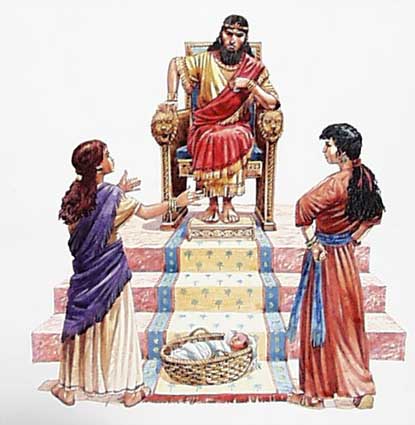
King Solomon was, according to the Hebrew Bible, a King of Israel. The biblical accounts identify Solomon as the son of David. The Hebrew Bible credits Solomon as the builder of the First Temple in Jerusalem and portrays him as great in wisdom, wealth, and power. Solomon had seven hundred wives and three hundred concubines. The wives are described as foreign princesses, including Pharaoh’s daughter and women of Moab, Ammon, Sidon and of the Hittites. He is considered the last ruler of the united Kingdom of Israel before its division into the northern Kingdom of Israel and the southern Kingdom of Judah. According to Jewish tradition, King Solomon wrote three books of the Torah/Bible: Mishlei (Book of Proverbs), Kohelet (Ecclesiastes), and Shir ha-Shirim (Song of Songs). (Annotated biography of King Solomon courtesy of Wikipedia.org, with edits.)

Editor’s Note: Today’s post became most famous in modern popular culture for the version put to music (with six words added) by Pete Seeger in 1962 and made more famous in 1965 when recorded by the Byrds. Thus, today’s post continues our ongoing discussion about where the lines of poetry and music are blurred.

Today’s post takes that discussion a step further, by taking a look at how biblical text and mythology come into play in poetry. Arguably mythological stories and oral storytelling, which later became incorporated into the written word and went on to form important texts such as the Torah, Bible, and Koran (among many others) are the oldest form of poetry. Ideas became stories and songs, stories and songs became the written word, the written word was crafted as a form of art, that art informed and inspired others, and poetry as we know it was born.

On my paternal grandmother’s side of the family a family tree has been kept for so many generations that it traces our lineage to King David. That makes King Solomon my kin, and I am proud to honor him today by celebrating his poetry. Let’s hope his talent runs in the family!

Want to read more by and about King Solomon?
King Solomon on Wikipedia
Turn! Turn! Turn! on Wikipedia
U Penn / Song of Songs